Where Belarusian Folklore Still Feels Alive
Belarusian folklore is best understood as a living borderland tradition: East Slavic in language and many of its beings, but shaped by Baltic, Polish, Jewish, Catholic, Orthodox and local rural influences.
Page outline Jump by section
What makes Belarusian folklore distinctive?
Belarusian folklore sits at a cultural crossroads. The country’s rural traditions preserve old East Slavic patterns: household spirits, water spirits, forest beings, seasonal songs, harvest rites, charms, tales of witches, and legends explaining why a lake, stone, mound or church ruin matters. At the same time, Belarus lies in a zone where Slavic and Baltic traditions overlapped for centuries, especially in the north-west. That helps explain why sacred stones, burial symbolism, lake legends and place-based stories often matter as much as named supernatural characters.[folklore.ee]folklore.eeFolklore…
This also means Belarusian folklore should not be reduced to a generic “Slavic mythology” list. Many beings are shared across Eastern Europe, but local Belarusian tradition gives them specific settings: a forest path, a bathhouse, a rye field, a lake with a vanished church, a household corner, a village procession, or a dangerous midsummer night. The strongest evidence comes from collected songs, tales, rituals and field records, not from modern internet creature catalogues. Belarusian scholars have published large folklore series, encyclopaedic work on Belarusian mythic thought, and specialised studies of themes such as mermaid traditions, folk medicine, sacred landscape and symbolic codes in oral culture.[Folklore]folklore.eeFolklore…
The folklore world: forest, water, house and field
The supernatural world of Belarusian tradition is deeply local. Spirits are not simply “monsters”; they express how people imagined risk, luck, fertility, illness, weather, death and proper behaviour in the places where they lived.
Forests are especially important. Belarus has long been associated with woodland landscapes, and forest spirits in the wider East Slavic tradition are often linked with getting lost, hearing false sounds, meeting an uncanny old man or encountering a power that guards animals and trees. In Belarusian material, such figures belong less to fantasy adventure than to practical rural warnings: do not behave arrogantly in the forest, do not ignore signs, and do not assume that human rules apply beyond the village edge. Comparative research on forest spirits in Estonian, Russian and Belarusian traditions shows how these beings were studied through motifs such as appearance, habitat and behaviour, rather than as fixed literary characters.[ResearchGate]researchgate.netOpen source on researchgate.net.
Water carries another strong cluster of beliefs. Rivers, lakes and marshes are settings for mermaid-like spirits, drowned souls, dangerous bathing, fertility rites and stories about vanished churches. Belarusian research has paid particular attention to the mermaid tradition, linking it with vegetation, agrarian timing and the ritual calendar rather than treating it only as a tale of seductive water women. This matters because it places the water spirit inside the farming year: the same figure can be frightening, fertile, mournful and seasonal.[Folklore]folklore.eeFolklore…
The house also had its unseen inhabitants. Across East Slavic folk belief, domestic spirits guarded or troubled the household, while everyday spaces such as the stove, threshold, attic, stable and bathhouse could be charged with meaning. Belarusian folklore studies do not isolate these beliefs from daily life: they are part of a wider system that includes family rites, healing charms, omens, ancestor remembrance and rules for keeping order in the home.[Folklore]folklore.eeFolklore…
Fields and crops complete the pattern. Seasonal songs, wreaths, bonfires, processions and protective rites make sense in a rural culture where harvest, weather, fertility and community cooperation were matters of survival. A spirit or witch in this context is not just a spooky figure; it is a way of talking about vulnerability at turning points in the year.
Seasonal rites still shape the public face of tradition
The clearest way to see Belarusian folklore today is through the ritual calendar. Some customs survive as local practice, some as staged heritage, and some as a mixture of devotion, tourism, scholarship and community identity.
The winter rite known in UNESCO’s English listing as the “Rite of the Kalyady Tsars” is performed in the village of Semezhava in the Minsk region and was inscribed in 2009 on the List of Intangible Cultural Heritage in Need of Urgent Safeguarding. Its importance lies not only in costume and performance, but in the fact that a local Christmas-season visiting tradition became recognised as vulnerable heritage needing active protection.[Intangible Cultural Heritage]ich.unesco.orgOpen source on unesco.org.
Spring has its own major example: the Spring Rite of “Juraŭski Karahod”, performed by residents of Pahost in the Homel region. UNESCO documentation presents it as a local village rite tied to the holiday cycle, showing how Belarusian folklore often survives through place-specific performance rather than through a single national myth.[Intangible Cultural Heritage]ich.unesco.org42912 EN.doc42912 EN.doc
Summer brings the most widely recognised magical night: Kupala Night. Modern Belarusian tourism descriptions present it as one of the country’s most significant folk holidays, with songs, bonfires, wreaths, water rituals, herb gathering and legends of a fern flower that blooms for only a moment. The beliefs around the night are explicitly supernatural: rivers shine with strange light, mermaid-like souls bathe, witches and spirits walk, animals and plants may speak, and the dawn sun “plays”.[en.belarus.travel]en.belarus.travelFolk holiday «Kupala Night» — Belarus TravelFolk holiday «Kupala Night» — Belarus Travel
What is important here is not whether readers believe in fern flowers or witches. The folklore value is that Kupala gathers many themes into one night: danger and desire, water and fire, youth courtship, harvest hope, magical knowledge, protection from harm and the crossing of ordinary boundaries.
Sacred places: lakes, stones and the memory of older worlds
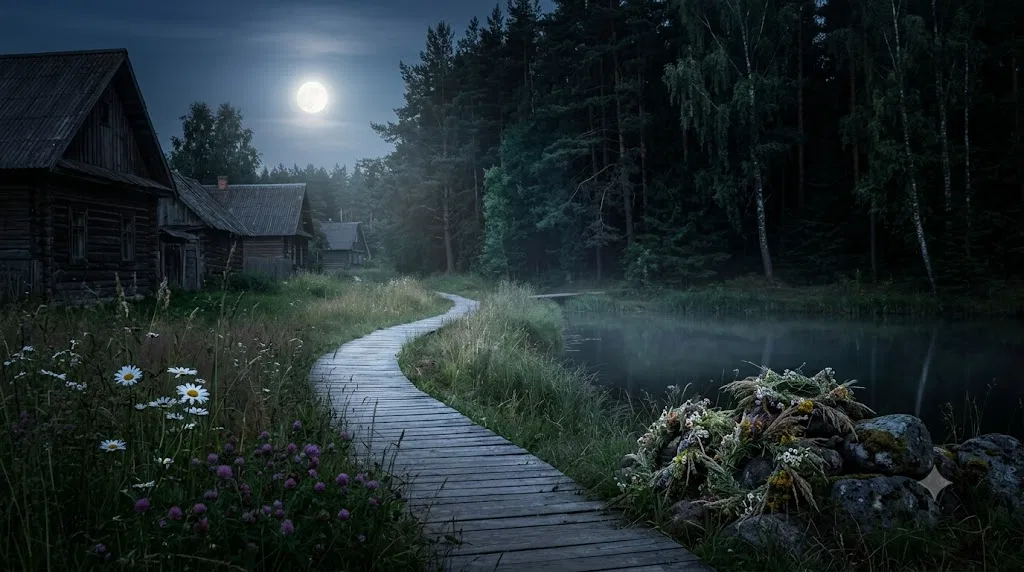
Belarusian folklore is strongly attached to landscape. A lake is not just water; a stone is not just geology; a mound is not just earth. Place legends explain why a location is feared, blessed, avoided, visited or remembered.
In the Dvina region of north-west Belarus, research on sacred lakes has examined legends of vanished churches. These stories often say that a church sank, disappeared or was swallowed by a lake, leaving behind a sacred or uncanny body of water. The scholar Uladzimir Lobach argues that such place legends mark the sacred status of the lakes and may combine pre-Christian layers with early medieval Christian meanings connected with the baptism of the Polotsk region.[Klaipėdos universitetas]e-journals.ku.ltThe Sacred Lakes of the Dvina Region (northwest Belarus)…
Sacred stones are another powerful example. At Scebiaraky in north-west Belarus, five stones with incised symbols have been studied as part of a Baltic-Slavic contact zone. Andrei Prokhorov’s interpretation is cautious rather than sensational: the stones may carry cosmological symbolism, including a “world axis” idea linked to the North Star, funerary customs and sacred communication between worlds. He also stresses uncertainty, noting that the interpretation cannot be final.[BSU Electronic Library]elib.bsu.byElectronic LibraryElectronic Library
This is where Belarusian folklore becomes especially interesting for readers used to stories about creatures. Some of the country’s strongest legendary material is not a monster tale at all, but a relationship between people and place: stones that remember, lakes that hide a church, roads where the dead or the holy may be near, and village landscapes mapped by story.

Fairy tales and oral storytelling
Belarusian fairy tales are a major part of the country’s folklore, but they should not be imagined only as children’s bedtime stories. They are oral art: performances by narrators, shaped by dialect, memory, humour, local phrasing and inherited plot patterns. The National Academy of Sciences of Belarus has described Belarusian fairy-tale material as diverse in plot and theme, and reported that researchers have identified around 50 Belarusian fairy-tale plot types without analogues in the international fairy-tale index.[nasb.gov.by]nasb.gov.byII International Forum of researchers of the Belarusian fairy tale…
Modern digitisation has changed how this material can be encountered. A recent Belarusian fairy-tale portal, reported in 2026, makes it possible to read texts and listen to archival recordings, many from the late 1960s onward, with transcriptions and contextual details about who told the story, where and when. This is important because it restores something printed collections often lose: the living voice of the narrator.[Наша Ніва]nashaniva.comOpen source on nashaniva.com.
The history of collection also matters. Belarusian tales were sometimes published under Russian or Polish labels in earlier periods, reflecting the political and cultural pressures around Belarusian identity. Later folklorists worked to recognise and classify them as Belarusian tradition in their own right. That history helps explain why folklore is not just entertainment in Belarus; it is also tied to language, identity and cultural recognition.[Наша Ніва]nashaniva.comOpen source on nashaniva.com.
Folk religion: saints, ancestors and older patterns
Belarusian folklore often blends Christian and older rural patterns rather than keeping them in neat separate boxes. Catholic and Orthodox practice both shaped the country, while folk belief attached sacred meaning to icons, springs, crosses, stones, feast days, pilgrimage and household ritual.
The Budslaŭ Fest is a clear modern example of folk religion as living heritage. UNESCO lists the celebration in honour of the Budslaŭ icon of Our Lady as an element of intangible cultural heritage, centred on Budslaŭ village in the Minsk region and held annually on the first weekend of July. It is a Catholic pilgrimage and devotional event, but it also belongs to the broader Belarusian pattern in which sacred place, annual journey, communal memory and ritual performance reinforce one another.[Intangible Cultural Heritage]ich.unesco.orgOpen source on unesco.org.
This mixture is not unusual. Folklore research on Belarus has drawn attention to “Folk Bible” material, folk medicine, body symbolism, ritual speech and religious narrative in modern records. Such traditions show how biblical, saintly and church-related ideas circulated through village storytelling and practical belief, often alongside older ideas about fate, illness, fertility, death and protection.[Folklore]folklore.eeFolklore…
How old is the tradition, and how well attested is it?
Belarusian folklore is well attested compared with many national folk traditions, but the evidence is uneven. Some material comes from nineteenth-century collectors and antiquarians; much comes from twentieth-century academic fieldwork; some is still being recorded or digitised today. The Folklore Archive connected with the National Academy of Sciences preserves records from institute expeditions, collector competitions, university archives and private donations, including manuscripts, photographs, musical notation, audio and video. Tradition Archives notes that the collection contains more than 30,000 rare sound recordings made in Belarus and neighbouring countries from the early twentieth to the early twenty-first century.[Tradition Archives]traditionarchives.orgTradition Archivestraditionarchives.orgTradition Archivestraditionarchives.org
The academic infrastructure is also substantial. Belarusian folklore studies have been centred around the Institute of Art Study, Ethnography and Folklore of the National Academy of Sciences since 1957, with major work on oral poetry, folk music, regional song collections, ritual recording and comparative Slavic folklore. By the early 2000s, researchers had produced nearly 50 volumes of a major Belarusian folklore series, multi-volume genre studies and an encyclopaedia of Belarusian folklore.[Folklore]folklore.eeFolklore…
That does not mean every claim found online is equally reliable. A modern list of “Belarusian mythical creatures” may mix authentic beings, pan-Slavic figures, literary inventions, neopagan reconstruction and internet fantasy. A better test is whether a figure or custom appears in archival records, academic studies, local ritual practice, credible ethnographic publication or documented oral performance.
Old tradition, literary retelling and modern reinvention
Belarusian folklore has always changed as it moved between village speech, manuscript, printed book, school culture, museum display, festival stage and the internet. A tale recorded from a village narrator is not the same kind of evidence as a polished literary retelling; a UNESCO-recognised rite is not identical to an ordinary village practice; a tourist Kupala festival may preserve real motifs while also reshaping them for visitors.
This does not make modern forms “fake”. It means readers should ask what kind of folklore they are looking at. There are several useful categories:
- Old oral tradition: tales, songs, charms, legends and beliefs collected from narrators and ritual participants.
- Antiquarian and scholarly collection: nineteenth- and twentieth-century records shaped by the interests and language politics of collectors.
- Living ritual: customs still practised by communities, sometimes fragile and sometimes officially protected.
- Literary folklore: stories adapted by writers, poets and children’s publishers.
- Heritage and tourism folklore: staged or promoted events that make tradition visible to wider audiences.
- Internet-era folklore: modern lists, artwork, videos and fantasy adaptations that may be inspired by tradition but should not be mistaken for field evidence.
Belarusian folklore is strongest when these layers are kept distinct. Kupala Night, for example, is both a living seasonal celebration and a tourist-facing heritage event. Fairy tales are both archival oral performances and modern digital texts. Sacred stones are both archaeological or landscape features and carriers of legend.[belarus.travel]en.belarus.travelFolk holiday «Kupala Night» — Belarus TravelFolk holiday «Kupala Night» — Belarus Travel
Why Belarusian folklore matters today
Belarusian folklore matters because it preserves ways of imagining the world that are local, practical and emotionally durable. It tells us how rural communities thought about danger in the forest, fertility in the field, death near the water, luck in the household, holiness in the landscape and identity in the spoken word.
It also matters because it complicates simple national myth. Belarusian tradition is not sealed off from neighbours; it is part of wider East Slavic, Baltic and European cultural zones. Yet its local records, dialects, rituals and place legends give it a recognisable voice of its own. The country’s folklore is not only a catalogue of mermaids, witches and spirits. It is a map of relationships: between village and wilderness, living and dead, Christian and pre-Christian memory, scholarly archive and living performance, old tale and modern reinterpretation.
For a reader approaching Belarus through legends and supernatural tradition, the most useful starting point is therefore not one single mythic creature, but the whole pattern: a landscape alive with story, a ritual year full of thresholds, and an oral tradition still being recovered through archives, recordings, festivals and local memory.
Amazon book picks
Further Reading
Books and field guides related to Where Belarusian Folklore Still Feels Alive. Use these as the next step if you want deeper reading beyond the article.
The Bathhouse at Midnight
Covers the supernatural worldview shared across much of Eastern Europe.
Russian Fairy Tales (Illustrated by Ivan Bilibin)
Shares many folk motifs and spirit traditions found in Belarus.
eBay marketplace picks
Marketplace Samples
Live-tested eBay searches with available results related to this page.
Endnotes
1.
Source: folklore.ee
Link:https://www.folklore.ee/folklore/vol72/introduction.pdf
Source snippet
Folklore...
2.
Source: e-journals.ku.lt
Title: Klaipėdos universitetas
Link:https://e-journals.ku.lt/journal/AB/article/1696
Source snippet
The Sacred Lakes of the Dvina Region (northwest Belarus)...
3.
Source: elib.bsu.by
Title: Electronic Library
Link:https://elib.bsu.by/bitstream/123456789/93081/1/Prokhorov_Scebiaraky.pdf
4.
Source: researchgate.net
Link:https://www.researchgate.net/publication/393989274_Forest_Spirits_and_Their_Functions_in_the_Traditions_of_Estonians_Estonian_Russians_and_Belarusians
5.
Source: ich.unesco.org
Link:https://ich.unesco.org/en/USL/rite-of-the-kalyady-tsars-christmas-tsars-00308
6.
Source: unesco.org
Title: document 293
Link:https://www.unesco.org/archives/multimedia/document-293
7.
Source: ich.unesco.org
Title: 42912 EN.doc
Link:https://ich.unesco.org/doc/src/42912-EN.doc
8.
Source: ich.unesco.org
Title: Intangible Cultural Heritage Belarus
Link:https://ich.unesco.org/en/state/belarus-BY
9.
Source: en.belarus.travel
Title: Folk holiday «Kupala Night» — Belarus Travel
Link:https://en.belarus.travel/events/folk-holiday-kupala-night
10.
Source: en.belarus.travel
Title: kupale in belarus
Link:https://en.belarus.travel/news/kupale-in-belarus
11.
Source: nasb.gov.by
Link:https://nasb.gov.by/eng/news/11085/
Source snippet
II International Forum of researchers of the Belarusian fairy tale...
12.
Source: ich.unesco.org
Link:https://ich.unesco.org/en/RL/celebration-in-honor-of-the-budsla-icon-of-our-lady-budsla-fest-01387
13.
Source: ich.unesco.org
Link:https://ich.unesco.org/en/news/thirty-one-new-elements-inscribed-on-the-representative-list-00327
14.
Source: folklore.ee
Link:https://folklore.ee/sator/wp-content/uploads/2026/03/08.pdf
15.
Source: folklore.ee
Link:https://folklore.ee/sator/wp-content/uploads/2026/03/sator28.FULL_.pdf
16.
Source: unesco.org
Link:https://www.unesco.org/en
17.
Source: ich.unesco.org
Title: 6 periodic reporting 00383
Link:https://ich.unesco.org/en/6-periodic-reporting-00383?id=00757&include=slideshow_inc.php
18.
Source: ich.unesco.org
Link:https://ich.unesco.org/doc/src/LHE-19-14.COM-4-EN.docx
19.
Source: ich.unesco.org
Title: le rite des tsars de kalyady tsars de noel 00308
Link:https://ich.unesco.org/fr/USL/le-rite-des-tsars-de-kalyady-tsars-de-noel-00308
20.
Source: unesco.org
Title: document 4369
Link:https://www.unesco.org/archives/multimedia/document-4369
21.
Source: ich.unesco.org
Link:https://ich.unesco.org/en/video/1892
22.
Source: ich.unesco.org
Link:https://ich.unesco.org/en/decisions/4.COM/14.01
23.
Source: ich.unesco.org
Link:https://ich.unesco.org/en/decisions/13.COM/10.B.6
24.
Source: ich.unesco.org
Link:https://ich.unesco.org/en/video/45058
25.
Source: ich.unesco.org
Link:https://ich.unesco.org/en/video/36542
26.
Source: ich.unesco.org
Link:https://ich.unesco.org/en/Decisions/11.COM/10.b.4
27.
Source: ich.unesco.org
Title: 39068 EN.doc
Link:https://ich.unesco.org/doc/src/39068-EN.doc
28.
Source: ich.unesco.org
Title: photo pop up 00973
Link:https://ich.unesco.org/en/photo-pop-up-00973?photoID=11760
29.
Source: ich.unesco.org
Title: 10b representative list 00891
Link:https://ich.unesco.org/en/10b-representative-list-00891?id=01174&include=slideshow_inc.php
30.
Source: researchgate.net
Title: 403218974 Notes on Belarusian Mythology Studies Personalities and Research
Link:https://www.researchgate.net/publication/403218974_Notes_on_Belarusian_Mythology_Studies_Personalities_and_Research
31.
Source: researchgate.net
Link:https://www.researchgate.net/publication/399011010_INCANTATION_PRACTICES_OF_BELARUSIANS_CHARACTERIZATION_IN_SEARCH_OF_A_RESEARCH_PARADIGM
32.
Source: researchgate.net
Link:https://www.researchgate.net/publication/365377561_THE_CONNECTION_OF_MYTHOLOGICAL_STONES_TO_DEITIES_OF_THE_EARTH_AND_LOWER_WORLD_AND_THEIR_PLACE_IN_THE_SACRED_LANDSCAPE
33.
Source: archives.gov.by
Title: creative collaborations
Link:https://archives.gov.by/en/welcome-to-the-archives-of-belarus-website/subject-guides-to-archival-records/famous-people/archival-documents-and-materials-2/archival-documents-and-materials-relating-to-yefim-karsky/creative-collaborations
34.
Source: belarus.by
Link:https://www.belarus.by/en/travel/heritage/kolyady-tsars
35.
Source: president.gov.by
Link:https://president.gov.by/en/belarus/social/culture/heritage
36.
Source: traditionarchives.org
Title: Tradition Archivestraditionarchives.org
Link:https://www.traditionarchives.org/archives/belarus
37.
Source: nashaniva.com
Link:https://nashaniva.com/en/390909
38.
Source: Wikipedia
Title: Kalyady Tsars
Link:https://en.wikipedia.org/wiki/Kalyady_Tsars
39.
Source: Wikipedia
Link:https://en.wikipedia.org/wiki/Folklore
40.
Source: Wikipedia
Title: Kupala Night
Link:https://en.wikipedia.org/wiki/Kupala_Night
41.
Source: academia.edu
Link:https://www.academia.edu/157011820/Introduction_Belarusian_Folklore_Studies
42.
Source: folkloredatabase.com
Link:https://www.folkloredatabase.com/index.php?pl=db_bibliography
43.
Source: allslavic.pl
Link:https://allslavic.pl/slavic-creatures/
44.
Source: lexpatent.by
Title: Kalyady Tsars
Link:https://lexpatent.by/en/news/2023/01/13/Kalyady-Tsars/
Additional References
45.
Source: academia.edu
Link:https://www.academia.edu/84854332/Folk_image_of_woman_the_perspective_of_otherness_Folklore_and_literature
46.
Source: facebook.com
Link:https://www.facebook.com/groups/137414080218517/posts/1112168179409764/
47.
Source: instagram.com
Link:https://www.instagram.com/p/DWkFuheEhIR/
48.
Source: reddit.com
Link:https://www.reddit.com/r/AskARussian/comments/10k55eb/any_other_interesting_creatures_from_slavic/
49.
Source: belcentre.by
Link:https://belcentre.by/en/%D0%B1%D0%B5%D0%BB%D0%BE%D1%80%D1%83%D1%81%D1%81%D0%BA%D0%B8%D0%B9-%D1%84%D0%BE%D0%BB%D1%8C%D0%BA%D0%BB%D0%BE%D1%80-%D0%BC%D0%B0%D1%82%D0%B5%D1%80%D0%B8%D0%B0%D0%BB%D1%8B-%D0%B8-%D0%B8%D1%81%D1%81/
50.
Source: polyglotclub.com
Link:https://polyglotclub.com/wiki/Language/Belarusian/Culture/Belarusian-Mythology
51.
Source: belarusguide.com
Link:https://www.belarusguide.com/history1/Stones.html
52.
Source: facebook.com
Link:https://www.facebook.com/groups/societyforstorytelling/posts/10163118244950461/
53.
Source: morphic.com
Link:https://morphic.com/resources/videos/slavic-folklore-videos
54.
Source: facebook.com
Link:https://www.facebook.com/belarusbyofficial/posts/-belarus-heritage-international-day-of-the-intangible-cultural-heritagethe-42nd-/1388176683309983/
Topic Tree
Follow this branch
Related pages 192
- Afghan Folklore
- Albanian Folklore
- Algerian Folklore
- Australian Folklore
- Azerbaijan Folklore
- +187 more in sidebar