Within South Sudan Folklore
Why Did Heaven Move Away?
Dinka stories of Garang, Abuk, the sky and cattle explain divine distance, hunger, work, sacrifice and the moral shape of everyday life.
On this page
- Garang, Abuk and the broken sky link
- Cattle, rain and sacrifice in Dinka belief
- How oral variants change the story
Page outline Jump by section
Introduction
Among the Dinka of South Sudan, creation stories are not simply tales about the distant past. They explain why human beings must work, why hunger exists, why death became permanent, and why the sky feels far away. At the centre of many versions stand the first man and woman, Garang and Abuk, whose actions transformed an original world in which heaven and earth were close together. These stories are also inseparable from cattle. In Dinka thought, cattle are not merely livestock or wealth; they connect people to rain, sacrifice, ancestry, and divine power. Understanding Dinka creation traditions therefore means understanding a wider cattle-centred view of the universe in which social life, religion, and the natural world form a single moral order. The traditions are among the best documented in South Sudan, particularly through the work of anthropologist Godfrey Lienhardt, whose studies of Dinka religion remain foundational.[Google Books]books.google.comGoogle BooksDivinity and Experience: The Religion of the DinkaAuthor, Godfrey Lienhardt; Publisher, Oxford University Press, UK, 1961…

Why Did Heaven Move Away?
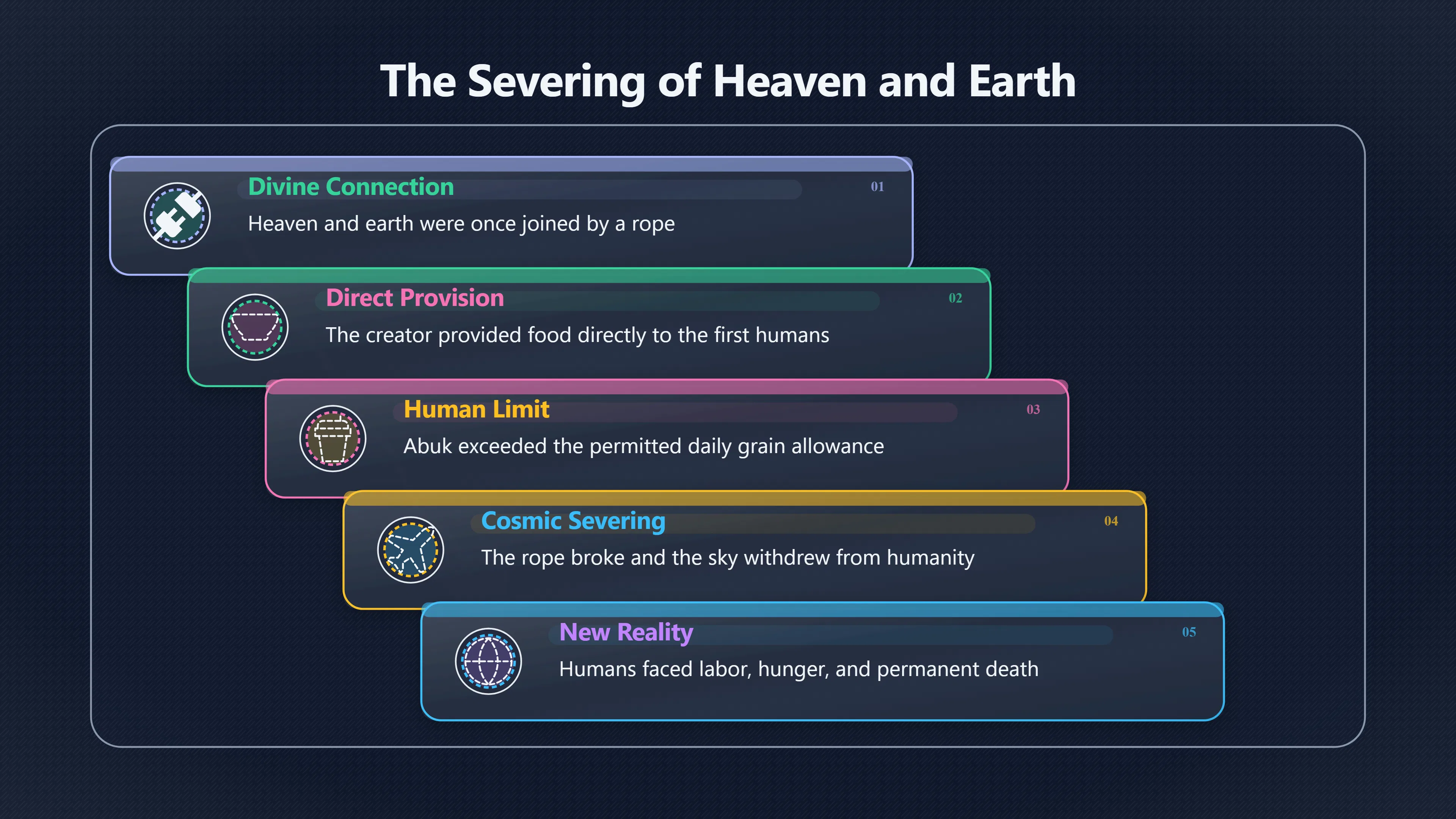
One of the most widespread Dinka creation narratives begins with a world very different from the present. Heaven and earth were once connected, often by a rope or direct pathway. The creator, usually identified as the sky deity Nhialic, lived close to humanity. There was no great distance between the divine and human realms, and in some versions there was no permanent death.[Wikipedia]WikipediaDinka religionDinka religion
The first humans, Garang and Abuk, received food directly from the creator. They were instructed to live within clear limits, often represented by a daily allowance of grain or millet. The crucial turning point comes when those limits are broken. In many versions, Abuk pounds or grows more grain than she has been permitted. The act is not usually presented as simple wickedness. Rather, it reflects a recognisably human response to hunger, scarcity, and the desire for security.[wikipedia.org]WikipediaDinka religionDinka religion
The consequences are enormous. The grain reaches the creator, causing offence, and the connection between heaven and earth is severed. The rope is cut, the sky withdraws, and humanity loses its immediate access to the divine realm. At the same time, people become subject to labour, uncertainty, and death. The story explains why human beings must cultivate food rather than receive it effortlessly, and why the creator is experienced as distant rather than physically present.[Wikipedia]WikipediaDinka religionDinka religion
Unlike some creation stories elsewhere that focus on cosmic battles or heroic exploits, the Dinka narrative centres on everyday necessities. Hunger, food preparation, farming, and obedience become the mechanisms through which the human condition is explained. The myth turns ordinary experience into a sacred history.
Garang and Abuk as Cultural Ancestors
Garang and Abuk are more than the first man and woman. They function as cultural ancestors whose experiences establish the pattern of later human life. Different Dinka communities preserve different details about them, and no single authoritative version exists. Oral tradition encourages retelling, adaptation, and local emphasis.[Wikipedia]WikipediaDinka religionDinka religion
Abuk is especially significant because she is associated not only with the first woman but also with fertility, cultivation, nourishment, and motherhood. In some traditions she is linked symbolically with gardens, rain, and even serpentine imagery. Later religious traditions sometimes connect her to the rain and fertility deity Deng.[Wikipedia]WikipediaDeng (godDeng (god
The moral lesson of the story is therefore more complex than a simple warning against disobedience. The narrative reflects an enduring tension between human need and divine order. People seek abundance, yet abundance pursued without restraint can disrupt the balance established by the creator.
Cattle, Rain and Sacrifice in Dinka Belief
If the creation story explains why humans became separated from heaven, cattle provide one of the principal means through which relationships with the divine continue to be maintained.
For the Dinka, cattle occupy a place that combines economic, social, aesthetic, and spiritual importance. Cattle shape marriage exchanges, personal identity, poetry, naming practices, ritual obligations, and ideas of beauty. Their significance is so extensive that many scholars describe Dinka society as profoundly pastoral in both material and symbolic terms.[google.com]artsandculture.google.comGoogle Arts & CultureDinka: Legendary Cattle Keepers of SudanThe Dinka consult spiritual healers in order to drive out disease, bring rai…
Within this worldview, cattle are not merely possessions. They participate in a sacred network linking humans, ancestors, spirits, rain, and divine power. Ritual specialists pray for healthy herds, protection from disease, fertility, and rainfall. Since rain determines the success of both people and cattle, heavenly blessing remains closely tied to survival.[Google Arts & Culture]artsandculture.google.comGoogle Arts & CultureDinka: Legendary Cattle Keepers of SudanThe Dinka consult spiritual healers in order to drive out disease, bring rai…
A recurring theme in Dinka religion is that communication with divine forces requires sacrifice. Bulls and oxen are especially important offerings. Through sacrificial rituals, communities seek healing, reconciliation, protection, rain, or relief from misfortune. The animal becomes a mediator between human concerns and spiritual powers. Lienhardt described animal sacrifice as the central religious act in traditional Dinka religion.[Scribd]scribd.comDivinity and Experience The Religion of The Dinka PDFGODFREY LIENHARDT I. Animal sacrifice is the central religious act of the Dink…
This sacrificial system helps explain why cattle occupy such a central place in Dinka cosmology. They are valuable not only because they sustain life but because they help bridge the distance created when heaven moved away. The same separation established in the creation story is partially addressed through prayer, ritual, and sacrificial exchange.[Wikipedia]WikipediaDinka religionDinka religion
The Link Between Rain and Divine Power
The sky remains the source of life even after its separation from humanity. Rain descends from above, nourishing grass, cattle, and people. Several Dinka religious figures, including Deng, are associated with rain, fertility, storms, and the life-giving forces that connect heaven to earth.[Wikipedia]WikipediaDeng (godDeng (god
Because cattle depend on pasture and water, they stand at the centre of this cycle. A healthy herd reflects divine favour, social harmony, and ecological balance. Drought, disease, or herd loss can therefore carry both practical and spiritual significance. Ritual responses frequently seek to restore proper relationships among humans, ancestors, and divine powers.[Google Arts & Culture]artsandculture.google.comGoogle Arts & CultureDinka: Legendary Cattle Keepers of SudanThe Dinka consult spiritual healers in order to drive out disease, bring rai…
How Oral Variants Change the Story
One reason Dinka creation traditions remain fascinating is that they do not exist in a single fixed text. They survive primarily through oral transmission. Storytellers, elders, ritual specialists, and local communities have preserved multiple versions over generations.[Google Books]books.google.comGoogle BooksDivinity and Experience: The Religion of the DinkaAuthor, Godfrey Lienhardt; Publisher, Oxford University Press, UK, 1961…
As a result, important details vary:
- Some versions emphasise the rope connecting heaven and earth.
- Others focus on the creator’s daily gift of grain.
- Some describe humanity being formed from clay.
- Others portray humans descending from the sky or emerging through different creative acts.
- The role of permanent death differs between versions, though separation from heaven remains a common theme.[Wikipedia]WikipediaDinka religionDinka religion
These differences are not usually treated as contradictions. In oral cultures, variation is often a sign of vitality rather than instability. Stories are adapted to local circumstances, ritual contexts, and the concerns of particular communities. The core message remains recognisable even when details shift.
The creation narrative also acquired new meanings as Christianity spread across South Sudan during the twentieth century and beyond. Many Dinka today identify as Christians, yet older stories about Garang, Abuk, cattle, rain, and the distant sky continue to survive as cultural memory and heritage. Traditional themes are sometimes interpreted through Christian frameworks rather than abandoned entirely.[Joshua Project]joshuaproject.netJoshua ProjectDinka, Central in South Sudan ProfileTheir traditional beliefs include reverence for Nhialic, the creator god, and a panthe…
Why the Creation Story Still Matters
For outsiders, the most striking feature of Dinka creation stories may be the image of heaven retreating from earth. Yet within the wider cosmology, the story does much more. It explains the origins of work, mortality, hunger, divine distance, sacrifice, and the continuing importance of cattle.
The narrative also shows why cattle occupy such an extraordinary place in Dinka life. They are not simply economic assets. They stand within a sacred landscape shaped by rain, ancestry, fertility, and communication with powers beyond the human world. The creation story and cattle cosmology therefore belong together. One explains how the bond between heaven and earth was broken; the other explains how people continue trying to maintain that bond through ritual, sacrifice, and everyday pastoral life.[scribd.com]scribd.comDivinity and Experience The Religion of The Dinka PDFGODFREY LIENHARDT I. Animal sacrifice is the central religious act of the Dink…
Amazon book picks
Further Reading
Books and field guides related to Why Did Heaven Move Away?. Use these as the next step if you want deeper reading beyond the article.
Divinity and Experience
Directly addresses Dinka cosmology, creation beliefs and ritual life.
African Myths of Origin
Places Dinka creation narratives in an African comparative framework.
African Religions and Philosophy
Explains African religious concepts relevant to creation myths.
eBay marketplace picks
Marketplace Samples
Live-tested eBay searches with available results related to this page.
Endnotes
1.
Source: books.google.com
Link:https://books.google.com/books/about/Divinity_and_Experience_The_Religion_of.html?id=z7Y4X9kHeU8C
Source snippet
Google BooksDivinity and Experience: The Religion of the DinkaAuthor, Godfrey Lienhardt; Publisher, Oxford University Press, UK, 1961...
2.
Source: scribd.com
Link:https://www.scribd.com/document/376949155/Divinity-and-Experience-The-Religion-of-the-Dinka-pdf
Source snippet
Divinity and Experience The Religion of The Dinka PDFGODFREY LIENHARDT I. Animal sacrifice is the central religious act of the Dink...
3.
Source: Wikipedia
Title: Dinka religion
Link:https://en.wikipedia.org/wiki/Dinka_religion
4.
Source: Wikipedia
Link:https://en.wikipedia.org/wiki/Nhialic
5.
Source: Wikipedia
Title: Deng (god)
Link:https://en.wikipedia.org/wiki/Deng_%28god%29
6.
Source: Wikipedia
Title: Abuk (mitología)
Link:https://es.wikipedia.org/wiki/Abuk_%28mitolog%C3%ADa%29
7.
Source: artsandculture.google.com
Link:https://artsandculture.google.com/story/dinka-legendary-cattle-keepers-of-sudan-african-ceremonies/HAWRQAnmgQYA8A?hl=en
Source snippet
Google Arts & CultureDinka: Legendary Cattle Keepers of SudanThe Dinka consult spiritual healers in order to drive out disease, bring rai...
8.
Source: Wikipedia
Title: Dinka people
Link:https://en.wikipedia.org/wiki/Dinka_people
9.
Source: davidgraeber.org
Link:https://davidgraeber.org/papers/the-divine-kingship-of-the-shilluk/
Source snippet
Here is one typical, Dinka version. Divinity (and the sky) and men (and the earth) were...
10.
Source: joshuaproject.net
Link:https://joshuaproject.net/people_groups/print/11562/OD
Source snippet
Joshua ProjectDinka, Central in South Sudan ProfileTheir traditional beliefs include reverence for Nhialic, the creator god, and a panthe...
Additional References
11.
Source: ojs.globalmissiology.org
Link:https://ojs.globalmissiology.org/index.php/english/article/view/400/1036
Source snippet
of Ritual and Sacrifice Among the Dinka of Southern...Cattle are highly revered in the Dinka culture, and thus such a sacrifice is grea...
12.
Source: facebook.com
Link:https://www.facebook.com/groups/3662574880668021/posts/3995199544072218/
13.
Source: facebook.com
Link:https://www.facebook.com/groups/2606490539622396/posts/3947967115474725/
14.
Source: johnryle.com
Link:https://johnryle.com/pdf/JR%202015%20-%20www.johnryle.com%20-%20Godfrey%27s%20gift%20-%20Festschrift%20for%20Godrey%20Lienhardt%20-%201997%20-%20Journal%20of%20the%20Anthropological%20Society%20of%20Oxford%20%28JASO%29.pdf
Source snippet
GODFREY LIENHARDT (1921-1993) - John Ryle11 Nov 1993 — Colonial officers kept their distance from the 'natives' Abuk is the first woman...
15.
Source: medium.com
Link:https://medium.com/%40amal_80891/the-timeless-myths-of-the-dinka-echoes-of-creation-cattle-and-the-spirit-world-f924b44cde8d
Source snippet
The Timeless Myths of the Dinka: Echoes of Creation...Abuk represents nourishment, motherhood, feminine strength, and the hearth...
16.
Source: facebook.com
Link:https://www.facebook.com/Tonjtimes/posts/the-dinka-tradition-of-keeping-cattle-is-one-of-south-sudans-most-unique-culture/1229484039200267/
Source snippet
e family, legacy, and the heartbeat of every important moment.Read more...
17.
Source: fanack.com
Title: dinka people mythic life in sudan
Link:https://fanack.com/sudan/society-of-sudan/dinka-people-mythic-life-in-sudan/
Source snippet
Dinka People: Mythic Life in Sudan31 Oct 2023 — The myth revolves around the arrival of the revered Dinka ancestor, Deng Det, whose name...
18.
Source: paanluelwel.com
Link:https://paanluelwel.com/2019/10/02/dinka-mythology-the-legend-of-abuk-ku-garang/
Source snippet
Dinka Mythology – The Legend of Abuk ku Garang2 Oct 2019 — The Dinka believe that the Creator made Abuk and Garang, the first man, out of...
19.
Source: frontierspartnerships.org
Link:https://www.frontierspartnerships.org/journals/pastoralism-research-policy-and-practice/articles/10.3389/past.2025.15651/full
Source snippet
Blood and relational selfhood: crisis and sacrifice among the...by E Hashimoto — Cattle play a central role in shaping Nuer selfhood and...
20.
Source: facebook.com
Link:https://www.facebook.com/100063838954700/posts/dinka-tribe-south-sudanthe-dinka-are-one-of-the-largest-ethnic-groups-in-south-s/1175052484632706/
Source snippet
dowries, and sacrifices in spiritual...
Topic Tree