Why South Korean Folklore Still Feels Alive
South Korea’s folklore is not a single book of myths, but a living field of stories, household customs, village rites, ghosts, trickster beings, sacred mountains, island goddesses and modern screen reinventions.
Page outline Jump by section
Introduction
South Korea’s folklore is not a single book of myths, but a living field of stories, household customs, village rites, ghosts, trickster beings, sacred mountains, island goddesses and modern screen reinventions. Its best-known traditions range from the national foundation myth of Dangun, preserved in a medieval text, to mischievous dokkaebi, fox spirits, tiger tales, restless ghosts and shamanic rites that still shape heritage, tourism and popular culture. What makes South Korean folklore especially rich is the way older oral tradition sits beside Buddhism, Confucian family ritual, local spirit worship, state heritage preservation and global media. A goblin in a folk tale, a village shrine on Jeju Island and a supernatural character in a television drama may all belong to different layers of the same cultural imagination.[or.kr]library.ltikorea.or.krGojoseon by Dangun. With its five volumes, nine sections and 144 entries, Samguk ・…
The most useful way to understand it is to avoid treating every supernatural figure as a “monster”. Many Korean beings are morally mixed. They test, trick, protect, punish, heal or explain misfortune. Folklore here is not just entertainment; it is a way of thinking about family duty, the dead, dangerous landscapes, village protection, unfair power, seasonal risk and the uneasy boundary between human society and the spirit world.[go.kr]folkency.nfm.go.krOpen source on go.kr.
What counts as South Korean folklore?
South Korean folklore covers inherited stories and practices from the Korean peninsula as they are preserved, performed, retold and reinterpreted in the Republic of Korea today. Some traditions are pan-Korean in origin, especially older myths and folktales recorded before modern division. Others are strongly local, such as Jeju Island’s village shrines and sea-related rites. A country-level South Korea page therefore has to hold two ideas together: the older Korean cultural inheritance, and the specifically South Korean institutions, museums, heritage systems, media industries and tourism settings that now present it.
The National Folk Museum of Korea describes modern folklore research as an effort to document the everyday life of Korean people, including folk beliefs, shamanism, festivals, rites of passage, folktales, folk songs, food, clothing, housing and livelihood. That matters because “folklore” is not limited to fairy tales. It includes the objects used in ritual, the songs and speech of shamans, village guardians at roadsides, paintings hung to repel harm, and seasonal customs that connect families to ancestors and place.[nfm.go.kr]nfm.go.krNational Folk Museum of KoreaNational Folk Museum of Korea
South Korean folklore is also layered. Shamanic traditions gave people ritual ways to negotiate with gods, ancestors and restless spirits. Buddhist stories added karmic and devotional frames. Confucian family ethics reshaped ideas of proper burial, marriage, ancestry and social completion. Modern nationalism gave the Dangun foundation myth a prominent public role. Film, television and web culture have then recast older figures as romantic leads, horror icons, mascots and fantasy characters.[or.kr]library.ltikorea.or.krGojoseon by Dangun. With its five volumes, nine sections and 144 entries, Samguk ・…
The foundation myth: why Dangun still matters
The best-known Korean foundation story is the myth of Dangun, the legendary founder of the first Korean kingdom. Its most famous written source is the Samguk yusa, compiled in the late Goryeo period by the Buddhist monk Iryeon, who lived from 1206 to 1289. The Digital Library of Korean Literature describes the work as one of the two most important surviving historical texts from Goryeo and notes that it includes history, geography, philosophy, culture, folk culture, language, art and religion.[LTI Korea Library]library.ltikorea.or.krGojoseon by Dangun. With its five volumes, nine sections and 144 entries, Samguk ・…
In the myth, a heavenly figure descends to the human world. A bear and a tiger wish to become human and are given a test involving seclusion and sacred food. The tiger gives up; the bear endures and becomes a woman. She later gives birth to Dangun, who founds the ancient kingdom. The National Museum of Korea notes that Samguk yusa helped establish Dangun Joseon as the starting point of Korean history, while the National Folk Museum’s folklore encyclopaedia treats the story as a myth rather than a straightforward historical record.[국립중앙박물관]museum.go.krOpen source on go.kr.
For modern readers, the important point is not whether the story proves an ancient date. It does not work like archaeology. Its power lies in how it joins sky, mountain, animal transformation, endurance and political origin into a memorable story of peoplehood. The tiger and bear also became symbols open to interpretation: rival clans, moral contrasts, wildness and patience, or the tension between mountain danger and ancestral identity. Modern South Korea still marks National Foundation Day on 3 October, and public-facing cultural sources continue to use the Dangun story to explain how myth and identity overlap.[Korea.Net]korea.netOpen source on korea.net.
Spirits, ghosts and the unfinished dead
Ghosts in Korean folklore are usually not random Halloween figures. They often express the idea that death leaves trouble behind when social, emotional or ritual obligations are unresolved. This is why Korean ghost traditions so often circle around revenge, improper death, family duty, marriage, burial and the need for ritual settlement.
A common type is the restless human spirit, often described as a ghost of someone who died with unfinished ties to the living world. Popular tradition includes many named ghost types, but the wider pattern is more important than the catalogue: the dead may remain near people because something has gone wrong. They might have been murdered, neglected, unmarried, childless, improperly mourned or unable to receive ancestral rites.[Wikipedia]WikipediaOpen source on wikipedia.org.
The famous “virgin ghost” is one of the clearest examples of folklore shaped by social structure. In older Confucian society, marriage was not only romance; it placed a woman within a household, lineage and ritual order. A young woman who died unmarried could therefore be imagined as socially incomplete, and later ghost stories turned that anxiety into a recognisable figure: white clothing, loose hair, grievance and a demand for resolution. Modern horror often uses the image for atmosphere, but the older belief points to gender, family pressure and ritual belonging.[K-Occult]koccult.comOpen source on koccult.com.
South Korean ghost lore should therefore be read with care. These stories can be frightening, but they are not only about fear. They are also folk arguments about justice. A ghost appears because the living have failed to recognise a wrong, honour the dead, or repair a broken social bond.
Dokkaebi: tricksters, helpers and modern “goblins”
Dokkaebi are among the most recognisable beings in Korean folklore, but the English word “goblin” can mislead. They are not simply small evil monsters. The National Folk Museum’s folklore encyclopaedia defines the dokkaebi as a spirit with extraordinary powers and skills, able to enchant, tease, taunt and sometimes help humans. Stories describe them as playful, disruptive, generous, dangerous or ridiculous depending on the tale.[folkency.nfm.go.kr]folkency.nfm.go.krOpen source on go.kr.
Many dokkaebi stories are comic tests of human wit. They challenge people, offer treasure, create illusions or turn up in uncanny lights and fires. One National Folk Museum entry on “goblin fire” describes accounts of glimmering lights or tall blue flames associated with dokkaebi encounters. Another tale records a woman living with dokkaebi who bring her treasures, only for the story to become a lesson in managing supernatural wealth and risk.[folkency.nfm.go.kr]folkency.nfm.go.krblin Fireblin Fire
Their origin is also different from ghosts. In common explanation, ghosts are dead humans, whereas dokkaebi are more often linked with animated objects, spirit power or uncanny presences in the world. That makes them closer to trickster spirits than to the souls of the deceased. They can punish greed, reward cleverness, mock authority, or simply make the world stranger.
Modern South Korean television changed the global image of the dokkaebi. The drama often known in English as Goblin recast the figure as a tragic immortal hero rather than the rough, teasing being of folk tradition. Recent scholarship on South Korean supernatural television notes that twenty-first-century dramas have repeatedly turned to folklore and supernatural tales as vehicles for humour, romance and social critique. The result is not “wrong” folklore, but adaptation: older materials are being translated into new emotional forms for contemporary audiences.[series.unibo.it]series.unibo.itOpen source on unibo.it.
Fox spirits, tigers and animal intelligence
Animals in South Korean folklore are rarely just animals. They are moral actors, boundary-crossers and symbols of power. Three are especially important for general readers: the fox, the tiger and the magpie.
The fox spirit is often associated with transformation, seduction and danger. In Korean tales, the nine-tailed fox commonly appears as a shape-shifter, often female, whose beauty conceals predatory or uncanny power. The National Folk Museum’s entry on the “fox marble” links such tales to the fox woman and the gumiho motif, where a human encounter with a fox being becomes a test of knowledge, desire and survival.[folkency.nfm.go.kr]folkency.nfm.go.krFox MarbleFox Marble
The tiger has an even broader role. It appears in the Dangun foundation myth, in children’s origin tales, in mountain lore and in folk painting. In the tale often translated as “Sister Sun and Brother Moon”, a tiger devours a mother and pursues her children, who escape into the sky and become the sun and moon. The National Folk Museum identifies the tale as an origin story for the sun and moon, while Korea.net presents it as one of Korea’s well-known folktales.[folkency.nfm.go.kr]folkency.nfm.go.krSister Sun and Brother MoonSister Sun and Brother Moon
Yet the tiger is not only terrifying. In Korean art it can be a guardian against evil, a comic fool, a mountain authority, or a satirical stand-in for arrogant power. The National Museum of Korea notes that tiger paintings were used to ward off evil spirits from the early Joseon dynasty onwards. In folk paintings of tigers and magpies, the tiger may look fierce, absurd or outwitted, while the magpie often acts as messenger, commentator or lucky presence.[국립중앙박물관]museum.go.krOpen source on go.kr.
This mixture of fear and comedy is one of the pleasures of Korean folklore. The tiger can eat your mother in one tale, guard your home in another and be mocked by a bird in a painting. Folklore does not require one fixed meaning; it keeps a creature useful by letting it carry different emotional jobs.
Village guardians and sacred landscapes
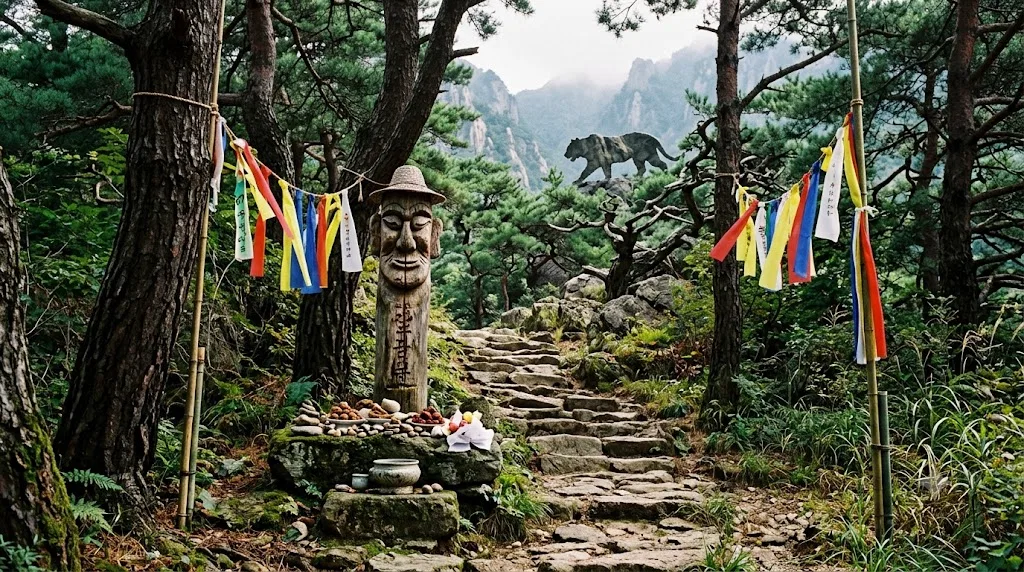
South Korean folklore is deeply tied to place. Spirits may inhabit mountains, trees, stones, village entrances, sea shrines and household spaces. This place-based quality is one reason older beliefs survived even as the country modernised: they were attached not just to abstract doctrine, but to roads, coastlines, homes and communities.
Village guardian traditions are a good example. The National Folk Museum describes village-god shrines as places connected with deities that protect a community, with local terms varying by region. Such shrines show how supernatural protection could be mapped onto the physical edge of a settlement. A village was not just a cluster of houses; it was a guarded social body with ritual boundaries.[folkency.nfm.go.kr]folkency.nfm.go.krShrine for Village GodsShrine for Village Gods
Jeju Island has especially distinctive guardian traditions. The National Folk Museum defines the stone grandfather figure of Jeju as a stone deity erected outside fortress gates during the Joseon dynasty. Today these figures are widely visible as local icons, tourist images and heritage symbols, but their deeper meaning comes from protection, boundary-marking and island identity.[folkency.nfm.go.kr]folkency.nfm.go.krStone GrandfatherStone Grandfather
Mountain spirits also remain central to Korean folk religion. Contemporary reporting on South Korean shamans notes that many practitioners worship local deities such as mountain gods, great spirit grandmothers and dragon kings. This fits a much older pattern in which mountains, water and settlement boundaries are spiritually active. Folklore here is not only narrative; it is geography made meaningful.[Reuters]reuters.comSouth Korea's young shamans revive ancient tradition with social mediaSouth Korea's young shamans revive ancient tradition with social media
Shamanic rites: where folklore is performed, not just told
South Korean shamanism is one of the most important living frameworks for understanding the country’s folk belief culture. It is not a single centralised religion with one scripture or hierarchy. It is better understood as a varied set of ritual practices in which specialists communicate with gods, ancestors and spirits through offerings, music, costume, dance, speech and divination.
The National Folk Museum’s exhibition on the folklorist Kim Taegon shows how seriously these practices have been documented. Kim began field research into different types of shamanic rites from 1960, and a donation connected with his work included 31,742 items such as spirit paintings, ritual costumes, equipment, photographs and films. That scale of collection makes clear that shamanism is not a marginal curiosity; it is a major archive of Korean religious and performance culture.[nfm.go.kr]nfm.go.krOpen source on go.kr.
Shamanic rites often deal with practical crises: illness, death, household misfortune, village safety, sea danger, harvests, ancestors or the need to pacify spirits. They are dramatic events, but they are also social work. They gather people, name misfortune, stage communication with the unseen and create a form of resolution that ordinary speech may not provide.
In contemporary South Korea, shamanism is both stigmatised and newly visible. Reuters reported in 2024 that young shamans have used social media to reach clients, while interest was also boosted by the film Exhuma. The same report cited a culture ministry agency estimate of 300,000 to 400,000 shamans and fortune-tellers in South Korea, and noted that modern clients often seek advice about jobs, relationships and anxiety.[Reuters]reuters.comSouth Korea's young shamans revive ancient tradition with social mediaSouth Korea's young shamans revive ancient tradition with social media
This does not mean every modern consultation is an unchanged ancient survival. It means older ritual roles have adapted to new media, new worries and new markets. The continuity lies less in identical performance and more in the enduring idea that human trouble may need negotiation with forces beyond ordinary control.
Jeju Island: sea goddesses, village shrines and local identity
Jeju Island is one of the most important regions for South Korean folklore because its island environment preserved distinctive forms of belief. Its traditions are strongly connected to sea work, wind, village shrines, women divers and local gods.
The best-known example is Jeju Chilmeoridang Yeongdeunggut, a shamanic ritual inscribed by UNESCO in 2009. UNESCO describes it as a ritual held in the second lunar month to pray for calm seas, an abundant harvest and a plentiful sea catch. The Korea Heritage Service describes the same tradition as a series of shamanistic rituals indigenous to Jeju Island and associated with the goddess of the wind.[UNESCO ICH]ich.unesco.orgOpen source on unesco.org.
This rite shows how folklore works as ecological knowledge and community protection. Wind and sea are not background scenery on Jeju; they directly affect fishing, diving, harvests and safety. A goddess of wind gives ritual form to that uncertainty. Women divers, shipowners and villagers participate not because the rite is a quaint performance, but because it expresses dependence on dangerous waters and seasonal change.[Korea Cultural Heritage Admin]english.cha.go.krOpen source on go.kr.
Jeju’s tourism materials also emphasise that old towns on the island have village shrines connected with patron gods who protect residents. That public presentation can simplify complex local practice, but it also helps visitors understand why Jeju folklore feels different from mainland tradition: it is island-based, sea-facing and unusually rich in local divine figures.[m.visitjeju.net]m.visitjeju.netOpen source on visitjeju.net.
Folk tales as moral puzzles, not just children’s stories
Many South Korean folktales are now introduced to children, but their older logic can be sharp, violent and socially observant. They teach cleverness, endurance, filial duty, suspicion of greed and the possibility that injustice will return in supernatural form.
“Sister Sun and Brother Moon” is a good example. On the surface, it explains the origin of the sun and moon. Underneath, it is a tale of danger entering the household. The tiger uses deception, clothing and voice to imitate the mother, turning a family scene into a survival test. The children’s escape into the sky transforms terror into cosmic order.[folkency.nfm.go.kr]folkency.nfm.go.krSister Sun and Brother MoonSister Sun and Brother Moon
“Kongjwi and Patjwi”, often compared to Cinderella, also shows how Korean versions can be darker than the simplified international fairy-tale frame suggests. The story includes a persecuted heroine, a cruel stepfamily, supernatural help, marriage, murder, ghostly revelation and punishment. The National Folk Museum’s Korean folk literature volume is cited in summaries of the tale as documenting its oral transmission, regional variants and moral pattern of rewarding virtue and punishing vice.[Wikipedia]WikipediaKongjwi and PatjwiKongjwi and Patjwi
Such tales matter because they reveal how ordinary people imagined justice when official life was unfair. A weak child, daughter-in-law, widow, traveller or poor farmer could be vindicated by animals, ghosts, gods or the strange logic of fate. Folklore made moral order imaginable even when social order failed.
The old, the collected and the invented
A common mistake is to treat all Korean supernatural material as equally ancient. South Korean folklore is better understood as a chain of transmission with several layers.
Some stories are recorded in medieval texts, such as the Dangun myth in Samguk yusa. Some are oral tales collected, classified and published by folklorists and museums. Some are ritual traditions preserved in communities and recognised as intangible cultural heritage. Some are literary or television reinventions that borrow older names while changing the character’s meaning.[or.kr]library.ltikorea.or.krGojoseon by Dangun. With its five volumes, nine sections and 144 entries, Samguk ・…
Dokkaebi are a clear case of transformation. The older folk figure is teasing, uncanny and morally mixed; modern drama often makes the dokkaebi handsome, tragic and romantic. Fox spirits have also moved from dangerous shape-shifters into complex heroines or anti-heroines. Ghosts that once expressed ritual incompletion now appear in school horror, cinema and web stories. These adaptations keep folklore visible, but they should not be mistaken for untouched tradition.[series.unibo.it]series.unibo.itOpen source on unibo.it.
The same is true of heritage tourism. Jeju rituals, stone guardians, folk villages and museum displays help preserve and explain tradition, but they also frame it for visitors. That framing can be valuable when it is honest about local history; it becomes weaker when it turns living belief into a decorative backdrop.
Why South Korean folklore feels so modern
South Korean folklore remains culturally powerful because it adapts easily to modern anxieties. Restless ghosts speak to injustice and social pressure. Shamans offer counsel in times of uncertainty. Fox spirits and goblins become figures of desire, alienation or moral ambiguity. Tigers and magpies become mascots, art motifs and pop-cultural characters. Village gods and island rites become heritage symbols in a country that has urbanised at extraordinary speed.
Recent scholarship on supernatural South Korean television argues that folklore and supernatural tales have become vehicles for humour and social critique. That helps explain why these figures travel well. A drama can use a ghost story to talk about grief, a goblin romance to discuss fate and memory, or a shamanic plot to explore stigma, class and modern fear.[series.unibo.it]series.unibo.itOpen source on unibo.it.
At the same time, old images still carry older meanings. The tiger is not just a cute retro design; it has guarded homes, haunted mountain tales and symbolised power. The Jeju wind goddess is not just a festival figure; she belongs to a ritual system shaped by real dependence on sea and weather. The virgin ghost is not only a horror cliché; she reflects the burdens older family systems placed on women’s lives and deaths.[go.kr]museum.go.krOpen source on go.kr.
The strongest way to read South Korean folklore, then, is as a conversation between memory and reinvention. Its beings survive because they are useful: they explain danger, mock authority, protect thresholds, voice grief, dramatise unfairness and give modern audiences a language for experiences that still feel difficult to name.

eBay marketplace picks
Marketplace Samples
Live-tested eBay searches with available results related to this page.

Endnotes
1.
Source: nfm.go.kr
Link:https://www.nfm.go.kr/user/bbs/english/17/469/bbsDataView/7560.do
2.
Source: series.unibo.it
Link:https://series.unibo.it/article/download/9158/10211/34072
3.
Source: folkency.nfm.go.kr
Link:https://folkency.nfm.go.kr/en/topic/detail/1968
4.
Source: folkency.nfm.go.kr
Title: Sister Sun and Brother Moon
Link:https://folkency.nfm.go.kr/en/topic/detail/6006
5.
Source: nfm.go.kr
Title: National Folk Museum of Korea
Link:https://www.nfm.go.kr/user/bbs/english/17/469/bbsDataView/22864.do?bbsDataCategory=&column=&page=3&search=&searchEDate=&searchSDate=
6.
Source: Wikipedia
Link:https://en.wikipedia.org/wiki/Korean_shamanism
7.
Source: folkency.nfm.go.kr
Title: Myth of Dangun
Link:https://folkency.nfm.go.kr/en/topic/detail/5336
8.
Source: korea.net
Link:https://www.korea.net/NewsFocus/Culture/view?articleId=121092
9.
Source: Wikipedia
Link:https://en.wikipedia.org/wiki/Gwisin
10.
Source: Wikipedia
Title: Korean virgin ghost
Link:https://en.wikipedia.org/wiki/Korean_virgin_ghost
11.
Source: folkency.nfm.go.kr
Title: blin Fire
Link:https://folkency.nfm.go.kr/en/topic/detail/5780
12.
Source: folkency.nfm.go.kr
Title: How to Eradicate Goblins
Link:https://folkency.nfm.go.kr/en/topic/detail/5778
13.
Source: folkency.nfm.go.kr
Title: Fox Marble
Link:https://folkency.nfm.go.kr/en/topic/detail/5909
14.
Source: korea.net
Link:https://www.korea.net/NewsFocus/Culture/view?articleId=122348
15.
Source: folkency.nfm.go.kr
Title: Shrine for Village Gods
Link:https://folkency.nfm.go.kr/EN/topic/detail/1788
16.
Source: folkency.nfm.go.kr
Title: Stone Grandfather
Link:https://folkency.nfm.go.kr/EN/topic/detail/1993
17.
Source: reuters.com
Title: South Korea’s young shamans revive ancient tradition with social media
Link:https://www.reuters.com/world/asia-pacific/south-koreas-young-shamans-revive-ancient-tradition-with-social-media-2024-06-08/
18.
Source: ich.unesco.org
Link:https://ich.unesco.org/en/RL/jeju-chilmeoridang-yeongdeunggut-00187
19.
Source: m.visitjeju.net
Link:https://m.visitjeju.net/en/themtour/view?contentsid=CNTS_300000000012487&menuId=DOM_000005000000000221
20.
Source: Wikipedia
Title: Kongjwi and Patjwi
Link:https://en.wikipedia.org/wiki/Kongjwi_and_Patjwi
21.
Source: Wikipedia
Link:https://en.wikipedia.org/wiki/Dokkaebi
22.
Source: Wikipedia
Link:https://en.wikipedia.org/wiki/South
23.
Source: Wikipedia
Title: Korean folklore
Link:https://en.wikipedia.org/wiki/Korean_folklore
24.
Source: Wikipedia
Title: Jeju Chilmeoridang Yeongdeunggut
Link:https://en.wikipedia.org/wiki/Jeju_Chilmeoridang_Yeongdeunggut
25.
Source: Wikipedia
Link:https://en.wikipedia.org/wiki/Tan%27gun
26.
Source: Wikipedia
Title: Samguk yusa
Link:https://en.wikipedia.org/wiki/Samguk_yusa
27.
Source: nfm.go.kr
Link:https://www.nfm.go.kr/user/bbs/english/16/439/bbsDataView/6880.do?bbsDataCategory=&column=&page=7&search=&searchEDate=&searchSDate=
28.
Source: nfm.go.kr
Title: Mediator between Heaven and Earth
Link:https://www.nfm.go.kr/user/bbs/english/16/439/bbsDataView/6890.do?bbsDataCategory=&column=&page=8&search=&searchEDate=&searchSDate=
29.
Source: nfm.go.kr
Title: Special Exhibition
Link:https://www.nfm.go.kr/user/bbs/english/17/469/bbsDataView/23209.do?page=1
30.
Source: nfm.go.kr
Link:https://www.nfm.go.kr/english/subIndex/1041.do
31.
Source: folkency.nfm.go.kr
Link:https://folkency.nfm.go.kr/en/topic/detail/5974
32.
Source: folkency.nfm.go.kr
Title: nfm.go.kr Lady Dohwa and Bachelor Bihyeong
Link:https://folkency.nfm.go.kr/en/topic/detail/5786
33.
Source: folkency.nfm.go.kr
Title: nfm.go.kr Why Sea Water Tastes Salty
Link:https://folkency.nfm.go.kr/en/topic/detail/5815
34.
Source: honoraryreporters.korea.net
Link:https://honoraryreporters.korea.net/board/detail.do?articlecate=1&board_no=10446&tpln=1
35.
Source: korea.net
Link:https://www.korea.net/NewsFocus/HonoraryReporters/view?articleId=209070
36.
Source: korea.net
Link:https://www.korea.net/NewsFocus/People/view?articleId=249901
37.
Source: korea.net
Link:https://www.korea.net/NewsFocus/HonoraryReporters/view?articleId=205298
38.
Source: ich.unesco.org
Link:https://ich.unesco.org/en/RL/knowledge-beliefs-and-practices-related-to-jang-making-in-the-republic-of-korea-01975
39.
Source: ia800409.us.archive.org
Title: 한국민속문학사전 본문 최종 opt
Link:https://ia800409.us.archive.org/5/items/opt_20230726/%ED%95%9C%EA%B5%AD%EB%AF%BC%EC%86%8D%EB%AC%B8%ED%95%99%EC%82%AC%EC%A0%84-%EB%B3%B8%EB%AC%B8-%EC%B5%9C%EC%A2%85_opt.pdf
40.
Source: youtube.com
Title: Dark & Mysterious Monsters from South Korean Legends
Link:https://www.youtube.com/watch?v=7UFjRzJQz7g
Source snippet
Dokkaebi | The Korean Goblin...
41.
Source: youtube.com
Title: Dokkaebi | The Korean Goblin
Link:https://www.youtube.com/watch?v=_PHPwlTVRhg
Source snippet
Musok | The Legacy and History of Korean Shamanism a Religion of Resistance...
42.
Source: library.ltikorea.or.kr
Link:https://library.ltikorea.or.kr/originalworks/101451
Source snippet
Gojoseon by Dangun. With its five volumes, nine sections and 144 entries, Samguk ・...
43.
Source: museum.go.kr
Link:https://www.museum.go.kr/ENG/contents/E0403000000.do?relicId=2492&schM=relic_represent_view
44.
Source: museum.go.kr
Link:https://www.museum.go.kr/ENG/contents/E0402000000.do?relicId=2487&schM=view&searchId=search
45.
Source: worldhistory.org
Title: Samguk Yusa
Link:https://www.worldhistory.org/Samguk_Yusa/
46.
Source: koccult.com
Link:https://koccult.com/creatures/cheonyeo-gwisin
47.
Source: english.cha.go.kr
Link:https://english.cha.go.kr/chaen/search/selectGeneralSearchDetail.do%3Bjsessionid%3DO2YXpRHDDrsbSo5ZoPvoJ9xoXKMJQcnnau7BPkl6tnjfdG1QlTTJ8NybW1i5ZPe8.cha-was01_servlet_engine4?canAsset=&canceled=&ccebAsno=0000710000000&ccebCtcd=&ccebKdcd=&ccebPcd1=&enCcebAsdt=&endNum=&mn=EN_01_01&pageIndex=382®ion=&sCcebCtcd=50&sCcebKdcd=17&searchWrd=&stCcebAsdt=&startNum=
48.
Source: washingtondc.korean-culture.org
Link:https://washingtondc.korean-culture.org/en/1126/board/890/read/140745
49.
Source: dictionary.cambridge.org
Link:https://dictionary.cambridge.org/vi/dictionary/english/korean
50.
Source: koccult.com
Link:https://koccult.com/folk-practices/dokkaebi-gosa
51.
Source: koccult.com
Link:https://koccult.com/folk-practices/gut-shamanic-ritual
52.
Source: koccult.com
Link:https://koccult.com/creatures/haetae
53.
Source: londonkoreanlinks.net
Title: national folk museum
Link:https://londonkoreanlinks.net/2016/05/16/national-folk-museum/
54.
Source: english.cha.go.kr
Link:https://english.cha.go.kr/cop/bbs/selectBoardArticle.do%3Bjsessionid%3DcIfNItPU3lj1TIAxnLZzcz0IEoNpE094cYNy4vs9ybEyXYyhtMqyLey1H8tClaVW.cha-was01_servlet_engine4?bbsId=BBSMSTR_1200&ctgryLrcls=&ctgryMdcls=&ctgrySmcls=&mn=EN_01_01&ntcEndDt=&ntcStartDt=&nttId=80667&pageUnit=0&searchCnd=&searchUseYn=&searchWrd=
55.
Source: themagicians.fandom.com
Link:https://themagicians.fandom.com/wiki/Dokkaebi
56.
Source: pdsh.fandom.com
Link:https://pdsh.fandom.com/wiki/Dokkaebi
Additional References
57.
Source: youtube.com
Title: Every Mythical Creature from Korean Folklore Explained in 15 Minutes
Link:https://www.youtube.com/watch?v=ITbMe4aCIrA
Source snippet
Korean Folklore Is DARKER Than K Dramas Admit...
58.
Source: jstor.org
Link:https://www.jstor.org/stable/j.ctv21hrjd9
59.
Source: facebook.com
Link:https://www.facebook.com/groups/814204010473746/posts/did-you-know-that-korean-fairy-tales-have-one-of/1455216886372452/
60.
Source: facebook.com
Link:https://www.facebook.com/thesoulofseoulblog/posts/dive-into-the-eerie-world-of-korean-folklore-where-vengeful-gwishin-spirits-and-/1140785314718581/
61.
Source: omnika.org
Link:https://omnika.org/library/encyclopedia-of-korean-folk-culture-ekfc
62.
Source: medium.com
Link:https://medium.com/%40pepperscript/from-boogeyman-to-guardian-spirit-997b47e1b19b
63.
Source: instagram.com
Link:https://www.instagram.com/p/DR7KWBfE66C/?img_index=2
64.
Source: ijcsrr.org
Link:https://ijcsrr.org/wp-content/uploads/2023/02/25-09-2023.pdf
65.
Source: english.khs.go.kr
Link:https://english.khs.go.kr/cop/bbs/selectBoardArticle.do?bbsId=BBSMSTR_1205&ctgryLrcls=CTGRY210&mn=EN_03_02&nttId=58141&uniq=0
66.
Source: facebook.com
Link:https://www.facebook.com/thekoreatimes/posts/korea-has-officially-designated-a-rare-set-of-19th-century-shamanic-paintings-as/1331931305779298/
Topic Tree
Follow this branch
Related pages 192
- Afghan Folklore
- Albanian Folklore
- Algerian Folklore
- Australian Folklore
- Azerbaijan Folklore
- +187 more in sidebar