Haunting Traditions of Saudi Arabia
Saudi Arabia’s folklore is not a single storybook tradition but a wide field of oral poetry, tribal memory, sacred landscapes, household arts, seasonal performance, desert cautionary tales and beliefs about unseen beings.
Page outline Jump by section
Why Saudi folklore is hard to pin down
Saudi Arabia covers several historically distinct cultural regions: the western Hijaz, the central Najd, the eastern Gulf-facing areas, the northern desert routes, and the southern highlands of Asir and Jazan. Folklore changes across these regions because livelihood, landscape and social history change: oasis towns, pilgrimage routes, nomadic pastoral life, mountain villages and Red Sea ports produced different kinds of stories, songs and warnings.
The second difficulty is that much Saudi folklore was transmitted orally. Stories were told by elders, poets, travellers, camel herders and household narrators long before they were collected in books or filmed for heritage projects. A study of Saudi folklore argues that folk elements pass between generations as carriers of social values and shared experience, with oral poetry and music among the country’s most important folk genres.[kirj.ee]kirj.eeHISTOR Y OF SAUDI FOLKLORE AND FACTORS THATHISTOR Y OF SAUDI FOLKLORE AND FACTORS THAT
That oral basis means the evidence is uneven. Some traditions are now well documented through UNESCO, Saudi cultural institutions and academic research. Others, especially local ghost stories or creature legends, survive mainly through family memory, regional tellings, scattered theses and modern retellings. The result is a folklore landscape where a national heritage performance may be carefully archived, while a mountain spirit story may exist in only a few collected versions.
The jinn: the unseen beings at the centre of Saudi supernatural belief
For most readers, the central supernatural figure in Saudi and wider Arabian folklore is the jinn. In Islamic belief and Arabic folklore, jinn are intelligent unseen beings, morally varied rather than simply evil. Folklore often places them in deserts, ruins, lonely valleys, wells, abandoned houses and other marginal spaces, which makes them especially suited to Saudi Arabia’s desert and oasis storytelling traditions. Medical and anthropological studies from Saudi Arabia show that belief in jinn, the evil eye and magical harm remains socially significant, not only as folklore but also as a way some people interpret illness, misfortune and distress.[PMC]pmc.ncbi.nlm.nih.govOpen source on nih.gov.
In older Arabian storytelling, jinn are not just monsters. They may frighten, mislead, possess, inspire, protect or punish. They are sometimes linked to poets and soothsayers, sometimes to animals or sudden lights, and sometimes to places that people approach with caution. This flexibility is what has kept them alive in stories: the jinn can explain a noise in a deserted place, a strange illness, a risky journey, a nightmare, or a warning about disrespecting a place.
Modern readers should be careful not to flatten jinn belief into “ghost stories”. In Saudi Arabia, as elsewhere in Muslim societies, jinn belong simultaneously to religious cosmology, folk explanation, moral teaching and popular horror. A person may discuss jinn as a matter of faith, as a childhood fright, as a family story, as a metaphor, or as a disputed explanation for mental or physical symptoms. Saudi medical research on faith healers and epilepsy shows that these beliefs can have real-world consequences for healthcare, because some patients and families may mix medical treatment with spiritual interpretation.[PMC]pmc.ncbi.nlm.nih.govOpen source on nih.gov.
Desert monsters, ghouls and warning tales
Saudi supernatural folklore also belongs to the wider Arabian world of desert monsters. The ghoul is the best-known example in English: a graveyard or wilderness being associated with danger, shapeshifting and the fear of being devoured or lured away. It is not uniquely Saudi, but it fits the older Arabian habit of imagining the wilderness as a place where normal human rules weaken. Reputable summaries of the Arabic ghoul tradition describe it as rooted in Arabic folklore and associated with graveyards, desolate places and predatory danger.[EBSCO]ebsco.comOpen source on ebsco.com.
The important point is not whether every named creature has a neat Saudi “national” version. Folklore rarely respects modern borders. Many Saudi stories share motifs with Yemen, Oman, Jordan, Iraq, the Gulf states and the wider Arabic-speaking world: the trickster spirit, the desert apparition, the dangerous female figure, the child-frightener, the uncanny animal, the light that leads travellers astray.
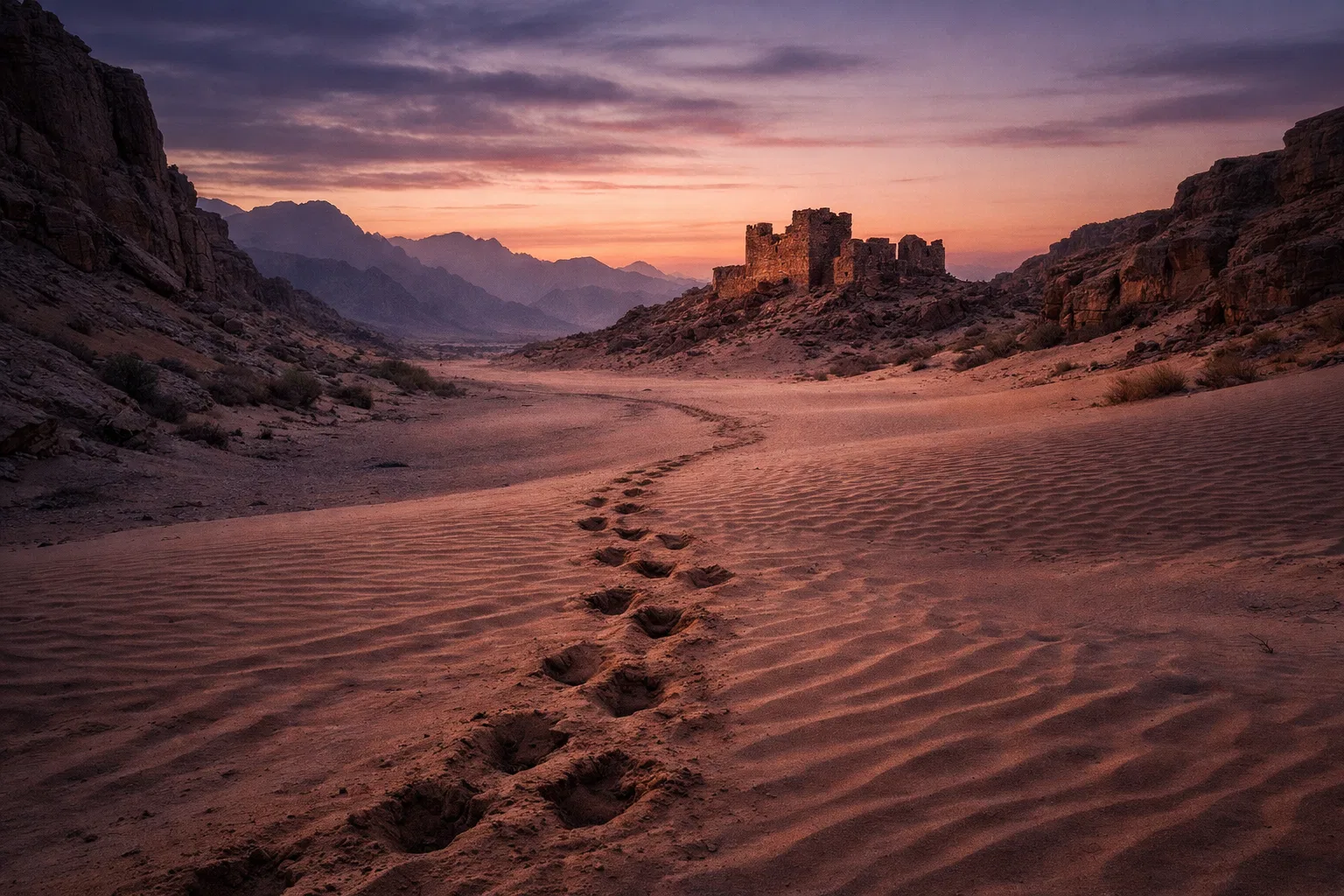
What makes the Saudi setting distinctive is the landscape. Empty roads, volcanic fields, wadis, ruins, mountain passes and long-distance travel all lend themselves to tales of warning. A story about a light in the desert is not just a spooky image; it is also a practical memory of how dangerous it is to become lost. A tale about an unseen being in a valley can work as a rule about humility, caution and not treating remote places casually.
Folktales from the south-west: Jazan and mountain storytelling
One of the strongest reminders that Saudi folklore is regionally varied comes from southern Saudi Arabia. An annotated academic collection based on fieldwork in Jazan records local folktales and legends, including stories identified as El Nabash, Al Jarjoof and The Jinne of the Mountains.[ProQuest]search.proquest.comOpen source on proquest.com.
That matters because Jazan is not the desert stereotype many outsiders imagine when they hear “Saudi Arabia”. The region includes mountains, valleys, villages and a Red Sea-facing cultural world. Its folklore has different textures from central desert narratives: mountain spirits, village anxieties, family storytelling and localised legendary beings sit closer to the everyday environment.
The southern highlands also show how folklore is not only verbal. In Asir, women’s interior wall decoration has become one of Saudi Arabia’s best-known intangible heritage elements. UNESCO describes Al-Qatt Al-Asiri as a traditional female art form used to decorate interior walls, especially guest rooms, and as a key element of Asir’s regional identity. Although it is not a monster legend, it belongs firmly to folk culture: it is inherited practice, household symbolism, social bonding and regional memory made visible on walls.[Intangible Cultural Heritage]ich.unesco.orgOpen source on unesco.org.
Hegra, AlUla and the transformation of a feared place
Few Saudi sites show the meeting of legend, religion, archaeology and tourism as clearly as Hegra, also known as Madain Saleh, in AlUla. Archaeologically, it is one of the most important ancient sites in the country. UNESCO describes Hegra as an outstanding Nabataean site with 111 monumental tombs, 94 decorated, along with water wells that show Nabataean architectural and hydraulic skill. It became Saudi Arabia’s first UNESCO World Heritage Site.[UNESCO World Heritage Centre]whc.unesco.orgOpen source on unesco.org.
Folklorically, the site has long carried a more uneasy reputation. Reporting on AlUla’s modern tourism development notes that Madain Saleh was widely seen as haunted or cursed, while analysis by the Italian Institute for International Political Studies explains that religious objections to visiting Hegra were tied to traditions about places of divine punishment and an official prohibition in the early 1970s.[Reuters]reuters.comSaudi antiquities site, long seen as haunted, tries to wooSaudi antiquities site, long seen as haunted, tries to woo
That tension is exactly what makes Hegra important for a folklore page. The old fear was not simply “people believed in ghosts”. It combined Islamic memory, local caution, respect for ruined places, and uncertainty about pre-Islamic remains. The modern tourism campaign has reframed the site as world heritage, archaeology and national cultural capital. This does not erase the older aura; it changes how the place is narrated. A location once approached with religious unease is now presented through guides, conservation work and visitor experiences as part of Saudi Arabia’s deep historical landscape.[UNESCO]unesco.orgguardians hegra unlocking alulas storiesguardians hegra unlocking alulas stories
Poetry, performance and the public face of folk memory
Saudi folklore is often most visible not in spooky stories but in performance. Alardah Alnajdiyah, inscribed by UNESCO in 2015, combines dance, drumming and chanted poetry and is performed at notable occasions. UNESCO describes it as marking the beginning and end of important events, which makes it both a ceremonial form and a public expression of collective memory.[Intangible Cultural Heritage]ich.unesco.orgOpen source on unesco.org.
This is crucial because poetry has long been one of Arabia’s major vehicles of memory. In Saudi contexts, oral poetry can preserve tribal affiliation, praise, satire, battle memory, love, moral instruction and local history. A ghost story may explain a dangerous place, but a poem can preserve a lineage, a political moment, a landscape or a code of honour.
The Janadriyah heritage festival, for many years one of Saudi Arabia’s major national showcases of folk culture, brought together regional performance, traditional crafts, poetry, camel racing and village-style heritage displays. Reporting on the 2018 festival describes visitors encountering cultures and heritage from across the Kingdom, including the Saudi ardah and poetic drama.[Arab News PK]arabnews.pkArab News PKJanadriyah festival celebrates the best of Saudi heritageArab News PKJanadriyah festival celebrates the best of Saudi heritage
Camels, calls and the sound of inherited life
Some Saudi folklore is not a tale at all, but a sound. UNESCO lists Alheda’a, the oral tradition of calling camel flocks, as intangible cultural heritage shared by Saudi Arabia, Oman and the United Arab Emirates. The tradition uses vocal sounds by camel herders to communicate with their animals, and the camels respond according to tone and training.[Intangible Cultural Heritage]ich.unesco.orgsaudi arabia SAsaudi arabia SA
For a folklore reader, this is a useful corrective. Folklore is not only mythic narrative; it is also the practical art of living in a landscape. Camel calls carry knowledge about animals, rhythm, memory and desert work. They belong to the same inherited world as poems, proverbs, cautionary tales and seasonal customs.
Date palm traditions, falconry and calligraphy also appear on Saudi Arabia’s UNESCO intangible heritage record, showing that the country’s official heritage framing now includes everyday skills and practices alongside performance arts.[Intangible Cultural Heritage]ich.unesco.orgsaudi arabia SAsaudi arabia SA
Women’s traditions and the folklore of the home
Saudi folklore is sometimes imagined as a male world of poets, warriors, tribes and desert journeys. That misses a great deal. Household storytelling, lullabies, children’s warnings, wedding customs, food knowledge, textile patterns and wall decoration have often been carried by women.
Al-Qatt Al-Asiri is the clearest internationally recognised example. UNESCO presents it as a female traditional interior wall decoration in Asir, originally practised by women in the community and closely tied to identity, solidarity and domestic hospitality.[Intangible Cultural Heritage]ich.unesco.orgOpen source on unesco.org.
This matters because the home is one of folklore’s strongest settings. A painted guest room is not merely decorative; it tells visitors who the household is, what region it belongs to, and what forms of beauty and hospitality it values. In the same way, stories told by grandmothers, older aunts or mothers can preserve local fears and moral lessons long after public performance has changed.
Saudi cultural institutions have also begun presenting folktales in modern formats. Ithra, the King Abdulaziz Center for World Culture, has highlighted collected Hejazi folktales from older women narrators, showing how women’s oral storytelling is being documented and reframed for contemporary audiences.[Ithra]ithra.comOpen source on ithra.com.
Old tradition, modern invention and internet folklore
Not every Saudi “legend” online is old. Some are local memories reshaped for tourism, some are social media horror, some are pan-Arab motifs pasted onto Saudi locations, and some are modern inventions that feel traditional because they use jinn, ruins or desert roads.
A useful rule is to ask what kind of evidence supports a story:
- Well-attested heritage: UNESCO-listed performances, camel calls and regional arts have formal documentation, named communities of practice and preservation programmes.
- Collected oral folklore: Jazan folktales and Hejazi women’s stories have stronger grounding when they come from fieldwork, recorded narrators or cultural institutions.
- Shared Arabian motifs: Jinn, ghouls and desert apparitions are old and regionally widespread, but individual Saudi versions may vary greatly.
- Tourist retellings: Hegra’s “cursed” reputation is real as a social and religious memory, but modern visitor writing often simplifies it into a haunted-site hook.
- Internet-era folklore: Reddit threads, short videos and social media posts may reveal living belief and humour, but they should not be treated as proof of ancient tradition without corroboration.
This distinction helps keep Saudi folklore interesting without turning it into unsourced creepypasta. The modern web has amplified ghost roads, abandoned buildings and jinn encounters, but the deeper tradition is older, wider and more varied than viral horror.
How Saudi folklore is understood today
Today, Saudi folklore sits between preservation, religion, entertainment and national identity. Official heritage projects present folk arts as cultural assets. Tourism projects turn landscapes such as AlUla into visitor experiences. Academic researchers collect regional folktales before older narrators disappear. Families continue to tell cautionary stories, and online communities remix jinn and haunted-place narratives for a new audience.
There is also a serious contemporary side. Beliefs about the evil eye, magic and jinn possession still affect how some people understand illness or misfortune. Saudi research on faith healers in Al-Qassim found that clients presented symptoms interpreted as the evil eye, jinn possession or magical spells, while research on epilepsy found that jinn possession remained a believed cause among some educated Saudis.[PMC]pmc.ncbi.nlm.nih.govOpen source on nih.gov.
The strongest reading of Saudi folklore, then, is not that the country has one neat mythology. It has a layered belief culture: Islamic cosmology, pre-modern Arabian motifs, tribal oral poetry, women’s domestic arts, regional folktales, sacred geography, national festivals and modern media all overlap. Its most memorable stories often begin in the same places where daily life once demanded caution: the desert at night, the mountain path, the abandoned ruin, the guest room, the camel herd, the poem, and the voice of an elder telling children what lies beyond the safe edge of home.
![Cover for The Arabian Nights Entertainments [7 stories]](https://covers.openlibrary.org/b/id/1046897-M.jpg)
eBay marketplace picks
Marketplace Samples
Live-tested eBay searches with available results related to this page.

Endnotes
1.
Source: kirj.ee
Title: HISTOR Y OF SAUDI FOLKLORE AND FACTORS THAT
Link:https://kirj.ee/public/trames_pdf/2017/issue_2/Trames-2017-2-161-171.pdf
2.
Source: ebsco.com
Link:https://www.ebsco.com/research-starters/literature-and-writing/ghoul-mythical-creature
3.
Source: search.proquest.com
Link:https://search.proquest.com/openview/bbe400d2f07e63e5c0151886256fb1f8/1?cbl=18750&pq-origsite=gscholar
4.
Source: ich.unesco.org
Link:https://ich.unesco.org/en/RL/al-qatt-al-asiri-female-traditional-interior-wall-decoration-in-asir-saudi-arabia-01261
5.
Source: unesco.org
Title: document 4652
Link:https://www.unesco.org/archives/multimedia/document-4652
6.
Source: whc.unesco.org
Link:https://whc.unesco.org/en/list/1293/
7.
Source: reuters.com
Title: Saudi antiquities site, long seen as haunted, tries to woo
Link:https://www.reuters.com/article/lifestyle/saudi-antiquities-site-long-seen-as-haunted-tries-to-woo-visitors-idUSKCN1PT1CJ/
8.
Source: unesco.org
Title: guardians hegra unlocking alulas stories
Link:https://www.unesco.org/en/articles/guardians-hegra-unlocking-alulas-stories
9.
Source: ich.unesco.org
Link:https://ich.unesco.org/en/RL/alardah-alnajdiyah-dance-drumming-and-poetry-in-saudi-arabia-01196
10.
Source: ich.unesco.org
Link:https://ich.unesco.org/en/Decisions/10.COM/10.b.26
11.
Source: arabnews.pk
Title: Arab News PKJanadriyah festival celebrates the best of Saudi heritage
Link:https://www.arabnews.pk/node/1424111/saudi-arabia
12.
Source: ich.unesco.org
Title: saudi arabia SA
Link:https://ich.unesco.org/en/state/saudi-arabia-SA
13.
Source: ich.unesco.org
Link:https://ich.unesco.org/en/decisions/12.COM/11.B.27
14.
Source: ithra.com
Link:https://www.ithra.com/en/news/timeless-folktales-saudi-arabia
15.
Source: ithra.com
Link:https://www.ithra.com/en/news/tradition-hakawati-and-modern-storytelling
16.
Source: ich.unesco.org
Link:https://ich.unesco.org/en/lists
17.
Source: ich.unesco.org
Title: 38275 EN
Link:https://ich.unesco.org/doc/src/38275-EN.pdf
18.
Source: ich.unesco.org
Title: 17331 EN
Link:https://ich.unesco.org/doc/src/17331-EN.pdf
19.
Source: ich.unesco.org
Link:https://ich.unesco.org/en/video/36193
20.
Source: ich.unesco.org
Title: 36279 EN.doc
Link:https://ich.unesco.org/doc/src/36279-EN.doc
21.
Source: ich.unesco.org
Link:https://ich.unesco.org/en/news/UNESCO-approves-emergency-funds-for-inventory-of-Mali%27s-intangible-heritage-00065?call=film&id=36193&include=film_inc.php&width=700
22.
Source: ich.unesco.org
Title: 10b representative list 00779
Link:https://ich.unesco.org/en/10b-representative-list-00779?id=01196&include=slideshow_inc.php
23.
Source: ich.unesco.org
Title: photo pop up 00973
Link:https://ich.unesco.org/en/photo-pop-up-00973?photoID=10232
24.
Source: ich.unesco.org
Title: search 00795
Link:https://ich.unesco.org/en/search-00795?call=film&id=36193&include=film_inc.php&width=700
25.
Source: ich.unesco.org
Link:https://ich.unesco.org/en/video/41059
26.
Source: ich.unesco.org
Title: armenia AM
Link:https://ich.unesco.org/en-state/armenia-AM?call=film&id=36193&include=film_inc.php&width=700
27.
Source: ich.unesco.org
Title: lapiccirella zingari valentina 02514
Link:https://ich.unesco.org/en/trainer/lapiccirella-zingari-valentina-02514?call=film&id=36193&include=film_inc.php&width=700
28.
Source: ithra.com
Link:https://www.ithra.com/en/news/special-feature-sheikha-al-dosary-discovers-five-legends-saudi-arabia
29.
Source: reddit.com
Link:https://www.reddit.com/r/saudiarabia/comments/ur9y0w/local_ghost_stories/
30.
Source: pmc.ncbi.nlm.nih.gov
Link:https://pmc.ncbi.nlm.nih.gov/articles/PMC3425750/
31.
Source: rcu.gov.sa
Link:https://www.rcu.gov.sa/en/about-rcu/about-alula
32.
Source: saudipedia.com
Link:https://saudipedia.com/en/unesco%22s-list-of-saudi-intangible-cultural-heritage
33.
Source: Wikipedia
Link:https://en.wikipedia.org/wiki/Jinn
34.
Source: Wikipedia
Link:https://en.wikipedia.org/wiki/Hegra
35.
Source: arabnews.com
Link:https://www.arabnews.com/node/360020
36.
Source: arabnews.com
Link:https://www.arabnews.com/node/2625870/unesco%E2%80%99s-intangible-cultural-heritage-list-adds-traditions-middle-east-and-africa
37.
Source: arabnews.com
Title: saudi arabia
Link:https://www.arabnews.com/node/1914541/saudi-arabia
38.
Source: spa.gov.sa
Link:https://www.spa.gov.sa/en/N2553034
39.
Source: spa.gov.sa
Link:https://spa.gov.sa/en/N2547400
40.
Source: vision2030.ai
Link:https://vision2030.ai/encyclopedia/alula/
41.
Source: boneandsickle.com
Title: the jinn
Link:https://www.boneandsickle.com/2020/07/20/the-jinn/
Additional References
42.
Source: youtube.com
Link:https://www.youtube.com/watch?v=v3obeGlLWE8
Source snippet
Alardah Alnajdiyah, dance, drumming and poetry in Saudi Arabia...
43.
Source: youtube.com
Title: Jinn: The Ancient Arabian Shapeshifters | Monstrum
Link:https://www.youtube.com/watch?v=YvdedlbyrQM
Source snippet
Only Video You Need on Arabian Pre-Islamic Mythology: Gods, Jinn & Ancient Beliefs – Full Doc...
44.
Source: youtube.com
Title: Revealing the Djinn
Link:https://www.youtube.com/watch?v=52TUDYpCR4k
Source snippet
Jinn: The Ancient Arabian Shapeshifters | Monstrum...
45.
Source: youtube.com
Title: On Arabian Oral Poetry and Tribal Lore
Link:https://www.youtube.com/watch?v=0H0HAihRK9Q
Source snippet
Revealing the Djinn - The Complete History of Arabia's Oldest Secret...
46.
Source: academia.edu
Link:https://www.academia.edu/164930528/A_Religious_and_Sociological_Inquiry_into_the_Belief_in_the_Evil_Eye_Nazar
47.
Source: researchgate.net
Link:https://www.researchgate.net/publication/408307452Reading_in_Al-Janadriyah_Festival_and_its_Influence_on_Saudi_Literature_3-_qraat_fy_mhrjan_aljnadryt_wtathyrh_ly_aladb_alswdy
48.
Source: researchgate.net
Link:https://www.researchgate.net/publication/231211731_A_pilot_study_of_faith_healers%27_views_on_evil_eye_jinn_possession_and_magic_in_the_kingdom_of_Saudi_Arabia
49.
Source: researchgate.net
Link:https://www.researchgate.net/publication/399670154_Caliphs_Jinns_and_Sufifi_Shrines_The_Protection_of_Cultural_Heritage_and_Cultural_Rights_under_Islamic_Law
50.
Source: experiencealula.com
Link:https://www.experiencealula.com/en/places-to-go/hegra
51.
Source: medium.com
Link:https://medium.com/teatime-history/al-ghoul-devilish-arabian-monster-6876c0a5b442
Topic Tree
Follow this branch
Related pages 192
- Afghan Folklore
- Albanian Folklore
- Algerian Folklore
- Australian Folklore
- Azerbaijan Folklore
- +187 more in sidebar