Where Colombia's Legends Still Haunt the Landscape
Colombian folklore is not a single storybook tradition. It is a living mixture of Indigenous cosmologies, Afro-Colombian memory, Spanish Catholic ritual, river legends, forest spirits, carnival performance and modern retellings in schools, tourism, music and online media.
Page outline Jump by section
The old heart of Colombian myth is landscape
Many Colombian legends begin with place. A lake is not just a lake; it may be a shrine, an origin point, a site of offerings or the remembered scene of a colonial misunderstanding. A river is not just transport; it can be a boundary between ordinary life and danger. A forest is not merely wild land; it may be watched by a spirit who punishes greed, infidelity or disrespect for nature.
That landscape-centred quality is clearest in the Muisca world of the central highlands, around present-day Bogotá, Boyacá and Cundinamarca. Muisca sacred geography is now best known internationally through El Dorado, but the wider tradition includes origin narratives, civilising figures, sacred lakes, solar and lunar associations, ritual offering and later colonial chroniclers trying to explain what they encountered. Modern scholarship is careful here: Spanish accounts shaped much of the written record, and archaeology sometimes complicates the grander European versions of the story.[Encyclopedia.com]encyclopedia.comOpen source on encyclopedia.com.
The same pattern appears elsewhere. In the Amazonian and north-western regions, sacred knowledge and ritual calendars remain part of living Indigenous traditions rather than simply “myths” in the museum sense. UNESCO’s account of the traditional knowledge of the jaguar shamans of Yuruparí describes a ceremonial calendar used to gather the community, heal, prevent illness and manage relations with the natural and spiritual world. That is folklore in a deeper sense: not just tales about the supernatural, but inherited knowledge about how a community should live.[ICH UNESCO]ich.unesco.orgOpen source on unesco.org.
El Dorado: from sacred offering to global treasure myth
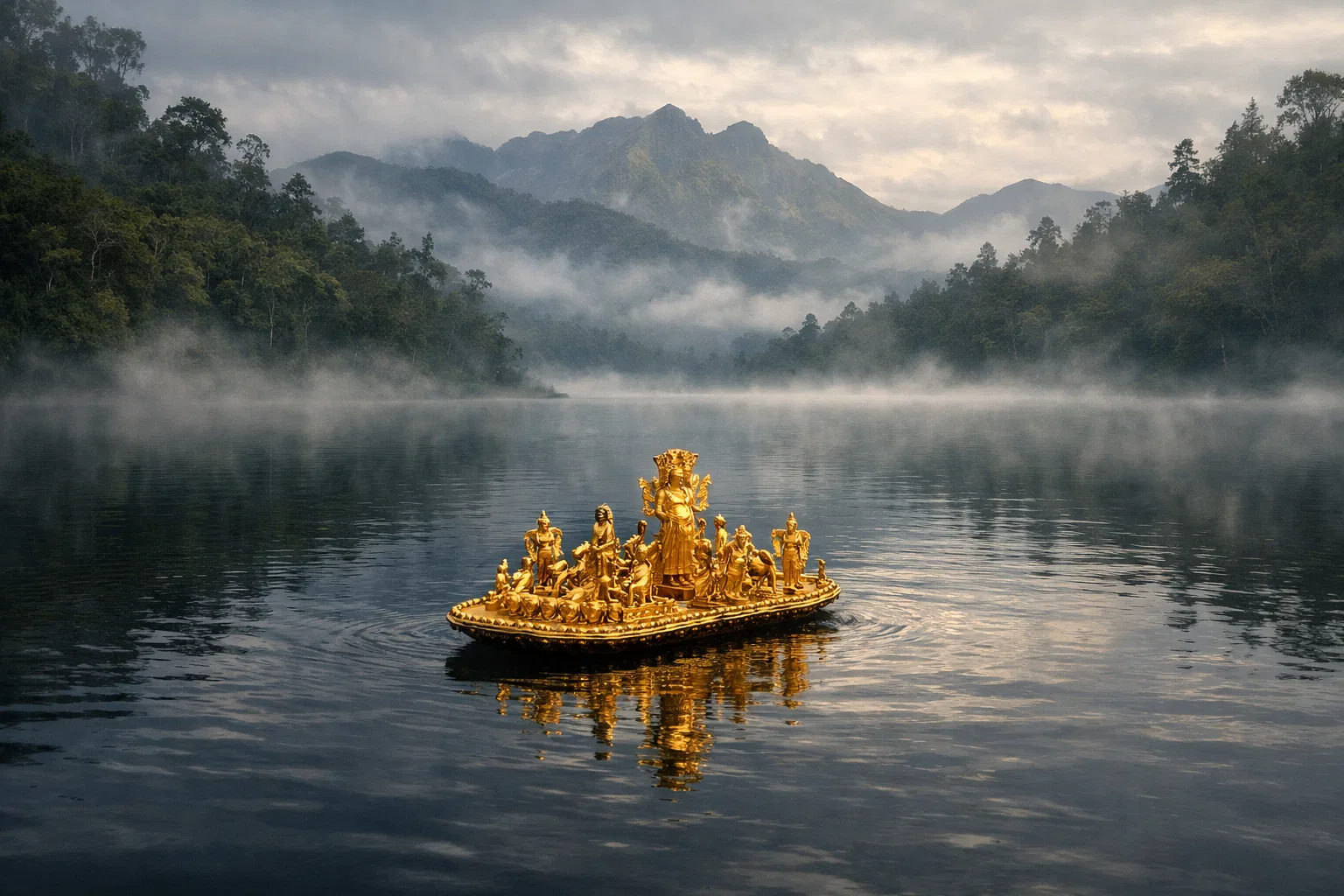
El Dorado is the Colombian legend most familiar outside the country, but it is often misunderstood. In popular retellings it becomes a lost city of gold. In its Colombian setting, the strongest historical core is the Muisca ritual world around sacred lakes, especially Lake Guatavita, where Spanish chroniclers described offerings and the investiture of a ruler. The famous golden Muisca Raft, now associated with Bogotá’s Gold Museum, is a small but extraordinarily powerful object because it seems to visualise a ceremonial scene: a central figure on a raft, accompanied by attendants, connected in later imagination to the gold-covered ruler of El Dorado.[banrepcultural.org]banrepcultural.orgLa Balsa muisca y El DoradoLa Balsa muisca y El Dorado
The important distinction is between ritual truth and treasure fantasy. The Muisca did use gold in sophisticated votive objects, but gold did not mean the same thing to them that it meant to European invaders. For Europeans arriving in the sixteenth century, gold was wealth, currency and imperial ambition. For Muisca ritual practice, gold objects could be offerings, mediating between people, deities, ancestors and sacred places. The legend grew when European hunger for treasure converted a religious landscape into a rumour of limitless riches.[banrepcultural.org]banrepcultural.orgLa Balsa muisca y El DoradoLa Balsa muisca y El Dorado
Recent archaeological work around Lake Guatavita has made the story more interesting rather than less so. A study published through Cambridge University Press notes that sixteenth- and seventeenth-century chronicles helped make Guatavita famous as the centre of lavish offering ceremonies, but the archaeological evidence points more cautiously to a shrine where small-scale ritual offerings took place, rather than necessarily the spectacular mass ceremonies imagined in later legend. That does not “debunk” El Dorado so much as relocate it: the enduring myth grew from real Muisca sacred practice, then expanded through colonial desire, travel writing, archaeology, museum display and tourism.[Cambridge University Press & Assessment]cambridge.orgOpen source on cambridge.org.
Muisca origin stories: Bachué, Bochica and sacred order
Beyond El Dorado, Muisca mythology offers some of Colombia’s most influential origin stories. Bachué is associated with human origins and Lake Iguaque, while Bochica is remembered as a civilising and protective figure. In one widely circulated version, Bochica saves the people from a catastrophic flood by breaking open the rocks so that the waters escape through Tequendama Falls. This kind of story explains more than a natural feature; it tells listeners that the landscape has moral history and that social order is linked to sacred intervention.[Encyclopedia.com]encyclopedia.comOpen source on encyclopedia.com.
These stories have also had a second life in Colombian art and national identity. In the twentieth century, Bachué and Bochica were adopted by artists and intellectuals interested in Indigenous symbolism as a foundation for a distinctly Colombian or Latin American modernism. A recent discussion of Rómulo Rozo’s sculpture Bachué shows how a mythic Muisca mother figure could become part of debates about art, nationalism, Indigenous inheritance and cultural memory, long after the sacred context that produced the myth had changed.[JSTOR]jstor.orgOpen source on jstor.org.
For readers, the key is not to flatten these figures into “Colombian gods” in a simple fantasy sense. Their modern visibility comes through layers: Indigenous religion, colonial-era recording, nineteenth- and twentieth-century scholarship, school retellings, art history, museum interpretation and tourism. Each layer preserves something and changes something.[Encyclopedia.com]encyclopedia.comOpen source on encyclopedia.com.
Forest spirits and moral monsters
Many of Colombia’s best-known popular legends are not grand creation myths but cautionary beings: creatures told about to warn children, travellers, hunters, loggers, lovers, drunkards or the morally careless. These figures vary by region and teller, but they often share a pattern. The supernatural appears at the edge of human control: by a riverbank at night, inside a forest, along a lonely path, during a storm or where desire overrules caution.
La Madremonte is one of the clearest examples. She is usually presented as a powerful female guardian of the forest, dressed in leaves, moss or vegetation, associated with storms, muddy waters and punishment for those who invade land, damage nature or behave wrongly. Official and cultural explainers describe her as both frightening and ecological: a spirit who enforces respect for forests, water sources and boundaries.[Marca país]colombia.cos myths legendss myths legends
El Mohán is more strongly tied to rivers, especially in Tolima and the Magdalena River imagination. He is often described as hairy, bearded, tobacco-smoking, seductive and dangerous, sometimes a guardian of waters and sometimes a kidnapper or tempter of women near the river. The figure’s ambiguity matters: he is not simply a monster but a personification of river power, male desire, danger, mystery and the need to respect aquatic places.[Marca país]colombia.cos myths legendss myths legends
La Patasola belongs to the frightening forest-woman family of South American folklore. Colombian retellings often describe her as a beautiful woman who lures men into the forest before revealing a monstrous form, sometimes with a single leg or hoof. Her origin stories vary, but they often involve betrayal, sexual transgression, jealousy or punishment. In practice, the legend works as a warning about entering wild places alone, exploiting women, abandoning social rules or confusing desire with safety.[Marca país]colombia.cos myths legendss myths legends
These figures should not be read as fixed characters with one canonical biography. They belong to oral tradition, where variation is normal. A child may hear a softened version in school; a rural family may tell a sharper version; a tourism site may turn the being into a mascot; an internet post may make the horror more graphic. The continuity lies less in exact plot than in recurring anxieties: forest danger, river danger, sexual danger, ecological punishment and the fragile boundary between the village and the wild.[Culture and Recreation Secretary]culturarecreacionydeporte.gov.comitos y leyendas de colombiamitos y leyendas de colombia
River legends: El Hombre Caimán and the Magdalena imagination
El Hombre Caimán is one of Colombia’s most memorable regional legends because it is comic, disturbing and place-specific at once. The story is centred on Plato, Magdalena, on the Caribbean side of the country. In common versions, a man obsessed with spying on women bathing in the Magdalena River uses magic to transform into a caiman, but the reversal fails and he is left trapped as a half-man, half-caiman figure.[Radio Nacional]radionacional.coleyenda hombre caiman edgar romanosleyenda hombre caiman edgar romanos
Unlike some older sacred traditions, El Hombre Caimán has a visible modern festival and tourist life. Colombia’s tourism material points to the monument in Plato as a way the town preserves and celebrates the legend, while Colombian media have reported on efforts to recognise the legend and its festival as cultural heritage. Radio Nacional de Colombia also highlights the role of performers and local custodians who keep the character alive in public memory.[colombia.travel]colombia.travelOpen source on colombia.travel.
The story’s appeal comes from its contradictions. It is funny enough to become a festival icon, but its plot is also a warning about voyeurism, shame and punishment. It belongs to the river, but it also belongs to performance, music, civic identity and local pride. That is typical of Colombian folklore: a legend may begin as a cautionary tale and later become a town’s public emblem.[WRadio]wradio.com.coWRadio Plato, Magdalena, disfrutó de su Festival de la Leyenda delWRadio Plato, Magdalena, disfrutó de su Festival de la Leyenda del
Catholic ritual, carnival and the supernatural public square
Colombian folklore is not limited to creatures and ancient myths. Some of the country’s most important traditional culture is performed in public ritual calendars, where Catholic observance, Indigenous inheritance, African influence, music, dance, masks and civic identity overlap.
Barranquilla Carnival is the most internationally visible example. UNESCO describes it as a four-day celebration before Lent, with dances and musical expressions drawn from different Colombian subcultures, shaped by Barranquilla’s Caribbean location and its history as a meeting point for European, African and Indigenous peoples. Its characters, masks, dances and comic inversions make it a major home for Colombian popular imagination, not just a party before Lent.[ICH UNESCO]ich.unesco.orgOpen source on unesco.org.
The Carnival of Blacks and Whites in Pasto offers a different regional model. UNESCO describes it as a celebration in south-western Colombia running from 28 December to 6 January, emerging from Andean Indigenous and Hispanic traditions. Its public play with colour, identity, satire, craft and collective participation shows how folklore can be festive rather than ghostly, and how inherited tradition can be renewed through urban creativity.[ICH UNESCO]ich.unesco.orgOpen source on unesco.org.
Popayán’s Holy Week processions show a more solemn side of Colombian traditional culture. UNESCO identifies them as among Colombia’s oldest traditions, practised since the colonial period, with nightly processions from Tuesday to Saturday before Easter following a route through the historic centre. They are religious observance, but also folk performance: images, routes, timing, craftsmanship, inherited roles and communal memory all matter.[ICH UNESCO]ich.unesco.orgOpen source on unesco.org.
Afro-Colombian oral tradition and living cultural memory
Afro-Colombian folklore is especially visible in San Basilio de Palenque, near Cartagena. UNESCO describes the cultural space of Palenque de San Basilio as encompassing social, medical and religious practices, as well as musical and oral traditions, many with African roots. This is not folklore as decorative heritage; it is the cultural memory of a community founded by escaped enslaved people and sustained through language, music, ritual and social organisation.[ICH UNESCO]ich.unesco.orgOpen source on unesco.org.
Palenque also shows how tradition survives by changing form. Contemporary reporting has highlighted music, language revitalisation and artists using rap and Afro-Colombian rhythms to keep Palenquero speech and identity visible for younger generations. That matters because oral tradition is not only what elders remember; it is also what a community chooses to teach, sing, perform and defend under modern pressures.[El País]elpais.comEl País Kombilesa Mi, el grupo que rescata la lengua palenquera a través del rapAdemás de su trabajo musical, Kombilesa Mi fundó en 2015 la escuela AfroKR, donde enseñan música, danza y tradiciones afrocolombianas a m…
The Wayuu normative system in La Guajira offers another example of oral authority rather than monster lore. UNESCO describes the system as a body of principles, procedures and rites governing social and spiritual conduct, applied by recognised orators who resolve conflicts between matrilineal clans through reparation and compensation. For a folklore page, this matters because it shows that spoken tradition can be law, diplomacy and social repair, not merely entertainment.[ICH UNESCO]ich.unesco.orgOpen source on unesco.org.
Amazonian sacred knowledge is not just “myth”
Some Colombian traditions are easily damaged when they are reduced to exotic story summaries. The traditional knowledge of the jaguar shamans of Yuruparí, associated with the Pirá Paraná region in Vaupés, is one such case. UNESCO presents it as ancestral wisdom expressed through ritual ceremonies and a ceremonial calendar, connected to healing, prevention of illness and the care of sacred sites.[ICH UNESCO]ich.unesco.orgOpen source on unesco.org.
For general readers, the useful distinction is between a legend told about a creature and a sacred knowledge system still embedded in community life. The first can often be summarised as a story; the second requires more care because it may include restricted knowledge, ritual authority and responsibilities towards territory. Calling it “folklore” is valid only if the word is used broadly and respectfully, to mean living traditional knowledge rather than quaint superstition.[ICH UNESCO]ich.unesco.orgICH UNESCOProjectICH UNESCOProject
This also helps explain why Colombia’s folklore cannot be reduced to a list of monsters. The country contains many Indigenous nations, regional histories and sacred geographies. Some traditions have been written down by outsiders; others are performed in public festivals; others remain community-held and are only partly visible to visitors or researchers.
How old are these traditions?
The answer depends on the tradition. Muisca sacred stories and ritual landscapes reach back before the Spanish conquest, but much of what non-Indigenous readers know about them comes through colonial chroniclers, later scholars, archaeological interpretation and museum display. El Dorado has a pre-Hispanic ritual core, but its global form as a treasure myth is inseparable from European conquest and colonial fantasy.[Cambridge University Press & Assessment]cambridge.orgOpen source on cambridge.org.
Other legends are old in oral circulation but hard to date precisely. La Madremonte, El Mohán, La Patasola and La Llorona are transmitted through families, schools, regional storytelling, radio, books and online articles. They are well attested as part of Colombian popular imagination, but that does not mean each has one recoverable “original” version. The more honest claim is that they are durable traditional figures with many local forms.[Culture and Recreation Secretary]culturarecreacionydeporte.gov.comitos y leyendas de colombiamitos y leyendas de colombia
Some traditions have a clearer public heritage timeline. Barranquilla Carnival was inscribed by UNESCO in 2008; the Carnival of Blacks and Whites and Popayán’s Holy Week processions were inscribed in 2009; the Wayuu normative system followed in 2010; the jaguar shamans of Yuruparí in 2011; and traditional Vallenato music of the Greater Magdalena region was placed on UNESCO’s Urgent Safeguarding List in 2015. These dates do not mark when the traditions began. They mark moments when international heritage institutions formally recognised them.[ICH UNESCO]ich.unesco.orgICH UNESCOColombiaICH UNESCOColombia
Modern retellings: schoolbooks, tourism, music and the internet
Today, Colombian folklore circulates through several channels at once. Children encounter myths and legends through classroom materials and public cultural explainers. Travellers meet El Dorado at the Gold Museum, Lake Guatavita tours or Colombia’s official tourism pages. Local festivals turn frightening or sacred figures into civic symbols. Musicians and performers keep oral traditions alive by adapting them to new audiences.[misenal.tv]misenal.tvmitos colombianos y leyendas cortas para ninosmitos colombianos y leyendas cortas para ninos
This modern circulation can preserve tradition, but it can also simplify it. Tourism tends to prefer clear images: the golden raft, the forest woman, the river monster, the colourful carnival. Oral tradition is messier. It varies by region, age, class, ethnicity, religion and family memory. A legend told to frighten a child may become a sculpture in a town square; a sacred rite may become a museum label; a warning about rivers may become a song or festival costume.[radionacional.co]radionacional.coleyenda hombre caiman edgar romanosleyenda hombre caiman edgar romanos
The internet adds another layer. Colombian legends now appear in short videos, horror blogs, school resources, tourism pages and social media posts. That visibility can introduce more readers to the tradition, but it also encourages exaggerated “monster profile” versions that strip away local context. The strongest modern retellings are the ones that keep the place, community and moral function attached to the story.
What Colombian folklore is really about
The recurring theme in Colombian folklore is relationship: people and water, people and forest, people and ancestors, people and saints, people and gold, people and the dead, people and the land they depend on. The supernatural often appears when that relationship is broken. A greedy conqueror sees sacred gold as treasure. A careless traveller enters the forest without respect. A man violates women’s privacy at the river. A community must repair conflict through speech. A carnival temporarily turns social order upside down so that people can recognise themselves again.
That is why Colombia’s folklore remains culturally powerful. It is entertaining, but it is not only entertainment. It stores memory of conquest, slavery, Indigenous survival, Catholic devotion, ecological warning, regional pride and everyday fear. Its beings may be frightening, comic, holy or beautiful, but they usually ask the same question in different forms: how should people behave in a world where land, water, ancestors and community are never merely background?
Amazon book picks
Further Reading
Books and field guides related to Where Colombia's Legends Still Haunt the Landscape. Use these as the next step if you want deeper reading beyond the article.
Popol Vuh
Provides valuable comparative context for creation stories and sacred landscapes.
The Mythology of the Americas
Places Colombian legends within the wider Indigenous myth traditions of the Americas.
South American Mythology
Introduces major mythic themes found across northern South America, including Colombia.
Latin American Folktales
Covers storytelling traditions closely related to Colombian folk narratives.
eBay marketplace picks
Marketplace Samples
Live-tested eBay searches with available results related to this page.


Endnotes
1.
Source: cambridge.org
Link:https://www.cambridge.org/core/journals/latin-american-antiquity/article/el-dorado-offerings-in-lake-guatavita-a-muisca-ritual-archaeological-site/CCCA4FF23E90BA66FD0A1353C353434F
2.
Source: ich.unesco.org
Link:https://ich.unesco.org/en/RL/traditional-knowledge-of-the-jaguar-shamans-of-yurupari-00574
3.
Source: ich.unesco.org
Link:https://ich.unesco.org/en/RL/carnival-of-barranquilla-00051
4.
Source: encyclopedia.com
Link:https://www.encyclopedia.com/environment/encyclopedias-almanacs-transcripts-and-maps/muisca-religion
5.
Source: ich.unesco.org
Title: ICH UNESCOProject
Link:https://ich.unesco.org/en/project-education/safeguarding-traditional-knowledge-in-the-territory-of-the-jaguars-of-yurupari-00433
6.
Source: banrepcultural.org
Title: La Balsa muisca y El Dorado
Link:https://www.banrepcultural.org/bogota/museo-del-oro/coleccion-arqueologica-y-etnografica/la-balsa-muisca-y-el-dorado
7.
Source: jstor.org
Link:https://www.jstor.org/stable/jj.5211766.20
8.
Source: colombia.co
Title: s myths legends
Link:https://colombia.co/en/colombia-country/history/colombias-myths-legends
9.
Source: colombia.travel
Link:https://colombia.travel/en/cienaga/caiman-legend-monumemt
10.
Source: ich.unesco.org
Link:https://ich.unesco.org/en/news/the-beats-of-cumbia-fandango-and-merengue-carranguero-welcome-intergovernmental-committee-for-the-safeguarding-of-the-intangible-cultural-heritage-opening-in-bogota-13245
11.
Source: ich.unesco.org
Link:https://ich.unesco.org/en/RL/carnaval-de-negros-y-blancos-00287
12.
Source: ich.unesco.org
Link:https://ich.unesco.org/en/decisions/4.COM/13.28
13.
Source: ich.unesco.org
Link:https://ich.unesco.org/en/RL/holy-week-processions-in-popayan-00259
14.
Source: colombia.travel
Title: holy week
Link:https://colombia.travel/en/popayan/holy-week
15.
Source: ich.unesco.org
Link:https://ich.unesco.org/en/RL/cultural-space-of-palenque-de-san-basilio-00102
16.
Source: unesco.org
Title: document 619
Link:https://www.unesco.org/archives/multimedia/document-619
17.
Source: colombia.travel
Link:https://colombia.travel/en/blog/community-tourism/san-basilio-de-palenque-colombia
18.
Source: ich.unesco.org
Link:https://ich.unesco.org/en/RL/wayuu-normative-system-applied-by-the-putchipu-ui-palabrero-00435
19.
Source: unesco.org
Title: document 1664
Link:https://www.unesco.org/archives/multimedia/document-1664
20.
Source: ich.unesco.org
Link:https://ich.unesco.org/en/assistances/safeguarding-of-the-traditional-knowledge-for-the-protection-of-sacred-natural-sites-in-the-territory-of-the-jaguars-of-yurupari-vaupes-province-colombia-01224
21.
Source: descubridor.banrepcultural.org
Link:https://descubridor.banrepcultural.org/discovery/fulldisplay/alma991006165699707486/57BDLRDC_INST%3A57BDLRDC_INST
22.
Source: ich.unesco.org
Title: ICH UNESCOColombia
Link:https://ich.unesco.org/en/state/colombia-CO
23.
Source: ich.unesco.org
Title: traditional vallenato music of the greater magdalena region 01095
Link:https://ich.unesco.org/en/USL/traditional-vallenato-music-of-the-greater-magdalena-region-01095
24.
Source: banrepcultural.org
Title: asi luce el nuevo montaje de la balsa muisca
Link:https://www.banrepcultural.org/multimedia/asi-luce-el-nuevo-montaje-de-la-balsa-muisca
25.
Source: colombia.travel
Link:https://colombia.travel/en/blog/muisca-raft-symbol-el-dorado
26.
Source: whc.unesco.org
Link:https://whc.unesco.org/en/list/1121/
27.
Source: unesco.org
Link:https://www.unesco.org/es
28.
Source: unesdoc.unesco.org
Title: pf0000232498 eng
Link:https://unesdoc.unesco.org/ark%3A/48223/pf0000232498_eng
29.
Source: ich.unesco.org
Title: colombia CO
Link:https://ich.unesco.org/es/estado/colombia-CO
30.
Source: unesco.org
Title: Carnival of Barranquilla
Link:https://www.unesco.org/archives/multimedia/document-3737
31.
Source: unesco.org
Title: document 301
Link:https://www.unesco.org/archives/multimedia/document-301
32.
Source: ich.unesco.org
Link:https://ich.unesco.org/en/video/4308
33.
Source: ich.unesco.org
Link:https://ich.unesco.org/en/decisions/5.COM/6.9
34.
Source: ich.unesco.org
Link:https://ich.unesco.org/doc/src/Signed%20periodic%20report%20-%20Periodic%20report-49839.pdf
35.
Source: ich.unesco.org
Title: traditional knowledge of the jaguar shamans of yurupari 00574
Link:https://ich.unesco.org/en/RL/traditional-knowledge-of-the-jaguar-shamans-of-yurupari-00574?call=film&id=41298&include=film_inc.php&width=700
36.
Source: ich.unesco.org
Title: 07464 EN
Link:https://ich.unesco.org/doc/src/07464-EN.pdf
37.
Source: ich.unesco.org
Link:https://ich.unesco.org/en/lists?id=04308&include=film_inc.php
38.
Source: ich.unesco.org
Title: 07887 ES
Link:https://ich.unesco.org/doc/src/07887-ES.pdf
39.
Source: ich.unesco.org
Title: ITH 6.CO M 1.SU B 7 EN.doc
Link:https://ich.unesco.org/doc/src/ITH-6.COM-1.SUB-7-EN.doc
40.
Source: ich.unesco.org
Title: el carnaval de negros y blancos 00287
Link:https://ich.unesco.org/es/RL/el-carnaval-de-negros-y-blancos-00287
41.
Source: ich.unesco.org
Title: 30442 EN.doc
Link:https://ich.unesco.org/doc/src/30442-EN.doc
42.
Source: ich.unesco.org
Link:https://ich.unesco.org/en/video/41298
43.
Source: ich.unesco.org
Link:https://ich.unesco.org/en/decisions/10.COM/10.a.2
44.
Source: ich.unesco.org
Title: photo pop up 00973
Link:https://ich.unesco.org/en/photo-pop-up-00973?photoID=02649
45.
Source: ich.unesco.org
Link:https://ich.unesco.org/en/video/35323
46.
Source: ich.unesco.org
Link:https://ich.unesco.org/es/-00973?photoID=02653
47.
Source: ich.unesco.org
Title: new inscriptions on the lists of intangible cultural heritage 00161
Link:https://ich.unesco.org/en/news/new-inscriptions-on-the-lists-of-intangible-cultural-heritage-00161
48.
Source: ich.unesco.org
Title: 00540 ES
Link:https://ich.unesco.org/doc/src/00540-ES.pdf?v=1406620608
49.
Source: ich.unesco.org
Title: photo pop up 00973
Link:https://ich.unesco.org/en/photo-pop-up-00973?photoID=09593
50.
Source: ich.unesco.org
Link:https://ich.unesco.org/es/video/41299
51.
Source: ich.unesco.org
Link:https://ich.unesco.org/doc/src/30068.pdf
52.
Source: ich.unesco.org
Title: photo pop up 00973
Link:https://ich.unesco.org/en/photo-pop-up-00973?photoID=01371
53.
Source: ich.unesco.org
Title: 10a urgent safeguarding list 00780
Link:https://ich.unesco.org/en/10a-urgent-safeguarding-list-00780?call=slideshow&id=01095&include=slideshow_inc.php&mode=scroll&width=620
54.
Source: ich.unesco.org
Link:https://ich.unesco.org/fr/video/41299
55.
Source: ich.unesco.org
Title: ITH 15 10.CO M Decisions EN.doc
Link:https://ich.unesco.org/doc/src/ITH-15-10.COM-Decisions_-EN.doc
56.
Source: banrepcultural.org
Title: la balsa muisca las historias detras de su historia
Link:https://www.banrepcultural.org/multimedia/la-balsa-muisca-las-historias-detras-de-su-historia
57.
Source: banrepcultural.org
Link:https://www.banrepcultural.org/noticias/muisca-raft-offering-care-world
58.
Source: babel.banrepcultural.org
Link:https://babel.banrepcultural.org/digital/api/collection/p17054coll23/id/77/download
59.
Source: colombia.travel
Title: holy week 1
Link:https://colombia.travel/en/fairs-and-festivals/holy-week-1
60.
Source: colombia.co
Title: san basilio de palenque first free town africans americas
Link:https://colombia.co/en/colombia-country/environment/caribbean-region/san-basilio-de-palenque-first-free-town-africans-americas
61.
Source: youtube.com
Title: La Patasola
Link:https://www.youtube.com/watch?v=Xhnftgk_Q4c
Source snippet
Marca País Colombia...
62.
Source: youtube.com
Title: Muisca Mythology
Link:https://www.youtube.com/watch?v=oWe3WwpqLIw
Source snippet
The Legend of La Madremonte Legends of Colombia | The Grim Reader...
63.
Source: culturarecreacionydeporte.gov.co
Title: mitos y leyendas de colombia
Link:https://www.culturarecreacionydeporte.gov.co/es/principal/noticias/mitos-y-leyendas-de-colombia
64.
Source: elpais.com
Link:https://elpais.com/america-colombia/2024-09-15/colombia-despide-en-silencio-la-bachue-de-rozo-un-tesoro-artistico-incomprendido.html
65.
Source: Wikipedia
Link:https://en.wikipedia.org/wiki/Patasola
66.
Source: radionacional.co
Title: leyenda hombre caiman edgar romanos
Link:https://www.radionacional.co/cultura/tradiciones/leyenda-hombre-caiman-edgar-romanos
67.
Source: bluradio.com
Link:https://www.bluradio.com/regiones/caribe/la-leyenda-del-hombre-caiman-esta-a-un-paso-de-convertirse-en-patrimonio-cultural-colombiano-rg10
68.
Source: wradio.com.co
Title: WRadio Plato, Magdalena, disfrutó de su Festival de la Leyenda del
Link:https://www.wradio.com.co/2022/12/13/plato-magdalena-disfruto-de-su-festival-de-la-leyenda-del-hombre-caiman-2022/
69.
Source: elpais.com
Title: El País Kombilesa Mi, el grupo que rescata la lengua palenquera a través del rap
Link:https://elpais.com/america-colombia/2025-06-14/kombilesa-mi-el-grupo-que-rescata-la-lengua-palenquera-a-traves-del-rap.html
Source snippet
Además de su trabajo musical, Kombilesa Mi fundó en 2015 la escuela AfroKR, donde enseñan música, danza y tradiciones afrocolombianas a m...
70.
Source: misenal.tv
Title: mitos colombianos y leyendas cortas para ninos
Link:https://www.misenal.tv/noticias/para-chicos/mitos-colombianos-y-leyendas-cortas-para-ninos
71.
Source: Wikipedia
Title: Muisca mythology
Link:https://en.wikipedia.org/wiki/Muisca_mythology
72.
Source: Wikipedia
Title: El Dorado
Link:https://en.wikipedia.org/wiki/El_Dorado
73.
Source: Wikipedia
Title: Colombian folklore
Link:https://en.wikipedia.org/wiki/Colombian_folklore
74.
Source: Wikipedia
Title: Barranquilla Carnival
Link:https://en.wikipedia.org/wiki/Barranquilla_Carnival
75.
Source: Wikipedia
Title: Muisca raft
Link:https://en.wikipedia.org/wiki/Muisca_raft
76.
Source: Wikipedia
Title: San Basilio de Palenque
Link:https://en.wikipedia.org/wiki/San_Basilio_de_Palenque
77.
Source: Wikipedia
Title: El Hombre Caimán
Link:https://en.wikipedia.org/wiki/El_Hombre_Caim%C3%A1n
78.
Source: facebook.com
Title: El Dorado
Link:https://www.facebook.com/katrin.schaper/posts/el-dorado-the-legendary-city-of-gold-is-located-just-2-hours-driving-outside-bog/10235684296181220/
79.
Source: cipdh.gob.ar
Title: Cultural Space of Palenque de San Basilio
Link:https://www.cipdh.gob.ar/memorias-situadas/en/lugar-de-memoria/espacio-cultural-de-palenque-de-san-basilio/
80.
Source: scribd.com
Link:https://www.scribd.com/document/467011196/ElDorado
81.
Source: radionacional.co
Link:https://www.radionacional.co/cultura?_wrapper_format=html&anoncsrf=xF6CeOQn7n0m3kYh-0KmC2KgUeqINIGci6_0IT-RdC8&field_category_target_id=All&page=441
82.
Source: mythus.fandom.com
Title: Muisca mythology
Link:https://mythus.fandom.com/wiki/Muisca_mythology
Additional References
83.
Source: youtube.com
Title: The Legend of La Madremonte Legends of Colombia | The Grim Reader
Link:https://www.youtube.com/watch?v=Sd6KfPSlppE
Source snippet
Muisca Religion – The Sacred Beliefs of Colombia's Ancient Andean Civilization...
84.
Source: arxiv.org
Link:https://arxiv.org/abs/0812.0574
85.
Source: facebook.com
Link:https://www.facebook.com/LosInformantesTV/videos/as%C3%AD-es-la-balsa-el-tesoro-dorado-de-los-muiscas/943014644915818/
86.
Source: researchgate.net
Link:https://www.researchgate.net/figure/A-Sculpture-depicting-Hombre-Caiman-at-Plato-Magdalena-Photograph-Juan-Salvador_fig2_401473088
87.
Source: visit-latin-america.com
Link:https://visit-latin-america.com/en/bachue-the-goddess-of-fertility-mythology-of-the-muisca-indigenous-civilization/
88.
Source: bahaiteachings.org
Link:https://bahaiteachings.org/bochica-indigenous-messenger-of-god-in-colombia/
89.
Source: instagram.com
Link:https://www.instagram.com/p/DEGpeCnzy35/
90.
Source: rupestreweb.info
Link:https://www.rupestreweb.info/motif.html
91.
Source: mythlok.com
Link:https://mythlok.com/chiminigagua/
92.
Source: instagram.com
Link:https://www.instagram.com/reel/DSnCSfbAGD-/?hl=en
Topic Tree
Follow this branch
Related pages 192
- Afghan Folklore
- Albanian Folklore
- Algerian Folklore
- Australian Folklore
- Azerbaijan Folklore
- +187 more in sidebar