Where Palau's Stories Live in the Landscape
Palau’s folklore is not a separate world of “old stories” kept apart from daily life. It is woven into place names, chiefly titles, village histories, carved meeting houses, birth customs, fishing knowledge, sacred hills, museum collections and the way families explain where they belong.
Page outline Jump by section
Introduction
The key thing to understand is that Palauan folklore is often local, ranked and owned. A story may belong to a village, clan, title or line of descent rather than to “Palau” in a loose national sense. That is why public summaries can introduce the main themes, but they cannot replace the authority of elders and culture-bearers who have the right to tell particular versions. Palau’s Bureau of Arts and Culture notes that its traditional-place-name work was based on living memory, interviews, verification with the Society of Historians, and the recognition that variants differ between villages and clans.[FlipHTML5]fliphtml5.comFlip HTML5Traditional Place Names of Palau: from Ridge to ReefFlip HTML5Traditional Place Names of Palau: from Ridge to Reef
Why Palauan folklore is tied to land, sea and rank
Many readers arrive looking for “Palauan mythology” as if it were a neat list of gods and monsters. Palau’s traditions do include gods, demi-gods, spirits, monster snakes, sea women, talking or divine animals, and origin beings. But the stories often work less like a single national pantheon and more like a map of remembered relationships: between villages, between people and gods, between reef and garden, between the living and their ancestors.
Researchers Jolie Liston and Melson Miko describe Palau as having a rich body of myths, stories and legends “woven into every aspect of daily life”. They stress that oral traditions educate, settle questions of protocol and ownership, preserve social values, and help modern Palauans identify with ancestors. At the same time, they warn that oral traditions must be interpreted carefully because they can compress long historical processes into memorable story events and may reflect the interests of particular social groups.[Academia]academia.eduPDF) Oral tradition and archaeology Palau's earth architecturePDF) Oral tradition and archaeology Palau's earth architecture
This is especially important because Palauan knowledge has rules. A person may know a story but not have the cultural standing to claim or tell all of it. A 2023 Pacific Island Times feature, drawing on Palauan discussions of oral history and archaeology, explains that access to some knowledge depends on clan, rank and location, and that some stories can be passed only to legitimate heirs. That does not make the stories less real as cultural evidence; it means public retellings are only one layer of a more controlled system of memory.[pactimes]pacificislandtimes.compactimes Telling Palau's stories is a privilege reserved for only a fewpactimes Telling Palau's stories is a privilege reserved for only a few
The creation stories: islands made from living bodies
The most central Palauan mythic material concerns beginnings: the creation of land, social order, village origins and the movement from an age of gods to the present human world. An annotated inventory of Palauan legends in the Belau National Museum describes a traditional three-part view of the past: first an era of darkness when only gods existed, then a period when gods and humans lived side by side, and finally the present era dominated by human beings. The same inventory classifies 74 legend texts into stories of gods, stories of interaction between gods and humans, and stories centred more on human deeds.[Scribd]scribd.comPalauan Legends Inventory at Belau Museum | PDFPalauan Legends Inventory at Belau Museum | PDF
One major cluster begins with a being called Latmikaik and the child Uab, whose body is associated with the formation and naming of places. A Palau Bureau of Arts and Culture place-name publication says place naming begins at Lukes, where a clam gives birth to Latmikaik; Latmikaik later gives birth to Uab, a magical child whose rapid growth and hunger lead villagers to set Uab on fire. In these traditions, geography is not just scenery. Land, village names and social memory emerge from mythic events.[FlipHTML5]fliphtml5.comFlip HTML5Traditional Place Names of Palau: from Ridge to ReefFlip HTML5Traditional Place Names of Palau: from Ridge to Reef
Another major figure is Milad, whose story connects disaster, renewal and the origins of major villages. In one version summarised in the Belau National Museum inventory, the gods decide to destroy a lawless human race so a new, law-abiding one can arise. A woman is warned of the coming flood after she gives food to divine messengers; she dies, is revived, and is named Milad. She then gives birth to children who become progenitors of principal Palauan villages. A variant changes the number and names of her children, which is a useful reminder that Palauan legends exist in multiple local versions rather than one fixed canonical text.[Scribd]scribd.comPalauan Legends Inventory at Belau Museum | PDFPalauan Legends Inventory at Belau Museum | PDF
These origin stories matter because they explain more than “how the islands began”. They encode social order: which villages matter, how food and generosity shape survival, how lawlessness threatens the world, and how a new human order is born after divine judgement. They also show why Palauan myth often reads like history, genealogy, geography and moral teaching at the same time.
Gods, demi-gods and dangerous beings
Palauan legend is full of encounters between human beings and powerful non-human figures. The Belau National Museum inventory includes stories in which gods teach skills, control fish or currents, build meeting houses, punish wrongdoing, or appear as monstrous threats. These are not random fantasy episodes; they often explain why a place has a resource, why a custom exists, or why a village has a particular status.[Scribd]scribd.comPalauan Legends Inventory at Belau Museum | PDFPalauan Legends Inventory at Belau Museum | PDF
A good example is the legend of Mengidabrutkoel or Mangidabrutgongel, a spider-man figure associated with childbirth. In one version, people formerly killed mothers by cutting them open to get the baby, until a spider in human form married a woman and taught natural delivery. Another version gives the spider-man a different route and later adventure, showing how the same core theme can appear in significantly different forms.[Scribd]scribd.comPalauan Legends Inventory at Belau Museum | PDFPalauan Legends Inventory at Belau Museum | PDF
Other stories explain marine and village features. In one, the god Ngirabeliliou of Peleliu exchanges his school of mullet fish for the strong current kept by the god Bekereuet of Ngiwal; the result is that strong currents are common on the southern side of Peleliu, while Ngiwal’s lagoon is rich in mullet. In another, a blind god cheated of tuna creates a rooster whose crow frightens gods into abandoning a great dome before dawn. Such stories make natural abundance and landscape features legible through social relationships, bargains and trickery.[Scribd]scribd.comPalauan Legends Inventory at Belau Museum | PDFPalauan Legends Inventory at Belau Museum | PDF
Palau also has monster and man-eater legends. The inventory records a man-eating god on Ngcheangel island, a man-eating snake near Elechui, and a monster snake of Chelechui. These tales follow a pattern familiar in many oral traditions: a community flees, an overlooked or vulnerable figure remains, an extraordinary child is born, and the monster is defeated, allowing people to return and re-establish social order.[Scribd]scribd.comPalauan Legends Inventory at Belau Museum | PDFPalauan Legends Inventory at Belau Museum | PDF
The bai: where stories became architecture
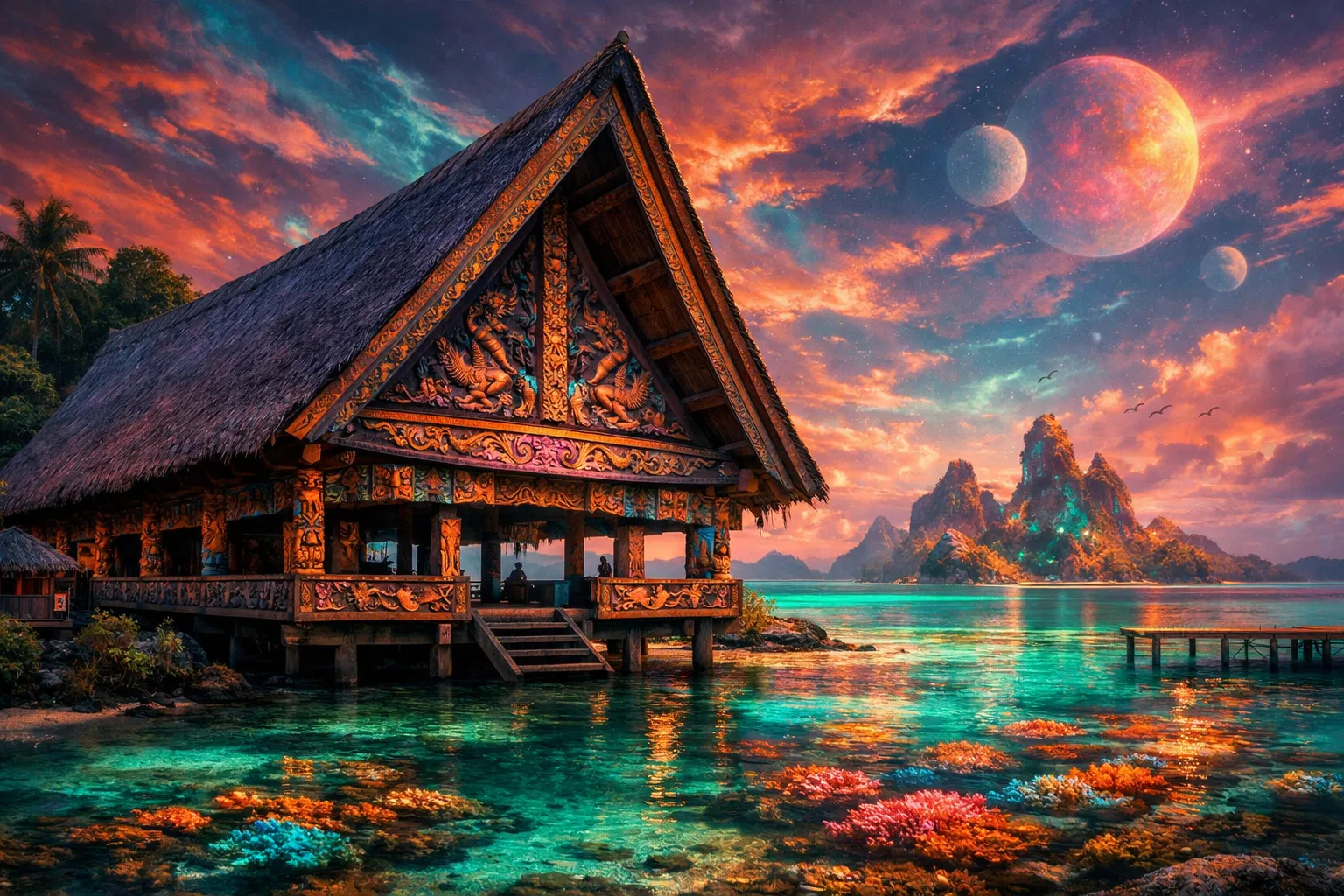
The most visible public face of Palauan folklore is the bai, the traditional men’s meeting house. A bai was not just a building; it was a political, social and artistic centre where stories were made visible. PBS’s Palau materials describe the most elaborate bai as council houses for village chiefs, while others served as clubhouses where men learned fishing, hunting, building and warfare. Their interior beams and outside gables were decorated with carved and painted stories showing village history, humorous tales and important legends.[PBS]pbs.orgPalau Paradise of the Pacific- Legends of PalauPalau Paradise of the Pacific- Legends of Palau
The bai helps explain why Palauan folklore is so visual. Stories were not only spoken; they were carved, painted and placed above people’s heads in the central building of community life. The University of Pennsylvania Museum’s discussion of Palauan storyboards notes that in older bai decoration, chiefs and elders selected the stories, and the choice of symbols was considered highly creative because the beams and gables expressed the values, history and virtues of a club or village.[Penn Museum]penn.museumOpen source on penn.museum.
One legend attached to bai origins tells of Orachel and his snake mother. In the Belau National Museum inventory, Orachel sees gods building a bai under the water, later reaches Babeldaob, helps people in Melekeok build one, and then builds the first bai in Aimeliik after being paid in Palauan money. That first Aimeliik bai becomes a model for other municipalities. The story makes architecture itself a supernatural inheritance, not merely a craft technique.[Scribd]scribd.comPalauan Legends Inventory at Belau Museum | PDFPalauan Legends Inventory at Belau Museum | PDF
Dilukai and the problem of changing interpretation
One of the best-known Palauan figures in museum collections is Dilukai, the exposed female gable figure placed on men’s houses. The Metropolitan Museum of Art states that the island of Belau is especially known for its large bai and that many had a carved young woman with legs spread wide as a gable ornament. The Met gives one local legend in which Dilukai is a promiscuous woman tied in this position by her father as a warning to village women.[The Metropolitan Museum of Art]metmuseum.orgThe Metropolitan Museum of Art MicronesiaThe Metropolitan Museum of Art Micronesia
That interpretation is not the whole story. Public museum labels and older outsider accounts often frame Dilukai as a moral warning about female sexuality, but other interpretations understand the figure in relation to protection, fertility, women’s generative power, or the ritual force of display. The safest way to present Dilukai is therefore not as a single “meaning”, but as a powerful Palauan image whose interpretation has shifted across local storytelling, missionary influence, museum collecting and modern heritage display. The existence of late nineteenth- and early twentieth-century Dilukai figures in major museum collections also shows how Palauan sacred and architectural art moved into global art-history settings.[The Metropolitan Museum of Art]metmuseum.orgThe Metropolitan Museum of Art Figure, One of a PairThe Metropolitan Museum of Art Figure, One of a Pair
For readers, Dilukai is a useful caution. Folklore figures do not always keep the same meaning when they pass from a village building to a colonial description, then to a museum label, then to tourism or the internet. A single sensational retelling can flatten a symbol that originally sat within a much richer system of gender, protection, chiefly houses and community identity.
Storyboards: old legends in a modern art form
Modern Palauan storyboards are among the most accessible ways visitors encounter Palauan legends. They are carved wooden panels depicting scenes or symbols from traditional stories. Their roots lie in bai beams and gables, but the portable storyboard form developed as a newer art practice, especially in the twentieth century, when Palauan carving adapted to collectors, tourism and public display.[pristineparadisepalau.com]pristineparadisepalau.comPalauan Artisanal Wood Carving w/ Master Carver LingPalauan Artisanal Wood Carving w/ Master Carver Ling
The University of Pennsylvania Museum makes an important distinction: modern storyboards are connected to bai traditions, but they do not reproduce traditional bai storytelling exactly. Tourist boards often use a single recognisable symbol to stand for a whole tale: an upturned shark may signal a deceived-husband story, fish coming through a tree trunk may signal the breadfruit story, and a small board may reduce a complex narrative to one emblem. Larger boards can show more scenes, but the museum notes that modern storyboards do not depict stories in the old bai-beam manner.[Penn Museum]penn.museumOpen source on penn.museum.
One vivid example is the tragic story of Surech and Dulei. In the old-style storyboard described by the Penn Museum, Dulei loves Surech, but a chief demands that Dulei bring him Surech’s face. Depending on the version, Dulei either misunderstands the order or recognises the chief’s predatory intent. Surech sings of her love, Dulei cuts off her head, and he presents it in a basket. The story is memorable not because it is simply gruesome, but because it concentrates love, rank, obedience, ambiguity and violence into one visual sequence.[Penn Museum]penn.museumOpen source on penn.museum.
Storyboards therefore sit between folklore and the market. They preserve stories, but also simplify, stylise and repackage them. A visitor who buys or sees one should treat it as an entry point into Palauan tradition, not as the whole tradition itself.
Sacred landscapes and remembered migration
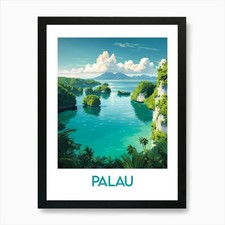
Palauan folklore is also anchored in landscapes that still have cultural force. The Rock Islands Southern Lagoon, now a UNESCO World Heritage Site, is not only valued for marine beauty and biodiversity. UNESCO describes village settlements, burial caves and their settings as part of the cultural value of the property, and states that oral histories and continuing traditions on Palau’s main island keep alive memories of migration away from the Rock Islands and the histories associated with them.[UNESCO World Heritage Centre]whc.unesco.orgWorld Heritage Centre Rock Islands Southern LagoonWorld Heritage Centre Rock Islands Southern Lagoon
This is where folklore, archaeology and conservation meet. UNESCO also notes that traditional value systems and resource governance are assets for managing the Rock Islands, while cultural sites are protected under Palau’s cultural-resource legislation. In practical terms, stories are part of how places remain meaningful and protected. A cave, reef passage or abandoned settlement is not only an archaeological feature; it can be part of a remembered route, an ancestral claim or a cautionary tale.[UNESCO World Heritage Centre]whc.unesco.orgWorld Heritage Centre Rock Islands Southern LagoonWorld Heritage Centre Rock Islands Southern Lagoon
Traditional place names are especially important. The Palau Bureau of Arts and Culture publication on place names says such names identify specific histories, people and places, and that most have stories attached. It also describes place names as being passed down through oral repetition and experience, linked to lineage, clan land, burial platforms, food gathering and taro fields. In that sense, Palauan folklore is literally embedded in names.[FlipHTML5]fliphtml5.comFlip HTML5Traditional Place Names of Palau: from Ridge to ReefFlip HTML5Traditional Place Names of Palau: from Ridge to Reef
Oral tradition and archaeology do not always say the same thing
One of the most interesting modern questions is how Palauan oral tradition relates to archaeology. Palau’s largest island, Babeldaob, contains extensive earth architecture: terraces, ridges, hills and sculpted forms that point to complex past settlement and political organisation. Yet Liston and Miko found that Palau’s oral sources are strikingly thin in direct references to these massive earthworks as constructed monuments. They argue that oral tradition can illuminate archaeological evidence, but it should not be forced to supply a single historical “truth”.[Academia]academia.eduPDF) Oral tradition and archaeology Palau's earth architecturePDF) Oral tradition and archaeology Palau's earth architecture
This gap is not a failure of folklore. It tells us something about cultural memory. The researchers suggest that when lowlands and shorelines became the main focus of social and economic life, older inland earthwork complexes became less relevant to living institutions and were gradually relegated to an obsolete past. In other words, what a society remembers most vividly may be what remains socially useful, ritually important or politically meaningful.[Academia]academia.eduPDF) Oral tradition and archaeology Palau's earth architecturePDF) Oral tradition and archaeology Palau's earth architecture
At the same time, public reporting on Palauan elders’ accounts shows that some high places, terraces and large stones are understood as connected with gods, sacred power or routes between worlds. The Pacific Island Times article describes accounts in which people built settlements and altars on elevated ground to be closer to demi-gods, and notes that many terraces and high peaks are considered sacred or forbidden. The tension between archaeological interpretation and authorised oral memory is part of what makes Palau’s folklore so rich: it is not merely a list of tales, but an active field of interpretation.[pactimes]pacificislandtimes.compactimes Telling Palau's stories is a privilege reserved for only a fewpactimes Telling Palau's stories is a privilege reserved for only a few
Folklore, life-cycle customs and everyday values
Palauan legends often explain customs, but customs also keep legend alive. The Belau National Museum’s “Cycle of Life” exhibit presents Palauan life from birth to death through themes including childbirth, herbal hot-bath ceremony, taro patches, fishing, the bai and funerals. This matters because many stories are not just entertainment; they give origin, meaning or authority to practices around birth, food, gendered work, social rank and death.[Belau National Museum]palaunationalmuseum.pwBelau National Museum ExhibitsBelau National Museum Exhibits
The story of the spider-man who teaches natural childbirth is one example of myth explaining a life-saving cultural practice. The Penn Museum also notes that a Palau Museum bai beam depicted a related childbirth story and the ritual steaming and public presentation of a new mother after the birth of a first child. Here folklore, women’s bodily knowledge, ritual and carved art all meet.[Scribd]scribd.comPalauan Legends Inventory at Belau Museum | PDFPalauan Legends Inventory at Belau Museum | PDF
Palauan culture is also strongly shaped by matrilineal and chiefly systems. Palau’s official tourism site describes villages as matriarchal and matrilineal, with chiefs and women’s councils both playing important roles, and women responsible for educating children in traditions and culture. That social background helps explain why folklore cannot be separated from land, titles, food production, exchange and family identity.[pristineparadisepalau.com]pristineparadisepalau.comOpen source on pristineparadisepalau.com.
How Palauan folklore is understood today
Today, Palauan folklore lives in several overlapping forms. It is still held in families, clans, villages and authorised lines of knowledge. It is taught through cultural programmes and Palauan studies. It appears in museum exhibitions, public heritage projects, carved storyboards, tourism interpretation and online summaries. It is also examined by archaeologists, anthropologists and historians who compare stories with sites, artefacts and settlement patterns.[FlipHTML5]fliphtml5.comFlip HTML5Traditional Place Names of Palau: from Ridge to ReefFlip HTML5Traditional Place Names of Palau: from Ridge to Reef
This modern visibility brings both preservation and risk. Public retelling can keep stories alive for younger generations and visitors, but it can also detach them from the protocols that once governed who could tell them, where, and why. The Palau Bureau of Arts and Culture’s place-name work explicitly acknowledges that some ancient ways now live only in cultural memory, some are disappearing, and others remain essential to Palauan identity.[FlipHTML5]fliphtml5.comFlip HTML5Traditional Place Names of Palau: from Ridge to ReefFlip HTML5Traditional Place Names of Palau: from Ridge to Reef
For a general reader, the most respectful approach is to see Palauan folklore as living cultural heritage rather than a set of exotic curiosities. The stories explain islands, villages, sacred hills, fish runs, birth customs, meeting houses and social rank. They also show how a small island nation can hold a vast narrative world in names, carvings, chants, ritual practice and carefully guarded memory.
Amazon book picks
Further Reading
Books and field guides related to Where Palau's Stories Live in the Landscape. Use these as the next step if you want deeper reading beyond the article.
eBay marketplace picks
Marketplace Samples
Live-tested eBay searches with available results related to this page.


Endnotes
1.
Source: academia.edu
Title: (PDF) Oral tradition and archaeology Palau’s earth architecture
Link:https://www.academia.edu/30063668/Oral_tradition_and_archaeology_Palaus_earth_architecture
2.
Source: scribd.com
Title: Palauan Legends Inventory at Belau Museum | PDF
Link:https://www.scribd.com/document/525606860/AN1013531X-v30-p113-125
3.
Source: fliphtml5.com
Title: Flip HTML5Traditional Place Names of Palau: from Ridge to Reef
Link:https://fliphtml5.com/gjrn/ggeh/Traditional_Place_Names_of_Palau%3A_from_Ridge_to_Reef/
4.
Source: fliphtml5.com
Title: Flip HTML5Traditional Place Names of Palau: from Ridge to Reef
Link:https://fliphtml5.com/gjrn/ggeh/Traditional_Place_Names_of_Palau%3A_from_Ridge_to_Reef/16/
5.
Source: pbs.org
Title: Palau Paradise of the Pacific- Legends of Palau
Link:https://www.pbs.org/edens/palau/p_legends.htm
6.
Source: penn.museum
Link:https://www.penn.museum/sites/expedition/the-palauan-storyboards/
7.
Source: pristineparadisepalau.com
Title: Palauan Artisanal Wood Carving w/ Master Carver Ling
Link:https://pristineparadisepalau.com/happenings/palauan-artisanal-wood-carving-w-master-carver-ling-inabo/
8.
Source: palau.co
Link:https://palau.co/discover-palau/culture/storyboards/
9.
Source: whc.unesco.org
Title: World Heritage Centre Rock Islands Southern Lagoon
Link:https://whc.unesco.org/en/list/1386/
10.
Source: fliphtml5.com
Title: Flip HTML5Traditional Place Names of Palau: from Ridge to Reef
Link:https://fliphtml5.com/gjrn/ggeh/Traditional_Place_Names_of_Palau%3A_from_Ridge_to_Reef/15/
11.
Source: pristineparadisepalau.com
Link:https://pristineparadisepalau.com/culture/
12.
Source: pbs.org
Link:https://www.pbs.org/edens/palau/p_legends2.htm
13.
Source: unesdoc.unesco.org
Link:https://unesdoc.unesco.org/ark%3A/48223/pf0000225313
14.
Source: unesdoc.unesco.org
Link:https://unesdoc.unesco.org/ark%3A/48223/pf0000214652
15.
Source: unesdoc.unesco.org
Link:https://unesdoc.unesco.org/ark%3A/48223/pf0000245592
16.
Source: unesdoc.unesco.org
Link:https://unesdoc.unesco.org/ark%3A/48223/pf0000368351
17.
Source: unesdoc.unesco.org
Link:https://unesdoc.unesco.org/ark%3A/48223/pf0000145919
18.
Source: unesdoc.unesco.org
Link:https://unesdoc.unesco.org/ark%3A/48223/pf0000395687
19.
Source: unesdoc.unesco.org
Link:https://unesdoc.unesco.org/ark%3A/48223/pf0000390088
20.
Source: unesdoc.unesco.org
Link:https://unesdoc.unesco.org/ark%3A/48223/pf0000217331
21.
Source: unesdoc.unesco.org
Link:https://unesdoc.unesco.org/ark%3A/48223/pf0000232381
22.
Source: unesdoc.unesco.org
Link:https://unesdoc.unesco.org/ark%3A/48223/pf0000378881
23.
Source: scribd.com
Link:https://www.scribd.com/document/2663224/the-palau-storyboard-and-other-legends
24.
Source: fliphtml5.com
Link:https://fliphtml5.com/gjrn/ggeh/Traditional_Place_Names_of_Palau%3A_from_Ridge_to_Reef/4/
25.
Source: palau.co
Title: bai chiefs meeting houses
Link:https://www.palau.co/discover-palau/culture/bai-chiefs-meeting-houses/
26.
Source: palau.co
Title: UNESC O World Heritage Rock Islands
Link:https://palau.co/discover-palau/natural-wonders/unesco-world-heritage-rock-islands/
27.
Source: pacificislandtimes.com
Title: pactimes Telling Palau’s stories is a privilege reserved for only a few
Link:https://www.pacificislandtimes.com/post/telling-palau-s-stories-is-a-privilege-reserved-for-only-a-few
28.
Source: metmuseum.org
Title: The Metropolitan Museum of Art Micronesia
Link:https://www.metmuseum.org/essays/micronesia
29.
Source: metmuseum.org
Title: The Metropolitan Museum of Art Figure, One of a Pair
Link:https://www.metmuseum.org/ru/art/collection/search/318938
30.
Source: palaunationalmuseum.pw
Title: Belau National Museum Exhibits
Link:https://palaunationalmuseum.pw/exhibits/
31.
Source: Wikipedia
Title: Belau National Museum
Link:https://en.wikipedia.org/wiki/Belau_National_Museum
32.
Source: Wikipedia
Link:https://en.wikipedia.org/wiki/Dilukai
33.
Source: ministryofhrctd.pw
Link:https://ministryofhrctd.pw/wp-content/uploads/2020/07/Palau-Soc-Hist-Entertainment-2002-English.pdf
34.
Source: palaunationalmuseum.pw
Link:https://palaunationalmuseum.pw/
35.
Source: instagram.com
Link:https://www.instagram.com/belaunationalmuseum/
36.
Source: metmuseum.org
Link:https://www.metmuseum.org/de/departments/oceanic-art
37.
Source: world-heritage-datasheets.unep-wcmc.org
Title: rock islands southern lagoon
Link:https://world-heritage-datasheets.unep-wcmc.org/datasheet/output/site/rock-islands-southern-lagoon
38.
Source: traveladventures.org
Link:https://www.traveladventures.org/continents/oceania/belau-national-museum.html
39.
Source: wonderfulmuseums.com
Title: belau national museum
Link:https://www.wonderfulmuseums.com/museum/belau-national-museum/
40.
Source: press-files.anu.edu.au
Title: anu.edu.auterra australis 35
Link:https://press-files.anu.edu.au/downloads/press/p147701/pdf/ch12.pdf
41.
Source: irci.jp
Title: Belau National Museum
Link:https://www.irci.jp/rdb/item/3625
42.
Source: journals.lib.washington.edu
Link:https://journals.lib.washington.edu/index.php/BIPPA/article/view/11816/10444
Additional References
43.
Source: facebook.com
Link:https://www.facebook.com/adventure/posts/because-of-palaus-history-the-food-scene-is-more-diverse-than-youd-expect-the-hi/971274908365482/
44.
Source: archive.unesco-ichcap.org
Link:https://archive.unesco-ichcap.org/eng/ek/sub10/pdf_down/05-2.%20Palauan%20Bai%20%28Meeting%20House%29%20Parts%20and%20Depictions%20as%20a%20Pictorial%20Representation%20of%20Palau.pdf
45.
Source: davidrumsey.com
Link:https://www.davidrumsey.com/amica/amico1056229-104733.html
46.
Source: medium.com
Link:https://medium.com/new-literary-society/chuabs-gift-how-a-goddess-became-palau-7b671b3f6888
47.
Source: Wikipedia
Link:https://de.wikipedia.org/wiki/Datei%3ADilukai_from_the_Caroline_Islands%2C_Belau_%28Palau%29%2C_19th-early_20th_century%2C_Metropolitan_Museum_of_Art.jpg
48.
Source: arthistoryproject.com
Link:https://www.arthistoryproject.com/timeline/industrial-revolution/pacific-oceanic-cultures/gable-figure-dilukai/
49.
Source: facebook.com
Link:https://www.facebook.com/belaumuseum/photos/featured-artwork-dilukai-by-master-carver-ananias-bultedaob-this-beautifully-car/1222384866252901/
50.
Source: facebook.com
Link:https://www.facebook.com/paradisescom/posts/exploring-palaus-vibrant-history-and-culture-at-the-belau-national-museum-%EF%B8%8Fthe-b/869384315216916/
51.
Source: tripadvisor.com
Link:https://www.tripadvisor.com/ShowUserReviews-g294136-d312355-r610208866-Belau_National_Museum-Koror_Koror_Island.html
52.
Source: darwininitiative.org.uk
Link:https://www.darwininitiative.org.uk/documents/DAR15030/18422/15-030%20AR3%20App3%20IBAs%20in%20Palau%20LowRes.pdf
Topic Tree
Follow this branch
Related pages 192
- Afghan Folklore
- Albanian Folklore
- Algerian Folklore
- Australian Folklore
- Azerbaijan Folklore
- +187 more in sidebar