Where Armenia's Old Stories Still Live
Armenian folklore is not a single neat mythology but a layered tradition: mountain epics, dragon stones, Christian saints’ legends, fairy-tale plots, household spirits, ritual bread, dance, water festivals and literary retellings all sit beside one another.
Page outline Jump by section
Introduction
Armenian folklore is not a single neat mythology but a layered tradition: mountain epics, dragon stones, Christian saints’ legends, fairy-tale plots, household spirits, ritual bread, dance, water festivals and literary retellings all sit beside one another. Its centre is the Armenian Highlands, where oral storytelling preserved heroic resistance, sacred landscapes and everyday moral tales long after older religious beliefs had been reshaped by Christianity. The best-known national story is the epic of the Daredevils of Sassoun, while the most visually striking old mystery may be Armenia’s prehistoric “dragon stones”, carved monuments linked in both name and later imagination with water-dragons.[UNESCO Intangible Cultural Heritage]ich.unesco.orgUNESCO Intangible Cultural HeritagePerformance of the Armenian epic of 'Daredevils…The Armenian epic Daredevils of Sassoun recounts th…
For a modern reader, the important point is that Armenian folklore is both ancient and alive. Some traditions are known through medieval written sources, some through nineteenth- and twentieth-century collectors, and some through living heritage recognised by UNESCO, such as lavash bread-making and the Kochari group dance. Others, such as Vardavar, survive as popular national customs whose current form blends Christian calendar practice with remembered pre-Christian associations.[UNESCO Intangible Cultural Heritage]ich.unesco.orgOpen source on unesco.org.
What makes Armenian folklore distinctive?
Armenian folklore is shaped by geography first. Mountains, gorges, springs, high pastures and caves are not decorative backdrops; they are places where stories gather. The country’s best-known sacred and legendary landscapes include the Upper Azat Valley and Geghard Monastery, a rock-cut Christian complex associated with relics, caves and a sacred setting, and the Garni area, often visited with Geghard as a paired route through Armenia’s pre-Christian and Christian past. UNESCO describes Geghard as a major medieval ecclesiastical and cultural centre with a school, scriptorium and library, as well as rock-cut cells and religious buildings.[UNESCO World Heritage Centre]whc.unesco.orgOpen source on unesco.org.
The second distinctive feature is layering. Armenia’s conversion to Christianity in the early fourth century did not simply erase older narrative patterns. Instead, many older figures, places and seasonal rites were reinterpreted, moralised or attached to Christian feasts. A study of Armenian fairy traditions notes that, after Christianisation, older gods and spirits could be rejected, demonised or “Christianised”, allowing fragments of earlier belief to survive in altered form within folk narratives.[ResearchGate]researchgate.netResearch Gate(PDF) Christianization of Fairies in ArmeniaResearch Gate(PDF) Christianization of Fairies in Armenia
The third feature is the closeness of oral and literary culture. Armenian folk tales survived in oral circulation, but many reached modern readers through collectors, translators and writers. Research on Armenian folk tales describes the written tales as growing from oral tradition gathered from peasants in the Armenian highlands, including villages around Mount Ararat. Hovhannes Tumanyan, one of Armenia’s most beloved writers, helped turn folk and fairy-tale material into widely read literature, while his museum and later scholarship preserve evidence of his interest in Armenian and translated fairy tales.[thebrpi.org]ijbss.thebrpi.orgOpen source on thebrpi.org.
The national epic: why David of Sassoun matters
The Armenian epic known in English as the Daredevils of Sassoun, or David of Sassoun, is the clearest starting point for Armenian legendary tradition. UNESCO describes it as the story of David of Sassoun, a defiant and self-reliant youth who, “by the grace of God”, defends his homeland. It is not merely an old heroic tale: it is a performed oral tradition, a national story of courage, stubbornness, justice and survival.[UNESCO Intangible Cultural Heritage]ich.unesco.orgUNESCO Intangible Cultural HeritagePerformance of the Armenian epic of 'Daredevils…The Armenian epic Daredevils of Sassoun recounts th…
The epic matters because it turns local heroic storytelling into a national moral world. David is not a polished courtly knight; he is powerful, impulsive, rough-edged and deeply tied to his people. That makes him memorable. The story’s emotional centre is not abstract conquest but defence: the hero stands against oppression and protects his homeland. For readers new to Armenian folklore, this explains why the epic often appears in discussions of identity, education, public culture and modern literary retellings.
It also shows how Armenian folklore changes over time. The epic was transmitted orally before being written down and edited, and modern Armenian prose continues to revisit it. Scholarship on contemporary Armenian literature notes that writers return to Armenian mythology and the Sassoun epic, but often prefer more complex or contradictory characters rather than simply repeating heroic models. In other words, David of Sassoun is not a fossil; he is a figure later writers can question, reshape and argue with.[FUP OA Journals]oajournals.fupress.netFUP OA Journals Re-readings of the epic Sasna Tsrrer (Daredevils of SassounFUP OA Journals Re-readings of the epic Sasna Tsrrer (Daredevils of Sassoun
Dragons, water and the mystery of the stone monuments
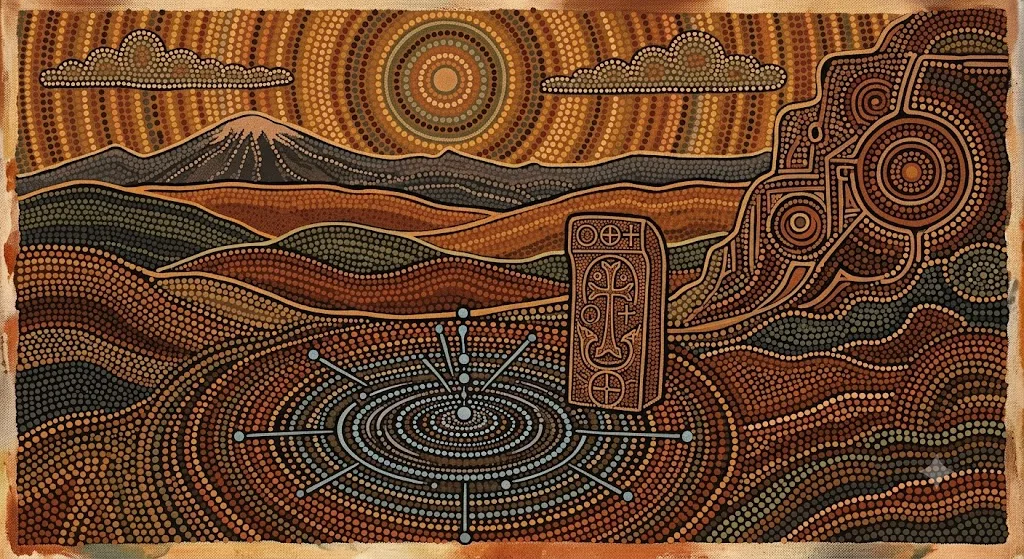
One of Armenia’s most compelling folklore-meets-archaeology subjects is the dragon stone. These prehistoric stelae, often called “dragon stones” in English, are large carved monuments found in high-altitude areas of Armenia and neighbouring regions. Recent research in Heritage Science describes them as stone stelae decorated with animal imagery, located mostly in high mountain pastures between roughly 1,000 and 3,000 metres above sea level. The same study notes that the word used for them is linked to the Armenian word for “dragon”, giving the monuments a powerful later folkloric name even when their original meaning remains debated.[Nature]nature.comVishap stelae as cult dedicated prehistoric monuments of…by V Gurzadyan · 2025 — Vishaps (from the Armenian word for “dragon”) a…
The best current interpretation is cautious but fascinating. The 2025 research argues, from distribution and size analysis, that the monuments were not placed randomly. Their location near springs, water sources and prehistoric irrigation systems supports the idea that they were linked to a water cult or water-focused ritual system. A 2026 follow-up paper goes further in interpretation, suggesting that the labour needed to move and set up some of these heavy stones points to a socially organised ritual landscape around water.[arXiv]arxiv.orgOpen source on arxiv.org.
For folklore readers, the important distinction is this: the stones are archaeological objects, while “dragon” is the later interpretive and folkloric language through which people have understood them. That does not make the folklore false or unimportant. It shows how a physical landscape can keep generating stories. A carved stone near a mountain spring becomes not only a prehistoric monument but also a visible invitation to imagine dragons, serpents, rain, fertility, danger and blessing.
Gods, heroes and older mythic fragments
Armenian mythology is preserved unevenly. Some names and stories come through medieval authors, later folklore, religious polemic, literary retelling and comparative scholarship rather than through a continuous pagan scripture. One of the most famous fragments concerns Vahagn, a fiery heroic figure associated with dragon-slaying. A recent study of ancient Armenian mythology notes that Movses Khorenatsi preserves the “Birth of Vahagn”, a striking poetic fragment in which heaven, earth and the sea are in labour before the fiery hero appears.[Pan-Armenian Digital Library]arar.sci.amPan-Armenian Digital Library Heaven and Earth in Ancient Armenian MythologyPan-Armenian Digital Library Heaven and Earth in Ancient Armenian Mythology
The goddess Anahit is another major figure in the older Armenian religious imagination. Later accounts describe her as a goddess associated with fertility, healing, wisdom and water, and she became one of the most prominent deities in the Armenian pantheon. Because surviving evidence comes through classical, Armenian and later interpretive sources, it is best to treat modern summaries of Anahit as reconstructions from scattered evidence rather than as a single fixed myth-cycle.[Wikipedia]WikipediaOpen source on wikipedia.org.
These older figures still matter because they explain why Armenian folklore so often joins fire and water, dragons and fertility, heroic violence and cosmic order. When Vardavar is associated in popular explanation with the goddess of water, beauty, love and fertility, or when dragon stones are linked with water, these are not isolated details. They belong to a wider symbolic field in which life, danger, mountains, springs and divine power are closely connected.[Smithsonian Magazine]smithsonianmag.comwhen point splashy holiday getting wet 180969520when point splashy holiday getting wet 180969520
Spirits, fairies and monsters in Armenian tradition
Armenian supernatural tradition includes dragons, demons, fairy-like beings, healing dog-spirits and dangerous household or wilderness figures. The evidence for these beings varies widely. Some are discussed in academic work on demonology and fairy belief; others are best known through later compilations, folklore summaries or popular retellings. A critical study of Armenian demonology describes the field as covering ancient and later Armenian texts, modern dialects and Western Armenian traditions that remained alive into the early twentieth century.[Academia]academia.eduPDF) Armenian Demonology: A Critical OverviewPDF) Armenian Demonology: A Critical Overview
Among the most memorable beings are the Aralez, dog-like spirits said in Armenian tradition to revive fallen warriors by licking their wounds. They are often mentioned in connection with heroic death and restoration, and their appeal today is easy to understand: they combine the loyalty of dogs, the horror of the battlefield and the hope that a brave person might not be lost forever. Popular modern sources repeat the resurrection motif, though readers should recognise that many online accounts simplify a much more complex tradition.[History Of Armenia]historyofarmenia.orgHistory Of Armenia The Dog Like Gods Of Ancient Armenians: AralezHistory Of Armenia The Dog Like Gods Of Ancient Armenians: Aralez
Armenian tales also include dangerous spirits and demon-like figures. Some traditions speak of beings that attack mothers or infants, water monsters that lure victims, mountain spirits, dragons and fairy-like invisible beings. The details vary by region, period and collector. That variation is not a flaw; it is normal folklore behaviour. A being that appears as a demon in one Christianised telling may look more like a fairy, mountain spirit or older local power in another.
Folk tales: cleverness, testing and the moral world of ordinary people
Armenian folk tales are not only about gods and monsters. Many are about clever girls, foolish kings, poor families, impossible tasks, talking animals, magical helpers and the consequences of greed or kindness. Research on Armenian folk tales notes that collections often organise the material into myths and legends, animal tales, fairy tales and stories of everyday life. This range matters because it prevents Armenian folklore from being reduced to heroic nationalism or ancient religion alone.[IJBSS]ijbss.thebrpi.orgOpen source on thebrpi.org.
The oral roots of these tales are especially important. The written versions many readers encounter today often come through collectors and literary mediators. A study of Armenian folk-tale translation notes that some Armenian tales circulated in non-Armenian environments and were recorded in languages other than Armenian, meaning that collectors sometimes acted as both recorders and translators. This helps explain why English-language readers may meet Armenian stories through international fairy-tale anthologies rather than directly through Armenian-language oral collections.[ResearchGate]researchgate.netResearch Gate Armenian Folk Tales Translated: A Chronological ApproachResearch Gate Armenian Folk Tales Translated: A Chronological Approach
Writers such as Hovhannes Tumanyan gave many Armenian tale motifs a lasting literary form. His works include fairy tales, fables and retellings that remain central to Armenian cultural memory. The point is not that every Tumanyan tale is a verbatim oral transcript. Rather, his work shows how folklore becomes literature: a village story, proverb-like plot or oral motif is polished into a text that children read, theatres stage, illustrators reimagine and families continue to quote.[UNESCO Courier]courier.unesco.orghovhannes tumanyan passion storytellinghovhannes tumanyan passion storytelling

Seasonal customs: water, bread and dance as living folklore
Folklore is not only what people tell; it is also what they do. Armenia’s living heritage includes ritualised food-making, festive movement and calendar customs that carry memory through repeated practice.
Vardavar is the most immediately visible example. Today it is famous as Armenia’s summer water festival, when people splash or drench one another in streets and public spaces. The Smithsonian has reported the common explanation that Vardavar was originally associated with Astghik, a goddess of water, beauty, love and fertility, and was later incorporated into the Armenian Apostolic Church calendar after Christianisation. The modern festival is joyful and public, but it also preserves the older idea that water blesses, renews and protects.[Smithsonian Magazine]smithsonianmag.comwhen point splashy holiday getting wet 180969520when point splashy holiday getting wet 180969520
Lavash, Armenia’s traditional thin bread, may seem less obviously “folkloric” than a dragon or ghost, but UNESCO’s inscription treats its preparation, meaning and appearance as an expression of culture in Armenia. The practice is typically carried out by small groups of women and is tied to family, hospitality, feasting and social continuity. In folklore terms, lavash is a ritual object as much as a food: it appears at weddings, meals, seasonal gatherings and everyday acts of welcome.[UNESCO Intangible Cultural Heritage]ich.unesco.orgOpen source on unesco.org.
Kochari, a traditional group dance, shows the same principle in movement. UNESCO describes it as widely performed throughout Armenia at holidays, festive celebrations, family ceremonies and other social events, open to participants regardless of age, gender or social status. Its importance lies in shared participation: the dance turns community into a visible pattern of steps, rhythm and collective identity.[UNESCO Intangible Cultural Heritage]ich.unesco.orgOpen source on unesco.org.
Sacred landscapes: caves, springs and the Christian reshaping of place
Armenia’s Christian sacred geography often rests on older-feeling landscapes: caves, cliffs, springs, gorges and mountain routes. Geghard is the clearest example. UNESCO presents it as a medieval monastic and cultural centre, while other accounts note its association with rock-cut architecture and a sacred cave-spring tradition. Even where specific legends are hard to verify, the pattern is clear: Armenian sacred places often make nature, architecture and story inseparable.[UNESCO World Heritage Centre]whc.unesco.orgOpen source on unesco.org.
Garni adds another layer. The site is widely presented as Armenia’s most famous surviving pre-Christian-style monument, and UNESCO’s tentative-list material describes the Garni temple as a first-century structure associated with King Tiridates I and Hellenistic architectural influence. Its exact original function has been debated in scholarship, but in public culture it functions as a powerful symbol of pre-Christian Armenia.[UNESCO World Heritage Centre]whc.unesco.orgOpen source on unesco.org.
Together, Garni and Geghard show how Armenian folklore is often experienced by visitors: not as a museum label saying “myth”, but as a journey through places where pagan memory, Christian devotion, natural drama and national storytelling overlap. This is why tourism retellings can be useful but also risky. They keep stories alive, yet they may smooth out uncertainty, simplify dating or present attractive legends as established fact.
Old tradition, literary invention and modern reinterpretation
A good way to read Armenian folklore is to ask what kind of tradition you are looking at. Some material is ancient but fragmentary, such as the mythic references preserved by medieval authors. Some is oral but known through later written collectors. Some is literary work inspired by folklore. Some is living custom. Some is modern heritage branding, tourism or internet-era retelling.
This distinction matters especially for famous names. David of Sassoun is rooted in oral epic performance, but modern printed and staged versions shape how people now know him. Anahit is an ancient goddess, but modern children may also meet “Anahit” as the title character of a literary fairy tale by Ghazaros Aghayan, where the name evokes older cultural memory while the story itself belongs to a nineteenth-century educational and literary world.[UNESCO Intangible Cultural Heritage]ich.unesco.orgUNESCO Intangible Cultural HeritagePerformance of the Armenian epic of 'Daredevils…The Armenian epic Daredevils of Sassoun recounts th…
The same caution applies to monsters. Online lists often present Armenian creatures as if they formed a single stable bestiary. In reality, names, traits and moral meanings shift across sources. A dragon may be a water power, a chaos monster, a carved stone, a literary enemy or a tourist symbol, depending on context. Armenian folklore is richest when those layers are kept visible rather than flattened into fantasy encyclopaedia entries.
How Armenian folklore is understood today
Today, Armenian folklore works in several ways at once. It is national memory, especially in the case of the Sassoun epic. It is family and community practice, as with lavash and Kochari. It is festival culture, as with Vardavar. It is sacred tourism, as with Geghard, Garni and the wider landscape of monasteries, springs and mountains. It is also creative material for writers, illustrators, animators, musicians and diaspora communities trying to keep Armenian identity legible across languages and borders.
The diaspora dimension is important. Armenian stories have travelled through displacement, translation and multilingual publication. That means Armenian folklore is not confined to the borders of the modern Republic of Armenia, even though this page keeps Armenia as its centre of gravity. Some tales reached English readers through translators and international fairy-tale anthologies; others survive through family narration, church culture, children’s books and community festivals far from the Armenian Highlands.[ResearchGate]researchgate.netResearch Gate Armenian Folk Tales Translated: A Chronological ApproachResearch Gate Armenian Folk Tales Translated: A Chronological Approach
The most honest modern understanding is therefore layered rather than nostalgic. Armenian folklore is old, but not untouched. It is Christian, but not only Christian. It is national, but also regional and diasporic. It includes heroic epics and fairy tales, sacred bread and summer water-fights, dragon stones and literary children’s stories. Its power lies in how these different forms keep asking the same questions: where do people belong, what protects a community, what must be remembered, and how can a landscape hold a story long after its first tellers are gone?
eBay marketplace picks
Marketplace Samples
Live-tested eBay searches with available results related to this page.

Endnotes
1.
Source: ich.unesco.org
Link:https://ich.unesco.org/en/RL/performance-of-the-armenian-epic-of-daredevils-of-sassoun-or-david-of-sassoun-00743
Source snippet
UNESCO Intangible Cultural HeritagePerformance of the Armenian epic of 'Daredevils...The Armenian epic Daredevils of Sassoun recounts th...
2.
Source: nature.com
Link:https://www.nature.com/articles/s40494-025-01998-z
Source snippet
Vishap stelae as cult dedicated prehistoric monuments of...by V Gurzadyan · 2025 — Vishaps (from the Armenian word for “dragon”) a...
3.
Source: ich.unesco.org
Link:https://ich.unesco.org/en/RL/lavash-the-preparation-meaning-and-appearance-of-traditional-bread-as-an-expression-of-culture-in-armenia-00985
4.
Source: ich.unesco.org
Link:https://ich.unesco.org/en/RL/kochari-traditional-group-dance-01295
5.
Source: whc.unesco.org
Link:https://whc.unesco.org/en/list/960/
6.
Source: whc.unesco.org
Link:https://whc.unesco.org/en/tentativelists/6808/
7.
Source: researchgate.net
Title: Research Gate(PDF) Christianization of Fairies in Armenia
Link:https://www.researchgate.net/publication/348919061_Christianization_of_Fairies_in_Armenia
8.
Source: courier.unesco.org
Title: hovhannes tumanyan passion storytelling
Link:https://courier.unesco.org/en/articles/hovhannes-tumanyan-passion-storytelling
9.
Source: arxiv.org
Link:https://arxiv.org/abs/2508.11324
10.
Source: arxiv.org
Link:https://arxiv.org/abs/2605.02991
11.
Source: Wikipedia
Link:https://en.wikipedia.org/wiki/Anahit
12.
Source: academia.edu
Title: (PDF) Armenian Demonology: A Critical Overview
Link:https://www.academia.edu/114929599/Armenian_Demonology_A_Critical_Overview
13.
Source: researchgate.net
Title: Research Gate Armenian Folk Tales Translated: A Chronological Approach
Link:https://www.researchgate.net/publication/369899694_Armenian_Folk_Tales_Translated_A_Chronological_Approach
14.
Source: armenia.travel
Link:https://armenia.travel/articles/vardavar-armenian-water-festival/
15.
Source: unesco.org
Title: document 4631
Link:https://www.unesco.org/archives/multimedia/document-4631
16.
Source: unesco.ru
Title: 55 geghard
Link:https://unesco.ru/en/news/55-geghard/
17.
Source: Wikipedia
Title: Garni Temple
Link:https://en.wikipedia.org/wiki/Garni_Temple
18.
Source: Wikipedia
Title: Anahit (fairy tale)
Link:https://en.wikipedia.org/wiki/Anahit_%28fairy_tale%29
19.
Source: ich.unesco.org
Link:https://ich.unesco.org/en/lists
20.
Source: ich.unesco.org
Link:https://ich.unesco.org/en/video/27617
21.
Source: ich.unesco.org
Link:https://ich.unesco.org/en/video/41007
22.
Source: ich.unesco.org
Title: yalli kochari tenzere traditional group dances of nakhchivan 01190
Link:https://ich.unesco.org/en/USL/yalli-kochari-tenzere-traditional-group-dances-of-nakhchivan-01190
23.
Source: ich.unesco.org
Link:https://ich.unesco.org/en/decisions/9.COM/10.3
24.
Source: ich.unesco.org
Link:https://ich.unesco.org/en/decisions/12.COM/11.B.2
25.
Source: ich.unesco.org
Title: photo pop up 00973
Link:https://ich.unesco.org/en/photo-pop-up-00973?photoID=08601
26.
Source: ich.unesco.org
Title: morocco MA
Link:https://ich.unesco.org/ar/state/morocco-MA?call=film&id=27617&include=film_inc.php&width=700
27.
Source: ich.unesco.org
Link:https://ich.unesco.org/en/video/35317
28.
Source: Wikipedia
Link:https://en.wikipedia.org/wiki/Armenians
29.
Source: Wikipedia
Link:https://en.wikipedia.org/wiki/Armenia
30.
Source: Wikipedia
Title: Folklore of the Low Countries
Link:https://en.wikipedia.org/wiki/Folklore_of_the_Low_Countries
31.
Source: Wikipedia
Link:https://en.wikipedia.org/wiki/Vishapakar
32.
Source: Wikipedia
Title: Daredevils of Sassoun
Link:https://en.wikipedia.org/wiki/Daredevils_of_Sassoun
33.
Source: Wikipedia
Title: Armenian mythology
Link:https://en.wikipedia.org/wiki/Armenian_mythology
34.
Source: Wikipedia
Link:https://en.wikipedia.org/wiki/Vardavar
35.
Source: Wikipedia
Title: The Langs’ Fairy Books
Link:https://en.wikipedia.org/wiki/The_Langs%27_Fairy_Books
36.
Source: Wikipedia
Link:https://en.wikipedia.org/wiki/Geghard
37.
Source: researchgate.net
Link:https://www.researchgate.net/publication/395176933_Vishap_stelae_as_cult_dedicated_prehistoric_monuments_of_Armenian_Highlands_data_analysis_and_interpretation
38.
Source: archaeology.org
Title: researchers solve mystery of armenias dragon stones
Link:https://archaeology.org/news/2025/09/22/researchers-solve-mystery-of-armenias-dragon-stones/
39.
Source: academia.edu
Link:https://www.academia.edu/113337696/Spirit_Beings_in_European_Folklore_volume_3
40.
Source: smithsonianmag.com
Title: when point splashy holiday getting wet 180969520
Link:https://www.smithsonianmag.com/smithsonian-institution/when-point-splashy-holiday-getting-wet-180969520/
41.
Source: ijbss.thebrpi.org
Link:https://ijbss.thebrpi.org/journals/Vol_2_No_24_Special_Issue_December_2011/8.pdf
42.
Source: oajournals.fupress.net
Title: FUP OA Journals Re-readings of the epic Sasna Tsrrer (Daredevils of Sassoun
Link:https://oajournals.fupress.net/index.php/bsfm-lea/article/download/7704/7702/7581
43.
Source: arar.sci.am
Title: Pan-Armenian Digital Library Heaven and Earth in Ancient Armenian Mythology
Link:https://arar.sci.am/Content/376756/126-145.pdf
44.
Source: historyofarmenia.org
Title: History Of Armenia The Dog Like Gods Of Ancient Armenians: Aralez
Link:https://historyofarmenia.org/2017/06/21/dog-like-gods-ancient-armenians-aralez/
45.
Source: brickthology.com
Link:https://brickthology.com/2015/01/12/aralez/
46.
Source: indyguide.com
Title: Garni Temple
Link:https://indyguide.com/tours/garni-temple-geghard-monastery-and-lake-sevan
47.
Source: peopleofar.wordpress.com
Title: armenian mythology
Link:https://peopleofar.wordpress.com/tag/armenian-mythology/
48.
Source: peopleofar.wordpress.com
Title: armenian tales
Link:https://peopleofar.wordpress.com/tag/armenian-tales/
49.
Source: supportarmenian.com
Link:https://www.supportarmenian.com/pages/holidays/vardavar
Additional References
50.
Source: youtube.com
Title: The Vishapakar Stones: Armenia’s Strangest Megalithic Mystery
Link:https://www.youtube.com/watch?v=nKEPS7N0T9Y
Source snippet
The Mystery of the Mountaintop Fish Megaliths...
51.
Source: instagram.com
Link:https://www.instagram.com/reel/DZwXqTCTb62/
52.
Source: lyovson.com
Link:https://www.lyovson.com/posts/a-vardavar-tale-my-water-drenched-childhood-trauma
53.
Source: facebook.com
Link:https://www.facebook.com/groups/155837376254411/posts/695782732259870/
54.
Source: facebook.com
Link:https://www.facebook.com/armenianhistory/posts/aralezs-revered-in-armenian-mythology-are-celestial-dog-like-beings-believed-to-/1462855121371453/
55.
Source: instagram.com
Link:https://www.instagram.com/p/DOnzxfID-qg/?img_index=11
56.
Source: facebook.com
Link:https://www.facebook.com/ArmeniaTravelOfficial/posts/if-you-are-in-armenia-in-the-last-week-of-july-then-we-advise-you-to-go-outside-/695098147601996/
57.
Source: facebook.com
Link:https://www.facebook.com/groups/archeologyandcivilizations/posts/8980333198726791/
58.
Source: scribd.com
Link:https://www.scribd.com/doc/166649783/Abeghyan-Armenian-Folk-Beliefs
59.
Source: fairytalez.com
Link:https://fairytalez.com/region/armenian/
Topic Tree
Follow this branch
Related pages 192
- Afghan Folklore
- Albanian Folklore
- Algerian Folklore
- Australian Folklore
- Azerbaijan Folklore
- +187 more in sidebar