Where Mauritania's Stories Still Speak
Mauritania’s folklore is not best understood as a catalogue of famous monsters. Its richest traditions are oral: sung epics, praise poetry, family histories, children’s tales, religious teaching, desert-city legends and stories attached to scholarly places such as Chinguetti.
Page outline Jump by section
Introduction
The clearest evidence comes from living heritage rather than old printed myth books. UNESCO lists Mauritania’s Moorish epic T’heydinn as heritage needing urgent safeguarding, recognises Mahadra as a living system for transmitting traditional knowledge and oral expressions, and in 2024 inscribed the Epic of Samba Gueladio on the Representative List. These are not museum curiosities; they are ways Mauritanians have remembered ancestry, authority, courage, learning and belonging.[ICH UNESCO]unesco.orgICH UNESCOMoorish epic T'heydinn The T'heydinn epic encompasses dozens of poems lauding the glorious feats of Moorish emirs and sultansICH UNESCOMoorish epic T'heydinnThe T'heydinn epic encompasses dozens of poems lauding the glorious feats of Moorish emirs and sultans. G…
Why Mauritanian folklore is mostly heard, sung and memorised
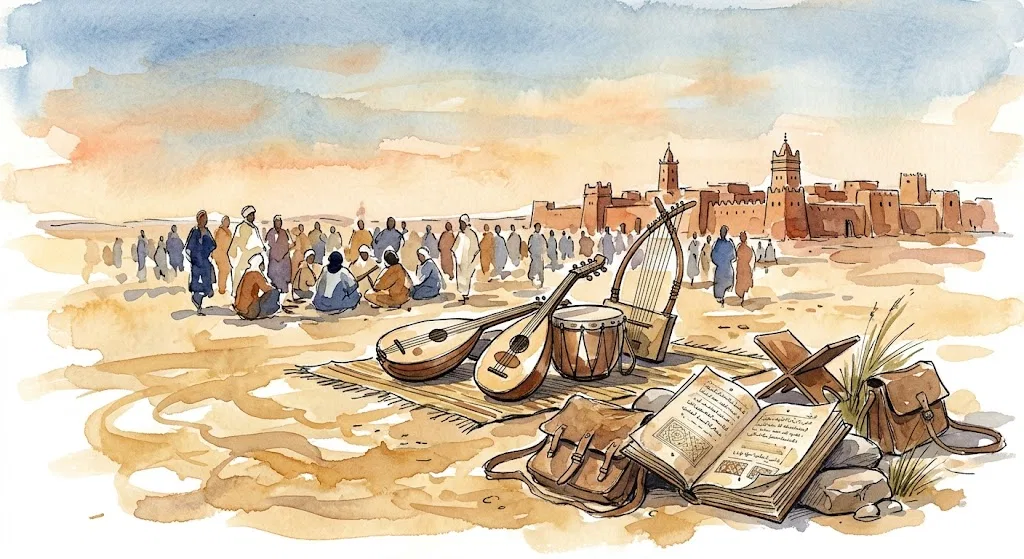
Mauritanian tradition gives unusual weight to the spoken and performed word. In Moorish society, specialist performers preserve histories and poems through music, while elders, teachers and families transmit tales, proverbs, religious lessons and local memory. UNESCO’s description of T’heydinn is especially revealing: the epic consists of dozens of poems in Hassaniya, praises Moorish emirs and sultans, and preserves collective memory through performances by griots accompanied by stringed instruments and kettledrum.[ICH UNESCO]unesco.orgICH UNESCOMoorish epic T'heydinn The T'heydinn epic encompasses dozens of poems lauding the glorious feats of Moorish emirs and sultansICH UNESCOMoorish epic T'heydinnThe T'heydinn epic encompasses dozens of poems lauding the glorious feats of Moorish emirs and sultans. G…
This matters because “folklore” in Mauritania often overlaps with history. A story may be entertaining, but it may also explain tribal status, praise a lineage, remember a battle, teach restraint, or place a family within a moral universe. The boundary between legend and record is therefore not always the modern boundary between fiction and fact. UNESCO’s 2024 note on the Epic of Samba Gueladio says the community regards it as oral historical tradition as well as legend, which is exactly the kind of double life many Mauritanian narratives have.[ICH UNESCO]ich.unesco.orgOpen source on unesco.org.
The country’s linguistic and cultural mixture deepens that pattern. Mauritania’s population includes Arab-Berber Moorish communities and Black African communities including Pulaar, Soninke and Wolof speakers, while Sunni Islam provides a broad shared religious frame. That does not erase local traditions; it gives many stories an Islamic moral language while leaving room for older heroic, genealogical and regional memories.[Minority Rights Group]minorityrights.orgOpen source on minorityrights.org.
The great sung epics: memory with music
T’heydinn and the Moorish heroic past
T’heydinn is one of Mauritania’s most important documented oral traditions. UNESCO describes it as a Moorish epic made of poems praising the feats of emirs and sultans and preserving the community’s collective memory. It is performed by griots with instruments including lute, harp and kettledrum, and is passed down within performing families.[ICH UNESCO]unesco.orgICH UNESCOMoorish epic T'heydinn The T'heydinn epic encompasses dozens of poems lauding the glorious feats of Moorish emirs and sultansICH UNESCOMoorish epic T'heydinnThe T'heydinn epic encompasses dozens of poems lauding the glorious feats of Moorish emirs and sultans. G…
For a general reader, the important point is that T’heydinn is not simply “old poetry”. It is a performed archive. In a society where memory, honour, lineage and public reputation matter, the epic turns the past into something that can be heard in the present. Its values include courage, generosity and social cohesion, but its vulnerability is also part of the story: UNESCO placed it on the Urgent Safeguarding List in 2011, signalling that transmission had weakened and needed support.[ICH UNESCO]unesco.orgICH UNESCOMoorish epic T'heydinn The T'heydinn epic encompasses dozens of poems lauding the glorious feats of Moorish emirs and sultansICH UNESCOMoorish epic T'heydinnThe T'heydinn epic encompasses dozens of poems lauding the glorious feats of Moorish emirs and sultans. G…
The endangered status helps distinguish old tradition from modern reinvention. T’heydinn is not an internet-era legend newly attached to Mauritania; it is a recognised oral performance tradition with named bearers, instruments, language and community functions. At the same time, what survives today is shaped by changing livelihoods, reduced patronage for hereditary performers and the difficulty of persuading younger people to inherit demanding oral arts.[Wikipedia]WikipediaOpen source on wikipedia.org.
Samba Gueladio and the hero cast aside
The Epic of Samba Gueladio belongs to the Fouta Toro cultural world associated with the Senegal River region, which makes it especially useful for understanding Mauritania as a crossroads rather than a sealed folklore container. UNESCO summarises the story as a legend in which Samba Gueladio, the rightful heir, is pushed aside by his uncle and must form alliances to regain his throne. The epic is performed through storytelling, song and declamation at community events and cultural gatherings.[ICH UNESCO]ich.unesco.orgOpen source on unesco.org.
Its appeal is easy to grasp: it is a tale of dispossession, endurance and political return. But its deeper social role lies in what UNESCO calls its celebration of inter-ethnic alliance and ancestral values. In other words, the hero’s story is not just about one man’s claim to power. It becomes a way to talk about legitimacy, kinship, betrayal, diplomacy and the moral obligations that hold communities together.[ICH UNESCO]ich.unesco.orgOpen source on unesco.org.
The epic also shows why country-level folklore pages need regional nuance. Samba Gueladio is Mauritanian in UNESCO’s listing, but its world is not limited by the modern state border. It belongs to a wider riverine and West African historical imagination, which is why it naturally connects Mauritania with Senegal River traditions and Pulaar-speaking cultural memory.[ICH UNESCO]ich.unesco.orgOpen source on unesco.org.
Chinguetti and the folklore of sacred learning
Chinguetti is one of Mauritania’s most powerful folklore landscapes because it turns knowledge itself into legend. UNESCO’s World Heritage description of the ancient towns of Ouadane, Chinguetti, Tichitt and Oualata says they were founded in the 11th and 12th centuries as caravan settlements and became trading and religious centres where Islamic culture flourished. Their preserved urban fabric, narrow streets, courtyard houses and mosques reflect a traditional Saharan way of life linked to nomadic culture.[UNESCO World Heritage Centre]whc.unesco.orgOpen source on unesco.org.
Chinguetti’s manuscript libraries give this landscape a near-mythic reputation. UNESCO describes the desert libraries as part of the World Heritage property and notes Chinguetti’s role as an outpost on trans-Saharan trade routes, nicknamed the “Sorbonne of the Sahara”. Recent reporting has described family-run libraries preserving religious, scientific and literary manuscripts, while also showing how desertification, declining tourism and regional insecurity threaten the town’s heritage.[UNESCO]unesco.orgOpen source on unesco.org.
The folklore here is not a ghost story in the usual sense. It is the aura of a city remembered as a place where books, saints, scholars, pilgrims and caravans met in the desert. Claims that Chinguetti is a holy city or an exceptional centre of Islamic learning are part history, part civic memory and part local pride. Scholarship on Mauritania’s Islamic knowledge tradition also warns against romanticising the country as timeless or untouched by modernity, so the better reading is balanced: Chinguetti is historically important, but its image has been shaped by later heritage language, tourism and national symbolism.[MDPI]mdpi.comOpen source on mdpi.com.
Spirits, religion and the invisible Sahara
Mauritanian supernatural belief is strongly shaped by Islam, which means that spirits are usually discussed through Islamic categories rather than as a separate pagan pantheon. Erin Pettigrew’s study of Mauritania, Invoking the Invisible in the Sahara, argues that spirits, miracles and divine forces need to be taken seriously as part of Saharan historical experience, not dismissed as marginal decoration. The work especially highlights jinn as beings understood within Islamic thought to move between human and spirit worlds.[Cambridge University Press & Assessment]cambridge.orgUniversity Press & AssessmentUniversity Press & Assessment
For readers looking for “Mauritanian monsters”, this is an important correction. The best-attested supernatural material is not a tidy list of named beasts like a fantasy bestiary. It is a religious and social field: spirits, saintly mediation, blessing, healing, moral danger and invisible presence in desert and community life. These beliefs are not unique to Mauritania, but Mauritania’s Saharan setting and Islamic scholarly culture give them a distinctive local texture.[Cambridge University Press & Assessment]cambridge.orgUniversity Press & AssessmentUniversity Press & Assessment
That distinction also helps avoid internet folklore errors. A vague online claim about “desert demons of Mauritania” is much weaker than a source-grounded account of how Islamic spirit belief, scholarly authority and Saharan social change interact. Mauritanian supernatural tradition is real as lived belief and narrative practice, but it should be presented as tradition, not as proof of supernatural events.[Cambridge University Press & Assessment]cambridge.orgUniversity Press & AssessmentUniversity Press & Assessment
Soninke memory, Wagadu and the serpent of gold
Southern and south-eastern Mauritania connect the country to one of West Africa’s great legendary-historical traditions: Wagadu, the Soninke name associated with the Ghana Empire. Modern historians treat the relationship between oral traditions, Arabic written sources and archaeological sites such as Kumbi Saleh with caution. Oxford’s account of the Ghana Empire notes that the empire became equated with the Soninke legend of Wagadu and that Kumbi Saleh in southern Mauritania was identified as its capital, but also stresses that many basic questions remain uncertain.[OUP Academic]academic.oup.comAcademic The Empire of GhanaAcademic The Empire of Ghana
The legendary core is memorable. In Soninke oral traditions, the foundation and fall of Wagadu are linked to a serpent figure often called Bida, associated with gold, rain and sacrifice. Some versions describe a pact in which prosperity depends on offerings to the serpent; the killing of the serpent explains the loss of abundance and the dispersal of the people. Because these stories are embedded in oral epic and origin tradition, they should not be flattened into either “mere myth” or straightforward political history.[Wikipedia]WikipediaGhana EmpireGhana Empire
This is one of the clearest places where Mauritanian folklore meets archaeology and medieval history. Kumbi Saleh is in Mauritania and has long been discussed as a possible capital of the Ghana Empire, but excavation and written evidence do not settle every question. A good folklore reading therefore keeps both layers visible: the serpent story belongs to Soninke cultural memory, while the historical Ghana Empire belongs to a difficult evidence base spanning oral tradition, Arabic texts and archaeology.[OUP Academic]academic.oup.comAcademic The Empire of GhanaAcademic The Empire of Ghana

Children’s tales and everyday moral storytelling
Not all Mauritanian folklore is epic or scholarly. UNESCO’s assistance project on children’s tales and narratives in Mauritania is a useful sign that everyday storytelling is now being treated as heritage worth safeguarding. The project, approved with support from the Intangible Cultural Heritage Fund, aims to inventory children’s tales, train community members, involve women and youth, and transmit stories through workshops and educational activities.[ICH UNESCO]ich.unesco.orgOpen source on unesco.org.
This matters because children’s tales are often where folklore does its quietest work. They teach behaviour, caution, wit, generosity, respect for elders and the consequences of foolishness. They may not have the prestige of a national epic, but they are often the stories people remember first because they were heard at home, in the evening, or from older relatives. The fact that Mauritania is inventorying them suggests both cultural value and concern about transmission.[ICH UNESCO]ich.unesco.orgOpen source on unesco.org.
The safeguarding language also tells us something about change. Oral traditions do not vanish only because people stop caring. They weaken when communities urbanise, when schooling and media habits change, when older storytellers die, or when younger people no longer learn performance styles. Modern workshops and written collections can help, but they also change the setting of the tale: what was once intimate and improvised may become staged, archived or taught in formal cultural programmes.[ICH UNESCO]ich.unesco.orgOpen source on unesco.org.
Desert, sea and the stories landscapes carry
Mauritania’s folklore is inseparable from landscape. The Sahara gives stories a vocabulary of wells, caravans, scholars, dunes, lost towns and endurance. UNESCO’s description of the ancient ksour emphasises how these settlements served caravan routes and preserved a way of life shaped by the western Sahara. That is why Chinguetti, Ouadane, Tichitt and Oualata are not only architectural sites; they are settings for memory.[UNESCO World Heritage Centre]whc.unesco.orgOpen source on unesco.org.
The Atlantic coast adds a different kind of tradition. Banc d’Arguin National Park is primarily famous as a natural World Heritage site, but UNESCO also notes the presence of dolphins used by fishermen to attract shoals of fish. The resident Imraguen communities and their traditional fishing practices are part of the cultural character of the park, even when the official designation is ecological rather than folkloric.[UNESCO World Heritage Centre]whc.unesco.orgOpen source on unesco.org.
This is not “myth” in the sense of a supernatural legend, but it is belief culture in a broader sense: inherited ecological knowledge, repeated seasonal practice and stories of human partnership with the sea. For folklore readers, Banc d’Arguin shows that tradition can live in technique as much as in tale. A fishing method, a place-name, a remembered migration route or a family library may carry as much cultural meaning as a named spirit.[UNESCO World Heritage Centre]whc.unesco.orgOpen source on unesco.org.
What is old, what is documented and what is changing now
Mauritanian folklore is well attested in some areas and thinly documented in others. The strongest evidence is for public oral heritage: T’heydinn, Mahadra, Samba Gueladio, children’s tale safeguarding projects, Chinguetti’s manuscript culture and the ancient ksour. These have institutional documentation, heritage listings or scholarly attention.[unesco.org]unesco.orgICH UNESCOMoorish epic T'heydinn The T'heydinn epic encompasses dozens of poems lauding the glorious feats of Moorish emirs and sultansICH UNESCOMoorish epic T'heydinnThe T'heydinn epic encompasses dozens of poems lauding the glorious feats of Moorish emirs and sultans. G…
Supernatural beings and ghostly traditions are harder to summarise responsibly at country level. Islamic spirit belief is clearly relevant, and recent scholarship treats invisible forces as part of Mauritanian religious and social history. But there is not the same easily accessible, well-documented national corpus of named monsters or haunted places that exists for some countries. The honest conclusion is that Mauritania’s most visible folklore is less about horror and more about memory, authority, poetry, learning and moral instruction.[Cambridge University Press & Assessment]cambridge.orgUniversity Press & AssessmentUniversity Press & Assessment
Today, the main pressure on these traditions is not disbelief alone. It is changing transmission. Griot lineages face reduced performance contexts; desert libraries face sand, heat, conservation costs and falling tourism; children’s storytelling needs active inventorying; and sacred scholarly cities are increasingly framed through heritage, travel and climate-risk narratives. In 2025, reporting on Chinguetti described only a reduced number of family-run libraries still operating and warned of encroaching desert sands threatening homes and manuscripts.[The Guardian]theguardian.comAt its peak, Chinguetti hosted around 30 family-run libraries; only 12 remain, with just two open to the public. Climate change, economic…
Why Mauritania’s folklore matters
Mauritania’s folklore matters because it preserves ways of thinking that written national history alone cannot hold. The epics remember legitimacy and alliance. The desert cities remember scholarship and pilgrimage. The Soninke legends connect Mauritania to deep West African origin traditions. Children’s tales carry everyday ethics. Spirit beliefs show how the invisible remains part of social and religious life. Together they form a cultural map of a country often reduced from the outside to desert, iron trains or remote adventure travel.
The most useful way to approach Mauritanian folklore is therefore not to ask, “What is Mauritania’s national monster?” A better question is, “How has Mauritania remembered itself?” The answer is through voices: sung by griots, recited by storytellers, taught in religious schools, preserved in family libraries, carried along caravan routes and adapted under the pressure of modern life. That makes Mauritanian folklore quieter than a sensational ghost legend, but often richer: it is a living art of memory in a country where landscape, learning and oral performance still shape how the past is made present.
Amazon book picks
Further Reading
Books and field guides related to Where Mauritania's Stories Still Speak. Use these as the next step if you want deeper reading beyond the article.
The palm-wine drinkard and his dead palm-wine tapster in the...
First published 1952. Subjects: Fiction, Yoruba (African people), Folklore, Wine and wine making, Nigeria, fiction.
eBay marketplace picks
Marketplace Samples
Live-tested eBay searches with available results related to this page.

Endnotes
1.
Source: ich.unesco.org
Link:https://ich.unesco.org/en/USL/moorish-epic-[t-heydinn
Source snippet
Moorish epic T'heydinnThe T'heydinn epic encompasses dozens of poems lauding the glorious feats of Moorish emirs and sultans. G...
2.
Source: ich.unesco.org
Link:https://ich.unesco.org/en/RL/mahadra-a-community-system-for-transmission-of-traditional-knowledge-and-oral-expressions-01960
Source snippet
of expression that promotes socialization, communication, integration and social...
3.
Source: ich.unesco.org
Link:https://ich.unesco.org/en/RL/the-epic-of-samba-gueladio-01692
4.
Source: ich.unesco.org
Link:https://ich.unesco.org/en/Decisions/19.COM/7.b.48
5.
Source: ich.unesco.org
Link:https://ich.unesco.org/doc/src/ITH-11-6.COM-CONF.206-Decisions-EN.doc
6.
Source: Wikipedia
Link:https://en.wikipedia.org/wiki/T%27heydinn
7.
Source: whc.unesco.org
Link:https://whc.unesco.org/en/list/750/
8.
Source: unesco.org
Title: document 1168
Link:https://www.unesco.org/archives/multimedia/document-1168
9.
Source: unesco.org
Link:https://www.unesco.org/en/culture-emergencies/heritage-emergency-fund/connecting-generations-through-safeguarding-and-enhancing-protection-desert-libraries-mauritania
10.
Source: mdpi.com
Link:https://www.mdpi.com/2077-1444/12/11/953
11.
Source: cambridge.org
Title: University Press & Assessment
Link:https://www.cambridge.org/core/books/invoking-the-invisible-in-the-sahara/introduction/C29D8610A41FADCDCB0AF12381F4470C
12.
Source: academic.oup.com
Title: Academic The Empire of Ghana
Link:https://academic.oup.com/edited-volume/61663/chapter-abstract/553497129?redirectedFrom=fulltext
13.
Source: Wikipedia
Title: Ghana Empire
Link:https://en.wikipedia.org/wiki/Ghana_Empire
14.
Source: Wikipedia
Title: Oral traditions of the Soninke people
Link:https://en.wikipedia.org/wiki/Oral_traditions_of_the_Soninke_people
15.
Source: Wikipedia
Title: Koumbi Saleh
Link:https://en.wikipedia.org/wiki/Koumbi_Saleh
16.
Source: ich.unesco.org
Link:https://ich.unesco.org/es/decisiones-mesa/18.COM%202.BUR/4.2
17.
Source: ich.unesco.org
Title: ICH UNESCOMauritania
Link:https://ich.unesco.org/en/state/mauritania-MR
18.
Source: ich.unesco.org
Link:https://ich.unesco.org/en/news/mauritania-launches-an-international-assistance-project-on-strengthening-capacities-of-ngos-in-the-field-of-intangible-cultural-heritage-13253
19.
Source: whc.unesco.org
Link:https://whc.unesco.org/en/list/506/
20.
Source: ich.unesco.org
Title: mauritania MR
Link:https://ich.unesco.org/en/state/mauritania-MR?info=projects
21.
Source: unesco.org
Title: document 2211
Link:https://www.unesco.org/archives/multimedia/document-2211
22.
Source: ich.unesco.org
Title: 17330 EN
Link:https://ich.unesco.org/doc/src/17330-EN.pdf?v=1344431951
23.
Source: whc.unesco.org
Link:https://whc.unesco.org/en/activities/1307/
24.
Source: ich.unesco.org
Title: 10141 EN.doc
Link:https://ich.unesco.org/doc/src/10141-EN.doc
25.
Source: ich.unesco.org
Link:https://ich.unesco.org/en/video/73081
26.
Source: ich.unesco.org
Link:https://ich.unesco.org/es/00555
27.
Source: ich.unesco.org
Link:https://ich.unesco.org/en/decisions/18.COM/8.B.44
28.
Source: ich.unesco.org
Link:https://ich.unesco.org/en/video/5362
29.
Source: ich.unesco.org
Title: Leaflet 2011 inscriptions EN
Link:https://ich.unesco.org/doc/src/Leaflet-2011_inscriptions-EN.pdf
30.
Source: ich.unesco.org
Link:https://ich.unesco.org/en/RL/mahadra-a-community-system-for-transmission-of-traditional-knowledge-and-oral-expressions-01960?call=film&id=73081&include=film_inc.php&width=700
31.
Source: ich.unesco.org
Title: 8b representative list 01325
Link:https://ich.unesco.org/en/8b-representative-list-01325?call=slideshow&id=01960&include=slideshow_inc.php&mode=scroll&width=620
32.
Source: ich.unesco.org
Title: photo pop up 00973
Link:https://ich.unesco.org/en/photo-pop-up-00973?photoID=16476
33.
Source: ich.unesco.org
Title: mauritania MR
Link:https://ich.unesco.org/en-state/mauritania-MR?call=film&id=73081&include=film_inc.php&width=700
34.
Source: ich.unesco.org
Link:https://ich.unesco.org/es/asistencias/02046
35.
Source: ich.unesco.org
Title: LHE 24 19.CO M 4 EN.docx
Link:https://ich.unesco.org/doc/src/LHE-24-19.COM-4_EN.docx
36.
Source: ich.unesco.org
Title: 8b representative list 01325
Link:https://ich.unesco.org/en/8b-representative-list-01325?call=film&id=73081&include=film.inc.php&width=700
37.
Source: ich.unesco.org
Link:https://ich.unesco.org/en/video/72532
38.
Source: ich.unesco.org
Title: 7b representative list 01370
Link:https://ich.unesco.org/en/7b-representative-list-01370?call=slideshow&id=01692&include=slideshow_inc.php&mode=scroll&width=620
39.
Source: ich.unesco.org
Title: the epic of samba gueladio 01692
Link:https://ich.unesco.org/en/RL/the-epic-of-samba-gueladio-01692?call=film&id=72532&include=film_inc.php&width=700
40.
Source: Wikipedia
Title: Lists of Intangible Cultural Heritage elements
Link:https://en.wikipedia.org/wiki/Lists_of_Intangible_Cultural_Heritage_elements
41.
Source: Wikipedia
Link:https://en.wikipedia.org/wiki/Chinguetti
42.
Source: Wikipedia
Title: Islam in Mauritania
Link:https://en.wikipedia.org/wiki/Islam_in_Mauritania
43.
Source: Wikipedia
Title: List of Intangible Cultural Heritage elements in Mauritania
Link:https://en.wikipedia.org/wiki/List_of_Intangible_Cultural_Heritage_elements_in_Mauritania
44.
Source: Wikipedia
Title: Banc d’Arguin National Park
Link:https://en.wikipedia.org/wiki/Banc_d%27Arguin_National_Park
45.
Source: mdpi.com
Link:https://www.mdpi.com/2071-1050/12/22/9416
46.
Source: minorityrights.org
Link:https://minorityrights.org/country/mauritania/
47.
Source: ebsco.com
Link:https://www.ebsco.com/research-starters/geography-and-cartography/mauritania
48.
Source: theguardian.com
Link:https://www.theguardian.com/world/2025/nov/12/city-of-libraries-chinguetti-mauritania-sahara-unesco-preservation
Source snippet
At its peak, Chinguetti hosted around 30 family-run libraries; only 12 remain, with just two open to the public. Climate change, economic...
49.
Source: beingafrican.org
Link:https://beingafrican.org/mauritania/
50.
Source: worldhistory.org
Title: Ghana Empire
Link:https://www.worldhistory.org/Ghana_Empire/
51.
Source: epicmauritania.com
Link:https://www.epicmauritania.com/destinations/chinguetti/
52.
Source: nathannothinsez.blogspot.com
Link:https://nathannothinsez.blogspot.com/2013/05/mauritania.html
Additional References
53.
Source: govinfo.gov
Link:https://www.govinfo.gov/content/pkg/GOVPUB-D301-PURL-gpo68484/pdf/GOVPUB-D301-PURL-gpo68484.pdf
54.
Source: apnews.com
Link:https://apnews.com/article/fddd80d31620355b06afca4cc9f94d99
55.
Source: tripadvisor.co.uk
Link:https://www.tripadvisor.co.uk/Attraction_Review-g5973140-d324016-Reviews-Ancient_Ksour_of_Ouadane_Chinguetti_Tichitt_and_Oualata-Ouadane_Adrar_Region.html
56.
Source: tripadvisor.com
Link:https://www.tripadvisor.com/Attraction_Review-g5973140-d324016-Reviews-Ancient_Ksour_of_Ouadane_Chinguetti_Tichitt_and_Oualata-Ouadane_Adrar_Region.html
57.
Source: worldheritagesites.net
Link:https://worldheritagesites.net/ancient-ksour-of-ouadane-chinguetti-tichitt-and-oualata/
58.
Source: facebook.com
Link:https://www.facebook.com/groups/435820846445944/posts/7556756787685612/
59.
Source: ramsar.org
Link:https://www.ramsar.org/sites/default/files/documents/library/ramsar_whc_case_study_banc_darguin_e.pdf
60.
Source: kanaga-at.com
Link:https://www.kanaga-at.com/en/trip-info/mauritania-en/chinguetti-and-the-desert-libraries/
61.
Source: facebook.com
Link:https://www.facebook.com/AfricaViewFacts/posts/chinguetti-a-medieval-library-town-in-the-sahara-desert-mauritania-/162452422876307/
62.
Source: researchgate.net
Link:https://www.researchgate.net/publication/355852349_Global_Shinqit_Mauritania%27s_Islamic_Knowledge_Tradition_and_the_Making_of_Transnational_Religious_Authority_Nineteenth_to_Twenty-First_Century
Topic Tree
Follow this branch
Related pages 192
- Afghan Folklore
- Albanian Folklore
- Algerian Folklore
- Australian Folklore
- Azerbaijan Folklore
- +187 more in sidebar