Where Tanzanian Folklore Still Lives
Tanzania’s folklore is not a single mythology with one fixed cast of gods and monsters.
Page outline Jump by section
Introduction
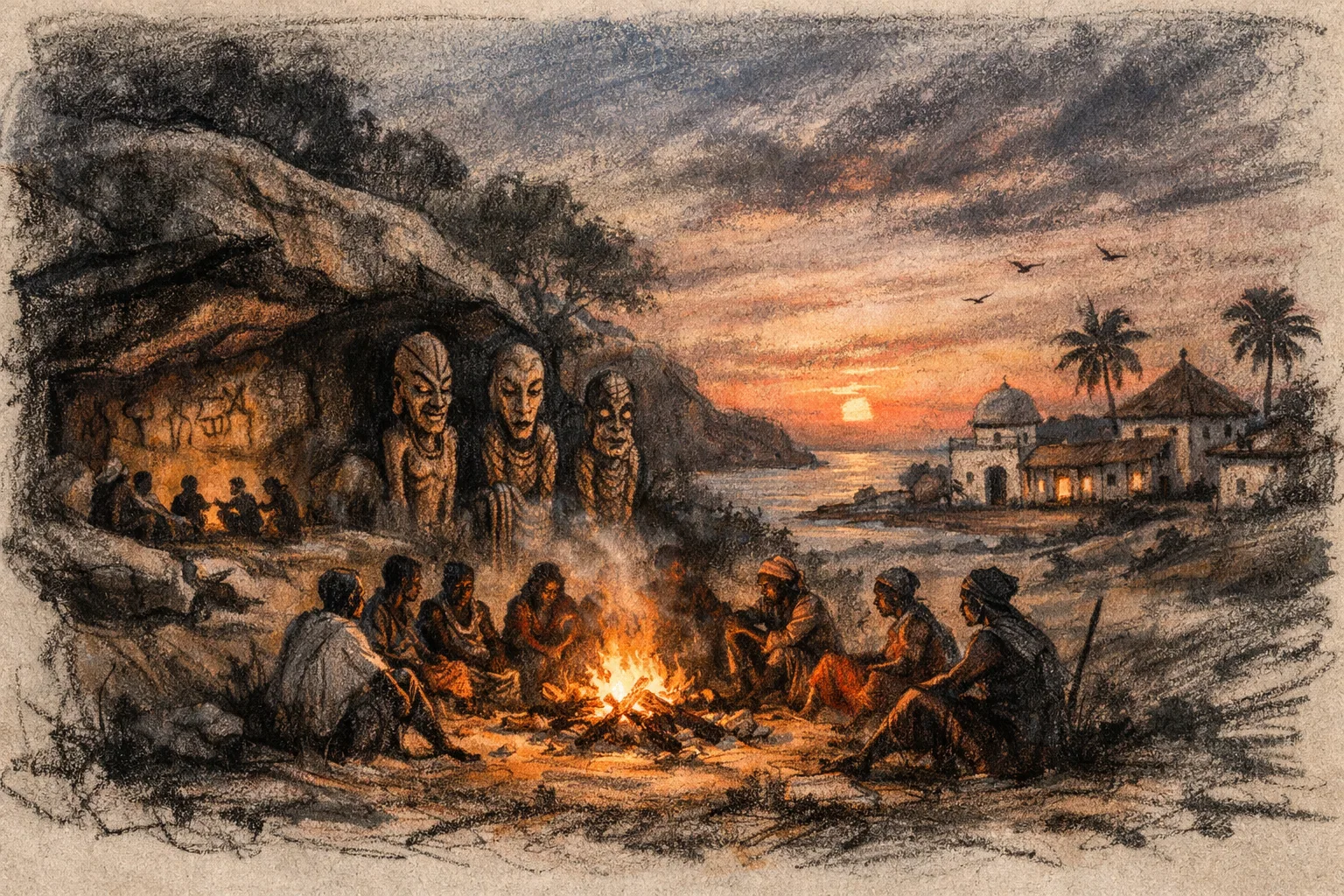
The best-attested examples are not always the most sensational. Kondoa’s rock-art shelters are still used in local ritual contexts; the Hadza maintain cosmological stories around sun, moon, ancestors and the dark-moon dance; Makonde spirit carving transformed local and coastal spirit ideas into internationally recognised modern art; and Zanzibar’s Popobawa panic shows how a modern monster story can carry political memory, fear and rumour. Tanzania’s folklore matters because it shows culture as something people actively interpret, protect, dispute and remake.[unesco.org]unesco.orgOpen source on unesco.org.
Why Tanzanian folklore is regional rather than national
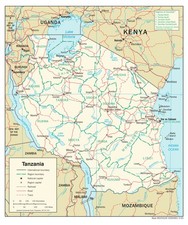
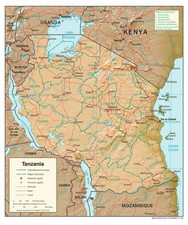
A reader looking for “Tanzanian mythology” may expect a neat national pantheon. Tanzania does not really work that way. The country includes mainland regions, the Zanzibar archipelago, pastoralist societies, farming communities, hunter-gatherer groups, coastal Swahili communities, and peoples whose traditions cross modern borders into Kenya, Mozambique, Malawi, Rwanda, Burundi and the Democratic Republic of the Congo. The country’s folklore is therefore better read as a network of local traditions rather than a single national canon.
That variety is also why oral tradition is so important. UNESCO’s Dar es Salaam office places oral traditions, performing arts, social practices, rituals, festive events, knowledge of nature and traditional craft within the wider field of intangible cultural heritage, and notes that Tanzania ratified the 2003 Convention for the Safeguarding of Intangible Cultural Heritage in 2011. In other words, stories, songs, ceremonies, craft knowledge and sacred practices are not just “old tales”; they are recognised heritage forms that transmit skills, memory and identity across generations.[UNESCO]unesco.orgOpen source on unesco.org.
This regional pattern also means that “folklore” may appear in unexpected places: in a carved mask, a rainmaking shelter, a clan grove, a children’s animal tale, a rumour about night attacks, or a tourist retelling of a mountain legend. The strongest evidence usually comes when oral accounts, ritual use, museum collections, fieldwork and local practice can be read together.
Kondoa: rock art that is still part of ritual life
One of Tanzania’s clearest meeting points between ancient image, sacred place and living tradition is the Kondoa Rock-Art Sites in central Tanzania. UNESCO describes the sites as retaining an active role in local rituals, including weather divination, healing and initiation. It also notes that some rainmaking rituals involve offerings such as animal fat and beer over the paintings, a practice that creates a real conservation dilemma: the sites are meaningful because communities still use them, but that same use can damage fragile art.[UNESCO World Heritage Centre]whc.unesco.orgOpen source on unesco.org.
Kondoa is especially important because it resists a simple “prehistoric art in a museum frame” reading. UNESCO stresses that the art has not been restored or enhanced, and that its value lies partly in its original natural setting and in a rich living heritage. The same shelters where earlier hunter-gatherers may have painted in relation to weather and ritual are still used by later farming communities for rainmaking and other ceremonies.[UNESCO World Heritage Centre]whc.unesco.orgOpen source on unesco.org.
Research on the rock art also shows why caution matters. A 2015 study by Emmanuel Bwasiri and Benjamin Smith reviewed nearly a century of scholarship and argued that there had been no broadly agreed sequence or simple authorship for the Kondoa paintings. Their analysis identified multiple artistic traditions with overlap and borrowing, which points to ethnic complexity rather than a single origin story.[the UWA Profiles and Research Repository]research-repository.uwa.edu.authe rock art of kondoa district tanzaniathe rock art of kondoa district tanzania
For folklore readers, Kondoa’s lesson is powerful: a sacred landscape can be old without being frozen. The stories and rituals attached to it have changed as communities changed, yet the site remains a place where art, rain, healing, ancestry and local authority meet.

Spirits, ancestors and sacred landscapes
Across Tanzania, supernatural traditions often centre less on distant gods than on ancestors, spirits and morally charged places. Sacred groves are a good example. Research on sacred forests in Njombe describes these places as small, scattered forest patches with special religious importance, historically managed through local lineages or kinship groups. They are not merely ecological remnants; they are places where biodiversity, cosmology and traditional authority overlap.[openaccess.wgtn.ac.nz]openaccess.wgtn.ac.nzOpen source on wgtn.ac.nz.
The same study warns against treating sacred forests as static survivals from a “primordial” past. In the Bena case in southwest Tanzania, sacred groves were embedded in changing cultural, political and ecological conditions from the 1880s to 2019. That matters for folklore because it shows that sacred places are maintained by institutions, memory, rules and negotiation. They can be protected, neglected, contested, commercialised or reinterpreted over time.[openaccess.wgtn.ac.nz]openaccess.wgtn.ac.nzOpen source on wgtn.ac.nz.
This is a useful corrective to tourist clichés. A haunted or sacred place is rarely just a dramatic story attached to scenery. It may involve rules about who can enter, what may be taken, when rituals are performed, which elders hold knowledge, and how land-use change affects spiritual authority. In Tanzania, sacred landscape traditions belong as much to environmental history and local governance as to “myth”.
Hadza cosmology: sun, moon, ancestors and the dark-moon dance
The Hadza of the Lake Eyasi region are often discussed in relation to hunting and gathering, but their folklore and ritual life are also significant. A University of Sheffield research fieldsite summary notes that anthropologists have sometimes described the Hadza as having little or no religion, yet still agree that they have a cosmology involving the sun, moon, stars and ancestors. Their creation stories include descent to earth from a baobab tree or down the neck of a giraffe.[cultureandmind.sites.sheffield.ac.uk]cultureandmind.sites.sheffield.ac.ukCulture and the MindCulture and the Mind
The same source highlights the dark-moon dance known as epeme. It takes place when the moon is not visible, under cover of darkness. Men dance in turn as embodiments of ancestors while women and children are present as audience and participants in the wider ritual setting. This is not simply “performance” in the entertainment sense; it connects hunting, gender, maturity, ancestry and night-time cosmology.[cultureandmind.sites.sheffield.ac.uk]cultureandmind.sites.sheffield.ac.ukCulture and the MindCulture and the Mind
For a folklore reader, the Hadza example is valuable because it shows how myth may be carried through action rather than through a long written narrative. A story of origins, a rule about meat, a dance in darkness and the presence of ancestors all form part of the same cultural system.
Makonde spirit art: from ritual carving to global modernism
The Makonde, whose communities span southern Tanzania and northern Mozambique, are internationally known for carving. Some of the most distinctive modern carvings depict spirit figures often called shetani in Swahili usage. These figures are not just fantasy monsters for the art market. They grew from a world of spirit belief, dream imagery, coastal religious vocabulary and Makonde sculptural innovation.
Modern Makonde art developed strongly in Tanzania in the twentieth century. Accounts of the art movement identify the early 1950s as a key period for the emergence of abstract spirit sculpture, with master carvers and patrons in Dar es Salaam helping to shape a new artistic language. Later artists such as George Lilanga helped carry these spirit forms into internationally recognised contemporary African art.[Wikipedia]WikipediaMakonde artMakonde art
This is one of the clearest cases where old tradition, modern invention and commercial circulation overlap. The spirit forms may draw on local and coastal belief, but the specific sculptural style is also a modern art history. That does not make it fake. It makes it a good example of how folklore survives by being reworked: dreams become carvings, carvings become gallery objects, and spirit beings become part of Tanzania’s public cultural image.
Zanzibar’s Popobawa: a modern monster with political memory
Zanzibar’s most famous modern supernatural figure is Popobawa, often described as a bat-winged or shape-shifting night attacker. It is tempting to treat the story as a simple “demon legend”, but the evidence is more interesting. Martin Walsh’s study of the 1995 panic describes an extraordinary wave of fear across the Zanzibar archipelago, beginning on Pemba and spreading to Unguja and parts of the mainland coast.[Academia]academia.eduOpen source on academia.edu.
The panic was not explained in only one way. Walsh records local interpretations involving witch-finding, revenge, spirit possession, political conspiracy and memories of Zanzibar’s revolutionary past. In some areas, Popobawa narratives became tied to party politics and distrust of the ruling establishment; in others, they echoed older fears of occult attack or unresolved violence.[Academia]academia.eduOpen source on academia.edu.
This makes Popobawa a strong example of internet-era and media-era folklore before it became an online monster profile. It is modern, but not trivial. It shows how nightmares, rumours, politics, sexuality, sleep experiences and collective memory can fuse into a supernatural narrative. The important point is not whether the creature “exists”, but why the story became believable to particular communities at particular moments.

Animal tales and moral teaching
Tanzanian folklore also includes animal tales, trickster stories, proverbs and moral narratives told in domestic, educational and performance settings. Across East Africa, clever small animals, greedy predators and foolish rivals often carry lessons about intelligence, patience, social conduct and danger. The hare and hyena pattern, widely attested in East African storytelling, is one of the best-known examples: the physically weaker trickster survives through wit while the stronger or greedier figure is exposed.
These tales should not be dismissed as children’s entertainment only. In oral cultures, animal stories can encode practical social knowledge: how to recognise boastfulness, how to survive unequal power, why greed leads to humiliation, and why clever speech can matter as much as strength. Studies of animal folktales more broadly have argued that animal pairings and deception motifs often reflect real-world ecological and social relationships, although any specific Tanzanian tale still needs local context before being interpreted too confidently.[arXiv]arxiv.orgOpen source on arxiv.org.
Because these stories travel easily, the same plot may appear in Tanzania, Kenya, Uganda, Mozambique or farther away with different animals, names and morals. A Tanzanian version is therefore not always “owned” by one ethnic group; it may be part of a shared East African storytelling repertoire, reshaped by language, setting and performer.
Witchcraft belief: folklore, fear and real harm
No account of Tanzanian supernatural belief should romanticise witchcraft accusations. Belief in occult power can be part of traditional explanation, healing and moral order, but it can also lead to violence. The most documented modern harm concerns attacks on people with albinism, driven by false beliefs that their body parts can bring wealth or power. UN Human Rights reporting has described brutal attacks and killings in Tanzania linked to myths and witchcraft, while also criticising the institutionalisation and segregation of children placed in protective centres.[OHCHR]ohchr.orgprotect rights people albinismprotect rights people albinism
Human Rights Watch likewise reported that, after ritual killings and amputations increased in the late 2000s, Tanzania created temporary holding shelters and special boarding schools intended to protect children with albinism, but that this approach created further hardship and separation from family and community life.[Human Rights Watch]hrw.orgOpen source on hrw.org.
For a folklore page, the distinction is essential. It is legitimate to study witchcraft belief as part of cultural history, but harmful accusations and ritual violence are not colourful folklore. They are human rights abuses. A grounded account must therefore separate traditional narrative and ritual practice from exploitative claims made by people who profit from fear.
Museums, archives and the problem of who tells the story
Tanzanian folklore has also been shaped by colonial collecting and by today’s efforts to reconnect objects with the communities that made and used them. The Ethnologisches Museum in Berlin describes a long-term collaboration with the National Museum of Tanzania and the University of Dar es Salaam to investigate the colonial origins of collections from present-day mainland Tanzania. The project includes provenance research, interviews with descendants of makers and users, digitisation, archival work and exhibition planning in Dar es Salaam.[Staatliche Museen zu Berlin]smb.museumOpen source on smb.museum.
This matters because many ritual objects, carvings, figures, masks and everyday artefacts were removed from their local settings and interpreted through foreign categories. A carved figure in a European museum may be labelled as “art”, “ethnography” or “religion”, while its community context may involve initiation, healing, satire, ancestry, status or performance. Provenance research can restore some of that missing context, though it cannot always recover every story.
For readers, the practical takeaway is simple: when encountering Tanzanian folklore through museum objects, ask who collected the item, when, under what conditions, what local knowledge was recorded, and whether present-day communities have been involved in interpretation.
How Tanzanian folklore is changing today
Tanzanian folklore is still changing because the conditions that carry it are changing. Urbanisation, schooling, tourism, churches, mosques, national heritage policy, social media and the art market all affect how stories are told and valued. A sacred grove may become a conservation issue. A spirit carving may become a gallery piece. A local rumour may become an online monster entry. A mountain legend may be simplified for climbers. A ritual site may be promoted as heritage while local communities worry about access, authority or damage.
UNESCO’s cultural work in Tanzania frames heritage as both memory and creativity, not just preservation of old things. Its list of Tanzania’s World Heritage properties includes cultural sites such as Kondoa, Kilwa Kisiwani, Songo Mnara and Stone Town, natural sites such as Kilimanjaro and the Serengeti, and the mixed landscape of Ngorongoro. These places are not all “folklore sites” in the narrow sense, but many are surrounded by oral tradition, sacred geography, historical memory or contested cultural meaning.[UNESCO]unesco.orgOpen source on unesco.org.
The strongest modern approach is therefore neither sceptical dismissal nor uncritical celebration. Tanzania’s folklore is best understood as a living archive: some of it ancient, some recently invented, some sacred, some playful, some commercialised, and some dangerous when tied to accusation or violence. Its richness lies in that movement between story, place, belief and change.
Amazon book picks
Further Reading
Books and field guides related to Where Tanzanian Folklore Still Lives. Use these as the next step if you want deeper reading beyond the article.
African Folktales
Covers storytelling traditions comparable to those found across Tanzania.
Nelson Mandela's Favorite African Folktales
Introduces readers to a wide range of African oral narratives.
The Palm-Wine Drinkard
Illustrates the imaginative world of African spirit and folktale traditions.
African Myths of Origin
Provides strong background for understanding Tanzanian folklore.
eBay marketplace picks
Marketplace Samples
Live-tested eBay searches with available results related to this page.
Endnotes
1.
Source: unesco.org
Link:https://www.unesco.org/en/fieldoffice/daressalaam/expertise/fosteringculturaldiversity
2.
Source: whc.unesco.org
Link:https://whc.unesco.org/en/list/1183/
3.
Source: cultureandmind.sites.sheffield.ac.uk
Title: Culture and the Mind
Link:https://cultureandmind.sites.sheffield.ac.uk/fieldsites/hadza
4.
Source: academia.edu
Link:https://www.academia.edu/694054/The_politicisation_of_Popobawa_changing_explanations_of_a_collective_panic_in_Zanzibar
5.
Source: openaccess.wgtn.ac.nz
Link:https://openaccess.wgtn.ac.nz/articles/thesis/Traditional_Institutions_Management_of_Sacred_Forests_in_Tanzania_History_Narratives_and_Evidence_from_Njombe_Region_1880s-2019/17147762/1/files/31708052.pdf
6.
Source: Wikipedia
Title: Makonde art
Link:https://en.wikipedia.org/wiki/Makonde_art
7.
Source: arxiv.org
Link:https://arxiv.org/abs/1907.03969
8.
Source: ohchr.org
Title: protect rights people albinism
Link:https://www.ohchr.org/en/stories/2014/12/protect-rights-people-albinism
9.
Source: Wikipedia
Link:https://en.wikipedia.org/wiki/Tanzania
10.
Source: Wikipedia
Title: Nyamwezi people
Link:https://en.wikipedia.org/wiki/Nyamwezi_people
11.
Source: Wikipedia
Title: Chaga people
Link:https://en.wikipedia.org/wiki/Chaga_people
12.
Source: Wikipedia
Link:https://en.wikipedia.org/wiki/Popobawa
13.
Source: Wikipedia
Link:https://en.wikipedia.org/wiki/Shetani
14.
Source: Wikipedia
Title: Hadza people
Link:https://en.wikipedia.org/wiki/Hadza_people
15.
Source: Wikipedia
Title: Iraqw people
Link:https://en.wikipedia.org/wiki/Iraqw_people
16.
Source: ohchr.org
Title: un expert welcomes african court ruling against tanzania failing protect
Link:https://www.ohchr.org/en/press-releases/2025/02/un-expert-welcomes-african-court-ruling-against-tanzania-failing-protect
17.
Source: unesdoc.unesco.org
Link:https://unesdoc.unesco.org/ark%3A/48223/pf0000139564
18.
Source: ich.unesco.org
Link:https://ich.unesco.org/en/lists
19.
Source: folktales.africa
Title: Senegalese Hare and Hyena stories
Link:https://folktales.africa/five-hare-and-hyena-folktales-from-senegal-lessons-in-patience-and-wisdom/
20.
Source: academia.edu
Link:https://www.academia.edu/30230024/Identifying_Documenting_and_Inventorying_Tangible_and_Tangible_Heritage_in_Tanzania
21.
Source: academia.edu
Link:https://www.academia.edu/43178733/The_Iraqw_and_the_Problem_of_Space_Chapter_1_in_Space_Time_and_Culture_among_the_Iraqw_of_Tanzania
22.
Source: academia.edu
Link:https://www.academia.edu/7274784/Rock_Art_of_Kondoa_Irangi_and_Other_Attractions_Tanzania
23.
Source: youtube.com
Link:https://www.youtube.com/watch?v=7Eerrmdhx40
Source snippet
Makonde, Carving Through Life...
24.
Source: research-repository.uwa.edu.au
Title: the rock art of kondoa district tanzania
Link:https://research-repository.uwa.edu.au/en/publications/the-rock-art-of-kondoa-district-tanzania/
25.
Source: hrw.org
Link:https://www.hrw.org/news/2019/02/09/it-felt-punishment-growing-albinism-tanzania
26.
Source: smb.museum
Link:https://www.smb.museum/en/museums-institutions/ethnologisches-museum/collection-research/research/collaborative-provenance-research-on-collections-from-tanzania/
27.
Source: zenodo.org
Link:https://zenodo.org/records/18852954
28.
Source: unitedrepublicoftanzania.com
Link:https://unitedrepublicoftanzania.com/tanzania-culture/worship-rituals-in-tanzania/shetani-the-spirit-of-east-african-mythology-mashetani-makonde-pictures-meaning-name-mask-sculpture-films-ivory-carvings-art-lava-flows-caves-in-english-elephant-poacher/
29.
Source: fredsakademiet.dk
Link:https://fredsakademiet.dk/ordbog/tord/_pdf/Kondoa.pdf
30.
Source: kids.nationalgeographic.com
Link:https://kids.nationalgeographic.com/geography/countries/article/tanzania
31.
Source: GOV.UK
Link:https://www.gov.uk/foreign-travel-advice/tanzania
32.
Source: ehrafworldcultures.yale.edu
Link:https://ehrafworldcultures.yale.edu/cultures/fn11/summary
33.
Source: ebsco.com
Link:https://www.ebsco.com/research-starters/geography-and-cartography/tanzania
Additional References
34.
Source: youtube.com
Title: Makonde Art: The Leon V. and Norrie Johnson Hirsch Collection
Link:https://www.youtube.com/watch?v=-7rmv1G8Ct8
Source snippet
Uncovering Tradition: One Night in the Digo People's Swahili Coast...
35.
Source: youtube.com
Title: Among the Hadza and Maasai: Kinship in Tanzania
Link:https://www.youtube.com/watch?v=yCfb45fzXfU
Source snippet
Makonde Art: The Leon V. and Norrie Johnson Hirsch Collection...
36.
Source: researchgate.net
Link:https://www.researchgate.net/publication/265035108_When_Hypothesis_Becomes_Myth_The_Iraqi_Origin_of_the_Iraqw
37.
Source: tumblr.com
Link:https://www.tumblr.com/bestiarium/649064531504627712/image-source-1-wikipedia-user-gadfium-image
38.
Source: researchgate.net
Link:https://www.researchgate.net/publication/335440203_Human_rights_violations_of_persons_with_albinism_in_Tanzania_The_case_of_children_in_temporary_holding_shelters
39.
Source: instagram.com
Link:https://www.instagram.com/p/DHtnpjJqiwC/
40.
Source: facebook.com
Link:https://www.facebook.com/GovernorLeeKinyanjui/posts/a-story-is-told-about-the-proverbial-hyena-and-the-hare-they-were-great-friends-/1030477105116820/
41.
Source: unicef.org
Link:https://www.unicef.org/esa/media/8961/file/Tanzania-Addressing-Witchcraft-Case-Study-2021.pdf
42.
Source: britishmuseum.org
Link:https://www.britishmuseum.org/our-work/departments/africa-oceania-and-americas/africa
43.
Source: facebook.com
Link:https://www.facebook.com/atvgambia/posts/tanzaniathe-hadzabe-also-known-as-hadza-or-wahadzabe-are-one-of-the-last-remaini/1063505779176936/
Topic Tree
Follow this branch
Related pages 192
- Afghan Folklore
- Albanian Folklore
- Algerian Folklore
- Australian Folklore
- Azerbaijan Folklore
- +187 more in sidebar