Madagascar's Living World of Ancestors and Taboos
Madagascar’s folklore is not a single book of myths but a living web of stories, taboos, ancestor beliefs, sacred places, verbal arts and local ritual practice.
Page outline Jump by section
Introduction
Madagascar’s folklore is not a single book of myths but a living web of stories, taboos, ancestor beliefs, sacred places, verbal arts and local ritual practice. Its best-known traditions include the island-wide hero epic usually known as Ibonia, reverence for ancestors, rules of avoidance called fady, spirit-possession ceremonies, legends about the mysterious first inhabitants called Vazimba, and animal stories in which lemurs, birds and forest creatures carry moral or ancestral meaning. These traditions matter because they are not just entertainment: they shape how people speak at weddings and funerals, how tombs and forests are treated, how royal history is remembered, and how modern Madagascar negotiates Christianity, tourism, conservation and local identity. Madagascar’s folklore is especially distinctive because the Malagasy people and language reflect deep connections with both Island Southeast Asia and East Africa, while the island’s stories have developed in a landscape unlike anywhere else.[nih.gov]pmc.ncbi.nlm.nih.govGenome-wide evidence of Austronesian–Bantu admixture and…by D Pierron · 2014 · Cited by 114 — In conclusion, we found that the thre…
Why Madagascar’s folklore feels so distinctive
Madagascar sits off the south-east coast of Africa, but its cultural history is Indian Ocean history rather than a simple extension of mainland Africa. Genetic and linguistic research points to Malagasy origins in a mixture of Austronesian and African ancestry, while the Malagasy language belongs to the Austronesian family and is closely related to languages of Borneo. That helps explain why Malagasy verbal art, taboos, ancestor customs and epic storytelling often feel both African and Austronesian, without being reducible to either.[nih.gov]pmc.ncbi.nlm.nih.govGenome-wide evidence of Austronesian–Bantu admixture and…by D Pierron · 2014 · Cited by 114 — In conclusion, we found that the thre…
For folklore, that mixed history matters because stories travel with people, but they also change when they meet new landscapes. Madagascar’s rice terraces, highland tombs, dry southern cattle country, western royal shrines and eastern rainforests all shape different local traditions. A taboo around a particular animal may be tied to an ancestral story in one region, while a sacred hill or tomb may carry royal significance in another. The result is a country where folklore is often local, practical and place-bound rather than arranged as a neat national pantheon.
A first-time reader should also be careful with the word “mythology”. Madagascar certainly has myths, legendary beings and sacred narratives, but much Malagasy tradition lives through performance: formal speech, proverbs, riddles, family ceremonies, healing rituals, tomb customs and stories told for instruction or amusement. UNESCO describes Malagasy kabary, a formal public speaking tradition, as poeticised speech built from proverbs, maxims and rhetorical figures; it is not “myth” in a narrow sense, but it is part of the same verbal world that keeps inherited values alive.[Intangible Cultural Heritage]ich.unesco.orgOpen source on unesco.org.
Ancestors are the centre of the supernatural world
The most important key to Malagasy folklore is ancestor reverence. Many traditions place the dead not in a distant, sealed-off afterlife but in continuing relationship with the living. Ancestors may bless, protect, warn, punish or impose taboos. This is why tombs, burial places, inherited land, family ceremonies and royal shrines carry such strong emotional and ritual weight.[Cambridge University Press & Assessment]cambridge.orgUniversity Press & Assessment14University Press & Assessment14
This does not mean every Malagasy person practises the same religion. Madagascar includes Christians, Muslims and people who follow local ancestral customs, and many families combine different layers of practice. The important point for folklore is that ancestor belief has long provided a framework for explaining misfortune, obligation, healing, kinship and moral behaviour. A rule may be followed not simply because it is “old”, but because breaking it risks offending those who came before.
One of the clearest examples is fady, a system of prohibitions or taboos. A fady can apply to a food, animal, place, gesture, day, family line or activity. Some are broad and widely recognised, such as avoiding disrespectful behaviour around tombs; others are intensely local, attached to a village, clan, forest or sacred site. Conservation researchers studying eastern Madagascar note that fady can range from strict ancestral prohibitions to social norms governing how wild species may be used.[nih.gov]pubmed.ncbi.nlm.nih.govOpen source on nih.gov.
The important distinction is that fady is not just “superstition” in the dismissive sense. It can act as law, etiquette, environmental rule, family memory and spiritual boundary all at once. Sometimes it protects animals or forests; sometimes it may conflict with modern conservation or public-health goals. That tension is part of why Malagasy folklore remains socially powerful rather than merely decorative.[Mongabay News]news.mongabay.comin madagascar cultural taboos can protect or harm the environmentin madagascar cultural taboos can protect or harm the environment
The turning of the bones and the living memory of the dead
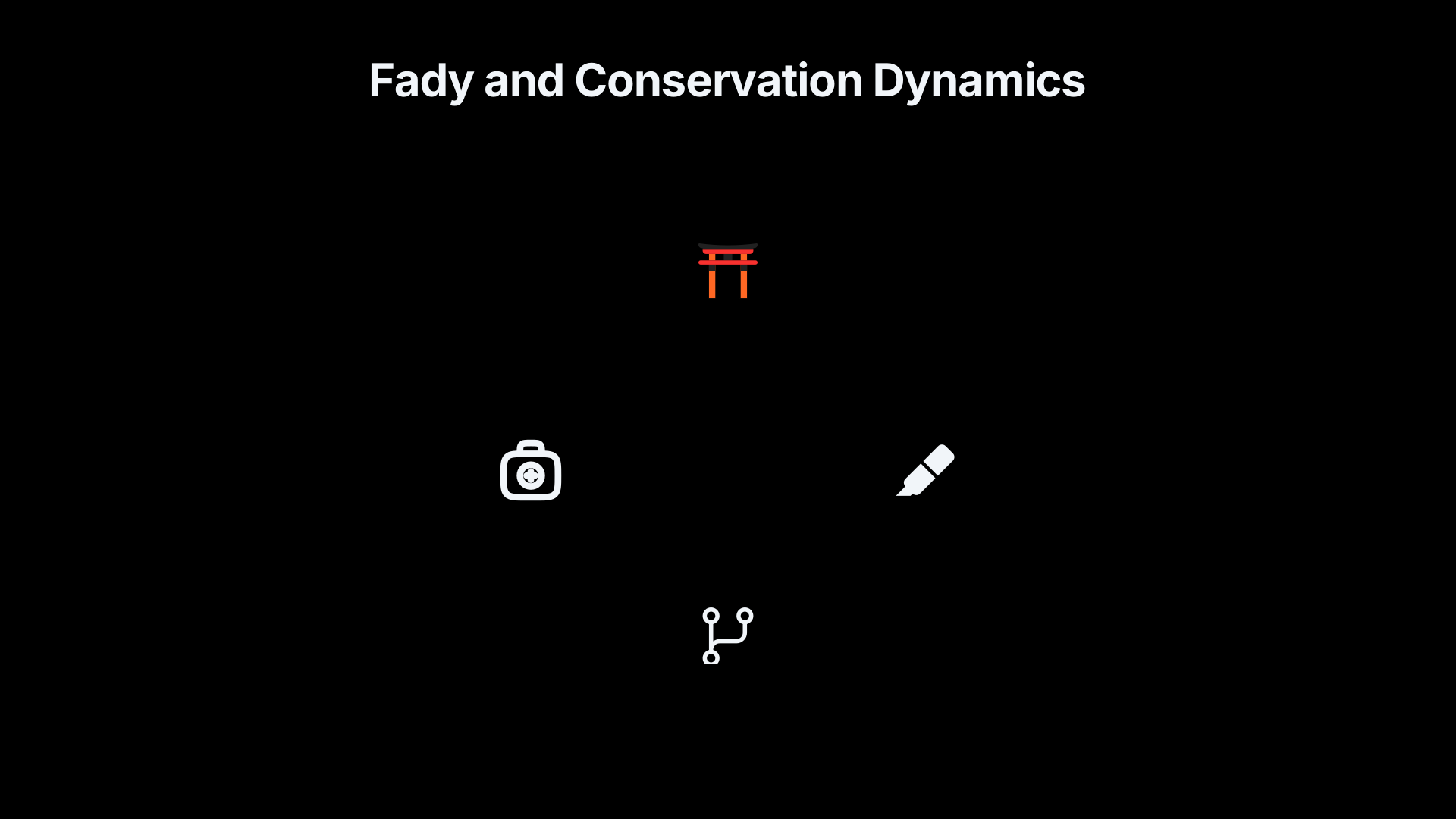
The ceremony often called “turning of the bones” is one of Madagascar’s most widely reported ancestral customs. In highland practice, families may reopen a tomb, bring out ancestral remains, rewrap them in fresh cloth, celebrate with music and kin, and return them to the tomb. Anthropologist David Graeber described the rite in the Imerina region as deeply bound up with memory, obligation, taboo and the continuing force of ancestors.[AnthroSource]anthrosource.onlinelibrary.wiley.comOpen source on wiley.com.
For outside observers, this ceremony is often sensationalised because it involves physical remains. That misses the cultural logic. The event is not a horror spectacle; it is a family reunion across generations. It can reaffirm descent, settle obligations, gather scattered relatives, honour the dead and renew the social bond between the living and the ancestral tomb. Archaeological and anthropological work on burial in Madagascar also shows how ancestral tombs can serve as evidence of belonging to land and lineage.[Hal Science]hal.scienceParker Pearson & Regnier 2018 Collective and single burial in MadagascarParker Pearson & Regnier 2018 Collective and single burial in Madagascar
The custom is not uniform across the island and should not be treated as something every Malagasy person practises. It is best known from the central highlands, and it has changed under the influence of Christianity, urbanisation, expense, public health concerns and changing family life. The point for folklore is broader: death in Madagascar’s traditional story-world is not simply an ending. It is a passage into a different kind of social presence.
Ibonia: Madagascar’s great heroic story
The best-known Malagasy epic is Ibonia, a tale of a royal hero whose life begins before birth and unfolds through betrothal, conflict, verbal contest, heroic struggle and eventual union. Folklorist Lee Haring’s open-access study presents it as a major work of Malagasy oral literature, not merely a curiosity collected by outsiders. The story was written down in the nineteenth century, with a major published version associated with the missionary Lars Dahle’s 1870s collections, but Haring stresses that it belongs to a wider oral and performative world.[oapen.org]library.oapen.orgOpen source on oapen.org.
What makes Ibonia important is not only its plot. It shows what Malagasy heroic tradition values: eloquence, ancestry, royal legitimacy, testing, marriage alliance and verbal skill. The hero does not merely fight; he speaks, debates and proves himself through language. That matters in a culture where formal oratory, proverbs and indirect speech have high prestige.[Intangible Cultural Heritage]ich.unesco.orgOpen source on unesco.org.
The tale also reminds readers not to imagine oral tradition as a single “original” text. Ibonia exists through variants, performance history, transcription and translation. The version most English readers encounter is already shaped by collectors, editors and scholars. That does not make it fake; it means it has the layered history typical of many great oral works. A useful comparison is not “myth versus literature”, but living performance versus fixed printed text.
Sacred hills, royal memory and haunted landscapes
Madagascar’s folklore is strongly tied to landscape. Hills, tombs, forests, springs, stones and old settlements may be remembered as places where history, ancestors and sacred power meet. The Royal Hill of Ambohimanga, north-east of Antananarivo, is the clearest national example. UNESCO describes it as a sacred town, royal burial site and religious capital of the nineteenth-century kingdom, with royal tombs, holy places, sacred basins, woods, sacrificial stones and trees.[UNESCO World Heritage Centre]whc.unesco.orgOpen source on unesco.org.
Ambohimanga is not just an archaeological monument. World Monuments Fund notes that ancestor worship remains an important aspect of the site, which continues to draw worshippers and pilgrims. This is a crucial point for readers: a “historic site” in Madagascar may also be a living sacred place. Its meaning is not exhausted by kings, walls and dates.[World Monuments Fund]wmf.orgOpen source on wmf.org.
The hill also connects royal history with older legendary layers. Traditions about Vazimba, often described as early inhabitants or ancestral beings, are attached to parts of the highlands and to sacred places. In modern retellings, the Vazimba may appear as ancient people, spirits, first occupants, dwarfish beings, river powers or guardians of old sites. The evidence is a mixture of oral tradition, historical speculation and local sacred geography, so it is best to speak of “Vazimba traditions” rather than a single settled account.[Vivy Travel Madagascar]vivytravel.comVivy Travel Madagascar Vazimba: Who Were Madagascar's First Inhabitants?Vivy Travel Madagascar Vazimba: Who Were Madagascar's First Inhabitants?
Vazimba: first people, spirits or guardians?
The Vazimba are among the most intriguing figures in Malagasy legendary history because they sit between folklore, ancestry and historical memory. In some accounts they are the island’s earlier inhabitants, displaced or absorbed by later groups. In others they are powerful spirits associated with rivers, forests, stones or ancient graves. The ambiguity is exactly what makes them important: they are a way of talking about origins, land rights, sacred danger and the presence of those who were there before.[Vivy Travel Madagascar]vivytravel.comVivy Travel Madagascar Vazimba: Who Were Madagascar's First Inhabitants?Vivy Travel Madagascar Vazimba: Who Were Madagascar's First Inhabitants?
For a modern reader, the safest interpretation is that Vazimba traditions preserve social memory rather than straightforward archaeology. They may reflect real earlier populations, but the stories have also been used to mark places as ancient, powerful or forbidden. A village’s claim to be first on the land can be strengthened by stories of ancestors, old tombs or relations with earlier beings. Research on burial and land in Madagascar shows how ancestral presence can be closely connected with belonging and authority.[Hal Science]hal.scienceParker Pearson & Regnier 2018 Collective and single burial in MadagascarParker Pearson & Regnier 2018 Collective and single burial in Madagascar
This is why Vazimba stories often feel like ghost lore and origin history at the same time. They are not simply monsters. They represent a question every society has to answer: who owns the past, and how should the living behave towards it?
Spirit possession and the return of royal ancestors
Another major supernatural tradition is spirit possession, especially the ceremony often associated with Sakalava communities in western and north-western Madagascar. Anthropologist Lesley Sharp’s study of possession in Ambanja argues that possession is not marginal there but central to Sakalava culture and identity. Through such ceremonies, spirits, often royal ancestors, may speak through living mediums and address questions of illness, conflict, status or social belonging.[UC Press E-Books Collection]publishing.cdlib.orgOpen source on cdlib.org.
This is folklore in action rather than folklore as a bedtime story. The spirit has a name, history, style of speech, preferences and authority. The medium is not simply “pretending” in the terms of the tradition; the ceremony gives the community a recognised way to bring the past into the present. Michael Lambek’s work on Sakalava possession similarly treats it as a way of making history present, not as an exotic oddity.[JSTOR]jstor.orgThe Sakalava Poiesis of HistoryThe Sakalava Poiesis of History
Possession traditions also show how Malagasy supernatural culture has changed over time. Spirits can travel, new spirits can appear, and colonial or postcolonial experiences can be absorbed into ritual life. That makes possession a living archive: it remembers kings and ancestors, but it also responds to migration, illness, politics and modern uncertainty.
Animal legends and the moral life of the forest
Madagascar’s animals are so unusual that outsiders often turn them into symbols of the island, but Malagasy folklore does something more intimate. Animals can be kin-like, taboo, comic, dangerous, sacred or morally instructive. Nineteenth-century writing on Malagasy folklore noted the richness of animal references in proverbs and tales, arguing that birds and animal habits were used with close observation.[Wikisource]en.wikisource.orgOn the Oratory, Songs, Legends, and Folk tales of the Malagasy (pp.On the Oratory, Songs, Legends, and Folk tales of the Malagasy (pp.
The indri, one of Madagascar’s largest lemurs, is the most famous example. It is widely associated with origin legends and taboos against killing or eating it. Conservation sources note that the animal remains critically endangered despite such taboos, because habitat loss and hunting pressures can overwhelm older protections.[Wikipedia]WikipediaOpen source on wikipedia.org.
A common legend explains the indri’s human-like status through kinship. In one version, a boy trapped in a tree is rescued by an indri; in another, a father and son are transformed into lemurs. These stories explain why the animal’s call sounds mournful or human, and why harming it may be forbidden. Whether every detail is ancient or locally variable is less important than the pattern: the forest animal is not just wildlife, but a being placed inside a moral relationship with people.[The Safina Center]safinacenter.orgThe Safina Center The legend of BabakotoThe Safina Center The legend of Babakoto
Animal tales can also work as fables. Trickery, foolishness, pride and reversal are common folktale themes across the Indian Ocean and Africa, and Malagasy stories take part in that wider world while using local animals and landscapes. The result is a body of tales that teaches social intelligence as much as obedience.
Proverbs, formal speech and the art of saying things indirectly
Madagascar’s folklore is not only about supernatural beings. Much of it lives in verbal skill: proverbs, formal speeches, riddles, poetic exchanges and indirect argument. UNESCO’s inscription of Malagasy kabary highlights a tradition of structured public speech using proverbs, maxims and rhetorical figures. It is performed at ceremonies and public occasions, and skill in this art carries social prestige.[Intangible Cultural Heritage]ich.unesco.orgOpen source on unesco.org.
The poetic form known as hainteny is another important part of Malagasy oral literature, especially associated with the Merina highlands. It relies on metaphor, allusion and verbal indirection. Collections and studies of this tradition shaped not only Malagasy literary history but also the work of French writer Jean Paulhan, whose encounter with Malagasy proverbs influenced his later thinking about language and ambiguity.[Wikipedia]WikipediaOpen source on wikipedia.org.
This matters because it changes how readers should approach Malagasy tales. A story may not state its lesson directly. A proverb may carry ancestral authority precisely because it is old, compressed and indirect. A ceremonial speaker may win respect not by bluntness but by choosing the right inherited phrase at the right moment. In Madagascar, folklore is often a way of speaking well.
Old tradition, colonial collection and modern retelling
Many Malagasy traditions are old, but the versions available to readers today often come through nineteenth- and twentieth-century collection, missionary transcription, colonial scholarship, modern tourism, conservation writing and online retelling. That layered history is especially clear with Ibonia, where a living oral tale became a written text, then a scholarly translation, then an emblem of national literature for global readers.[OAPEN]library.oapen.orgOpen source on oapen.org.
This creates two common mistakes. The first is to assume that every online summary preserves an ancient belief unchanged. The second is to assume that anything written down by missionaries or scholars is merely invented. The better approach is to ask what kind of evidence is being used. Is it an oral variant? A ritual observed by an anthropologist? A UNESCO heritage description? A tourist-board simplification? A conservation article using folklore to explain animal protection? Each can be useful, but each has limits.
Modern Madagascar also keeps reshaping its folklore. Ancestor ceremonies may be debated by Christian families. Sacred sites may become tourist destinations while remaining places of pilgrimage. Taboos may protect a forest in one place and weaken in another. Lemur legends may be used in conservation education. The tradition is not frozen; it is continually being reinterpreted.
What readers should remember about Madagascar’s folklore
Madagascar’s folklore is best understood as a living culture of relationship: between the living and the dead, people and land, speech and authority, animals and ancestors, local memory and national identity. Its most memorable stories include heroic epic, first-inhabitant legends, animal taboos and spirit possession, but its deeper structure lies in the everyday force of ancestors, taboos, tombs, sacred places and formal speech.
The most distinctive feature is that folklore in Madagascar often has practical consequences. A story can explain why an animal must not be harmed. A taboo can regulate behaviour in a forest. A tomb can anchor a family’s claim to land. A spirit ceremony can make royal history speak in the present. A proverb can settle a social moment more elegantly than direct argument.
For curious readers, the richest way into Malagasy folklore is therefore not to look for a single list of gods and monsters. It is to follow the places, ceremonies and words through which people remember who they are, where they belong, and what they owe to those who came before.
Amazon book picks
Further Reading
Books and field guides related to Madagascar's Living World of Ancestors and Taboos. Use these as the next step if you want deeper reading beyond the article.
The Penguin Book of Myths and Legends of Africa
Useful comparative reading for African oral traditions.
eBay marketplace picks
Marketplace Samples
Live-tested eBay searches with available results related to this page.
Endnotes
1.
Source: pmc.ncbi.nlm.nih.gov
Link:https://pmc.ncbi.nlm.nih.gov/articles/PMC3903192/
Source snippet
Genome-wide evidence of Austronesian–Bantu admixture and...by D Pierron · 2014 · Cited by 114 — In conclusion, we found that the thre...
2.
Source: arxiv.org
Title: arXiv Malagasy Dialects and the Peopling of Madagascar
Link:https://arxiv.org/abs/1102.2180
3.
Source: library.oapen.org
Link:https://library.oapen.org/bitstream/handle/20.500.12657/30303/646721.pdf
4.
Source: arxiv.org
Title: arXiv The origins of the Malagasy people, some certainties and a few mysteries
Link:https://arxiv.org/abs/1803.02197
5.
Source: ich.unesco.org
Link:https://ich.unesco.org/en/RL/malagasy-kabary-the-malagasy-oratorical-art-01741
6.
Source: Wikipedia
Link:https://en.wikipedia.org/wiki/Hainteny
7.
Source: cambridge.org
Title: University Press & Assessment14
Link:https://www.cambridge.org/core/books/sacred-species-and-sites/role-of-taboos-and-traditional-beliefs-in-aquatic-conservation-in-madagascar/C629FC6AE555BF8F8E7699A60639323F
8.
Source: hal.science
Title: Parker Pearson & Regnier 2018 Collective and single burial in Madagascar
Link:https://hal.science/hal-01882328/file/Parker%20Pearson%20%26%20Regnier%202018%20Collective%20and%20single%20burial%20in%20Madagascar.pdf
9.
Source: researchgate.net
Link:https://www.researchgate.net/publication/5235404_The_Importance_of_Taboos_and_Social_Norms_to_Conservation_in_Madagascar
10.
Source: news.mongabay.com
Title: in madagascar cultural taboos can protect or harm the environment
Link:https://news.mongabay.com/2021/05/in-madagascar-cultural-taboos-can-protect-or-harm-the-environment/
11.
Source: whc.unesco.org
Link:https://whc.unesco.org/en/list/950/
12.
Source: Wikipedia
Link:https://en.wikipedia.org/wiki/Ambohimanga
13.
Source: resolve.cambridge.org
Link:https://resolve.cambridge.org/core/services/aop-cambridge-core/content/view/ECBD15D434C70469BDEA576487972F03/9789048508112c6_p135-152_CBO.pdf/tromba-children-maresaka-and-postcolonial-malady-in-madagascar.pdf
14.
Source: jstor.org
Title: The Sakalava Poiesis of History
Link:https://www.jstor.org/stable/646688
15.
Source: en.wikisource.org
Title: On the Oratory, Songs, Legends, and Folk tales of the Malagasy (pp. 1 15)
Link:https://en.wikisource.org/wiki/The_Folk-Lore_Journal/Volume_1/On_the_Oratory%2C_Songs%2C_Legends%2C_and_Folk-tales_of_the_Malagasy_%28pp._1-15%29
16.
Source: Wikipedia
Link:https://en.wikipedia.org/wiki/Indri
17.
Source: Wikipedia
Title: Malagasy mythology
Link:https://en.wikipedia.org/wiki/Malagasy_mythology
18.
Source: Wikipedia
Link:https://en.wikipedia.org/wiki/Ibonia
19.
Source: Wikipedia
Link:https://en.wikipedia.org/wiki/Famadihana
20.
Source: Wikipedia
Title: Malagasy peoples
Link:https://en.wikipedia.org/wiki/Malagasy_peoples
21.
Source: jstor.org
Link:https://www.jstor.org/stable/j.ctt5vjtj7
22.
Source: jstor.org
Link:https://www.jstor.org/stable/3818280
23.
Source: jstor.org
Link:https://www.jstor.org/stable/3819116
24.
Source: shs.hal.science
Title: science The first migrants to Madagascar and their
Link:https://shs.hal.science/halshs-00706173/document
25.
Source: researchgate.net
Link:https://www.researchgate.net/publication/249743065_Austronesian_Migration_and_the_Establishment_of_the_Malagasy_Civilization_Contrasted_Readings_in_Linguistics_Archaeology_Genetics_and_Cultural_Anthropology
26.
Source: pubmed.ncbi.nlm.nih.gov
Link:https://pubmed.ncbi.nlm.nih.gov/18616743/
27.
Source: anthrosource.onlinelibrary.wiley.com
Link:https://anthrosource.onlinelibrary.wiley.com/doi/10.1525/ae.1995.22.2.02a00030
28.
Source: books.openbookpublishers.com
Link:https://books.openbookpublishers.com/10.11647/obp.0034.pdf
29.
Source: wmf.org
Link:https://www.wmf.org/projects/royal-hill-ambohimanga
30.
Source: metmuseum.org
Link:https://www.metmuseum.org/perspectives/ambohimanga
31.
Source: vivytravel.com
Title: Vivy Travel Madagascar Vazimba: Who Were Madagascar’s First Inhabitants?
Link:https://www.vivytravel.com/malagasy-lexicon-who-are-the-vazimba/
32.
Source: publishing.cdlib.org
Link:https://publishing.cdlib.org/ucpressebooks/public/book/the-possessed-and-the-dispossessed-spirits-identity-and-power-in-a-madagascar-migrant-town.html
33.
Source: safinacenter.org
Title: The Safina Center The legend of Babakoto
Link:https://www.safinacenter.org/blog/the-legend-of-babakoto
34.
Source: books.openbookpublishers.com
Link:https://books.openbookpublishers.com/10.11647/obp.0315/ch1.xhtml
35.
Source: books.openbookpublishers.com
Link:https://books.openbookpublishers.com/10.11647/obp.0111/ch6.xhtml
36.
Source: vivytravel.com
Link:https://www.vivytravel.com/malagasy-folklore-stories-passed-through-generations/
37.
Source: vivytravel.com
Link:https://www.vivytravel.com/essential-guidelines/tromba-ceremony-madagascar-guide/
38.
Source: vivytravel.com
Link:https://www.vivytravel.com/experiences/madagascar-culture-history-traditions/malagasy-oral-tradition/
39.
Source: thewhaledreamer.com
Link:https://www.thewhaledreamer.com/indri
40.
Source: pmc.ncbi.nlm.nih.gov
Link:https://pmc.ncbi.nlm.nih.gov/articles/PMC11076115/
41.
Source: edblogs.columbia.edu
Link:https://edblogs.columbia.edu/worldepics/project/ibonia/
42.
Source: conbio.onlinelibrary.wiley.com
Title: j.1523 1739.2008.00970.x
Link:https://conbio.onlinelibrary.wiley.com/doi/abs/10.1111/j.1523-1739.2008.00970.x
43.
Source: wildlifemadagascar.org
Link:https://wildlifemadagascar.org/animals/indri/
44.
Source: babakoto.eu
Link:https://www.babakoto.eu/Articles/Madagascar/Babakoto/Babakoto-English.htm
Additional References
45.
Source: youtube.com
Title: Malagasy Spirituality: Ancestors, Famadihana, & the Hidden History of Madagascar
Link:https://www.youtube.com/watch?v=-PsWkHXFCuE
Source snippet
Inside the Lost World of Madagascar | Island of Myths...
46.
Source: youtube.com
Title: Inside the Lost World of Madagascar | Island of Myths
Link:https://www.youtube.com/watch?v=XXfSVNmU-AU
Source snippet
Madagascar's Traditional Medicine and Animist Beliefs | SLICE...
47.
Source: youtube.com
Title: Madagascar’s Traditional Medicine and Animist Beliefs | SLICE
Link:https://www.youtube.com/watch?v=h3-1Kk8WhGM
Source snippet
A Family Affair: Truly Revisiting the Dead...
48.
Source: academia.edu
Link:https://www.academia.edu/11323051/The_story_tells_us_that_the_creator_God
49.
Source: madamagazine.com
Link:https://www.madamagazine.com/en/fady/
50.
Source: academia.edu
Link:https://www.academia.edu/30094449/Three_TricksTers_world_disTribuTion_of_zoomorphic_proTagonisTs_in_folklore_Tales_1
51.
Source: earthtrip.co.uk
Link:https://www.earthtrip.co.uk/experience/ambohimanga/
52.
Source: davidgraeber.org
Link:https://davidgraeber.org/articles/dancing-with-corpses-reconsidered-an-interpretation-of-famadihana-in-arivonimamo-madagascar/
53.
Source: facebook.com
Link:https://www.facebook.com/Greatafrica6/posts/did-you-know-that-the-people-of-madagascar-dont-just-have-african-roots-despite-/1530220905782560/
54.
Source: freebookapalooza.blogspot.com
Link:https://freebookapalooza.blogspot.com/2019/01/haring-ibonia-epic-from-madagascar.html
Topic Tree
Follow this branch
Related pages 192
- Afghan Folklore
- Albanian Folklore
- Algerian Folklore
- Australian Folklore
- Azerbaijan Folklore
- +187 more in sidebar