Why American Folklore Still Feels Unfinished
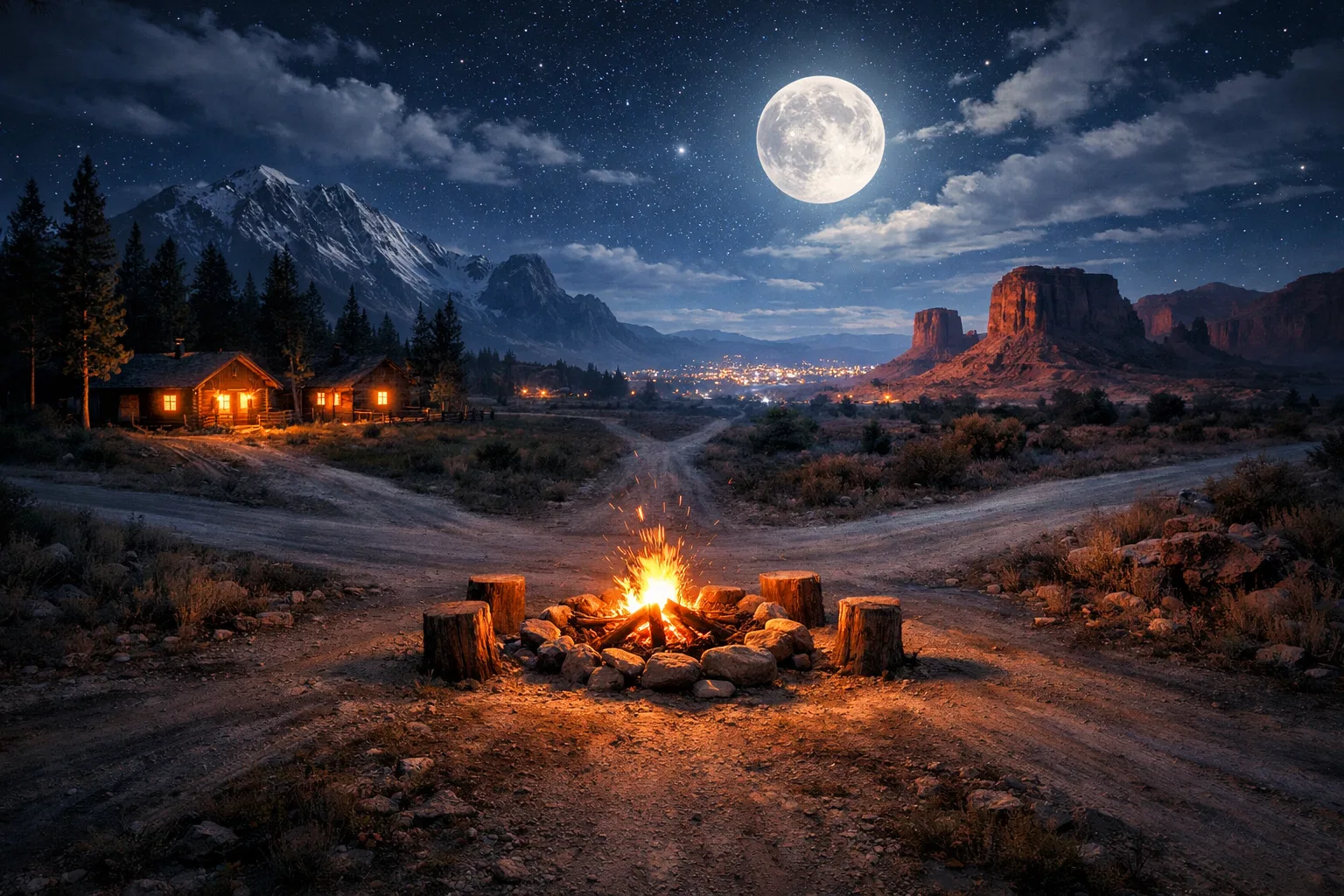
Folklore in the United States is not one tradition but a crowded meeting ground: Indigenous sacred stories, African American conjure and trickster tales, European settler legends, immigrant customs, frontier tall tales, regional monsters, ghost tourism, children’s games, internet horror and living community practice all sit inside the same national frame.
Page outline Jump by section
Introduction
American folklore matters because the country’s stories often reveal what formal history leaves emotionally unresolved. Bigfoot turns remote forests into imaginative territory; the Jersey Devil gives the New Jersey Pine Barrens a local demon; Salem turns a real legal and religious tragedy into a modern symbol of persecution, tourism and witch identity; and digital legends such as Slender Man show that folklore has not disappeared online, but accelerated.[smithsonianmag.com]smithsonianmag.comSmithsonian Magazine Why Do So Many People Still Want to Believe in Bigfoot?Smithsonian Magazine Why Do So Many People Still Want to Believe in Bigfoot?
What counts as United States folklore?
In a US context, folklore includes traditional stories, customs, songs, sayings, crafts, beliefs, rituals and informal knowledge passed through families, communities, workplaces, schools, churches, reservations, neighbourhoods and online spaces. The American Folklore Society describes folklore as including the traditional art, stories, knowledge and practices of a people, while stressing that folklore is not only old or false but living, adaptive cultural expression.[The American Folklore Society]americanfolkloresociety.orgOpen source on americanfolkloresociety.org.
That point is important because American folklore is often misread in two opposite ways. One mistake is to treat it as childish make-believe: Bigfoot, haunted roads, witches, campfire ghosts. Another is to flatten it into national nostalgia: apple-pie Americana, cowboys, barn dances and old-time music. The fuller picture is more complicated. Folklore can be sacred knowledge, family memory, coded resistance, comic exaggeration, tourist branding, community identity, children’s play, religious practice or internet performance.
It also changes depending on who is telling the story. A creature legend may be a joke to one community, a tourism symbol to another, a sacred being to another, and a modern horror property to yet another. That is why the most careful approach is to ask where a tradition comes from, who maintains it, how it has been recorded, and whether it is an old oral tradition, a literary invention, a hoax, a revival, a commercial retelling or a digital legend.
Indigenous stories come first, but they are not one mythology
Any country-level account of US folklore has to begin before the United States itself existed. Indigenous nations have distinct languages, lands, histories and sacred narratives; there is no single “Native American mythology”. The Smithsonian’s National Museum of the American Indian explains that oral traditions connect past, present and future, strengthen tribal and family bonds, and preserve historical knowledge within specific Native communities.[National Museum of the American Indian]americanindian.si.edustorytelling and oral traditionsstorytelling and oral traditions
These traditions can include creation stories, animal narratives, hero stories, cautionary tales, ceremonial knowledge and accounts of relationships between human beings, animals, spirits and landscapes. The Library of Congress’s accessible bibliography on Native American folklore notes that stories transmitted through oral tradition can include creation myths, hero tales, warnings and family histories, covering both natural and supernatural worlds.[The Library of Congress]loc.govOpen source on loc.gov.
A useful example is the Haudenosaunee Creation Story, presented by the Oneida Indian Nation as a foundational narrative of history and heritage. It is not simply an entertaining origin tale; it teaches moral and spiritual ideas about human complexity, balance and responsibility.[Oneida Indian Nation]oneidaindiannation.comOpen source on oneidaindiannation.com.
For readers new to this subject, the key distinction is respect. Some stories are public and widely shared; others are seasonal, ceremonial, restricted, family-specific or sacred. Folklore writing should not treat Indigenous traditions as a free mine of monster lore. It is better to speak of particular nations and communities when possible, and to recognise that language preservation, storytelling and cultural sovereignty remain central to how these traditions live today. The Smithsonian’s Native Knowledge 360° project was created partly to correct the shallow and inaccurate ways Native histories and cultures have often been taught in US schools.[National Museum of the American Indian]americanindian.si.eduOpen source on si.edu.
Storytelling traditions shaped by migration, slavery and settlement
US folklore developed through contact, conflict and movement. European settlers brought ballads, witch beliefs, fairy lore, saints’ days, harvest customs, ghost stories and magic tales. Enslaved Africans and their descendants preserved and transformed spiritual practices, animal tales, music, healing knowledge and trickster traditions under violent conditions. Immigrant communities brought new saints, spirits, holiday customs, foodways and household beliefs. The result is not a neat melting pot but a layered folklore map.
The American Folklife Center’s folktale guide groups archival material into genres such as Jack tales, magic tales, tall tales, jokes, animal tales, trickster tales, legends and belief stories, showing the range of oral narrative documented across the country.[Research Guides]guides.loc.govfolktales oral storytellingfolktales oral storytelling
One important strand is the Jack tale tradition of the Appalachian South. These stories, related to European wonder tales but reshaped in American mountain storytelling, often follow a clever young hero named Jack through giants, bargains, riddles and impossible tasks. The Library of Congress’s collections include recordings from North Carolina storyteller Maud Gentry Long, preserving Jack tales alongside riddles, songs and ballads.[Research Guides]guides.loc.govResearch Guides Jack Tales and other Magic TalesResearch Guides Jack Tales and other Magic Tales
African American folklore is equally central. Trickster figures, especially Brer Rabbit in published retellings, are often read as stories of wit, survival and reversal under unequal power. Hoodoo, conjure and rootwork show a different but connected dimension: folk religion, healing, protection, botanical knowledge and spiritual practice. The National Park Service describes Hoodoo as a tradition created by enslaved African Americans in the United States, inspired by Central and West African religious practices and including herbal healing, ancestor veneration, divination, charms, sacred music and ritual movement.[National Park Service]nps.govhoodoo in st louis an african american religious traditionhoodoo in st louis an african american religious tradition
The Smithsonian has also framed Hoodoo as a tradition formed out of necessity during the transatlantic slave trade period, connected to African religious practice and Southern African American culture.[Smithsonian Folklife Festival]festival.si.eduginseng hoodoo african american traditionsginseng hoodoo african american traditions This is an area where popular horror has often distorted living religious and cultural traditions. Careful folklore writing distinguishes Hoodoo from Haitian Vodou, Louisiana Voodoo, commercial “voodoo doll” imagery and sensational film stereotypes.
Tall tales made a huge country feel tellable
The American tall tale is one of the country’s most recognisable folklore forms because it fits the scale of the landscape and the national habit of exaggeration. Tall tales usually begin in something ordinary — logging, river work, hunting, farming, railroads, frontier travel — and enlarge it until it becomes comic myth.
Paul Bunyan is the classic lumberjack giant. Johnny Appleseed, based on the historical John Chapman, became a wandering folk hero of orchards and frontier simplicity. Davy Crockett and Mike Fink blend documented frontier lives with comic bragging and violence. These figures are not sacred myths in the Indigenous sense, nor are they simply children’s stories. They are vernacular ways of turning labour, expansion, masculinity, risk and landscape into memorable narrative.
The Library of Congress notes that the American Folklife Center holds hours of audio recordings of American tall tales across several regions.[Research Guides]guides.loc.govResearch Guides Tall Tales and JokesResearch Guides Tall Tales and Jokes That archive evidence matters because tall tales are not just printed literary curiosities. They circulated in performance: in logging camps, river towns, family settings, schools, festivals and later children’s books.
Tall tales also invite scepticism. Many were polished by writers, advertisers and regional boosters. Paul Bunyan, for example, became heavily commercialised in the twentieth century as a mascot for lumber country. That does not make him irrelevant to folklore; it shows how oral tradition, print, tourism and branding can feed one another.
Monsters and cryptids turn landscapes into legends
Few parts of US folklore are as public-facing as its regional monsters. These beings are rarely supported by strong physical evidence, but they are powerful folklore because they attach fear, humour and identity to specific places.
Bigfoot is the best-known national cryptid. The Smithsonian notes that large wild-human beings appear in many North American Indigenous traditions, especially in the Pacific Northwest, but the modern Bigfoot media phenomenon was transformed by the famous 1958 Bluff Creek footprint story in northern California. Those particular tracks were later linked by Ray Wallace’s family to a prank after his death, yet the legend had already escaped into newspapers, books, films, television and local identity.[Smithsonian Magazine]smithsonianmag.comSmithsonian Magazine Why Do So Many People Still Want to Believe in Bigfoot?Smithsonian Magazine Why Do So Many People Still Want to Believe in Bigfoot?
The Jersey Devil belongs to the Pine Barrens of southern New Jersey. The Pinelands Preservation Alliance describes it as New Jersey’s infamous resident and notes the familiar modern image: a kangaroo-like creature with a horse-like or dog-like face, bat wings, horns and a tail.[pinelandsalliance.org]pinelandsalliance.orgthe jersey devil and folklorethe jersey devil and folklore Atlantic County’s own public history page presents the legend through Leeds Point and Mother Leeds traditions, showing how local government and regional identity now preserve the story as heritage as well as entertainment.[atlanticcountynj.gov]atlanticcountynj.govJersey DevilJersey Devil
The Mothman is more recent. The legend is tied to Point Pleasant, West Virginia, and a cluster of reported sightings in 1966–67, later connected in popular retellings to the 1967 Silver Bridge collapse. Modern accounts often treat Mothman as an omen, but that connection was strengthened by later books, media and tourism rather than by the earliest newspaper reports alone.[Wikipedia]WikipediaOpen source on wikipedia.org.
These monsters are useful because they show folklore working at several levels at once. At the local level, they give communities a story to tell about woods, swamps, roads and ruins. At the national level, they become part of a shared American monster map. In popular culture, they can become plush toys, museum exhibits, horror films, festivals and memes.
Ghosts, witches and haunted places keep history emotionally unsettled
US ghost lore often grows around places where history feels unfinished: battlefields, plantations, prisons, hotels, cemeteries, theatres, mining towns and old roads. The point is not whether a ghost has been proved. The folklore question is why a community keeps telling that story in that place.
Salem, Massachusetts, is the clearest example of historical tragedy becoming supernatural memory. The Salem witch trials of 1692 were real legal proceedings, and hundreds of surviving documents include examinations, depositions, warrants and other court papers. In 2023, Associated Press reported that 527 Salem witch trial documents were transferred from the Peabody Essex Museum to the Massachusetts Judicial Archives for preservation. The trials led to the execution of 20 people.[AP News]apnews.comOpen source on apnews.com.
Yet Salem today is also a centre of Halloween tourism, modern witch identity, museums, memorials and popular culture. Destination Salem markets the city through art, culture, history, witch trial education and visitor experiences.[Destination Salem]salem.orgOpen source on salem.org. The National Park Service’s Salem Maritime site adds another layer, interpreting more than 600 years of New England maritime and global history rather than reducing the city to witchcraft alone.[National Park Service]nps.govOpen source on nps.gov.
This tension is typical of American haunted places. A site may be a memorial, a tourist attraction, a sacred place, a commercial brand and a story setting all at once. Good folklore interpretation asks what is being remembered, what is being sold, and whose suffering or belief is being simplified.
Washington Irving’s “The Legend of Sleepy Hollow” shows a different route into American ghost lore: literary invention that becomes local legend. Published in 1820, Irving’s tale of Ichabod Crane and the Headless Horseman drew partly on European headless-rider motifs, but it became one of the United States’ most enduring ghost stories because it attached old-world supernatural fear to a recognisable Hudson Valley landscape.[Wikipedia]WikipediaThe Legend of Sleepy HollowThe Legend of Sleepy Hollow
Seasonal customs and public rituals make folklore visible
American folklore is not only monsters and ghost stories. It is also ritual: how people decorate, cook, mourn, celebrate, joke, bless, parade and mark the year. Halloween is the most obvious national folklore season, because it openly combines costumes, ghost stories, haunted houses, carved pumpkins, trick-or-treating, divination games, horror films and local legends.
Other US seasonal traditions include Thanksgiving stories and counter-stories, Christmas mumming and neighbourhood light displays, Mardi Gras masking in Louisiana, Día de los Muertos observances in Mexican American communities, Juneteenth celebrations, powwows, county fairs, rodeos, harvest festivals and homecoming rituals. These customs vary hugely by region and community, and many combine religious, civic, family and commercial elements.
The Smithsonian Folklife Festival offers one institutional window into this living variety. Its past programmes have included Indigenous voices, regional traditions, craft, music, foodways and community culture from across the United States and beyond.[Smithsonian Folklife Festival]festival.si.eduOpen source on si.edu.
The important point is that folklore is often ordinary before it is spectacular. A family recipe, a graduation charm, a cemetery cleaning day, a baby naming custom, a fishing superstition, a schoolyard dare or a workplace initiation can be folklore even if it never appears in a monster book.
Archives show how folklore is collected, not just imagined
Because American folklore is so varied, archives matter. They show that folklore is not only a set of famous tales repeated online; it has been recorded from singers, storytellers, workers, elders, migrants, children, craftspeople, religious practitioners and local historians.
The Library of Congress’s Archive of Folk Culture began as the Archive of American Folk Song in 1928 and later became part of the American Folklife Center. Its holdings now include multiformat documentation of traditional culture from the United States and around the world.[The Library of Congress]loc.govOpen source on loc.gov. The centre’s digital collections include dialect recordings, oral histories, interviews, music, photographs and manuscripts.[The Library of Congress]loc.govThe Library of Congress Digital CollectionsThe Library of Congress Digital Collections
This archival record helps correct two common myths. First, folklore is not only rural. The American Folklife Center collects occupational folklife, web culture, immigrant traditions, urban stories and contemporary community practice.[The Library of Congress]loc.govOpen source on loc.gov. Second, folklore is not only anonymous. Many collections preserve named performers, collectors, communities and contexts, making it possible to understand how a story was told, not merely what its plot was.
Archives also raise ethical questions. Recording a sacred story, a family belief or a community ritual changes its audience. Contemporary folklore work increasingly pays attention to consent, cultural authority and the right of communities to interpret their own traditions.
Internet folklore is not a break from tradition
The United States is also one of the major engines of internet-era folklore. Memes, creepypasta, chain messages, Reddit legends, viral rumours, fake screenshots, horror games and collaborative myth-making have become part of the same broad field as older oral storytelling.
The Library of Congress recognised this shift by creating the Web Cultures Web Archive, a collection documenting emergent cultural traditions on the web, including remix, slang and memes.[The Library of Congress]blogs.loc.govremix slang and memes a new collection documents web cultureremix slang and memes a new collection documents web culture A scholarly essay on that archive argues that the web produced new forms of vernacular culture and that archives of folklife need to preserve digital material as part of the record.[IUScholarWorks]scholarworks.iu.eduOpen source on iu.edu.
Slender Man is the best-known case. The character began in 2009 on the Something Awful forums as an invented horror image, but legal and folklore scholarship now uses it as a case study in collaborative internet folklore: a figure created by one user, then expanded by many others through stories, videos, games, art, wikis and performance.[UF Law Scholarship Repository]scholarship.law.ufl.eduOpen source on ufl.edu.
This does not mean every creepypasta is old folklore in disguise. Slender Man is different from a centuries-old oral legend because its point of origin is traceable and recent. But it behaves folklorically: it varies, spreads through informal networks, invites performance, acquires local versions and becomes meaningful beyond its creator’s first post.
How to read US folklore without flattening it
The best way to read United States folklore is to sort each tradition by origin, community, evidence and use. A few practical distinctions help:
Old oral tradition versus modern invention. Indigenous creation stories, African American conjure traditions and Appalachian Jack tales come from long oral and community practice. Slender Man, by contrast, is a known internet invention that became collaborative folklore. Both matter, but they matter differently.[si.edu]americanindian.si.edustorytelling and oral traditionsstorytelling and oral traditions
Belief tradition versus entertainment property. Bigfoot can be a serious subject for believers, a tribal or regional story with older roots, a pop-culture monster, a tourism brand and a sceptical case study in media amplification. Those layers should not be collapsed into one claim.[Smithsonian Magazine]smithsonianmag.comSmithsonian Magazine Why Do So Many People Still Want to Believe in Bigfoot?Smithsonian Magazine Why Do So Many People Still Want to Believe in Bigfoot?
Local memory versus commercial tourism. Salem, Sleepy Hollow, Point Pleasant and the Pine Barrens all show how stories can become visitor economies. Tourism does not make folklore fake, but it can simplify, exaggerate or repackage it.[salem.org]salem.orgOpen source on salem.org.
Sacred tradition versus public curiosity. Some stories are shared for teaching, ceremony, healing or community continuity. They should not be treated as open-access horror material just because they appear in a search result or anthology.
Why United States folklore still feels so alive
United States folklore remains lively because the country is large, mobile, diverse and unsettled in its memory. Its stories travel along highways, rivers, migration routes, reservations, plantations, churches, schools, logging camps, military bases, message boards and social platforms. Some preserve deep cultural knowledge. Some make jokes out of hardship. Some turn fear into a creature. Some turn injustice into a haunting. Some are deliberately invented, then become traditional through repetition.
The strongest US folklore is not merely strange; it is place-making. Bigfoot makes the Pacific Northwest forest feel watched. The Jersey Devil gives the Pine Barrens a voice in the dark. Salem makes legal history feel morally present. Hoodoo preserves spiritual creativity under oppression. Slender Man shows how young internet users can build a monster together at digital speed.[smithsonianmag.com]smithsonianmag.comSmithsonian Magazine Why Do So Many People Still Want to Believe in Bigfoot?Smithsonian Magazine Why Do So Many People Still Want to Believe in Bigfoot?
That range is why a country-level folklore page for the United States should not try to reduce the subject to one pantheon or one national myth. The United States is better understood as a folklore crossroads: Indigenous, African, European, Latin American, Asian, Pacific, immigrant, regional, religious, commercial and digital traditions continually meeting, clashing, adapting and being retold.
Amazon book picks
Further Reading
Books and field guides related to Why American Folklore Still Feels Unfinished. Use these as the next step if you want deeper reading beyond the article.
Fearsome Creatures of the Lumberwoods
Illustrates how folklore develops around place and occupation.
The Annotated African American Folktales
Covers a foundational strand of American folklore.
American Myths, Legends, and Tall Tales
Surveys major American stories, heroes and monsters.
eBay marketplace picks
Marketplace Samples
Live-tested eBay searches with available results related to this page.
Endnotes
1.
Source: pinelandsalliance.org
Title: the jersey devil and folklore
Link:https://pinelandsalliance.org/learn-about-the-pinelands/pinelands-history-and-culture/the-jersey-devil-and-folklore/
2.
Source: atlanticcountynj.gov
Title: Jersey Devil
Link:https://www.atlanticcountynj.gov/government/government-information/history-of-atlantic-county/jersey-devil-fact-or-fiction
3.
Source: Wikipedia
Link:https://en.wikipedia.org/wiki/Mothman
4.
Source: salem.org
Link:https://www.salem.org/
5.
Source: Wikipedia
Title: The Legend of Sleepy Hollow
Link:https://en.wikipedia.org/wiki/The_Legend_of_Sleepy_Hollow
6.
Source: history.com
Title: legend sleepy hollow headless horseman
Link:https://www.history.com/articles/legend-sleepy-hollow-headless-horseman
7.
Source: wired.com
Title: slender man movie story folklore
Link:https://www.wired.com/story/slender-man-movie-story-folklore
8.
Source: united.com
Link:https://www.united.com/
9.
Source: Wikipedia
Title: Folklore (Taylor Swift album)
Link:https://en.wikipedia.org/wiki/Folklore_%28Taylor_Swift_album%29
10.
Source: Wikipedia
Title: American Folklife Center
Link:https://en.wikipedia.org/wiki/American_Folklife_Center
11.
Source: Wikipedia
Title: United States
Link:https://en.wikipedia.org/wiki/United_States
12.
Source: Wikipedia
Link:https://en.wikipedia.org/wiki/Folklore
13.
Source: Wikipedia
Title: American Airlines
Link:https://en.wikipedia.org/wiki/American_Airlines
14.
Source: Wikipedia
Title: Folklore of the United States
Link:https://en.wikipedia.org/wiki/Folklore_of_the_United_States
15.
Source: Wikipedia
Title: United Airlines
Link:https://en.wikipedia.org/wiki/United_Airlines
16.
Source: Wikipedia
Link:https://en.wikipedia.org/wiki/Bigfoot
17.
Source: Wikipedia
Title: Jersey Devil
Link:https://en.wikipedia.org/wiki/Jersey_Devil
18.
Source: Wikipedia
Title: Salem, Massachusetts
Link:https://en.wikipedia.org/wiki/Salem%2C_Massachusetts
19.
Source: Wikipedia
Title: Hoodoo (spirituality)
Link:https://en.wikipedia.org/wiki/Hoodoo_%28spirituality%29
20.
Source: Wikipedia
Title: Salem (TV series)
Link:https://en.wikipedia.org/wiki/Salem_%28TV_series%29
21.
Source: Wikipedia
Title: Slender Man
Link:https://en.wikipedia.org/wiki/Slender_Man
22.
Source: Wikipedia
Title: Halloween (1978 film)
Link:https://en.wikipedia.org/wiki/Halloween_%281978_film%29
23.
Source: Wikipedia
Link:https://en.wikipedia.org/wiki/Halloween
24.
Source: reddit.com
Title: whats the real story behind the mothman legend
Link:https://www.reddit.com/r/cryptids/comments/1m2555h/whats_the_real_story_behind_the_mothman_legend/
25.
Source: reddit.com
Link:https://www.reddit.com/r/Thetruthishere/comments/66hd6r/anybody_near_the_pine_barrens_area_think_the/
26.
Source: history.com
Title: bigfoot legend newspaper
Link:https://www.history.com/articles/bigfoot-legend-newspaper
27.
Source: nationalarchives.gov.uk
Link:https://www.nationalarchives.gov.uk/
28.
Source: historians.org
Link:https://www.historians.org/perspectives-article/educating-america-the-historians-responsibility-to-native-americans-and-the-public-may-2000/
Published: may 2000
29.
Source: salem.org
Title: maritime history walk
Link:https://www.salem.org/blog/maritime-history-walk/
30.
Source: loc.gov
Link:https://www.loc.gov/research-centers/american-folklife-center/about-this-research-center/
31.
Source: loc.gov
Link:https://www.loc.gov/research-centers/american-folklife-center/collections/
32.
Source: blogs.loc.gov
Title: remix slang and memes a new collection documents web culture
Link:https://blogs.loc.gov/loc/2017/06/remix-slang-and-memes-a-new-collection-documents-web-culture/
33.
Source: smithsonianmag.com
Title: Smithsonian Magazine Why Do So Many People Still Want to Believe in Bigfoot?
Link:https://www.smithsonianmag.com/history/why-so-many-people-still-believe-in-bigfoot-180970045/
34.
Source: apnews.com
Link:https://apnews.com/article/c61fc1d8aadae74dca07edb57a233a00
35.
Source: scholarship.law.ufl.edu
Link:https://scholarship.law.ufl.edu/flr/vol70/iss3/3/
36.
Source: americanfolkloresociety.org
Link:https://americanfolkloresociety.org/
37.
Source: americanindian.si.edu
Title: storytelling and oral traditions
Link:https://americanindian.si.edu/nk360/informational/storytelling-and-oral-traditions
38.
Source: loc.gov
Link:https://www.loc.gov/nls/new-materials/book-lists/folklore-and-stories-from-native-american-culture/
39.
Source: oneidaindiannation.com
Link:https://www.oneidaindiannation.com/the-haudenosaunee-creation-story
40.
Source: americanindian.si.edu
Link:https://americanindian.si.edu/nk360/about/essential-understandings
41.
Source: smithsonianmag.com
Link:https://www.smithsonianmag.com/smithsonian-institution/inside-new-effort-change-what-schools-teach-about-native-american-history-180973166/
42.
Source: guides.loc.gov
Title: folktales oral storytelling
Link:https://guides.loc.gov/folktales-oral-storytelling
43.
Source: guides.loc.gov
Title: Research Guides Jack Tales and other Magic Tales
Link:https://guides.loc.gov/folktales-oral-storytelling/jack-tales-magic-tales
44.
Source: guides.loc.gov
Title: Research Guides Tall Tales and Jokes
Link:https://guides.loc.gov/folktales-oral-storytelling/tall-tales-jokes
45.
Source: guides.loc.gov
Title: Research Guides Animal and Trickster Tales
Link:https://guides.loc.gov/folktales-oral-storytelling/animal-trickster-tales
46.
Source: nps.gov
Title: hoodoo in st louis an african american religious tradition
Link:https://www.nps.gov/articles/000/hoodoo-in-st-louis-an-african-american-religious-tradition.htm
47.
Source: festival.si.edu
Title: ginseng hoodoo african american traditions
Link:https://festival.si.edu/blog/ginseng-hoodoo-african-american-traditions
48.
Source: nps.gov
Link:https://www.nps.gov/sama/
49.
Source: festival.si.edu
Link:https://festival.si.edu/past-programs/a-z/list
50.
Source: loc.gov
Title: The Library of Congress Digital Collections
Link:https://www.loc.gov/research-centers/american-folklife-center/collections/digital-collections/
51.
Source: loc.gov
Link:https://www.loc.gov/collections/occupational-folklife-project/about-this-collection/
52.
Source: scholarworks.iu.edu
Link:https://scholarworks.iu.edu/journals/index.php/ndif/article/view/31246
53.
Source: firstmonday.org
Link:https://firstmonday.org/ojs/index.php/fm/article/view/6901/6311
54.
Source: geo.loc.gov
Title: the american folklife center online
Link:https://geo.loc.gov/datasets/the-american-folklife-center-online
55.
Source: guides.loc.gov
Title: oral history interviews
Link:https://guides.loc.gov/indigenous-peoples-of-the-Americas-folklife/oral-history-interviews
56.
Source: loc.gov
Link:https://www.loc.gov/loc/lcib/0506-8/voices.html
57.
Source: loc.gov
Link:https://www.loc.gov/podcasts/folklife-today/
58.
Source: guides.loc.gov
Link:https://guides.loc.gov/washington-folklife/introduction
59.
Source: guides.loc.gov
Title: related resources
Link:https://guides.loc.gov/public-memory-folklife/related-resources
60.
Source: guides.loc.gov
Title: finland folklife
Link:https://guides.loc.gov/finland-folklife
61.
Source: loc.gov
Link:https://www.loc.gov/acq/devpol/folklore.pdf
62.
Source: findingaids.loc.gov
Link:https://findingaids.loc.gov/subjects/3913
63.
Source: guides.loc.gov
Title: maine folklife
Link:https://guides.loc.gov/maine-folklife
64.
Source: blogs.loc.gov
Link:https://blogs.loc.gov/folklife/
65.
Source: loc.gov
Link:https://www.loc.gov/research-centers/american-folklife-center/collections/web-archives/
66.
Source: guides.loc.gov
Link:https://guides.loc.gov/folktales-oral-storytelling/genre
67.
Source: guides.loc.gov
Title: scary stories
Link:https://guides.loc.gov/folktales-oral-storytelling/scary-stories?loclr=bloglaw
68.
Source: guides.loc.gov
Title: searching the collections
Link:https://guides.loc.gov/folktales-oral-storytelling/searching-the-collections
69.
Source: dictionary.cambridge.org
Link:https://dictionary.cambridge.org/dictionary/english-portuguese/official
70.
Source: dictionary.cambridge.org
Link:https://dictionary.cambridge.org/dictionary/english/new
71.
Source: festival.si.edu
Title: folklore and folklife
Link:https://festival.si.edu/articles/1968/folklore-and-folklife
72.
Source: festival.si.edu
Title: the historic roots of american folklife
Link:https://festival.si.edu/articles/1968/the-historic-roots-of-american-folklife
73.
Source: si.edu
Title: missing evidence bigfoot full episode:yt WIy Mnt Zzb38
Link:https://www.si.edu/object/missing-evidence-bigfoot-full-episode%3Ayt_WIyMntZzb38
74.
Source: si.edu
Link:https://www.si.edu/object/black-magic-religion-and-african-american-conjuring-tradition-yvonne-p-chireau%3Asiris_sil_1110812
75.
Source: americanindian.si.edu
Link:https://americanindian.si.edu/nk360
76.
Source: facebook.com
Link:https://www.facebook.com/United/?locale=en_GB
77.
Source: cryptidz.fandom.com
Link:https://cryptidz.fandom.com/wiki/Mothman
78.
Source: theslenderman.fandom.com
Title: Slender Man
Link:https://theslenderman.fandom.com/wiki/Slender_Man
79.
Source: tandfonline.com
Link:https://www.tandfonline.com/journals/rfol20
80.
Source: research.dom.edu
Link:https://research.dom.edu/NAS/myth
81.
Source: americanfolkloresociety.org
Link:https://americanfolkloresociety.org/about/
82.
Source: americanfolkloresociety.org
Title: What Is Folklore?
Link:https://americanfolkloresociety.org/resources/what-is-folklore/
83.
Source: americanfolkloresociety.org
Title: position statement human subjects
Link:https://americanfolkloresociety.org/our-work/position-statement-human-subjects/
84.
Source: americanfolkloresociety.org
Link:https://americanfolkloresociety.org/resource-types/collection/
85.
Source: americanfolkloresociety.org
Link:https://americanfolkloresociety.org/our-community/sections/folklore-and-historic-preservation/
86.
Source: americanfolkloresociety.org
Title: american folklife center seeks program specialist
Link:https://americanfolkloresociety.org/american-folklife-center-seeks-program-specialist/
87.
Source: americanfolkloresociety.org
Title: folklore podcasts
Link:https://americanfolkloresociety.org/resources/folklore-podcasts/
88.
Source: americanfolkloresociety.org
Title: apply now for grants and awards from the american folklife center
Link:https://americanfolkloresociety.org/apply-now-for-grants-and-awards-from-the-american-folklife-center/
89.
Source: historicaldigression.com
Title: headless horseman
Link:https://historicaldigression.com/tag/headless-horseman/
90.
Source: stuff.coffeecode.net
Link:https://stuff.coffeecode.net/www.loc.gov/folklife/guide/storytelling.html
91.
Source: loc.academia.edu
Link:https://loc.academia.edu/Departments/American_Folklife_Center/Documents
92.
Source: cfs.osu.edu
Link:https://cfs.osu.edu/about/resources/folklore
93.
Source: nps.gov
Link:https://www.nps.gov/planyourvisit/event-details.htm?id=1DDFAC0D-98ED-42E8-C48549CC3FC32F27
94.
Source: collinsdictionary.com
Link:https://www.collinsdictionary.com/dictionary/english/new
95.
Source: allthatsinteresting.com
Link:https://allthatsinteresting.com/mothman
96.
Source: uwm.edu
Title: history student tells the story of the mothman
Link:https://uwm.edu/letters-science/in-focus-2021/history-student-tells-the-story-of-the-mothman/
97.
Source: ebsco.com
Link:https://www.ebsco.com/research-starters/history/folklore
98.
Source: salemweb.com
Title: Salem, Massachusetts
Link:https://salemweb.com/
Additional References
99.
Source: doi.gov
Link:https://www.doi.gov/iacb/native-american-artists-featured-smithsonians-first-folklife-festival-1967-washington-dc
100.
Source: youtube.com
Title: This Town Has Been Terrorized by a Monster for Over 50 Years
Link:https://www.youtube.com/watch?v=2j4V7V4u6h0
Source snippet
How The Internet Created Its Own Viral Monster...
101.
Source: youtube.com
Title: The Most Puzzling UFO Case of the 20th Century
Link:https://www.youtube.com/watch?v=Pex7x4Z9htw
Source snippet
This Town Has Been Terrorized by a Monster for Over 50 Years...
102.
Source: facebook.com
Link:https://www.facebook.com/chronicle5/posts/the-legend-of-sleepy-hollow-and-the-story-of-the-headless-horseman-was-created-b/1016022663865760/
103.
Source: academia.edu
Link:https://www.academia.edu/19546356/Contemporary_Folklore_Slender_Man_and_the_Age_of_the_Internet
104.
Source: instagram.com
Link:https://www.instagram.com/americanair/?hl=en
105.
Source: facebook.com
Link:https://www.facebook.com/americanfolklifecenter/
106.
Source: jstor.org
Link:https://www.jstor.org/publisher/folk
107.
Source: facebook.com
Link:https://www.facebook.com/johanegerkranspublic/posts/badabing-the-jersey-devil-is-a-folkloric-monster-according-to-the-legend-the-thi/1308624001065177/
108.
Source: facebook.com
Link:https://www.facebook.com/smithsonianmagazine/posts/bigfoot-is-not-the-first-fabled-hominid-to-roam-north-america/871445188181006/
Topic Tree
Follow this branch
Related pages 192
- Afghan Folklore
- Albanian Folklore
- Algerian Folklore
- Australian Folklore
- Azerbaijan Folklore
- +187 more in sidebar