Why Liechtenstein's Legends Feel So Close
Liechtenstein’s folklore is small in scale but unusually dense: mountain legends, ghostly returns, witch-trial memories, Walser highland culture, seasonal fire customs and named landscapes all sit very close together.
Page outline Jump by section
Introduction
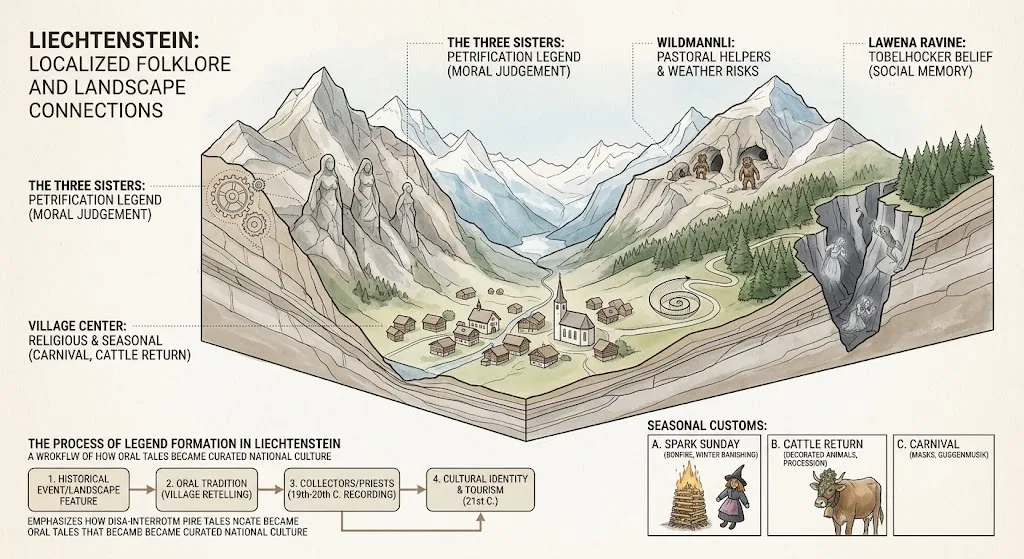
The country’s most distinctive folkloric tradition is the memory of the witch persecutions and their aftermath, especially the Tobelhocker belief connected with Triesen and Triesenberg. In this tradition, the moral order is turned upside down: not the alleged witches, but the accusers and persecutors are imagined as the guilty dead, condemned to haunt a ravine. That gives Liechtenstein folklore a sharper historical edge than many “haunted mountain” traditions, because the story is not only about spirits but about social memory, blame and the long afterlife of violence.[historisches-lexikon.li]historisches-lexikon.liTobelhocker – Historisches LexikonTobelhocker – Historisches Lexikon
What makes Liechtenstein folklore distinctive?
Liechtenstein folklore belongs to the broader Alpine and Alemannic world shared with eastern Switzerland and Vorarlberg, yet it has a recognisably local pattern. Its tales often explain visible places: a mountain chain, a street name, a ravine, a cave, a chapel or a field name. The Historical Lexicon describes such stories as localised narratives with a stronger claim to reality than fairy tales, and notes that Liechtenstein’s legends include demons, spirits, giants, dwarfs, devils, historical memories and origin stories for puzzling features in the landscape.[historisches-lexikon.li]historisches-lexikon.liSagen und Legenden – Historisches LexikonSagen und Legenden – Historisches Lexikon
That local anchoring matters because Liechtenstein is tiny, mountainous and village-centred. A legend can point to a specific place and still feel nationally meaningful. The official tourism selection of “most famous legends” moves across Planken, Vaduz, Eschen, Triesenberg and Balzers, showing how a small country can hold a surprisingly varied map of supernatural tradition: petrified sisters above the Rhine Valley, a devilish horse in Vaduz, a trickster chest in Eschen, helpful wild mountain beings around Triesenberg, and a nocturnal procession in Balzers.[Visit Liechtenstein]en.tourismus.liVisit Liechtenstein Top legends of LiechtensteinVisit Liechtenstein Top legends of Liechtenstein
The other distinctive feature is the way folklore and documented history overlap. Liechtenstein’s witch persecutions were not simply a vague “dark past”: the Historical Lexicon records several waves of persecution in Vaduz and Schellenberg, with about 200 documented death sentences overall and especially intense proceedings in 1679–1680. The same entry notes that the last trials of 1679–1680 were, after the Salzburg persecutions around the so-called Zauberer-Jackl case, the second-largest witch-trial series of their time.[historisches-lexikon.li]historisches-lexikon.liHexenverfolgung – Historisches LexikonHexenverfolgung – Historisches Lexikon
The Three Sisters: a mountain turned into a moral story
The Three Sisters legend is probably the best-known Liechtenstein tale because it links a dramatic mountain form with a clear, memorable warning. In the official retelling, three young women go berry-picking above Planken on Lady Day, 15 August, instead of obeying the church bells calling them to the feast. On their way home, they refuse berries to a radiant woman, who declares that their hearts are stone and that as stone they shall remain. The mountain rocks are then explained as the sisters themselves, petrified above the Rhine Valley.[Visit Liechtenstein]en.tourismus.liVisit Liechtenstein The Drei Schwestern mountain chainVisit Liechtenstein The Drei Schwestern mountain chain
The story is easy to read as a Catholic moral tale: neglect of a holy day, failure of charity and punishment through transformation. It is also a classic landscape legend. Rather than treating the mountain as anonymous geology, the tale gives it personality and memory. A traveller seeing the peaks is invited to read them as a frozen human drama: pride, refusal, revelation and judgement. The official tourism page also connects the legend with walking routes to the mountain range, showing how oral tradition has become part of contemporary landscape interpretation and visitor culture.[Visit Liechtenstein]en.tourismus.liVisit Liechtenstein The Drei Schwestern mountain chainVisit Liechtenstein The Drei Schwestern mountain chain
The Three Sisters tale also shows the role of retelling. It is not presented today as an eyewitness report, but as a traditional narrative attached to place. The Historical Lexicon’s discussion of Liechtenstein legends warns that many collected tales were shaped by educated collectors who sometimes added moralising or religious emphasis. That does not make the stories “fake”; it means readers should treat them as living cultural material, not as untouched recordings from an ancient past.[historisches-lexikon.li]historisches-lexikon.liSagen und Legenden – Historisches LexikonSagen und Legenden – Historisches Lexikon
Witch trials, ghosts and the Tobelhocker memory
The strongest example of folklore carrying historical trauma is the Tobelhocker tradition. According to the Historical Lexicon, the Tobelhocker belief remembers the final witch trials of 1679–1680. The persecutors and their descendants were imagined as being banished after death into the Lawena ravine near Triesen, where they had to atone for their own misdeeds or those of their ancestors. The Lexicon calls this tradition unusual outside Liechtenstein because it links the age of witch persecutions to a belief that survived into modern times.[historisches-lexikon.li]historisches-lexikon.liTobelhocker – Historisches LexikonTobelhocker – Historisches Lexikon
This is not a simple ghost story. In many European witch traditions, the supposed witch is the frightening figure. In the Tobelhocker tradition, the moral horror is redirected towards denunciation and judicial violence. The Lexicon explains that after the last Vaduz witch trials were declared unlawful, victims were not only rehabilitated in legal or symbolic terms; the stigma was also transferred to the families of accusers and denouncers, sometimes called “burners”. That stigma endured for centuries, even affecting marriage circles in Triesen and Triesenberg into the twentieth century.[historisches-lexikon.li]historisches-lexikon.liTobelhocker – Historisches LexikonTobelhocker – Historisches Lexikon
The historical background is severe. In Vaduz and Schellenberg, witch beliefs involved ideas of harmful magic, devil pacts, sabbaths and flight; these ideas were widespread across the German-speaking world, but the small local political structure made the persecutions especially intense. The Historical Lexicon records that in 1679 three quarters of those executed were male, and in 1680 about 40 per cent were male, which is important because it complicates the common assumption that witch persecutions always targeted women almost exclusively.[historisches-lexikon.li]historisches-lexikon.liHexenverfolgung – Historisches LexikonHexenverfolgung – Historisches Lexikon
The Tobelhocker legend therefore works as social memory. It gave a ravine a haunted charge, but it also gave a community a way to say that the wrong people had been condemned. Its horror lies less in monsters than in the persistence of blame: the dead accusers remain bound to place, and their descendants inherit the story’s shadow.[historisches-lexikon.li]historisches-lexikon.liTobelhocker – Historisches LexikonTobelhocker – Historisches Lexikon
The Walser layer: highland identity and legendary walking routes
Triesenberg adds a second major layer to Liechtenstein folklore: Walser culture. The Walser were settlers from the Valais region of Switzerland who moved into high Alpine areas; the Walser Museum states that migrants from Valais settled in Triesenberg in the thirteenth century and developed an isolated but independent existence with distinctive customs. The Historical Lexicon gives a more precise historical frame, noting that German-speaking Walser settlement at Triesenberg is first documented in 1355, though it may have begun before then, possibly around the late thirteenth century.[Walsermuseum]walsermuseum.liOpen source on walsermuseum.li.
This Walser heritage is not only historical; it remains a cultural marker. The Walser Museum describes the Triesenberg dialect as part of the High Alemannic language group, still associated with Upper Valais and other Walser regions. It also highlights a distinctive way of life based on alpine dairying, self-sufficiency and former civil liberties. In a folklore context, that matters because legends are carried not only by plots but by dialect, settlement patterns, farming rhythms and local memory.[Walsermuseum]walsermuseum.liThe Walser people | Walsermuseum TriesenbergThe Walser people | Walsermuseum Triesenberg
Modern Liechtenstein actively stages this heritage through the Walser Museum and the Walser Legends Trail. The official trail site describes a circular route starting and ending at the Walser Museum, while Liechtenstein Tourism says the trail tells legends on station and information boards against views of the Rhine Valley. This is a good example of folklore changing form: what may once have been told in homes, inns or work settings is now also experienced through curated walks, museum interpretation and cultural tourism.[walsersagenweg.li]walsersagenweg.liOpen source on walsersagenweg.li.
Wild mountain beings, night processions and devilish animals
Liechtenstein’s supernatural beings are often modest, local and practical rather than grandly mythological. The Wildmannli, for example, are described in the official tourism retelling as fur-covered mountain creatures who lived in caves in the Nenzing valley and came to Malbun and Steg to care for the cattle of Triesenberg people. They are helpful, but not fully dependable: when a foehn wind blows, they stay away, and the unattended cattle suffer.[Visit Liechtenstein]en.tourismus.liVisit Liechtenstein The WildmannliVisit Liechtenstein The Wildmannli
That detail gives the tale a recognisable Alpine realism. The story is about a marvellous helper, but it is also about weather, cattle, labour and risk. The Wildmannli are not simply “monsters”; they dramatise a world in which survival depends on knowing mountains, winds and animals. A second episode, in which a midwife receives charcoal that later proves valuable, belongs to a wider family of European fairy and dwarf reward tales: the human fails to recognise the worth of a strange payment until too late.[Visit Liechtenstein]en.tourismus.liVisit Liechtenstein The WildmannliVisit Liechtenstein The Wildmannli
The Night Folks of Balzers are more eerie and less morally explained. In the tourism version, a man hears a strange noise at night, rushes to the window with only one leg in his trousers, and sees a dark, thunderous procession. At the end walks a figure who mirrors him, also with one trouser leg on. The tale feels like a warning against looking too closely at nocturnal powers, but it is also almost comic in its final image.[Visit Liechtenstein]en.tourismus.liVisit Liechtenstein The Night PeopleVisit Liechtenstein The Night People
The Lochgass white horse in Vaduz is more explicitly moral. A greedy farmer who steals even on Christmas Eve mounts a saddled white horse by the Rhine, is carried violently back towards Vaduz, breaks his neck, sees the horse turn into the devil, and is then condemned to haunt the lane as a white horse until a wayside cross ends the haunting. The story ties together theft, sacred time, the devil, a street name and the protective power of Christian signs.[Visit Liechtenstein]en.tourismus.liVisit Liechtenstein The Lochgass white horseVisit Liechtenstein The Lochgass white horse
Seasonal customs: fire, carnival and the cattle’s return
Liechtenstein folklore is not only a body of stories; it also lives in seasonal customs. Liechtenstein Tourism describes the country’s identity as shaped by church festivals and everyday traditions, with influences shared with Switzerland and Vorarlberg. Three customs are especially useful for understanding the rhythm of public tradition: Carnival before Lent, Spark Sunday with its winter-banishing bonfires, and the autumn return of cattle from the mountain pastures.[Visit Liechtenstein]en.tourismus.liVisit Liechtenstein Customs & traditions in LiechtensteinVisit Liechtenstein Customs & traditions in Liechtenstein
Spark Sunday is the most visually folkloric. In each municipality, one or more wooden towers are built from collected dry Christmas trees, with a “spark witch” placed at the top. The tower is burned, and the explosion of the powder-filled figure is treated as the highlight; according to the tourism page, the faster the fire burns and the doll explodes, the sooner winter is supposed to vanish. Today it is also a social event with pastries, fireworks and local gatherings.[Visit Liechtenstein]en.tourismus.liVisit Liechtenstein Spark Sunday in LiechtensteinVisit Liechtenstein Spark Sunday in Liechtenstein
Carnival is presented as Liechtenstein’s “fifth season”, with costumes, parades, masked balls and Guggenmusik-style noisy brass-and-percussion bands. Every municipality has its own celebrations, which means the custom is national in reach but local in performance. Folklorically, Carnival belongs to a European pre-Lenten world of inversion, disguise, noise and public release, but in Liechtenstein it is best understood through its village scale: a shared festive grammar played out in Vaduz, Schaan, Triesen, Eschen, Mauren, Malbun and Triesenberg.[Visit Liechtenstein]en.tourismus.liVisit Liechtenstein Fasnacht in LiechtensteinVisit Liechtenstein Fasnacht in Liechtenstein
The autumn alpine descent is gentler but equally tied to landscape. Cows and cattle return from mountain pastures decorated with elaborate headpieces and bells; the timing depends on weather and remaining fodder, and each alp has its own customs. The official account also notes cattle prize events, including the playful title “Miss Liechtenstein” for prize-winning cows. This is folklore as lived pastoral culture: sound, procession, animal beauty, weather sense and community recognition.[Visit Liechtenstein]en.tourismus.liVisit Liechtenstein Alpine skiing in LiechtensteinVisit Liechtenstein Alpine skiing in Liechtenstein
How old are these traditions, and how reliable is the evidence?
The evidence for Liechtenstein folklore is mixed, and that is part of the story. Some customs are still actively practised and documented by municipalities, museums and tourism bodies. Some legends are known through twentieth-century and late nineteenth-century collections. Some beliefs, especially around the witch trials, can be checked against historical research and legal memory, though the supernatural claims themselves remain traditional narratives rather than verifiable events.[Visit Liechtenstein]en.tourismus.liVisit Liechtenstein Customs & traditions in LiechtensteinVisit Liechtenstein Customs & traditions in Liechtenstein
The Historical Lexicon is clear that Liechtenstein’s storytelling history has not been fully researched as a field. It also notes that collectors and editors were often educated figures such as teachers and priests, who inherited nineteenth-century Romantic ideas about “folk poetry” and sometimes wrapped stories in religious or moral commentary. This is crucial for readers: the legends are not worthless because they were edited, but they should not be treated as pristine transcripts from an immemorial past.[historisches-lexikon.li]historisches-lexikon.liSagen und Legenden – Historisches LexikonSagen und Legenden – Historisches Lexikon
The collection history is nevertheless substantial. The Lexicon lists Hans-Friedrich Walser’s 1948 collection as the first Liechtenstein monograph on the subject, later republished under a title meaning Liechtenstein legends from mountain and valley. It also identifies Otto Seger’s 1966 “Sagen aus Liechtenstein”, with a 1973 supplement and later separate editions, as the best-known and commonly used Liechtenstein legend book. A 2020 LandesMuseum edition of Liechtenstein legends collected by Seger shows how this collected material continues to be republished for modern readers in illustrated and multilingual form.[historisches-lexikon.li]historisches-lexikon.liSagen und LegendenSagen und Legenden
So the safest reading is layered: old oral motifs, local place-names, Catholic moral framing, early modern historical trauma, twentieth-century collecting and twenty-first-century tourism all contribute to the folklore now associated with Liechtenstein. The country’s legends are not a single untouched inheritance; they are a cultural conversation across generations.

How Liechtenstein folklore is understood today
Today, Liechtenstein folklore is public-facing, walkable and museum-friendly. The Walser Legends Trail, the Walser Museum, the Liechtenstein National Museum and official tourism pages all present legends and customs as part of cultural identity rather than as literal supernatural claims. The National Museum’s broader remit covers the history, natural history and culture of the country, while the Walser Museum focuses on the everyday life, farming, logging, livestock economy and domestic culture of the Triesenberg Walser community.[Tourismus]tourismus.liOpen source on tourismus.li.
This modern framing changes the function of the stories. A tale such as the Three Sisters may once have taught religious obedience and generosity; now it also helps visitors read the mountain landscape. The Lochgass horse may once have warned against theft and Christmas Eve impiety; now it also explains a Vaduz place-name. The Wildmannli may preserve memories of uncertain mountain labour; now they also give families and hikers a memorable way into Walser culture.[Visit Liechtenstein]en.tourismus.liVisit Liechtenstein The Drei Schwestern mountain chainVisit Liechtenstein The Drei Schwestern mountain chain
The Tobelhocker tradition remains the most ethically charged because it cannot be reduced to picturesque heritage. It points back to accusations, executions, unlawful proceedings, family stigma and the long social afterlife of persecution. In that sense, Liechtenstein folklore is at its most powerful when it refuses to separate the supernatural from the human. The ravine-haunting is frightening, but the deeper fear is communal: what happens when a society believes the wrong story about its neighbours, and how long that story can continue to shape the living.[historisches-lexikon.li]historisches-lexikon.liTobelhocker – Historisches LexikonTobelhocker – Historisches Lexikon
Amazon book picks
Further Reading
Books and field guides related to Why Liechtenstein's Legends Feel So Close. Use these as the next step if you want deeper reading beyond the article.
The Uses of Enchantment
Explains how traditional tales function within communities and collective memory.
The Lore of Scotland
Demonstrates how local landscapes preserve legends, similar to Alpine traditions.
The Book of Symbols
Helps readers interpret recurring symbolic motifs in legends and folklore.
Dr. Bruno Bettelheim Reads "the Struggle for Meaning" and "Ha...
First published 1985.
eBay marketplace picks
Marketplace Samples
Live-tested eBay searches with available results related to this page.
Endnotes
1.
Source: en.tourismus.li
Title: Visit Liechtenstein Top legends of Liechtenstein
Link:https://en.tourismus.li/reiseland/unser-land/feiertage-brauchtum/top-sagen-liechtensteins.html
2.
Source: historisches-lexikon.li
Title: Sagen und Legenden – Historisches Lexikon
Link:https://historisches-lexikon.li/Sagen_und_Legenden
3.
Source: historisches-lexikon.li
Title: Tobelhocker – Historisches Lexikon
Link:https://historisches-lexikon.li/Tobelhocker
4.
Source: historisches-lexikon.li
Title: Hexenverfolgung – Historisches Lexikon
Link:https://historisches-lexikon.li/Hexenverfolgung
5.
Source: en.tourismus.li
Title: Visit Liechtenstein The Drei Schwestern mountain chain
Link:https://en.tourismus.li/reiseland/unser-land/feiertage-brauchtum/top-sagen-liechtensteins/die-drei-schwestern.html
6.
Source: en.tourismus.li
Title: Visit Liechtenstein The Lochgass white horse
Link:https://en.tourismus.li/reiseland/unser-land/feiertage-brauchtum/top-sagen-liechtensteins/der-lochgass-schimmel.html
7.
Source: en.tourismus.li
Title: Visit Liechtenstein The Golden Boos
Link:https://en.tourismus.li/reiseland/unser-land/feiertage-brauchtum/top-sagen-liechtensteins/die-goldene-boos.html
8.
Source: en.tourismus.li
Title: Visit Liechtenstein The Wildmannli
Link:https://en.tourismus.li/reiseland/unser-land/feiertage-brauchtum/top-sagen-liechtensteins/die-wildmannli.html
9.
Source: en.tourismus.li
Title: Visit Liechtenstein The Night People
Link:https://en.tourismus.li/reiseland/unser-land/feiertage-brauchtum/top-sagen-liechtensteins/das-nachtvolk.html
10.
Source: walsermuseum.li
Link:https://walsermuseum.li/en
11.
Source: historisches-lexikon.li
Title: Triesenberg – Historisches Lexikon
Link:https://historisches-lexikon.li/Triesenberg
12.
Source: walsermuseum.li
Title: The Walser people | Walsermuseum Triesenberg
Link:https://walsermuseum.li/en/die-walser
13.
Source: en.tourismus.li
Title: Visit Liechtenstein On the trail of the Walser
Link:https://en.tourismus.li/reiseland/unser-land/feiertage-brauchtum/walser.html
14.
Source: en.tourismus.li
Title: Visit Liechtenstein Walser Museum, Triesenberg
Link:https://en.tourismus.li/map/poi/walsermuseum-e7e9eda4-f07a-4f43-bb4b-f58006674111.html
15.
Source: en.tourismus.li
Title: Visit Liechtenstein Customs & traditions in Liechtenstein
Link:https://en.tourismus.li/reiseland/unser-land/brauchtum.html
16.
Source: en.tourismus.li
Title: Visit Liechtenstein Spark Sunday in Liechtenstein
Link:https://en.tourismus.li/reiseland/unser-land/feiertage-brauchtum/funkensonntag.html
17.
Source: en.tourismus.li
Title: Visit Liechtenstein Fasnacht in Liechtenstein
Link:https://en.tourismus.li/reiseland/unser-land/feiertage-brauchtum/fasnacht.html
18.
Source: en.tourismus.li
Title: Visit Liechtenstein Alpine skiing in Liechtenstein
Link:https://en.tourismus.li/reiseland/unser-land/feiertage-brauchtum/alpabfahrt.html
19.
Source: historisches-lexikon.li
Title: Sagen und Legenden
Link:https://historisches-lexikon.li/index.php?action=mpdf&title=Sagen_und_Legenden
20.
Source: shop.landesmuseum.li
Link:https://shop.landesmuseum.li/produkt/liechtensteinische-sagen/
21.
Source: tourismus.li
Link:https://tourismus.li/map/poi/liechtensteinisches-landesmuseum-a6cb2da3-e9af-4f96-9ae2-033a7d9c8541.html
22.
Source: en.tourismus.li
Title: li Package “On the trail of the Walser”
Link:https://en.tourismus.li/map/poi/auf-den-spuren-der-walser-889a0771-98e6-4da0-a061-4681344142e2.html
23.
Source: historisches-lexikon.li
Link:https://historisches-lexikon.li/Planken
24.
Source: historisches-lexikon.li
Link:https://historisches-lexikon.li/index.php?action=mpdf&title=Tobelhocker
25.
Source: historisches-lexikon.li
Link:https://historisches-lexikon.li/Schaan
26.
Source: walsermuseum.li
Link:https://walsermuseum.li/
27.
Source: landesmuseum.li
Link:https://www.landesmuseum.li/de/
28.
Source: museums.ch
Link:https://www.museums.ch/de/museumsbesuch/museen/museen/liechtensteinisches-landesmuseum-2368.html
29.
Source: walsersagenweg.li
Link:https://walsersagenweg.li/en
30.
Source: Wikipedia
Link:https://de.wikipedia.org/wiki/Tobelhocker
31.
Source: myswitzerland.com
Link:https://www.myswitzerland.com/en/experiences/triesenberg-walser-museum/
32.
Source: about-liechtenstein.co.uk
Link:https://about-liechtenstein.co.uk/index.php/history/natural/people/customs
33.
Source: tourispo.com
Title: Walser Museum Triesenberg
Link:https://www.tourispo.com/museum/walser-museum-triesenberg.html
34.
Source: tripadvisor.com
Title: Walsermuseum Triesenberg
Link:https://www.tripadvisor.com/Attraction_Review-g190370-d10749030-Reviews-Walsermuseum_Triesenberg-Triesenberg.html
35.
Source: aroundus.com
Title: Walsermuseum Triesenberg
Link:https://aroundus.com/p/5907585-walsermuseum-triesenberg
36.
Source: culturalheritageonline.com
Title: Walser Museum
Link:https://culturalheritageonline.com/places/walser-museum-l2820/
37.
Source: swissvillages.org
Link:https://swissvillages.org/triesenberg/?lang=de
38.
Source: evendo.com
Link:https://evendo.com/locations/liechtenstein/eschnerberg/attraction/walsermuseum
Additional References
39.
Source: youtube.com
Title: The Witchhunt that Founded Liechtenstein
Link:https://www.youtube.com/watch?v=1wC2iHX2dX4
Source snippet
The Principality of Liechtenstein: Nature, Culture, and Culinary Highlights – with Sebastian Ströbel...
40.
Source: youtube.com
Title: Liechtenstein Explained in 14 Minutes | History, Geography, Culture
Link:https://www.youtube.com/watch?v=rG14hmPq9Mg
Source snippet
Liechtenstein: The Tiny Country with a Giant Secret...
41.
Source: vanone.co.uk
Link:https://www.vanone.co.uk/relocating-to-liechtenstein/liechtenstein
42.
Source: magicbohemia.com
Link:https://magicbohemia.com/a-peasant-girl-haunts-lichtenstein-palace/
43.
Source: facebook.com
Link:https://www.facebook.com/groups/catholicandproud/posts/25213188238287025/
44.
Source: facebook.com
Link:https://www.facebook.com/GermanCultureandMore/posts/carnival-has-only-just-come-to-an-end-but-it-is-already-time-for-the-next-tradit/1254627446848519/
45.
Source: academia.edu
Link:https://www.academia.edu/62698795/Die_Tobelhocker_in_Liechtenstein_von_T%C3%A4tern_und_Opfern_nach_dem_Ende_der_Hexenprozesse
46.
Source: instagram.com
Link:https://www.instagram.com/reel/DD0lt3YvZ7X/?hl=en
47.
Source: facebook.com
Link:https://www.facebook.com/groups/1064192623599055/posts/8587015331316709/
48.
Source: myswitzerland.com
Link:https://www.myswitzerland.com/en-ch/experiences/events/events-search/-/eastern-switzerland-liechtenstein/?p=2&rubrik=customsandtraditions
Topic Tree
Follow this branch
Related pages 192
- Afghan Folklore
- Albanian Folklore
- Algerian Folklore
- Australian Folklore
- Azerbaijan Folklore
- +187 more in sidebar