Where Myanmar's Spirits Still Have Places
Myanmar’s folklore is not a single story-world but a layered religious and oral landscape: Buddhist relic legends, spirit worship, village guardians, festival myths, ogres, ghosts, enchanted animals, sacred mountains and ethnic origin stories all sit beside one another.
Page outline Jump by section
Introduction
For a reader coming fresh to Myanmar folklore, the key point is that many famous tales are not “myths” in the distant, literary sense. They are attached to places people still visit, festivals people still attend, and rituals that still structure household, village and pilgrimage life. Mount Popa, Taungbyone, Shwedagon Pagoda, Pindaya Caves and the New Year water festival are not just attractions or calendar entries; they are public stages where old stories remain visible, argued over, adapted and retold.[travelfish.org]travelfish.orgOpen source on travelfish.org.
Why Myanmar folklore feels both Buddhist and older than Buddhism
Myanmar is strongly associated with Theravada Buddhism, but its folklore is full of beings and practices that do not fit neatly into formal Buddhist doctrine. This is not a contradiction so much as a long cultural pattern. Maung Htin Aung’s classic account of folk elements in Burmese Buddhism describes spirit worship, astrology and alchemy as major pre-existing popular traditions when King Anawrahta of Bagan made Theravada Buddhism central to royal and public life in the eleventh century.[The Atlantic]theatlantic.comOpen source on theatlantic.com.
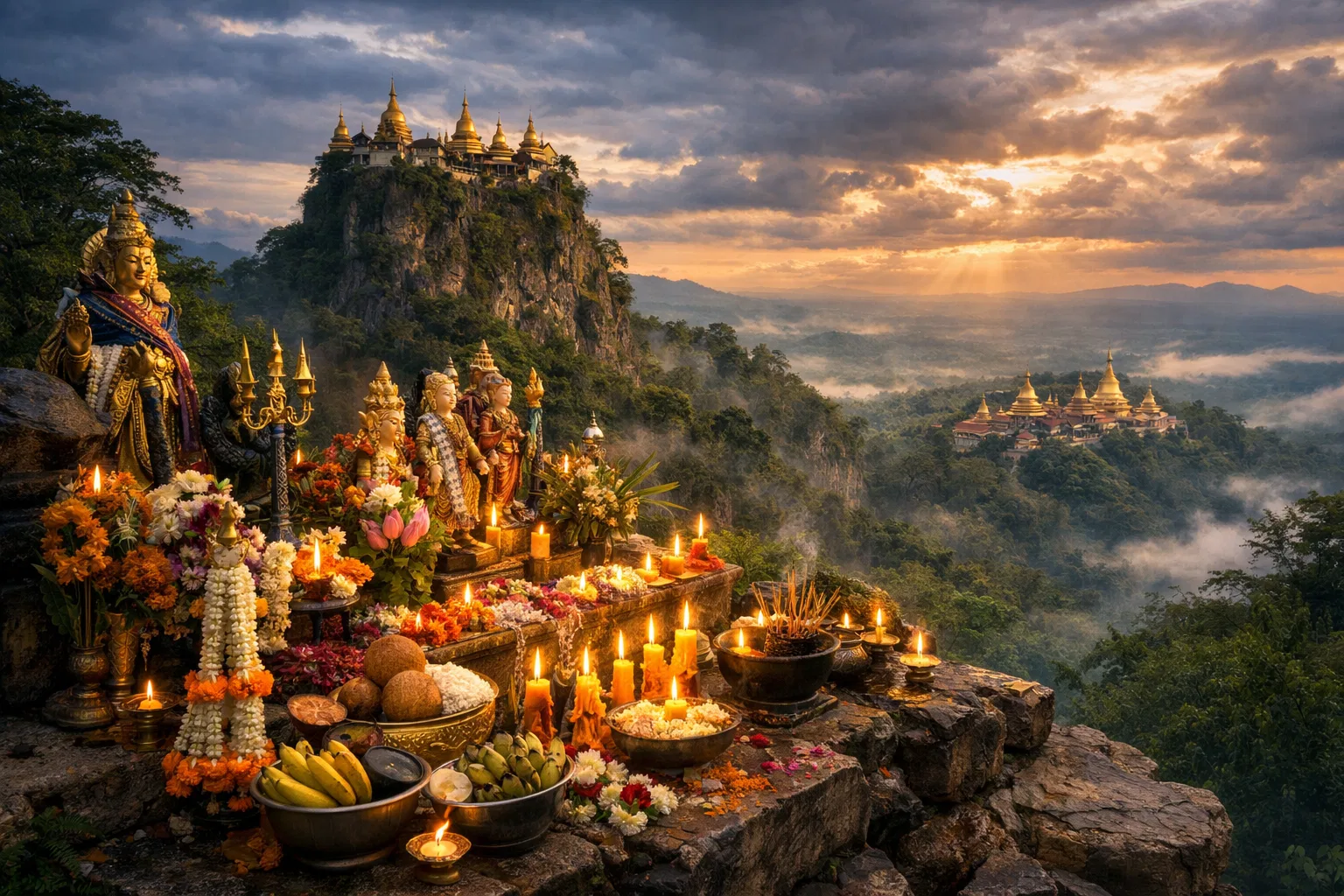
The spirit tradition most often mentioned in Myanmar is the cult of nats. In broad terms, nats are powerful spirits or deities who may protect, punish, bless, demand offerings, inhabit natural features or act as guardians of families and territories. Reference works and ethnographic studies repeatedly stress that the word covers more than one category: nature spirits, local guardian spirits, former humans, royal or heroic figures, and beings connected with land, trees, water, fields and villages.[Encyclopedia.com]encyclopedia.comOpen source on encyclopedia.com.
A famous organising idea is the group of Thirty-Seven Great Nats. Tradition links their formalisation to King Anawrahta, whose religious policy is often interpreted as an attempt to bring older spirit devotion into a Buddhist royal order rather than simply abolish it. This is why Myanmar folklore often feels double-layered: a spirit may be ritually honoured, feared or loved, while still being placed beneath the higher moral and cosmic frame of Buddhism.[Encyclopedia.com]encyclopedia.comOpen source on encyclopedia.com.
That layering matters for interpretation. It stops us from treating Myanmar folklore as a museum of “pre-Buddhist survivals” on one side and “Buddhist stories” on the other. In practice, the two have long interacted. A family shrine, a village guardian, a nat festival, a Buddhist pagoda legend and a moral tale about merit may all be part of the same lived religious world.
Nats: the spirits at the centre of Myanmar’s supernatural imagination
The most memorable nat stories often begin with death. Many of the famous nats are said to have been human beings who died suddenly, violently or unjustly, then became powerful spirits. This gives the tradition a striking emotional shape: folklore becomes a way of remembering wronged people, dangerous power and unfinished social debts. The spirits are not simply “gods” in a tidy pantheon; they are personalities with biographies, grievances, preferences and places.[Encyclopedia.com]encyclopedia.comOpen source on encyclopedia.com.
In ordinary description, nat worship is sometimes called animist, but that word can flatten the tradition if used carelessly. Nat belief is not only a belief that nature has spirits. It also includes court legends, village protection, family obligations, mediums, music, possession, offerings, festival economies and stories of kings attempting to domesticate unruly supernatural powers. Melford Spiro’s influential study, first based on fieldwork in the early 1960s, framed Burmese supernaturalism as a system concerned with explaining and reducing suffering, rather than as a set of disconnected superstitions.[ResearchGate]researchgate.netResearch Gate(PDF) Burmese SupernaturalismResearch Gate(PDF) Burmese Supernaturalism
Nats are especially important because they connect the supernatural to the social world. A nat may explain illness, bad luck, danger at a place, a family obligation or the success of a journey. Devotion can involve flowers, food, music, dance, coconuts, cloth, spirit mediums and vows. The tradition has been more visible in rural and local settings than in highly urbanised modern life, but it remains a widely recognised part of Myanmar’s cultural vocabulary.[InsideAsia Tours]insideasiatours.comOpen source on insideasiatours.com.
A useful way to understand the tradition is to think of nats as “nearby powers”. Buddhist cosmology may describe vast heavens and rebirths, but nats bring supernatural attention close to the road, the tree, the house, the mountain, the village, the shrine and the family line.
Mount Popa and Taungbyone: where spirit stories become public events
Two places show why Myanmar folklore cannot be separated from landscape and performance: Mount Popa and Taungbyone.
Mount Popa, near Bagan, is often described as the great centre of nat devotion. The mountain’s sacred reputation comes from its association with powerful spirits, especially the famous Popa mother figure and other nats linked to Bagan-era legend. Modern accounts commonly present the site as the symbolic home or gathering place of major nat devotion, while also recognising that its stories have been shaped by Buddhist pilgrimage, royal memory and tourism.[The Revealer]therevealer.orgreviving burmese nat shrines to protect myanmars mount popa national parkreviving burmese nat shrines to protect myanmars mount popa national park
The stories around Mount Popa are vivid because they combine mountain, monarchy and danger. One well-known cycle tells of a flower-eating ogress or powerful female being associated with Popa, while another links the mountain to sibling nats from older royal legend. These are not merely decorative tales attached to a scenic site; they help explain why the mountain is approached as a charged place where devotion, fear, fertility, protection and political memory meet.[Wikipedia]WikipediaMount PopaMount Popa
Taungbyone, near Mandalay, is even more visibly theatrical. The Taungbyone festival honours two famous brother spirits and is widely described as Myanmar’s largest or most famous nat festival. Visitors, devotees and mediums gather for days of offerings, music, dance, possession rituals, socialising and commerce. Travel accounts can sometimes overemphasise colour and spectacle, but academic and ethnographic accounts show that the festival is also a structured ritual world with hereditary roles, spirit palaces, ritual sequences and obligations.[chula.ac.th]digital.car.chula.ac.thOpen source on chula.ac.th.
The legend at the heart of Taungbyone tells of two brothers connected with King Anawrahta’s service. In the best-known version, they neglected a duty connected with the building of a pagoda and were executed or killed; after death they became powerful spirits granted territory. The festival keeps that story alive not as a static narrative but through repeated performance: dances, invocations, ritual bathing, offerings and re-enactments of episodes from the brothers’ lives.[Academia]academia.eduOpen source on academia.edu.
Taungbyone also matters because it reveals how folklore can create temporary social worlds. For the duration of the festival, a village becomes a dense ritual marketplace: spirit mediums perform, pilgrims seek help or blessing, traders sell food and goods, and sacred biography becomes public entertainment as well as devotion.[Travelfish]travelfish.orgOpen source on travelfish.org.
Sacred pagodas and foundation legends
Some of Myanmar’s most important legends are attached not to monsters or ghosts but to sacred architecture. Pagoda foundation stories explain why a place is holy, why relics matter, and why kings, merchants, monks and spirits belong in the same national story.
The Shwedagon Pagoda in Yangon is the clearest example. According to tradition, two merchant brothers met the Buddha soon after his enlightenment, received hair relics from him, and eventually enshrined them at the site now associated with Shwedagon. UNESCO’s tentative-list description records the central contrast between legend and archaeology: the legend places the foundation more than 2,600 years ago, while scholarly research generally places the earliest construction much later, between roughly the sixth and tenth centuries CE.[UNESCO World Heritage Centre]whc.unesco.orgOpen source on unesco.org.
That difference does not make the legend unimportant. It tells us how sacred time works in Myanmar folklore. A pagoda legend is not only a construction report; it links the present landscape directly to the Buddha, earlier Buddhas, royal patrons and the preservation of religious truth. Donald Stadtner’s study of Shwedagon myths shows how the story of the merchant brothers developed through Pali sources, inscriptions and later Burmese religious imagination, with the local connection to Yangon becoming especially important in later Lower Myanmar tradition.[Academia]academia.eduPDF) The Shwedagon Pagoda: Myths and HistoryPDF) The Shwedagon Pagoda: Myths and History
Bagan carries a related but different kind of legendary weight. Its temples and monuments are historical remains of a major Buddhist kingdom, but its kings, relics and spirit stories have also become part of folklore. UNESCO notes the importance of Bagan’s eleventh- and twelfth-century religious monuments, murals and pilgrim culture, while popular tradition remembers Anawrahta as both a Buddhist king and a figure in stories about the ordering of nat worship.[UNESCO World Heritage Centre]whc.unesco.orgOpen source on unesco.org.
In Myanmar, then, sacred-site folklore often does two things at once. It gives a local place cosmic importance, and it gives national history a memorable narrative shape. A hill, cave, stupa or shrine is rarely just a monument; it is a story one can walk around.
Ogres, spiders, animal helpers and other beings in folk tales
Beyond nat devotion and pagoda legends, Myanmar has a rich body of folk tales: wonder tales, animal tales, moral tales, trickster episodes, origin stories and local legends. Gerry Abbott and Khin Thant Han’s The Folk-Tales of Burma is a major English-language scholarly guide to this material, presenting Burmese tales as a diverse field involving Burman, Karen, Shan, Pa-O, Kayah and other traditions rather than a single national canon.[Brill]brill.comOpen source on brill.com.
One famous kind of being is the ogre or demon figure. In Myanmar story culture, ogres may be man-eating, shape-shifting, terrifying, comic or morally complicated depending on the tale. Their prominence is helped by the long influence of Buddhist birth stories and dramatic retellings of the Ramayana in Myanmar performance culture. Such beings are not simply imported monsters; they have been localised through theatre, children’s literature, Buddhist teaching and oral storytelling.[Wikipedia]WikipediaMythical creatures in Burmese folkloreMythical creatures in Burmese folklore
The Pindaya Caves in Shan State offer a particularly public example of a monster legend. A giant spider is said to have trapped princesses in the cave until a prince rescued them with his bow. Today the legend is visibly marked near the cave entrance by sculptures of the spider and archer, while the caves themselves are also a major Buddhist devotional site filled with images. The tale is a good reminder that Myanmar folklore often survives through place, sculpture and tourism as much as through oral narration.[Fodors Travel Guide]fodors.comTravel Guide The Bizarre Legend Behind Myanmar's Pindaya CavesTravel Guide The Bizarre Legend Behind Myanmar's Pindaya Caves
Animal stories are also central. Like many Southeast Asian and Buddhist-influenced story traditions, Myanmar tales use animals to teach practical wisdom, social caution and moral judgement. The Brill table of contents for The Folk-Tales of Burma includes sections on animal tales, wonder tales, legends and Buddhist-related material such as Jataka stories, showing how the same storytelling environment can hold talking animals, moral fables, local legends and religious exempla together.[GBV]gbv.deOpen source on gbv.de.
This is where the word “folklore” is especially useful. It allows us to see that a ghost, a demon, a clever animal, a Buddhist moral tale and a sacred cave legend are not isolated genres. They are different tools for thinking about danger, luck, desire, justice, cleverness and the unseen pressures around human life.

Ghosts, witches and the uneasy dead
Myanmar supernatural tradition also includes ghosts, witches, ghouls and troubling beings that do not fit neatly into the official nat order. Some accounts distinguish between powerful nats and more restless or dangerous dead, while everyday speech and storytelling may blur those boundaries. An Australian National University feature on Burmese ghosts notes that choosing “the most famous Burmese ghost” is difficult partly because the Thirty-Seven Nats themselves can be understood as representative spirits of people who died through mistreatment or violence.[ANU College of Asia & the Pacific]asiapacific.anu.edu.auOpen source on edu.au.
This overlap is important. In many Western categories, gods, ghosts and demons are sharply divided. Myanmar folklore often works with a more fluid scale of power, status and ritual relationship. A dead person may become dangerous, protective, elevated, localised or domesticated through story and ritual. Some spirits are feared; others are petitioned; some are folded into Buddhist morality; some remain associated with wildness, greed, violence or improper attachment.
Melford Spiro’s work is useful here because it treats such beliefs as part of a practical moral and ritual system. Supernatural beings help explain why misfortune happens and what people may do about it: make offerings, consult specialists, perform rites, change conduct, or interpret suffering as part of a larger unseen order.[ResearchGate]researchgate.netResearch Gate(PDF) Burmese SupernaturalismResearch Gate(PDF) Burmese Supernaturalism
For readers interested in haunted folklore, Myanmar’s ghost traditions should therefore be read less as a catalogue of “scary stories” and more as a cultural grammar of unfinished relations. The dead may matter because kinship, injustice, place, desire and memory have not been settled.
Thingyan: New Year, water and the celestial inspector
Myanmar’s New Year water festival, Thingyan, is one of the country’s most visible seasonal traditions. In 2024, UNESCO inscribed Myanmar’s traditional New Year Atā Thingyan festival on the Representative List of the Intangible Cultural Heritage of Humanity, describing it as a five-day festival observed to celebrate the traditional new year.[ICH UNESCO]ich.unesco.orgOpen source on unesco.org.
For folklore, the important figure is the celestial king who descends during the festival to inspect human conduct. Contemporary explanations say that during Thingyan this being comes to earth and records good and bad deeds, a story that gives the water festival a moral dimension as well as a celebratory one. ANU’s cultural explainer connects this belief with the idea that the celestial figure checks human misdemeanours during the year.[ANU College of Asia & the Pacific]asiapacific.anu.edu.auOpen source on edu.au.
Water is the festival’s most famous public sign: splashing, washing, renewal and the symbolic removal of the old year’s impurities. But Thingyan is not only a water fight. It also involves merit-making, respect for elders, almsgiving, household preparation, music, food and public performance. The folklore gives the festival narrative drama: the year turns, the celestial order pays attention, and human beings begin again under moral observation.[Wikipedia]WikipediaOpen source on wikipedia.org.
Thingyan also shows how Myanmar folklore changes with modern life. Urban stages, popular music, films and public celebrations have expanded the festival’s entertainment side, while family and religious practices preserve quieter meanings of cleansing, respect and renewal. The old story of supernatural inspection survives because it still fits a recognisable human need: the wish to start over, but not without accountability.
Ethnic oral traditions beyond the central Bamar frame
A country-level page on Myanmar folklore should not reduce the whole field to central Burman Buddhist and nat traditions. Myanmar contains many ethnic communities, languages and religious histories, and oral tradition is especially important in communities whose stories were long preserved outside written court chronicles. Minority Rights Group notes Burma/Myanmar’s great ethnic diversity and the long history of cross-border migration and cultural mixture in the region.[Minority Rights Group]minorityrights.orgMinority Rights Group Minorities in BurmaMinority Rights Group Minorities in Burma
Karen traditions, for example, include extensive oral storytelling. The Karen Women’s Organisation describes Karen literary tradition as largely oral, with many hundreds of traditional stories told in the evenings to teach children or entertain adults. Medical and cultural background resources also note the importance of animism, Buddhism and Christianity among Karen communities, a mixture that has shaped how older spirit and story traditions are remembered today.[KWO]karenwomen.orgKWOBackground of the Karen PeopleKWOBackground of the Karen People
Chin origin traditions provide another example. A Chin Human Rights Organisation account discusses the widely repeated myth that Chin ancestors emerged from a cave, rock or underground place, with many variant spellings and local versions. Whether treated as history, mythic memory or identity narrative, the story matters because it gives a people a shared point of emergence and a symbolic homeland.[Chin Human Rights]chinhumanrights.orgOpen source on chinhumanrights.org.
Among Karen communities in Karen State, recent research on sacred forests and conservation has explored the role of spirits in indigenous ways of understanding land, forest and moral responsibility. This is a useful modern reminder that folklore is not only about old tales; it can influence how communities think about forests, ownership, restraint and ecological care.[ResearchGate]researchgate.netOpen source on researchgate.net.
These regional and ethnic traditions are not side notes. They show that “Myanmar folklore” is a national umbrella over many local story systems. Some are tied to Buddhism, some to Christianity, some to animist practice, some to migration memory, and many to more than one of these at once.
How old is the evidence, and what can we trust?
Myanmar folklore is well attested, but not all parts are attested in the same way. Some traditions are documented in inscriptions, chronicles, Pali texts, colonial-era ethnography, twentieth-century scholarship, festival observation and modern heritage records. Others survive through family narration, local ritual, tourist retelling or internet-era summaries. A careful reader should ask not only “What is the story?” but “Where is this version coming from?”
The Shwedagon legend is a good example of layered evidence. The story links the pagoda to the Buddha’s lifetime, but UNESCO’s description makes clear that archaeological and historical research points to a much later construction period. The legend remains culturally central, yet its historical claims need to be read differently from material evidence.[UNESCO World Heritage Centre]whc.unesco.orgOpen source on unesco.org.
Taungbyone offers another kind of evidence. Its stories are tied to chronicles and nat biographies, but the festival’s meaning is also produced through annual performance. A written summary cannot capture the whole tradition because mediumship, music, offerings, hierarchy, commerce and bodily performance are part of the evidence.[digital.car.chula.ac.th]digital.car.chula.ac.thOpen source on chula.ac.th.
Folktale collections raise a third issue. Abbott and Khin Thant Han’s work is valuable because it classifies and contextualises tales from different communities, but any collection fixes a moving oral tradition into selected written versions. A printed tale may be reliable evidence for one recorded version, not proof that every village told it the same way.[Brill]brill.comOpen source on brill.com.
The safest approach is to treat Myanmar folklore as a living archive with different levels of certainty. Sacred legends may be religiously powerful without being archaeologically literal. Festival myths may preserve older patterns while changing through performance. Tourist retellings may keep a story visible while simplifying it. Online summaries may help orientation but should be checked against stronger scholarly, institutional or local sources.
How Myanmar folklore is understood today
Today, Myanmar folklore lives in several overlapping worlds. It survives in rituals, festivals, household practices, pagoda legends, children’s stories, theatre, comics, films, tourism, scholarship and diaspora memory. Some traditions are still devotional; others are mostly cultural, literary or nostalgic. Some are being reframed through heritage language, such as UNESCO recognition for Thingyan, while others remain informal and local.[ICH UNESCO]ich.unesco.orgOpen source on unesco.org.
Modernity has not simply erased older belief. Urbanisation, education, political change, migration and digital media have altered how people encounter folklore, but the underlying figures remain recognisable: the powerful nat, the judging celestial king, the sacred relic, the haunted dead, the giant spider, the ogre, the cave of origin, the forest spirit. These beings continue to offer memorable ways of talking about luck, danger, justice, obligation, ancestry and place.
The most distinctive feature of Myanmar folklore is its closeness to lived culture. A visitor may encounter it as a statue beside a cave, a coconut in a home, a festival dance near Mandalay, a water ritual in April, a pagoda legend in Yangon, or a story told by an elder about where a people came from. The tradition matters because it makes the unseen social: spirits have biographies, places have memories, festivals have moral drama, and sacred landscapes tell stories that are still being retold.
Amazon book picks
Further Reading
Books and field guides related to Where Myanmar's Spirits Still Have Places. Use these as the next step if you want deeper reading beyond the article.
Burmese Folk-tales
One of the most relevant introductions to Burmese traditional stories.
The River of Lost Footsteps
Helps explain the historical setting of Myanmar traditions.
Folk Elements in Burmese Buddhism
Explains spirits, rituals and folklore within Burmese culture.
eBay marketplace picks
Marketplace Samples
Live-tested eBay searches with available results related to this page.
Endnotes
1.
Source: encyclopedia.com
Link:https://www.encyclopedia.com/philosophy-and-religion/eastern-religions/buddhism/nats
2.
Source: travelfish.org
Link:https://www.travelfish.org/beginners_detail/burma_myanmar/111
3.
Source: whc.unesco.org
Link:https://whc.unesco.org/en/tentativelists/6367/
4.
Source: ich.unesco.org
Link:https://ich.unesco.org/en/RL/myanmar-traditional-new-year-at-thingyan-festival-02085
5.
Source: Wikipedia
Title: Nat (deity)
Link:https://en.wikipedia.org/wiki/Nat_%28deity%29
6.
Source: Wikipedia
Title: Taungbyone Festival
Link:https://en.wikipedia.org/wiki/Taungbyone_Festival
7.
Source: researchgate.net
Title: Research Gate(PDF) Burmese Supernaturalism
Link:https://www.researchgate.net/publication/324396335_Burmese_Supernaturalism
8.
Source: Wikipedia
Title: Mount Popa
Link:https://en.wikipedia.org/wiki/Mount_Popa
9.
Source: digital.car.chula.ac.th
Link:https://digital.car.chula.ac.th/cgi/viewcontent.cgi?article=75294&context=chulaetd
10.
Source: academia.edu
Link:https://www.academia.edu/10381446/Taungbyone_Pwe_motivating_of_the_ritual_in_Myanmar
11.
Source: Wikipedia
Link:https://en.wikipedia.org/wiki/Taungbyon
12.
Source: academia.edu
Title: (PDF) The Shwedagon Pagoda: Myths and History
Link:https://www.academia.edu/12927164/The_Shwedagon_Pagoda_Myths_and_History
13.
Source: whc.unesco.org
Link:https://whc.unesco.org/en/news/924
14.
Source: Wikipedia
Link:https://en.wikipedia.org/wiki/Anawrahta
15.
Source: brill.com
Link:https://brill.com/abstract/title/7001?language=en&srsltid=AfmBOor6ldUr3ya-ctBOobBvgkKZ9eTtPzmVMjfpUzepclon2MS7bdeB
16.
Source: gbv.de
Link:https://www.gbv.de/dms/hebis-mainz/toc/090982991.pdf
17.
Source: Wikipedia
Title: Mythical creatures in Burmese folklore
Link:https://en.wikipedia.org/wiki/Mythical_creatures_in_Burmese_folklore
18.
Source: archive.org
Link:https://archive.org/details/folktalesofburma0000abbo
19.
Source: fodors.com
Title: Travel Guide The Bizarre Legend Behind Myanmar’s Pindaya Caves
Link:https://www.fodors.com/world/asia/myanmar/experiences/news/the-place-where-a-giant-spider-stands-guard-over-a-cave-filled-with-9000-buddha-statues
20.
Source: Wikipedia
Link:https://en.wikipedia.org/wiki/Thingyan
21.
Source: karenwomen.org
Title: KWOBackground of the Karen People
Link:https://karenwomen.org/background-of-the-karen-people/
22.
Source: researchgate.net
Link:https://www.researchgate.net/publication/359610676_The_Role_of_Spirits_in_Indigenous_Ontologies_and_Their_Implications_for_Forest_Conservation_in_Karen_State_Myanmar
23.
Source: Wikipedia
Link:https://en.wikipedia.org/wiki/Myanmar
24.
Source: Wikipedia
Link:https://id.wikipedia.org/wiki/Myanmar
25.
Source: Wikipedia
Title: Burmese folk religion
Link:https://en.wikipedia.org/wiki/Burmese_folk_religion
26.
Source: Wikipedia
Title: Shwedagon Pagoda
Link:https://en.wikipedia.org/wiki/Shwedagon_Pagoda
27.
Source: Wikipedia
Title: Karen peoples
Link:https://en.wikipedia.org/wiki/Karen_peoples
28.
Source: Wikipedia
Title: Naga peoples
Link:https://en.wikipedia.org/wiki/Naga_peoples
29.
Source: Wikipedia
Title: Buddhism in Myanmar
Link:https://en.wikipedia.org/wiki/Buddhism_in_Myanmar
30.
Source: myanmar.com
Title: nat spirit worship in myanmar
Link:https://myanmar.com/religion/nat-spirit-worship-in-myanmar/
31.
Source: myanmar.com
Title: nat statues and symbolism in myanmar spiritual culture
Link:https://myanmar.com/culture/nats/nat-statues-and-symbolism-in-myanmar-spiritual-culture/
32.
Source: myanmar.com
Link:https://myanmar.com/culture/nats/
33.
Source: myanmar.com
Link:https://myanmar.com/
34.
Source: myanmar.com
Link:https://myanmar.com/culture/nats/thagyamin-king-of-the-nats/
35.
Source: archive.org
Link:https://archive.org/details/xxVG_folk-elements-in-burmese-buddhism-by-maung-htin-aung-1959-rangoon-u-hla-maung-bu
36.
Source: archive.org
Link:https://archive.org/details/burmesesupernatu0000spir
37.
Source: archive.org
Link:https://archive.org/details/in.ernet.dli.2015.48633
38.
Source: academia.edu
Link:https://www.academia.edu/10927164/Burmese_and_Mon_Foundation_Myths
39.
Source: academia.edu
Link:https://www.academia.edu/34954574/The_Nats_of_Myanmar_spirits_gods_or_devils
40.
Source: academia.edu
Link:https://www.academia.edu/24375706/A_Book_Review_of_Burmese_Supernaturalism_A_Study_in_the_Explanation_and_Reduction_of_Suffering_Melford_E_Spiro_Author
41.
Source: academia.edu
Link:https://www.academia.edu/100152216/Tantrism_and_the_Weretiger_Lore_of_Burma_Thailand_and_Cambodia_draft_
42.
Source: researchgate.net
Link:https://www.researchgate.net/publication/231930887_Myanmar_The_Folk-Tales_of_Burma_An_Introduction_G_ABBOTT_and_KHIN_THANT_HAN_LeidenBostonKoln_Brill_Handbuch_der_Orientalistik_III_vol_11_2000_Pp_xiv_392_Illustrations_Bibliography_Ethnological_Notes_I
43.
Source: researchgate.net
Link:https://www.researchgate.net/publication/307989509_NAGA_SELF-ADMINISTERED_ZONE_NAGAS_LAND_IN_MYANMAR_COLLECTION_BY_MYO_AUNG
44.
Source: researchgate.net
Title: 326882625 Esoteric Theravada Buddhism in BurmaMyanmar
Link:https://www.researchgate.net/publication/326882625_Esoteric_Theravada_Buddhism_in_BurmaMyanmar
45.
Source: ich.unesco.org
Link:https://ich.unesco.org/en/video/72560
46.
Source: travel.state.gov
Link:https://travel.state.gov/content/travel/en/international-travel/International-Travel-Country-Information-Pages/Burma.html
47.
Source: theatlantic.com
Link:https://www.theatlantic.com/magazine/archive/1958/02/folk-elements-in-burmese-buddhism/306833/
48.
Source: insideasiatours.com
Link:https://www.insideasiatours.com/blog/burmese-nat-worship
49.
Source: asiapacific.anu.edu.au
Link:https://asiapacific.anu.edu.au/content-centre/article/news/ghosts-ghosts-everywhere
50.
Source: therevealer.org
Title: reviving burmese nat shrines to protect myanmars mount popa national park
Link:https://therevealer.org/reviving-burmese-nat-shrines-to-protect-myanmars-mount-popa-national-park/
51.
Source: asiapacific.anu.edu.au
Link:https://asiapacific.anu.edu.au/content-centre/article/news/splash-culture-and-tradition-thingyan-or-myanmar-new-year-water
52.
Source: minorityrights.org
Title: Minority Rights Group Minorities in Burma
Link:https://minorityrights.org/app/uploads/2024/01/download-424-minorities-in-burma.pdf
53.
Source: chinhumanrights.org
Link:https://www.chinhumanrights.org/the-origin-of-the-chin/
54.
Source: ebsco.com
Link:https://www.ebsco.com/research-starters/geography-and-cartography/myanmar
55.
Source: relief.unboundmedicine.com
Link:https://relief.unboundmedicine.com/relief/view/The-World-Factbook/563030/all/Burma?q=burma
56.
Source: seasite.niu.edu
Link:https://seasite.niu.edu/Burmese/Culture/thingyan.htm
57.
Source: heritagevoyager.com
Link:https://www.heritagevoyager.com/en/sites/bagan/
58.
Source: books.google.com
Title: Folk Elements in Burmese Buddhism
Link:https://books.google.com/books/about/Folk_Elements_in_Burmese_Buddhism.html?id=bY5vHLw6MU0C
59.
Source: undeniableblessing.org
Title: Water Festival
Link:https://undeniableblessing.org/blog/Water-Festival
60.
Source: insideasiatours.com
Link:https://www.insideasiatours.com/us/blog/burmese-nat-worship
61.
Source: insideasiatours.com
Link:https://www.insideasiatours.com/blog/thingyan-a-survival-guide-for-burmese-new-year
62.
Source: openfactbook.org
Link:https://openfactbook.org/countries/burma/
63.
Source: myanmars.info
Title: the history of buddhism
Link:https://myanmars.info/faith/the-history-of-buddhism.html
64.
Source: ehrafworldcultures.yale.edu
Link:https://ehrafworldcultures.yale.edu/cultures/ap07/summary
65.
Source: geofactbook.com
Link:https://geofactbook.com/countries/myanmar
66.
Source: gomyanmartours.com
Title: Shwedagon Pagoda
Link:https://www.gomyanmartours.com/shwedagon-pagoda-golden-jewel-of-myanmar/
67.
Source: tempo.co
Link:https://www.tempo.co/tag/myanmar
68.
Source: hrw.org
Link:https://www.hrw.org/world-report/2025/country-chapters/myanmar
Additional References
69.
Source: youtube.com
Title: The Preta Family | True Burmese ghost story
Link:https://www.youtube.com/watch?v=MGC1CTujnNg
Source snippet
Burma: What Secrets Lie Hidden Among Its 2000 buddhist pagodas?...
70.
Source: ocbs.org
Link:https://ocbs.org/archive/70-74/1972-book-reviews-of-burmese-supernaturalism-by-melford-e-spiro-buddhism-and-society-a-great-tradition-and-its-burmese-vicissitudes-by-melford-e-spiro-modern-asian-studies-vol-6-no/
71.
Source: amazon.de
Link:https://www.amazon.de/-/en/Anon-Mouse-ebook/dp/B074PH6PN6?tag=searcht-20
72.
Source: facebook.com
Link:https://www.facebook.com/AmazingMyanmar2021/posts/37-nats-deity-in-burma%EF%B8%8F%EF%B8%8Fnat-deity-the-nats-are-god-like-spirits-venerated-in-bur/201278948633349/
73.
Source: scribd.com
Link:https://www.scribd.com/document/483401219/9-Folk-Elements-in-Burmese-Buddhism-Maung-Htin-Aung-blank-pages-omitted-pdf
74.
Source: thesiamsociety.org
Link:https://thesiamsociety.org/knowledge-hub/uploads/research/172/663f7b7c8a1ea.pdf
75.
Source: naushawng.org
Link:https://naushawng.org/wp-content/uploads/2019/03/Kachin-religious.pdf
76.
Source: atlasobscura.com
Link:https://www.atlasobscura.com/places/pindaya-cave
77.
Source: sampantravel.com
Link:https://www.sampantravel.com/bagan/
78.
Source: accesstoinsight.org
Link:https://www.accesstoinsight.org/lib/authors/bischoff/wheel399.html
Topic Tree
Follow this branch
Related pages 192
- Afghan Folklore
- Albanian Folklore
- Algerian Folklore
- Australian Folklore
- Azerbaijan Folklore
- +187 more in sidebar