Why Spain's Folklore Changes by Region
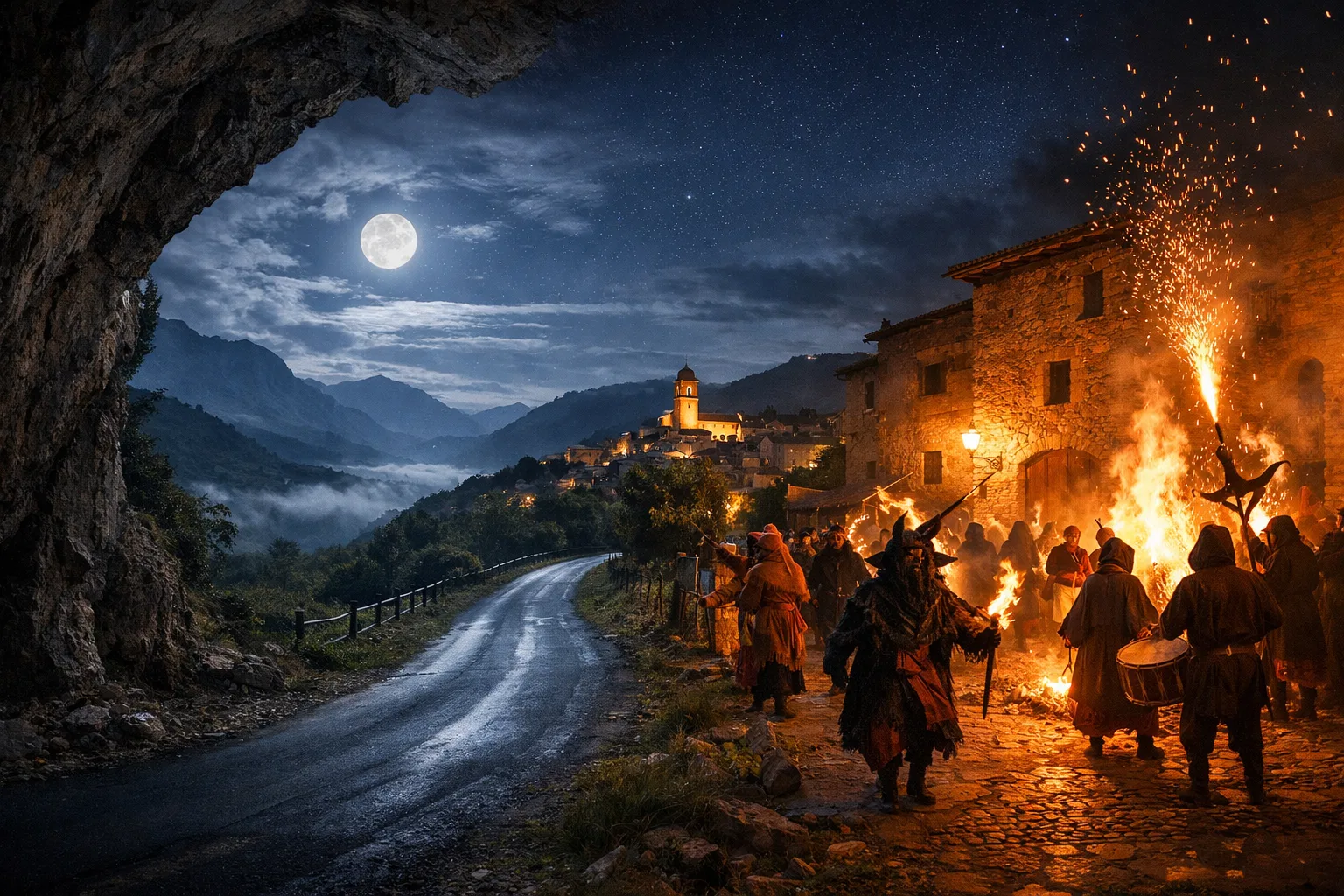
Spain’s folklore is not a single national story so much as a thick map of regional traditions: mountain goddesses in the Basque Country, ghost processions in Galicia and Asturias, dragons and water fairies in the north, witch legends in Navarre, fire rituals in Catalonia and the Pyrenees, and literary legends reshaped by Romantic writers.
Page outline Jump by section
Why Spanish folklore is so regional
A reader looking for “Spanish mythology” may expect a neat pantheon, but Spain’s legendary culture is shaped by languages, landscapes and local identities. Basque, Galician, Asturian, Cantabrian, Catalan, Castilian, Andalusian, Valencian, Balearic and Canary Island traditions do not simply repeat one another under different names. They share motifs — enchanted women by water, treasure-guarding beings, witches, giants, dragons, haunted roads and ritual fire — but each region gives them its own settings, moral tone and calendar.
This regional texture matters because many Spanish traditions are anchored in very specific places. A cave in Navarre can become a witch landscape because of trial records and later memory; a Galician crossroads can become frightening because of stories about processions of the dead; a Catalan town square can turn into a ritual stage through fire, music and masked or symbolic figures. Official cultural and tourism sources still present many of these traditions through local routes, festivals and heritage sites, which is why Spanish folklore is often encountered through travel as much as through books.[xareta.eus]xareta.euswitchcraft museum zugarramurdiwitchcraft museum zugarramurdi
The evidence also varies by tradition. Some tales are preserved in oral collections and folktale indexes; some customs are documented through UNESCO heritage files; some legends survive through local museums and tourism interpretation; and some famous “Spanish legends” are known mainly because writers reshaped them into literature. Ralph S. Boggs’s Index of Spanish Folktales, catalogued by HathiTrust, is one sign that Spanish oral tale material has long been studied comparatively, while scholarship on Hispanic oral literature stresses the vitality of storytelling traditions beyond elite written literature.[HathiTrust]catalog.hathitrust.orgOpen source on hathitrust.org.
The northern otherworld: caves, water and powerful women
Northern Spain is one of the richest areas for supernatural beings tied to mountains, caves, springs and rivers. In Basque tradition, the central figure is Mari, often associated with high caves and mountains such as Anboto. Modern summaries describe her as a powerful female being linked with weather, justice, truth-telling and the underground or mountain world; older collections and later scholars, including Resurrección María de Azkue and José Miguel de Barandiaran, helped preserve the material now used in many retellings.[Wikipedia]WikipediaMari (goddessMari (goddess
Mari is a good example of why care is needed with the word “goddess”. In public-facing mythology pages she is often called the main goddess of pre-Christian Basque mythology, but the surviving evidence is filtered through Christianisation, folklore collection and modern interpretation. The important point for a general reader is not that there was once a tidy “Basque Olympus”, but that many Basque stories imagine the landscape as morally alive: caves, storms, mountains and oaths are connected, and supernatural power often punishes arrogance, lying or broken promises.[Wikipedia]WikipediaMari (goddessMari (goddess
Basque river beings known as lamiak or laminak show another recurring Spanish motif: the beautiful water woman who is not entirely human. They are often described as living near rivers, combing their hair and sometimes having animal-like feet; some traditions present them as dangerous or seductive, while others remember them as helpers who reward gifts or proper behaviour. Similar female water or forest beings appear elsewhere in northern Spain, including xanas in Asturias and anjanas in Cantabria, although the local names, appearance and moral roles vary.[Wikipedia]WikipediaLamia (Basque mythologyLamia (Basque mythology
Asturian and Cantabrian folklore also preserves dragons, small household tricksters and fairy-like women. Tourism Asturias promotes the Camín Encantáu route in Llanes as a family walk where landscape and Asturian mythology are staged through life-sized figures, showing how beings such as the xana, the trasgu and the cuélebre have moved from oral tradition into public heritage and leisure culture. The cuélebre is commonly described as a great serpent or dragon associated with caves, treasure and enchanted beings, a pattern that links northern Spain to wider European dragon lore while remaining strongly local in setting.[turismoasturias.es]turismoasturias.esOpen source on turismoasturias.es.
Witches, trials and the danger of confusing folklore with history
Spain’s witch folklore is especially vivid, but it sits at the meeting point of belief, accusation, legal history and later storytelling. The best-known place is Zugarramurdi in Navarre, popularly called the “Town of the Witches”. Local heritage material connects its reputation to the 1610 witch trials and notes that similar witchcraft panic affected many other Navarrese towns, not just Zugarramurdi.[xareta.eus]xareta.euswitchcraft museum zugarramurdiwitchcraft museum zugarramurdi
The Zugarramurdi caves and museum show how folklore and history can become inseparable in public memory. Visit Navarra describes the cave as a mainstay of legends of covens and witchcraft, and also notes its modern afterlife in film, including Álex de la Iglesia’s Witching and Bitching. Rural tourism sources present the museum and caves as part of a heritage route around a real early modern witch hunt, while other travel writing highlights the museum’s attempt to distinguish local beliefs and misconceptions from the historical persecution of accused witches.[visitnavarra.es]visitnavarra.esOpen source on visitnavarra.es.
Galicia has its own famous witch figure, the meiga. Popular summaries often quote the well-known Galician saying that roughly means “I do not believe in witches, but they exist”, a phrase that captures the mixture of scepticism, humour and caution around witch belief. In tourism and local storytelling, meigas may be harmful, helpful, healing or ambiguous rather than simply evil. That ambiguity is important: Spanish witch folklore is not just a set of horror stories, but a way rural communities have talked about envy, illness, protection, misfortune, social suspicion and folk healing.[Albergue Monte do Gozo]montedogozo.comAlbergue Monte do Gozo Legends of Galicia: the most magical stories of this landAlbergue Monte do Gozo Legends of Galicia: the most magical stories of this land
The key distinction is this: witch trials are historical events involving accusation, fear and punishment, while witch legends are traditional narratives that may preserve older beliefs, later moral lessons, anti-witch stereotypes or local identity. Modern witch tourism can illuminate that history, but it can also simplify it into spooky branding if it treats accused people as proven witches or turns persecution into entertainment. The strongest public interpretation is the kind that keeps both parts visible: the recorded violence of witch-hunting and the longer life of supernatural belief in local culture.[xareta.eus]xareta.euswitchcraft museum zugarramurdiwitchcraft museum zugarramurdi
Ghost processions and the fear of meeting the dead
One of Spain’s most memorable ghost traditions is the Galician Santa Compaña, usually described as a night procession of dead souls. Galicia’s official tourism blog presents it as a procession crossing Galician lands and frightening those who meet it, led by a tall spectral figure and associated with dark clothing, villages, mountains and the search for a living person to carry the cross.[Turismo de Galicia Blog]blog.turismo.galtunics songs and prayers terror around the santa companatunics songs and prayers terror around the santa compana
The legend is powerful because it turns ordinary rural geography into a threshold between worlds. Roads, crossroads, church paths and night journeys become risky. Later popular summaries describe the procession as a warning of death or misfortune, sometimes led by a living person who is cursed to walk with the dead until another person takes their place. Variants are associated with Galicia, Asturias and northern Portugal, which places the tradition within a wider north-western Iberian and Atlantic pattern of ghostly processions.[viajecaminodesantiago.com]viajecaminodesantiago.comlegend santa compana caminolegend santa compana camino
For readers today, the Santa Compaña is best understood as both a death legend and a social story. It gives frightening form to grief, illness, night travel, church ritual, purgatory belief and the sense that the dead remain close to the living. It is not a single fixed tale: details differ by locality, and modern Halloween coverage often repackages it as seasonal horror. The older texture is more specific and more interesting than that: it is a tradition about what might be heard, smelt or glimpsed on a road when the village is asleep.[Turismo de Galicia Blog]blog.turismo.galtunics songs and prayers terror around the santa companatunics songs and prayers terror around the santa compana
Dragons, fairies, giants and household tricksters
Spanish folk creatures often work like moral weather: they explain luck, danger, generosity, disobedience or the unease of certain landscapes. In Asturias and Cantabria, the cuélebre or culebre is a dragon-like serpent tied to caves, treasure and captive enchanted women. Its presence makes the cave more than a geological feature: it becomes a guarded boundary between human life and hidden wealth or danger.[David Wacks]davidwacks.uoregon.eduDavid Wacks Some thoughts on Asturian mythologyDavid Wacks Some thoughts on Asturian mythology
Cantabrian mythology has its own contrast between benevolent and dangerous beings. The anjana is often presented as a good fairy associated with forests, water, springs, gift-giving and protection, while the one-eyed ojáncano appears in modern Cantabrian folklore interpretation as a destructive giant or ogre-like figure. Tourist sites in Cantabria now stage these beings in mythological parks and forest walks, showing how local creatures have become part of regional cultural branding as well as storytelling.[wikipedia.org]WikipediaAnjana (Cantabrian mythologyAnjana (Cantabrian mythology
Household and small trickster figures are another part of the landscape. The Asturian trasgu, often grouped in modern route material with xanas, busgosu figures and the cuélebre, belongs to a broader Iberian and European family of domestic spirits who disturb order, misplace things or test the patience of a household. Such beings are easy to trivialise as “goblins”, but their role is practical as well as comic: they give narrative form to disorder inside the home, the uncertainty of rural labour and the feeling that domestic space is never fully under human control.[Turismo Asturias]turismoasturias.esOpen source on turismoasturias.es.
These beings are not “monsters” in the modern horror-game sense. Many are conditional: they may help, harm, guard, seduce, punish or reward depending on how humans behave. That conditional quality is one reason Spanish folk beings feel so deeply tied to everyday ethics. The question is often not simply “does the creature exist?” but “what kind of behaviour does the story warn against or praise?”

Sacred places, fire and the ritual calendar
Spanish folklore is not only told; it is performed. Public festivals carry older patterns of purification, satire, seasonal change, danger and renewal into visible communal events. The Fallas festival in Valencia, recognised by UNESCO in 2016, centres on large satirical monuments erected in public space and then burned, with UNESCO’s archive describing the burning as symbolising a rejuvenation of social activity.[UNESCO]unesco.orgdocument 4396document 4396
In Catalonia, La Patum of Berga takes place around Corpus Christi and is built from music, drums, fire, dances and symbolic figures. UNESCO describes it as an annual celebration during Corpus Christi week, while Spain’s tourism portal presents it as an oral and intangible heritage event where fire and dance are central. For folklore readers, La Patum matters because it shows how Christian calendar time, civic identity and older festive imagery can merge into a dramatic public ritual.[Intangible Cultural Heritage]ich.unesco.orgIntangible Cultural Heritage Patum of BergaIntangible Cultural Heritage Patum of Berga
The Pyrenean summer solstice fire festivals offer another clear example of seasonal folklore that is still practised. Spain’s official tourism site describes midsummer rituals centred on fire, including people carrying flaming home-made torches down from high points, drawing shapes with fire, dancing or lighting a large bonfire in the village square. A 2022 heritage study notes that UNESCO inscribed the summer solstice fire festivals of the Pyrenees on the Representative List of the Intangible Cultural Heritage of Humanity in 2015.[Spain Tourism]spain.infoOpen source on spain.info.
Not every ritual custom is eerie. Catalonia’s Christmas log tradition, often known by its Catalan name, is promoted by the official Catalonia tourism site as a magical Christmas custom with rural and pre-Christian associations. It is playful, domestic and child-centred, but it belongs to the same wider pattern: seasonal change is made memorable through an object, repeated actions, songs and family performance.[Catalunya]catalunya.comOpen source on catalunya.com.
Literary legends: when folklore becomes Spanish literature
Some of the most famous “Spanish legends” are not simply oral traditions written down unchanged. They are literary works that borrow from folk belief, medieval atmosphere, religious imagination and local legend. Gustavo Adolfo Bécquer’s Legends are a major example. The Biblioteca Virtual Miguel de Cervantes preserves an English translation of Romantic Legends of Spain, and modern Spanish cultural commentary still treats Bécquer’s legends as central to Spanish Romantic and post-Romantic supernatural prose.[Biblioteca Virtual Miguel de Cervantes]cervantesvirtual.comOpen source on cervantesvirtual.com.
Bécquer’s importance for folklore is not that every story is an ancient oral survival. Rather, he helped create the way many readers imagine Spanish legend: ruined monasteries, haunted mountains, enchanted eyes, religious fear, fatal desire and the past pressing into the present. In other words, he is part collector, part inventor, part atmosphere-maker. For a folklore page, that distinction matters because literary legend can preserve motifs while also reshaping them for art, readership and national imagination.[Project Gutenberg]gutenberg.orgOpen source on gutenberg.org.
Don Juan is another case where Spanish legend became global literature. The character is usually traced to the early seventeenth-century play The Trickster of Seville and the Stone Guest, traditionally associated with Tirso de Molina, though modern authorship studies have complicated some older assumptions. The legendary core is not merely seduction; it is supernatural judgement. Don Juan kills, deceives and refuses repentance, and the stone guest or statue motif turns moral consequence into a terrifying encounter with the dead.[wikipedia.org]WikipediaDon JuanDon Juan
These literary afterlives are part of Spain’s folklore ecosystem. They show how oral motifs, religious anxieties and local settings can move into theatre, school reading, opera, film and tourism. They also remind readers not to treat every famous legend as a transparent window into ancient belief. Sometimes the version everyone knows is famous because a writer made it unforgettable.

Modern Spain: heritage, tourism and internet-era retellings
Today, Spanish folklore lives in several places at once. It is in local speech, seasonal practice, children’s customs, heritage festivals, hiking routes, museum displays, novels, films, Halloween articles and social media posts. Spain’s official tourism site explicitly uses legends to invite visitors into places such as tunnels, crypts and mythic landscapes, while regional sites package mythological beings into routes and family experiences.[spain.info]spain.infoTourism Legends of SpainTourism Legends of Spain
This modern visibility is not automatically a bad thing. Tourism can keep names and stories alive, support local museums and make regional traditions legible to visitors. UNESCO recognition can also help communities safeguard living customs by valuing the skills, performance and community memory involved. The risk is flattening: a complex witch-trial history becomes a spooky attraction; a death procession becomes Halloween content; a local fairy becomes a generic fantasy creature; a ritual fire festival becomes just a spectacle for cameras.[Spain Tourism]spain.infoOpen source on spain.info.
The best modern retellings do three things. They name the region, because Spanish folklore is strongly local. They distinguish belief, story, festival and history, because those are not the same kind of evidence. And they keep the human meaning visible: fear of death, respect for landscape, community renewal, justice, protection, satire, childhood, grief, courtship, danger and memory.
How to read Spanish folklore well
The first rule is to ask where a tradition comes from. “Spanish folklore” is a helpful umbrella, but “Basque mountain tradition”, “Galician ghost belief”, “Asturian dragon lore” or “Valencian fire festival” will usually tell the reader much more. Spain’s regional diversity is not a footnote; it is the structure of the subject.
The second rule is to ask what kind of source is speaking. A UNESCO listing is strong evidence for a living public ritual, but it may not explain every mythic association. A tourism page is useful for current interpretation and place-based context, but it may simplify disputed history. A literary text may be culturally influential without being an old oral record. A folktale index can prove that tale material was collected and classified, but it will not capture the full performance context of a story told aloud.[hathitrust.org]catalog.hathitrust.orgOpen source on hathitrust.org.
The third rule is to enjoy the stories without turning them into fake certainty. Spanish folklore is at its strongest when treated as tradition: a way communities have imagined the landscape, remembered danger, marked the seasons, explained misfortune, disciplined behaviour, entertained children and kept the dead, saints, spirits and ancestors close to everyday life. That is more interesting than pretending every tale is either literal history or empty fantasy.
Amazon book picks
Further Reading
Books and field guides related to Why Spain's Folklore Changes by Region. Use these as the next step if you want deeper reading beyond the article.
The Basque History of the World
Explains regional identity that shapes distinctive folklore traditions.

The Penguin Book of Dragons
Supports reading on dragon and monster traditions found in Spanish folklore.
Index of Spanish folktales
First published 1930. Subjects: Bibliography, Classification, Fairy tales, Folklore, Spanish Tales.
Index of Spanish Folktales, Classified According to Antti Aar...
Directly covers regional folk traditions across Spain.
eBay marketplace picks
Marketplace Samples
Live-tested eBay searches with available results related to this page.
Endnotes
1.
Source: spain.info
Title: Tourism Legends of Spain
Link:https://www.spain.info/en/top/famous-legends-spain/
2.
Source: ich.unesco.org
Link:https://ich.unesco.org/en/state/spain-ES
3.
Source: spain.info
Link:https://www.spain.info/en/discover-spain/fiestas-spain-unesco-intangible-cultural-heritage/
4.
Source: xareta.eus
Title: witchcraft museum zugarramurdi
Link:https://www.xareta.eus/en/quehacer/witchcraft_museum_zugarramurdi/2
5.
Source: blog.turismo.gal
Title: tunics songs and prayers terror around the [santa compana]({{ ‘ghost-roads/’ | relative_url }})
Link:https://blog.turismo.gal/tunics-songs-and-prayers-terror-around-the-santa-compana/
6.
Source: spain.info
Link:https://www.spain.info/en/calendar/fiesta-patum-berga/
7.
Source: catalog.hathitrust.org
Link:https://catalog.hathitrust.org/Record/001648782
8.
Source: Wikipedia
Title: Mari (goddess)
Link:https://en.wikipedia.org/wiki/Mari_%28goddess%29
9.
Source: Wikipedia
Title: Basque mythology
Link:https://en.wikipedia.org/wiki/Basque_mythology
10.
Source: Wikipedia
Title: Lamia (Basque mythology)
Link:https://en.wikipedia.org/wiki/Lamia_%28Basque_mythology%29
11.
Source: Wikipedia
Title: Anjana (Cantabrian mythology)
Link:https://en.wikipedia.org/wiki/Anjana_%28Cantabrian_mythology%29
12.
Source: Wikipedia
Link:https://en.wikipedia.org/wiki/Cu%C3%A9lebre
13.
Source: unesco.org
Title: document 4396
Link:https://www.unesco.org/archives/multimedia/document-4396
14.
Source: ich.unesco.org
Link:https://ich.unesco.org/en/Decisions/11.COM/10.b.30
15.
Source: ich.unesco.org
Title: Intangible Cultural Heritage Patum of Berga
Link:https://ich.unesco.org/en/RL/patum-of-berga-00156
16.
Source: spain.info
Link:https://www.spain.info/en/calendar/fiestas-fire-summer-solstice-pyrenees/
17.
Source: catalunya.com
Link:https://www.catalunya.com/en/continguts/article/caga-tio-catalan-pooping-log-1731507242824
18.
Source: gutenberg.org
Link:https://www.gutenberg.org/ebooks/50044
19.
Source: Wikipedia
Title: Don Juan
Link:https://en.wikipedia.org/wiki/Don_Juan
20.
Source: spainculture.us
Title: el burlador de sevilla
Link:https://www.spainculture.us/city/new-york/el-burlador-de-sevilla/
21.
Source: ich.unesco.org
Title: 47193 EN.doc
Link:https://ich.unesco.org/doc/src/47193-EN.doc
22.
Source: ich.unesco.org
Title: spain ES
Link:https://ich.unesco.org/en/state/spain-ES?info=activities-with-the-patronage
23.
Source: ich.unesco.org
Title: flamenco 00363
Link:https://ich.unesco.org/en/RL/flamenco-00363
24.
Source: ich.unesco.org
Title: spain ES
Link:https://ich.unesco.org/en/state/spain-ES?info=periodic-reporting
25.
Source: unesco.org
Title: document 1696 eng 2
Link:https://www.unesco.org/archives/multimedia/document-1696-eng-2
26.
Source: ich.unesco.org
Title: spain ES
Link:https://ich.unesco.org/en-state/spain-ES?info=activities-with-the-patronage
27.
Source: ich.unesco.org
Title: summer solstice fire festivals in the pyrenees 01073
Link:https://ich.unesco.org/en/RL/summer-solstice-fire-festivals-in-the-pyrenees-01073
28.
Source: ich.unesco.org
Link:https://ich.unesco.org/en/video/32987
29.
Source: ich.unesco.org
Title: spain ES
Link:https://ich.unesco.org/en-state/spain-ES?call=film&id=32987&include=film_inc.php&width=700
30.
Source: archive.org
Link:https://archive.org/details/folktalesfairylo00macduoft
31.
Source: archive.org
Title: talesofenchantmentfromspain 2506 librivox
Link:https://archive.org/details/talesofenchantmentfromspain_2506_librivox
32.
Source: archive.org
Title: historical tales vii spanish 1611 librivox
Link:https://archive.org/details/historical_tales_vii_spanish_1611_librivox
33.
Source: Wikipedia
Title: List of Intangible Cultural Heritage elements in Spain
Link:https://en.wikipedia.org/wiki/List_of_Intangible_Cultural_Heritage_elements_in_Spain
34.
Source: Wikipedia
Title: Galician mythology
Link:https://en.wikipedia.org/wiki/Galician_mythology
35.
Source: Wikipedia
Title: Gustavo Adolfo Bécquer
Link:https://en.wikipedia.org/wiki/Gustavo_Adolfo_B%C3%A9cquer
36.
Source: Wikipedia
Link:https://en.wikipedia.org/wiki/Cuento
37.
Source: Wikipedia
Title: Tió de Nadal
Link:https://en.wikipedia.org/wiki/Ti%C3%B3_de_Nadal
38.
Source: Wikipedia
Title: Patum de Berga
Link:https://en.wikipedia.org/wiki/Patum_de_Berga
39.
Source: Wikipedia
Link:https://en.wikipedia.org/wiki/Fallas
40.
Source: blogs.cervantes.es
Title: es Gustavo Adolfo Bécquer
Link:https://blogs.cervantes.es/dublin/tag/gustavo-adolfo-becquer/
41.
Source: unesco.de
Link:https://www.unesco.de/en/sites/intangible-cultural-heritage/
42.
Source: sustainability.spain.info
Link:https://sustainability.spain.info/en/top/sustainable-culture-spain/
43.
Source: gutenberg.org
Link:https://www.gutenberg.org/files/50044/50044-h/50044-h.htm
44.
Source: catalunya.com
Link:https://www.catalunya.com/en/continguts/esdeveniments-agenda/la-patum-festival-in-berga-1-1-13839
45.
Source: folklore.ee
Link:https://www.folklore.ee/folklore/vol62/oriol.pdf
46.
Source: journal.oraltradition.org
Title: 6 webber
Link:https://journal.oraltradition.org/wp-content/uploads/files/articles/1ii/6_webber.pdf
47.
Source: turismoasturias.es
Link:https://www.turismoasturias.es/en/senderismo/rutas/familias/familias/el-camin-encantau
48.
Source: davidwacks.uoregon.edu
Title: David Wacks Some thoughts on Asturian mythology
Link:https://davidwacks.uoregon.edu/2014/12/12/asturian/
49.
Source: visitnavarra.es
Link:https://www.visitnavarra.es/en/caves-navarra
50.
Source: turismoruralnavarra.com
Link:https://www.turismoruralnavarra.com/en/listado/museo-de-las-brujas-zugarramurdi-2/
51.
Source: montedogozo.com
Title: Albergue Monte do Gozo Legends of Galicia: the most magical stories of this land
Link:https://www.montedogozo.com/legends-of-galicia-the-most-magical-stories-of-this-land/
52.
Source: viajecaminodesantiago.com
Title: legend santa compana camino
Link:https://viajecaminodesantiago.com/en/news/legend-santa-compana-camino/
53.
Source: mythus.fandom.com
Title: Myth and Folklore Santa Compaña | Myth and Folklore Wiki
Link:https://mythus.fandom.com/wiki/Santa_Compa%C3%B1a
54.
Source: surdelabahia.es
Title: Sur de la Bahía Cantabrian mythology
Link:https://surdelabahia.es/en/cantabrian-mythology/
55.
Source: cervantesvirtual.com
Link:https://www.cervantesvirtual.com/obra/romantic-legends-of-spain/
56.
Source: mythus.fandom.com
Link:https://mythus.fandom.com/wiki/Anjana
57.
Source: en.wikisource.org
Title: Index of Spanish Folktales
Link:https://en.wikisource.org/wiki/Index_of_Spanish_Folktales
58.
Source: journal.oraltradition.org
Title: 7b harvilahti
Link:https://journal.oraltradition.org/wp-content/uploads/files/articles/18ii/7b_harvilahti.pdf
59.
Source: cervantesvirtual.com
Title: romantic legends of spain
Link:https://www.cervantesvirtual.com/portales/martin_codax/obra/romantic-legends-of-spain/
60.
Source: mythics.eu
Link:https://mythics.eu/index.php/anjanas/?lang=en
61.
Source: ijih.org
Link:https://www.ijih.org/volumes/article/616
62.
Source: meta.wikimedia.org
Title: Intangible Cultural Heritage of Spain
Link:https://meta.wikimedia.org/wiki/Wiki_Loves_Living_Heritage/Intangible_Cultural_Heritage_of_Spain
63.
Source: erasmusu.com
Link:https://erasmusu.com/en/erasmus-blog/main/basque-mythology-1237794
Additional References
64.
Source: cadenaser.com
Link:https://cadenaser.com/nacional/2025/11/02/las-leyendas-de-becquer-terrorificas-y-sorprendentes-cadena-ser/
Source snippet
Las "Leyendas" abarcan diversos temas: la tradición cristiana, la mitología oriental, el misterio, el terror y los cuentos de hadas, aunq...
65.
Source: arxiv.org
Title: arXiv Automatic Authorship Attribution in the Work of Tirso de Molina
Link:https://arxiv.org/abs/2304.00363
66.
Source: academia.edu
Link:https://www.academia.edu/88363482/Tales_of_oral_tradition_in_Spain
67.
Source: researchgate.net
Link:https://www.researchgate.net/publication/318243435_Tradicion_oral_en_Madrid_cronica_de_la_recogida_Oral_Tradition_in_Madrid_Chronicle_of_the_Collection
68.
Source: researchgate.net
Link:https://www.researchgate.net/publication/397872811_From_Oral_Tradition_to_Digital_Archives_How_Global_Storytelling_Ecosystems_Influence_National_Identity
69.
Source: facebook.com
Link:https://www.facebook.com/euskalsouvenirs/posts/basque-legends-collected-chiefly-in-the-labourd-wentworth-websterthe-legends-col/1336713975160298/
70.
Source: bizkaiatalent.eus
Link:https://www.bizkaiatalent.eus/en/pais-vasco-te-espera/senas-de-identidad/vasco-tierra-leyendas/
71.
Source: lurkaia.com
Link:https://lurkaia.com/en/dioses
72.
Source: cadenaser.com
Link:https://cadenaser.com/cmadrid/2025/10/30/la-santa-compana-las-almas-que-caminan-en-la-noche-ser-madrid-norte/
73.
Source: mein-barcelona.com
Link:https://www.mein-barcelona.com/cagatio.html
Topic Tree
Follow this branch
Related pages 192
- Afghan Folklore
- Albanian Folklore
- Algerian Folklore
- Australian Folklore
- Azerbaijan Folklore
- +187 more in sidebar