Within Latvian Folklore
What Haunted the Latvian Home After Dark?
Night demons, laumas and witches explain fears, illness and misfortune in legends rooted in everyday rural life.
On this page
- The Lietuvens and Sleep Paralysis
- Laumas Between Fairy and Witch
- Milk Witches and Folk Belief
Page outline Jump by section
Introduction
Many Latvian supernatural beliefs grew not from distant heroic myths but from the anxieties of everyday farm life. What caused a healthy cow to stop producing milk? Why did a sleeper wake unable to move, feeling a crushing weight on the chest? Why did misfortune seem to follow one household but not another? In traditional Latvian belief, answers often came in the form of spirits, witches and supernatural beings that moved through homes, barns and village landscapes after dark.

These traditions reveal how rural communities interpreted illness, bad luck, unexplained experiences and economic rivalry. Some figures were feared as night demons, others occupied an uncertain space between fairy and witch, and some were believed to be ordinary neighbours using hidden magic. Together they form one of the most intimate parts of Latvian folklore: the supernatural world of the household itself.[LU LFMI]lulfmi.lvLU LFMIArchives of Latvian FolkloreThe Archives of Latvian Folklore (ALF) is the most significant center for the documentation, archiving…
The Lietuvēns and Sleep Paralysis
Among Latvia’s most famous supernatural beings is the Lietuvēns, a night-attacking spirit blamed for terrifying experiences during sleep. Traditional accounts describe it as the restless soul of someone who died violently or before their proper time, sometimes including unbaptised children. Rather than haunting castles or wildernesses, it entered houses through cracks, keyholes or other tiny openings and attacked people in their beds.[Wikipedia]WikipediaOpen source on wikipedia.org.
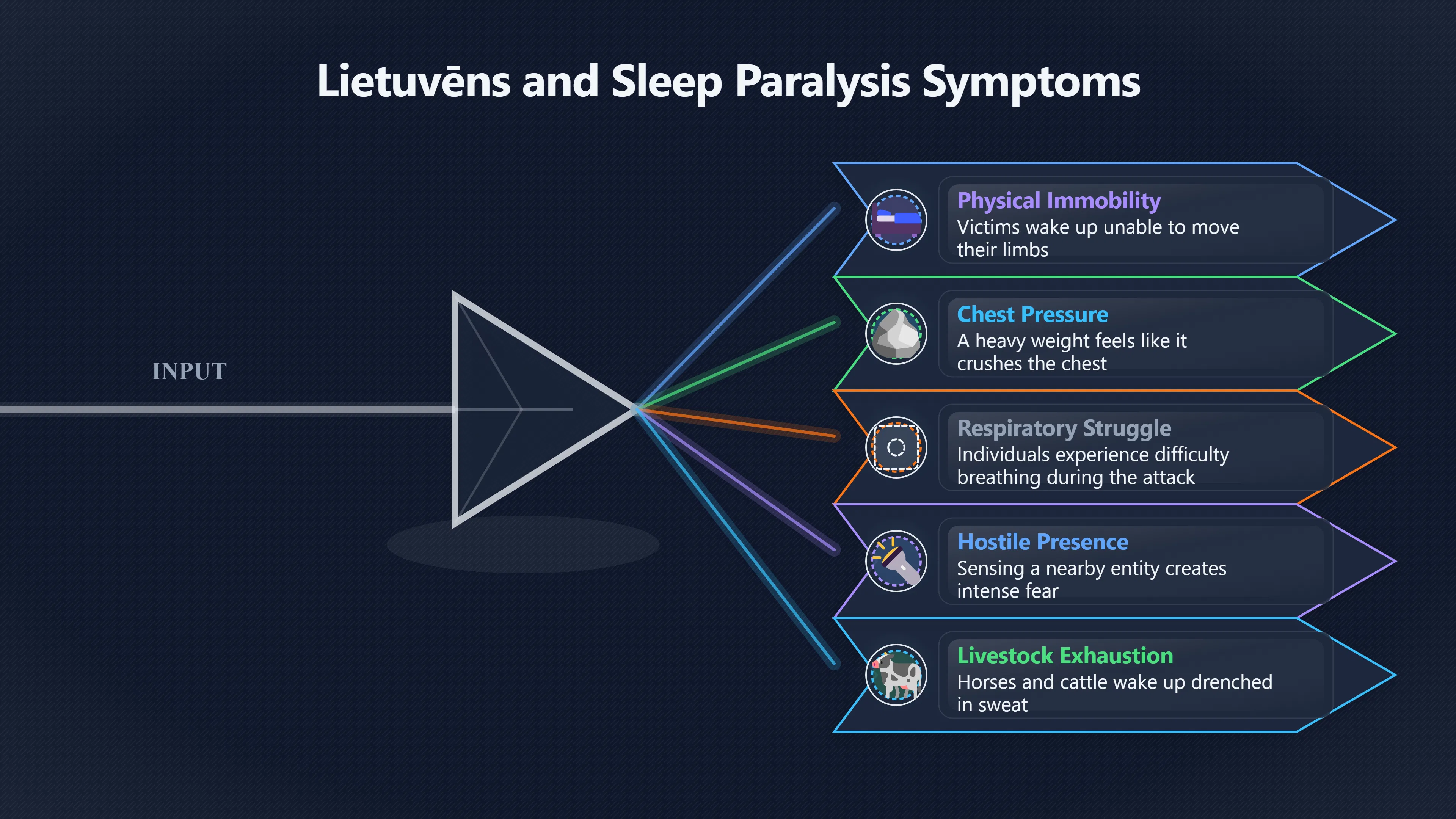
Descriptions of a Lietuvēns attack are strikingly familiar to modern readers. Victims reported waking suddenly but being unable to move, feeling a heavy pressure on their chest, struggling to breathe and sensing a hostile presence nearby. Folklore records also claim that horses and cattle could be attacked during the night, becoming exhausted and drenched in sweat by morning.[Wikipedia]WikipediaOpen source on wikipedia.org.
Today, historians and folklorists commonly recognise these stories as traditional explanations for what medicine calls sleep paralysis, a condition in which aspects of dreaming and wakefulness overlap. The experience often includes immobility, a feeling of presence and intense fear, making it easy to understand why earlier generations interpreted it as a supernatural assault.[PMC]pmc.ncbi.nlm.nih.govPMCSleep paralysis and folkloreNIHby AM Cox · 2015 · Cited by 39 — The earliest reference to Lilith is found in the Sumerian King list of 2400 BC known as Lilitu…
What makes the Latvian tradition distinctive is the practical advice attached to it. Folk remedies included making a small movement with a toe, using protective signs, or displaying the so-called Lietuvēns cross, a star-shaped protective symbol believed to repel the attacker. These measures transformed a frightening and uncontrollable experience into something people felt they could resist.[Wikipedia]WikipediaOpen source on wikipedia.org.
The enduring popularity of the Lietuvēns story demonstrates how folklore often functioned as a way of naming and managing fear. Rather than dismissing the experience, the tradition provided an explanation, a culprit and a defence.
Laumas Between Fairy and Witch
Few figures in Latvian folklore are as difficult to classify as the lauma. In older Baltic tradition, laumas were often supernatural female beings associated with childbirth, children, fate and the margins of the human world. They could help abandoned children, reward kindness and possess powers beyond ordinary humans.[Wikipedia]WikipediaOpen source on wikipedia.org.
Yet in Latvia the image of the lauma gradually shifted. Modern folklore research has shown that over time the figure became increasingly associated with witchcraft. Rather than remaining purely a fairy-like being, the lauma was drawn into beliefs about harmful magic and human witches. Scholars describe this process as the “witchisation” of an older supernatural tradition.[zurnalai.vu.lt]zurnalai.vu.ltLatvian Laumas: Reflections on the Witchisation of Traditionby S Laime · 2021 · Cited by 2 — It was humanised and incorporated in the wit…
This transformation reflects wider changes in Baltic society. As Christian ideas about witchcraft spread and witch persecutions affected the region between the sixteenth and eighteenth centuries, older supernatural beings were often reinterpreted through the lens of demonic magic. A being once connected with fertility, motherhood or fate could become a dangerous witch capable of harming neighbours or livestock.[zurnalai.vu.lt]zurnalai.vu.ltLatvian Laumas: Reflections on the Witchisation of Traditionby S Laime · 2021 · Cited by 2 — It was humanised and incorporated in the wit…
The ambiguity of the lauma is precisely what makes the figure important. Unlike the clear villain of a fairy tale, the lauma sits on a boundary. She can appear as a helper, a supernatural foster mother, a nature spirit or a witch. That uncertainty reflects the complexity of folk belief itself, where categories were often fluid and local traditions differed from one village to another.[Wikipedia]WikipediaOpen source on wikipedia.org.

Milk Witches and Folk Belief
For many Latvian farming families, the greatest supernatural threat was not a night demon but a witch stealing prosperity.
One of the most widespread beliefs concerned the so-called milk witch. These witches were thought to rob neighbours of milk, butter, cream or general agricultural good fortune. Unlike fairy-tale sorceresses, they were usually imagined as ordinary human beings living within the community. The accusation was not that they performed spectacular magic but that they secretly redirected another family’s wealth to themselves.[LLTI]llti.ltLatvian Laumas: Reflections on the Witchisation of Traditionby M Liugaitė-Černiauskienė · Cited by 2 — 2) The belief in the dairy wit…
In a dairy-based rural economy, milk was a measure of survival and success. If a cow suddenly stopped producing, a family needed an explanation. Folk belief provided one. Stories circulated about witches magically drawing milk away from neighbouring herds or sending animals such as toads and snakes to perform the theft on their behalf.[Wikipedia]WikipediaLatvian mythologyLatvian mythology
Researchers studying Latvian witch traditions argue that dairy witch beliefs belong to one of the oldest layers of witchcraft folklore in the region. Unlike later demonological ideas that connected witches with the devil, milk-witch stories were closely tied to practical economic concerns. They explained why one household prospered while another struggled.[LLTI]llti.ltLatvian Laumas: Reflections on the Witchisation of Traditionby M Liugaitė-Černiauskienė · Cited by 2 — 2) The belief in the dairy wit…
These accusations also reveal social tensions. A neighbour who seemed unusually successful, secretive or different could become a target of suspicion. Folklore therefore acted not only as an explanation for misfortune but also as a way of expressing anxieties about competition, envy and fairness within small rural communities.[LLTI]llti.ltLatvian Laumas: Reflections on the Witchisation of Traditionby M Liugaitė-Černiauskienė · Cited by 2 — 2) The belief in the dairy wit…
Night Witches and Dangerous Places
Latvian folklore did not always imagine witches as people. In some regions, especially northern Vidzeme and northern Latgale, traditions describe supernatural night witches associated with specific landscapes. Researchers have identified clusters of stories connected to hills, marshes, rocks and other places whose names themselves contain references to witches.[University of Latvia]lu.lvUniversity of LatviaRESEARCH on Night Witches19 Feb 2014 — Laime reveals that names of territories in Latvia where the beliefs about nigh…
These beliefs linked danger to particular locations. Certain places were thought to become threatening after sunset, and encounters with supernatural female beings could bring illness, confusion or bad luck. Such stories helped map invisible dangers onto the physical landscape. A marsh or lonely hill became memorable not only because of its geography but because of the narrative attached to it.[University of Latvia]lu.lvUniversity of LatviaRESEARCH on Night Witches19 Feb 2014 — Laime reveals that names of territories in Latvia where the beliefs about nigh…
The tradition also illustrates how household fears and landscape fears overlapped. The same witch who threatened travellers in remote places might also be blamed for trouble among livestock or within the home. The supernatural world was not neatly divided between indoors and outdoors; it moved freely between both.
Why These Beliefs Endured
From a modern perspective, many Latvian household supernatural traditions can be linked to natural experiences: sleep paralysis, disease, livestock problems, economic uncertainty or social conflict. Yet reducing the stories to simple misunderstandings misses their cultural role.
These beliefs provided explanations at times when scientific answers were unavailable or inaccessible. They offered practical responses to fear, whether through protective symbols, rituals, charms or social rules. They also preserved community memory by turning recurring problems into memorable stories.[Wikipedia]WikipediaOpen source on wikipedia.org.
Today the Lietuvēns, the lauma and the milk witch survive largely as elements of folklore rather than living explanations for daily events. They appear in folklore archives, scholarly studies, museums, literature and popular culture. Yet they remain compelling because they speak to universal experiences: the terror of waking helpless in the night, the suspicion that bad luck has a hidden cause, and the uneasy feeling that ordinary domestic life may conceal forces beyond human control.[LU LFMI]lulfmi.lvLU LFMIArchives of Latvian FolkloreThe Archives of Latvian Folklore (ALF) is the most significant center for the documentation, archiving…
Amazon book picks
Further Reading
Books and field guides related to What Haunted the Latvian Home After Dark?. Use these as the next step if you want deeper reading beyond the article.
The Hero with a Thousand Faces
Helps general readers compare Latvian stories with world mythology.
eBay marketplace picks
Marketplace Samples
Live-tested eBay searches with available results related to this page.
Endnotes
1.
Source: lulfmi.lv
Link:https://lulfmi.lv/en/archives-of-latvian-folklore
Source snippet
LU LFMIArchives of Latvian FolkloreThe Archives of Latvian Folklore (ALF) is the most significant center for the documentation, archiving...
2.
Source: llti.lt
Link:https://www.llti.lt/failai/laime%281%29.pdf
Source snippet
Latvian Laumas: Reflections on the Witchisation of Traditionby M Liugaitė-Černiauskienė · Cited by 2 — 2) The belief in the dairy wit...
3.
Source: Wikipedia
Link:https://en.wikipedia.org/wiki/Lietuv%C4%93ns
4.
Source: Wikipedia
Title: Latvian mythology
Link:https://en.wikipedia.org/wiki/Latvian_mythology
5.
Source: pmc.ncbi.nlm.nih.gov
Title: PMCSleep paralysis and folklore
Link:https://pmc.ncbi.nlm.nih.gov/articles/PMC5167075/
Source snippet
NIHby AM Cox · 2015 · Cited by 39 — The earliest reference to Lilith is found in the Sumerian King list of 2400 BC known as Lilitu...
6.
Source: Wikipedia
Link:https://en.wikipedia.org/wiki/Lauma
7.
Source: zurnalai.vu.lt
Link:https://www.zurnalai.vu.lt/td/en/article/view/26701
Source snippet
Latvian Laumas: Reflections on the Witchisation of Traditionby S Laime · 2021 · Cited by 2 — It was humanised and incorporated in the wit...
8.
Source: lu.lv
Link:https://www.lu.lv/en/about-us/ul-media/news/archive/archive-news/t/21063/
Source snippet
University of LatviaRESEARCH on Night Witches19 Feb 2014 — Laime reveals that names of territories in Latvia where the beliefs about nigh...
Additional References
9.
Source: reddit.com
Link:https://www.reddit.com/r/BalticStates/comments/10a0l1b/latvians_what_is_this_about/
Source snippet
Latvians, what is this about? 🤨: r/BalticStatesSome mythical demon thing. BushMonsterInc. •. 4y ago... Suicided lietuvėnai come back as...
10.
Source: e-journals.ku.lt
Link:https://e-journals.ku.lt/journal/AB/issue/78?page=2
Source snippet
ku.ltArchaeology, Religion and Folklore in the Baltic Sea RegionIt is mentioned in 15th to 18th-century written sources that in Lithuania...
11.
Source: lifeinriga.com
Link:https://lifeinriga.com/latvian-myth/
Source snippet
The white witch. And she said yes. But choosing these people isn't easy and there are many more...Read more...
12.
Source: researchgate.net
Title: 365386590 Latvian Laumas Reflections on the Witchisation of Tradition
Link:https://www.researchgate.net/publication/365386590_Latvian_Laumas_Reflections_on_the_Witchisation_of_Tradition
Source snippet
Latvian Laumas: Reflections on the Witchisation of Tradition19 May 2026 — The aim of the article is to analyse the sources of North Latvi...
Published: May 2026
13.
Source: scribd.com
Link:https://www.scribd.com/document/505581813/Magical-Beliefs-for-Stealing-the-Milk-Of
Source snippet
The majority of those women blamed for stealing the milk of cows. Accompanying the witches...Read more...
14.
Source: x.com
Link:https://x.com/Burtenieks/status/1084884024148004866
Source snippet
In Latvian folk culture sleep paralysis is called a torture or...It is thought to be a soul of a killed (strangled, drowned, hanged) person...
15.
Source: academia.edu
Title: Magical Beliefs for Stealing the Milk of Animals
Link:https://www.academia.edu/12779640/Magical_Beliefs_for_Stealing_the_Milk_of_Animals_A_Case_study_on_the_Romanian_Villages_in_Transylvania_18th_19th_Centuries_
Source snippet
A Case-...... which are to be found in the folk narratives. The majority of those women blamed for stealing the milk of cows Accompanyin...
16.
Source: facebook.com
Link:https://www.facebook.com/groups/thedivineshekhinah/posts/1762698757758462/
Source snippet
ss of sorcery, defender of witches. She is sometimes treated as evil...
17.
Source: research.lu.lv
Link:https://research.lu.lv/en/publications/latvian-laumas-reflections-on-the-witchisation-of-tradition/
Source snippet
Laumas: Reflections on the Witchisation of TraditionDive into the research topics of 'Latvian Laumas: Reflections on the Witchisation of...
18.
Source: researchgate.net
Title: (PDF) Sleep paralysis and folklore
Link:https://www.researchgate.net/publication/282802121_Sleep_paralysis_and_folklore
Source snippet
demon sits on her victim, crushing their chest. Although such a demonic presence (likely a description of sleep paralysis) is wide-spread...
Topic Tree