Where Sri Lanka's Legends Still Live
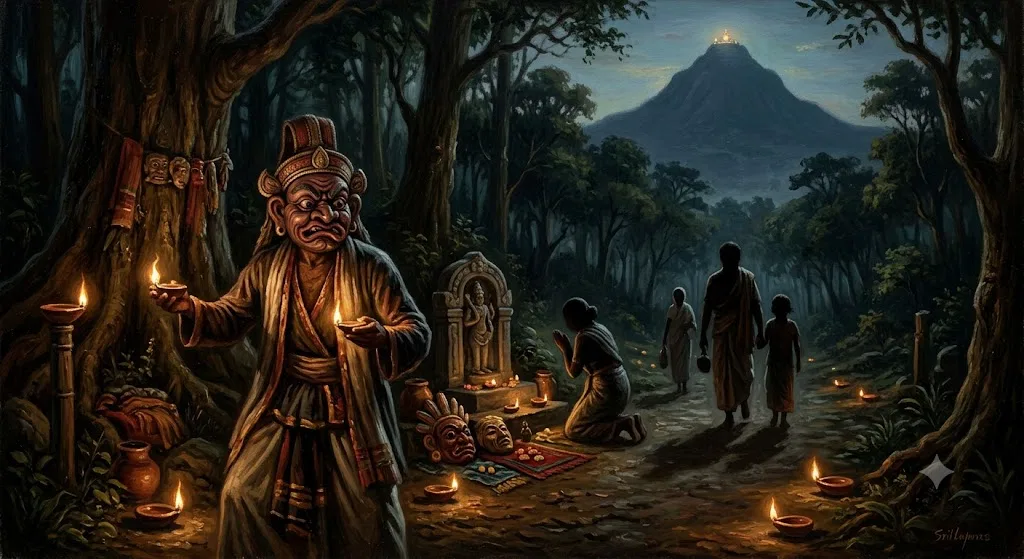
Sri Lankan folklore is not a single shelf of old stories. It is a living mixture of village tales, Buddhist chronicles, Hindu epic retellings, goddess worship, healing rituals, masked performance, puppet drama, sacred mountains and modern tourist myth-making.
Page outline Jump by section
Why Sri Lankan folklore feels so layered
Sri Lanka sits close to South India, on old sea routes and pilgrimage routes, and its traditions reflect centuries of contact as well as sharply local imagination. Sinhala Buddhist, Tamil Hindu, Muslim, Christian and Indigenous traditions have all shaped how stories are told, where shrines are visited, and which beings are feared or honoured. A reader looking for “Sri Lankan mythology” will therefore find several overlapping worlds rather than one tidy pantheon.
One layer comes from chronicle and royal legend. The island’s origin stories are preserved in Buddhist historical literature, especially stories around Prince Vijaya, Kuveni and the first settlement of the island. These are not simple factual records; modern scholarship treats them as texts that mix memory, political meaning, performance culture and literary shaping. A recent study of the Vijaya-Kuveni story, for example, uses the chronicles and commentarial texts to ask what they suggest about early performing arts and social life, not merely whether every episode “really happened”.[Journal of Research in Music]jrm.sljol.infoOpen source on sljol.info.
A second layer comes from village storytelling. The three-volume early twentieth-century collection Village Folk-Tales of Ceylon, gathered and translated by Henry Parker, remains one of the best-known English-language records of older Sinhala and Vedda-related tale material. Its contents include creation stories, animal tales, trickster episodes, stories of princes and princesses, and encounters with supernatural beings. The collection is also a colonial-era document, so it should be read as a valuable but mediated archive rather than a transparent recording of village voices.[Project Gutenberg]gutenberg.orgProject Gutenberg Village Folk-Tales of Ceylon; Volume IProject Gutenberg Village Folk-Tales of Ceylon; Volume I
A third layer is ritual. Sri Lankan folklore is often performed, danced, sung, drummed, carved or enacted before it is written down. Healing rites, goddess ceremonies, pilgrimage festivals, masked dances and puppet dramas all carry stories in public form. This is why Sri Lankan folklore often feels less like “mythology in a book” and more like a culture of events: stories are activated at shrines, in courtyards, on stages, beside sacred trees and along pilgrimage paths.
Kuveni and the island’s founding imagination
One of the most important legendary figures in Sri Lanka is Kuveni, the woman or spirit-queen associated with the arrival of Prince Vijaya. In the familiar chronicle version, Vijaya comes to the island with followers; Kuveni is linked with the island’s earlier inhabitants and supernatural powers; she helps Vijaya, bears him children, and is later rejected. The story is a founding tale about settlement, betrayal, legitimacy and displacement.
The detail that makes Kuveni so powerful is her double position. She is sometimes described as a supernatural woman, sometimes as a regional leader, and often as a figure who stands at the boundary between the island’s earlier world and the new political order represented by Vijaya. The 2024 study of the Vijaya-Kuveni story notes that chronicle material presents Kuveni as the daughter of a regional leader and shows her engaged in everyday production, spinning cotton yarn, rather than merely as a monster of romance.[Journal of Research in Music]jrm.sljol.infoOpen source on sljol.info.
For folklore readers, Kuveni matters because she keeps the origin story morally unsettled. Vijaya’s arrival is not just a heroic landing; it is also a story of alliance, gendered betrayal and the cost of founding a kingdom. Later retellings often heighten this tragedy, turning Kuveni into a cursed or wronged woman whose grief shadows the island’s political destiny. Such versions should be treated as evolving legend rather than ancient fact, but their emotional force explains why Kuveni remains more than a minor chronicle character.
The story also connects to Sri Lanka’s Indigenous Vedda traditions in complicated ways. Some later accounts associate Kuveni’s children with forest-dwelling peoples, but this should be handled carefully: folklore, chronicle, colonial anthropology and modern identity politics have all shaped how these links are described. The safest reading is that Kuveni functions as a symbolic ancestor figure in stories about belonging, exclusion and the relationship between state-centred history and older local communities.
Demons, masks and healing rituals
Sri Lanka’s best-known supernatural performance traditions are the masked healing and exorcism rites often described in English as “devil dances”. The phrase can be misleading if it suggests simple horror theatre. These rituals combine illness explanation, drama, music, offerings, comic performance and social release. They present dangerous beings as characters who can be named, negotiated with, mocked, fed and sent away.
The most famous example is the Sanni Yakuma, a healing ritual in which masked performers represent disease-causing demons. A British Medical Journal article describes it as the best-known Sri Lankan exorcism ritual and notes that performers wear masks showing demons associated with particular ailments.[PMC]pmc.ncbi.nlm.nih.govOpen source on nih.gov. Museum descriptions of Sri Lankan masks likewise explain that the great demon of disease is represented with smaller disease demons and that the ritual aims to cure through offerings, blessings and staged confrontation.[Google Arts & Culture]artsandculture.google.comOpen source on google.com.
The masks are not random grotesques. They are a visual map of suffering. A swollen face, twisted mouth, animal feature or exaggerated expression can signal a particular illness or disturbance. The ritual gives shape to fear and makes illness socially visible. That does not mean the ritual replaces modern medicine; it means that in its traditional setting it addressed illness as a disturbance of body, mind, household and community.
Humour is part of the power. Accounts of Sri Lankan exorcistic performance often stress that the frightening and the comic sit together. Demons may be mocked or made absurd. The patient and community are not simply passive spectators; they witness a drama in which disorder is brought into public form and contained. This helps explain why masks carved for ritual have also become museum objects, tourist souvenirs and stage icons. Once removed from ritual, they can be admired as art, but their older meaning is inseparable from healing performance.
Guardian deities and everyday protection
Sri Lankan folklore is full of beings who do not fit neatly into the categories “god”, “spirit”, “demon” or “ancestor”. In Buddhist-majority contexts especially, local and Hindu-derived deities have often been incorporated as protectors of the land, the faith, a region, a shrine or a specialised human need. This makes Sri Lankan religious folklore highly practical: people seek blessing, healing, rain, fertility, justice, safe travel or protection from misfortune.
Kataragama is one of the clearest examples. The shrine town in south-eastern Sri Lanka is associated with Skanda or Murugan, but it is not only a Tamil Hindu site. It is a major multi-religious pilgrimage centre where Buddhist, Hindu and Muslim meanings have overlapped. The classic scholarly study of the Kataragama pilgrimage describes it as one of Sri Lanka’s remarkable ritual events and treats it as important for understanding Hindu-Buddhist interaction in a polyethnic society.[JSTOR]jstor.orgThe Kataragama Pilgrimage: Hindu-BuddhistThe Kataragama Pilgrimage: Hindu-Buddhist
This is where folklore becomes geography. A deity is not just a name in a myth; the god is encountered through route, shrine, vow, offering, festival, ordeal and story. Kataragama’s annual pilgrimage, devotional acts and legends create a shared sacred landscape even when different communities explain the god differently.
Pattini, the goddess associated with chastity, fertility, disease, protection and healing, shows another kind of layering. Gananath Obeyesekere’s major study describes Pattini as a folk deity of Sinhala Buddhists and an assimilated goddess of the Hindu pantheon, worshipped in Sri Lanka and South India for fifteen hundred years or more. His research connects her worship to healing, propitiation and the post-harvest ritual known as the gammaduva.[Google Books]books.google.comBooks The Cult of the Goddess PattiniBooks The Cult of the Goddess Pattini
Pattini traditions are especially important because they show how a goddess can travel between literary story, village ritual and public crisis. During illness or epidemic, rituals of solace may combine dance, chanting, drumming and offerings to seek protection and remove harmful influences.[Asia Research Institute, NUS]ari.nus.edu.sgAsia Research Institute, NUSThe Cult of Goddess Pattini at a time of PandemicAsia Research Institute, NUSThe Cult of Goddess Pattini at a time of Pandemic For a folklore reader, Pattini is not only “a goddess” but a whole ritual complex: myth, gender ideal, healing power, shrine practice and community reassurance.
Sacred places where several stories meet
Sri Lankan folklore is unusually place-rich. Mountains, caves, trees, river routes, ruins and shrines often carry multiple stories at once. A single site may be Buddhist, Hindu, Muslim, Christian, local, royal and tourist-facing, depending on who is telling the story.
Sri Pada, widely known in English as Adam’s Peak, is the strongest example. UNESCO’s World Heritage tentative-list page describes it as a pilgrimage site sacred to Buddhists, Hindus, Christians and Muslims. Buddhists venerate the summit mark as the Buddha’s footprint; Hindus connect it with Shiva; some Christians and Muslims identify it with Adam, while other Christian traditions connect it with St Thomas.[UNESCO World Heritage Centre]whc.unesco.orgOpen source on unesco.org.
The same source gives a deep historical frame: the wider route was used from early historical times, and the site is associated in records and tradition with kings, inscriptions and travellers including Fa Hian, Marco Polo, Al-Biruni and Ibn Battuta. It also notes that firm inscriptional evidence for the footprint cult appears in the reign of King Vijayabahu I, while later rulers supported pilgrims with grants, pathways and protective works.[UNESCO World Heritage Centre]whc.unesco.orgOpen source on unesco.org.
For folklore, the point is not to choose only one “correct” footprint story. The importance of Sri Pada lies in the coexistence of claims. The footprint is a sacred sign that different communities read through their own cosmology. That shared-but-contested quality makes the mountain a rare example of how legend can produce common pilgrimage space without requiring one single interpretation.
Adam’s Bridge, the chain of shoals between Sri Lanka and India, works in a similar but more contested way. In Hindu epic geography it is associated with Rama’s bridge to Lanka; in Islamic-linked naming traditions it connects with Adam’s journey. Modern travel writing often retells these legends beside geological explanations and political debates over infrastructure.[Condé Nast Traveler]cntraveler.comOpen source on cntraveler.com. The useful distinction is clear: the shoals are a real formation, while the stories attached to them belong to religious geography, epic imagination and modern heritage tourism.
Ravana: villain, king, ancestor, tourist icon
No figure shows the modern transformation of Sri Lankan legend more clearly than Ravana. In the classical Indian Ramayana, Ravana is the powerful ruler of Lanka who abducts Sita and is defeated by Rama. In Sri Lanka, however, Ravana has often been reinterpreted more sympathetically: as a learned king, a technological genius, a defender of the island, or a symbol of pre-Vijayan antiquity.
Sri Lanka Tourism’s own material presents Ravana as a legendary emperor and lists places linked to the Ravana legend, including Sita Eliya, Ravana Ella Cave, Wariyapola and Horton Plains, while noting that some modern claims go as far as identifying him as a Buddhist king or builder of monasteries.[Sri Lanka Travel]srilanka.travelSri Lanka Travel RavanaSri Lanka Travel Ravana The same tourism ecosystem has promoted a Ramayana trail, with brochures describing dozens of locations connected to the epic and marketed to pilgrims and visitors.[SLTDA]sltda.gov.lkSLTDAContent of Ramayana YathraSLTDAContent of Ramayana Yathra
This is where old tradition, literary epic and modern invention must be separated. There are certainly long-standing Ramayana associations in Sri Lanka, and Ravana’s Lanka has been imagined through South Asian literature for centuries. But many specific site claims are modern, tourism-driven or politically charged. Scholarly discussion of the Ravana figure points to a resurgence of Ravana texts and a modern “cult status” around the legendary king, especially in relation to folk imagination and national identity.[OUSL Journal]ouslj.sljol.infoOpen source on sljol.info.
The modern Ravana is therefore not just a mythic character; he is a debate about how Sri Lanka imagines its deep past. For some, he offers a proud indigenous counter-story to Indian epic dominance. For others, modern Ravana enthusiasm risks turning flexible folklore into pseudo-history. A fair reading keeps both points in view: Ravana is culturally important precisely because he is adaptable, but adaptation is not the same as archaeological proof.

Village tales, animals and moral cleverness
Beyond famous deities and sacred sites, Sri Lanka has a rich body of village tales. These stories often feature kings, poor villagers, clever wives, foolish men, animals, spirits, monks, merchants and magical objects. Their world is more earthy than grand mythology. Hunger, debt, marriage, farming, status, luck and cunning matter as much as gods or demons.
Henry Parker’s Village Folk-Tales of Ceylon gives English readers one of the most accessible older windows into this world. The first volume includes tales with titles such as “The Making of the Great Earth”, “The Sun, the Moon, and Great Paddy”, “The Frog Prince”, “The Prince and the Yakā” and “How a Yakā and a Man fought”.[Project Gutenberg]gutenberg.orgProject Gutenberg Village Folk-Tales of Ceylon; Volume IProject Gutenberg Village Folk-Tales of Ceylon; Volume I Such titles show how Sri Lankan tale tradition moves easily between cosmic explanation, animal fable, wonder tale and spirit encounter.
These stories often reward practical intelligence rather than noble birth. A weak character may survive by trickery; a foolish one may be punished for greed; a supernatural threat may be defeated by presence of mind. Like folktales elsewhere, Sri Lankan village stories travelled through telling, adaptation and borrowing. Some motifs resemble stories found in India, the Middle East or Europe, but local setting, crops, kinship patterns, animals and ritual assumptions give them Sri Lankan texture.
The word “fairy tale” can be used for some of these stories, but it should not imply European fairies. Sri Lankan wonder tales may include enchanted princesses and miraculous transformations, yet their supernatural beings are usually better understood through local categories of spirits, demons, deities, animals and fate. The pleasure of the stories lies in their practical imagination: they explain how to live in a world where power is uneven, danger is near, and clever speech may save a life.
Puppets, masks and the stage as folklore archive
Sri Lankan folklore has also survived through performance forms that are entertaining rather than strictly ritual. Traditional string puppet drama, known locally as Rukada Natya, is a good example. UNESCO describes it as a drama performed with string puppets, traditionally used to entertain village communities and convey moral lessons. Its themes include folktales, Buddhist stories, ancient literature, historical narratives and humorous anecdotes.[UNESCO Intangible Cultural Heritage]ich.unesco.orgOpen source on unesco.org.
UNESCO’s 2018 inscription notes that the tradition is performed by family groups connected with the Gamwari lineage around southern coastal towns; puppeteers make their own wooden puppets and prepare handwritten scripts, while music accompanies the performance.[UNESCO]unesco.orgdocument 4778document 4778 Sri Lanka’s National Library also notes that the art is practised mainly in southern and western coastal areas and that its exact origin is uncertain, with some researchers suggesting possible links to migrants from southern or south-western India.[National Library of Sri Lanka]natlib.lkOpen source on natlib.lk.
This matters because puppetry shows folklore becoming public theatre. A tale told at home can become a village performance; a Buddhist moral story can become comic drama; a historical episode can become a puppet scene. The puppet is both craft object and storytelling body.
Masks perform a similar double role. In ritual, they confront illness and spirits. In tourist shops and museums, they become portable symbols of Sri Lankan culture. The danger is that visitors may see only colourful faces and miss the ritual grammar behind them. A mask of a disease demon is not merely “spooky”; it belongs to a larger system of diagnosis, offering, dance, music and negotiated healing.
What is old, what is retold, and what is modern folklore?
Sri Lankan folklore is easiest to understand if its traditions are sorted by evidence type rather than by how dramatic they sound.
Well-attested living traditions include recognised performance and ritual forms such as Rukada Natya, healing rites, pilgrimage practices, goddess rituals and sacred-tree offerings. These can be documented through practitioners, heritage inventories, ethnographic studies, museums and continuing performance. Sri Lanka’s national intangible heritage inventory explicitly uses UNESCO-style categories including oral traditions, performing arts, social practices, rituals, nature knowledge and craftsmanship.[National Library of Sri Lanka]natlib.lkOpen source on natlib.lk.
Chronicle legends include stories such as Vijaya and Kuveni. These are old and culturally central, but they are not neutral modern histories. They survive in literary and religious texts, and their meaning has changed as communities have argued about origins, identity and legitimacy.[Journal of Research in Music]jrm.sljol.infoOpen source on sljol.info.
Sacred landscape traditions include Sri Pada, Kataragama and Adam’s Bridge. These are attached to real places and long-standing pilgrimage patterns, but each site may carry multiple explanations. A pilgrim, a monk, a tourist guide, a historian and a geologist may all speak truthfully in different registers, provided they do not confuse devotion, memory, marketing and physical evidence.[UNESCO World Heritage Centre]whc.unesco.orgOpen source on unesco.org.
Modern reinterpretations include much of the present-day Ravana revival. Ravana is an old epic figure, but many claims about aircraft, hidden technologies, specific landing sites or exact archaeological identifications belong to recent nationalist, literary, internet or tourism culture. They are important as modern folklore, not as established ancient history.[Sri Lanka Travel]srilanka.travelSri Lanka Travel RavanaSri Lanka Travel Ravana
This distinction does not make modern folklore worthless. On the contrary, modern folklore reveals what people now want the past to mean. Ravana tourism, mask souvenirs, online ghost stories and revived goddess narratives all show how older symbols are being reworked for identity, commerce, entertainment and spiritual reassurance.

Haunted and supernatural Sri Lanka today
Sri Lankan supernatural belief has not disappeared into museums. Stories of possession, restless spirits, cursed places, protective gods, ominous dreams and ritual specialists continue to circulate, though they vary widely by region, class, religion and family background. In everyday life, these beliefs may sit beside Buddhism, Hindu worship, Christianity, Islam, biomedical care, psychology and popular media.
The most important point for outside readers is that supernatural tradition in Sri Lanka is often relational. A spirit may be dangerous because a promise was broken, a ritual neglected, a death was troubled, a boundary crossed or envy entered the household. Healing therefore may require more than “removing a ghost”. It can involve restoring order: making offerings, fulfilling vows, consulting ritual experts, repairing social relations or seeking blessings from a deity.
At the same time, not every modern ghost story has deep roots. Internet-era folklore can attach itself quickly to abandoned buildings, battle sites, roads, hotels or forests. Some stories are local memory; some are entertainment; some are tourism; some are imported paranormal language placed over Sri Lankan settings. A grounded approach asks: who tells the story, how long has it circulated, is it attached to a ritual or shrine, and does it appear in older collections or only in recent online retellings?
Why Sri Lankan folklore still matters
Sri Lankan folklore matters because it is one of the clearest ways to see how the island thinks about power, illness, landscape and belonging. Kuveni turns the founding of a kingdom into a story of betrayal and memory. Demon masks turn sickness into a drama that a community can face. Pattini rituals place healing, fertility and moral order under the care of a goddess. Sri Pada shows how one mountain can hold several religious worlds. Ravana shows how epic characters can be remade for modern identity and tourism.
The strongest Sri Lankan traditions are not frozen relics. They have survived by changing form: oral tale to printed collection, ritual mask to museum object, village puppet drama to UNESCO-listed heritage, pilgrimage path to national and international tourism route, epic villain to contested local hero. That movement is exactly what makes Sri Lankan folklore so rich. It is old enough to feel rooted, flexible enough to keep changing, and complex enough to resist any single simple summary.
Amazon book picks
Further Reading
Books and field guides related to Where Sri Lanka's Legends Still Live. Use these as the next step if you want deeper reading beyond the article.
The Ramayana
Many Sri Lankan folklore traditions engage with Ravana and Ramayana-derived narratives.
Indian Mythology
Provides regional mythological context influencing Sri Lankan folklore.
eBay marketplace picks
Marketplace Samples
Example marketplace items related to this page. Use the search link to explore similar finds on eBay.
Endnotes
1.
Source: gutenberg.org
Title: Project Gutenberg Village Folk-Tales of Ceylon; Volume I
Link:https://www.gutenberg.org/files/56614/56614-h/56614-h.htm
2.
Source: pmc.ncbi.nlm.nih.gov
Link:https://pmc.ncbi.nlm.nih.gov/articles/PMC1761180/
3.
Source: artsandculture.google.com
Link:https://artsandculture.google.com/story/mysterious-masks-museum-histoire-naturelle-de-nimes/3AWx42He4T3c5g?hl=en
4.
Source: jstor.org
Title: The Kataragama Pilgrimage: Hindu-Buddhist
Link:https://www.jstor.org/stable/2053418
5.
Source: books.google.com
Title: Books The Cult of the Goddess Pattini
Link:https://books.google.com/books/about/The_Cult_of_the_Goddess_Pattini.html?id=WVTvDwAAQBAJ
6.
Source: ari.nus.edu.sg
Title: Asia Research Institute, NUSThe Cult of Goddess Pattini at a time of Pandemic
Link:https://ari.nus.edu.sg/20331-91/
7.
Source: whc.unesco.org
Link:https://whc.unesco.org/en/tentativelists/5531/
8.
Source: sltda.gov.lk
Title: SLTDAContent of Ramayana Yathra
Link:https://www.sltda.gov.lk/storage/common_media/ramayanaya-yathra%20E%20Brochure4096755957.pdf
9.
Source: ich.unesco.org
Link:https://ich.unesco.org/en/RL/rkada-ntya-traditional-string-puppet-drama-in-sri-lanka-01370
10.
Source: unesco.org
Title: document 4778
Link:https://www.unesco.org/archives/multimedia/document-4778
11.
Source: archive.org
Title: 2015.236340.Religion And djvu.txt
Link:https://archive.org/stream/in.ernet.dli.2015.236340/2015.236340.Religion-And_djvu.txt
12.
Source: archive.org
Title: Village Folk tales Of Ceylon V.1
Link:https://archive.org/details/VillageFolk-talesOfCeylonV.1
13.
Source: archive.org
Link:https://archive.org/details/cu31924070625813
14.
Source: archive.org
Title: Village Folk tales Of Ceylon V.3
Link:https://archive.org/details/VillageFolk-talesOfCeylonV.3
15.
Source: archive.org
Link:https://archive.org/details/villagefolktales0000park
16.
Source: ich.unesco.org
Link:https://ich.unesco.org/en/lists
17.
Source: ich.unesco.org
Title: huaconada ritual dance of mito 00390
Link:https://ich.unesco.org/en/RL/huaconada-ritual-dance-of-mito-00390
18.
Source: ich.unesco.org
Title: sri lanka LK
Link:https://ich.unesco.org/en/state/sri-lanka-LK?info=periodic-reporting
19.
Source: ich.unesco.org
Title: mask dance of the drums from drametse 00161
Link:https://ich.unesco.org/en/RL/mask-dance-of-the-drums-from-drametse-00161
20.
Source: ich.unesco.org
Title: what is intangible heritage 00003
Link:https://ich.unesco.org/en/what-is-intangible-heritage-00003
21.
Source: ich.unesco.org
Title: coming forth of the masks and puppets in markala 01004
Link:https://ich.unesco.org/en/RL/coming-forth-of-the-masks-and-puppets-in-markala-01004
22.
Source: ich.unesco.org
Link:https://ich.unesco.org/en/activities/4th-international-conference-on-intangible-cultural-heritage-preserving-and-safeguarding-cultural-heritage-through-traditional-insights-00448
23.
Source: ich.unesco.org
Title: raiho shin ritual visits of deities in masks and costumes 01271
Link:https://ich.unesco.org/en/RL/raiho-shin-ritual-visits-of-deities-in-masks-and-costumes-01271
24.
Source: ich.unesco.org
Title: ITH 16 11.CO M 1.BU R 2 EN.doc
Link:https://ich.unesco.org/doc/src/ITH-16-11.COM_1.BUR-2-EN.doc
25.
Source: ich.unesco.org
Title: furyu odori ritual dances imbued with people s hopes and prayers 01701
Link:https://ich.unesco.org/en/RL/furyu-odori-ritual-dances-imbued-with-people-s-hopes-and-prayers-01701
26.
Source: ich.unesco.org
Link:https://ich.unesco.org/en/convention
27.
Source: ich.unesco.org
Link:https://ich.unesco.org/en/RL/shrovetide-door-to-door-processions-and-masks-in-the-villages-of-the-hlinecko-area-00397
28.
Source: ich.unesco.org
Link:https://ich.unesco.org/
29.
Source: ich.unesco.org
Title: cheoyongmu 00189
Link:https://ich.unesco.org/en/RL/cheoyongmu-00189
30.
Source: ich.unesco.org
Title: traditional craftsmanship of making dumbara rat kalla 01693
Link:https://ich.unesco.org/en/RL/traditional-craftsmanship-of-making-dumbara-rat-kalla-01693
31.
Source: ich.unesco.org
Title: sada shin noh sacred dancing at sada shrine shimane 00412
Link:https://ich.unesco.org/en/RL/sada-shin-noh-sacred-dancing-at-sada-shrine-shimane-00412
32.
Source: ich.unesco.org
Title: oral traditions and expressions 00053
Link:https://ich.unesco.org/en/oral-traditions-and-expressions-00053
33.
Source: ich.unesco.org
Title: talchum mask dance drama in the republic of korea 01742
Link:https://ich.unesco.org/en/RL/talchum-mask-dance-drama-in-the-republic-of-korea-01742
34.
Source: unesco.org
Link:https://www.unesco.org/en/intangible-cultural-heritage
35.
Source: ich.unesco.org
Title: 37980 EN
Link:https://ich.unesco.org/doc/src/37980-EN.pdf
36.
Source: ich.unesco.org
Title: sri lanka LK
Link:https://ich.unesco.org/en/state/sri-lanka-LK
37.
Source: ich.unesco.org
Title: accredited ngos 00331&name=00716
Link:https://ich.unesco.org/en/accredited-ngos-00331%26name%3D00716?call=film&id=44840&include=film_inc.php&width=700
38.
Source: artsandculture.google.com
Title: aw Uxj RGO3u Eo TQ
Link:https://artsandculture.google.com/story/masks-representing-myths-of-asean-countries-ichcap/awUxjRGO3uEoTQ?hl=en
39.
Source: books.google.com
Title: Village Folk tales of Ceylon
Link:https://books.google.com/books/about/Village_Folk_tales_of_Ceylon.html?id=RotqO5MrOtQC
40.
Source: books.google.com
Title: Village Folk tales of Ceylon
Link:https://books.google.com/books/about/Village_Folk_tales_of_Ceylon.html?id=HEIkAQAAIAAJ
41.
Source: gutenberg.org
Link:https://www.gutenberg.org/ebooks/56614
42.
Source: kataragama.org
Link:https://kataragama.org/research/davidson.htm
43.
Source: jstor.org
Link:https://www.jstor.org/stable/678568
44.
Source: sri.com
Title: History, Leadership, and Values
Link:https://www.sri.com/about-us/
45.
Source: natlib.lk
Link:https://www.natlib.lk/NLDSB/national-inventory-of-the-intangible-cultural-heritage-of-sri-lanka/
46.
Source: jrm.sljol.info
Link:https://jrm.sljol.info/articles/10.4038/jrm.v2i2.28
47.
Source: cntraveler.com
Link:https://www.cntraveler.com/stories/2015-11-02/the-many-legends-of-adams-bridge-sri-lanka-india
48.
Source: srilanka.travel
Title: Sri Lanka Travel Ravana
Link:https://www.srilanka.travel/ravana
49.
Source: ouslj.sljol.info
Link:https://ouslj.sljol.info/articles/7555/files/submission/proof/7555-1-27301-1-10-20220209.pdf
50.
Source: natlib.lk
Link:https://www.natlib.lk/NLDSB/rukada-natya/
51.
Source: Wikipedia
Title: Sri Lanka
Link:https://en.wikipedia.org/wiki/Sri_Lanka
52.
Source: Wikipedia
Link:https://en.wikipedia.org/wiki/Lanka
53.
Source: Wikipedia
Link:https://en.wikipedia.org/wiki/Ravana
54.
Source: Wikipedia
Title: Sanni Yakuma
Link:https://en.wikipedia.org/wiki/Sanni_Yakuma
55.
Source: Wikipedia
Link:https://en.wikipedia.org/wiki/Kuveni
56.
Source: Wikipedia
Title: Prince Vijaya
Link:https://en.wikipedia.org/wiki/Prince_Vijaya
57.
Source: srilankatourravana.com
Link:https://srilankatourravana.com/
58.
Source: slncu.lk
Title: rukada natya
Link:https://slncu.lk/partnerships-networks/ich/rukada-natya/
59.
Source: noolaham.net
Title: village folk-tales
Link:https://noolaham.net/project/1264/126374/126374.pdf
61.
Source: srilanka.travel
Link:https://www.srilanka.travel/ramayanaya/resources/itineraries/aitken-spence-1.pdf
62.
Source: historiskmuseum.no
Link:https://www.historiskmuseum.no/english/exhibitions/exhibitions-archive/masks-for-life-and-death/sanni/
63.
Source: gov.lk
Link:https://www.gov.lk/
64.
Source: culturaldept.gov.lk
Link:https://www.culturaldept.gov.lk/index.php?Itemid=230&id=108&lang=en&option=com_content&view=article
65.
Source: ird.gov.lk
Link:https://www.ird.gov.lk/en/sitepages/default.aspx
66.
Source: lankatravelgateway.com
Link:https://www.lankatravelgateway.com/destinations/kataragama
67.
Source: stamps.gov.lk
Link:https://www.stamps.gov.lk/945.php
68.
Source: globalbuddhism.org
Link:https://www.globalbuddhism.org/article/view/4086/4173
Additional References
69.
Source: youtube.com
Title: How Negombo Got Its Name | Folklore, Myths & Legends of Sri Lanka
Link:https://www.youtube.com/watch?v=0tIBLt5gif8
Source snippet
Sri Lankan low country dance - the Devil Dance...
70.
Source: youtube.com
Title: Legend of Vijaya and Kuweni | The First King of Sri Lanka
Link:https://www.youtube.com/watch?v=B0ipoEP8R6k
Source snippet
What They Never Told You About King Ravana...
71.
Source: youtube.com
Title: Sri Lankan low country dance
Link:https://www.youtube.com/watch?v=L2cZPN83rDk
Source snippet
Legend of Vijaya and Kuweni | The First King of Sri Lanka...
72.
Source: researchgate.net
Link:https://www.researchgate.net/publication/335108679_Reclaiming_Ravana_in_Sri_Lanka_Ravana%27s_Sinhala_Buddhist_Apotheosis_and_Tamil_Responses
73.
Source: bliptext.com
Link:https://bliptext.com/articles/adam-s-peak
74.
Source: facebook.com
Link:https://www.facebook.com/groups/ancient.civilizationsz/posts/1335930844639722/
75.
Source: scribd.com
Link:https://www.scribd.com/document/262047773/Prince-Vijaya
76.
Source: instagram.com
Link:https://www.instagram.com/p/DK9EZUTiBdP/?hl=en
77.
Source: facebook.com
Link:https://www.facebook.com/bloonsoo/posts/during-hindu-festivals-like-thaipusam-sri-lankan-devotees-perform-the-kavadi-dan/748725001078910/
78.
Source: academia.edu
Link:https://www.academia.edu/123305182/Exploring_the_Socio_Cultural_Significance_and_Community_Dynamics_of_the_Ankeliya_Pattini_Ritual_Game_in_Sri_Lanka
Topic Tree
Follow this branch
Related pages 192
- Afghan Folklore
- Albanian Folklore
- Algerian Folklore
- Australian Folklore
- Azerbaijan Folklore
- +187 more in sidebar