Within Congo Folklore
Why Were Kongo Power Figures Feared?
Kongo power figures were ritually charged objects used for healing, oath-taking, protection and the punishment of wrongdoing.
On this page
- What power figures were made to do
- Nails, medicines and ancestor force
- Museum objects and colonial misunderstandings
Page outline Jump by section
Introduction
Kongo power figures are among the most striking ritual objects associated with the Congo region. Covered with nails, blades, mirrors and packets of medicinal substances, they are often displayed in museums as dramatic works of African art. Yet their original purpose was not decorative. In Kongo communities, these figures were believed to help maintain justice, protect people from harm, settle disputes, enforce oaths and punish wrongdoing. They stood at the meeting point of law, healing, religion and community responsibility. Rather than being worshipped as gods, they were understood as tools through which spiritual forces could be called upon to act in the world. Their reputation for power came precisely from their role as guardians against lies, theft, broken promises and social disorder.[The Metropolitan Museum of Art]metmuseum.orgThe Metropolitan Museum of Art Power Figure: Male (NkisiThe Metropolitan Museum of ArtPower Figure: Male (Nkisi) - Kongo peoplesConceived to house specific mystical forces, they were collaborat…
The tradition belongs to the wider Kongo cultural world, which stretches across parts of the modern Republic of the Congo, Democratic Republic of the Congo and Angola. Because these objects were used in public rituals and legal agreements, they offer a rare window into how many Kongo communities understood justice, protection and the unseen forces believed to support social order.[Africa Museum]africamuseum.beAfrica MuseumThe Kongo kingdomThe Kongo kingdom is one of Africa's ancient kingdoms whose history is exceptionally well documented. This…
Why Were Kongo Power Figures Feared?
The figures most often discussed today are known as nkisi nkondi, usually translated as “power figures” or “hunting figures”. The word “hunter” is important. These objects were believed to pursue offenders, uncover hidden wrongdoing and act against those who broke agreements. They were not passive symbols. Their purpose was intervention.[khanacademy.org]khanacademy.orgKhan AcademyPower Figure, Nkisi Nkondi, Kongo peoples (article)A nkisi nkondi can act as an oath taking image which is used to resolve ve…
Communities called upon them in situations that modern readers might associate with courts, mediation or public enforcement. A dispute between neighbours, an accusation of theft, a trade disagreement or a solemn oath could all involve a power figure. The ritual specialist responsible for the figure, known as a nganga, would invoke its force to witness an agreement or seek justice. The fear attached to the object came from the belief that a dishonest person could not escape the consequences.[umich.edu]umma.umich.eduArt Object: Power FigureAgreements, pacts, and oaths are taken in front of an nkondi, into which the nganga drives a nail or blade to…
Large and imposing examples reinforced this message visually. Some stood more than a metre tall with fierce expressions, tense postures and dense coverings of iron blades. Their appearance communicated authority long before any ritual began. As several museum collections note, these figures were deliberately designed to inspire awe and caution.[metmuseum.org]metmuseum.orgThe Metropolitan Museum of ArtMangaaka Power Figure (Nkisi N'Kondi) - Kongo peoplesOn the other hand, the nails representing so many past…
What Power Figures Were Made to Do
Power figures served many functions, but several themes appear repeatedly in historical accounts and surviving objects.
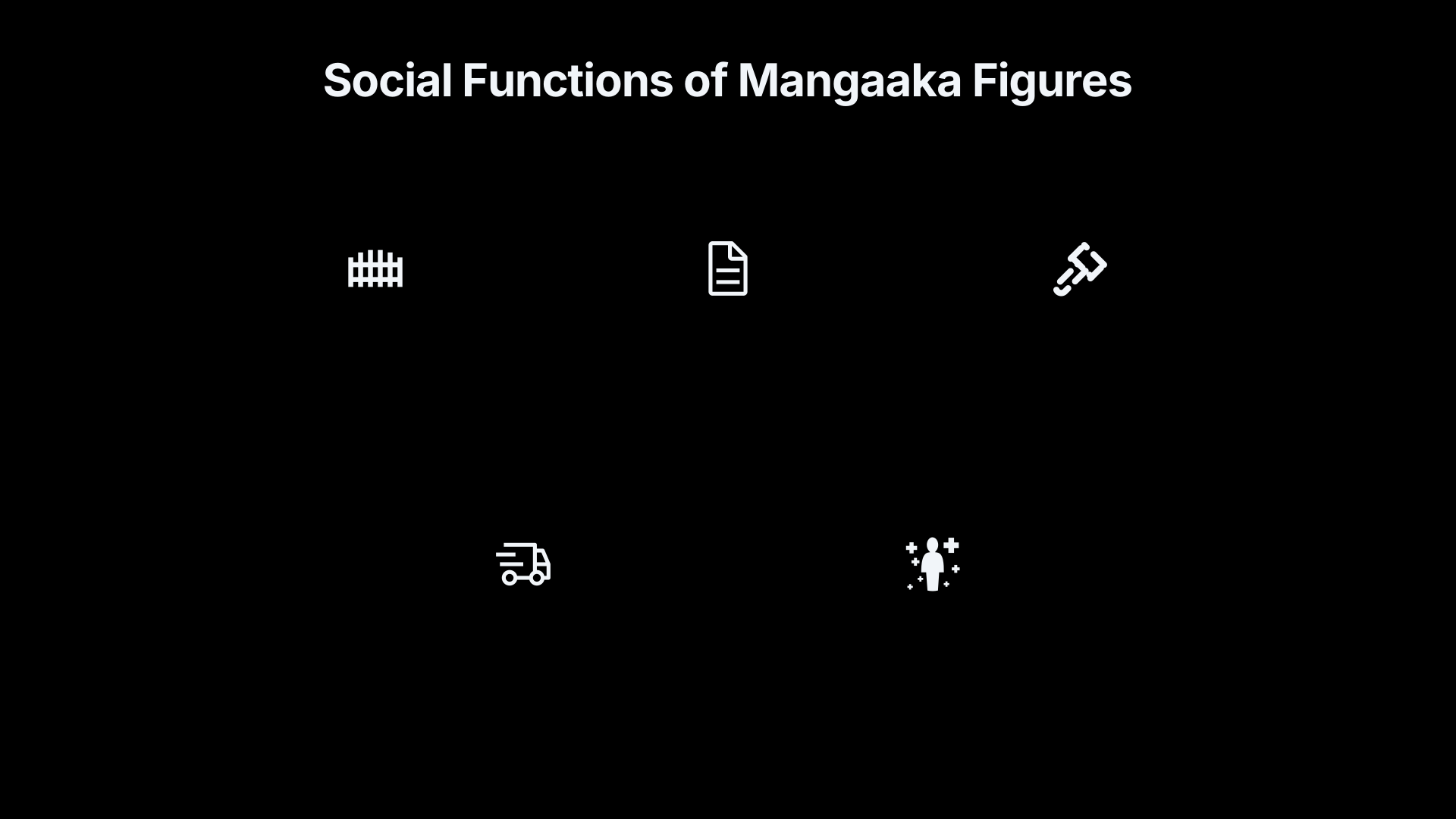
Protection of communities. Many figures were placed near settlements, entrances or boundaries. They were believed to guard villages from harmful forces, hostile intentions and spiritual threats.[duke.edu]blogs.library.duke.edunkisi nkondi history medicine collectionsnkisi that are used to punish wrongdoing and enforce oaths. The… The spirit would then hunt down wrongdoers, such as thieves or an oat…
Oath-taking and contract enforcement. Agreements could be made before a power figure, with participants swearing truthfulness in its presence. The figure acted as a witness whose supernatural authority reinforced the promise.[umich.edu]umma.umich.eduArt Object: Power FigureAgreements, pacts, and oaths are taken in front of an nkondi, into which the nganga drives a nail or blade to…
Settlement of disputes. Historical descriptions emphasise the use of nkisi nkondi in resolving arguments, lawsuits and conflicts. Rather than relying solely on human testimony, disputants could appeal to a force believed to know hidden truths.[khanacademy.org]khanacademy.orgKhan AcademyPower Figure, Nkisi Nkondi, Kongo peoples (article)A nkisi nkondi can act as an oath taking image which is used to resolve ve…
Punishment of wrongdoers. If someone stole property, broke an oath or violated a communal obligation, the figure could be ritually activated against them. The fear of supernatural punishment encouraged compliance with social rules.[duke.edu]blogs.library.duke.edunkisi nkondi history medicine collectionsnkisi that are used to punish wrongdoing and enforce oaths. The… The spirit would then hunt down wrongdoers, such as thieves or an oat…
Healing and restoration. Although modern images often emphasise punishment, many power figures were also linked to healing illness, restoring harmony and protecting innocent people. Justice and wellbeing were seen as connected rather than separate concerns.[The Metropolitan Museum of Art]metmuseum.orgThe Metropolitan Museum of Art Power Figure: Male (NkisiThe Metropolitan Museum of ArtPower Figure: Male (Nkisi) - Kongo peoplesConceived to house specific mystical forces, they were collaborat…
This combination of roles helps explain why the figures appear so frequently in discussions of Kongo belief. They addressed practical problems that affected everyday life.
Nails, Medicines and Ancestor Force
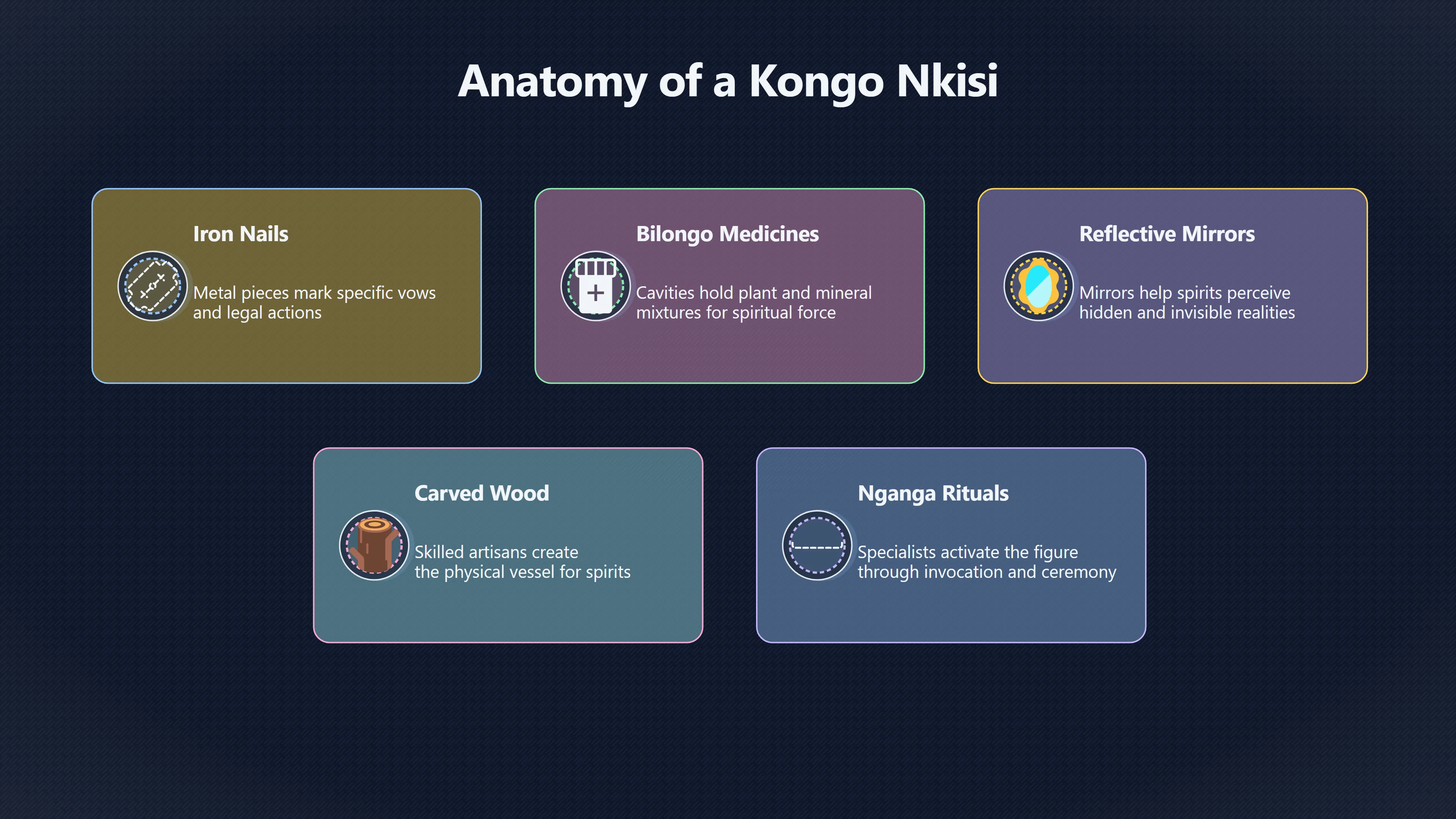
The most famous feature of many Kongo power figures is the mass of iron nails, blades and metal fragments driven into their bodies. Popular imagination sometimes treats these as acts of destruction, but researchers have shown that the metal pieces usually marked moments of activation. Each nail could represent a vow, a request, a legal action or a call for intervention. Driving the metal into the figure was a way of awakening its force and directing it towards a specific task.[umich.edu]umma.umich.eduArt Object: Power FigureAgreements, pacts, and oaths are taken in front of an nkondi, into which the nganga drives a nail or blade to…
The power of the object did not come from the nails alone. Kongo specialists filled cavities within the figure with substances known as medicines, often called bilongo in scholarly descriptions. These mixtures could include plant, animal and mineral materials, sometimes combined with earth associated with ancestors or burial places. Such ingredients were believed to connect the figure to powerful unseen forces.[metmuseum.org]metmuseum.orgThe Metropolitan Museum of Art Power Figure: Male (NkisiThe Metropolitan Museum of ArtPower Figure: Male (Nkisi) - Kongo peoplesConceived to house specific mystical forces, they were collaborat…
Mirrors are another common feature. A reflective surface was often placed over a cavity in the body, particularly the abdomen. According to Kongo belief recorded by researchers and museums, the mirror helped the spirit associated with the figure perceive hidden realities and act across the boundary between visible and invisible worlds.[duke.edu]blogs.library.duke.edunkisi nkondi history medicine collectionsnkisi that are used to punish wrongdoing and enforce oaths. The… The spirit would then hunt down wrongdoers, such as thieves or an oat…
The result was not simply a sculpture but a collaborative creation. A skilled carver made the figure, while the nganga transformed it into an active ritual object through medicines, invocations and ceremonial use.[The Metropolitan Museum of Art]metmuseum.orgThe Metropolitan Museum of Art Power Figure: Male (NkisiThe Metropolitan Museum of ArtPower Figure: Male (Nkisi) - Kongo peoplesConceived to house specific mystical forces, they were collaborat…
A Famous Example: Mangaaka and Judicial Authority
Among the most celebrated Kongo power figures are the monumental examples known as Mangaaka. These large figures were associated especially with judicial authority and public order. Historical and museum research describes them as powerful arbiters invoked in major disputes, trade agreements and contracts. Their size and prestige reflected the seriousness of the matters they addressed.[Princeton University Art Museum]artmuseum.princeton.eduPrinceton University Art MuseumAuthority Embodied: Nkisi | Princeton University Art MuseumOct 22, 2014 — A Nkisi Mangaaka's powers were i…
Mangaaka figures demonstrate that Kongo power figures were not merely personal charms. Some operated at the level of whole communities, helping regulate relationships, commerce and collective obligations. Their authority rested on a combination of ritual expertise, social recognition and belief in spiritual enforcement.[Princeton University Art Museum]artmuseum.princeton.eduPrinceton University Art MuseumAuthority Embodied: Nkisi | Princeton University Art MuseumOct 22, 2014 — A Nkisi Mangaaka's powers were i…
For historians, these objects reveal sophisticated local systems for managing trust and accountability long before colonial administrations attempted to impose European legal structures.
Museum Objects and Colonial Misunderstandings
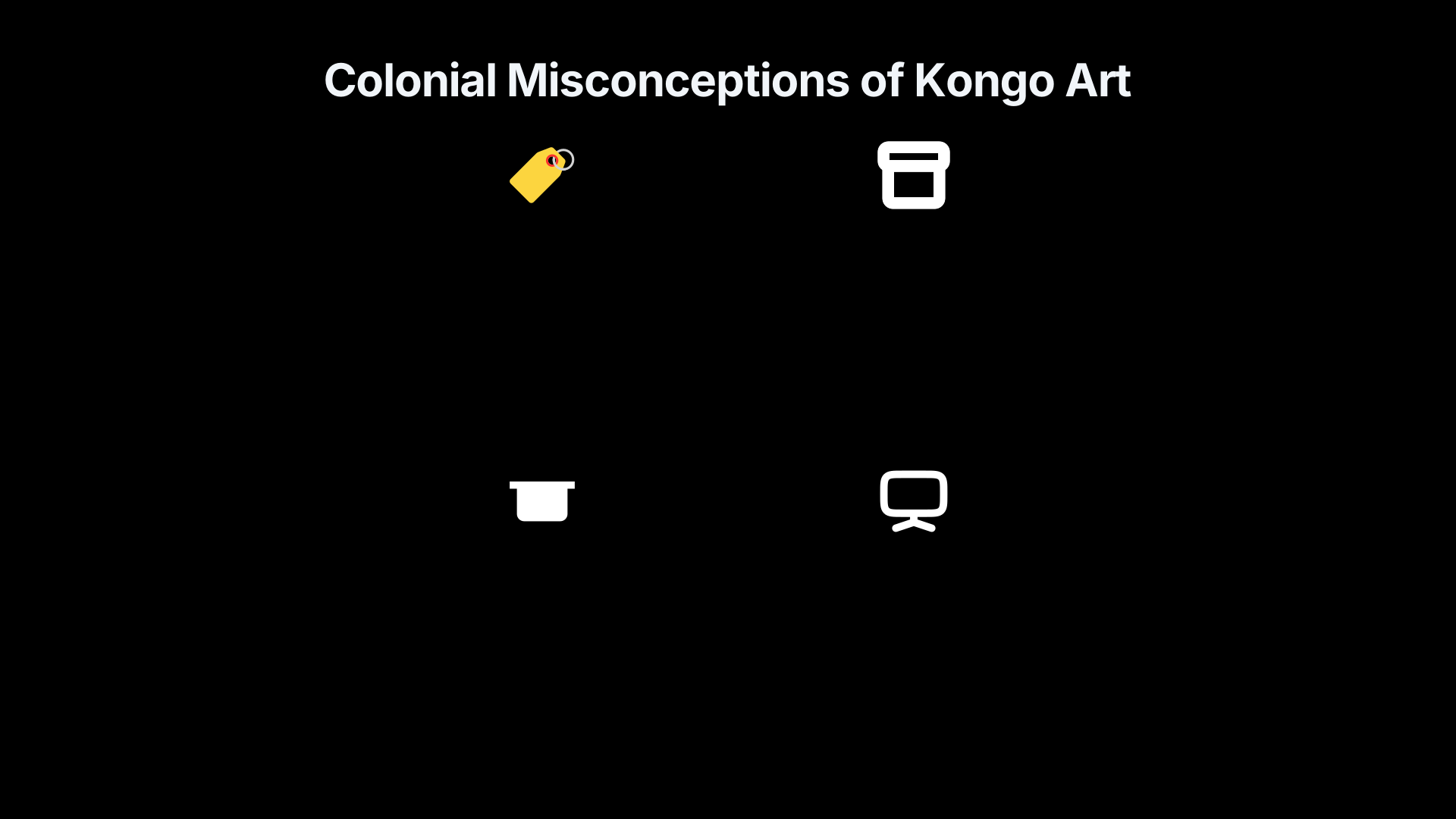
Power figures entered European collections in large numbers during the nineteenth and early twentieth centuries. Colonial observers often misunderstood them, describing them with labels such as “fetishes” and treating them as evidence of superstition rather than as parts of complex social and religious systems. Modern scholarship has increasingly challenged these interpretations.[The Art Institute of Chicago]artic.eduThe Art Institute of ChicagoCharged by PowerOnce labeled as a “fetish,” a term derived from the Portuguese word for witchcraft, the verna…
One persistent misunderstanding concerns the nails. Early collectors sometimes assumed they represented random violence or fear. Research now shows that the metal pieces often recorded specific acts, agreements and ritual activations. In this sense, a heavily nailed figure can be read almost as a historical record of past interventions.[metmuseum.org]metmuseum.orgThe Metropolitan Museum of ArtMangaaka Power Figure (Nkisi N'Kondi) - Kongo peoplesOn the other hand, the nails representing so many past…
Another misconception is that power figures were idols. Museum studies and Kongo specialists generally describe them instead as containers or vehicles for spiritual force. Their significance lay not in the wood itself but in the medicines, rituals, ancestral connections and communal relationships that activated them.[si.edu]si.eduSmithsonian InstituteMale figureA nkisi is the physical container for a spirit from the other world, the land of the dead. When activated…
Today, major museums increasingly present these objects within their original cultural context, emphasising their roles in justice, healing, protection and social regulation rather than displaying them merely as exotic curiosities. Exhibitions devoted to Kongo history and art have helped bring this broader understanding to public audiences.[The Metropolitan Museum of Art]metmuseum.orgThe Metropolitan Museum of ArtKongo: Power and MajestySep 18, 2015 — This international loan exhibition explores the region's history and…
How They Are Understood Today
Modern Kongo power figures occupy a complex place between heritage, religion, art history and folklore. Most surviving examples now sit in museums and collections, but they continue to shape popular ideas about Central African spiritual traditions. Their dramatic appearance ensures that they remain among the most recognisable ritual objects from the Congo region.[The Metropolitan Museum of Art]metmuseum.orghandle with care mangaakaThe Metropolitan Museum of ArtHandle with Care: A Mangaaka Power Figure's Journey…Oct 9, 2015 — The exhibition Kongo: Power and Majest…
For folklore enthusiasts, their importance lies in what they reveal about the unseen social world imagined by many Kongo communities. Stories about oath-breakers, thieves and hidden wrongs were not only told around fires or preserved in oral tradition. They were also embedded in objects believed capable of acting on behalf of justice itself. The fear they inspired was therefore inseparable from the protection they offered. A power figure was frightening because it stood with the community against deception, disorder and harm.[duke.edu]blogs.library.duke.edunkisi nkondi history medicine collectionsnkisi that are used to punish wrongdoing and enforce oaths. The… The spirit would then hunt down wrongdoers, such as thieves or an oat…
eBay marketplace picks
Marketplace Samples
Live-tested eBay searches with available results related to this page.
Endnotes
1.
Source: artmuseum.princeton.edu
Link:https://artmuseum.princeton.edu/art/stories-perspectives/authority-embodied-nkisi
Source snippet
Princeton University Art MuseumAuthority Embodied: Nkisi | Princeton University Art MuseumOct 22, 2014 — A Nkisi Mangaaka's powers were i...
2.
Source: blogs.library.duke.edu
Title: nkisi nkondi history medicine collections
Link:https://blogs.library.duke.edu/rubenstein/2016/04/13/nkisi-nkondi-history-medicine-collections/
Source snippet
nkisi that are used to punish wrongdoing and enforce oaths. The... The spirit would then hunt down wrongdoers, such as thieves or an oat...
3.
Source: metmuseum.org
Title: The Metropolitan Museum of Art Power Figure: Male (Nkisi)
Link:https://www.metmuseum.org/art/collection/search/316404
Source snippet
The Metropolitan Museum of ArtPower Figure: Male (Nkisi) - Kongo peoplesConceived to house specific mystical forces, they were collaborat...
4.
Source: metmuseum.org
Title: The Metropolitan Museum of Art Power Figure: Male (Nkisi Nkondi)
Link:https://www.metmuseum.org/art/collection/search/312221
Source snippet
The Metropolitan Museum of ArtPower Figure: Male (Nkisi Nkondi) - Kongo peoplesThis work was the product of a collaboration between a scu...
5.
Source: khanacademy.org
Link:https://www.khanacademy.org/humanities/ap-art-history/africa-apah/central-africa-apah/a/nkisi-nkondi
Source snippet
Khan AcademyPower Figure, Nkisi Nkondi, Kongo peoples (article)A nkisi nkondi can act as an oath taking image which is used to resolve ve...
6.
Source: africamuseum.be
Link:https://www.africamuseum.be/en/discover/history_articles/kongo-kingdom
Source snippet
Africa MuseumThe Kongo kingdomThe Kongo kingdom is one of Africa's ancient kingdoms whose history is exceptionally well documented. This...
7.
Source: rowtonsmuseum.co.uk
Link:https://rowtonsmuseum.co.uk/collection/nkisi-nkondi-power-figure/
Source snippet
Nkisi Nkondi Power FigureA nkisi nkondi is therefore a “hunter” of the Kongo spiritual realm, being called upon to hunt down and attack w...
8.
Source: umma.umich.edu
Link:https://umma.umich.edu/objects/power-figure-2005-1-178/
Source snippet
Art Object: Power FigureAgreements, pacts, and oaths are taken in front of an nkondi, into which the nganga drives a nail or blade to...
9.
Source: metmuseum.org
Link:https://www.metmuseum.org/art/collection/search/320053
Source snippet
The Metropolitan Museum of ArtMangaaka Power Figure (Nkisi N'Kondi) - Kongo peoplesOn the other hand, the nails representing so many past...
10.
Source: maa.missouri.edu
Title: Museum of Art and Archaeology Nkisi’ Nkonde (power figure)
Link:https://maa.missouri.edu/education/museum-in-30-objects/nkisi-nkonde-power-figure
Source snippet
Museum of Art and ArchaeologyNkisi' Nkonde (power figure) - Museum of Art and ArchaeologyHistorically, they were used by individuals, fam...
11.
Source: dma.org
Link:https://dma.org/art/collection/object/3285325
Source snippet
Dallas Museum of ArtDallas Museum of ArtThe latter type of nkisi is called a power figure. The empowering medicines (bilongo), which were...
12.
Source: famsf.org
Link:https://www.famsf.org/artworks/nkisi-nkondi-nail-and-blade-oath-taking-figure
Source snippet
Fine Arts Museums of San FranciscoNkisi nkondi (Nail and blade oath-taking figure)Created by a skilled Kongo artist, nkisi nkondi can ser...
13.
Source: si.edu
Link:https://www.si.edu/object/nmafa
Source snippet
Smithsonian InstituteMale figureA nkisi is the physical container for a spirit from the other world, the land of the dead. When activated...
14.
Source: brooklynmuseum.org
Link:https://www.brooklynmuseum.org/tr-TR/objects/2957
Source snippet
Nkisi Nkondi (Power Figure)Image of a man, stuck with nails and knives. Mirror in navel. Free carved feet standing on a block. Hands at h...
15.
Source: britishmuseum.org
Link:https://www.britishmuseum.org/collection/object/E_Af1905
Source snippet
figureTo instruct the nkisi in a particular task, the nganga would drive an iron blade into the figure, with an accompanying invocation...
16.
Source: brooklynmuseum.org
Link:https://www.brooklynmuseum.org/objects/71253
Source snippet
Power Figure (Nkisi Nkondi)An nkisi nkondi serves as a container for potent ingredients used in magic and medicine, and in judicial and h...
17.
Source: britishmuseum.org
Link:https://www.britishmuseum.org/collection/object/E_Af1905
Source snippet
figureThe Kongo peoples produce carved wooden figures, minkisi (singular: nkisi), with metal pieces embedded into the main body, which ar...
18.
Source: artic.edu
Link:https://www.artic.edu/interactive-features/charged-by-power
Source snippet
The Art Institute of ChicagoCharged by PowerOnce labeled as a “fetish,” a term derived from the Portuguese word for witchcraft, the verna...
19.
Source: metmuseum.org
Link:https://www.metmuseum.org/exhibitions/listings/2015/kongo
Source snippet
The Metropolitan Museum of ArtKongo: Power and MajestySep 18, 2015 — This international loan exhibition explores the region's history and...
20.
Source: metmuseum.org
Title: handle with care mangaaka
Link:https://www.metmuseum.org/exhibitions/listings/2015/kongo/blog/posts/handle-with-care-mangaaka
Source snippet
The Metropolitan Museum of ArtHandle with Care: A Mangaaka Power Figure's Journey...Oct 9, 2015 — The exhibition Kongo: Power and Majest...
Additional References
21.
Source: entwistlegallery.com
Link:https://www.entwistlegallery.com/notable-sales/kongo-power-figure
Source snippet
Kongo Power Figure nkisi n'kondi mangaakaThis 19th century Kongo Power Figure Nkisi N'Kondi is from the Democratic Republic of Congo or A...
22.
Source: africankingdoms.co.uk
Link:https://africankingdoms.co.uk/wp-content/uploads/2024/01/05_Fowler-Museum-Nkisi-Lesson.pdf
Source snippet
LESSON 2: EFFICACY AND ACTIONPower figure (nkisi nkondi). Yombe peoples, Democratic Republic of the Congo. 18th–19th century. Wood, metal...
23.
Source: smarthistory.org
Link:https://smarthistory.org/nkisi-nkondi-kongo-people/
Source snippet
Power Figure (Nkisi Nkondi), Kongo peoplesA nkisi nkondi can act as an oath taking image which is used to resolve verbal disputes or laws...
24.
Source: uen.pressbooks.pub
Link:https://uen.pressbooks.pub/arth2720/chapter/kongo-power-figures/
Source snippet
Figures – Renaissance Through Contemporary Art...The roles of power figures varied enormously, from curing minor ailments to stimulating...
25.
Source: vindevie.me
Title: tracking the power figures of the congo basin on north american soil
Link:https://vindevie.me/2025/09/21/tracking-the-power-figures-of-the-congo-basin-on-north-american-soil/
Source snippet
Tracking the power figures of the Congo Basin on North...21 Sept 2025 — The figures below, nkisi, mnkisi, were created by master sculpto...
26.
Source: researchgate.net
Title: 292073401 Nkisi Nkondi Nail Figure Congolese Republic of the Congo
Link:https://www.researchgate.net/publication/292073401_Nkisi_Nkondi_Nail_Figure_Congolese_Republic_of_the_Congo
Source snippet
Nkisi Nkondi (Nail Figure): Congolese, Republic of the...17 Dec 2025 — One of his work was among 100 pieces, selected from 8,000 entries...
27.
Source: facebook.com
Link:https://www.facebook.com/groups/275114380263865/posts/1604553610653262/
Source snippet
Nkisi power figures in African spiritual traditionsNkondi are invoked to search out wrongdoing, enforce oaths, and cause or cure sickness...
28.
Source: tretyakovgallerymagazine.com
Link:https://www.tretyakovgallerymagazine.com/node/4457
Source snippet
stication and spectrum of artistic expression was a continuum, from the time of...Read more...
29.
Source: magiccityreligion.org
Title: female power figure with nails at birmingham museum of art
Link:https://magiccityreligion.org/2020/11/23/female-power-figure-with-nails-at-birmingham-museum-of-art/
Source snippet
Female Power Figure with Nails at Birmingham Museum of...23 Nov 2020 — This female power figure with nails is a religious image that fun...
30.
Source: artsbma.org
Link:https://www.artsbma.org/collection/female-power-figure-with-nails-nkisi-nkonde/
Source snippet
ium wood, textile, metal, small animal skull · Dimensions 22 x 7 x 7 in...Read more...
Topic Tree