Within Uruguay Folklore
When Does the Gaucho Become Legend?
Uruguayan gaucho folklore blends horsemanship, song duels, roadside ghosts and stories of forbidden gifts from La Salamanca.
On this page
- The horseman as national folk figure
- Payada, guitar and improvised reputation
- La Salamanca and supernatural skill
Page outline Jump by section
Introduction
Few figures loom larger in Uruguayan folk culture than the gaucho, the horseman of the Río de la Plata grasslands. Yet in folklore the gaucho is more than a rural worker. He becomes a singer who can defeat rivals with improvised verse, a wanderer who encounters ghosts on lonely roads, and sometimes a man tempted by dangerous shortcuts to fame and skill. The traditions surrounding payada—competitive improvised singing—and stories of supernatural bargains reveal how Uruguay’s folklore blends admiration for talent with suspicion of power gained too easily.
These stories belong to a wider Río de la Plata world shared with neighbouring Argentina and southern Brazil, but they have long been part of Uruguay’s own rural imagination. In them, reputation is earned through courage, wit and mastery of the guitar. The greatest threat is often not a monster but the temptation to exchange one’s integrity for extraordinary gifts.[Encyclopedia.com]encyclopedia.comOpen source on encyclopedia.com.
When Does the Gaucho Become Legend?
The historical gaucho was a cattle worker, rider and labourer of the plains. In folklore, however, he becomes an almost mythic character whose freedom, horsemanship and independence are exaggerated into legend. Nineteenth-century poetry, songs and oral tales transformed rural figures into cultural heroes, creating a folklore that blurred the line between real people and larger-than-life characters.[eNotes]enotes.come Notes The Poetic Tradition of the GauchoThe Poetic Tradition of the Gaucho - William KatraIndeed, the gaucho poetry of the Río de la Plata region presents a case perhaps w…
What makes the gaucho legendary is not supernatural power but exceptional skill. The ideal folk hero rides farther, sings better and endures hardship more successfully than ordinary people. Around campfires and at rural gatherings, stories celebrated men whose abilities seemed almost impossible. As often happens in folklore, listeners then asked a dangerous question: if a person is truly extraordinary, where did that talent come from?
That question opened the door to tales of devils, enchanted places and secret bargains.
The Horseman as National Folk Figure
Uruguayan gaucho lore is full of travellers crossing immense open country. The landscape itself shapes the stories. Vast plains, isolated ranches and long rides after dark create settings where the ordinary and supernatural can meet.
Many rural legends place gauchos in encounters with unexplained lights, phantom riders or mysterious strangers. Such stories are not always intended as literal accounts. They often function as cautionary tales about pride, greed, loneliness or poor judgement. The gaucho survives because he possesses practical wisdom as well as courage.
At the same time, folk memory celebrates the gaucho as a keeper of tradition. Historians of gaucho culture have noted how songs, poetry and oral storytelling became central to rural identity, preserving local values long before mass education or modern media reached every corner of the countryside.[Wikipedia]WikipediaFernando O. AssunçãoFernando O. Assunção
Payada, Guitar and Improvised Reputation
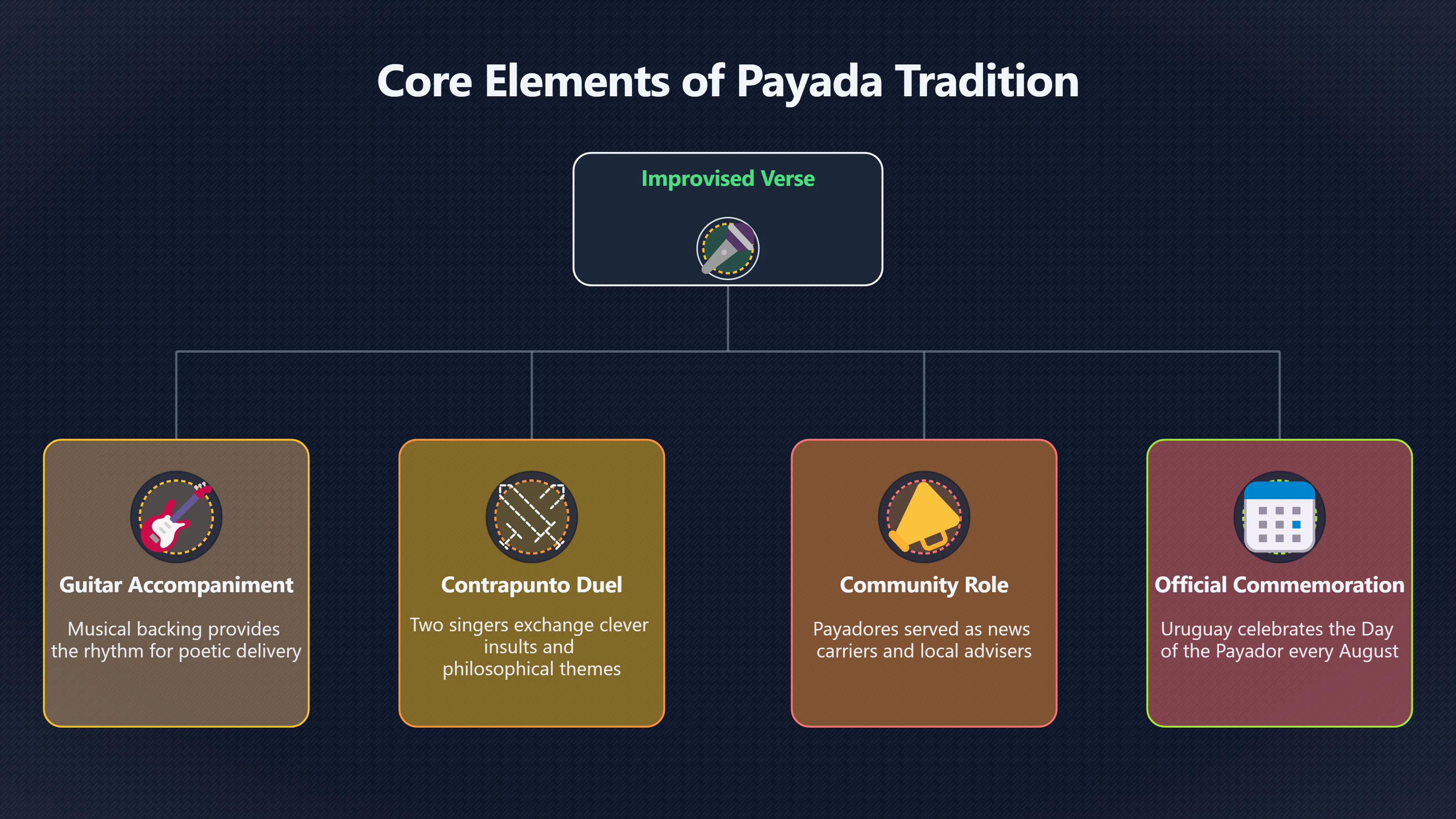
Among all gaucho traditions, few are more distinctive than the payada. A payada is an improvised sung poem, usually accompanied by guitar. The performer, known as a payador, creates verses in real time, often responding to challenges from another singer. These contests, called contrapuntos, can continue for hours as each participant answers questions, delivers clever insults or tackles philosophical themes without preparation.[wikipedia.org]WikipediaOpen source on wikipedia.org.
In rural society, a successful payador earned prestige not through wealth but through verbal brilliance. The ability to think quickly, remember traditional forms and maintain composure under pressure made the payador a respected figure. Some accounts describe payadores acting as entertainers, news carriers, advisers and commentators in communities where written culture was less widespread.[Wikipedia]WikipediaOpen source on wikipedia.org.
Uruguay remains deeply connected to this tradition. The country officially commemorates the Day of the Payador on 24 August, the birthday of the Montevideo-born poet Bartolomé Hidalgo, who is widely regarded as a foundational figure in gaucho poetry. Payada festivals and performances continue today, linking contemporary musicians with an older oral tradition.[Wikipedia]WikipediaOpen source on wikipedia.org.
A famous symbol of the shared Río de la Plata tradition occurred in Paysandú in 1884, when the Uruguayan payador Juan de Nava faced the Argentine Gabino Ezeiza in a celebrated duel of improvisation. The event became legendary on both sides of the border and is still remembered as a landmark moment in payador culture.[ehplustv.com]ehplustv.comThe Ancient Art of the PayadaThe Payada is a poetic style that is part of the Hispanic musical culture. Its comes from Muslim Andalusia a…
Why Folk Singers End Up Fighting the Devil
Across the Río de la Plata, the greatest payador legends eventually become supernatural.
The most famous example is the story of Santos Vega, a legendary singer celebrated in literature and oral tradition. In the best-known version, Vega is considered unbeatable until a mysterious challenger appears. The stranger defeats him in a singing duel and is later revealed to be the Devil. The story became enormously influential through nineteenth-century poetry and helped establish a recurring folklore theme: the supreme artist tested by infernal forces.[Encyclopedia.com]encyclopedia.comOpen source on encyclopedia.com.
The tale works on several levels. It dramatises the importance of payada by turning a musical contest into a cosmic struggle. It also warns against excessive pride. No matter how talented a singer may be, someone—or something—can still surpass him.
For audiences in Uruguay, such stories linked artistic brilliance with moral questions. Extraordinary talent inspired admiration, but it also invited suspicion. Could anyone really become that skilled through ordinary means?
La Salamanca and Supernatural Skill
One answer appears in stories of La Salamanca, perhaps the most famous tradition of devilish bargains in the broader gaucho world.
La Salamanca is usually described as a hidden cave, underground gathering place or secret location where supernatural beings meet. According to folklore, ambitious individuals seek it out in order to gain exceptional abilities. Musicians, singers, dancers, healers and other talented people are among the figures most commonly associated with these stories. Those who survive the frightening initiation rites may leave with remarkable gifts; those who fail risk madness, misfortune or spiritual ruin.[Reddit]reddit.comThe Legend of La Salamanca: r/argentinaThe Legend of La Salamanca: r/argentinaJuly 16, 2025 — According to the popular Argentine myth, La Salamanca is only reached when…
Although the legend is better documented in parts of Argentina, versions and references circulated throughout the Río de la Plata cultural region, including areas that influenced Uruguayan rural folklore. The story became especially attached to musicians because it offered a dramatic explanation for seemingly impossible talent. If a guitarist could play beyond normal human ability, some listeners joked—or half-believed—that he must have visited La Salamanca.[Reddit]reddit.comThe Legend of La Salamanca: r/argentinaThe Legend of La Salamanca: r/argentinaJuly 16, 2025 — According to the popular Argentine myth, La Salamanca is only reached when…
Importantly, these tales are not simple celebrations of supernatural power. The bargain usually carries a cost. The seeker gains fame, skill or knowledge but sacrifices something valuable in return. The folklore therefore expresses a recurring rural moral lesson: hard-earned reputation is honourable, while shortcuts to greatness are dangerous.
What These Stories Mean Today
Modern Uruguay does not treat gaucho legends as literal history, yet they remain culturally powerful. Payadas are still performed at festivals, rural gatherings and heritage events. Musicians continue to celebrate legendary payadores, while writers and performers revisit stories of Santos Vega, infernal challengers and mysterious sources of artistic inspiration.[Wikipedia]WikipediaOpen source on wikipedia.org.
The enduring appeal of these traditions lies in their tension between skill and temptation. Gaucho folklore admires excellence, but it also asks where excellence comes from. Is greatness the result of discipline, experience and perseverance, or is there a darker shortcut hidden somewhere beyond the campfire’s light?
That question gives lasting life to the legends. In Uruguayan folk culture, the guitar duel and the devilish bargain are not separate stories. They are two sides of the same idea: the belief that exceptional talent is powerful enough to seem almost supernatural, and valuable enough to tempt people into risking everything to obtain it.[encyclopedia.com]encyclopedia.comOpen source on encyclopedia.com.
Amazon book picks
Further Reading
Books and field guides related to When Does the Gaucho Become Legend?. Use these as the next step if you want deeper reading beyond the article.
The Gaucho Martín Fierro
Introduces the legendary gaucho tradition that informs Uruguayan folklore.
Don Segundo Sombra
Captures the mythic transformation of the horseman into a cultural hero.
The Book of Imaginary Beings
Supports exploration of folklore, supernatural motifs and legendary storytelling traditions.
Martín Fierro
Central literary expression of gaucho identity, song, honour and legend in the Río de la Plata world.
Endnotes
1.
Source: encyclopedia.com
Link:https://www.encyclopedia.com/humanities/encyclopedias-almanacs-transcripts-and-maps/payador
2.
Source: Wikipedia
Link:https://en.wikipedia.org/wiki/Payada
3.
Source: enotes.com
Title: e Notes The Poetic Tradition of the Gaucho
Link:https://www.enotes.com/topics/gaucho-literature/criticism/criticism-overviews-and-general-studies/william-katra-essay-date-2000
Source snippet
The Poetic Tradition of the Gaucho - William KatraIndeed, the gaucho poetry of the Río de la Plata region presents a case perhaps w...
4.
Source: Wikipedia
Title: Fernando O. Assunção
Link:https://en.wikipedia.org/wiki/Fernando_O._Assun%C3%A7%C3%A3o
5.
Source: Wikipedia
Link:https://es.wikipedia.org/wiki/Payador
6.
Source: ehplustv.com
Link:https://ehplustv.com/en/the-ancient-art-of-the-payada/
Source snippet
The Ancient Art of the PayadaThe Payada is a poetic style that is part of the Hispanic musical culture. Its comes from Muslim Andalusia a...
7.
Source: Wikipedia
Link:https://es.wikipedia.org/wiki/Payada
8.
Source: reddit.com
Title: The Legend of La Salamanca: r/argentina
Link:https://www.reddit.com/r/argentina/comments/1m0zajg/la_leyenda_de_la_salamanca/?tl=en
Source snippet
The Legend of La Salamanca: r/argentinaJuly 16, 2025 — According to the popular Argentine myth, La Salamanca is only reached when...
Published: July 16, 2025
9.
Source: Wikipedia
Title: History of folkloric music in Argentina
Link:https://en.wikipedia.org/wiki/History_of_folkloric_music_in_Argentina
Source snippet
[1] It was shaped by four major historical-cultural events.Read more...
10.
Source: youtube.com
Title: Santos Vega: The Payador Who Defied the Devil
Link:https://www.youtube.com/watch?v=6LzuOmpPAQU
Source snippet
Wikipedia...
Additional References
11.
Source: citylore.org
Link:https://citylore.org/poetry-duels/payadores-argentina/
Source snippet
Payadores ArgentinaThe payador tradition extends to Uruguay, southern Brazil and Paraguay, and comprises part of the Gaucho (cowboy) cult...
12.
Source: journeylatinamerica.com
Link:https://www.journeylatinamerica.com/travel-inspiration/culture-music-sport-and-festivals/halloween-inspired-latin-americas-spookiest-myths/
Source snippet
Halloween Inspired: Latin America's Spookiest MythsLuz Mala, one of the most prolific myths in Argentine and Uruguayan history, Literally...
13.
Source: melodigging.com
Link:https://www.melodigging.com/genre/payada
Source snippet
PayadaPayada is a South American tradition of improvised sung poetry performed by gaucho troubadours called payadores. Verses are typical...
14.
Source: americanantiquarian.org
Link:https://www.americanantiquarian.org/proceedings/44807152.pdf
Source snippet
The Cult of the Gaucho and the Creation of a LiteratureIt produced a vital tradition and a large body of folklore that inspired a truly n...
15.
Source: upload.wikimedia.org
Link:https://upload.wikimedia.org/wikipedia/commons/4/49/Through_South_America%27s_southland%3B_with_an_account_of_the_Roosevelt_Scientific_Expedition_to_South_America_%28IA_throughsouthamer00zahmuoft%29.pdf
Source snippet
South America's southlandUruguay and the Uruguayans...... 125. VIII... legend of Deucalion, from the stones of the earth... devil...
16.
Source: anaforas.fic.edu.uy
Link:https://anaforas.fic.edu.uy/jspui/bitstream/123456789/72704/1/lospayadoresgau00page.pdf
Source snippet
Payadores Gauchoslegends, hold no place in the Gaucho verse. It is therefore, original, a native if not a national creation, in that it i...
17.
Source: folkworks.org
Title: cowboy music of the southern hemisphere musica gaucha
Link:https://folkworks.org/cowboy-music-of-the-southern-hemisphere-musica-gaucha/
Source snippet
Cowboy Music of the Southern Hemisphere: Música Gaúcha24 Oct 2023 — Música Gaúcha, associated with the culture of the South American cowb...
18.
Source: gutenberg.org
Link:https://www.gutenberg.org/files/44112/44112-h/44112-h.htm
Source snippet
The Project Gutenberg eBook of Argentina Legend And...El gaucho argentino vivía absoluto e independiente,[27] con un individualismo prop...
19.
Source: facebook.com
Link:https://www.facebook.com/100044323074283/videos/de-las-hist%C3%B3ricas-payadas-de-uruguay-finales-d%C3%A9cada-del-60-m%C3%A1s-o-menosel-vasco/837732524046004/
Source snippet
en el camino cantando en Iglesias un gran payador que visitó 25 de...
20.
Source: facebook.com
Link:https://www.facebook.com/OldAmericanLife/posts/the-gaucho-was-a-man-of-mixed-heritageborn-of-a-spanish-father-and-an-indigenous/697282023194754/
Source snippet
would challenge each other to improvised verse...Read more...
Topic Tree