Within Macedonian Folklore
What Lurks Beyond the Village Edge?
North Macedonian supernatural beings gather around night, water, forests, childbirth and the unsafe edge of village life.
On this page
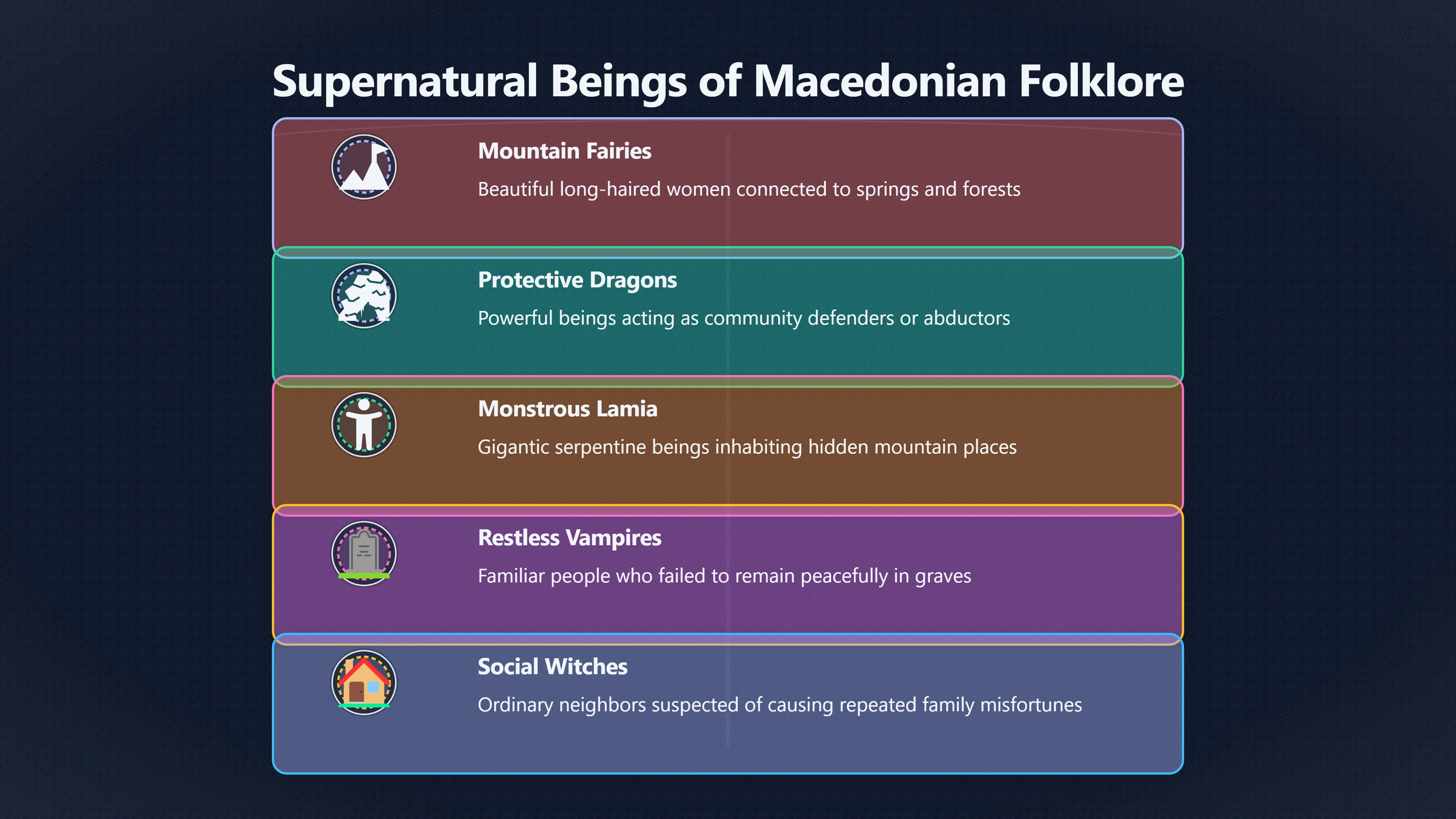
- Fairy like women, dragons and lamia monsters
- Vampires and the restless dead
- Witches, healers and everyday misfortune
Page outline Jump by section
Introduction
Stories about fairies, vampires and dangerous spirits occupy a special place in the folklore of North Macedonia because they explain what happens at the boundaries of ordinary life. These beings are rarely encountered in the safety of the home. Instead, they appear beside rivers, in mountain clearings, near caves, at crossroads, around graveyards, or at moments of vulnerability such as childbirth, illness and death. In traditional belief, the edge of the village was also the edge of certainty. Beyond it lay a world shared with supernatural forces that could help, seduce, mislead or destroy. Folklore collected across the region shows a remarkably rich landscape of fairy women, dragons, witches, vampires and restless spirits whose stories survived well into the modern era.[DergiPark]dergipark.org.trSupernatural Beings in Macedonian BeliefsJune 22, 2020 — by A Kechan · Cited by 2 — This essay will present one area of the beli…
Rather than forming a single organised mythology, these figures belong to a network of local traditions shaped by Slavic heritage, older Balkan beliefs and later Christian influences. The same spirit might be feared in one village and respected in another. What unites them is their role as guardians of thresholds: the line between civilisation and wilderness, health and sickness, life and death.[DergiPark]dergipark.org.trSupernatural Beings in Macedonian BeliefsJune 22, 2020 — by A Kechan · Cited by 2 — This essay will present one area of the beli…
Why the Village Edge Matters
Many Macedonian supernatural traditions are organised around places that people considered uncertain or dangerous. Rivers could drown travellers, forests concealed predators, caves hid unknown dangers, and lonely roads exposed people to bandits and storms. Folklore translated these risks into stories about spirits and monsters.
The village itself represented social order. Beyond its limits lived beings that were neither fully human nor fully divine. Fairies danced in mountain meadows, dragons emerged from caves, witches travelled at night, and vampires wandered back from the grave. Such stories provided explanations for misfortune while also teaching practical caution: do not wander alone after dark, avoid certain places, respect the dead and follow communal customs.[DergiPark]dergipark.org.trSupernatural Beings in Macedonian BeliefsJune 22, 2020 — by A Kechan · Cited by 2 — This essay will present one area of the beli…
Fairy Women, Dragons and Lamia Monsters
The mountain fairies
Among the best-known supernatural beings are fairy-like women often described as extraordinarily beautiful, long-haired and connected to mountains, springs, forests and rivers. They are usually portrayed as powerful rather than harmless. A traveller might encounter them dancing in a remote clearing, singing near water or celebrating mysterious weddings beyond human sight.[DergiPark]dergipark.org.trSupernatural Beings in Macedonian BeliefsJune 22, 2020 — by A Kechan · Cited by 2 — This essay will present one area of the beli…
These fairy women occupy an ambiguous position. They can reward kindness, teach healing knowledge and protect chosen individuals. Yet they can also cause illness, madness or death if offended. In Macedonian tradition they are often associated with healing plants and secret knowledge, reflecting a broader belief that wisdom comes from contact with the hidden world. Some stories describe gifted healers receiving knowledge from supernatural female beings after visions or encounters at the margins of ordinary reality.[Academia]academia.eduThe Secret Knowledge of Folk Healers in Macedoniansamovila who represents death acts as their guiding spirit. These are people believed to be destined for death, or already very close to…
A recurring theme is seduction and disappearance. Men who follow enchanting voices into the mountains may lose their way, fall ill or become detached from normal village life. The danger is not simply physical but social: abandoning family, work and community for an irresistible but destructive attraction.[Wikipedia]WikipediaSamodiva (folkloreSamodiva (folklore
Dragons as protectors and abductors
Dragons in Macedonian folklore differ from the treasure-hoarding reptiles of many Western fairy tales. They often possess partly human characteristics and can act as both defenders and threats. Some stories portray them as powerful beings who protect communities from destructive forces, while others describe them carrying off beautiful women to remote mountain lairs.[Wikipedia]WikipediaMacedonian Slavic mythologyMacedonian Slavic mythology
Their dual role mirrors a common Balkan folklore pattern: supernatural power is rarely entirely good or entirely evil. The dragon belongs to the wild landscape beyond the village and therefore remains unpredictable.
Lamia and the devouring wilderness
Another feared creature is the lamia, a monstrous being linked to caves, mountains and hidden places. Unlike the fairy women, whose danger often comes through beauty and enchantment, the lamia represents a more openly destructive force. Folk descriptions portray it as gigantic, serpentine and associated with devouring or hoarding.[Wikipedia]WikipediaMacedonian Slavic mythologyMacedonian Slavic mythology
The lamia embodies fears of the untamed world. It occupies places where humans should not linger and often appears in tales explaining why certain locations are avoided. In wider Balkan traditions the figure overlaps with ideas of female monsters, revenants and night-haunting beings, demonstrating how folklore categories frequently merge rather than remain neatly separated.[caieteleechinox.lett.ubbcluj.ro]caieteleechinox.lett.ubbcluj.rolamia a sorceress a fairy or a revenantLamia: a Sorceress, a Fairy or a Revenant?15 Jun 2012 — On the other hand, she could be a revenant, a female vampire that comes back from…
Vampires and the Restless Dead
No supernatural figure from the Balkans has achieved greater international fame than the vampire, and Macedonian folklore contains a particularly varied vampire tradition. Folklorists have recorded beliefs not merely in one type of vampire but in several forms, reflecting different anxieties about death and the afterlife.[dergipark.org.tr]dergipark.org.trSupernatural Beings in Macedonian BeliefsJune 22, 2020 — by A Kechan · Cited by 2 — This essay will present one area of the beli…
Unlike the aristocratic vampire popularised by nineteenth-century fiction, the traditional Macedonian vampire was usually a familiar person who had died improperly or failed to remain peacefully in the grave. The threat came precisely because the vampire was known to the community.
Why someone became a vampire
Traditional explanations varied from place to place, but many centred on disturbed burial practices, improper mourning, spiritual contamination or unusual circumstances surrounding death. Folklore recorded a range of preventative measures designed to stop the dead from returning. These included ritual treatment of the body, special care around graves and protective actions carried out during the period immediately after death.[Slavorum]slavorum.orgA shortVampires in Macedonian beliefs and traditionsMay 13, 2016 — 13 May 2016 — In ancient times, people in the villages of Macedonia b…
Such customs reveal a broader concern with managing the transition between life and death. The vampire was not merely a monster; it represented a failed passage from one state of existence to another.
The surprisingly domestic vampire
One striking feature of Macedonian vampire lore is that not every vampire was imagined as a blood-drinking predator. Folklore records stories about vampire husbands returning to wives, vampire household helpers assisting families and other forms that retained social relationships from life. Alongside these stood more dangerous vampires that harmed livestock, damaged crops or terrorised villages.[Wikipedia]WikipediaMacedonian Slavic mythologyMacedonian Slavic mythology
This variety shows that the traditional vampire was less a single creature than a category of restless dead. The central fear was that death had not properly ended a person’s involvement in the world of the living.
Water, graves and boundaries
Many vampire traditions connect the restless dead to physical boundaries. Water often appears as a protective barrier, while graveyards become contested spaces where the dead might attempt to return. These themes reinforce the wider folklore pattern in which rivers, crossroads and village margins mark transitions between worlds.[Slavorum]slavorum.orgA shortVampires in Macedonian beliefs and traditionsMay 13, 2016 — 13 May 2016 — In ancient times, people in the villages of Macedonia b…

Witches, Healers and Everyday Misfortune
Not every supernatural threat came from legendary monsters. Many traditional Macedonian communities explained illness, crop failure, infertility or family conflict through the actions of witches and magical practitioners. Unlike fairy women or dragons, these figures were often believed to be ordinary members of neighbouring villages.[Journals at KU]journals.ku.eduThese are women who personify social tension among…
Folklore research describes witches less as demonic beings and more as socially feared individuals onto whom communities projected suspicion and tension. Accusations frequently emerged when families experienced repeated misfortune or unexplained illness. The witch therefore occupied another kind of boundary: she belonged to society yet was imagined as working against it.[Journals at KU]journals.ku.eduThese are women who personify social tension among…
Alongside witches stood respected healers and charmers. These specialists used prayers, rituals, herbal knowledge and spoken formulas to remove curses, heal sickness and restore balance. In folklore they function as counterparts to harmful magic. Where witches represented disorder, healers represented the community’s attempt to repair it.[Journals at KU]journals.ku.eduThese are women who personify social tension among…
The contrast between witch and healer reveals an important feature of Macedonian belief culture. Supernatural power itself was not automatically evil. What mattered was how that power was used and whether it served or threatened the community.
How These Spirits Are Understood Today
Belief in fairies, vampires and village-edge spirits has declined as a literal explanation for everyday events, yet the traditions remain culturally important. They survive in folk narratives, local storytelling, academic folklore collections, festivals, artistic reinterpretations and popular discussions of Balkan heritage. Researchers continue to document these traditions because they reveal how communities understood danger, morality, illness, death and the natural landscape.[DergiPark]dergipark.org.trSupernatural Beings in Macedonian BeliefsJune 22, 2020 — by A Kechan · Cited by 2 — This essay will present one area of the beli…
Modern readers often encounter these beings as colourful folklore characters, but historically they performed practical social functions. Fairies warned against wandering into dangerous places. Vampires expressed anxieties about death and mourning. Witches gave shape to fears of envy and misfortune. Healers offered hope when conventional remedies seemed inadequate. Together they created a supernatural map of life beyond the village edge.
In North Macedonian folklore, the most revealing question is often not whether these beings existed. It is why people believed they might be waiting just beyond the last house, where cultivated land gave way to forest, mountain and darkness. That threshold—between the familiar and the unknown—remains the true home of the country’s fairies, vampires and restless spirits.[dergipark.org.tr]dergipark.org.trSupernatural Beings in Macedonian BeliefsJune 22, 2020 — by A Kechan · Cited by 2 — This essay will present one area of the beli…
Amazon book picks
Further Reading
Books and field guides related to What Lurks Beyond the Village Edge?. Use these as the next step if you want deeper reading beyond the article.
Fairy and Folk Tales of the Irish Peasantry
Provides useful comparison for fairy-like village-edge beings.
eBay marketplace picks
Marketplace Samples
Live-tested eBay searches with available results related to this page.
Endnotes
1.
Source: journals.ku.edu
Link:https://journals.ku.edu/folklorica/article/download/3797/3635/4674
Source snippet
These are women who personify social tension among...
2.
Source: Wikipedia
Title: Macedonian Slavic mythology
Link:https://en.wikipedia.org/wiki/Macedonian_Slavic_mythology
3.
Source: Wikipedia
Title: Samodiva (folklore)
Link:https://en.wikipedia.org/wiki/Samodiva_%28folklore%29
4.
Source: academia.edu
Title: The Secret Knowledge of Folk Healers in Macedonian
Link:https://www.academia.edu/70341969/The_Secret_Knowledge_of_Folk_Healers_in_Macedonian_Traditional_Culture
Source snippet
samovila who represents death acts as their guiding spirit. These are people believed to be destined for death, or already very close to...
5.
Source: caieteleechinox.lett.ubbcluj.ro
Title: lamia a sorceress a fairy or a revenant
Link:https://caieteleechinox.lett.ubbcluj.ro/lamia-a-sorceress-a-fairy-or-a-revenant/
Source snippet
Lamia: a Sorceress, a Fairy or a Revenant?15 Jun 2012 — On the other hand, she could be a revenant, a female vampire that comes back from...
6.
Source: academia.edu
Title: the legend of lamia from the mythical period to the modern
Link:https://www.academia.edu/91132248/THE_LEGEND_OF_LAMIA_FROM_THE_MYTHICAL_PERIOD_TO_THE_MODERN_ERA
Source snippet
Vampire" La profesora de matemáticas Ririko Kagome era una Lamia con tendencias masoquistas.... Johnston Sarah Iles, Restless Dead: Enco...
7.
Source: slavorum.org
Title: A short
Link:https://www.slavorum.org/vampires-in-macedonian-beliefs-and-traditions/
Source snippet
Vampires in Macedonian beliefs and traditionsMay 13, 2016 — 13 May 2016 — In ancient times, people in the villages of Macedonia b...
Published: May 13, 2016
8.
Source: Wikipedia
Link:https://en.wikipedia.org/wiki/Lamia
Source snippet
Lamia"Vampire". Greek Mythology: An Encyclopedia of Myth and Legend. Aquarian Press. pp. 178–179. ISBN 9780850309348.: "Lamia (not t...
9.
Source: dergipark.org.tr
Link:https://dergipark.org.tr/tr/download/article-file/1163759
Source snippet
Supernatural Beings in Macedonian BeliefsJune 22, 2020 — by A Kechan · Cited by 2 — This essay will present one area of the beli...
Published: June 22, 2020
Additional References
10.
Source: archive.org
Link:https://archive.org/download/macedonianfolklo00abborich/macedonianfolklo00abborich.pdf
Source snippet
Internet ArchiveMacedonian folklore... vampire. The name given to this hideous monster in Macedonia is, generally speaking, the same as t...
11.
Source: facebook.com
Link:https://www.facebook.com/groups/1870439410119194/posts/2166462187183580/
Source snippet
Macedonia's Usalii winter ritual and dancing spiritsThis ancient ritual is a living expression of Macedonian cultural identity and season...
12.
Source: facebook.com
Link:https://www.facebook.com/groups/worldwatercolor/posts/4176170229309020/
Source snippet
Vampire legend in Balkan folkloreIn Slavic folklore, vampire-demons are considered resurrected dead, causing harm to living people and an...
13.
Source: researchgate.net
Title: 276237840 The Secret Knowledge of Folk Healers in Macedonian Traditional Culture
Link:https://www.researchgate.net/publication/276237840_The_Secret_Knowledge_of_Folk_Healers_in_Macedonian_Traditional_Culture
Source snippet
The Secret Knowledge of Folk Healers in Macedonian...27 Dec 2025 — Palpating history: Magical healing and revolutionary care in Rural Se...
14.
Source: upload.wikimedia.org
Title: Macedonian folklore (IA macedonianfolklo00abborich)
Link:https://upload.wikimedia.org/wikipedia/commons/d/dc/Macedonian_folklore_%28IA_macedonianfolklo00abborich%29.pdf
Source snippet
folklore... vampire. The name given to this hideous monster in Macedonia is, generally speaking, the same as that by which it is known in...
15.
Source: instagram.com
Title: Spooky Macedonian Folklore for Halloween!
Link:https://www.instagram.com/p/DQfTTb9DPVk/
Source snippet
👻🎃 🇲🇰...Macedonia has its legendary creatures that have haunted stories for centuries: ♀️ Баба Рога (Baba Roga) – The classic witch who...
16.
Source: open.spotify.com
Link:https://open.spotify.com/episode/4l1r8ohBxRT5wwyHy5YFpV
Source snippet
Benandanti - Spirits: Mythology, Legends, & FolkloreThis week, Julia decided to give us all a history lesson. We're talking about The Ben...
17.
Source: youtube.com
Link:https://www.youtube.com/watch?v=e29eSrUHlkA
Source snippet
mythical beings that reflect the rich cultural heritage of the...
18.
Source: facebook.com
Title: Самовила / Samovila
Link:https://www.facebook.com/damjangjart/posts/%D1%81%D0%B0%D0%BC%D0%BE%D0%B2%D0%B8%D0%BB%D0%B0-samovila-something-from-a-project-i-started-with-the-art-of-stefan-cvet/454178290330117/
Source snippet
Something from a project I started...In Macedonian folklore, Samovila's are often seen that they have the ability to hurt people or to h...
19.
Source: makedonskadrzava.com
Link:https://www.makedonskadrzava.com/books/vampires-in-macedonian-beliefs-and-legends
Source snippet
ernatural beings...
Topic Tree