Why Panama's Legends Still Haunt the Isthmus
Panama’s folklore is best understood as a crossroads tradition: Indigenous oral history, Catholic ritual, Afro-Caribbean performance, rural cautionary tales and modern heritage tourism all meet on a narrow isthmus between two oceans.
Page outline Jump by section
Introduction
For a first-time reader, three strands matter most. Rural and literary collections preserve legends such as the Tulivieja, the Silampa, the headless priest and enchanted women. Indigenous peoples such as the Guna, Wounaan, Emberá and Ngäbe-Buglé keep living traditions in which story, law, healing, landscape and ritual are intertwined. Afro-Panamanian Congo culture and Catholic festival drama turn history into masked performance, especially in Portobelo and Corpus Christi celebrations recognised by UNESCO as intangible cultural heritage.[udelistmo.edu]catalogo.udelistmo.eduOpen source on udelistmo.edu.
What makes Panamanian folklore distinctive?
Panama’s position between Central and South America gives its folklore an unusually layered feel. Some legends are shared with neighbouring Costa Rica and Colombia; others are strongly local, attached to particular rivers, villages, churches, mountains or festivals. That is why the same figure may appear under different names, or with different moral meanings, depending on whether the storyteller is speaking from a rural Catholic, Indigenous, Afro-Caribbean or literary setting.
The country also has a strong record of collecting and teaching folk tradition. The national literary record includes Sergio González Ruiz’s Veintiséis leyendas panameñas and Luisita Aguilera Patiño’s Tradiciones y leyendas panameñas, both listed together in library records that name tales such as the Tulivieja, the Silampa, the Tepesa, the headless priest, enchanted women, sacred trees, devil stones, mysterious flames and legendary rivers.[Udelistmo Catalogo]catalogo.udelistmo.eduOpen source on udelistmo.edu. Dora Pérez de Zárate’s En torno al cuento folklórico panameño is catalogued by the Biblioteca Nacional de Panamá as a study of Panamanian folk tales, including children’s tales, animal tales, cumulative tales, riddling formula tales, fables, marvellous tales and stories centred on human characters.[Iberoamérica Digital]iberoamericadigital.netIberoamérica Digital
That matters because it shows that Panama’s folklore is not just a handful of spooky stories repeated online. It has been collected, classified, taught, performed, commercialised, adapted into literature and kept alive through festivals, music, tourism, family memory and local ritual. The strongest way to read it is not as a single “monster list”, but as a living story-map of the country.
The Tulivieja, the Tepesa and the river-haunting woman
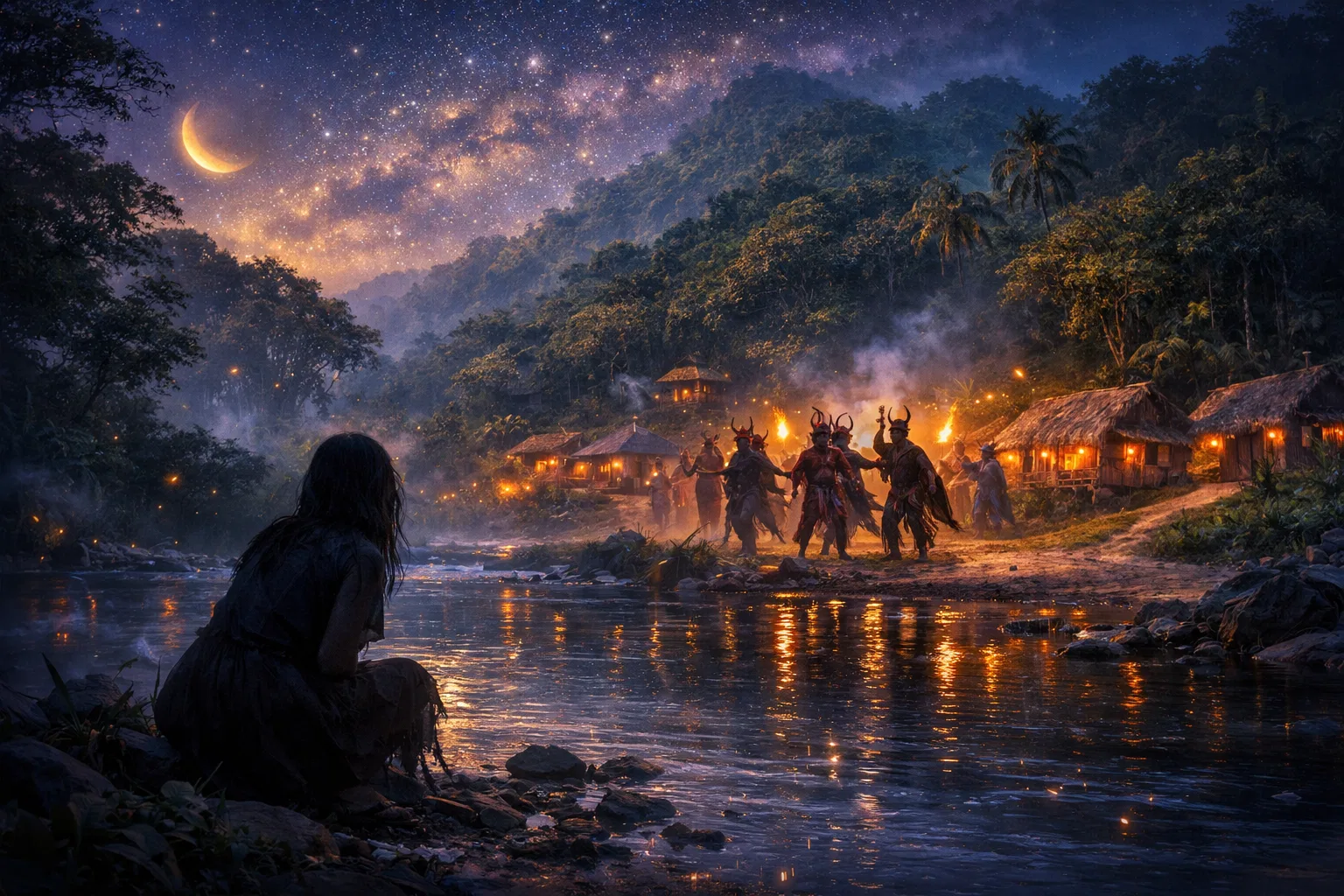
The best-known supernatural figure in Panamanian folklore is the Tulivieja, also associated in Panama with the Tepesa. In broad terms, she is a terrifying wandering woman linked to rivers, lost children, maternal grief and punishment. Modern summaries often describe her as a female ghost or monstrous woman who searches for a child she lost or killed, with details that vary by region: sometimes she has birdlike features, sometimes she is connected to milk, water, a hat or a transformation curse.[Wikipedia]WikipediaOpen source on wikipedia.org.
The important point is that this is not just “Panama’s version of a scary woman”. The Tulivieja belongs to a wider Central American family of river and weeping-woman legends, but the Panamanian tradition gives her local names, landscapes and meanings. In some accounts she overlaps with the famous Latin American weeping-mother motif; in others, the Tepesa is linked more specifically to Ngäbe-Buglé tradition and to anxieties around colonial contact, sexuality, shame and childbirth.[RANDOM Times •]random-times.comRANDOM Times •The legend of La Tulevieja, the woman-like creatureRANDOM Times •The legend of La Tulevieja, the woman-like creature
A useful way to understand the legend is to ask what work it does. It warns children away from rivers at night. It encodes fear around pregnancy, abandonment and social judgement. It turns dangerous landscapes into memorable story places. It also shows how a legend can move between oral tradition, school retellings, literary collections and internet-era monster articles without staying exactly the same. Library records for Veintiséis leyendas panameñas and Tradiciones y leyendas panameñas list both the Tepesa and the Tulivieja among Panamanian legend material, suggesting that these figures are part of the country’s collected tradition rather than merely recent web folklore.[Udelistmo Catalogo]catalogo.udelistmo.eduOpen source on udelistmo.edu.

Other ghosts, warnings and rural monsters
Panamanian legend collections point to a much wider supernatural landscape than the Tulivieja alone. The contents listed for major collections include the Silampa, the headless priest, buried treasure and souls, an enchanted girl, sacred trees, engraved stones, ghostly masses, a phantom boat, mysterious cemetery flames, devil stones, mountain women and legendary rivers.[Udelistmo Catalogo]catalogo.udelistmo.eduOpen source on udelistmo.edu. These titles reveal a pattern familiar across rural Latin America but locally rooted in Panama: the supernatural often appears where memory, danger and place meet.
Several recurring story types stand out:
Haunted religious figures. The headless priest and ghostly masses belong to a Catholic-inflected world where sin, penance and unfinished ritual continue after death. Such tales make churches, cemeteries and lonely roads feel morally charged rather than merely frightening.
Enchanted women and dangerous waters. Stories of enchanted women, sirens, river spirits and women in mourning often attach female supernatural figures to waterfalls, pools, rivers and coastlines. These tales can warn against sexual misconduct, unsafe travel, night wandering or disrespect for powerful places.
Hidden treasure and restless souls. Buried treasure stories often connect wealth with danger. The treasure may be guarded, cursed or linked to a dead person who still demands recognition. This is folklore as social memory: wealth from the colonial, rural or family past becomes something both desired and feared.
Animal and forest presences. Animal tales and mountain figures are not simply entertainment. They help encode how people should behave around forests, rivers, farms and night roads. In a country of rainforest, coasts, highlands and villages, the border between practical caution and supernatural warning is often thin.
Because many of these tales survive through titles, schoolbooks, local retellings and literary collections, their exact age and oldest form can be hard to prove. The safer claim is that they are well represented in Panamanian folkloric collecting and public memory, not that every modern version is ancient or unchanged.
Indigenous traditions are not just “myths”
Panama is home to seven Indigenous peoples: the Ngäbe, Buglé, Guna, Emberá, Wounaan, Bri bri and Naso Tjërdi.[IWGIA]iwgia.orgOpen source on iwgia.org. Their traditions should not be treated as a decorative preface to national folklore. In many communities, story is tied to governance, medicine, land, environmental knowledge and identity.
Among the Guna, the congress house is both political and spiritual space. Cultural Survival describes community leaders conducting meetings from hammocks while ancient songs carry history, law, moral codes and relationships with the natural world. It also reports that Guna molas are understood by some culture bearers not merely as decoration, but as cosmological designs connected with stars, moon and sun.[Cultural Survival]culturalsurvival.orgOpen source on culturalsurvival.org. Minority Rights similarly notes that a key part of the Guna leader’s role is to memorise and recite oral history, legends and laws.[Minority Rights Group]minorityrights.orgOpen source on minorityrights.org.
The Wounaan offer another example of how oral tradition continues in new forms. A Smithsonian Tropical Research Institute story describes a multilingual Wounaan children’s book developed by a Wounaan cultural team, centred on two siblings learning about their community, birds and the relationship between people and environment. The project explicitly responds to concern that ancestral stories are no longer told as frequently, and the digital audio version honours the importance of oral storytelling and verbal poetics in Wounaan culture.[Smithsonian Tropical Research Institute]stri.si.eduOpen source on si.edu.
For the Emberá-Wounaan, official tourism material stresses ancestral knowledge, spiritual leadership by elders, connection with nature, art and worldview; it also describes crafts as a means of expression and knowledge transfer, with baskets, carvings and animal motifs rooted in the surrounding forest world.[Tourism Panama]tourismpanama.comTourism Panama Emberá-Wounaan Community in Panama: Culture & TraditionTourism Panama Emberá-Wounaan Community in Panama: Culture & Tradition For the Ngäbe-Buglé, Panama’s tourism authority describes waterfall rites, a waterfall spirit called Bube, cacao rituals involving elders, storytelling, medicine and support for the sick.[Tourism Panama]tourismpanama.comTourism Panama Discover the Comarca of Panamá & the Ngäbe-Buglé TribeTourism Panama Discover the Comarca of Panamá & the Ngäbe-Buglé Tribe
The reader should be careful here. These are living Indigenous knowledge systems, not simply “Panamanian myths” available for casual extraction. Their stories may be public in some contexts, restricted in others, and transformed when translated into tourism, children’s books, state heritage language or online summaries.
Devils, masks and the drama of good and evil
One of Panama’s most vivid public folklore forms is the dance of devils, especially in Corpus Christi celebrations. Panama’s Corpus Christi dances and expressions were inscribed by UNESCO on the Representative List of the Intangible Cultural Heritage of Humanity in 2021.[UNESCO Intangible Cultural Heritage]ich.unesco.orgOpen source on unesco.org. Educa Panamá describes the Diablicos Sucios as part of a Catholic Corpus Christi festival fused with popular cultural practices: music, dance, street performance and theatrical-musical scenes.[Educa Panamá]educapanama.edu.paca PanamáDiablicos Sucios | Educa Panamá | Mi Portal Educativoca PanamáDiablicos Sucios | Educa Panamá | Mi Portal Educativo
The Diablicos Sucios are not just carnival monsters. Their performance dramatises a struggle for a soul between good, represented by the Archangel Michael, and evil, represented by the devil. The same educational source says the dance survives through oral tradition passed from generation to generation, and that masks may personify local animals; it also notes regional types such as dirty devils, clean or mirror devils, and Cucuás, with dress and performance varying by community.[Educa Panamá]educapanama.edu.paca PanamáDiablicos Sucios | Educa Panamá | Mi Portal Educativoca PanamáDiablicos Sucios | Educa Panamá | Mi Portal Educativo
The Ministry of Culture’s Sicultura entry for the dirty little devils of Santa Rosa and Nuevo San Juan in Colón gives the tradition a more local Afro-descendant texture. It says the dance is performed in three Afro-descendant communities, with a first stage in which devils, once angels, have been expelled from heaven, transformed into animals and pursued by a hunter. Their masks and movements match the animals they represent, and the performance is accompanied by accordion, drum, prayer, candles and community participation.[Sicultura]sicultura.gob.paOpen source on gob.pa.
This is a good example of Panamanian folklore refusing a simple category. It is Catholic and popular, theatrical and devotional, European in some inherited symbolism and deeply local in costume, movement, rhythm, animal imagery and community memory.
Congo culture and the devil as oppressor
On the Caribbean side, especially around Portobelo and Colón, Afro-Panamanian Congo culture turns the history of enslavement, resistance and colonial power into masked performance. UNESCO inscribed the ritual and festive expressions of Congo culture in Panama on the Representative List in 2018, describing the tradition as part of the cultural heritage of communities whose history is related to enslaved Africans and their descendants.[UNESCO Intangible Cultural Heritage]ich.unesco.orgOpen source on unesco.org.
In this tradition, the devil does not mean exactly what he means in every Corpus Christi drama. In Afro-colonial contexts, the devil can represent the enslaver, the colonial oppressor or the violent force that the community mocks, resists and symbolically defeats. Educa Panamá notes that one type of Panamanian devil dance is related to Afro-colonial populations who fled enslavement and formed settlements, creating rituals in which the slave master was represented by the devil.[Educa Panamá]educapanama.edu.paca PanamáDiablicos Sucios | Educa Panamá | Mi Portal Educativoca PanamáDiablicos Sucios | Educa Panamá | Mi Portal Educativo
Recent Associated Press coverage of Portobelo’s Festival of Devils and Congos describes townspeople wearing red and black devil masks to represent colonisers, while Congos in colourful costumes and angels in white take part in a ritual drama of resistance, protection and conversion.[AP News]apnews.comOpen source on apnews.com. Smithsonian Magazine, citing scholar Renée Alexander Craft, frames Congo performance as illuminating self-liberated Africans’ triumph over enslavement, parody of Spanish Crown and Catholic Church, communal values and self-determination.[Smithsonian Magazine]smithsonianmag.comOpen source on smithsonianmag.com.
This makes Congo culture one of the clearest cases where folklore is not merely “old belief”. It is history performed in public: a community archive in masks, music, gesture and satire.
The Black Christ of Portobelo
The Black Christ of Portobelo is one of Panama’s most important religious-folkloric traditions. Every 21 October, thousands of pilgrims travel to Portobelo in Colón province to honour the statue housed in San Felipe Church, and some crawl the final stretch in fulfilment of vows or acts of devotion. Associated Press describes it as one of Panama’s largest Catholic pilgrimages and says the tradition dates back centuries.[AP News]apnews.comOpen source on apnews.com.
The legend at the centre of the devotion varies. Smithsonian Magazine reports one version in which the life-size Black Christ was found floating in the ocean in the 1600s; AP reports a version in which a fisherman found the statue wrapped in a wooden boat off Portobelo on 21 October 1658, after which attempts to move it were thwarted by storms and the local population adopted it as patron.[Smithsonian Magazine]smithsonianmag.comOpen source on smithsonianmag.com.
Why include this in a folklore page? Because the Black Christ sits exactly where folk religion, legend, pilgrimage, colonial history and Afro-Panamanian identity overlap. Smithsonian Magazine describes the festival as a combination of pilgrimage and celebration that has helped recognise and nurture Afro-Panamanian identity for centuries.[Smithsonian Magazine]smithsonianmag.comOpen source on smithsonianmag.com. The story is not folklore because it is “false”; it is folklore because the statue’s power is carried through narrative, vow, bodily practice, clothing, procession, miracle claims and annual repetition.
Festivals that keep folklore public
Panama’s folklore is unusually visible because many traditions are performed in public, not hidden away in books. Corpus Christi and Congo traditions have UNESCO recognition, but the broader calendar also includes local festivals that gather music, dance, costume, oral poetry and craft.
The National Festival of La Mejorana in Guararé is a major example. Its own historical account says it was begun in 1949 by Professor Manuel F. Zárate and local collaborators, and that it continues to promote Panamanian folklore and protect traditional customs. The festival gathers folkloric groups in the Azuero Peninsula and includes music, dances, singing, an oxcart parade, popular dances and competitions.[Guarare]guarare.comOpen source on guarare.com.
This sort of festival changes folklore. On one hand, it helps preserve styles of dress, music, dance and oral performance that might otherwise fade. On the other, it places local practices on stage, in competitions, in tourism campaigns and in national heritage narratives. That can polish, standardise or reframe traditions that once belonged mainly to families, villages, religious calendars or informal gatherings.
The same tension appears in Indigenous community tourism. Emberá-Wounaan and Ngäbe-Buglé tourism pages invite visitors to learn about dances, crafts, plant knowledge, rivers, waterfalls and rituals, while also presenting those traditions in a visitor-friendly format.[Tourism Panama]tourismpanama.comTourism Panama Emberá-Wounaan Community in Panama: Culture & TraditionTourism Panama Emberá-Wounaan Community in Panama: Culture & Tradition This does not make the traditions fake. It means they are living in a modern economy where communities decide how much to share, how to teach it and how to benefit from outside interest.
Folklore, literature and modern retellings
Panamanian folklore has also entered national literature. A Harvard ReVista essay on the Panamanian novel notes that Guillermo Sánchez Borbón, writing as Tristán Solarte, used the Tulivieja legend in El ahogado, connecting the figure with divine punishment and a woman in mourning.[ReVista]revista.drclas.harvard.eduthe panamanian novelthe panamanian novel This is a useful reminder that folklore does not stay confined to oral storytelling. Writers adapt it, deepen it, modernise it and sometimes make one version more famous than others.
Collected legend books have had a similar effect. When a legend is gathered into a school or national collection, it becomes easier to teach and preserve, but also easier to freeze into a “standard” version. The catalogue entry for En torno al cuento folklórico panameño shows a scholarly impulse to classify Panamanian tales into types: animal stories, formula tales, fables, marvellous tales and human-centred stories.[Iberoamérica Digital]iberoamericadigital.netIberoamérica Digital The library record for Veintiséis leyendas panameñas and Tradiciones y leyendas panameñas shows an even broader legendary landscape, from saints and sacred trees to phantom boats and devil stones.[Udelistmo Catalogo]catalogo.udelistmo.eduOpen source on udelistmo.edu.
Online retellings add another layer. They often simplify the Tulivieja into a “monster” and place her in lists of Latin American creatures. Those versions can be useful introductions, but they frequently blur local variants, remove Indigenous or rural context, and make older cautionary or moral tales look like horror entertainment. A grounded reading keeps both facts in view: modern internet folklore is now part of the tradition’s afterlife, but it should not be mistaken for the whole tradition.
How to read Panama’s folklore today
The most reliable way to approach Panamanian folklore is to ask four questions.
First, who is telling the story? A Guna leader’s chant, a Wounaan children’s book, a Corpus Christi devil dance, a Congo performance, a Catholic pilgrimage and a schoolbook legend do not all work in the same way. They may all be traditional, but they belong to different communities and purposes.
Second, where is the story anchored? Panamanian legends often become meaningful through place: a river, waterfall, church, mountain, old town, cemetery, harbour or village square. The Black Christ belongs to Portobelo; Corpus Christi devils belong to particular communities; Ngäbe-Buglé waterfall and cacao rituals are tied to specific landscapes and healing practices.[tourismpanama.com]tourismpanama.comTourism Panama Discover the Comarca of Panamá & the Ngäbe-Buglé TribeTourism Panama Discover the Comarca of Panamá & the Ngäbe-Buglé Tribe
Third, what has changed through performance, tourism and heritage recognition? UNESCO listing can protect traditions and bring pride, but it can also reshape how they are explained to outsiders. Tourism can support communities, but it can also encourage simplified versions. Modern books and websites can preserve legends, but they can also flatten local difference.
Fourth, what should not be overclaimed? Some Panamanian legends are well represented in collections, but their oldest forms may be hard to date. Some Indigenous knowledge is public, while other knowledge may be restricted or context-specific. Some ghost stories attached to urban sites are recent tourism narratives rather than deeply attested oral traditions. Responsible folklore writing should enjoy the strangeness without pretending every dramatic detail is ancient.
Why Panama’s folklore matters
Panama’s folklore matters because it preserves forms of memory that ordinary political history often misses. The Tulivieja and related river women speak to fear, grief, shame, maternity and dangerous water. Congo devils turn enslavement and resistance into public theatre. Corpus Christi devils dramatise good, evil, animals, prayer and community identity. The Black Christ of Portobelo makes a statue into a moving centre of pilgrimage, legend and Afro-Panamanian belonging. Indigenous oral traditions hold law, cosmology, environmental knowledge, medicine and identity in songs, stories, crafts and ritual practice.[smithsonianmag.com]smithsonianmag.comOpen source on smithsonianmag.com.
The result is a folklore landscape that is not merely spooky, quaint or decorative. It is one of Panama’s ways of remembering who has lived on the isthmus, what they feared, what they resisted, what they made sacred and how they continue to pass knowledge on.
Amazon book picks
Further Reading
Books and field guides related to Why Panama's Legends Still Haunt the Isthmus. Use these as the next step if you want deeper reading beyond the article.
American Indian Myths and Legends
Helps readers understand oral traditions that parallel Panama's Indigenous narratives.
Latin American Folktales
Covers Indigenous and Hispanic narrative traditions relevant to Panama.
Myths and Legends of Latin America
Places Panamanian legends within the wider Latin American storytelling tradition.
eBay marketplace picks
Marketplace Samples
Live-tested eBay searches with available results related to this page.
Endnotes
1.
Source: catalogo.udelistmo.edu
Link:https://catalogo.udelistmo.edu/cgi-bin/koha/opac-MARCdetail.pl?biblionumber=8013
2.
Source: iberoamericadigital.net
Title: Iberoamérica Digital
Link:https://www.iberoamericadigital.net/BDPI/CompleteSearch.do%3Bjsessionid%3D037C8B0F0CE0A22913463D505044D60C?advanced=true&exclude=ES&field1=materia&field1Op=AND&field1val=%22Cuentos%22&institution=Biblioteca+Nacional+de+Panam%C3%A1&numfields=1&pageNumber=12&pageSize=1&pageSizeAbrv=20
3.
Source: Wikipedia
Link:https://en.wikipedia.org/wiki/Tulevieja
4.
Source: random-times.com
Title: RANDOM Times •The legend of La Tulevieja, the woman-like creature
Link:https://random-times.com/2023/02/06/the-legend-of-la-tulevieja-the-woman-like-creature-wandering-panamas-and-costa-ricas-rivers/
5.
Source: iwgia.org
Link:https://iwgia.org/en/panama.html
6.
Source: ich.unesco.org
Link:https://ich.unesco.org/en/decisions/16.COM/8.B.31
7.
Source: ich.unesco.org
Link:https://ich.unesco.org/en/decisions/13.COM/10.B.28
8.
Source: ich.unesco.org
Title: panama PA
Link:https://ich.unesco.org/en/state/panama-PA
9.
Source: guarare.com
Link:https://guarare.com/
10.
Source: revista.drclas.harvard.edu
Title: the panamanian novel
Link:https://revista.drclas.harvard.edu/the-panamanian-novel/
11.
Source: Wikipedia
Link:https://en.wikipedia.org/wiki/Panama
12.
Source: Wikipedia
Title: Guna people
Link:https://en.wikipedia.org/wiki/Guna_people
13.
Source: Wikipedia
Title: Luisita Aguilera Patiño
Link:https://es.wikipedia.org/wiki/Luisita_Aguilera_Pati%C3%B1o
14.
Source: Wikipedia
Title: Dora Pérez de Zárate
Link:https://es.wikipedia.org/wiki/Dora_P%C3%A9rez_de_Z%C3%A1rate
15.
Source: Wikipedia
Title: Corpus Christi en La Villa de Los Santos
Link:https://es.wikipedia.org/wiki/Corpus_Christi_en_La_Villa_de_Los_Santos
16.
Source: Wikipedia
Title: Cristo Negro (Portobelo)
Link:https://en.wikipedia.org/wiki/Cristo_Negro_%28Portobelo%29
17.
Source: Wikipedia
Link:https://en.wikipedia.org/wiki/Ng%C3%A4be
18.
Source: ich.unesco.org
Title: panama PA
Link:https://ich.unesco.org/en/state/panama-PA?call=film&id=45055&include=film_inc.php&width=700
19.
Source: unesco.org
Title: document 4768
Link:https://www.unesco.org/archives/multimedia/document-4768
20.
Source: ich.unesco.org
Title: 38918 EN.doc
Link:https://ich.unesco.org/doc/src/38918-EN.doc
21.
Source: ich.unesco.org
Link:https://ich.unesco.org/en/video/45055
22.
Source: ich.unesco.org
Link:https://ich.unesco.org/en/video/57871
23.
Source: unesco.org
Title: colon panama becomes hub dialogue intangible cultural heritage urban settings
Link:https://www.unesco.org/en/articles/colon-panama-becomes-hub-dialogue-intangible-cultural-heritage-urban-settings
24.
Source: ich.unesco.org
Link:https://ich.unesco.org/doc/src/45911.pdf
25.
Source: ich.unesco.org
Title: 47963 EN.doc
Link:https://ich.unesco.org/doc/src/47963-EN.doc
26.
Source: ich.unesco.org
Title: panama PA
Link:https://ich.unesco.org/en-state/panama-PA?call=film&id=57871&include=film_inc.php&width=700
27.
Source: guarare.com
Link:https://www.guarare.com/festival/festival_eng.htm
28.
Source: culturalsurvival.org
Link:https://www.culturalsurvival.org/publications/cultural-survival-quarterly/guna-yala-hammock-holds-everything-sea-coming-it-all
29.
Source: educapanama.edu.pa
Title: ca PanamáDiablicos Sucios | Educa Panamá | Mi Portal Educativo
Link:https://www.educapanama.edu.pa/?q=articulos-educativos%2Farticulos%2Fdiablicos-sucios
30.
Source: minorityrights.org
Link:https://minorityrights.org/communities/kuna/
31.
Source: stri.si.edu
Link:https://stri.si.edu/story/multilingual-storytelling
32.
Source: tourismpanama.com
Title: Tourism Panama Emberá-Wounaan Community in Panama: Culture & Tradition
Link:https://www.tourismpanama.com/culture-cuisine/indigenous-communities/embera-wounaan/
33.
Source: tourismpanama.com
Title: Tourism Panama Discover the Comarca of Panamá & the Ngäbe-Buglé Tribe
Link:https://www.tourismpanama.com/culture-cuisine/indigenous-communities/ngabe-bugle/
34.
Source: sicultura.gob.pa
Link:https://sicultura.gob.pa/manifestaciones-culturales/danza-de-los-diablitos-sucios-de-la-fiesta-del-corpus-christi-de-santa-rosa-y-san-juan-de-colon
35.
Source: apnews.com
Link:https://apnews.com/article/dede36b10b0f9ee21807a4571dccfb27
36.
Source: smithsonianmag.com
Link:https://www.smithsonianmag.com/travel/panamas-black-christ-festival-stirs-up-sorrow-and-sense-of-survival-180980836/
37.
Source: apnews.com
Link:https://apnews.com/article/panama-black-christ-pilgrimage-religion-portobelo-1394eb0de3ac6b6fe2d77f23e88505b3
38.
Source: apnews.com
Link:https://apnews.com/article/1394eb0de3ac6b6fe2d77f23e88505b3
39.
Source: stri.si.edu
Title: indigenous reforestation
Link:https://stri.si.edu/story/indigenous-reforestation
40.
Source: revistas.up.ac.pa
Link:https://revistas.up.ac.pa/index.php/saberes_apudep/article/download/7842/5764/17250
41.
Source: smithsonianmag.com
Link:https://www.smithsonianmag.com/sponsored/transformative-panama-180979822/
42.
Source: catalog.hathitrust.org
Link:https://catalog.hathitrust.org/Record/006939505
43.
Source: culturalsurvival.org
Title: meet our second cohort 2023 fellows
Link:https://www.culturalsurvival.org/news/meet-our-second-cohort-2023-fellows
44.
Source: biblioteca.asamblea.gob.pa
Title: asamblea.gob.pa Autoridad del Canal de Panamá
Link:https://biblioteca.asamblea.gob.pa/cgi-bin/koha/opac-search.pl?count=20&limit=ccode%3ACGE&q=ccl%3Dsu%3A%22Folklore%22+and+su-geo%3APanam%C3%A1+and+su-to%3ALiteratura+paname%C3%B1a&sort_by=relevance_dsc
45.
Source: micultura.gob.pa
Link:https://micultura.gob.pa/unesco-incluye-las-danzas-y-expresiones-del-corpus-christi-en-la-lista-representativa-del-patrimonio-inmaterial-de-la-humanidad/
46.
Source: folkways.si.edu
Link:https://folkways.si.edu/music-of-the-indians-of-panama-the-cuna-tule-and-chocoe-embera-tribes/american-indian-world/album/smithsonian
47.
Source: tourismpanama.com
Link:https://www.tourismpanama.com/
48.
Source: monster.fandom.com
Link:https://monster.fandom.com/wiki/Tulevieja
49.
Source: nativefuture.org
Link:https://www.nativefuture.org/ngabebugle
50.
Source: kids.nationalgeographic.com
Link:https://kids.nationalgeographic.com/geography/countries/article/panama
51.
Source: ecured.cu
Title: Luisita Aguilera Patiño
Link:https://www.ecured.cu/Luisita_Aguilera_Pati%C3%B1o
Additional References
52.
Source: youtube.com
Title: THE DEVIL DANCES
Link:https://www.youtube.com/watch?v=KFbkwy5I3Mk
Source snippet
Panama folklore legends English Scary Urban Legends In Each State DD Cohen...
53.
Source: youtube.com
Title: Ritual and festive expressions of the Congo culture
Link:https://www.youtube.com/watch?v=NFJEK3VEId0
Source snippet
The Guna People: Thriving in Panama’s Caribbean Coast...
54.
Source: facebook.com
Link:https://www.facebook.com/AJWitness/posts/50-years-ago-a-french-filmmaker-documented-the-indigenous-kuna-people-of-panama-/1019119866929788/
55.
Source: instagram.com
Link:https://www.instagram.com/reel/DQfjkJzjIzo/?hl=en
56.
Source: festivaldelamejorana.blogspot.com
Link:https://festivaldelamejorana.blogspot.com/2013/05/biografia-de-dora-perez-de-zarate.html
57.
Source: facebook.com
Link:https://www.facebook.com/groups/ventanadelgolem/posts/839064363936055/
58.
Source: facebook.com
Link:https://www.facebook.com/groups/269202760462518/posts/1348642235851893/
59.
Source: instagram.com
Link:https://www.instagram.com/p/CetHGedrnWG/
60.
Source: cicada.world
Link:https://cicada.world/en/home/research/documenting-oral-history-of-development-in-the-comarca-ngabe-bugle-panama/
61.
Source: instagram.com
Link:https://www.instagram.com/p/CQq_S-zr53c/?hl=en
Topic Tree
Follow this branch
Related pages 192
- Afghan Folklore
- Albanian Folklore
- Algerian Folklore
- Australian Folklore
- Azerbaijan Folklore
- +187 more in sidebar