Within Micronesian Folklore
Why Some Places Are Still Feared
Across FSM traditions, ruins, groves, valleys, reefs and animals can carry spiritual danger, memory and rules for behaviour.
On this page
- Places where story controls behaviour
- Sacred animals, offerings and avoidance
- How local traditions differ across Yap, Chuuk, Pohnpei and Kosrae
Page outline Jump by section
Introduction
Across the Federated States of Micronesia (FSM), folklore is often attached to places rather than detached stories. A reef passage, a stone ruin, a grove of trees, a mountain valley or a stretch of lagoon may be remembered as the dwelling place of spirits, ancestors or supernatural forces. The result is a landscape filled with rules about where people should go, what they should say, what they should avoid touching and when offerings should be made. These traditions are not identical across the country. Yap, Chuuk, Pohnpei and Kosrae each developed their own systems of sacred geography, spirit beliefs and taboos, many of which survived into the Christian era in altered forms. Rather than functioning as simple superstition, these beliefs often helped organise social life, define ownership, reinforce respect for ancestors and regulate behaviour in places considered spiritually dangerous or powerful.[micsem.org]micsem.orgMicronesian SeminarThe Meaning of Religionthe spirits inhabiting sacred groves in Yap were represented. Sacred persons and places were al…
Why Some Places Are Still Feared
One of the most striking features of traditional Micronesian religion was the idea that particular places possessed spiritual significance. Sacredness was not spread evenly across the landscape. Certain locations were believed to contain stronger connections with spirits, ancestors or divine powers than ordinary villages and gardens. Scholars of Micronesian religion repeatedly note the importance of sacred stones, ritual centres, shrines and landmarks that served as points of contact between human communities and the unseen world.[uog.edu]uog.eduSummoning the Powers Beyond: Traditional Religions in…by J SELLMANN — He identifies five features of the old religions: 1) sacred ston…
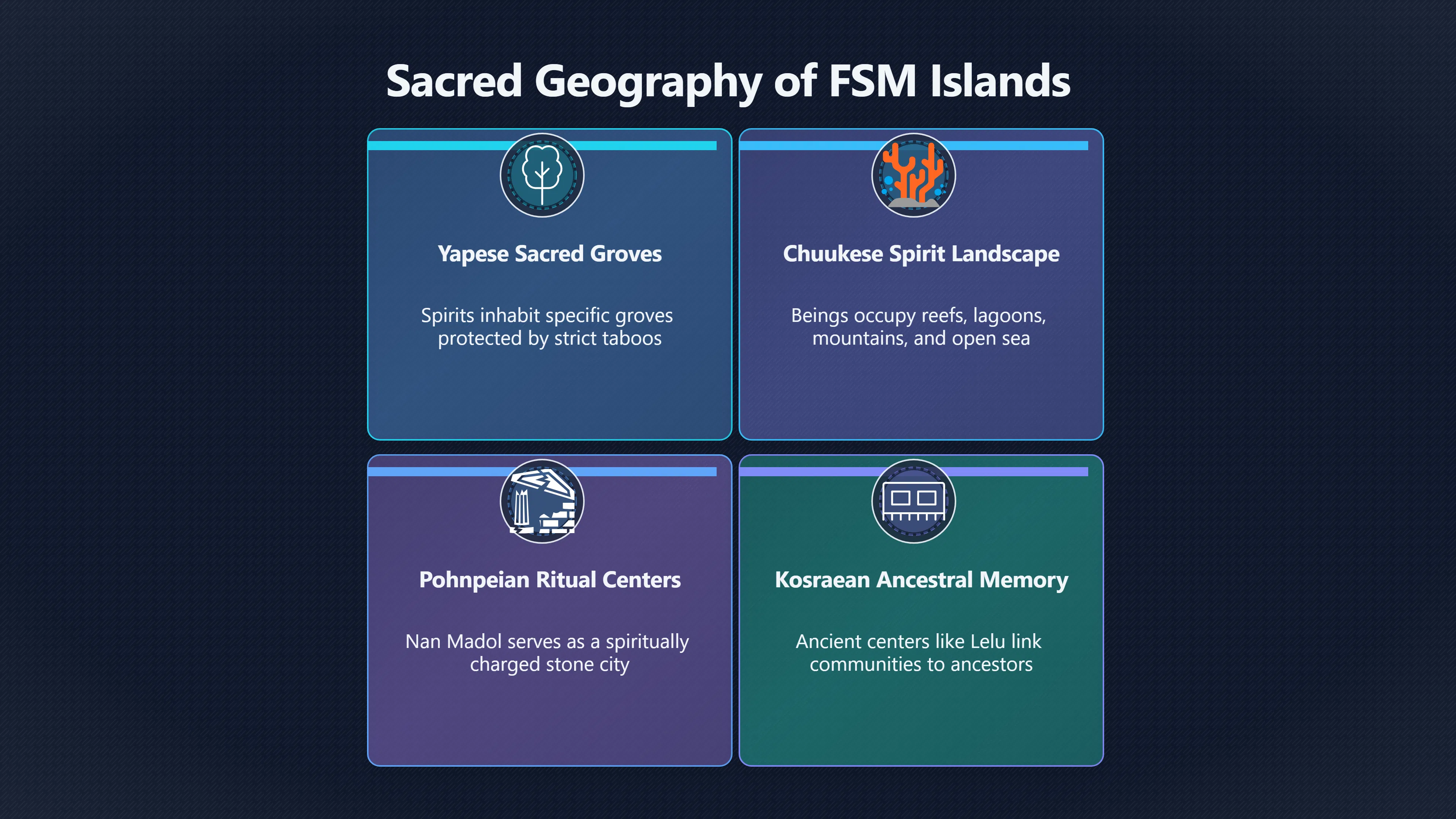
On Pohnpei, the most famous example is Nan Madol, the monumental stone city built on artificial islets beside Temwen Island. Archaeologically, it was the ceremonial centre of the Saudeleur rulers. In oral tradition, however, it remains a spiritually charged landscape associated with powerful rulers, sorcery and ancestral forces. Legends describe its construction by supernatural brothers who moved enormous stones through magical means. Long after its abandonment, many local stories continued to portray the site as a place demanding caution and respect.[Wikipedia]WikipediaNan MadolNan Madol
Other sacred centres existed elsewhere in Micronesia. Historical studies describe ritual locations at places such as Salapwuk on Pohnpei and Wene in Chuuk, alongside numerous local shrines that never achieved international fame but remained important within their own communities. These places were not merely historical monuments; they formed part of a living spiritual geography remembered through oral tradition.[uog.edu]uog.eduSummoning the Powers Beyond: Traditional Religions in…by J SELLMANN — He identifies five features of the old religions: 1) sacred ston…
Places Where Story Controls Behaviour
Many traditions attached practical rules to particular landscapes. A place might be avoided after dark, entered only with permission, approached through a specific path or treated with ritual respect. The story associated with the location explained why these restrictions existed.
In Yap, sacred groves were among the most important examples. Historical descriptions of traditional Yapese religion note that spirits were believed to inhabit certain groves and that these locations were protected by taboos. Sacred persons, shrines and ritual sites could all be surrounded by restrictions controlling who could enter and how people should behave. Violating these rules was believed to invite misfortune, illness or spiritual retaliation.[Micronesian Seminar]micsem.orgMicronesian SeminarThe Meaning of Religionthe spirits inhabiting sacred groves in Yap were represented. Sacred persons and places were al…
The same pattern appears in many island traditions throughout FSM. Spirits were frequently linked to identifiable natural features rather than distant heavenly realms. Reefs, forests, rocks, channels and mountains could all become part of a local map of danger and obligation. Knowledge of these places was often transmitted through families and clans, making folklore inseparable from local history and land rights.[Micronesian Seminar]micsem.orgMicronesian SeminarCongeries of SpiritsThroughout Micronesia there are certain named spirits that are believed to dwell in the heavens an…
For outsiders, such stories can appear to be simple ghost tales. Within the communities that preserved them, however, they also served as behavioural guides. They taught respect for ancestors, reinforced chiefly authority and reminded people that land and sea were embedded in relationships extending beyond the living generation.[Micronesian Seminar]micsem.orgMicronesian SeminarThe Meaning of Religionthe spirits inhabiting sacred groves in Yap were represented. Sacred persons and places were al…
Sacred Animals, Offerings and Avoidance
Animals also occupied an important place in sacred landscapes. Certain creatures were connected with ancestors, guardian spirits or ritual practice, and interactions with them could be governed by rules of avoidance.
One of the best-known examples comes from Nan Madol, where traditional accounts describe ceremonial offerings involving a sacred eel. Historical research on Pohnpeian religion notes that turtle sacrifices were associated with ritual activity connected to this revered animal. The eel was not simply wildlife; it formed part of a sacred relationship between rulers, ritual specialists and supernatural power.[Micronesian Seminar]micsem.orgMicronesian SeminarSUMMONiNG THE POwERS BEyONDThe ritual most closely identified with religion at Nan Madol, as has been noted, was the s…
Elsewhere in Micronesia, spirits were often believed capable of appearing in animal form. Traditions from Chuuk describe spirits associated with bats and other creatures, while broader Micronesian belief systems recognised both helpful ancestral beings and harmful spirits linked to land and sea. Encounters with unusual animals could therefore carry supernatural meaning rather than being interpreted as ordinary natural events.[pactimes]pacificislandtimes.comWhen a person died, his bad spirit would take the form of a fruitpactimesSpiritualism and superstitions: The Chuukese journey to…October 29, 2024 — 30 Oct 2024 — Chuukese people believed each person…
Offerings likewise formed an important part of maintaining relationships with spiritual powers. Traditional religions across Micronesia included food offerings, ritual exchanges and sacrifices associated with sacred sites and ancestral spirits. These practices were generally aimed at securing health, successful fishing, agricultural abundance or protection from harm.[uog.edu]uog.eduSummoning the Powers Beyond: Traditional Religions in…by J SELLMANN — He identifies five features of the old religions: 1) sacred ston…

How Local Traditions Differ Across Yap, Chuuk, Pohnpei and Kosrae
Yap: Taboos as a Social System
Yap preserved one of the most elaborate systems of ritual restrictions in Micronesia. Historical accounts describe sacred sites, ritual calendars, priesthoods and ranked social obligations woven together through taboos. Food rules, menstrual seclusion practices, restrictions linked to ritual purity and ceremonial access to sacred places formed part of a larger worldview in which spirits, land and social order were interconnected. Researchers have highlighted the ritual calendar of Rull as an example of how sacred places, priests and taboo restrictions worked together within community life.[gale.com]go.gale.comSummoning the Powers Beyond: Traditional Religions in…by D Hanlon · 2014 — The prominence of a ritual calendar at Rull in Yap that…
Chuuk: A Landscape Filled with Spirits
Traditional Chuukese belief placed spirits throughout the environment. Accounts describe beings inhabiting reefs, lagoons, rocks, mountains, bushes and the open sea. Ancestor spirits and nature spirits existed alongside stories of possession, dreams and encounters with supernatural beings. Because spirits were thought to occupy ordinary landscapes, everyday activities such as travelling, fishing or entering isolated areas could acquire spiritual significance.[pacificislandtimes.com]pacificislandtimes.comWhen a person died, his bad spirit would take the form of a fruitpactimesSpiritualism and superstitions: The Chuukese journey to…October 29, 2024 — 30 Oct 2024 — Chuukese people believed each person…
Pohnpei: Ruins, Ancestors and Sacred Power
Pohnpei’s sacred geography is dominated by Nan Madol, but the broader island tradition also linked power to specific stones, shrines and ritual centres. Oral traditions surrounding the Saudeleur rulers and later heroes such as Isokelekel transformed historical locations into legendary landscapes. Even when interpreted today through archaeology and heritage tourism, these places retain an aura shaped by centuries of folklore.[wikipedia.org]WikipediaNan MadolNan Madol
Kosrae: Sacred Places and Ancestral Memory
Kosrae’s traditions are often associated with ancient centres such as Lelu and with strong ancestral connections to place. While fewer sacred-place traditions have been published internationally than those of Yap or Pohnpei, historical studies of Micronesian religion indicate that ancestor veneration, spirit beliefs and place-based ritual practices were important components of Kosraean cultural life as well. Sacred locations frequently functioned as repositories of historical memory, linking living communities with earlier generations.[Encyclopedia.com]encyclopedia.comMicronesian Religions: An OverviewAnother almost universal belief in Micronesia is that a departed spirit can be helpful to its living ki…

What Changed After Christianity Arrived?
Christianity became dominant across FSM during the nineteenth and twentieth centuries, but older beliefs rarely disappeared completely. Instead, many sacred places acquired layered meanings. A grove once associated with spirits might now stand beside a church. A ruin understood archaeologically as a historic site might still be treated with caution because of local stories. Ancestors may no longer be worshipped, yet they remain important figures in cultural memory.[Catholics & Cultures]catholicsandcultures.orgmicronesia island cultures weave faith and traditions distinctive waysCatholics & CulturesMicronesia's island cultures weave faith and traditions in…5 Apr 2019 — The vast majority of Micronesians identify…
Modern residents often distinguish between Christian faith and traditional stories while continuing to respect inherited taboos. Some restrictions survive as cultural customs rather than explicit religious obligations. Others are remembered mainly by elders, storytellers and cultural practitioners. Yet the underlying idea remains remarkably persistent: certain places demand respect because they connect people to forces larger than themselves, whether those forces are understood as ancestors, spirits, history or identity.[micsem.org]micsem.orgMicronesian SeminarThe Meaning of Religionthe spirits inhabiting sacred groves in Yap were represented. Sacred persons and places were al…
Sacred Landscapes as Cultural Memory
For many readers, the most important lesson of FSM sacred-place traditions is that folklore is embedded in the land itself. Stories are not floating narratives detached from geography. They are attached to reefs where ancestors fished, ruins where rulers governed, groves where spirits were believed to dwell and pathways where generations learned how to behave.
This helps explain why sacred landscapes remain culturally powerful even when belief systems change. A reef may still be remembered as dangerous. A ruined ceremonial centre may still inspire caution. A grove may still be treated with respect. Whether interpreted as religion, folklore, heritage or local history, these places continue to shape how communities understand the relationship between people, ancestors and the islands they inhabit.[micsem.org]micsem.orgMicronesian SeminarThe Meaning of Religionthe spirits inhabiting sacred groves in Yap were represented. Sacred persons and places were al…
Amazon book picks
Further Reading
Books and field guides related to Why Some Places Are Still Feared. Use these as the next step if you want deeper reading beyond the article.
On the Road of the Winds
Explains sacred landscapes and cultural development across Pacific islands.
eBay marketplace picks
Marketplace Samples
Live-tested eBay searches with available results related to this page.

Endnotes
1.
Source: uog.edu
Link:https://www.uog.edu/_resources/files/schools-and-colleges/college-of-liberal-arts-and-social-sciences/pai/pai5-sellmann-book-review-dobbin.pdf
Source snippet
Summoning the Powers Beyond: Traditional Religions in...by J SELLMANN — He identifies five features of the old religions: 1) sacred ston...
2.
Source: Wikipedia
Title: Nan Madol
Link:https://en.wikipedia.org/wiki/Nan_Madol
3.
Source: Wikipedia
Title: Religion in Yap
Link:https://en.wikipedia.org/wiki/Religion_in_Yap
4.
Source: encyclopedia.com
Link:https://www.encyclopedia.com/environment/encyclopedias-almanacs-transcripts-and-maps/micronesian-religions-overview
Source snippet
Micronesian Religions: An OverviewAnother almost universal belief in Micronesia is that a departed spirit can be helpful to its living ki...
5.
Source: go.gale.com
Link:https://go.gale.com/ps/i.do?id=GALE%7CA382657920&issn=1043898X&it=r&linkaccess=abs&p=AONE&sid=googleScholar&sw=w&v=2.1
Source snippet
Summoning the Powers Beyond: Traditional Religions in...by D Hanlon · 2014 — The prominence of a ritual calendar at Rull in Yap that...
6.
Source: micsem.org
Link:https://micsem.org/print/?id=2065
Source snippet
Micronesian SeminarThe Meaning of Religionthe spirits inhabiting sacred groves in Yap were represented. Sacred persons and places were al...
7.
Source: catholicsandcultures.org
Title: micronesia island cultures weave faith and traditions distinctive ways
Link:https://www.catholicsandcultures.org/micronesia-island-cultures-weave-faith-and-traditions-distinctive-ways
Source snippet
Catholics & CulturesMicronesia's island cultures weave faith and traditions in...5 Apr 2019 — The vast majority of Micronesians identify...
8.
Source: micsem.org
Link:https://www.micsem.org/pubs/books/Summoning-the-Powers-Beyond.pdf
Source snippet
Micronesian SeminarSUMMONiNG THE POwERS BEyONDThe ritual most closely identified with religion at Nan Madol, as has been noted, was the s...
9.
Source: micsem.org
Link:https://micsem.org/article/congeries-of-spirits/
Source snippet
Micronesian SeminarCongeries of SpiritsThroughout Micronesia there are certain named spirits that are believed to dwell in the heavens an...
10.
Source: pacificislandtimes.com
Title: When a person died, his bad spirit would take the form of a fruit
Link:https://www.pacificislandtimes.com/post/spiritualism-and-superstitions-the-chuukese-journey-to-the-underworld-and-afterlife
Source snippet
pactimesSpiritualism and superstitions: The Chuukese journey to...October 29, 2024 — 30 Oct 2024 — Chuukese people believed each person...
Published: October 29, 2024
11.
Source: scholarspace.manoa.hawaii.edu
Link:https://scholarspace.manoa.hawaii.edu/bitstreams/063217c7-6d8b-4cd5-9ed9-2b98830fa6ea/download
Source snippet
Book and Media Reviewsby D Hanlon · 2014 — The prominence of a ritual calendar at Rull in Yap that linked social class, taboo...
Additional References
12.
Source: academia.edu
Link:https://www.academia.edu/99735947/Micronesia_Guam_Commonwealth_of_the_Northern_Mariana_Islands_the_Fed_States_of_Micronesia_Yap_Chuuk_Pohnpei_Kosrae_Palau_Marshals
Source snippet
Academia(PDF) Micronesia, Guam, Commonwealth of the Northern...Beliefs include veneration of ancestors for guidance in various life aspe...
13.
Source: facebook.com
Link:https://www.facebook.com/groups/archeologyandcivilizations/posts/9700167400076697/
Source snippet
Nan Madol, Federated States of MicronesiaNan Madol was a sacred site filled with altars, oracles, and temples. Many Saudeleur were priest...
14.
Source: s3.amazonaws.com
Link:https://s3.amazonaws.com/berkley-center/910701ReligiousBeliefsandEnvironmentalProtectionMalsheguGroveGhana.pdf
Source snippet
The Malshegu Sacred Grove in Northern GhanaMost were established centuries ago as dwelling places for traditional gods and are the sites...
15.
Source: folkknowledgeplace.org
Link:https://folkknowledgeplace.org/article/120043-sacred-isles-islands-as-sites-of-religious-spiritual-or-supernatural-exception
Source snippet
Sacred Isles: Islands as Sites of Religious, Spiritual or...12 Jun 2024 — The articles in this inaugural publication of the periodic sec...
16.
Source: pacificaffairs.ubc.ca
Link:https://pacificaffairs.ubc.ca/book-reviews/summoning-the-powers-beyond-traditional-religions-in-micronesia-by-jay-dobbin-with-francis-x-hezel/
Source snippet
igenous beliefs and practices as “gentle religions.” I think it is accurate to call the religions of Micronesia...
17.
Source: superstitionsmap.com
Link:https://superstitionsmap.com/micronesian-superstitions/
Source snippet
ure spirits, ancestor beliefs, taboo places, and ritual restrictions...Read more...
18.
Source: academia.edu
Title: The karanga people‟s strong beliefs in ancestral
Link:https://www.academia.edu/36228737/Totem_Taboos_and_sacred_places_An_analysis_of_Karanga_people_s_environmental_conservation_and_management_practices
Source snippet
Totem, Taboos and sacred places: An analysis of Karanga...Taboos regulate interactions with nature, prohibiting actions that harm the en...
19.
Source: researchgate.net
Link:https://www.researchgate.net/publication/362985524_Sacred_Groves_in_the_Global_South_A_Panacea_for_Sustainable_Biodiversity_Conservation
Source snippet
religious faith, which contribute significantly to nature conservation...
20.
Source: jarniascyril.com
Title: religious practices micronesia expat guide
Link:https://www.jarniascyril.com/expatriation/expatriation-micronesia-complete-guide/religious-practices-micronesia-expat-guide/
Source snippet
Religious Practices in Micronesia: A Guide for Expatriates8 Apr 2026 — On Yap, some sacred dances are performed at mass; in Pohnpei, the...
21.
Source: youtube.com
Title: Marine Archaeology Is Rewriting Nan Madol’s Mysterious Ruins
Link:https://www.youtube.com/watch?v=qxPaYCHBD4Y
Source snippet
The Mystery of Nan Madol: An Ancient Man-Made Island Built With Unexplained Technology...
Topic Tree