Where New Zealand's Stories Live in the Land
New Zealand folklore is not a single, tidy collection of monster stories. It is a living mix of Māori oral tradition, local landscape lore, ancestor stories, seasonal knowledge, settler ghost tales, literary retellings and modern media adaptation.
Page outline Jump by section
Introduction
For a curious reader, the key point is this: New Zealand’s folklore is deeply place-based. Mountains, rivers, caves, beaches, stars and even legal landscapes carry stories. Some tales are ancient oral traditions, some were reshaped by collectors and writers, some are modern tourist retellings, and some belong to contemporary ghost culture. The most reliable way to read them is not as “proof” of the supernatural, but as cultural narratives that preserve memory, identity, environmental warnings, sacred relationships and imaginative ways of understanding the country.[govt.nz]teara.govt.nzOpen source on govt.nz.
Why New Zealand folklore begins with land, sea and ancestry
Many of the best-known New Zealand traditions begin by explaining the landscape. In Māori tradition, the country is not merely scenery where stories happen; the land itself is part of the story. Te Ara, New Zealand’s national encyclopaedia, summarises this plainly: Māori tribes have stories about how New Zealand was created and how mountains, rivers, lakes and hot springs were shaped. Those stories include giants forming South Island lakes, water creatures rising into land, and mountains moving like living beings.[Te Ara Encyclopedia of New Zealand]teara.govt.nzwhenua how the land was shapedwhenua how the land was shaped
The most famous example is Māui fishing up the North Island. In one widespread version, Māui hides in his brothers’ canoe, persuades them to row into deep water, and casts a hook made from his grandmother’s jawbone. The huge fish he pulls up becomes the North Island, while in some traditions his canoe becomes the South Island and his anchor Stewart Island. This is why the North Island is often understood through the image of “Māui’s fish”, with the story turning a map into a remembered act of daring.[Te Ara Encyclopedia of New Zealand]teara.govt.nzpage 2One of the greatest stories of Māori literature recounts the fishing up of the North Island. It begins with…Read more…
This is not just a charming origin tale. It shows how New Zealand folklore often connects geography with genealogy, sacred knowledge and moral consequence. In retellings of the Māui story, the land’s rugged hills and valleys may be explained by the actions of Māui’s brothers, who cut into the fish before the proper rituals or instructions are complete. The landscape becomes a lesson about impatience, respect and the costs of acting without care.[Te Ara Encyclopedia of New Zealand]teara.govt.nzpage 2One of the greatest stories of Māori literature recounts the fishing up of the North Island. It begins with…Read more…
Kupe, another major figure, belongs to the traditions of discovery and navigation. Some tribal narratives describe Kupe as the first Polynesian to discover New Zealand after pursuing the great octopus of Muturangi from Hawaiki across the ocean. Te Papa notes that Kupe is important in many, though not all, iwi narratives, and that numerous stories, songs and places are associated with him. That caution matters: New Zealand oral tradition is not one uniform national script, but a network of tribal histories and local versions.[Te Ara Encyclopedia of New Zealand]teara.govt.nzpage 6Te Ara Encyclopedia of New ZealandKupe22 Sept 2012 — According to some tribal narratives, Kupe was the first Polynesian to discover the i…
The beings readers usually ask about: taniwha, forest spirits and night creatures
The creature most often associated with New Zealand folklore is the taniwha. In Māori tradition, taniwha are powerful supernatural beings linked especially with deep water, caves, rivers, lakes and the sea. Te Ara compares them loosely with serpents and dragons in other cultures, but stresses that their forms vary widely: some appear as reptile-like monsters, while others take the form of sharks, whales, octopuses or even floating logs.[Te Ara Encyclopedia of New Zealand]teara.govt.nzOpen source on govt.nz.
A common misunderstanding is that taniwha are simply “monsters”. Some stories do describe them as dangerous beings that kill people, kidnap women or lurk in treacherous water. But other traditions understand them as guardians of particular tribes, waterways or places. People might offer gifts or recite ritual words to them, and a taniwha could mark a site as spiritually powerful or physically hazardous. In that sense, a taniwha story can work as folklore, environmental warning, tribal memory and sacred geography at the same time.[Te Ara Encyclopedia of New Zealand]teara.govt.nzOpen source on govt.nz.
A concrete example is Poutini, described by Land Information New Zealand’s Māori oral history atlas as a guardian taniwha connected with pounamu, the greenstone so important in Māori culture. Poutini guards Kahue, the deity associated with pounamu, and the story links a supernatural being to stone, place, craft and ancestral knowledge. This is typical of the best-attested New Zealand traditions: the supernatural detail is not floating free, but attached to a landscape, a resource and a community memory.[Toitū Te Whenua]linz.govt.nzToitū Te Whenua PoutiniToitū Te Whenua Poutini
The patupaiarehe are another distinctive group. Te Ara describes them as fairy-like supernatural beings of forests and misty mountain tops, also known in some traditions by related names. They are often described as pale or fair-haired, without tattoos, and associated with secrecy, music, fog, night and remote places. Some traditions present them as dangerous to humans who intrude on their lands; others emphasise the eerie beauty of their music.[Te Ara Encyclopedia of New Zealand]teara.govt.nzpage 1page 1
These beings are often compared with European fairies, but that comparison can mislead. The resemblance lies in broad motifs — hidden people, enchanted music, mountain or forest dwellings, risky encounters — not in a simple one-to-one identity. In Māori tradition they belong to a local spiritual geography, not to imported fairyland. Their stories are also unevenly distributed: Whanganui traditions, for example, include accounts in which patupaiarehe are giants, while other accounts describe them differently.[Te Ara Encyclopedia of New Zealand]teara.govt.nzOpen source on govt.nz.

Matariki shows folklore as calendar, memory and public culture
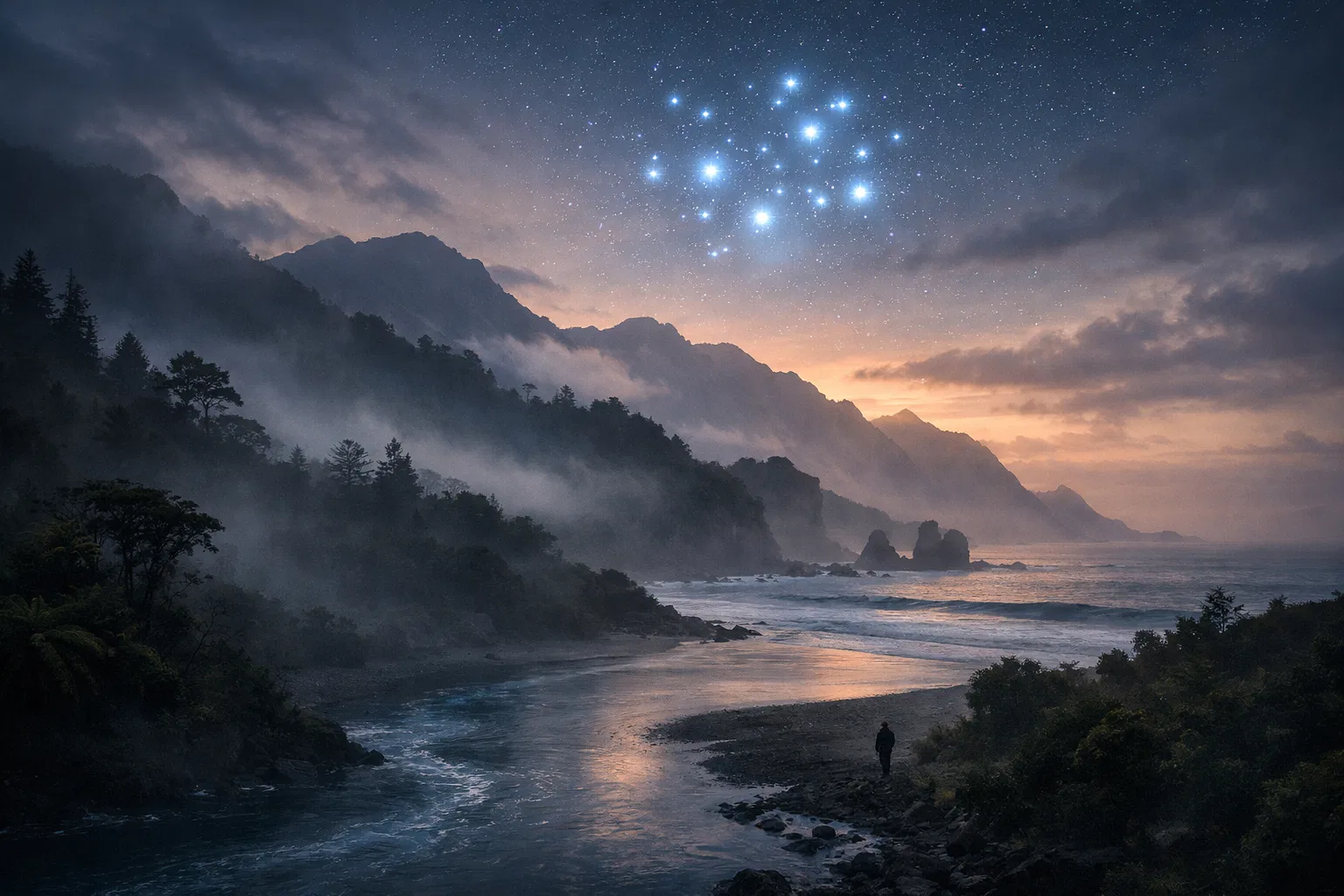
Matariki, the Māori name for the Pleiades star cluster, is one of the clearest examples of a traditional knowledge system that has become highly visible in modern New Zealand public life. For many Māori, its midwinter rising signals the start of a new year, although Te Ara notes that iwi across New Zealand understand and celebrate it in different ways and at different times.[Te Ara Encyclopedia of New Zealand]teara.govt.nzOpen source on govt.nz.
Traditional Matariki practices include remembrance of the dead, honouring ancestors, sharing food, storytelling, song and preparation for the year ahead. Tourism New Zealand describes older festivities as including ritual fires, offerings and celebrations to farewell the dead and honour ancestors; Te Papa frames Matariki today as a time to gather, reflect on the past, celebrate the present and plan for the future.[New Zealand]newzealand.comOpen source on newzealand.com.
The public holiday is modern, but the tradition behind it is not a recent invention. New Zealand first celebrated Matariki as an official public holiday in 2022, and its date changes because it is tied to a lunar-stellar calendar rather than the fixed Gregorian calendar. Te Papa explains that the holiday falls on the closest Friday to the Tangaroa lunar period during the lunar month of Pipiri, which is why the date differs from year to year.[www3.parliament.nz]www3.parliament.nzcelebrating matariki as a public holidaycelebrating matariki as a public holiday
Matariki is also a useful reminder that “folklore” does not only mean old stories about creatures. It can include seasonal custom, astronomy, mourning practice, food ritual, music, names, memory and the way a nation chooses to mark time. Its revival and public recognition show how traditional knowledge can move from local practice and community memory into national ceremony without ceasing to be culturally specific.[tepapa.govt.nz]tepapa.govt.nzOpen source on govt.nz.
Sacred places are not just “haunted places”
New Zealand has many places that visitors encounter through legends: mountains, rivers, caves, coasts, islands and geothermal landscapes. A casual tourist version might present them as scenic myths, but in Māori contexts these stories often express continuing relationships between people, ancestors and place. The Royal Society of New Zealand’s summary of Nēpia Mahuika’s work on oral history stresses that Indigenous oral histories should be understood as valid historical accounts and living phenomena important to identity and cultural politics.[Royal Society Te Apārangi]royalsociety.org.nzOpen source on royalsociety.org.nz.
The recent legal recognition of Taranaki Maunga shows how these ideas still matter. In 2025, New Zealand recognised the mountain as a legal person, acknowledging its ancestral and cultural significance for Māori and following earlier legal recognition of Te Urewera and the Whanganui River. The Associated Press reported that the law views the mountain and surrounding features as a living and indivisible whole, with physical and metaphysical elements. This is modern law, not folklore in the narrow sense, but it reflects a worldview in which landscape, ancestry and story are inseparable.[AP News]apnews.comOpen source on apnews.com.
The northern departure place of spirits is another major example. New Zealand’s haunted-location lists often mention Spirits Bay, but within Māori tradition the idea is not simply a spooky travel tale. It belongs to traditions of death, journeying and the movement of spirits beyond the living world. Treating such places merely as paranormal attractions strips away the cultural frame that gives the story its meaning.[Wikipedia]WikipediaList of reportedly haunted locations in New ZealandList of reportedly haunted locations in New Zealand
This distinction matters for readers and travellers. A haunted theatre story and a sacred landscape tradition are not the same kind of claim. One may be an entertainment-led ghost narrative attached to a building; the other may form part of a living cultural relationship with land, ancestry and ritual responsibility. Both can be “folklore” in a broad sense, but they require different levels of care.[digitalnz.org]digitalnz.orgOpen source on digitalnz.org.
Settler ghost stories and the newer haunted New Zealand
New Zealand also has a body of ghost lore shaped by European settlement, urban legends, old institutions, theatres, hotels, prisons and newspapers. Compared with Māori mythic and sacred traditions, these stories are usually more recent and often less strongly documented. They tend to circulate through local memory, ghost tours, newspaper features, paranormal groups, fiction and online storytelling.
DigitalNZ’s curated “Ghosts” story shows how New Zealand ghost material appears in archives, newspapers, theatre culture and visual collections, including Alexander Turnbull Library material, Wairarapa Archive items and an 1893 newspaper clipping. That does not prove hauntings; it shows that ghost imagery and ghost stories have long been part of New Zealand’s public imagination.[digitalnz.org]digitalnz.orgOpen source on digitalnz.org.
Commonly cited haunted sites include places such as the St James Theatre in Wellington, Napier Prison, Kingseat Hospital and older hotels or houses. These stories often involve apparitions, footsteps, figures seen in mirrors, voices, cold spots or tragic backstories. However, many individual claims are difficult to verify and are best read as local legend, heritage storytelling or paranormal folklore rather than established historical fact.[horror.org]horror.orghalloween haunted places of new zealand by dan rabarts lee murrayhalloween haunted places of new zealand by dan rabarts lee murray
There is also a Pākehā folklore question: what traditions did British and Irish settlers bring, and how did they change in New Zealand? Research on Pākehā folklore has argued that migrants brought vernacular traditions with them — not only animals, crops and tools, but rituals, rural practices and working-class customs — and that these continued to adapt in New Zealand conditions. This strand of folklore is less famous internationally than taniwha or Māui, but it helps explain why New Zealand’s supernatural culture includes both Indigenous and settler layers.[ResearchGate]researchgate.netResearch Gate New Zealand's Pakeha Folklore and Myths of OriginResearch Gate New Zealand's Pakeha Folklore and Myths of Origin

Oral tradition, books and the problem of “the official version”
A major trap in writing about New Zealand folklore is pretending that each story has one official version. Māori oral tradition is rich, regional and genealogical. Te Papa says of Kupe that stories vary by iwi, and Te Ara’s entries repeatedly show local differences in accounts of ancestors, beings and places.[Te Papa Collections Online]collections.tepapa.govt.nzTe Papa Collections Online Kupe | Collections OnlineTe Papa Collections Online Kupe | Collections Online
That variation is not a weakness. It is how oral tradition works. Auckland University Press’s introduction to Māori oral tradition describes it as a poetic record handed down through genealogies, sayings, narratives and songs, covering gods, migration from Hawaiki and life in New Zealand. These forms are not merely entertainment; they support speeches, songs, prayers and cultural teaching.[aucklanduniversitypress.co.nz]aucklanduniversitypress.co.nzOpen source on aucklanduniversitypress.co.nz.
Collectors, missionaries, ethnographers and later children’s writers also shaped how many readers now meet these stories. Some retellings are careful and community-grounded; others simplify, standardise or romanticise. The result is that a children’s book, a tourist panel, an encyclopaedia entry and an iwi account may all tell “the same” legend differently, because they serve different audiences and carry different authority.
A useful rule is to ask four questions: whose version is this, where is it located, when was it recorded or retold, and what purpose does it serve? A local tribal account, a national tourism page and a modern fantasy adaptation may all be valuable, but they should not be treated as interchangeable sources.
Modern retellings: from Whale Rider to Disney’s Māui
New Zealand folklore has not stayed in the past. It has entered novels, films, school resources, museum exhibitions, tourism campaigns, graphic novels and global animation. One of the most influential examples is Witi Ihimaera’s The Whale Rider, first published in 1987 and later adapted for film and stage. The National Library of New Zealand describes the novel as centred in Māori knowledge and the legend of Paikea.[National Library of New Zealand]natlib.govt.nzliterary papers or witi ihimaeras the whale riderliterary papers or witi ihimaeras the whale rider
The Paikea tradition is especially powerful because it links ancestry, whales, migration and community identity. Te Ara notes that whale riding is a common theme in Māori oral storytelling and that the Ngāti Porou tradition of Paikea became known worldwide through Whale Rider. In the story, Paikea survives betrayal at sea when a whale-form guardian carries him to safety.[Te Ara Encyclopedia of New Zealand]teara.govt.nzpage 2page 2
Global pop culture has also reshaped how many people encounter Polynesian figures such as Māui. Disney’s Moana brought a version of Māui to international audiences, but the portrayal has been debated across the Pacific. Reporting on reactions to Moana 2 noted both pride in Pacific representation and criticism that Disney’s comic, commercialised Māui can distort a figure who is culturally important in many Polynesian traditions, including Māori traditions.[The Guardian]theguardian.comOpen source on theguardian.com.
This does not mean modern retellings are automatically bad. They can introduce younger audiences to names, themes and stories they might later explore more deeply. But readers should recognise the difference between a living tradition, a literary adaptation and a corporate entertainment version. The most respectful route is to enjoy the adaptation while following it back to Māori and Pacific sources, local storytellers, museums and iwi-grounded accounts.
What is old, what is revived, and what is newly invented?
New Zealand folklore is easiest to understand when divided into overlapping layers.
Old oral traditions include creation narratives, ancestor voyages, taniwha, patupaiarehe, place-based stories, star lore and ritual knowledge. These are rooted in Māori oral transmission and vary by iwi and region. Their authority often comes from genealogy, place and community continuity rather than from a single written text.[aucklanduniversitypress.co.nz]aucklanduniversitypress.co.nzOpen source on aucklanduniversitypress.co.nz.
Recorded and edited traditions include stories written down by collectors, scholars, missionaries, newspapers and later educators. These sources can preserve valuable material, but they may also reflect the assumptions of the person recording or translating them. A polished printed legend may be easier to read than an oral account, but it may also be less locally specific.
Revived public traditions include modern Matariki celebrations. The public holiday is new, but the star lore, remembrance themes and seasonal framework are much older. This is a good example of revival rather than invention: a traditional practice has been renewed, reframed and made visible at national scale.[parliament.nz]www3.parliament.nzcelebrating matariki as a public holidaycelebrating matariki as a public holiday
Modern folklore and internet-era storytelling includes ghost lists, haunted-hotel claims, paranormal podcasts, Reddit threads, creepypasta-style retellings and tourism copy. Some of it draws on older traditions; some is entertainment. It can still be culturally interesting, but it needs a lighter evidential weight than material grounded in archives, oral history, iwi accounts or museum scholarship.[Reddit]reddit.comOpen source on reddit.com.
Why New Zealand folklore still matters
New Zealand folklore matters because it carries more than strange stories. It offers ways of remembering ancestors, naming places, warning about dangerous waters, marking seasonal change, respecting landscapes and debating identity in a post-colonial country. A taniwha can be a monster, a guardian, a warning and a sign of tribal authority. Matariki can be astronomy, mourning, food, family and national ceremony. Māui can be a trickster hero, a landscape-maker and a figure contested in global entertainment.[govt.nz]teara.govt.nzOpen source on govt.nz.
The most interesting thing about New Zealand’s folklore is therefore not simply that it has dragons, fairies, ghosts or demigods. It is that its stories keep asking readers to see the country differently: as a place where mountains can be ancestors, rivers can carry memory, stars can gather the dead, whales can preserve a lineage, and misty forests can still feel inhabited by older presences.[apnews.com]apnews.comOpen source on apnews.com.
Amazon book picks
Further Reading
No matched book cards were available for Where New Zealand's Stories Live in the Land, so this fallback keeps a direct Amazon reading path visible.
Topical books
New Zealand mythology guide
Browse books, explainers and reference titles related to this topic.
Search AmazonRelated search
New Zealand supernatural beings guide
Browse books, explainers and reference titles related to this topic.
Search AmazonRelated search
Matariki New Year guide
Browse books, explainers and reference titles related to this topic.
Search AmazonEndnotes
1.
Source: teara.govt.nz
Title: page 2
Link:https://teara.govt.nz/en/whenua-how-the-land-was-shaped/page-2
Source snippet
One of the greatest stories of Māori literature recounts the fishing up of the North Island. It begins with...Read more...
2.
Source: teara.govt.nz
Title: page 6
Link:https://teara.govt.nz/en/first-peoples-in-maori-tradition/page-6
Source snippet
Te Ara Encyclopedia of New ZealandKupe22 Sept 2012 — According to some tribal narratives, Kupe was the first Polynesian to discover the i...
3.
Source: teara.govt.nz
Link:https://teara.govt.nz/en/matariki-maori-new-year
4.
Source: teara.govt.nz
Link:https://teara.govt.nz/en/first-peoples-in-maori-tradition
5.
Source: teara.govt.nz
Title: whenua how the land was shaped
Link:https://teara.govt.nz/en/whenua-how-the-land-was-shaped
6.
Source: teara.govt.nz
Link:https://teara.govt.nz/en/whenua-how-the-land-was-shaped/print
7.
Source: teara.govt.nz
Title: maui fishes up the north island
Link:https://teara.govt.nz/en/artwork/5982/maui-fishes-up-the-north-island
8.
Source: teara.govt.nz
Link:https://teara.govt.nz/en/1966/maui-legends-of/page-4
9.
Source: collections.tepapa.govt.nz
Title: Te Papa Collections Online Kupe | Collections Online
Link:https://collections.tepapa.govt.nz/topic/10732
10.
Source: teara.govt.nz
Link:https://teara.govt.nz/en/taniwha
11.
Source: teara.govt.nz
Link:https://teara.govt.nz/en/taniwha/print
12.
Source: linz.govt.nz
Title: Toitū Te Whenua Poutini
Link:https://www.linz.govt.nz/our-work/new-zealand-geographic-board/place-name-stories/maori-oral-history-atlas/poutini-guardian-taniwha
13.
Source: teara.govt.nz
Title: page 1
Link:https://teara.govt.nz/en/patupaiarehe/page-1
14.
Source: teara.govt.nz
Link:https://teara.govt.nz/en/patupaiarehe
15.
Source: tepapa.govt.nz
Link:https://tepapa.govt.nz/digital-museum/explore-digital-museum/matariki-maori-new-year
16.
Source: www3.parliament.nz
Title: celebrating matariki as a public holiday
Link:https://www3.parliament.nz/mi/get-involved/features/celebrating-matariki-as-a-public-holiday/
17.
Source: tepapa.govt.nz
Link:https://tepapa.govt.nz/discover-collections/read-watch-play/matariki-maori-new-year/dates-for-matariki-public-holiday
18.
Source: matariki.com
Link:https://www.matariki.com/about
19.
Source: Wikipedia
Title: List of reportedly haunted locations in New Zealand
Link:https://en.wikipedia.org/wiki/List_of_reportedly_haunted_locations_in_New_Zealand
20.
Source: teara.govt.nz
Link:https://teara.govt.nz/en/whakapapa-genealogy
21.
Source: digitalnz.org
Link:https://digitalnz.org/stories/5424d4ff1257574260000008
22.
Source: horror.org
Title: halloween haunted places of new zealand by dan rabarts lee murray
Link:https://horror.org/halloween-haunted-places-of-new-zealand-by-dan-rabarts-lee-murray/
23.
Source: researchgate.net
Title: Research Gate New Zealand’s Pakeha Folklore and Myths of Origin
Link:https://www.researchgate.net/publication/236727768_New_Zealand%27s_Pakeha_Folklore_and_Myths_of_Origin
24.
Source: aucklanduniversitypress.co.nz
Link:https://aucklanduniversitypress.co.nz/content/9781869408619.pdf
25.
Source: natlib.govt.nz
Title: literary papers or witi ihimaeras the whale rider
Link:https://natlib.govt.nz/blog/posts/literary-papers-or-witi-ihimaeras-the-whale-rider
26.
Source: teara.govt.nz
Title: page 2
Link:https://teara.govt.nz/en/te-whanau-puha-whales/page-2
27.
Source: reddit.com
Link:https://www.reddit.com/r/newzealand/comments/1fussc0/why_doesnt_new_zealand_culture_have_any_tales_of/
28.
Source: reddit.com
Link:https://www.reddit.com/r/newzealand/comments/jix1e4/what_are_nzs_best/
29.
Source: Wikipedia
Link:https://en.wikipedia.org/wiki/Aotearoa
30.
Source: Wikipedia
Title: Māori mythology
Link:https://en.wikipedia.org/wiki/M%C4%81ori_mythology
31.
Source: Wikipedia
Title: Māui (Māori mythology)
Link:https://en.wikipedia.org/wiki/M%C4%81ui_%28M%C4%81ori_mythology%29
32.
Source: Wikipedia
Link:https://en.wikipedia.org/wiki/Patupaiarehe
33.
Source: Wikipedia
Title: Hine nui te pō
Link:https://en.wikipedia.org/wiki/Hine-nui-te-p%C5%8D
34.
Source: Wikipedia
Link:https://en.wikipedia.org/wiki/T%C4%81whirim%C4%81tea
35.
Source: Wikipedia
Link:https://en.wikipedia.org/wiki/Taniwha
36.
Source: Wikipedia
Link:https://en.wikipedia.org/wiki/Matariki
37.
Source: Wikipedia
Title: The Fish of Māui
Link:https://en.wikipedia.org/wiki/The_Fish_of_M%C4%81ui
38.
Source: Wikipedia
Link:https://en.wikipedia.org/wiki/Kupe
39.
Source: Wikipedia
Title: Whale Rider
Link:https://en.wikipedia.org/wiki/Whale_Rider
40.
Source: tepapa.govt.nz
Title: matariki 2026 at te papa
Link:https://tepapa.govt.nz/visit/events/matariki-2026-at-te-papa
41.
Source: tepapa.govt.nz
Link:https://tepapa.govt.nz/visit/events/matariki-after-dark-leading-from-the-front
42.
Source: teara.govt.nz
Link:https://teara.govt.nz/en/maori-creation-traditions/print
43.
Source: teara.govt.nz
Link:https://teara.govt.nz/en/1966/animals-mythical
44.
Source: teara.govt.nz
Link:https://teara.govt.nz/en/1966/kupe
45.
Source: teara.govt.nz
Link:https://teara.govt.nz/en
46.
Source: teara.govt.nz
Link:https://teara.govt.nz/en/maori-non-fiction-and-scholarship-nga-tuhinga-me-te-rangahau/print
47.
Source: natlib.govt.nz
Link:https://natlib.govt.nz/items?i%5Bsubject%5D%5B%5D=Ghost+stories&i%5Bsubject%5D%5B%5D=Haunted+places+–+Juvenile+fiction&i%5Btag%5D=natlib%3Aonly_at_the_library
48.
Source: natlib.govt.nz
Link:https://natlib.govt.nz/records/57889690?search%5Bi%5D%5Bsubject%5D%5B%5D=Ghost+stories&search%5Bi%5D%5Bsubject%5D%5B%5D=Haunted+places+–+Fiction&search%5Bpath%5D=items&search%5Btext%5D=-aerial
49.
Source: linz.govt.nz
Link:https://www.linz.govt.nz/our-work/new-zealand-geographic-board/place-name-stories/maori-oral-history-atlas/kupe-discoverer
50.
Source: linz.govt.nz
Link:https://www.linz.govt.nz/sites/default/files/nga-tohu-pumahara.pdf
51.
Source: digitalnz.org
Link:https://digitalnz.org/stories/5b1246d98d2a4e5987bd480d
52.
Source: nzhistory.govt.nz
Title: waka connecting ocean aotearoa new zealands history
Link:https://nzhistory.govt.nz/page/waka-connecting-ocean-aotearoa-new-zealands-history
53.
Source: researchgate.net
Link:https://www.researchgate.net/publication/320087736_The_Maori_calendar_of_New_Zealand_a_chronological_perspective
54.
Source: royalsociety.org.nz
Link:https://www.royalsociety.org.nz/150th-anniversary/tetakarangi/rethinking-oral-history-and-tradition-an-indigenous-perspective-nepia-mahuika-2019
55.
Source: apnews.com
Link:https://apnews.com/article/590fca0f3d648cc0bf86d970782e954c
56.
Source: newzealand.com
Link:https://www.newzealand.com/uk/matariki/
57.
Source: theguardian.com
Link:https://www.theguardian.com/global/2024/dec/06/moana-2-reaction-reviews-pacific-island-countries
58.
Source: ebsco.com
Link:https://www.ebsco.com/research-starters/religion-and-philosophy/tangaroa
59.
Source: museumsandtheweb.com
Title: Te Ara
Link:https://www.museumsandtheweb.com/biblio/te_ara_the_encyclopedia_of_new_zealand_an_encyclopedi.html
60.
Source: journals.openedition.org
Link:https://journals.openedition.org/ces/pdf/9149
61.
Source: youtube.com
Link:https://www.youtube.com/watch?v=3gaVGFsDhYg
62.
Source: instagram.com
Link:https://www.instagram.com/reel/DK8GALhuxEu/?hl=en
63.
Source: rachelsfeaturepresentations.blogspot.com
Title: whale rider
Link:https://rachelsfeaturepresentations.blogspot.com/2013/10/whale-rider.html
64.
Source: goodreads.com
Title: Te Ara
Link:https://www.goodreads.com/series/81309-te-ara—the-encyclopedia-of-new-zealand
65.
Source: libguides.wintec.ac.nz
Link:https://libguides.wintec.ac.nz/MaataurangaMaaori/Matariki
66.
Source: newzealand.com
Link:https://www.newzealand.com/de/feature/experience-maori-legends/
67.
Source: newzealand.com
Link:https://www.newzealand.com/int/matariki/
68.
Source: newzealand.com
Link:https://www.newzealand.com/uk/feature/experience-maori-legends/
69.
Source: newzealand.com
Link:https://www.newzealand.com/sg/feature/the-legend-of-new-zealand/
70.
Source: dokumen.pub
Title: Māori Oral Tradition
Link:https://dokumen.pub/download/mori-oral-tradition-he-krero-n-te-ao-tawhito-1869408616-9781869408619.html
71.
Source: tiff.net
Title: whale rider
Link:https://www.tiff.net/events/whale-rider
72.
Source: medium.com
Link:https://medium.com/%40damian.hill/new-zealand-exploring-forgotten-folklore-b12df0bb6af5
73.
Source: beastsoflegend.com
Link:https://beastsoflegend.com/bestiary/oceania-2/taniwha/
Additional References
74.
Source: youtube.com
Link:https://www.youtube.com/watch?v=5klpcQOpWjg
Source snippet
The Luminous Embrace | A Maori Creation Story | Maori Mythology...
75.
Source: youtube.com
Title: Mythical Creatures Of New Zealand Explained
Link:https://www.youtube.com/watch?v=Cw0QR28OKws
Source snippet
The Battle of the Mountains | New Zealand's Untold Māori Legend of Love & Rivalry...
76.
Source: youtube.com
Title: A MAUI TE TIPUA
Link:https://www.youtube.com/watch?v=5COowHKecJw
Source snippet
Tales from the mythologies of Creation, Maui and Aoraki...
77.
Source: youtube.com
Title: Tales from the mythologies of Creation, Maui and Aoraki
Link:https://www.youtube.com/watch?v=P6q8E1laQjY
Source snippet
Mythical Creatures Of New Zealand Explained...
78.
Source: academia.edu
Link:https://www.academia.edu/91106824/New_Zealand_history_is_Maori_history_Tikanga_as_the_ethical_foundation_of_historical_scholarship_In_Aotearoa_New_Zealand
79.
Source: channelnewsasia.com
Link:https://www.channelnewsasia.com/
80.
Source: facebook.com
Link:https://www.facebook.com/groups/aotearoanzhistory/posts/1091536686002026/
81.
Source: flightsandfables.com
Link:https://www.flightsandfables.com/european-ghost-stories-folklore/
82.
Source: facebook.com
Link:https://www.facebook.com/NZEmbassyUS/videos/happy-new-year-new-zealand-matariki-is-the-m%C4%81ori-name-for-the-cluster-of-stars-a/1717709555516280/
83.
Source: facebook.com
Link:https://www.facebook.com/nzherald.co.nz/posts/in-one-of-aotearoas-creation-stories-demi-god-maui-hauled-up-the-north-island-fr/1478084901023495/
Amazon book picks
Further Reading
Books and field guides related to Where New Zealand's Stories Live in the Land. Use these as the next step if you want deeper reading beyond the article.
The Illustrated Encyclopedia of Māori Myth and Legend
Explains important figures, places and traditions.
Myths and Legends of the Polynesians
Places New Zealand stories within a wider Pacific tradition.
Topic Tree
Follow this branch
Related pages 192
- Afghan Folklore
- Albanian Folklore
- Algerian Folklore
- Australian Folklore
- Azerbaijan Folklore
- +187 more in sidebar