Haunting Traditions of Dominican Republic
Folklore in the Dominican Republic is not a single, tidy mythology. It is a living mix of mountain spirits, shapeshifters, saint festivals, carnival devils, old Taíno sacred landscapes, African-derived ritual music, Catholic devotion, rural cautionary tales and modern literary reinvention.
Page outline Jump by section
Why Dominican folklore feels so layered
Dominican folklore reflects the island’s long history as part of Hispaniola: Indigenous Taíno worlds, Spanish colonial Catholicism, African enslavement and resistance, Haitian-Dominican borderland exchange, rural cattle economies, migration and modern nationalism all feed into the stories people tell. That is why the same figure can be described as a monster, a memory of fugitives, a moral warning, a poetic symbol or a local joke depending on who is telling the story.
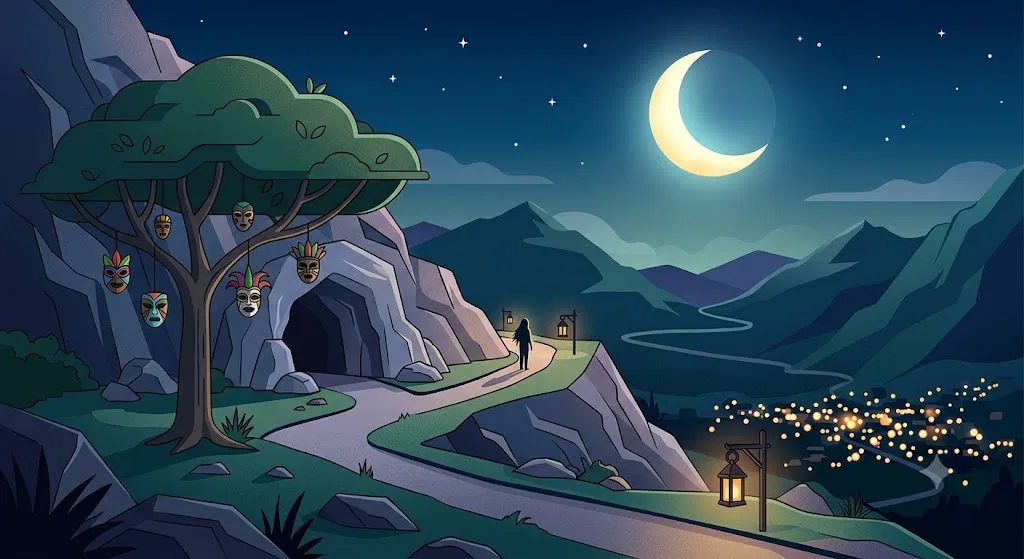
The country’s folklore is also unusually place-sensitive. Mountains, caves, rivers, plantations, borderlands, old colonial streets and carnival routes are not just backdrops; they are the settings that make the stories believable. The Ciguapa belongs to remote mountains and caves. The Biembienes are tied to the Bahoruco mountains, remembered as a refuge for Indigenous people and runaway slaves. The Bacá is especially meaningful in rural and borderland settings where animals, wealth, sorcery and suspicion overlap.[si.edu]folklife.si.eduOpen source on si.edu.
A useful way to read Dominican folklore is to ask what each tradition helps a community talk about. Some tales warn children not to wander. Some explain sudden wealth, illness or bad luck. Some preserve fragments of older religious ideas. Some bring satire into the streets. Others help writers and artists speak about gender, race and historical silence without turning the page into a history lecture.
The Ciguapa: the woman no one can follow
The Ciguapa is the Dominican Republic’s most recognisable legendary being. She is usually described as a mysterious female figure with very long hair and backward-facing feet, living in mountains, caverns, rivers or remote rural places. Dominicana Online describes her as one of the country’s best-known legends, while the Smithsonian Folklife article on Dominican-American writer Elizabeth Acevedo calls her the best-known figure in Dominican lore.[Dominicana Online]dominicanaonline.orgDominicana Online Myths and Beliefs – Dominicana OnlineDominicana Online Myths and Beliefs – Dominicana Online
The backward feet are the detail everyone remembers. They make her tracks unreadable: a person following her footprints cannot be sure whether she is arriving or leaving. In some tellings she is shy and elusive; in others she hypnotises men, seduces them and destroys them. The Smithsonian account notes these competing versions and also records the folklore motif that she can only be hunted by moonlight with the help of a special black-and-white dog.[Smithsonian Folklife Center]folklife.si.eduOpen source on si.edu.
Her origin is not straightforward. Popular retellings sometimes link her to Taíno ancestry or to fugitives from colonial violence, while other modern interpretations treat her as a figure of Black, Indigenous and female survival. Dominicana Online gives one literary-national version in which her backwards walking is connected to a Ciguaya princess of Samaná and her companions trying not to be tracked. It also notes that this reading has been exaggerated through the centuries and now circulates through the internet, visual art, music, literature and film.[Dominicana Online]dominicanaonline.orgDominicana Online Myths and Beliefs – Dominicana OnlineDominicana Online Myths and Beliefs – Dominicana Online
That uncertainty is part of her power. The Ciguapa is not simply “an ancient Taíno goddess” or “a Dominican succubus”, though both kinds of claim appear in simplified retellings. She is better understood as a flexible Dominican symbol: a rural warning, a mountain spirit, a sexual danger tale, a figure of female unknowability and a modern literary emblem for histories that are hard to trace.
Spirits of the dead, hidden people and mountain fear
The Ciguapa is only one part of a wider Dominican landscape of beings who appear at night, mislead travellers or blur the line between person and spirit. Dominicana Online lists Jupías as ghostly female beings connected to Taíno mythology and to accounts attributed to friar Ramón Pané, who recorded early Spanish-era descriptions of Indigenous belief on Hispaniola. In Dominican retelling, they are night-moving spirits who take bodies, seduce men and make them disappear.[Dominicana Online]dominicanaonline.orgDominicana Online Myths and Beliefs – Dominicana OnlineDominicana Online Myths and Beliefs – Dominicana Online
The Biembienes belong to a different kind of memory. They are linked to the Bahoruco mountains, a region described in Dominican cultural sources as a refuge for Indigenous people and runaway slaves. In the story, they live in hidden clans, move at night, steal crops and leave backward tracks to confuse pursuers. That detail connects them to the Ciguapa, but the social meaning is different: the Biembienes sound less like fairies than like a mythic echo of people who survived by hiding from colonial authority.[Dominicana Online]dominicanaonline.orgDominicana Online Myths and Beliefs – Dominicana OnlineDominicana Online Myths and Beliefs – Dominicana Online
These stories show how Dominican folklore often turns marginal places into supernatural zones. A mountain is not just a mountain; it may be a place where fugitives survived, where strangers should not wander at night, where ghosts confuse the living, or where a half-remembered history survives as a monster story.
Shapeshifters: Galipotes, Zánganos and the fear of hidden power
The Galipote is the Dominican shapeshifter par excellence. In popular accounts, Galipotes are people who can transform into animals or even objects such as tree trunks and rocks. Dominicana Online describes them as cruel and violent beings, immune to ordinary weapons, and links the dog-transforming form to the French-derived werewolf idea of the loup-garou.[Dominicana Online]dominicanaonline.orgDominicana Online Myths and Beliefs – Dominicana OnlineDominicana Online Myths and Beliefs – Dominicana Online
The Zángano is closely related. It shares shapeshifting traits but is also described as able to take huge strides, fly like a night bird, climb, run and disappear with impossible speed. These details place Dominican shapeshifters in a wider Caribbean and Atlantic family of beings that mix European werewolf motifs, African-derived spiritual ideas, Catholic fear of diabolical pacts and local rural landscapes.[Dominicana Online]dominicanaonline.orgDominicana Online Myths and Beliefs – Dominicana OnlineDominicana Online Myths and Beliefs – Dominicana Online
The most interesting thing about these beings is not whether they “come from” one origin. Dominican folklore usually works by combination. A Galipote can sound partly like a werewolf, partly like a sorcerer, partly like a rural predator and partly like an explanation for why certain people seem untouchable. The monster becomes a language for hidden privilege, secret violence and power that cannot be challenged directly.
The Bacá: when wealth becomes suspicious
The Bacá is one of the most revealing figures in Dominican supernatural belief because it is not just frightening; it is social commentary. In many accounts, it is a spirit or animal familiar associated with wealth, sorcery, illness and bargains with dangerous powers. Historian Lauren Derby, whose work focuses on oral histories from the Haitian-Dominican borderlands, describes the Bacá as a kind of “sent spirit” used to make something happen, including making money or causing harm.[UCLA International Institute]international.ucla.eduInternational InstituteShape-shifting and storytelling in Hispaniola…
Derby’s fuller study treats the Bacá as an “open secret”: widely recognised but not always publicly discussed. It may appear as a small humanoid figure in urban settings or as an animal host in rural areas. Her analysis also connects Bacá stories to animals introduced through colonialism, especially dogs, cattle, horses and pigs, and argues that Bacá narratives carry memories of wealth, dispossession, environmental change and predatory capitalism.[KC User Content]assets-us-01.kc-usercontent.comOpen source on kc-usercontent.com.
This helps explain why Bacá stories are more than simple “deal with the devil” tales. They ask a hard community question: where did that money come from? If someone suddenly becomes rich, if livestock behave strangely, if illness or misfortune seems targeted, folklore offers a way to speak about envy, exploitation and moral suspicion without naming a person directly.
Taíno sacred worlds beneath later folklore
Dominican folklore is often described as a mixture of Taíno, African and Spanish elements, but that phrase can become too vague. The strongest evidence for pre-colonial Taíno spiritual life comes not from modern monster lists but from archaeology, early colonial accounts and surviving objects. Taíno zemís were not merely statues; the term referred to spiritual and vital force connected with deities and ancestors. The Metropolitan Museum of Art explains that zemí figures could be used in ceremonies involving cohoba, and that Spanish accounts described them as stands, reliquaries or personal adornments.[The Metropolitan Museum of Art]metmuseum.orgThe Metropolitan Museum of Art Taíno artist(sThe Metropolitan Museum of Art Taíno artist(s
Smarthistory similarly explains that zemís could affect health, fertility, status and political power, and that some were understood as embodied spirit forces revealed through ritual specialists. This matters because it shows that the Indigenous background to Dominican folklore was not a simple catalogue of “gods and monsters”; it was a sacred system in which ancestors, landscape, power and ceremony were closely connected.[Smarthistory]smarthistory.orgtaino zemis and duhosTaíno zemís and duhos…
Caves are especially important. Taíno traditions across Hispaniola placed origins, ancestors and underworld forces in cave landscapes, and archaeological work in the Dominican Republic has documented cave use, rock art and ritual evidence while also warning that knowledge of Taíno cave practice remains incomplete.[Tiboko]tiboko.comTAINOS CAVESTAINOS CAVES
This is why claims that a modern Dominican being is “purely Taíno” should be handled carefully. Some beings, such as Jupías, clearly echo early colonial descriptions of Indigenous spirits of the dead. Others, such as the Ciguapa, have been linked to Indigenous identity in modern imagination but are also shaped by later rural, literary and diasporic retellings.

Folk religion: saints, healing, drums and hidden continuities
Dominican supernatural culture cannot be understood only through monsters. Folk religion is just as important: saint devotion, healing rituals, promises, drums, processions, spirit work and community festivals shape how many people encounter the sacred in everyday life. Ana-Maurine Lara’s study of Dominican Vudú describes it as a religious system of protection, healing and cultural meaning among communities of African descent, while also noting the pressure placed on such practices by national ideologies that preferred a more Hispanic and Catholic public identity.[Tiboko]tiboko.comANA LARAANA LARA
Lara also describes public ceremonies as acts of thanks and community obligation, and discusses Gagá as a Dominican form connected to Haitian Rará, plantation communities and Haitian-Dominican identities. In this framing, Gagá is not just performance; it is a ritual and social space where music, marching, devotion and identity meet.[Tiboko]tiboko.comANA LARAANA LARA
UNESCO recognition also helps show that Afro-Dominican tradition is not marginal to the country’s cultural heritage. The Brotherhood of the Holy Spirit of the Congos of Villa Mella is recognised for music, dance and popular festivities, with hand-drums whose origin is attributed within the tradition to the Holy Spirit. UNESCO’s archive states that the brotherhood was founded in the sixteenth century by African slaves and people of mixed origin and remains important to regional cultural identity.[UNESCO]unesco.orgOpen source on unesco.org.
Carnival devils and public folklore
Dominican carnival brings supernatural imagery into the street. Its most famous figure is the Diablo Cojuelo, the limping devil. A Dominican embassy cultural note describes the character as Spanish in origin, appearing in Santo Domingo during early American carnival celebrations, but changing over time into a festive and mischievous figure shaped by Dominican Hispanic and African influences.[bel.mirex.gob.do]bel.mirex.gob.doDiablo Conjuelo background noteDiablo Conjuelo background note
The Diablo Cojuelo is not simply a demon costume. In Dominican carnival he becomes a public performer: masked, noisy, colourful, satirical and regionally varied. The same source notes that costumes and masks vary by village or region, and that the figure can be used for social and political criticism. This is folklore doing civic work: it turns fear into spectacle and gives communities a licensed way to mock power.[bel.mirex.gob.do]bel.mirex.gob.doDiablo Conjuelo background noteDiablo Conjuelo background note
Other carnival traditions show how migration becomes folklore. UNESCO’s archive on Cocolo dance drama explains that the tradition developed among descendants of British Caribbean workers who came to the Dominican Republic in the nineteenth century to work in the sugar fields. Their annual dance dramas became a distinctive cultural expression, especially associated with San Pedro de Macorís and its carnival personages.[UNESCO]unesco.orgOpen source on unesco.org.
Oral tales, collectors and the archive
Dominican folklore has survived because people told stories, but it is also known through collectors, archives and scholarly work. Manuel José Andrade’s Folklore from the Dominican Republic, published by the University of Santo Domingo in 1948 and preserved through the Internet Archive, is one of the important documentary anchors for Dominican folktale study. Its presence as a bilingual Spanish-English folklore collection shows that Dominican oral tradition entered formal scholarship relatively early in the twentieth century.[Internet Archive]archive.orgOpen source on archive.org.
Collectors matter because oral tradition changes as it travels. A tale told in a household, a rural community, a schoolbook, a diaspora poem and a tourism blog may keep the same creature but alter its meaning. That is especially clear with the Ciguapa: nineteenth-century literary nationalism, rural oral memory, feminist reinterpretation, Afro-Dominican poetry and internet summaries now coexist.
For readers, the key is not to demand one “true” version too quickly. Folklore is not a police report. It is better read as a tradition with layers: the oldest attested form, local variants, literary reshaping, family memory, public performance and modern popular culture.
How Dominican folklore is understood today
Today, Dominican folklore lives in several overlapping worlds. It is taught as cultural heritage, performed in carnival, preserved in UNESCO-recognised traditions, studied by scholars, retold by families, marketed to visitors and reimagined by writers and artists in the Dominican Republic and the diaspora.
Elizabeth Acevedo’s work is a good example of modern reinterpretation. The Smithsonian Folklife article describes how Dominican folklore informs her poetry and fiction, especially the Ciguapa, and how she uses these figures to ask questions about gender, patriarchy, Afro-Dominican memory and histories that were not well documented.[Smithsonian Folklife Center]folklife.si.eduOpen source on si.edu.
This modern use does not make the folklore fake. It shows that Dominican legends remain useful. The Ciguapa can still be a mountain warning and a feminist symbol. The Bacá can still be a frightening spirit and a critique of suspicious wealth. Carnival devils can still be playful monsters and vehicles for political satire. Folk religion can still be devotion, healing, performance and resistance at once.
The Dominican Republic’s folklore is therefore best understood as a living cultural map. Its monsters and spirits point towards places where history presses hardest: the mountain, the cave, the plantation, the border, the carnival street, the saint festival, the family story and the unsettled space between fear and memory.
Amazon book picks
Further Reading
Books and field guides related to What Haunts Dominican Republic Folklore?. Use these as the next step if you want deeper reading beyond the article.
The Dominican Republic Reader
Offers background needed to understand folklore traditions.
eBay marketplace picks
Marketplace Samples
Live-tested eBay searches with available results related to this page.


Endnotes
1.
Source: archive.org
Link:https://archive.org/details/folkloredelarepu0000manu_h0p3
2.
Source: international.ucla.edu
Title: International Institute
Link:https://www.international.ucla.edu/lai/article/202890
Source snippet
Shape-shifting and storytelling in Hispaniola...
3.
Source: smarthistory.org
Title: taino zemis and duhos
Link:https://smarthistory.org/taino-zemis-and-duhos/
Source snippet
Taíno zemís and duhos...
4.
Source: tiboko.com
Title: TAINOS CAVES
Link:https://tiboko.com/wp-content/uploads/2023/07/TAINOS___CAVES.pdf
5.
Source: tiboko.com
Title: ANA LARA
Link:https://tiboko.com/wp-content/uploads/2023/07/ANA-LARA.pdf
6.
Source: unesco.org
Link:https://www.unesco.org/archives/multimedia/document-623
7.
Source: bel.mirex.gob.do
Title: Diablo Conjuelo background note
Link:https://bel.mirex.gob.do/wp-content/uploads/2023/07/Diablo-Cojuelo-ENG.pdf
8.
Source: unesco.org
Link:https://www.unesco.org/archives/multimedia/document-622
9.
Source: ich.unesco.org
Title: dominican republic DO
Link:https://ich.unesco.org/en/state/dominican-republic-DO
10.
Source: unesco.org
Title: Dominican Republic
Link:https://www.unesco.org/en/countries/do/lists-and-nominations
11.
Source: ich.unesco.org
Title: cocolo dance drama tradition 00104
Link:https://ich.unesco.org/en/RL/cocolo-dance-drama-tradition-00104
12.
Source: dominicanaonline.org
Title: Dominicana Online Myths and Beliefs – Dominicana Online
Link:https://www.dominicanaonline.org/en/cultura/mitos-creencias/
13.
Source: folklife.si.edu
Link:https://folklife.si.edu/magazine/beautiful-monsters-elizabeth-acevedo-poetry
14.
Source: Wikipedia
Title: Taíno mythology
Link:https://en.wikipedia.org/wiki/Ta%C3%ADno_mythology
15.
Source: assets-us-01.kc-usercontent.com
Link:https://assets-us-01.kc-usercontent.com/f7ca9afb-82c2-002a-a423-84e111d5b498/abab5669-3cb9-41af-95fa-6aec1cf1b4c1/978-1-4780-3278-6_601.pdf
16.
Source: metmuseum.org
Title: The Metropolitan Museum of Art Taíno artist(s)
Link:https://www.metmuseum.org/art/collection/search/313384
17.
Source: Wikipedia
Link:https://en.wikipedia.org/wiki/Ciguapa
18.
Source: Wikipedia
Title: Dominican Republic
Link:https://en.wikipedia.org/wiki/Dominican_Republic
19.
Source: metmuseum.org
Title: Taíno artist(s)
Link:https://www.metmuseum.org/art/collection/search/312602
20.
Source: x.com
Link:https://x.com/archaeologymag/status/1829912028212854891
21.
Source: fr.scribd.com
Title: The Ciguapa
Link:https://fr.scribd.com/document/960652801/The-Ciguapa
22.
Source: scribd.com
Title: The Ciguapa
Link:https://www.scribd.com/document/925931191/The-Ciguapa
23.
Source: spkofmarvels.wordpress.com
Title: elizabeth acevedo
Link:https://spkofmarvels.wordpress.com/2017/04/04/elizabeth-acevedo/
24.
Source: iic-spanish.com
Title: dominican carnival
Link:https://iic-spanish.com/en/dominican-carnival/
25.
Source: cayolevantadoresort.com
Title: dominican folklore
Link:https://www.cayolevantadoresort.com/en/blog/dominican-folklore/
26.
Source: artmuseum.princeton.edu
Link:https://artmuseum.princeton.edu/art/collections/objects/138829
27.
Source: monster.fandom.com
Link:https://monster.fandom.com/wiki/Ciguapa
Additional References
28.
Source: youtube.com
Title: The Ciguapa: Don’t Follow the Footprints
Link:https://www.youtube.com/watch?v=Y_-gT8nc264
Source snippet
Blue Women Of The Forest: the origins of the Ciguapa Legend (Dominican mythology)...
29.
Source: youtube.com
Title: The Dominican Republic’s Most Infamous Monster Terrified Me
Link:https://www.youtube.com/watch?v=8l3eFQ21vU0
Source snippet
The Ciguapa: Don't Follow the Footprints...
30.
Source: academia.edu
Link:https://www.academia.edu/9271289/TA%C3%8DNO_USE_OF_FLOODED_CAVERNS_IN_THE_EAST_NATIONAL_PARK_REGION_DOMINICAN_REPUBLIC
31.
Source: lameca.org
Link:https://www.lameca.org/publications-numeriques/dossiers-et-articles/palos-drumming-of-the-dominican-republic/1-a-panorama-of-dominican-folk-religion-and-its-music/
32.
Source: pisqueya.com
Link:https://pisqueya.com/blogs/news/4-dominican-urban-legends-of-dark-creatures-that-go-bump-in-the-night?srsltid=AfmBOoo9VNBBqw6rAmBzsQd3A8QIYfngDOYsLtKeOSJ7VqZfsPv4mn_I
33.
Source: pisqueya.com
Link:https://pisqueya.com/blogs/news/4-dominican-urban-legends-of-dark-creatures-that-go-bump-in-the-night?srsltid=AfmBOooHtz6WEghq1B9WfDT68dFXIpnGQUyB3Omm6W2ag67OZISRugyB
34.
Source: pisqueya.com
Link:https://pisqueya.com/blogs/news/4-dominican-urban-legends-of-dark-creatures-that-go-bump-in-the-night?srsltid=AfmBOopjPzaD8zLWPzQuY5DL5eO2y6w9Prtcu7ti55ixSI3HElY8NUc0
35.
Source: facebook.com
Link:https://www.facebook.com/groups/281886105961506/posts/1526491644834273/
36.
Source: cigarpress.com
Link:https://cigarpress.com/carnival-la-vega/
37.
Source: instagram.com
Link:https://www.instagram.com/p/CpFyVEBs-36/
Topic Tree
Follow this branch
Related pages 192
- Afghan Folklore
- Albanian Folklore
- Algerian Folklore
- Australian Folklore
- Azerbaijan Folklore
- +187 more in sidebar