Within PNG Folklore
How Did Hiri Voyages Become Legend?
The hiri voyage tradition turns coastal trade into a story-world of canoes, clay pots, exchange and southern seascapes.
On this page
- Motu canoes and clay pot trade
- Oral tradition and coastal exchange
- Hiri memory in modern culture
Page outline Jump by section
Introduction
The Hiri voyages are among the most famous traditions in Papua New Guinea because they sit at the meeting point of history, trade, seafaring skill and legend. For the Motu people of the southern coast around present-day Port Moresby, the annual Hiri was far more than a commercial expedition. It was a dangerous journey across the Gulf of Papua in large sailing vessels carrying clay pots to exchange for sago, the staple food that sustained many Motu communities. Over generations, the voyages became surrounded by stories of heroic sailors, protective rituals, sea spirits and faithful families waiting for their return. Today, the Hiri survives not only as a historical memory but also as one of Papua New Guinea’s strongest cultural symbols.[sprep.org]png-data.sprep.orgort Moresby region. Leaving their villages between…Read more…

Unlike many folklore traditions centred on monsters or supernatural beings, Hiri legends transform a real trading system into a story-world of courage, navigation, exchange and survival. The result is a body of oral tradition that links the sea, the wind, family loyalty and cultural identity.[Wikipedia]WikipediaHiri trade cycleHiri trade cycle
How Did Hiri Voyages Become Legend?
The historical Hiri trade cycle developed because the Motu homeland was relatively dry and poorly suited to producing large amounts of sago. Motu communities, however, became renowned potters. Every year fleets of large sailing craft travelled westward carrying thousands of clay pots to trading partners in the Gulf of Papua, returning with vast quantities of sago and other goods. Archaeological and historical research suggests that this maritime exchange operated for many centuries and became one of the most important long-distance trading systems in southern Papua New Guinea.[researchgate.net]researchgate.net319127540 Historicizing Motu Ceramics and the Hiri TradeResearchGate(PDF) Historicizing Motu Ceramics and the Hiri TradeAug 15, 2017 — A long-distance maritime enterprise involving shell valuab…
Yet people rarely remembered the Hiri simply as economics. The voyages demanded exceptional seamanship. Crews faced storms, strong currents and months away from home. Success brought prestige, while failure could mean death. In oral tradition, these risks encouraged stories explaining how the voyages began, who first undertook them and what spiritual powers guided them. Over time, historical memory and legend merged.
The very word “hiri” came to represent not only the trade expedition itself but also a way of life built around maritime knowledge, exchange relationships and inherited custom. Its importance was so great that the later lingua franca known as Hiri Motu took its name from the trading tradition.[Wikipedia]WikipediaHiri MotuHiri Motu
Motu Canoes and the Clay-Pot Trade
The most iconic image in Hiri tradition is the great lagatoi or lakatoi. These were large multi-hulled sailing vessels created by lashing together dugout canoes and building a cargo platform above them. Their distinctive crab-claw sails made them among the most recognisable Indigenous watercraft in the Pacific. Historical accounts describe fleets carrying enormous numbers of pots and sizeable crews over hundreds of kilometres of open coastline.[wikipedia.org]WikipediaOpen source on wikipedia.org.
The pottery itself carried cultural meaning. Motuan women produced the clay vessels that made the voyages possible. Oral traditions often emphasise that successful trade depended not only on brave sailors but also on the labour and expertise of the women who shaped and fired the pots before departure.[ict.gov.pg]ict.gov.pgthis annual collection of sago was.Read more…
In folklore, the lagatoi became more than transport. It became a symbol of adventure and endurance. Stories celebrate captains who mastered the winds, navigators who read the sea and crews who ventured into distant waters to secure the community’s future. The vessel itself is frequently treated almost as a living participant in the story, carrying hopes, fears and collective identity across the Gulf.[Wikipedia]WikipediaHiri trade cycleHiri trade cycle
The Legend of Edai Siabo
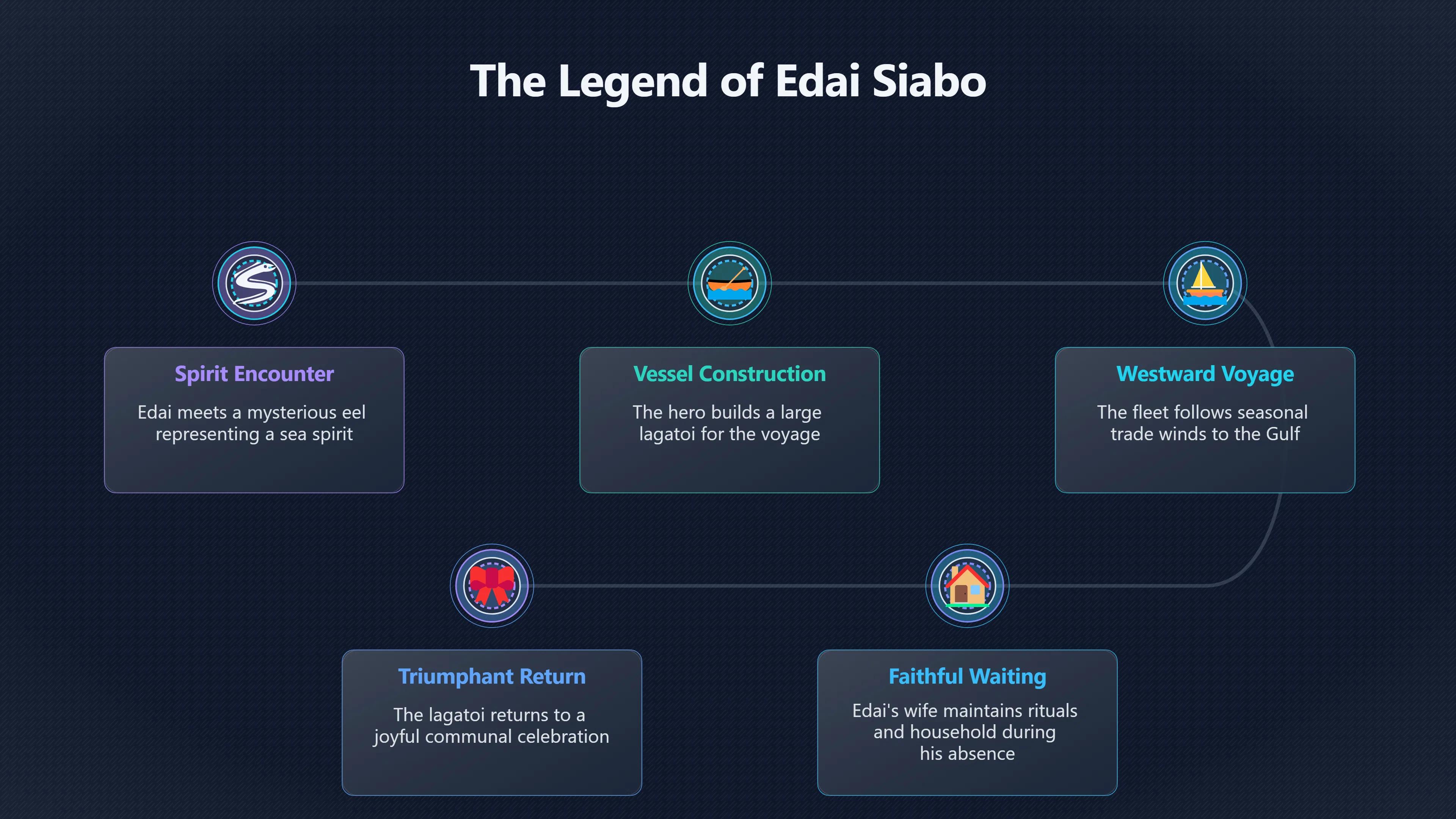
No Hiri legend is more famous than the story of Edai Siabo, often presented as the culture hero who established the first great trading voyage. According to traditional accounts, Edai encountered a mysterious eel that was actually a powerful sea spirit. The being instructed him to build a large lagatoi, load it with pottery and follow the seasonal trade winds westward. Obeying these instructions, Edai launched the first successful Hiri expedition.[Wikipedia]WikipediaHiri trade cycleHiri trade cycle
The story is notable because it combines practical seafaring knowledge with supernatural guidance. The sea spirit does not merely grant magical powers. Instead, it reveals the route, the timing and the method by which prosperity can be achieved. The lesson is that success comes through wisdom, discipline and respect for forces larger than oneself.[Wikipedia]WikipediaHiri trade cycleHiri trade cycle
Equally important is the role of Edai’s wife. While her husband is away, she follows strict instructions, keeps watch over the household and maintains ritual practices believed to protect the expedition. Villagers mock her and pressure her to abandon hope, but she remains loyal. When the lagatoi finally returns, her celebration becomes one of the most memorable moments in the story. This part of the legend highlights themes of patience, fidelity and communal responsibility rather than simple heroism.[Wikipedia]WikipediaHiri trade cycleHiri trade cycle
Oral Tradition and Coastal Exchange
The Hiri was not only an exchange of goods but also an exchange of stories, relationships and cultural knowledge. Trading partners along the Gulf coast developed long-term connections that extended beyond a single voyage. Oral traditions preserved memories of particular routes, destinations and alliances. These stories helped explain how distant communities became linked through generations of repeated contact.[Open Research Repository]openresearch-repository.anu.edu.auOpen Research RepositoryThe Hiri in history: further aspects of long distance Motu trade…These expeditions were called hiri, and were…
Modern archaeological research supports the idea that southern Papua New Guinea possessed extensive maritime networks long before European arrival. Pottery found in Gulf communities provides material evidence of long-distance exchange, reinforcing the broader picture preserved in oral memory. While archaeology cannot verify every legendary detail, it demonstrates that the seafaring world described in Hiri traditions was rooted in a real and sophisticated trading system.[Business Advantage PNG]businessadvantagepng.comBusiness Advantage PNGArchaeologists uncover new stories about IndigenousMay 13, 2019 — A team of researchers have discovered evidence of trade between Papua New Guinea and Australia over 2,500 years prior to c…
This relationship between evidence and legend is one reason the Hiri remains so compelling. The stories are not detached myths set in an unreachable past. They are narratives attached to identifiable places, known communities and historically documented voyages.
Winds, Rituals and the Sea
Many Hiri traditions focus on the relationship between people and the sea. Success depended on understanding seasonal winds, particularly the south-east trade winds that carried the vessels westward. In oral accounts these winds often appear almost as characters in their own right—forces to be respected rather than controlled.[Wikipedia]WikipediaHiri trade cycleHiri trade cycle
Traditional rituals surrounded departure and return. Families observed customs intended to ensure safe passage. Wives and relatives waiting at home followed prescribed behaviours that were believed to influence the wellbeing of the crew. These practices reveal a worldview in which distant events remained connected through social and spiritual obligations.[Wikipedia]WikipediaHiri trade cycleHiri trade cycle
Such traditions should not be understood simply as superstition. They provided a way to cope with uncertainty in a world where voyages could last for months and communication was impossible. Ritual transformed anxiety into action and gave communities a sense of participation in the fate of those at sea.
Hiri Memory in Modern Culture
The traditional voyages declined during the twentieth century and effectively ended after a fatal maritime disaster and subsequent colonial restrictions on the expeditions. Yet the Hiri did not disappear from cultural memory. Instead, it became a symbol of Indigenous achievement and regional identity.[Wikipedia]WikipediaHiri trade cycleHiri trade cycle
The most visible expression of this memory is the Hiri Moale Festival, held in and around Port Moresby. The festival commemorates the historic voyages through canoe re-enactments, dance performances, cultural displays and public celebrations. The arrival of the lagatoi remains one of the festival’s most dramatic moments because it recreates the emotional climax found in both history and legend: the safe return of the voyagers.[Papua New Guinea]papuanewguinea.travelPapua New GuineaHiri Moale Festival Guide - Papua New GuineaThe Hiri Moale Festival commemorates the historic Hiri trade voyages, where t…
Modern speakers and community leaders often describe the festival as a celebration of identity, continuity and resilience. In a rapidly changing urban environment, the Hiri serves as a reminder that the ancestors of the Motu and Koita peoples maintained one of the Pacific’s most impressive maritime traditions.[Business Advantage PNG]businessadvantagepng.comBusiness Advantage PNGHiri Moale Festival in Port Moresby: an inside lookSeptember 23, 2024 — 23 Sept 2024 — A: The festival is a celebra…
Why the Hiri Still Matters
Many folklore traditions explain how people relate to forests, mountains or spirits. The Hiri traditions explain how people relate to the sea. Their central figures are not dragon-slayers or supernatural kings but sailors, potters, traders and families whose survival depended on cooperation and courage.
What makes the Hiri distinctive within Papua New Guinea’s folklore landscape is that legend and history are unusually close together. The sea spirit of Edai Siabo, the faithful wife awaiting the return voyage, the great lagatoi on the horizon and the real archaeological evidence for centuries of coastal trade all exist within the same cultural memory.[wikipedia.org]WikipediaHiri trade cycleHiri trade cycle
For many Papua New Guineans, the Hiri remains a story about more than the past. It is a reminder that exchange, navigation, trust and endurance helped shape the southern coast long before modern roads, ports or national borders. The legends preserve that achievement in a form that can still be told, performed and celebrated today.[businessadvantagepng.com]businessadvantagepng.comBusiness Advantage PNGHiri Moale Festival in Port Moresby: an inside lookSeptember 23, 2024 — 23 Sept 2024 — A: The festival is a celebra…
eBay marketplace picks
Marketplace Samples
Live-tested eBay searches with available results related to this page.
Endnotes
1.
Source: png-data.sprep.org
Link:https://png-data.sprep.org/system/files/The_Hiri_in_History.pdf
Source snippet
ort Moresby region. Leaving their villages between...Read more...
2.
Source: researchgate.net
Title: 319127540 Historicizing Motu Ceramics and the Hiri Trade
Link:https://www.researchgate.net/publication/319127540_Historicizing_Motu_Ceramics_and_the_Hiri_Trade
Source snippet
ResearchGate(PDF) Historicizing Motu Ceramics and the Hiri TradeAug 15, 2017 — A long-distance maritime enterprise involving shell valuab...
3.
Source: Wikipedia
Title: Hiri trade cycle
Link:https://en.wikipedia.org/wiki/Hiri_trade_cycle
4.
Source: ict.gov.pg
Link:https://www.ict.gov.pg/wp-content/uploads/THE%20HIRI%20TRAIL%20-%20Culture%2C%20Trade%20and%20Identity%20of%20the%20Motu%20Koita%20Peoples.pdf
Source snippet
this annual collection of sago was.Read more...
5.
Source: Wikipedia
Title: Hiri Motu
Link:https://en.wikipedia.org/wiki/Hiri_Motu
6.
Source: Wikipedia
Link:https://en.wikipedia.org/wiki/Lakatoi
7.
Source: Wikipedia
Title: Motu people
Link:https://en.wikipedia.org/wiki/Motu_people
8.
Source: businessadvantagepng.com
Title: Business Advantage PNGArchaeologists uncover new stories about Indigenous
Link:https://www.businessadvantagepng.com/archaeologists-uncover-new-stories-about-indigenous-seagoing-between-papua-new-guinea-and-australia/
Source snippet
May 13, 2019 — A team of researchers have discovered evidence of trade between Papua New Guinea and Australia over 2,500 years prior to c...
Published: May 13, 2019
9.
Source: businessadvantagepng.com
Link:https://www.businessadvantagepng.com/hiri-moale-festival-in-port-moresby-an-inside-look/
Source snippet
Business Advantage PNGHiri Moale Festival in Port Moresby: an inside lookSeptember 23, 2024 — 23 Sept 2024 — A: The festival is a celebra...
Published: September 23, 2024
10.
Source: openresearch-repository.anu.edu.au
Link:https://openresearch-repository.anu.edu.au/items/675bbb26-d9a4-4d1b-a3e1-1c2301c84b0d
Source snippet
Open Research RepositoryThe Hiri in history: further aspects of long distance Motu trade...These expeditions were called hiri, and were...
11.
Source: geraldrknight.com
Title: the hiri
Link:https://geraldrknight.com/2021/04/08/the-hiri/
Source snippet
8 Apr 2021 — The Motu are people of Austronesian origin who, during the time of the Hiri expeditions, lived in stilt homes among seven vi...
12.
Source: papuanewguinea.travel
Link:https://papuanewguinea.travel/stories/hiri-moale-festival-guide/
Source snippet
Papua New GuineaHiri Moale Festival Guide - Papua New GuineaThe Hiri Moale Festival commemorates the historic Hiri trade voyages, where t...
13.
Source: papuanewguinea.travel
Title: Papua New Guinea Hiri Moale Festival | Stories
Link:https://papuanewguinea.travel/stories/hiri-moale-festival/
Source snippet
Papua New GuineaHiri Moale Festival | Stories - Papua New GuineaThis two-day festival provides an arena littered with cultural dances, st...
14.
Source: youtube.com
Link:https://www.youtube.com/watch?v=otkDZ1gmrVU
Source snippet
ural traditions, there was a man named Edai Siabo from the Motuan...
Additional References
15.
Source: facebook.com
Title: The Hiri Moale Festival celebrates a centuries
Link:https://www.facebook.com/ExxonMobilPNG1/posts/the-hiri-moale-festival-celebrates-a-centuries-old-traditional-trade-voyage-of-t/682842875512849/
Source snippet
The festival, commemorating 50 years of cultural heritage and traditional voyages, showcases the historic Hiri Expedition, unitin...
16.
Source: vocal.media
Title: The Hiri Trade in Papua New Guinea | History
Link:https://vocal.media/history/the-hiri-trade-in-papua-new-guinea
Source snippet
The hiri trade was a highly organized and ceremonial trading expedition carried out by the Motu people from the Port Moresby a...
17.
Source: facebook.com
Title: The Hiri voyages predated European influence
Link:https://www.facebook.com/groups/austronesian.languages/posts/1576240333298976/
Source snippet
Historical Hiri Trade and Lakatoi Sailing Canoes in Papua...Memorabilia from early times in Papua New Guinea 🇵🇬, of the Motu people in t...
18.
Source: thenational.com.pg
Title: motu koita group celebrates hiritrade
Link:https://www.thenational.com.pg/motu-koita-group-celebrates-hiritrade/
Source snippet
Motu-Koita Group celebrates Hiritrade5 Nov 2015 — The annual festival is hosted by the Motu-Koita Assembly and celebrates centuries-old t...
19.
Source: pagahill.com
Title: the ancient legend of edai boera
Link:https://www.pagahill.com/2020/09/25/the-ancient-legend-of-edai-boera/
Source snippet
Paga Hill EstateThe ancient legend of Edai Boera25 Sept 2020 —... Hiri Moale festival celebrates the seafaring tradition and culture of...
20.
Source: youtube.com
Link:https://www.youtube.com/watch?v=pYScZh_jlUc
Source snippet
Motu Gadodia Episode 6 Hiri Trade Definition and Experience Part1.mov...
21.
Source: thenational.com.pg
Title: symbol trade past present
Link:https://www.thenational.com.pg/symbol-trade-past-present/
Source snippet
The NationalA symbol of trade – past and presentMar 6, 2018 — Making a vicious voyage possible was the Lakatoi (Lagatoi), a doublehulled...
22.
Source: flickr.com
Link:https://www.flickr.com/photos/40295335%40N00/48378019906
Source snippet
Lakatoi Hiri Motu trading canoeJul 26, 2019 — Lakatoi Hiri Motu trading canoe from Papua New Guinea, Oceanic Culture Museum, Churaumi, Ok...
23.
Source: youtube.com
Title: Motu Gadodia Episode 6 Hiri Trade Definition and Experience Part1.mov
Link:https://www.youtube.com/watch?v=ncyv-wliodc
Source snippet
2023 Hiri Moale Festival...
24.
Source: youtube.com
Link:https://www.youtube.com/watch?v=VUQH5YKwhf8
Source snippet
HIRI MOALE 50TH ANNIVERSARY - FINAL DAY...
Topic Tree