Where Serbian Legend Meets Living Tradition
Serbian folklore is not a single story-world but a layered culture of oral epic, family ritual, saints’ days, vampires, fairies, dragons, sacred landscapes and village customs.
Page outline Jump by section
Introduction
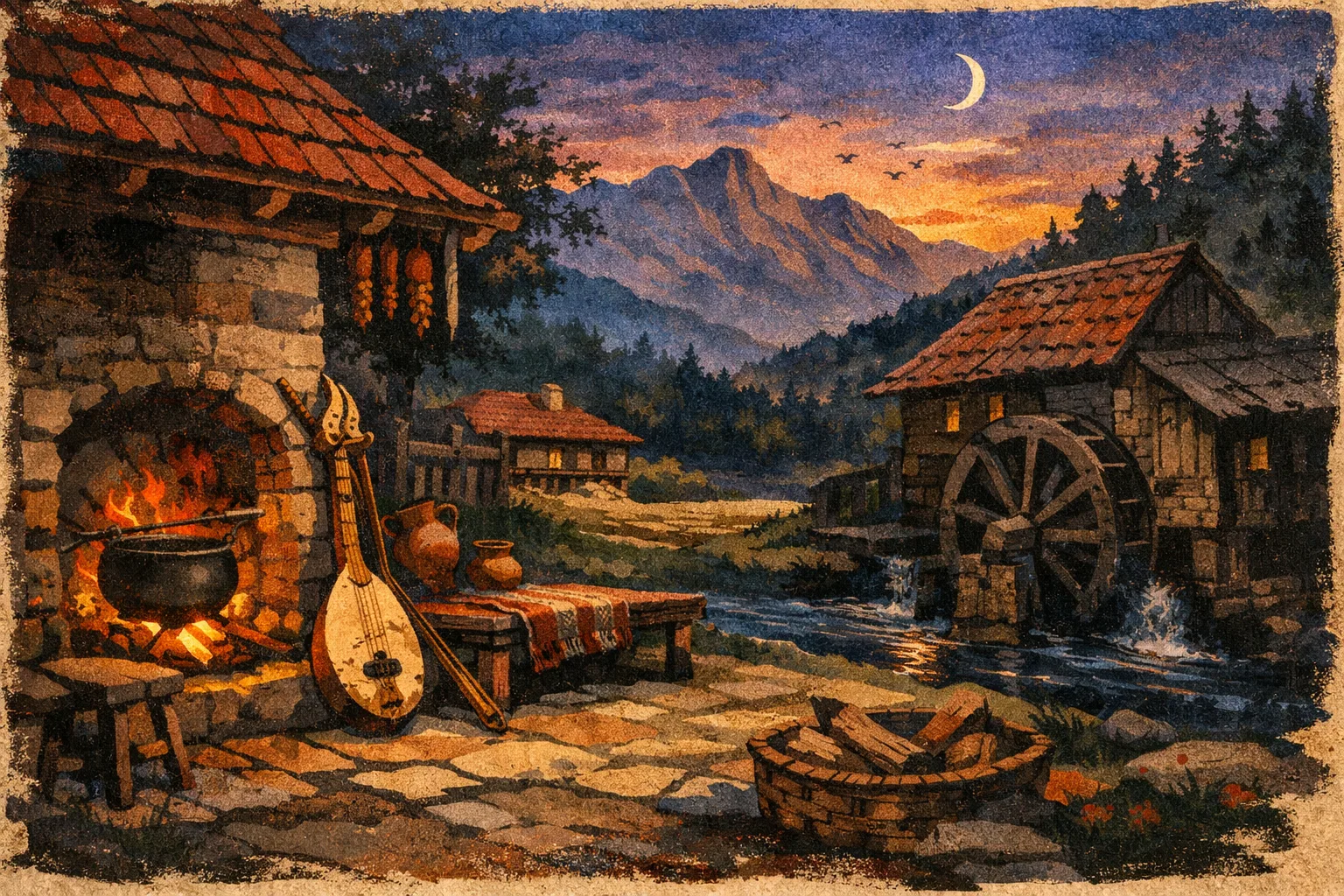
Serbian folklore is not a single story-world but a layered culture of oral epic, family ritual, saints’ days, vampires, fairies, dragons, sacred landscapes and village customs. Its best-known international contribution is the vampire panic of the eighteenth century, when cases from Serbian villages entered Austrian reports and helped shape the European idea of the vampire. Within Serbia itself, however, folklore is just as strongly rooted in household ritual, songs performed with the one-stringed gusle, the memory of medieval heroes, seasonal customs, and local places where geology, religion and legend meet. UNESCO’s listings for Serbia — including the family saint’s day celebration, circle dance, gusle singing, pottery-making and plum-spirit customs — show that many traditions are treated today not as museum curiosities but as living heritage.[unesco.org]ich.unesco.orgICH UNESCOSerbiaICH UNESCOSerbia
For a first-time reader, the key is to separate three things that often get blurred together: old oral belief, nineteenth-century collection and patriotic retelling, and modern tourism or pop-culture reinvention. Serbian folklore has been recorded in books, songs, museum collections and official heritage registers, but many of its most memorable beings — the vampire at the mill, the fairy in the mountains, the dragon lover, the ancestral presence at the hearth — come from a much older habit of explaining danger, luck, kinship and landscape through story.
Why Serbian folklore feels so distinctive
Serbia sits at a cultural crossroads: South Slavic, Balkan, Orthodox Christian, Ottoman-frontier, Habsburg-borderland and modern European influences all leave traces. That is why its folklore can move, sometimes within the same tradition, from heroic epic to household taboo, from saintly ritual to pre-Christian-looking seasonal symbolism, and from village fear of the restless dead to a modern tourist signpost for “vampire” country. The Ethnographic Museum in Belgrade describes its own field of work as traditional material culture, family life, customs, beliefs and folklore, which is a useful reminder that folklore here is not only “mythology” but everyday practice: dress, tools, rite objects, music, foodways and domestic ceremonies.[Google Arts & Culture]artsandculture.google.comOpen source on google.com.
The strongest traditions are often attached to repetition. A family marks the same saint’s day each year. A dance is learned by joining the chain. A singer remembers a heroic story through a recognisable metre and instrument. A Christmas log is cut, greeted and burned in a way that makes the household feel joined to ancestors, fields and faith. These forms survive because they are social: they gather people, teach belonging, and make the past visible in the present. UNESCO’s Serbian entries are especially helpful here because they focus on living practices rather than only old stories printed in books.[ICH UNESCO]ich.unesco.orgICH UNESCOSerbiaICH UNESCOSerbia
The vampire: Serbia’s most famous supernatural export
The vampire is the Serbian folklore figure most likely to surprise international readers, because the best-documented early European cases are not Transylvanian castles but Serbian village reports under Habsburg administration. The cases of Petar Blagojević in 1725 and Arnold Paole in the early 1730s were written up by Austrian officials and doctors, then circulated through European debate about whether the dead could return. Modern readers should treat these as reports of belief, fear, disease, corpse interpretation and official investigation, not as evidence for the supernatural.[Wikipedia]WikipediaArnold PaoleArnold Paole
Petar Blagojević, from Kisiljevo, is often cited as one of the earliest widely documented vampire cases. Reports claimed that villagers died after his death and that he appeared to them; the body was exhumed and interpreted through local signs of vampirism. What matters historically is not that the claims were “true”, but that village belief, imperial bureaucracy and early modern print culture met in one case. The vampire became legible to Europe because officials documented what villagers already feared.[Wikipedia]WikipediaPetar BlagojevićPetar Blagojević
Arnold Paole’s case, linked to a village rendered in German reports as Medveđa or a similar form, spread even further. The account involved alleged attacks, exhumations and medical-military signatures, giving the story a bureaucratic weight that later readers mistook for certainty. Today, the most cautious reading is that these reports show how communities made sense of sudden death, decomposition and contagion before modern medical explanation, while also showing how Balkan local belief entered European literary imagination.[Wikipedia]WikipediaArnold PaoleArnold Paole
Serbia also has a more folkloric vampire celebrity: Sava Savanović, associated with a watermill near the village of Zarožje. Unlike the eighteenth-century administrative cases, Sava belongs more clearly to legend and literary retelling, especially the image of a vampire haunting a mill and attacking millers. This figure has been repeatedly revived in tourism, journalism and film culture, which makes him a good example of how a local supernatural being can shift from oral fear to national curiosity and marketable dark heritage.[Wikipedia]WikipediaSava SavanovićSava Savanović
Fairies, dragons and the dangerous beauty of wild places
Serbian fairy tradition is centred less on tiny winged sprites and more on powerful female beings associated with mountains, forests, waters, clouds and song. In South Slavic folklore, the vila is beautiful, dangerous, helpful to favoured heroes, and easily angered when humans trespass on her space or break her rules. Academic work on the South Slavic vila stresses that she is not one simple creature type: her role changes between epic poetry, belief legend and later literary use.[researchgate.net]researchgate.netResearch Gate(PDF) A Treatise on the South Slavic VilaResearch Gate(PDF) A Treatise on the South Slavic Vila
In epic contexts, the vila may act as a supernatural ally, healer, sister-in-arms or punisher. This matters because it shows a different moral logic from many modern fantasy creatures. The vila is not simply “good” or “evil”; she is a being with status, territory and power. A hero who respects her may gain help. A person who disturbs her dancing place, water source or mountain realm may suffer. That pattern makes sense in a rural world where wild places were useful, beautiful and dangerous at the same time.[JSTOR]jstor.orgOpen source on jstor.org.
The Serbian dragon is just as complicated. In many Western fairytale habits, a dragon is a monster to be killed; in Serbian and wider Balkan traditions, the dragon can be a threat, lover, guardian or heroic ancestor. Some tales still place dragons in the role of captors or enemies, but other traditions imagine a dragon as a powerful male being connected with storms, fertility or heroic bloodlines. This ambiguity helps explain why dragon imagery appears in heroic and romantic contexts as well as in monster-slaying stories.[ZRC SAZU]sms.zrc-sazu.siOpen source on zrc-sazu.si.
These beings also show why “Serbian mythology” should not be flattened into a neat pantheon. Much of what survives is not a tidy list of gods, but story-patterns: fairies who demand respect, dragons who cross between sky and household, water and forest spirits that mark dangerous places, and domestic powers linked to ancestors. Folklore here often works as a map of relationships — between people and place, living and dead, household and wilderness.
Epic song and the making of national memory
Serbia’s heroic folklore is inseparable from oral epic poetry. The best-known cycles concern medieval rulers, the Battle of Kosovo, Prince Marko, outlaws and liberation struggles. These songs were not simply entertainment. They preserved moral examples, family loyalties, grief, courage, betrayal and sacrifice in a form that could be performed before audiences. The gusle, a one-stringed bowed instrument, became the emblematic accompaniment to this epic tradition and is now recognised by UNESCO as part of Serbia’s intangible cultural heritage.[Serbia Travel]serbia.travelTravel Intangible Cultural HeritageTravel Intangible Cultural Heritage
The nineteenth-century collector Vuk Karadžić is central to how modern readers know Serbian oral tradition. He gathered songs, tales and proverbs at a time when European Romanticism was eager to find national character in peasant speech and oral poetry. Scholars still debate how collection, editing and nationalism shaped the published corpus, but Karadžić’s role is undeniable: he helped turn living performance into a written archive that could circulate across Europe.[Oral Tradition]oraltradition.orgOral Tradition Back in the FoundationOral Tradition Back in the Foundation
The Kosovo cycle is the clearest example of folklore becoming national memory. The poems do not function like a neutral chronicle of the 1389 battle; rather, they turn defeat, loyalty and sacrifice into a moral universe. Figures such as Prince Lazar and the Kosovo Maiden carry meanings that later religious, literary and political traditions developed further. For a folklore page, the important point is not to treat the epics as straightforward history, but to understand how oral poetry made history emotionally memorable.[rastko.rs]rastko.rsOpen source on rastko.rs.
Prince Marko is another essential figure because he shows how folklore can transform a historical person into a larger-than-life character. In epic tradition he can be comic, violent, just, excessive, loyal, disobedient and superhuman. His horse, feats of strength and encounters with supernatural beings place him halfway between historical memory and mythic hero. That flexibility is one reason he travelled so widely through South Slavic oral tradition, crossing borders more easily than modern national categories.[Wikipedia]WikipediaSerbian epic poetrySerbian epic poetry
Household ritual: where folklore still lives
One of Serbia’s most important living traditions is the family saint’s day celebration, recognised by UNESCO in 2014. It is a household-centred annual ritual honouring a family patron saint, involving prayer, food, guests and continuity across generations. For outsiders, it can look like a purely church custom; for folklore readers, it is also a remarkable example of how kinship, memory, hospitality and sacred time are woven together inside the home.[ICH UNESCO]ich.unesco.orgICH UNESCOSerbiaICH UNESCOSerbia
The Christmas Eve oak log is another powerful example of layered tradition. Today it belongs to Orthodox Christmas practice, but scholars have long linked parts of the custom to older Slavic ideas about sacred trees, household fire, fertility and ancestors. The log is treated almost like a person: it is cut, greeted, brought into the household and burned. The point is not to strip the Christian meaning away, but to notice how Christian celebration and older domestic symbolism have become fused in practice.[Wikipedia]WikipediaBadnjak (SerbianBadnjak (Serbian
Domestic folklore in Serbia and the wider South Slavic region often centres on the threshold, hearth and ancestors. Comparative work on South Slavic mythological beings notes beliefs that a family ancestor’s spirit could be associated with the threshold or open hearth and, if properly treated, could protect the household’s good fortune. This helps explain why so many customs are not about spectacular monsters but about careful behaviour at home: when to give fire, how to honour guests, what to do at seasonal turning-points, and how to keep luck from leaving the house.[Journals at KU]journals.ku.eduJournals at KUMale Mythological Beings Among the South SlavsJournals at KUMale Mythological Beings Among the South Slavs
Seasonal rites broaden the same logic into the fields and village. Rain-making, spring, harvest and winter customs often join song, movement, greenery, water, fire or food. Some are now mostly performed as heritage, school, festival or staged tradition; others remain part of family and church calendars. The change does not make them fake. It means their function has shifted: from managing luck and fertility in a rural economy to expressing identity, memory and continuity in modern Serbia.
Dance, music and craft as folklore in motion
Folklore is often imagined as old stories, but Serbia’s recognised living heritage shows that movement, sound and making are just as important. The circle dance known as kolo was inscribed by UNESCO in 2017. It is performed by linked dancers, usually in a chain or circle, and its social meaning lies in participation: people learn by joining, not by reading a manual. At weddings, festivals and public events, kolo turns heritage into a shared bodily experience.[ICH UNESCO]ich.unesco.orgICH UNESCOSerbiaICH UNESCOSerbia
Singing to the gusle, inscribed in 2018, carries a different kind of memory. Its epic songs often use heroic themes, moral conflict and collective remembrance. Because the performance is solo but socially addressed, it creates a bridge between individual singer and listening community. It also helps explain why Serbian epic tradition remained so influential: the story was not only a text but a voice, instrument and occasion.[Serbia Travel]serbia.travelTravel Intangible Cultural HeritageTravel Intangible Cultural Heritage
Craft traditions also belong in a folklore page because they preserve knowledge through hands, materials and local practice. Zlakusa pottery, inscribed by UNESCO in 2020, is made with clay and calcite on a hand-run wheel, producing unglazed vessels used in households and restaurants. Its value is not only aesthetic; it carries local skill, food culture and village identity.[ICH UNESCO]ich.unesco.orgOpen source on unesco.org.
Even plum-spirit preparation, listed by Serbia’s intangible heritage authorities and UNESCO country pages, belongs to this broader field of traditional culture. It sits at the meeting point of orchard, household, hospitality and celebration. For readers interested in folklore, such practices matter because they show how belief culture is often embedded in ordinary acts: offering, toasting, hosting, cooking, dancing, singing and making.[nkns.rs]nkns.rsOpen source on nkns.rs.
Haunted and sacred landscapes
Serbian folklore is strongly attached to place. Some places are sacred because of monasteries, saints and pilgrimage; others are uncanny because their natural forms invite legend. Studenica Monastery, founded in the late twelfth century by Stefan Nemanja, is one of the great Serbian Orthodox monastic sites and a UNESCO World Heritage Site. Its importance is historical and artistic, but in cultural memory it also belongs to a sacred landscape where dynastic history, relics, frescoes and pilgrimage reinforce one another.[UNESCO World Heritage Centre]whc.unesco.orgOpen source on unesco.org.
Natural formations can become legendary through their shapes. Devil’s Town in southern Serbia is a striking landscape of earth pyramids and mineral springs, officially presented as a rare natural monument shaped by erosion. Yet its name and popular appeal come from legend as much as geology: a common retelling says the stone figures were a wedding party petrified through diabolical interference or divine punishment. The geological explanation and the legend do different jobs. One explains how the forms arose; the other explains why they feel morally and emotionally charged.[djavoljavaros.com]djavoljavaros.comOpen source on djavoljavaros.com.
Roman and medieval sites also collect story around them. Gamzigrad-Romuliana, the late Roman palace and memorial complex of Emperor Galerius, is not a folk site in the same sense as a vampire mill or village spring, but it shows how Serbian landscape contains older sacred and imperial layers that later visitors reinterpret. UNESCO describes the palace and memorial complex, including mausoleums of Galerius and his mother Romula, as a unique late Roman ensemble. Such places often become part of the broader imaginative geography through guidebooks, local storytelling and national heritage.[UNESCO World Heritage Centre]whc.unesco.orgOpen source on unesco.org.
Collectors, museums and the problem of “authentic” folklore
A major challenge in Serbian folklore is that many traditions reach modern readers through collectors, translators and national institutions. Elodie Lawton Mijatović’s nineteenth-century English-language collections helped introduce Serbian tales to foreign readers, while Project Gutenberg now makes some of these works easily accessible. They are valuable, but they are also products of their time: translated, selected and framed for particular audiences.[Project Gutenberg]gutenberg.orgOpen source on gutenberg.org.
Museums create another kind of preservation. The Ethnographic Museum in Belgrade, founded in the early twentieth century, collects and presents objects linked to traditional culture, costume, crafts, family life, rites and belief. This is crucial because folklore is not only verbal. A ritual loaf, wedding garment, musical instrument or household object can preserve evidence of practice that a written tale cannot.[google.com]artsandculture.google.comOpen source on google.com.
“Authentic” folklore is therefore not always the oldest version. A village belief recorded in the nineteenth century may preserve older elements, but it may also reflect the collector’s choices. A staged dance may be modernised, but still rooted in community practice. A vampire site may be promoted for tourism, yet based on genuine local legend or early modern documentation. The more useful question is: what kind of evidence are we looking at — oral tradition, archival report, church custom, museum object, literary retelling, tourist branding or internet folklore?
Modern Serbia: heritage, tourism and popular culture
Today, Serbian folklore lives in several registers at once. It appears in family celebrations and church calendars; in folk ensembles and cultural festivals; in museum displays; in schoolbooks and national symbolism; in horror films, travel writing and internet lists of “real vampires”. This mixture can be confusing, but it is also what keeps folklore alive. Traditions survive by being reused, argued over and reinterpreted.[nkns.rs]nkns.rsOpen source on nkns.rs.
The vampire is the clearest case of modern reinvention. Petar Blagojević and Arnold Paole belong to documented eighteenth-century panic; Sava Savanović belongs more to legend and literary-horror afterlife; newer articles, tours and films repackage all of them for audiences who already know Dracula. Serbia’s claim to vampire heritage is therefore partly historical and partly promotional. The responsible way to present it is to say that Serbia has some of Europe’s most important early documented vampire cases, not that it has proved the existence of vampires.[uea.ac.uk]ueaeprints.uea.ac.ukOpen source on uea.ac.uk.
Epic tradition has also changed. The gusle and heroic songs can be cherished as art, family memory and national heritage, but they can also become politically loaded when medieval themes are used to support modern claims. A careful folklore approach does not ignore that risk. It reads epic song as powerful cultural memory: meaningful, beautiful, sometimes contested, and shaped by the needs of later generations as much as by medieval events themselves.[JSTOR]jstor.orgOpen source on jstor.org.
What to remember about Serbian folklore
Serbian folklore is most rewarding when read as a culture of thresholds. The vampire stands at the threshold between living and dead. The household ritual stands between family and ancestor. The fairy stands between human settlement and wild nature. The dragon stands between monster and protector. Epic song stands between history and moral memory. Sacred landscapes stand between geology, architecture, pilgrimage and legend.
Its best-known stories are dramatic, but its deepest pattern is social continuity. People gather, sing, dance, host, remember, warn, bless, fear and retell. That is why Serbian folklore should not be reduced to vampires, even though Serbia’s vampire cases are internationally important. The fuller picture includes the family saint’s day, the Christmas log, mountain fairies, ambiguous dragons, heroic singers, monastery landscapes, village crafts and modern retellings that continue to reshape the old material for new audiences.

Amazon book picks
Further Reading
Books and field guides related to Where Serbian Legend Meets Living Tradition. Use these as the next step if you want deeper reading beyond the article.
The Vampire
Explains the Balkan roots of vampire traditions central to Serbian folklore.
Balkan Ghosts
Helps readers understand the wider cultural landscape behind Serbian traditions.

The Penguin Book of Dragons
Provides context for dragon traditions including Eastern European material.
eBay marketplace picks
Marketplace Samples
Live-tested eBay searches with available results related to this page.
Endnotes
1.
Source: ich.unesco.org
Title: ICH UNESCOSerbia
Link:https://ich.unesco.org/en/state/serbia-RS
2.
Source: nkns.rs
Link:https://nkns.rs/en
3.
Source: serbia.travel
Title: Travel Intangible Cultural Heritage
Link:https://www.serbia.travel/en/%D1%80%D0%B5%D0%BF%D1%80%D0%B5%D0%B7%D0%B5%D0%BD%D1%82%D0%B0%D1%82%D0%B8%D0%B2%D0%BD%D0%B0-%D0%BB%D0%B8%D1%81%D1%82%D0%B0-%D0%BD%D0%B5%D0%BC%D0%B0%D1%82%D0%B5%D1%80%D0%B8%D1%98%D0%B0%D0%BB%D0%BD%D0%BE/
4.
Source: artsandculture.google.com
Link:https://artsandculture.google.com/partner/ethnographic-museum
5.
Source: Wikipedia
Title: Arnold Paole
Link:https://en.wikipedia.org/wiki/Arnold_Paole
6.
Source: Wikipedia
Title: Petar Blagojević
Link:https://en.wikipedia.org/wiki/Petar_Blagojevi%C4%87
7.
Source: Wikipedia
Title: Sava Savanović
Link:https://en.wikipedia.org/wiki/Sava_Savanovi%C4%87
8.
Source: researchgate.net
Link:https://www.researchgate.net/publication/358767746_Balkan_Vampire_Myth_Urban_Legends_or_a_Publicity_tool
9.
Source: researchgate.net
Title: Research Gate(PDF) A Treatise on the South Slavic Vila
Link:https://www.researchgate.net/publication/241814095_A_Treatise_on_the_South_Slavic_Vila
10.
Source: jstor.org
Link:https://www.jstor.org/stable/3813822
11.
Source: sms.zrc-sazu.si
Link:https://sms.zrc-sazu.si/pdf/13/SMS_13_09_Marjanic.pdf
12.
Source: Wikipedia
Title: Slavic dragon
Link:https://en.wikipedia.org/wiki/Slavic_dragon
13.
Source: Wikipedia
Title: Serbian epic poetry
Link:https://en.wikipedia.org/wiki/Serbian_epic_poetry
14.
Source: jstor.org
Link:https://www.jstor.org/stable/44390761
15.
Source: rastko.rs
Link:https://www.rastko.rs/knjizevnost/usmena/battle_of_kosovo.html
16.
Source: books.google.com
Link:https://books.google.com/books/about/Songs_of_the_Serbian_People.html?id=1MRiAAAAMAAJ
17.
Source: Wikipedia
Title: Badnjak (Serbian)
Link:https://en.wikipedia.org/wiki/Badnjak_%28Serbian%29
18.
Source: journals.ku.edu
Title: Journals at KUMale Mythological Beings Among the South Slavs
Link:https://journals.ku.edu/folklorica/article/download/3699/3542
19.
Source: ich.unesco.org
Link:https://ich.unesco.org/en/RL/zlakusa-pottery-making-hand-wheel-pottery-making-in-the-village-of-zlakusa-01466
20.
Source: unesco.org
Title: document 5353
Link:https://www.unesco.org/archives/multimedia/document-5353
21.
Source: unesco.org
Link:https://www.unesco.org/en/countries/rs/lists-and-nominations
22.
Source: whc.unesco.org
Link:https://whc.unesco.org/en/list/389/
23.
Source: whc.unesco.org
Title: World Heritage Centre Studenica Monastery
Link:https://whc.unesco.org/en/list/389/video
24.
Source: djavoljavaros.com
Link:https://www.djavoljavaros.com/?cmbJezik=2
25.
Source: whc.unesco.org
Link:https://whc.unesco.org/en/tentativelists/1700/
26.
Source: whc.unesco.org
Link:https://whc.unesco.org/en/list/1253/
27.
Source: gutenberg.org
Link:https://www.gutenberg.org/ebooks/45321
28.
Source: gutenberg.org
Link:https://www.gutenberg.org/cache/epub/45321/pg45321-images.html
29.
Source: gutenberg.org
Link:https://www.gutenberg.org/ebooks/67191
30.
Source: museu.ms
Link:https://museu.ms/museum/details/218
31.
Source: researchgate.net
Link:https://www.researchgate.net/publication/397502924_Revenants_reimagined_The_persistence_of_Balkan_vampire_lore_in_contemporary_digital_contexts
32.
Source: researchgate.net
Link:https://www.researchgate.net/publication/333723617Dragon_and_Hero_or_How_to_Kill_a_Dragon-_on_the_Example_of_the_Legends_of_Medimurje_about_the_Grabancijas_and_the_Dragon_Zmaj_i_junak_ili_kako_ubiti_zmaja_na_primjeru_medimurskih_predaja_o_grabancija
33.
Source: researchgate.net
Title: 285898807 Elements of Ethnic Identification of the Serbs
Link:https://www.researchgate.net/publication/285898807_Elements_of_Ethnic_Identification_of_the_Serbs
34.
Source: researchgate.net
Link:https://www.researchgate.net/publication/358323464_The_Home_is_Where_The_Chronotopes_of_the_Origin_Myth_in_Pseudohistorical_Narratives_of_the_Serbian_Far-Right
35.
Source: researchgate.net
Title: 328342872 THE STONES OF FELIX ROMULIANA GAMZIGRAD SERBIA
Link:https://www.researchgate.net/publication/328342872_THE_STONES_OF_FELIX_ROMULIANA_GAMZIGRAD_SERBIA
36.
Source: Wikipedia
Title: Vila (fairy)
Link:https://en.wikipedia.org/wiki/Vila_%28fairy%29
37.
Source: Wikipedia
Title: Vampire folklore by region
Link:https://en.wikipedia.org/wiki/Vampire_folklore_by_region
38.
Source: Wikipedia
Link:https://en.wikipedia.org/wiki/Vampire
39.
Source: Wikipedia
Title: Slava (tradition)
Link:https://en.wikipedia.org/wiki/Slava_%28tradition%29
40.
Source: Wikipedia
Title: Slavic Native Faith
Link:https://en.wikipedia.org/wiki/Slavic_Native_Faith
41.
Source: Wikipedia
Link:https://en.wikipedia.org/wiki/Djavolja_varos
42.
Source: Wikipedia
Link:https://en.wikipedia.org/wiki/Gamzigrad
43.
Source: ich.unesco.org
Title: 43192 EN.doc
Link:https://ich.unesco.org/doc/src/43192-EN.doc
44.
Source: gutenberg.org
Link:https://www.gutenberg.org/ebooks/author/43218
45.
Source: kosovo.net
Link:https://www.kosovo.net/history/battle_of_kosovo.html
46.
Source: serbia.com
Title: the serbian dragon fact or fable
Link:https://serbia.com/the-serbian-dragon-fact-or-fable/
47.
Source: serbia.com
Title: is devils town worth visiting
Link:https://serbia.com/is-devils-town-worth-visiting/
48.
Source: serbia.com
Title: exploring the unesco heritage sites of serbia a cultural odyssey
Link:https://serbia.com/exploring-the-unesco-heritage-sites-of-serbia-a-cultural-odyssey/
49.
Source: serbia.travel
Title: World Cultural Heritage
Link:https://www.serbia.travel/en/world-cultural-heritage/
50.
Source: archive.org
Link:https://archive.org/download/serbianfolksongs00mguoft/serbianfolksongs00mguoft.pdf
51.
Source: ueaeprints.uea.ac.uk
Link:https://ueaeprints.uea.ac.uk/id/eprint/83493/
52.
Source: macsphere.mcmaster.ca
Title: Mac Sphere Treatise on the South Slavic Vila
Link:https://macsphere.mcmaster.ca/items/492d0d11-6a19-4e34-8b8e-73ac1f1d92bc
53.
Source: oraltradition.org
Title: Oral Tradition Back in the Foundation
Link:https://oraltradition.org/back-in-the-foundation/
54.
Source: sf7b18433def9bbe4.jimcontent.com
Title: SERIA IV 2021 SPECIAL corr4 c2
Link:https://sf7b18433def9bbe4.jimcontent.com/download/version/1659957542/module/17967973196/name/SERIA-IV_2021_SPECIAL_corr4_c2.pdf
55.
Source: vampire-encyclopedia.fandom.com
Title: Arnold Paole
Link:https://vampire-encyclopedia.fandom.com/wiki/Arnold_Paole
56.
Source: vampire-encyclopedia.fandom.com
Link:https://vampire-encyclopedia.fandom.com/wiki/Vampire
57.
Source: vampire-encyclopedia.fandom.com
Title: Sava Savanović
Link:https://vampire-encyclopedia.fandom.com/wiki/Sava_Savanovi%C4%87
58.
Source: facebook.com
Link:https://www.facebook.com/story.php/?id=100064622296812&story_fbid=964734209023980
59.
Source: booksfromfaeries.wordpress.com
Link:https://booksfromfaeries.wordpress.com/2025/03/07/vila/
60.
Source: galerijeimuzeji.rs
Title: Ethnographic Museum in Belgrade
Link:https://galerijeimuzeji.rs/en/ethnographic-museum-in-belgrade/
61.
Source: x.com
Link:https://x.com/archeohistories/status/2024747247532113976?lang=en
62.
Source: journal.oraltradition.org
Title: 5 bynum
Link:https://journal.oraltradition.org/wp-content/uploads/files/articles/1ii/5_bynum.pdf
63.
Source: storiespreschool.com
Title: Vampire | Historic Legends
Link:https://www.storiespreschool.com/vampire.html
64.
Source: exterminate.wiki.edu.rs
Link:https://exterminate.wiki.edu.rs/
Additional References
65.
Source: youtube.com
Title: Serbia Has a Government-Documented Vampire. I Slept in His Death Mill
Link:https://www.youtube.com/watch?v=IWjQt56EZVk
Source snippet
The Eastern European Mythology Iceberg Gets Dark...
66.
Source: academia.edu
Link:https://www.academia.edu/76776401/Dragons_in_Slavic_and_Romanian_Cultures
67.
Source: academia.edu
Link:https://www.academia.edu/9847188/Heroism_and_Patriotism_in_Serbian_Epic_Folk_Poetry_from_the_cycle_of_Kosovo
68.
Source: academia.edu
Link:https://www.academia.edu/145686159/A_Historical_Critical_Reading_of_the_1725_Frombald_Letter_on_Vampirism_in_Kisiljevo_In_Journal_of_Vampire_Studies
69.
Source: instagram.com
Link:https://www.instagram.com/reel/DRialiCkUEN/
70.
Source: wildwitchherbs.com
Link:https://wildwitchherbs.com/balkan-house-spirits-folklore/
71.
Source: academia.edu
Link:https://www.academia.edu/106648955/Balkan_Vampire_Myth_Urban_Legends_or_a_Publicity_tool
72.
Source: brill.com
Link:https://brill.com/display/book/9789004516311/BP000008.xml?language=en&srsltid=AfmBOooxegLwHifMGcaNFFItAe1r_7MZ9DySh4nl196YhmL4VRTxTxQt
73.
Source: naturetraveloffice.com
Link:https://naturetraveloffice.com/en/avanture/cultural-tours/prirodna-i-kulturna-dobra-kursumlije/
74.
Source: facebook.com
Link:https://www.facebook.com/serbiatourism/videos/devils-town-a-place-where-more-than-200-earth-pyramids-rise-shaped-over-centurie/840065838876899/
Topic Tree
Follow this branch
Related pages 192
- Afghan Folklore
- Albanian Folklore
- Algerian Folklore
- Australian Folklore
- Azerbaijan Folklore
- +187 more in sidebar