Within Namibia Folklore
Why Travellers Added Stones for Heitsi Eibeb
The Heitsi-Eibeb cairns reveal a tradition where travel, memory and sacred gesture meet in small heaps of stones and branches.
On this page
- Who Heitsi Eibeb is in Nama tradition
- Why the cairns are not ordinary graves
- Travel, ritual habit and colonial misreadings
Page outline Jump by section
Introduction
Across Namibia’s deserts, passes and old travel routes, visitors sometimes notice small heaps of stones beside the road. At first glance they resemble simple cairns or neglected graves. In Nama and related Khoekhoe traditions, however, many of these stone piles were associated with Heitsi-Eibeb (also rendered Haitsi Aibeb, Haiseb or Heitsi-Eibib), a legendary culture hero whose presence linked travel, luck, memory and sacred obligation. For generations, travellers added a stone, twig or other small offering when passing these sites, turning an ordinary journey into a ritual act. The tradition is one of Namibia’s most distinctive examples of folklore embedded in the landscape itself. Rather than being grand temples or shrines, the cairns demonstrate how belief could be expressed through repeated gestures carried out by countless travellers over long periods of time.[Namibia Digital Repository]namibiadigitalrepository.comThey seemed to offer the clue for learning about Heitsi-eibeb and the old Khoe…Read more…
Who Heitsi-Eibeb Is in Nama Tradition
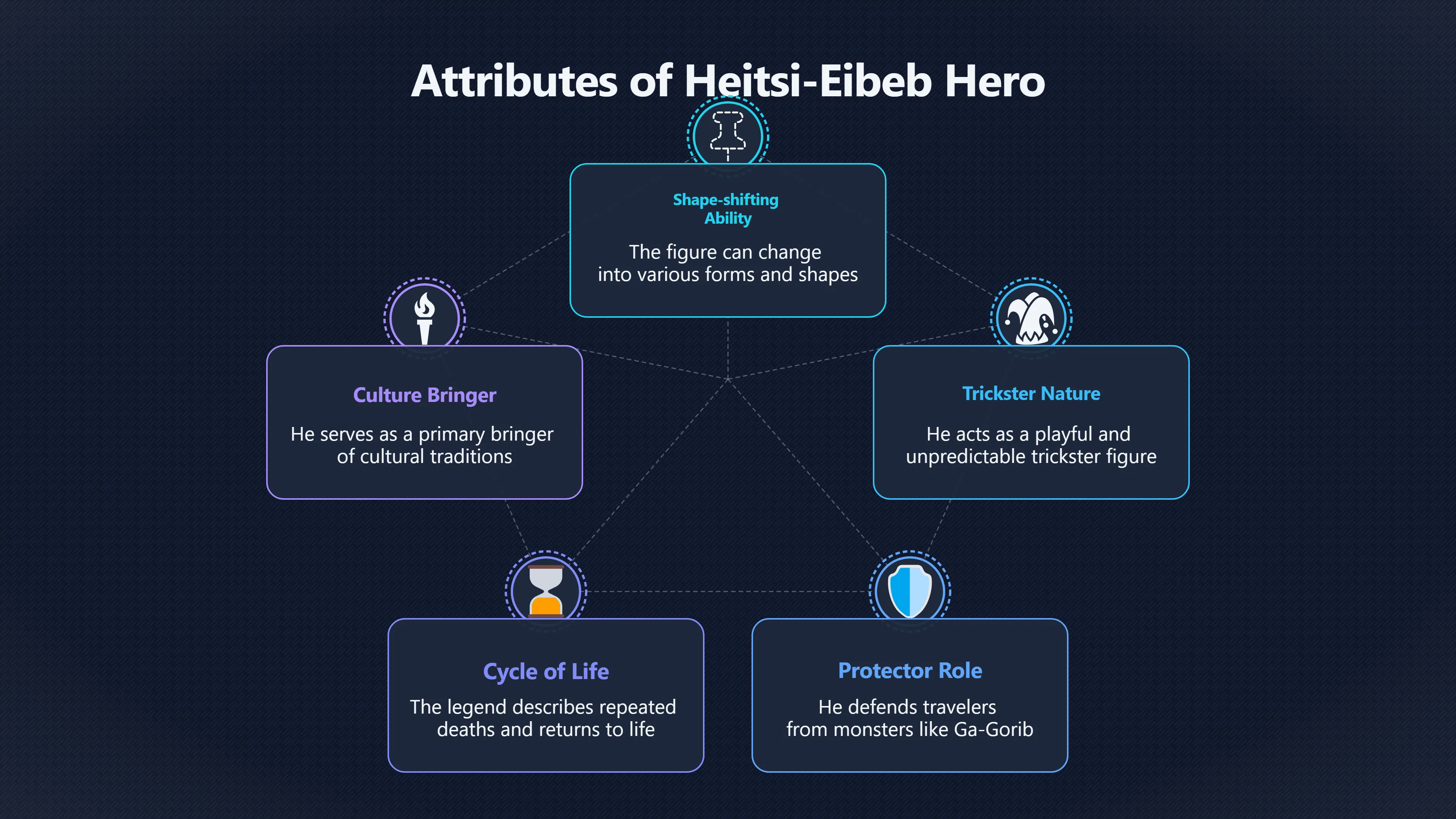
Heitsi-Eibeb occupies a central place in Khoekhoe folklore across parts of Namibia and southern Africa. Stories describe him as a powerful and unpredictable figure: hero, trickster, hunter, culture-bringer and shape-shifter. Different traditions tell of his miraculous birth, his ability to change form, and his repeated deaths and returns to life. One of the best-known tales recounts how he defeated the monster Ga-Gorib, who lured travellers to their deaths beside a pit. By outwitting the monster, Heitsi-Eibeb became a protector figure associated with survival and safe passage.[Wikipedia]WikipediaOpen source on wikipedia.org.
The importance of Heitsi-Eibeb helps explain why travellers treated certain roadside cairns with reverence. These places were not simply markers of a legendary hero. They were points where people could acknowledge powers believed to exist beyond everyday life and seek protection before continuing a difficult journey through arid country. In a landscape where travel could be dangerous and water scarce, such acts carried practical as well as spiritual meaning.[Gondwana Collection Namibia]gondwana-collection.comGondwana Collection NamibiaNamibia - The legend of Haitsi AibebOctober 23, 2015 — 23 Oct 2015 — Travellers who came across a Haitsi Aibeb…
Why the Cairns Are Not Ordinary Graves
One of the most persistent misunderstandings is that the stone heaps are literal graves containing the remains of Heitsi-Eibeb. Early European travellers often described them that way, and the label “Heitsi-Eibeb graves” became widespread in colonial literature. Yet the tradition itself is more complex. Heitsi-Eibeb was said to have died and returned repeatedly, making it impossible to identify any single burial place as his final resting site. The numerous cairns scattered across the landscape reflected this cycle of death and renewal rather than a conventional cemetery.[Future Pasts]futurepasts.nettracking haiseb in west namibiaFuture PastsTracking Haiseb in west Namibia5 Feb 2017 — European travellers moving through these areas came to know these mounds as Heits…
Researchers who examined the tradition in detail have argued that the term “grave” can be misleading. The cairns functioned more like sacred memorial markers, ritual stopping places or locations associated with the legendary presence of Heitsi-Eibeb. Their significance came not from what lay beneath them but from what people did there. The continual addition of stones and branches transformed them into living monuments maintained through custom rather than formal institutions.[Namibia Digital Repository]namibiadigitalrepository.comThey seemed to offer the clue for learning about Heitsi-eibeb and the old Khoe…Read more…
This distinction matters because it reveals a different understanding of sacred space. In many European traditions, a grave marks a single historical burial. In the Heitsi-Eibeb tradition, meaning accumulated through repeated acts of remembrance and respect. The cairn itself became important because generations of people treated it as important.[Namibia Digital Repository]namibiadigitalrepository.comThey seemed to offer the clue for learning about Heitsi-eibeb and the old Khoe…Read more…
Why Travellers Added Stones
Passing a Heitsi-Eibeb cairn was traditionally not a neutral event. Accounts collected from Namibia describe travellers adding a stone, twig or branch to the heap. Some also left drops of water, diluted honey, tobacco or food. Prayers could be spoken for good hunting, safe travel or favourable fortune. Refusing to acknowledge the site was sometimes believed to invite bad luck or mishap.[Gondwana Collection Namibia]gondwana-collection.comGondwana Collection NamibiaNamibia - The legend of Haitsi AibebOctober 23, 2015 — 23 Oct 2015 — Travellers who came across a Haitsi Aibeb…
The practice created an unusual form of communal participation. No single individual built the cairn. Instead, countless travellers contributed tiny additions over time. Each stone represented a brief encounter between a person and a sacred landscape. The result was a monument continually rebuilt by movement itself.[Gondwana Collection Namibia]gondwana-collection.comGondwana Collection NamibiaNamibia - The legend of Haitsi AibebOctober 23, 2015 — 23 Oct 2015 — Travellers who came across a Haitsi Aibeb…
Another striking feature was the rule reported in several accounts that travellers should not look back after leaving the site. Similar customs appear elsewhere in southern African ritual traditions, where turning back can symbolically undo a blessing or disturb a sacred encounter. In this context, continuing forward without looking behind reinforced the idea of protection for the road ahead.[Gondwana Collection Namibia]gondwana-collection.comGondwana Collection NamibiaNamibia - The legend of Haitsi AibebOctober 23, 2015 — 23 Oct 2015 — Travellers who came across a Haitsi Aibeb…
Travel, Landscape and Sacred Habit
The locations of many Heitsi-Eibeb cairns help explain their role. They often stood near routes, mountain passes, water sources or other points significant to travellers. Such places naturally attracted ritual attention because they marked transitions: from one valley to another, from danger to safety, or from one stage of a journey to the next.[Gondwana Collection Namibia]gondwana-collection.comGondwana Collection NamibiaNamibia - The legend of Haitsi AibebOctober 23, 2015 — 23 Oct 2015 — Travellers who came across a Haitsi Aibeb…
Unlike permanent religious buildings, these cairns fit the mobile lives of pastoral and hunting communities. They required no clergy, no fixed congregation and no elaborate construction. A traveller needed only a stone from the ground and a moment of acknowledgement. Through repetition, these small actions embedded sacred meaning into the landscape itself.[Namibia Digital Repository]namibiadigitalrepository.comThey seemed to offer the clue for learning about Heitsi-eibeb and the old Khoe…Read more…
This also helps explain why early outsiders often struggled to recognise Khoekhoe religious life. Colonial observers frequently expected temples, altars or formal ceremonies. When they encountered only stone heaps and brief acts of reverence, some concluded that the people they observed lacked religion or possessed only rudimentary beliefs. Modern scholarship has challenged those assumptions, arguing that such interpretations reflected European expectations more than Khoekhoe realities.[SciELO]scielo.org.zaThe interrelatedness between the Nama Khoikhoi supreme…by I Hartmann · 2024 · Cited by 1 — This article investigates two premature con…
Colonial Misreadings and Later Interpretation
The history of the cairns is also a history of misunderstanding. Early travellers recognised that local people treated the stone heaps with respect, but many could not obtain detailed explanations. Some concluded that every cairn was the tomb of a deity. Others assumed the practice represented a primitive form of ancestor worship. These interpretations entered colonial writings and were repeated for decades.[Namibia Digital Repository]namibiadigitalrepository.comThey seemed to offer the clue for learning about Heitsi-eibeb and the old Khoe…Read more…
Later researchers noted that local explanations were often more nuanced. The cairns were connected with Heitsi-Eibeb, but not in the straightforward sense of marking a single burial. Instead, they expressed ideas about transformation, memory, protection and the continuing presence of a legendary figure in the landscape. The tradition therefore reveals as much about how sacred places are created as it does about the hero himself.[Namibia Digital Repository]namibiadigitalrepository.comThey seemed to offer the clue for learning about Heitsi-eibeb and the old Khoe…Read more…
The debate over whether these sites should be called graves, shrines, memorials or ritual cairns continues in scholarly discussions. What is clear is that the older colonial image of simple tombs does not fully capture their role in Khoekhoe belief and practice.[Namibia Digital Repository]namibiadigitalrepository.comThey seemed to offer the clue for learning about Heitsi-eibeb and the old Khoe…Read more…

Why the Tradition Still Matters
Today many travellers pass Heitsi-Eibeb cairns without participating in the older rituals, and some sites have been damaged, moved or forgotten. Yet the cairns remain powerful symbols of Namibia’s folklore landscape. They show how stories can become attached to roads, stones and places of passage rather than existing only in spoken tales.[Future Pasts]futurepasts.nettracking haiseb in west namibiaFuture PastsTracking Haiseb in west Namibia5 Feb 2017 — European travellers moving through these areas came to know these mounds as Heits…
For readers exploring Namibian folklore, the cairns offer a reminder that sacred traditions are not always dramatic. Their significance lies in countless small acts of respect repeated across generations. A traveller places a stone on a heap, says a brief prayer, and continues on the journey. Over time those gestures create one of the most distinctive legendary landscapes in Namibia, where memory, travel and belief meet beside the road.[Gondwana Collection Namibia]gondwana-collection.comGondwana Collection NamibiaNamibia - The legend of Haitsi AibebOctober 23, 2015 — 23 Oct 2015 — Travellers who came across a Haitsi Aibeb…
Amazon book picks
Further Reading
Books and field guides related to Why Travellers Added Stones for Heitsi-Eibeb. Use these as the next step if you want deeper reading beyond the article.
Mythology
Rating: 2.5/5 from 14 Google Books ratings
Appeals to readers interested in comparative hero myths.
The Hero with a Thousand Faces
Useful for understanding recurring culture-hero patterns.
Specimens of Bushman Folklore
Contains key material on Khoisan mythic figures and folklore.
eBay marketplace picks
Marketplace Samples
Live-tested eBay searches with available results related to this page.


Endnotes
1.
Source: Wikipedia
Link:https://en.wikipedia.org/wiki/Heitsi-eibib
2.
Source: gondwana-collection.com
Link:https://gondwana-collection.com/blog/haitsi-aibeb-namibia
Source snippet
Gondwana Collection NamibiaNamibia - The legend of Haitsi AibebOctober 23, 2015 — 23 Oct 2015 — Travellers who came across a Haitsi Aibeb...
Published: October 23, 2015
3.
Source: namibiadigitalrepository.com
Link:https://namibiadigitalrepository.com/items/show/362
Source snippet
They seemed to offer the clue for learning about Heitsi-eibeb and the old Khoe...Read more...
4.
Source: futurepasts.net
Title: tracking haiseb in west namibia
Link:https://www.futurepasts.net/post/2017/02/05/tracking-haiseb-in-west-namibia
Source snippet
Future PastsTracking Haiseb in west Namibia5 Feb 2017 — European travellers moving through these areas came to know these mounds as Heits...
5.
Source: scielo.org.za
Link:https://www.scielo.org.za/scielo.php?pid=S0259-94222024000200028&script=sci_arttext
Source snippet
The interrelatedness between the Nama Khoikhoi supreme...by I Hartmann · 2024 · Cited by 1 — This article investigates two premature con...
6.
Source: ebsco.com
Link:https://www.ebsco.com/research-starters/ethnic-and-cultural-studies/cairns
Source snippet
Cairns | Ethnic and Cultural Studies | Research StartersCairns are human-made structures consisting of stacked stones, varying in shape a...
7.
Source: namibiadigitalrepository.com
Link:https://namibiadigitalrepository.com/items/browse?output=dcmes-xml&sort_field=Dublin+Core%2CTitle&tags=Folklore
Source snippet
dcmes-xmlSome Notes on the so-called Heitsi-Eibeb Graves in Namibia: Ancient Heaps of Stones at the Roadside When the early European sett...
8.
Source: namibiadigitalrepository.com
Link:https://namibiadigitalrepository.com/items/browse?output=dcmes-xml&tags=Graves
Source snippet
dcmes-xmlSome Notes on the so-called Heitsi-Eibeb Graves in Namibia: Ancient Heaps of Stones at the Roadside When the early European sett...
9.
Source: godchecker.com
Title: HEITS I-EIBIB
Link:https://www.godchecker.com/african-mythology/HEITSI-EIBIB/
Source snippet
HEITSI-EIBIB - African Mythology3 Nov 2018 — The demon was never seen again. Nowadays Heitsi-eibib potters around in graves and caves. He...
Additional References
10.
Source: facebook.com
Link:https://www.facebook.com/gondwana.collection.namibia/posts/haitsi-aibebs-ensuring-safe-passagecelebrating-25-years-with-gondwana-story-50pi/6172081732817764/
Source snippet
Ensuring safe passage Celebrating 25 years with GondwanaTravellers who came across a Haitsi Aibeb added a stone, a stick or a twig and oc...
11.
Source: facebook.com
Link:https://www.facebook.com/groups/685453765611979/posts/1558991594924854/
Source snippet
Heitsi-eibeb memorials in Southern AfricaTo the Nama, Heitsi-Eibib was a mythical trickster god in honour of whom cairns were formed by p...
12.
Source: experiencetibet.org
Link:https://experiencetibet.org/blog/mani-stone-cairns-in-tibet-meaning-traditions-and-how-to-respect-them-on-your-tour/?srsltid=AfmBOop-rHIofUf6Us-h52ryQoRwWt-vKisrqywfH-RUwHcvx_QxdPNS
Source snippet
Mani Stone Cairns in Tibet: Meaning, Traditions and How...6 Jan 2026 — This guide explains what mani stone cairns are, how they fit into...
13.
Source: youtube.com
Link:https://www.youtube.com/shorts/1FqGbuE62Wo?vl=en
Source snippet
Heitsi Eibib: The Trickster Hero of Khoikhoi MythologyLong before written records, the Heitsi Eibib lived in the oral traditions of the k...
14.
Source: instagram.com
Link:https://www.instagram.com/reel/DV8Tv6Lkgn1/
Source snippet
ter whose victories over monstrous foes are commemorated by stone cairns...
15.
Source: open.uct.ac.za
Title: st Rte in South Afric R.Read more
Link:https://open.uct.ac.za/bitstreams/2da9c0e8-d77e-4590-991c-16349f622df5/download
Source snippet
investigation into the supposed loss of the KhoiKhoi...by AC Nissen · 1990 · Cited by 6 — This study is nbout the Khoikhoi, known RS the...
16.
Source: youtube.com
Title: The Khoikhoi and Their Supreme God Tsui-Goab | Africa Good Life
Link:https://www.youtube.com/watch?v=r2Fl8uTn6oo
Source snippet
5 Fascinating Myths and Legends From Ancient African Cultures...
17.
Source: youtube.com
Title: Why Namibia Is Africa’s Most Personalised Travel Experience
Link:https://www.youtube.com/watch?v=6oUuS9snTIg
Source snippet
Bushmen Of The Kalahari - An Activity At The Gondwana Kalahari Park...
18.
Source: youtube.com
Title: 5 Fascinating Myths and Legends From Ancient African Cultures
Link:https://www.youtube.com/watch?v=IN6XhWwHEr8
Source snippet
Why Namibia Is Africa's Most Personalised Travel Experience...
19.
Source: mythopedia.com
Title: heitsi eibib
Link:https://mythopedia.com/topics/heitsi-eibib/
Source snippet
Heitsi-Eibib27 Sept 2023 — According to legend, Heitsi-Eibib began life as a patch of grass. After a cow ate that grass, he was born from...
Topic Tree