Where Zimbabwe's Spirits Live in the Land
Zimbabwe’s folklore is best understood as a living landscape of stories rather than a single, fixed mythology. Its most memorable traditions centre on ancestral spirits, sacred hills, rainmaking shrines, water beings, heroic spirit mediums, moral tales and the uneasy meeting point between oral tradition, archaeology, Christianity, nationalism and tourism.
Page outline Jump by section
Introduction
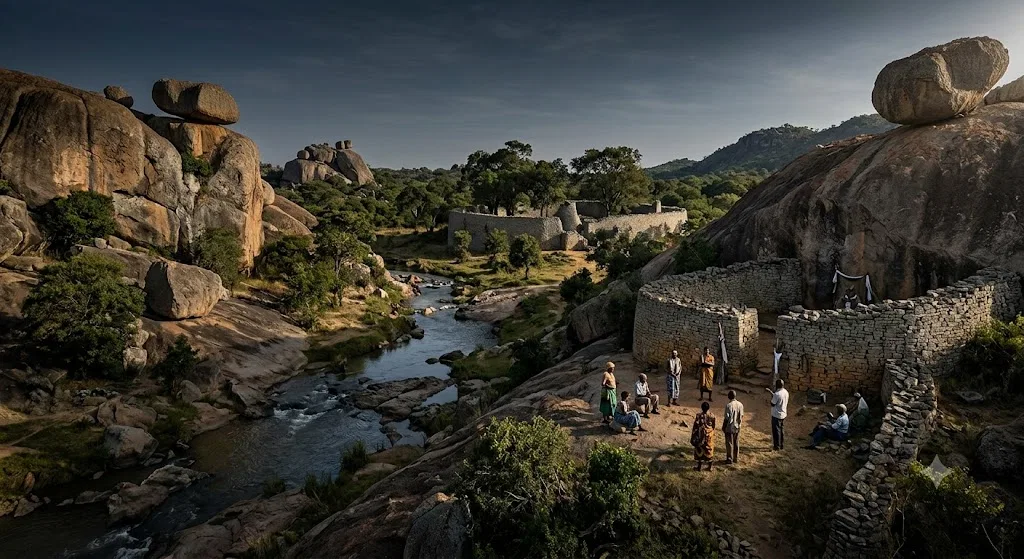
For a first-time reader, the most important point is that Zimbabwean folklore is strongly tied to place. The Matobo Hills are not merely dramatic rocks; they are associated with shrines, ancestral power and the Mwari religion. Great Zimbabwe is not only an archaeological ruin; it remains a sacred national symbol. The Zambezi is not just a river; in Tonga tradition it is linked to the river spirit Nyaminyami and the trauma of Kariba Dam. These traditions have changed over time, but they still shape heritage, literature, public memory and cultural identity today.[UNESCO World Heritage Centre]whc.unesco.orgUNESCO World Heritage CentreMatobo HillsThe Matobo rocks are seen as the seat of god and of ancestral spirits. Sacred shrines within the…
Why Zimbabwean folklore is rooted in land, ancestors and memory
Many Zimbabwean traditions begin with a basic idea: the living community includes the dead. Among Shona-speaking communities, family ancestors, territorial spirits and spirit mediums have long been central to ideas about wellbeing, justice, land and authority. The supreme being is commonly discussed in English as God, while ancestors and powerful territorial spirits mediate between people, place and the spiritual order. The same broad pattern appears in different forms among communities across the country, including Shona, Ndebele, Tonga, Kalanga, Venda, Ndau and others, though each has its own histories and local variations.[ACCORD]accord.org.zaACCORDThe role of traditional healers in conflict resolution31 Jul 2024 — Zimbabwean traditional societies strongly believed in mhondoro (spirits of departed kings who started dynasties) and…
This is why Zimbabwean folklore cannot be separated neatly from religion, law, ecology or politics. A story about a river spirit may also be a warning about water pollution, drought, displacement or disrespect for sacred places. A story about an avenging spirit may also be a moral framework for unresolved wrongdoing. A legend about a spirit medium may be both a sacred narrative and a national liberation symbol.[academicjournals.org]academicjournals.orgAcademic Journals Water spirits and the conservation of the natural environmentAcademic Journals Water spirits and the conservation of the natural environment
Oral tradition also matters because Zimbabwe’s documentary record was shaped by colonial power. The National Archives of Zimbabwe’s oral history programme began in 1968 and initially focused heavily on prominent Europeans and elite voices; later work sought to include African communities, minority groups, women and grassroots testimony more fully. That history helps explain why folklore and oral tradition are not just colourful extras to written history. They are part of how many communities preserve knowledge that was excluded, mistranslated or undervalued in official records.[Unisa Press Journals]unisapressjournals.co.zaUnisa Press Journalsoverview of the oral history programme at the nationalUnisa Press Journalsoverview of the oral history programme at the national
The Mwari tradition and the sacred power of Matobo
The Matobo Hills in south-western Zimbabwe are among the clearest examples of folklore, religion and landscape becoming inseparable. UNESCO describes the rocks as being seen as the seat of God and ancestral spirits, with shrines where contact can be made with the spiritual world. It also identifies the Mwari religion practised in the area as one of southern Africa’s most powerful oracular traditions.[UNESCO World Heritage Centre]whc.unesco.orgUNESCO World Heritage CentreMatobo HillsThe Matobo rocks are seen as the seat of god and of ancestral spirits. Sacred shrines within the…
The best-known shrine in this wider landscape is Njelele, associated with rainmaking, consultation and ritual authority. Research based on oral testimony describes Njelele as a shrine visited annually around August and September, before the rainy season, not only for rain but also for forgiveness after social wrongdoing and for help with human and animal disease. The shrine sits within the Matobo World Heritage landscape, but its significance is not only archaeological or scenic; it is bound to living custodianship, ritual rules and local memory.[Unisa Press Journals]unisapressjournals.co.zaUnisa Press Journals Understanding the Traditional and Contemporary PurposeUnisa Press Journals Understanding the Traditional and Contemporary Purpose
What makes Matobo especially important for folklore is that it shows how sacred places can resist being reduced to tourist sites. A visitor may see granite hills, rock art and spectacular balancing formations. Local traditions may see a spiritually charged landscape where ancestors, rain, social order and divine authority meet. This does not mean every Zimbabwean interprets Matobo in the same way, but it does mean the hills cannot be understood properly through geology or archaeology alone.[UNESCO World Heritage Centre]whc.unesco.orgUNESCO World Heritage CentreMatobo HillsThe Matobo rocks are seen as the seat of god and of ancestral spirits. Sacred shrines within the…
Great Zimbabwe: monument, myth and sacred national symbol
Great Zimbabwe is the country’s most famous historic site, but it is also a major folklore landscape. UNESCO describes the monument as a non-functional sacred archaeological site still used by contemporary communities for spiritual reasons. The ruins are often presented through archaeology, architecture and national history, yet local understandings also involve sacredness, memory and ancestral connection.[UNESCO World Heritage Centre]whc.unesco.orgThe method of construction is…Read more…
This matters because Great Zimbabwe has long been argued over. During the colonial period, false theories tried to detach the site from African builders, while modern scholarship recognises it as a major African urban and political centre. Folklore enters the picture not as a substitute for archaeology, but as a different kind of memory: local narratives, claims of sacred ownership, stories of desecration, and traditions connecting the site to political and spiritual authority. Research on heritage management has noted that official presentations of Great Zimbabwe have often privileged archaeological interpretation while giving less space to myths, oral histories and local folklore attached to the monument.[iccrom.org]iccrom.orgThe Preservation of Great ZimbabweThe Preservation of Great Zimbabwe
For readers of folklore, the key is to avoid two mistakes. One mistake is to treat Great Zimbabwe as a mysterious ruin needing exotic speculation. The other is to treat it as only a museum object, stripped of living meaning. The more grounded view is richer: Great Zimbabwe is an archaeological site, a national emblem, a sacred landscape and a place where oral tradition and formal heritage management have sometimes sat uneasily together.[UNESCO World Heritage Centre]whc.unesco.orgThe method of construction is…Read more…
Nyaminyami and the Zambezi: a river spirit shaped by dam, displacement and memory
Nyaminyami, often described in English as the Zambezi river spirit or river god, is one of the best-known legendary beings associated with Zimbabwe. The tradition is especially linked with Tonga communities of the Zambezi Valley and with the Kariba Gorge, now dominated by Kariba Dam and Lake Kariba. Modern retellings often picture Nyaminyami as a snake-like being with a fish-like head, but the deeper story is not just about a monster in the water. It is about a river, a people, and a violent transformation of place.[mythologicalafricans.substack.com]mythologicalafricans.substack.comNyaminyami and the Kariba Dam ProjectMythological Africans“Exploring the Origins and Expansion of the Nyaminyami (Water Spirit) Belief Systems among the BaTonga People of Nor…
The Kariba Dam project in the 1950s displaced Tonga communities on both sides of the Zambezi. In folklore retellings, the dam separated Nyaminyami from his mate and provoked floods, tremors or misfortune. Historically, the dam’s construction did coincide with destructive floods, engineering drama and large-scale resettlement, while later earth tremors around Lake Kariba have also been explained scientifically through reservoir-induced seismicity. The folklore does not need to be read as engineering evidence to be meaningful; it expresses the experience of ecological rupture, forced movement and loss of ancestral river life.[Wikipedia]WikipediaKariba DamKariba Dam
Nyaminyami has also become a tourist and popular-culture symbol. Pendants, carvings and souvenirs often turn the river spirit into a recognisable emblem of the Zambezi. That commercial image can be appealing, but it risks flattening the story into a decorative “lake monster”. Its strongest cultural meaning remains tied to Tonga memory, the Zambezi’s power and the human consequences of Kariba.[Wikipedia]WikipediaNyami NyamiNyami Nyami
Water spirits, mermaids and sacred pools
Zimbabwean water-spirit traditions are not limited to Nyaminyami. Among Shona and other communities, beings often translated as mermaids or water spirits are associated with pools, rivers, possession, healing, rainmaking and taboos around water. In academic writing on Zimbabwean mythology, these water spirits are described as beings whose mediums could have roles in rainmaking and environmental conservation.[Academic Journals]academicjournals.orgAcademic Journals Water spirits and the conservation of the natural environmentAcademic Journals Water spirits and the conservation of the natural environment
These traditions are easy for outsiders to misunderstand. The English word “mermaid” may suggest a European fairy-tale creature, but Zimbabwean water-spirit beliefs are better read in their own setting: sacred water places, ritual specialists, rules about pollution, and the idea that water is spiritually guarded. Recent work on Ndau religion, for example, emphasises water as sacred and protected by spirits, with taboos helping to safeguard wetlands and water resources.[HTS Teologiese Studies]hts.org.zaOpen source on hts.org.za.
The conservation angle is especially important. Some researchers argue that belief in water spirits can support respect for rivers, pools and wetlands by making them morally and spiritually protected. That does not mean traditional belief alone can solve modern environmental problems, but it shows why folklore can carry practical ecological memory. A pool that is “haunted” or spirit-protected may also be a place where people learn not to pollute, overfish, mock rituals or behave carelessly.[Academic Journals]academicjournals.orgAcademic Journals Water spirits and the conservation of the natural environmentAcademic Journals Water spirits and the conservation of the natural environment
Nehanda: ancestor, spirit medium and national legend
Nehanda is one of Zimbabwe’s most powerful legendary and historical figures, but the name needs careful handling. In many accounts, Nehanda is not simply one person. It is the name of a spirit associated with foundational Shona traditions, speaking through mediums across generations. Oxford Research Encyclopedia describes Nehanda as the spirit rather than the person, with traditions presenting the original female ancestor in different ways: as a semi-mythical forebear linked to Zezuru and Korekore origins, and as a daughter of Mutota, founder of the Mutapa state.[OUP Academic]oxfordre.comOpen source on oxfordre.com.
The best-known medium of Nehanda was Charwe, associated with resistance during the 1896–97 First Chimurenga against British settler rule. UNESCO Memory of the World nomination material for the Nehanda and Kaguvi judgment dockets describes the two as key spirit mediums who inspired resistance and helped unite local chiefdoms against colonial rule. Nehanda’s image later became central to nationalist memory, especially through the famous line attributed to Charwe before execution: “My bones will rise again.”[UNESCO]media.unesco.orgNomination formNomination form
Nehanda’s folklore has continued to evolve through literature, music, politics and public commemoration. Modern scholarship stresses that she became not only a remembered spirit medium but also a symbol of anti-colonial resistance, gendered power and national motherhood. This is a good example of how folklore changes: a sacred tradition becomes a historical memory, then a literary figure, then a national icon.[OUP Academic]oxfordre.comOpen source on oxfordre.com.
Avenging spirits, witches and moral order
Not all Zimbabwean supernatural traditions are about protection or blessing. Some concern danger, accusation and unresolved harm. One important example is the belief in avenging spirits, often discussed in Shona contexts as spirits of wronged dead people who seek justice or compensation from the living. Academic and pastoral studies describe these spirits as connected especially with murder, neglect or serious wrongdoing, and as believed to afflict families until the wrong is acknowledged and addressed.[SciELO]scielo.org.zaOpen source on scielo.org.za.
This tradition is not simply a ghost story. It is a moral system. The fear of an avenging spirit can express a community’s concern that wrongdoing does not disappear just because the victim is dead or the courts are silent. In some accounts, compensation and reconciliation are central to resolving the crisis. The belief can therefore function as a form of social memory, keeping old injuries alive until they are publicly recognised.[SciELO]scielo.org.zaOpen source on scielo.org.za.
Witchcraft beliefs are also part of Zimbabwean supernatural culture, but they should be discussed carefully. Sources on Shona and Ndebele religions distinguish protective ancestral spirits from harmful forces such as witches and avenging spirits. In everyday life, accusations of witchcraft can be socially damaging and dangerous, so responsible writing should avoid treating witchcraft claims as proof of supernatural harm. Folklorically, these beliefs reveal how communities explain misfortune, envy, illness, family conflict and sudden death.[Postcolonial Web]postcolonialweb.orgOpen source on postcolonialweb.org.
Dance, song and storytelling as living folklore
Zimbabwean folklore is not only told in myths about spirits. It is performed through songs, dances, praise poetry, naming practices, proverbs and public storytelling. Research on Shona oral traditions emphasises that myths, folktales and oral histories communicate moral lessons, explain natural phenomena, reinforce social norms and preserve symbolic systems.[Cambridge University Press & Assessment]cambridge.orgOpen source on cambridge.org.
A strong example is the Mbende Jerusarema dance, inscribed by UNESCO on the Representative List of the Intangible Cultural Heritage of Humanity. UNESCO describes it as a dance practised by Zezuru Shona communities in eastern Zimbabwe, formerly called Mbende before colonial rule, with the mole regarded as a symbol of fertility, sexuality and family. Over time, colonial suppression, Christian influence and changing public settings reshaped the dance, including the adoption of the name Jerusarema.[ICH UNESCO]ich.unesco.orgOpen source on unesco.org.
This kind of performance tradition matters for folklore because it keeps meaning embodied. A folktale can be written down, but a dance carries rhythm, gesture, gender roles, humour, restraint, transgression and community participation. It also shows how traditions survive by changing: what began in one ritual and social context may later appear at festivals, schools, heritage events or national celebrations.[ICH UNESCO]ich.unesco.orgOpen source on unesco.org.
Old tradition, literary invention and internet folklore
One challenge for readers is separating long-standing oral tradition from modern retelling. Zimbabwean folklore now circulates through academic books, school materials, novels, heritage displays, tourism websites, YouTube videos, Facebook posts and souvenir markets. Each medium changes the story.
Nyaminyami is a good example. Tonga river-spirit traditions are older than the internet, but the familiar tourist image of a dragon-like pendant is a modern public form. Nehanda is another example: older spirit traditions and 1890s colonial records sit alongside nationalist retellings, novels and contemporary gender readings. Great Zimbabwe has both local sacred narratives and a long history of speculative myths, some of them rooted in colonial denial of African achievement.[substack.com]mythologicalafricans.substack.comNyaminyami and the Kariba Dam ProjectMythological Africans“Exploring the Origins and Expansion of the Nyaminyami (Water Spirit) Belief Systems among the BaTonga People of Nor…
A useful rule is to ask what kind of source is speaking. Oral testimony may preserve local authority and lived meaning. Archaeology may clarify dates, settlement patterns and material culture. A novel may deliberately reshape tradition to explore memory or power. A tourist website may simplify a story into an attractive legend. A social-media post may repeat older material without context. None of these forms is automatically worthless, but they do different jobs.
How Zimbabwean folklore is understood today
Today, Zimbabwean folklore sits between continuity and change. Sacred places such as Matobo and Great Zimbabwe still matter to communities and heritage institutions. Water-spirit traditions are being discussed in relation to environmental care. Nehanda remains a national symbol as well as a complex spirit tradition. Oral history programmes continue to raise questions about whose voices are preserved, in which languages, and under whose authority.[unesco.org]whc.unesco.orgUNESCO World Heritage CentreMatobo HillsThe Matobo rocks are seen as the seat of god and of ancestral spirits. Sacred shrines within the…
The most interesting thing about Zimbabwean folklore is therefore not that it contains strange beings or dramatic legends, although it certainly does. Its deeper importance is that it keeps asking practical cultural questions: Who owns the land? Who may speak for the ancestors? What happens when a sacred river is dammed? How should a community remember violence? Can a monument be both archaeological heritage and a living sacred place? These questions make Zimbabwe’s folklore a vivid part of the country’s cultural life, not a museum shelf of dead stories.

Amazon book picks
Further Reading
Books and field guides related to Where Zimbabwe's Spirits Live in the Land. Use these as the next step if you want deeper reading beyond the article.
The Soul of Mbira
Explains Shona spiritual traditions, ceremonies and relationships with ancestral spirits.
Voices from the Rocks
Connects folklore, sacred geography, shrines and historical memory.
Great Zimbabwe
Helps readers understand the cultural and symbolic importance of Great Zimbabwe.
African Religions and Philosophy
Provides essential context for ancestors, spirits, sacred places and religious worldviews found in Zimbabwean folklore.
eBay marketplace picks
Marketplace Samples
Live-tested eBay searches with available results related to this page.
Endnotes
1.
Source: whc.unesco.org
Link:https://whc.unesco.org/en/list/306/
Source snippet
UNESCO World Heritage CentreMatobo HillsThe Matobo rocks are seen as the seat of god and of ancestral spirits. Sacred shrines within the...
2.
Source: whc.unesco.org
Link:https://whc.unesco.org/en/list/364/
Source snippet
The method of construction is...Read more...
3.
Source: mythologicalafricans.substack.com
Title: Nyaminyami and the Kariba Dam Project
Link:https://mythologicalafricans.substack.com/p/nyaminyami-and-the-kariba-dam-project
Source snippet
Mythological Africans“Exploring the Origins and Expansion of the Nyaminyami (Water Spirit) Belief Systems among the BaTonga People of Nor...
4.
Source: accord.org.za
Title: ACCORDThe role of traditional healers in conflict resolution
Link:https://www.accord.org.za/ajcr-issues/the-role-of-traditional-healers-in-conflict-resolution-in-zimbabwe-1890%E2%80%921980/
Source snippet
31 Jul 2024 — Zimbabwean traditional societies strongly believed in mhondoro (spirits of departed kings who started dynasties) and...
5.
Source: whc.unesco.org
Link:https://whc.unesco.org/document/153151
6.
Source: iccrom.org
Title: The Preservation of Great Zimbabwe
Link:https://www.iccrom.org/sites/default/files/publications/2019-11/iccrom_ics04_zimbabwe_en.pdf
7.
Source: jstor.org
Link:https://www.jstor.org/stable/10.1086/204698
8.
Source: unesdoc.unesco.org
Link:https://unesdoc.unesco.org/ark%3A/48223/pf0000390400
9.
Source: Wikipedia
Title: Kariba Dam
Link:https://en.wikipedia.org/wiki/Kariba_Dam
10.
Source: Wikipedia
Title: Nyami Nyami
Link:https://en.wikipedia.org/wiki/Nyami_Nyami
11.
Source: cambridge.org
Link:https://www.cambridge.org/core/journals/history-in-africa/article/an-innocent-woman-unjustly-accused-charwe-medium-of-the-nehanda-mhondoro-spirit-and-the-189697-central-shona-rising-in-zimbabwe/466CA1C5269F9CAB07A83F64E45FBAF1
12.
Source: media.unesco.org
Title: Nomination form
Link:https://media.unesco.org/sites/default/files/webform/mow001/zimbabwe_nehanda_kaguvi_en.pdf
13.
Source: jstor.org
Link:https://www.jstor.org/stable/pdf/1581363.pdf
14.
Source: cambridge.org
Link:https://www.cambridge.org/core/journals/public-humanities/article/shona-oral-traditions-and-the-quest-for-cognitive-justice-what-shona-public-humanities-contribute-to-a-world-in-crisis/473672CB19CDA7DF6B8743E6A5602E8A
15.
Source: ich.unesco.org
Link:https://ich.unesco.org/en/RL/mbende-jerusarema-dance-00169
16.
Source: ich.unesco.org
Title: ICH UNESCOPhoto pop-up
Link:https://ich.unesco.org/en/photo-pop-up-00973?photoID=00233
17.
Source: ich.unesco.org
Link:https://ich.unesco.org/en/projects/safeguarding-the-mbende-jerusarema-dance-00044
18.
Source: facebook.com
Link:https://www.facebook.com/100064489368586/posts/shona-people-are-you-still-using-this-spiritual-hierarchy-culturalheritage-zimba/1345215297638103/
19.
Source: facebook.com
Link:https://www.facebook.com/groups/875714655853865/posts/8921168201308430/
20.
Source: facebook.com
Link:https://www.facebook.com/justutter/posts/zimbabwe-horror-folklore-creatures-mermaids-the-feared-ones-in-landlocked-zimbab/1383674963758351/
21.
Source: facebook.com
Link:https://www.facebook.com/100069807941475/posts/-lets-learn-about-the-legend-of-nyami-nyamibefore-modern-dams-roads-and-technolo/1316827997320786/
22.
Source: facebook.com
Title: zimbabwe and its sacred history when the whites reached zimbabwe in 1880s they f
Link:https://www.facebook.com/rutendo.matinyarare/posts/zimbabwe-and-its-sacred-history-when-the-whites-reached-zimbabwe-in-1880s-they-f/10228177015584584/
23.
Source: facebook.com
Link:https://www.facebook.com/ZambeziRiverAuthority/posts/what-do-you-know-about-the-zambezi-river-godnyami-nyami/2404923099655113/
24.
Source: facebook.com
Link:https://www.facebook.com/groups/749068596457801/posts/782508936447100/
25.
Source: facebook.com
Link:https://www.facebook.com/zichmedia/posts/njelele-shrine-pilgrimage-a-sacred-journey-into-zimbabwes-spiritual-heartlandnes/1092441323100164/
26.
Source: facebook.com
Link:https://www.facebook.com/black.historystudies/posts/mbuya-nehanda-charwe-nyakasikana-was-the-spirit-medium-that-was-the-inspiration-/1075948067896173/
27.
Source: facebook.com
Link:https://www.facebook.com/groups/275114380263865/posts/746928749749090/
28.
Source: youtube.com
Link:https://www.youtube.com/watch?v=CaQ_UpYwaNE
29.
Source: youtube.com
Link:https://www.youtube.com/watch?v=9i7rwsIngYw
30.
Source: youtube.com
Link:https://www.youtube.com/watch?v=I1KRjQmFEIc
31.
Source: ich.unesco.org
Link:https://ich.unesco.org/en/video/41786
32.
Source: unesco.org
Title: document 44 eng 2
Link:https://www.unesco.org/archives/multimedia/document-44-eng-2
33.
Source: ich.unesco.org
Link:https://ich.unesco.org/doc/src/Signed%20periodic%20report%20-%20Periodic%20report-63478.docx
34.
Source: ich.unesco.org
Title: zimbabwe ZW
Link:https://ich.unesco.org/en/state/zimbabwe-ZW
35.
Source: ich.unesco.org
Title: 00209 EN
Link:https://ich.unesco.org/doc/src/00209-EN.pdf
36.
Source: ich.unesco.org
Title: photo pop up 00973
Link:https://ich.unesco.org/en/photo-pop-up-00973?photoID=00588
37.
Source: unesdoc.unesco.org
Link:https://unesdoc.unesco.org/ark%3A/48223/pf0000390398
38.
Source: ich.unesco.org
Title: 00264 EN
Link:https://ich.unesco.org/doc/src/00264-EN.pdf
39.
Source: ich.unesco.org
Title: Mbende Jerusarema dance 00169
Link:https://ich.unesco.org/en/RL/Mbende-Jerusarema-dance-00169?call=film&id=41786&include=film_inc.php&width=700
40.
Source: Wikipedia
Link:https://en.wikipedia.org/wiki/Mhondoro
41.
Source: Wikipedia
Title: Great Zimbabwe
Link:https://en.wikipedia.org/wiki/Great_Zimbabwe
42.
Source: Wikipedia
Title: Njelele Shrine
Link:https://en.wikipedia.org/wiki/Njelele_Shrine
43.
Source: matobo.org
Title: mcs newsletter 104
Link:https://matobo.org/mcs-newsletter-104/
44.
Source: youtube.com
Title: The Legend of Nyaminyami – The Zambezi River God | Zimbabwean Myth & Folklore
Link:https://www.youtube.com/watch?v=SKVT1uqezuk
Source snippet
The Hidden Story of the Mbire People Who Built Great Zimbabwe...
45.
Source: youtube.com
Title: The Hidden Story of the Mbire People Who Built Great Zimbabwe
Link:https://www.youtube.com/watch?v=pnq3ZWrQvhI
Source snippet
Wonders of Zimbabwe | Why Do Zimbabwe's Wild Villages Feel So Untouched? | Travel Documentary...
46.
Source: youtube.com
Link:https://www.youtube.com/watch?v=3iMvApn4RJI
Source snippet
Why Are Zimbabwe's Jungle Villages Hidden From the Modern World?...
47.
Source: youtube.com
Title: Why Are Zimbabwe’s Jungle Villages Hidden From the Modern World?
Link:https://www.youtube.com/watch?v=4QQSsxCrzZM
Source snippet
Don't Mess With the Water Spirit or Pay the Price #shorts #scary...
48.
Source: youtube.com
Title: Don’t Mess With the Water Spirit or Pay the Price #shorts #scary
Link:https://www.youtube.com/watch?v=Hjf5bL27d5E
49.
Source: postcolonialweb.org
Link:https://www.postcolonialweb.org/zimbabwe/religion/arntsen1.html
50.
Source: academicjournals.org
Title: Academic Journals Water spirits and the conservation of the natural environment
Link:https://academicjournals.org/journal/IJSA/article-full-text-pdf/B5D05C941150
51.
Source: scielo.org.za
Link:https://scielo.org.za/pdf/ids/v45n1/10.pdf
52.
Source: oxfordre.com
Link:https://oxfordre.com/africanhistory/display/10.1093/acrefore/9780190277734.001.0001/acrefore-9780190277734-e-1190?result=5&rskey=4ZSFtK
53.
Source: unisapressjournals.co.za
Title: Unisa Press Journalsoverview of the oral history programme at the national
Link:https://unisapressjournals.co.za/index.php/OHJSA/article/download/343/303/3700
54.
Source: upjournals.up.ac.za
Link:https://upjournals.up.ac.za/index.php/historia/article/view/1516
55.
Source: unisapressjournals.co.za
Title: Unisa Press Journals Understanding the Traditional and Contemporary Purpose
Link:https://www.unisapressjournals.co.za/index.php/OHJSA/article/download/4015/3935
56.
Source: hts.org.za
Link:https://hts.org.za/index.php/hts/article/view/10041/27685
57.
Source: frontiersin.org
Link:https://www.frontiersin.org/journals/conservation-science/articles/10.3389/fcosc.2026.1790546/full
58.
Source: hts.org.za
Link:https://hts.org.za/index.php/hts/article/download/9019/26178
59.
Source: scielo.org.za
Link:https://www.scielo.org.za/scielo.php?pid=S1017-04992020000100008&script=sci_arttext
60.
Source: journals.co.za
Link:https://journals.co.za/doi/pdf/10.10520/EJC38087
61.
Source: open.bu.edu
Link:https://open.bu.edu/bitstreams/13df5791-2664-4929-9e10-790f34681ecb/download
Additional References
62.
Source: academia.edu
Link:https://www.academia.edu/129543629/Water_Spirits_and_Sacred_Rituals_The_Role_of_African_Traditional_Juju_in_Protecting_Blue_Ecosystems_in_Cross_River_State
63.
Source: researchgate.net
Link:https://www.researchgate.net/publication/269679263_Water_spirits_and_the_conservation_of_the_natural_environment_A_case_study_from_Zimbabwe
64.
Source: academia.edu
Link:https://www.academia.edu/21484880/A_Zimbabwean_past_Shona_Dynastic_Histories_and_Oral_Traditions
65.
Source: x.com
Link:https://x.com/ZimbabweHistor2/status/2025816908902076900
66.
Source: x.com
Link:https://x.com/ZimbabweHistor2/status/2021796802995900640
67.
Source: instagram.com
Link:https://www.instagram.com/reel/DQRt-WGFGFl/
68.
Source: researchgate.net
Link:https://www.researchgate.net/publication/395287898_Shona_Oral_Traditions_and_the_Quest_for_Cognitive_Justice_What_Shona_Public_Humanities_Contribute_to_a_World_in_Crisis
69.
Source: si.edu
Link:https://www.si.edu/object/siris_sil_1008046
70.
Source: scribd.com
Link:https://www.scribd.com/document/398805635/The-First-Chimurenga-Notes
71.
Source: academia.edu
Link:https://www.academia.edu/33604144/The_Ritual_of_Avenging_Spirit_A_Case_Study_of_the_Zion_Christian_Church_of
Topic Tree
Follow this branch
Related pages 192
- Afghan Folklore
- Albanian Folklore
- Algerian Folklore
- Australian Folklore
- Azerbaijan Folklore
- +187 more in sidebar