Where French Legends Still Haunt the Map
France’s folklore is not one single mythology but a layered map of local traditions: Breton death messengers, Provençal dragons, Basque cave spirits, Alsatian winter bogeymen, fairy-tale salons, saintly stones, wolf panics, giants, witches, sacred springs and stories tied to particular forests, bridges, mountains and feast days.
Page outline Jump by section
Introduction
This matters because France’s best-known tales often sit between living local practice and polished national literature. Little Red Riding Hood, the Beast of Gévaudan, the Tarasque of Tarascon, Brocéliande’s Arthurian forest and the fairy Mélusine are all “French” in different ways: some are old oral motifs, some are medieval or early modern literary retellings, and some are historical events turned into legend. France’s Ministry of Culture now treats many such practices as intangible cultural heritage, with a national inventory launched in 2008 to document living practices with the help of communities, groups and individuals.[Ministère de la Culture]culture.gouv.frl inventaire national du patrimoine culturel immateriell inventaire national du patrimoine culturel immateriel
Why French folklore is so regional
A useful way to read French folklore is to think less of a single national pantheon and more of a country where local landscapes produced local supernatural grammar. Brittany gives France some of its strongest death lore and fairy traditions; Provence has dragon processions and saint legends; the Basque Country shares a mountain-and-cave mythology with the wider Basque world; Alsace has winter figures shaped by Germanic and Christian festive culture; the Massif Central preserves stories of wolves, shepherds and haunted uplands.
This regionalism is not a weakness. It is the reason French folklore feels so varied. The same broad themes recur across the country — dangerous waters, saintly miracles, night beings, shapeshifters, giants, witches, talking animals and warnings for children — but they attach themselves to local places. A stone that rings like a bell, a forest said to hold Merlin’s tomb, a bridge associated with fairy builders or a village festival where a monster parades through the streets can become more culturally powerful than an abstract mythic system.
Modern heritage work has reinforced this place-based view. The French intangible cultural heritage inventory includes ritual, festive, oral and craft practices, and individual entries often show how oral tradition, written culture, local memory and tourism overlap rather than existing in neat separate boxes. A good example is the ringing stone of Saint Gildas in Brittany, where the documented practice combines a chapel, a saint legend, a wish-making gesture, local oral transmission and formal heritage protection.[pci-lab.fr]pci-lab.frPC I LabPC I Lab
The old layers: caves, Gauls, saints and village memory
France has prehistoric sites that strongly shape the country’s imagination, but they should not be treated as folklore in the narrow sense. Lascaux and the decorated caves of the Vézère Valley are archaeological rather than oral-traditional sources. UNESCO describes the valley’s prehistoric sites as spanning roughly 400,000 to 10,000 years and reflecting a dense record of human occupation and artistic production.[UNESCO World Heritage Centre]whc.unesco.orgOpen source on unesco.org. The official Lascaux site notes that the cave’s discovery in 1940 opened a new era in knowledge of prehistoric art and human origins, and that it still feeds collective imagination today.[Archéologie]archeologie.culture.gouv.frOpen source on gouv.fr.
That distinction matters. It is tempting to call cave art “ancient French mythology”, but we do not have the stories that were told around those paintings. What we have are images, archaeological contexts and modern interpretations. They belong in the deep background of France’s mythic landscape, not as direct ancestors of later fairy tales or saint legends.
The same caution applies to pre-Christian Gaul. Archaeological collections in France show a rich world of gods, death practices and Gallo-Roman religious images. The Musée d’Archéologie nationale describes its Gallo-Roman department as covering “the world of the gods and the dead” as well as daily life, while the Musée de la Romanité notes the diversity of divine representations in the Gallo-Roman pantheon.[Musée Archéologie Nationale]musee-archeologienationale.frOpen source on musee-archeologienationale.fr. But later French folklore is not simply “Gaulish mythology continued”. It is a long mixture of Christianisation, local saints, medieval romance, household beliefs, regional languages and printed literature.
Saint legends are one of the bridges between older sacred landscapes and later local tradition. Caves, springs, ringing stones, healing places and unusual rocks were often folded into stories of saints or hermits. The Saint Gildas ringing stone in Brittany shows this clearly: the site is attached to a saintly hermitage, yet the practice around the stone also works as a local wish ritual transmitted through oral and written tradition.[pci-lab.fr]pci-lab.frPC I LabPC I Lab

Fairy tales: oral tradition reshaped for salons and children
For many readers outside France, French folklore begins with fairy tales: Cinderella, Sleeping Beauty, Puss in Boots, Bluebeard and Little Red Riding Hood. These are not simple transcripts of peasant storytelling. They are literary works built from oral motifs, earlier written sources and the tastes of late seventeenth-century elite culture.
The Bibliothèque nationale de France explains that the fairy tale long belonged to oral tradition, passed from mouth to mouth by generations of storytellers in popular and family settings.[Essentiels]essentiels.bnf.frOpen source on bnf.fr. It also notes that Charles Perrault’s tales referred to oral tradition while deliberately presenting themselves as a distinctive literary form.[Essentiels]essentiels.bnf.fr70b4c5d3 55e7 43b5 8019 507022d6ed4b charles perrault dela contes70b4c5d3 55e7 43b5 8019 507022d6ed4b charles perrault dela contes In another accessible account, the BnF describes literary fairy tales as emerging from oral storytelling a little over three centuries ago and originally being intended for adults rather than children.[Fantasy BnF]fantasy.bnf.frOpen source on bnf.fr.
This is why French fairy tales often feel both familiar and strange. Little Red Riding Hood is now a children’s classic, but older oral versions could be sharper, darker and more bodily than modern nursery retellings. The BnF notes that some oral versions ended tragically, as in Perrault, with the wolf alone after devouring everyone.[Essentiels]essentiels.bnf.frOpen source on bnf.fr. The printed tale became a moralised literary object, but it did not erase the older folk material beneath it.
French fairy-tale culture was also not only Perrault. The late seventeenth and early eighteenth centuries produced a large body of literary fairy tales in France, many by women writers. UCLA Library’s French studies guide notes that between 1690 and 1715 more than one hundred literary fairy tales appeared in France, with about two-thirds written by women.[guides.library.ucla.edu]guides.library.ucla.eduFolk and Fairy TalesFolk and Fairy Tales That matters because the “French fairy tale” was not just rustic folklore collected by scholars; it was also a salon genre shaped by aristocratic wit, gendered social spaces and literary experimentation.
Monsters that made places famous
France’s legendary creatures are memorable because they are usually tied to a specific place and social function. They explain danger, dramatise communal identity, turn landscape into story, or give a town a ritual centrepiece.
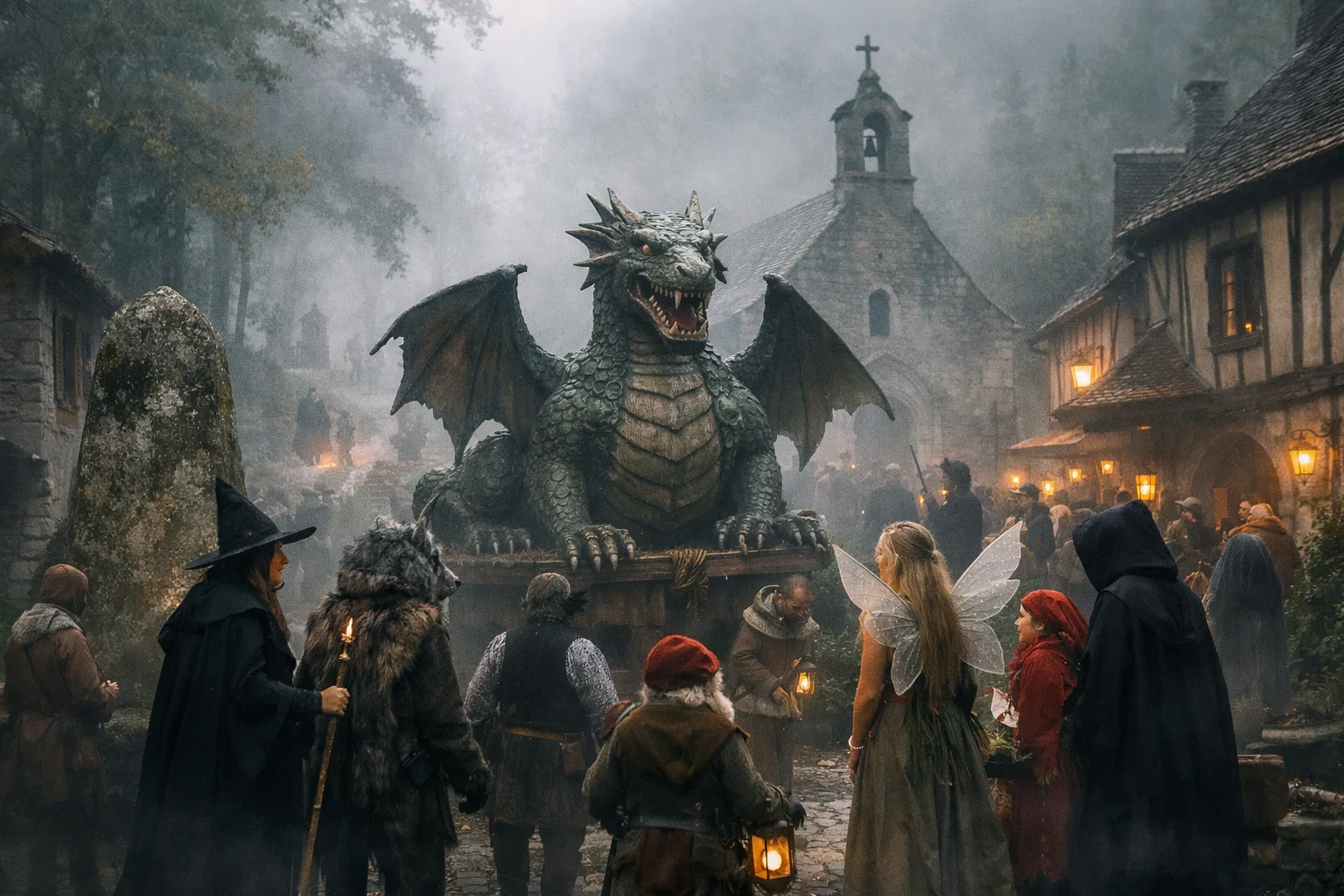
The Tarasque of Tarascon is the clearest example. In the legend, a destructive monster haunts the Rhône-side landscape until Saint Martha tames it. Today the creature belongs to Tarascon’s civic identity, appearing in festival processions rather than as a creature anyone is expected literally to fear. Provence-Alpes-Côte d’Azur’s tourism site describes the Tarasque as a hybrid monster from the banks of the Rhône and notes that the festival has been recognised by UNESCO as part of oral and intangible heritage.[Provence-Alpes-Côte d'Azur Tourisme]provence-alpes-cotedazur.comProvence-Alpes-Côte d'Azur Tourisme Tarasque of TarasconProvence-Alpes-Côte d'Azur Tourisme Tarasque of Tarascon Local tourism material traces the festival’s formal history to King René’s creation of the games in the fifteenth century, showing how a saint legend became a civic performance.[Coeur de la Provence Tourisme]lecoeurdelaprovence.frOpen source on lecoeurdelaprovence.fr.
The Beast of Gévaudan is different because it begins with real attacks. Between 1764 and 1767, people in the old province of Gévaudan, in today’s Lozère and Haute-Loire area, were killed by one or more predatory animals. Local tourism sources give the attack period as 30 June 1764 to 19 June 1767 and estimate between 82 and 124 victims.[Mende - Cœur de Lozère]mende-coeur-lozere.frOpen source on mende-coeur-lozere.fr. The Public Domain Review describes the Beast as one of the first international news stories, spreading from local newspapers to Paris and abroad.[The Public Domain Review]publicdomainreview.orgthe beast of gevaudanthe beast of gevaudan
What makes the Beast folklore is not that the attacks were imaginary. It is that uncertainty around the animal — wolf, unusually large canid, escaped exotic beast, several animals, or something exaggerated by panic and print culture — created a legend that outgrew the facts. The modern Beast is now part historical case, part rural trauma, part monster story and part tourist identity, with museums and routes keeping the story visible.
Giants belong to a broader comic and landscape-making tradition. Gargantua, made famous by Rabelais, also appears in local explanations for unusual stones, hills and rock formations. The French intangible heritage entry for the ringing stones of Saint-Cast-le-Guildo notes that local people know the stones through a Gargantua legend often transmitted in family settings, for example by grandparents during walks.[pci-lab.fr]pci-lab.frOpen source on pci-lab.fr. This is folklore at its most ordinary and durable: a family outing becomes a storytelling occasion, and a geological curiosity becomes a giant’s trace.
Brittany: death, fairies and Arthurian forest
Brittany has one of France’s most distinctive folklore profiles because its traditions draw on Breton language, Celtic cultural memory, maritime life, Catholic devotion and nineteenth-century collection of oral tales. Its folklore is not only charming fairy lore; it is also deeply concerned with death, the sea, penance and the border between the living and the dead.
The Ankou is the best-known Breton death figure. In Lower Brittany, he is often understood not as death itself but as death’s servant, collector or worker. Becedia, a Breton cultural resource, describes the Ankou as the personification of death and/or the one whose role is to seek out the dying and accompany them to the other world; it also traces the first known mention of the word to a ninth-century gloss.[Bretagne Culture Diversité]bcd.bzhBretagne Culture DiversitéThe Ankou in Lower-Brittany | BecediaBretagne Culture DiversitéThe Ankou in Lower-Brittany | Becedia A local tourism account similarly presents the Ankou as a major figure in Breton mythology, very present in oral tradition and tales of Lower Brittany.[Pleumeur-Bodou]pleumeur-bodou.comThe legend of Death, AnkouThe legend of Death, Ankou
Brittany’s fairies and little beings are equally important, though they should not be softened into harmless sprites. Korrigans and related fairy figures are often linked with stones, fountains, night dancing, seduction, danger and taboo. They belong to a wider pattern in which the non-human world is close, beautiful and unsafe if approached without respect.
Brocéliande, commonly identified with Paimpont Forest, shows a different kind of Breton legend-making. It is a real forest overlaid with Arthurian romance. Brittany Tourism describes the forest as associated with the fairy Vivien and notes that the Centre de l’imaginaire arthurien organises exhibitions, shows and walks there.[Brittany tourism]brittanytourism.comBrittany tourism Brocéliande ForestBrittany tourism Brocéliande Forest The place is not evidence that King Arthur’s court was historically based there; rather, it shows how medieval romance, regional identity and modern cultural tourism can make a landscape feel legendary.
Provence and the south: dragons, saints and ritual spectacle
Provençal folklore often feels more public and festive than the intimate night lore of Brittany. Its strongest examples join saints, civic ritual, seasonal celebration and monstrous figures. The Tarasque is again the key case: a dragon-like creature that once represented danger becomes a processional emblem of the town.
This shift from threat to festival is important. A monster in folklore does not always disappear when people stop fearing it. It can become a mascot, a heritage symbol, a children’s spectacle, a tourist image and a way for a community to perform continuity. The Tarasque is frightening in the story, but in the street it is also communal theatre.
Southern France also contains rich traditions of shepherding, transhumance, night hunters and mountain legends. The French intangible heritage entry on transhumance notes that many tales and legends connected with the practice are transmitted through oral tradition, especially in regions such as the Massif Central and Jura.[pci-lab.fr]pci-lab.frPC I LabPC I Lab This is a reminder that folklore is not only about famous named creatures. It is also embedded in working landscapes: routes, pastures, seasonal movement, weather signs and stories told by people whose livelihoods depended on reading the land.

Basque, Alsatian and borderland traditions
French folklore also includes traditions that cross modern national borders. The Basque Country and Alsace are especially good examples because their folklore belongs to cultural regions larger than the French state.
In the French Basque context, stories of cave beings, mountain powers and water spirits connect with the wider Basque mythological world. Basque tourism and cultural sources commonly describe beings called laminak as beautiful or fairy-like figures associated with water, caves, bridges and animal-like features such as webbed feet.[basquecountryspirit.com]basquecountryspirit.comOpen source on basquecountryspirit.com. They are not simply “French fairies”; they are part of a Basque-speaking cultural imagination in which caves, mountains, rivers and household protections carry strong symbolic force.
Alsace, by contrast, shows how folklore can cluster around the winter calendar. Its Christmas traditions include Saint Nicholas, Christkindel and Hans Trapp, a frightening companion or bogeyman figure. Official Alsace Christmas tourism describes Hans Trapp as a local version of the punitive Christmas companion, connected with the legend of Hans von Trotha of Wissembourg.[Christmas in Alsace]christmas.alsacein Alsace -Hans Trapp Wissenburg, Christmas Parade & Castlein Alsace -Hans Trapp Wissenburg, Christmas Parade & Castle Visit Alsace also frames the region’s Christmas season through tales and legends around Saint Nicholas, Hans Trapp and Christkindel.[Visit Alsace]visit.alsaceAlsace -Christmas in AlsaceAlsace -Christmas in Alsace
These border traditions matter because they prevent a too-centralised view of French folklore. France’s legendary culture has always been multilingual and regionally porous, shaped by Breton, Basque, Occitan, Alsatian, Catalan, Corsican and other local histories as well as by French-language print culture.
Witches, healers and the village edge
Witchcraft in French folklore should be treated carefully because three things are often mixed together: historical witch trials, village beliefs about harmful magic, and later romantic or tourist retellings. The “witch” may be a feared neighbour, a healer, a cunning person, a scapegoat, a literary figure or a symbol of rural otherness depending on the source.
Berry, the region associated with George Sand’s writing, is especially important in the literary memory of rural magic. Nineteenth-century writers and collectors helped turn local healers, night gatherings, spells and rural fears into a recognisable folklore landscape. But modern readers should avoid assuming that every colourful witch story is an ancient unchanged tradition. Some are literary reworkings; others are late tourist narratives; others preserve older oral motifs in altered form.
The broader French record shows that folklore collection itself shaped what later readers think of as “traditional”. Paul Sébillot’s multi-volume Le Folk-Lore de France, first published in the early twentieth century, gathered a huge range of material on the sky, earth, waters, animals, plants, monuments, people and history. Digitised copies identify it as a major work on folklore in France, with bibliographies and multiple volumes.[Internet Archive]archive.orggri 33125009698537gri 33125009698537 Arnold van Gennep’s Manuel de folklore français contemporain, first published from 1937, similarly became a major scholarly framework for French folklore study.[Internet Archive]archive.orgOpen source on archive.org.
Collectors preserved material, but they also organised it, selected it and sometimes made it look more coherent than village belief ever was in daily life. That is why source awareness matters: a witch tale recorded in a folklore collection, a legend retold in a novel and a festival script used today are related but not identical kinds of evidence.
Sacred places, haunted places and talking landscapes
French folklore often begins with a place that behaves unusually. A stone rings. A fountain grants healing. A cave shelters a saint or a fairy. A forest becomes a threshold. A mountain pass remembers a giant or a battle. This is why sacred and haunted geography is central to the country’s legendary culture.
The ringing stone of Saint Gildas in Brittany is a compact example. The stone is struck while a wish is made, and the practice is explained through saintly memory, local tradition and the unusual sound of the mineral object. The heritage entry explicitly says transmission occurs at the junction of oral tradition and writing, popular and learned culture, with those forms of knowledge mixing and sometimes contradicting each other.[pci-lab.fr]pci-lab.frPC I LabPC I Lab That sentence could describe much of French folklore.
Brocéliande works in a similar but more literary way. Its trees, springs and paths are read through Arthurian characters such as Merlin and Vivien. The forest’s modern attractions do not prove medieval events; they show how place, literature and guided experience keep legend active.[Brittany tourism]brittanytourism.comBrittany tourism Brocéliande ForestBrittany tourism Brocéliande Forest
The Beast of Gévaudan shows a darker landscape logic. The Margeride uplands become legible through fear: scattered communities, wolves, poor communications, royal authority, newspapers and rumour all combine to make a region feel haunted by a predator. In this case, folklore grew not from a sacred object but from repeated crisis and uncertainty.
How French folklore changed over time
French folklore has changed through at least five major filters.
First, oral tradition shaped tales long before they were written down. Family storytelling, seasonal gatherings, work settings and village evenings kept stories moving and changing. The BnF’s account of fairy tales stresses this mouth-to-mouth transmission before literary fixation.[Essentiels]essentiels.bnf.frOpen source on bnf.fr.
Second, medieval and early modern writers transformed oral and legendary material into literature. Mélusine is a good example. The fairy-serpent woman is tied to medieval dynastic legend, especially the Lusignan family. A University of Notre Dame medieval studies article notes that Jean d’Arras’s 1393 version presents Mélusine as a half-fairy woman cursed to take a half-serpent form on Saturdays and as a figure central to Lusignan prestige.[Notre Dame Sites]sites.nd.eduNotre Dame Sites Melusine: The Myth, the Woman, the LegendNotre Dame Sites Melusine: The Myth, the Woman, the Legend
Third, seventeenth-century fairy-tale writers turned popular motifs into refined literary tales. Perrault and the salon writers did not merely “collect” tales; they rewrote them for particular audiences.[Essentiels]essentiels.bnf.fr70b4c5d3 55e7 43b5 8019 507022d6ed4b charles perrault dela contes70b4c5d3 55e7 43b5 8019 507022d6ed4b charles perrault dela contes
Fourth, nineteenth- and twentieth-century collectors such as Sébillot, van Gennep and later regional writers documented folklore at a moment when rural life was changing rapidly. Their work is invaluable, but it is also part of the history of folklore-making.[Internet Archive]archive.orggri 33125009698537gri 33125009698537
Fifth, modern heritage and tourism have given old stories new formats: museum displays, guided walks, festivals, replicas, children’s books, regional branding, films and online explainers. This does not necessarily make the traditions fake. It means they are alive in new social settings.
What is old tradition, and what is modern invention?
A sensible reader does not need to choose between “ancient truth” and “made-up tourist story”. French folklore usually sits somewhere between those poles.
Some traditions are historically well anchored. The Beast of Gévaudan is supported by eighteenth-century reports of real attacks, even if the exact identity of the predator remains disputed.[The Public Domain Review]publicdomainreview.orgthe beast of gevaudanthe beast of gevaudan The Tarasque festival has documented civic and ritual history, even though the dragon itself belongs to legend.[Provence-Alpes-Côte d'Azur Tourisme]provence-alpes-cotedazur.comProvence-Alpes-Côte d'Azur Tourisme Tarasque of TarasconProvence-Alpes-Côte d'Azur Tourisme Tarasque of Tarascon The Ankou is attested in Breton tradition and discussed by specialist cultural sources, but specific modern descriptions may be shaped by books, tourism and popular media.[Bretagne Culture Diversité]bcd.bzhBretagne Culture DiversitéThe Ankou in Lower-Brittany | BecediaBretagne Culture DiversitéThe Ankou in Lower-Brittany | Becedia
Other traditions are literary from the start or survive mainly through literary form. Perrault’s tales draw on oral tradition, but the versions most people know are authored, moralised and printed.[Essentiels]essentiels.bnf.fr70b4c5d3 55e7 43b5 8019 507022d6ed4b charles perrault dela contes70b4c5d3 55e7 43b5 8019 507022d6ed4b charles perrault dela contes Mélusine has oral-motif roots, but her famous medieval shape is inseparable from dynastic romance and written narrative.[Notre Dame Sites]sites.nd.eduNotre Dame Sites Melusine: The Myth, the Woman, the LegendNotre Dame Sites Melusine: The Myth, the Woman, the Legend
Some modern retellings are best understood as heritage interpretation. A forest walk in Brocéliande, a Tarasque parade, a Christmas procession in Alsace or a Beast of Gévaudan museum display can be meaningful even when it is not a direct survival of an unchanged ancient rite. The honest question is not “is it all ancient?” but “what evidence do we have, and how has the story been used?”
Why French folklore still matters today
French folklore remains culturally powerful because it gives local places emotional depth. A visitor who knows the Tarasque sees Tarascon differently. A reader who understands the Ankou reads Breton churchyards and coastal death imagery differently. Someone walking in Brocéliande is not just in woodland but in a landscape of medieval romance, modern tourism and regional imagination. The Beast of Gévaudan turns an eighteenth-century rural crisis into a continuing argument about fear, evidence and monster-making.
It also matters because folklore is one way France negotiates the relationship between centre and region. Parisian literary culture gave the world Perrault’s fairy tales, but many of France’s strongest traditions are stubbornly local: Breton, Provençal, Basque, Alsatian, Corsican, Occitan, Alpine, Norman, Burgundian, Auvergnat and more. The national story is made from regional voices.
Finally, French folklore is a useful reminder that tradition is not the opposite of change. The French Ministry of Culture’s intangible heritage work treats living practices as things documented with communities rather than frozen relics.[Ministère de la Culture]culture.gouv.frl inventaire national du patrimoine culturel immateriell inventaire national du patrimoine culturel immateriel The best-known French legends have survived precisely because they kept changing medium: from spoken tale to manuscript, printed book, festival, museum, school story, film, tourist trail and internet page. The old stories endure not because they are untouched, but because each generation finds a new way to make them speak.
Amazon book picks
Further Reading
Books and field guides related to Where French Legends Still Haunt the Map. Use these as the next step if you want deeper reading beyond the article.
French Fairy Tales
Foundational to understanding French folklore and literary fairy tales.

The Complete Fairy Tales
Represents the salon culture that shaped French tale traditions.
eBay marketplace picks
Marketplace Samples
Example marketplace items related to this page. Use the search link to explore similar finds on eBay.
Endnotes
1.
Source: pci-lab.fr
Title: PC I Lab
Link:https://www.pci-lab.fr/component/fichesinventaire/fiche/105
2.
Source: whc.unesco.org
Link:https://whc.unesco.org/en/list/85/
3.
Source: essentiels.bnf.fr
Link:https://essentiels.bnf.fr/fr/litterature/themes-et-genres/3b1ffd27-797a-4c0e-a84a-d3e9fe65f237-contes-fees/article/dda50d0d-dc11-4c0a-84b2-11ebf6c0302a-origines-conte-fees
4.
Source: essentiels.bnf.fr
Title: 70b4c5d3 55e7 43b5 8019 507022d6ed4b charles perrault dela contes
Link:https://essentiels.bnf.fr/fr/article/70b4c5d3-55e7-43b5-8019-507022d6ed4b-charles-perrault-dela-contes
5.
Source: fantasy.bnf.fr
Link:https://fantasy.bnf.fr/en/understand/aristocracy-playground-short-history-fairy-tales
6.
Source: essentiels.bnf.fr
Link:https://essentiels.bnf.fr/fr/extrait/dd076cdc-4ed9-497c-8524-61bcd4bedb20-petit-chaperon-rouge-dans-tradition-orale
7.
Source: guides.library.ucla.edu
Title: Folk and Fairy Tales
Link:https://guides.library.ucla.edu/french/fairytales
8.
Source: mende-coeur-lozere.fr
Link:https://www.mende-coeur-lozere.fr/en/explore-lozere/gevaudan/beast-gevaudan/
9.
Source: pci-lab.fr
Link:https://www.pci-lab.fr/fiche-d-inventaire/fiche/106
10.
Source: pleumeur-bodou.com
Title: The legend of Death, Ankou
Link:https://www.pleumeur-bodou.com/The-legend-of-Death-the-Ankou.html?action=converser&redirect=https%3A%2F%2Fwww.pleumeur-bodou.com%2FThe-legend-of-Death-the-Ankou.html&var_lang=en
11.
Source: pci-lab.fr
Title: PC I Lab
Link:https://www.pci-lab.fr/component/fichesinventaire/fiche/398
12.
Source: basquecountryspirit.com
Link:https://www.basquecountryspirit.com/en/eventdetail/basque-folklore-and-mythology
13.
Source: christmas.alsace
Title: in Alsace -Hans Trapp Wissenburg, Christmas Parade & Castle
Link:https://www.christmas.alsace/experiences/meet-hans-trapp-at-the-wissembourg-parade-and-explore-his-hideaway/
14.
Source: visit.alsace
Title: Alsace -Christmas in Alsace
Link:https://www.visit.alsace/en/major-events-in-alsace/christmas-in-alsace/
15.
Source: archive.org
Title: gri 33125009698537
Link:https://archive.org/details/gri_33125009698537
16.
Source: archive.org
Title: gri 33125009698594
Link:https://archive.org/details/gri_33125009698594
17.
Source: archive.org
Link:https://archive.org/details/manueldefolklore0003genn
18.
Source: essentiels.bnf.fr
Link:https://essentiels.bnf.fr/fr/article/885cb7ed-8ba8-4256-8f2c-b8c6b23f7c9c-sources-contes-perrault
19.
Source: archive.org
Link:https://archive.org/details/lefolkloredefra05sbgoog
20.
Source: archive.org
Link:https://archive.org/details/lefolkloredefran02sbuoft
21.
Source: ich.unesco.org
Title: 00204 EN
Link:https://ich.unesco.org/doc/src/00204-EN.pdf?v=1268152633
22.
Source: ich.unesco.org
Title: france FR
Link:https://ich.unesco.org/en/state/france-FR?info=periodic-reporting
23.
Source: whc.unesco.org
Link:https://whc.unesco.org/en/documents/108437
24.
Source: unesdoc.unesco.org
Link:https://unesdoc.unesco.org/ark%3A/48223/pf0000074849
25.
Source: essentiels.bnf.fr
Link:https://essentiels.bnf.fr/fr/litterature/themes-et-genres/3b1ffd27-797a-4c0e-a84a-d3e9fe65f237-contes-fees/article/67498edc-9899-4dd8-ba58-2c5623b0129a-conte-un-genre-en-perpetuel-renouvellement
26.
Source: essentiels.bnf.fr
Title: 01bd2312 16c3 4751 856b 2ce6233a121b charles perrault
Link:https://essentiels.bnf.fr/fr/litterature/17e-siecle/7bca9765-3bbe-48d1-948c-df02dfdf6692-tous-auteurs-et-autrices-17e-siecle/personnalite/01bd2312-16c3-4751-856b-2ce6233a121b-charles-perrault
27.
Source: classes.bnf.fr
Link:https://classes.bnf.fr/recherche/classes.php?filtreressource=tout&lemot=conte&limitimages=50&limitressources=0&operateur=et&tri=PERTINENCE
28.
Source: cnlj.bnf.fr
Link:https://cnlj.bnf.fr/sites/default/files/bibliographies/DOSSIER_544.pdf
29.
Source: cnlj.bnf.fr
Link:https://cnlj.bnf.fr/sites/default/files/revues_document_joint/PUBLICATION_7678.pdf
30.
Source: gallica.bnf.fr
Link:https://gallica.bnf.fr/ark%3A/12148/bpt6k1230205.image
31.
Source: pci-lab.fr
Title: PC I Lab
Link:https://www.pci-lab.fr/component/fichesinventaire/fiche/100
32.
Source: pci-lab.fr
Link:https://www.pci-lab.fr/fiche-d-inventaire/fiche/373-le-conte-traditionnel-de-la-reunion-rakontaz-zistoir-la-renion
33.
Source: pci-lab.fr
Link:https://www.pci-lab.fr/fiche-d-inventaire/fiche/473-le-senibelet-de-gignac-avec-lane
34.
Source: pci-lab.fr
Link:https://www.pci-lab.fr/fiche-d-inventaire/fiche/386-le-djeliya-mandingue-en-ile-de-france
35.
Source: pci-lab.fr
Link:https://pci-lab.fr/en/fiche-d-inventaire/fiche/545
36.
Source: pci-lab.fr
Link:https://www.pci-lab.fr/component/fichesinventaire/fiche/104
37.
Source: pci-lab.fr
Link:https://www.pci-lab.fr/fiche-d-inventaire/fiche/432-les-fetes-de-la-tarasque
38.
Source: medium.com
Link:https://medium.com/%40margolestz/tarasque-festival-in-tarascon-there-be-dragons-there-413a90ee52c8
39.
Source: christmas.alsace
Link:https://www.christmas.alsace/experiences/soak-up-the-traditions-and-legends-of-northern-alsace/
40.
Source: christmas.alsace
Link:https://www.christmas.alsace/experiences/a-traditional-new-years-eve-at-the-alsace-ecomuseum/
41.
Source: medieval.eu
Title: tarascon and the tarasque
Link:https://www.medieval.eu/tarascon-and-the-tarasque/
42.
Source: history.com
Title: beast gevaudan france theories
Link:https://www.history.com/articles/beast-gevaudan-france-theories
43.
Source: youtube.com
Link:https://www.youtube.com/watch?v=JBRzTu_Eu14
Source snippet
The Beast of Gévaudan | Terror in the French Countryside | European History | Extra History...
44.
Source: youtube.com
Link:https://www.youtube.com/watch?v=qDf93nFGZuc
Source snippet
Melusine - The Serpent of Woe - European - Extra Mythology...
45.
Source: youtube.com
Link:https://www.youtube.com/watch?v=jbwTxZpBiKs
Source snippet
French folklore mythology legends The Fascinating Creatures of French Mythology See U in History / Mythology...
46.
Source: culture.gouv.fr
Title: l inventaire national du patrimoine culturel immateriel
Link:https://www.culture.gouv.fr/thematiques/patrimoine-culturel-immateriel/le-patrimoine-culturel-immateriel/l-inventaire-national-du-patrimoine-culturel-immateriel
47.
Source: archeologie.culture.gouv.fr
Link:https://archeologie.culture.gouv.fr/lascaux/en
48.
Source: musee-archeologienationale.fr
Link:https://musee-archeologienationale.fr/en/collection/periode/la-gaule-romaine
49.
Source: provence-alpes-cotedazur.com
Title: Provence-Alpes-Côte d’Azur Tourisme Tarasque of Tarascon
Link:https://provence-alpes-cotedazur.com/en/things-to-do/culture-and-heritage/traditions/tarasque/
50.
Source: lecoeurdelaprovence.fr
Link:https://www.lecoeurdelaprovence.fr/en/incontournables/plonger-dans-la-legende-de-la-tarasque/
51.
Source: publicdomainreview.org
Title: the beast of gevaudan 1764 1767
Link:https://publicdomainreview.org/collection/the-beast-of-gevaudan-1764-1767/
52.
Source: bcd.bzh
Title: Bretagne Culture DiversitéThe Ankou in Lower-Brittany | Becedia
Link:https://bcd.bzh/becedia/en/the-ankou-in-lower-brittany
53.
Source: brittanytourism.com
Title: Brittany tourism Brocéliande Forest
Link:https://www.brittanytourism.com/destinations/the-10-destinations/destination-broceliande/the-forest-of-broceliande/
54.
Source: sites.nd.edu
Title: Notre Dame Sites Melusine: The Myth, the Woman, the Legend
Link:https://sites.nd.edu/manuscript-studies/2024/10/02/melusine-the-myth-the-woman-the-legend/
55.
Source: Wikipedia
Title: French folklore
Link:https://en.wikipedia.org/wiki/French_folklore
56.
Source: Wikipedia
Title: Beast of Gévaudan
Link:https://en.wikipedia.org/wiki/Beast_of_G%C3%A9vaudan
57.
Source: Wikipedia
Link:https://en.wikipedia.org/wiki/Broc%C3%A9liande
58.
Source: Wikipedia
Link:https://en.wikipedia.org/wiki/Brittany
59.
Source: Wikipedia
Link:https://en.wikipedia.org/wiki/Lascaux
60.
Source: Wikipedia
Link:https://en.wikipedia.org/wiki/Gauls
61.
Source: mercure.accor.com
Title: french folklore
Link:https://mercure.accor.com/en/mercure-local-guide/cultural-treasures/french-folklore.html
62.
Source: culture.gouv.fr
Link:https://www.culture.gouv.fr/content/download/38503/file/Pr%C3%A9sentation%20du%20CFPCI%20en%20anglais.pdf
63.
Source: culture.gouv.fr
Title: les pratiques de sociabilites liees aux cercles en provence
Link:https://www.culture.gouv.fr/Media/Thematiques/Patrimoine-culturel-immateriel/Files/Fiches-inventaire-du-PCI/les-pratiques-de-sociabilites-liees-aux-cercles-en-provence
64.
Source: culture.gouv.fr
Link:https://www.culture.gouv.fr/mc/content/download/363525/pdf_file/20241125MC_Dossier%20de%20presse_C%C3%A9r%C3%A9monie%20nationale%20dinclusion%20%C3%A0%20lInventaire%20national%20du%20patrimoine%20culturel%20immat%C3%A9riel%20%28PCI%29.pdf?inLanguage=fre-FR&version=5
65.
Source: culture.gouv.fr
Link:https://www.culture.gouv.fr/thematiques/patrimoine-culturel-immateriel/le-patrimoine-culturel-immateriel/les-acteurs-de-la-sauvegarde-du-patrimoine-culturel-immateriel/patrimoine-culturel-immateriel-et-parcs-nationaux
66.
Source: culture.gouv.fr
Link:https://www.culture.gouv.fr/content/download/219347/2286552
67.
Source: culture.gouv.fr
Title: Le conte traditionnel de la Reunion Rakontaz zistoir la Renion
Link:https://www.culture.gouv.fr/Media/Thematiques/Patrimoine-culturel-immateriel/Files/Fiches-inventaire-du-PCI/Le-conte-traditionnel-de-la-Reunion-Rakontaz-zistoir-la-Renion
68.
Source: culture.gouv.fr
Link:https://www.culture.gouv.fr/content/download/29082/file/Le%20min%C3%A9ral%2C%20support%20de%20la%20l%C3%A9gende%20dor%C3%A9e.pdf
69.
Source: culture.gouv.fr
Title: FICHE PCI Roche tremblante de Huelgoat
Link:https://www.culture.gouv.fr/content/download/31215/file/FICHE%20PCI%20-%20Roche%20tremblante%20de%20Huelgoat.pdf
70.
Source: culture.gouv.fr
Link:https://www.culture.gouv.fr/Media/Thematiques/Patrimoine-culturel-immateriel/Files/Fiches-inventaire-du-PCI/les-pratiques-et-savoir-faire-de-la-transhumance-en-france.pdf
71.
Source: culture.gouv.fr
Title: FICH E PCI
Link:https://www.culture.gouv.fr/Media/Thematiques/Patrimoine-culturel-immateriel/Files/Fiches-inventaire-du-PCI/la-pierre-sonnante-de-saint-gildas-bieuzy-les-eaux
72.
Source: archeologie.culture.gouv.fr
Title: culture.gouv.fr The museum’s collections
Link:https://archeologie.culture.gouv.fr/sources-archeologie/en/museums-collections
73.
Source: archeologie.culture.gouv.fr
Link:https://archeologie.culture.gouv.fr/france/en/gauls-acy-romance
74.
Source: archeologie.culture.gouv.fr
Link:https://archeologie.culture.gouv.fr/lascaux/en/perspective
75.
Source: thegoodlifefrance.com
Link:https://thegoodlifefrance.com/korrigans-the-fairy-folk-of-brittany/
76.
Source: destination-broceliande.com
Link:https://www.destination-broceliande.com/en/discover/our-must-haves/the-forest-of-broceliande/legends-side/the-characters-of-the-arthurian-legend/the-fairy-vivian/
77.
Source: destination-broceliande.com
Link:https://www.destination-broceliande.com/en/discover/our-must-haves/the-forest-of-broceliande/legends-side/legendary-arthurian-sites-in-broceliande/vivians-hospitality/
78.
Source: frenchmoments.eu
Title: hans trapp
Link:https://frenchmoments.eu/hans-trapp/
79.
Source: provence-alpes-cotedazur.com
Link:https://provence-alpes-cotedazur.com/en/things-to-do/culture-and-heritage/traditions/
80.
Source: europeisnotdead.com
Link:https://europeisnotdead.com/france-broceliande-forest/
81.
Source: seeprovence.com
Title: tarasque festival
Link:https://www.seeprovence.com/events/calendar/tarasque-festival
82.
Source: archivesic.ccsd.cnrs.fr
Link:https://archivesic.ccsd.cnrs.fr/sic_00001629v1/document
83.
Source: cryptidarchives.fandom.com
Title: Beast of Gévaudan
Link:https://cryptidarchives.fandom.com/wiki/Beast_of_G%C3%A9vaudan
Additional References
84.
Source: bizkaiatalent.eus
Link:https://www.bizkaiatalent.eus/en/pais-vasco-te-espera/senas-de-identidad/vasco-tierra-leyendas/
85.
Source: nabasque.eus
Link:https://nabasque.eus/mythology.html
86.
Source: kerarmor.de
Link:https://www.kerarmor.de/bretagne-infos/mythische-gestalten-der-bretagne-%C3%BCberlieferungen/
87.
Source: pilgrimmap.com
Link:https://www.pilgrimmap.com/site/forest-of-paimpont-brocelia-de-forest-d83ad3f0
88.
Source: thebedlamfiles.com
Link:https://thebedlamfiles.com/commentary/claude-seignolle-in-english-2/
89.
Source: amazon.com
Link:https://www.amazon.com/Claude-Seignolle/e/B001K73B9O?tag=searcht-20
90.
Source: goodreads.com
Link:https://www.goodreads.com/series/289623-contes-r-cits-et-l-gendes-des-pays-de-france
91.
Source: lascaux-dordogne.com
Link:https://www.lascaux-dordogne.com/en/a-voir-a-faire/decouvrir/les-grottes/lascaux/la-grotte-de-lascaux/
92.
Source: scispace.com
Link:https://scispace.com/pdf/intangible-cultural-heritage-in-france-from-state-culture-to-4v1sg4vqq9.pdf
93.
Source: nightbringer.se
Link:https://nightbringer.se/myths-and-legends/mythic-fairies-and-elves/korrigans/
Topic Tree
Follow this branch
Related pages 192
- Afghan Folklore
- Albanian Folklore
- Algerian Folklore
- Australian Folklore
- Azerbaijan Folklore
- +187 more in sidebar