Why Ecuador's Legends Still Haunt Place
Ecuador’s folklore is not a single mythology with one cast of gods and monsters. It is a layered story-world shaped by Andean Indigenous cosmologies, Amazonian oral traditions, Catholic saints and devils, Afro-Ecuadorian music and ritual life, colonial city legends, and modern retellings in tourism, schools, festivals, film and the internet.
Page outline Jump by section
Why Ecuadorian folklore feels so regionally varied
Ecuador is compact, but its folklore changes sharply from region to region. In the Andes, stories often attach themselves to churches, convents, volcanoes, market towns and ritual calendars. On the coast, urban legends such as the veiled woman of Guayaquil carry the atmosphere of port streets, night wandering and social warning. In the Amazon, myth is often less a “story genre” than part of a wider system of ecological knowledge, healing, ritual, kinship and language. Among Afro-Ecuadorian communities in Esmeraldas, expressive traditions such as marimba music, chants and dances form part of community memory and ceremonial life. UNESCO describes marimba music and traditional chants and dances from Colombia’s South Pacific and Ecuador’s Esmeraldas province as integral to the family and community fabric of people of African descent.[Intangible Cultural Heritage]ich.unesco.orgOpen source on unesco.org.
That variety is why Ecuadorian folklore is best understood as a map of living traditions rather than a list of monsters. The National Institute of Cultural Heritage lists national intangible-heritage manifestations including the Mama Negra festival, the Píllaro devils, Corpus Christi, Carnival of Guaranda, the travelling Child procession in Cuenca, marimba, barter practices, chagra traditions and Ecuadorian pasillo song. This inventory is useful because it shows how folklore overlaps with music, food, processions, masks, oral history, religious devotion and local identity.[patrimoniocultural.gob.ec]patrimoniocultural.gob.ecOpen source on gob.ec.
The country’s Indigenous linguistic diversity also matters. A study of Ecuador’s Indigenous cultures notes that Ecuador is linguistically diverse and that Indigenous languages have struggled to enter literacy through educational systems, leaving several critically endangered. It also stresses that “oral tradition” includes myths, legends and songs, but also practical knowledge about biodiversity, forest conservation and medicine. In other words, a myth in Ecuador may also be a memory system, a moral lesson, a territorial claim or a way of teaching how to live with a landscape.[OpenEdition Books]books.openedition.orgOpen source on openedition.org.
Quito’s legends: devils, priests and stones that remember
Quito is one of Ecuador’s richest centres of urban legend because its historic centre gives stories a ready-made stage: churches, cloisters, plazas, narrow streets and religious art. The city’s official cultural and tourism programming still uses legendary figures in public performance. In 2024, Quito’s “Beyond Life” festival included theatricalised characters such as Father Almeida, Cantuña, the Cathedral Rooster, the Veiled Lady, Mariangula and other figures described by the municipality as part of Quito’s cultural life.[quitoinforma.quito.gob.ec]quitoinforma.quito.gob.ecel festival mas alla de la vida atrajo alrededor de 30 mil visitantesel festival mas alla de la vida atrajo alrededor de 30 mil visitantes
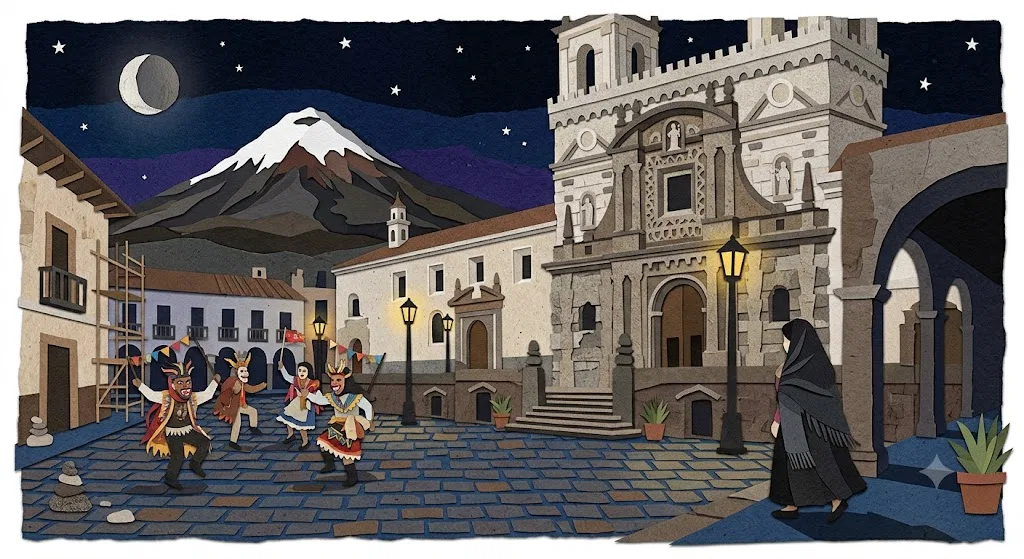
The most famous Quito legend is Cantuña. In the common version, an Indigenous builder or craftsman is unable to complete the atrium of San Francisco on time and makes a pact with the devil. Demons finish the work before dawn, but Cantuña saves his soul by ensuring that one stone is missing, so the work is technically unfinished and the pact cannot be fulfilled. The San Francisco Museum’s own account connects the Cantuña Chapel with Francisco Cantuña, described as a seventeenth-century Indigenous blacksmith from Sangolquí and a benefactor associated with the chapel; it also notes that his legendary fame helped fix the chapel’s name in Quito memory.[museosanfranciscodequito.com]museosanfranciscodequito.comOpen source on museosanfranciscodequito.com.
The legend’s endurance comes from the way it compresses colonial Quito into one memorable scene: Indigenous skill, Catholic architecture, a devil’s bargain, legalistic cunning and a sacred building that seems to carry a hidden flaw. Art historian Susan Verdi Webster has argued that Cantuña is one of Quito’s most popular and enduring legends, but also that legend and history around the chapel are entangled in ways that need careful handling. That is important: the tale is not a building record. It is a folkloric explanation of place, prestige and memory.[Cambridge University Press & Assessment]cambridge.orgOpen source on cambridge.org.
Father Almeida, another Quito favourite, belongs to a different moral register. He is usually described as a friar who sneaks out of his convent at night to drink and enjoy the city, until a supernatural warning — often an encounter with his own funeral or coffin — shocks him into repentance. Like many Catholic urban legends, the story is less about proving a ghost event than about dramatizing temptation, public reputation and reform. Quito’s continued use of Father Almeida in festivals and school-oriented performances shows how a once-moralising tale has become part of civic folklore and visitor culture.[quitoinforma.quito.gob.ec]quitoinforma.quito.gob.ecel festival mas alla de la vida atrajo alrededor de 30 mil visitantesel festival mas alla de la vida atrajo alrededor de 30 mil visitantes
The Cathedral Rooster works in a similar way. In common retellings, a boastful drunk insults or challenges the rooster figure associated with Quito’s cathedral; the supernatural response humiliates him and forces a promise to change. These stories are funny, frightening and disciplinary at once. They warn against drunkenness, arrogance and irreverence, but they also make the city feel alive, as if statues, stones and church façades might answer back after dark.

Coastal and city ghosts: the warning behind the beautiful stranger
The Veiled Lady is one of Ecuador’s best-known ghostly figures, especially associated with Guayaquil. In widely circulated versions, she appears at night as an elegant, veiled woman who attracts men — often drunk, boastful or predatory men — into lonely streets. When she lifts the veil, the alluring woman becomes a skull, corpse-face or deathly apparition, and the victim is left terrified, ill, speechless or dead. The story is commonly placed in old Guayaquil and often dated in retellings to the colonial period around the eighteenth century, although precise documentary origins are much harder to pin down than popular summaries suggest.[Scribd]scribd.comLegends of EcuadorLegends of Ecuador
The tale is easy to misread as simple horror. Its deeper function is social. Like many Latin American night-woman legends, it polices male behaviour in public space: drinking, wandering, sexual pursuit and the assumption that a woman alone at night is available. The frightening reveal reverses the gaze. The man who thinks he is the hunter becomes the one judged and pursued.
Modern internet retellings sometimes relocate the Veiled Lady to Quito or blend her with generic haunted-city material. That does not necessarily make those versions “fake”; folklore often travels. But it does matter for interpretation. The strongest traditional association is with Guayaquil’s nocturnal urban imagination, while contemporary tourism and blog culture increasingly reshape her into a more general Ecuadorian ghost. The useful distinction is between an older local legend, modern national branding and loose online adaptation.[quitoinforma.quito.gob.ec]quitoinforma.quito.gob.ecse queda en quito esta es la oferta turistica para este feriadose queda en quito esta es la oferta turistica para este feriado
Highland beings: goblins, mountain children and dangerous desire
Ecuadorian folklore also includes small or ambiguous beings that are neither exactly European fairies nor simple monsters. The figure often called the goblin appears across Iberian and Latin American tradition, but Ecuadorian stories give it local meanings. A University of New Mexico thesis on this figure in the Ecuadorian context, focused especially on Quito, describes it as a popular mythical character in written and oral traditions and examines how stories about it reproduce ideas about gender roles and violence against women.[UNM Digital Repository]digitalrepository.unm.edultam etdsltam etds
That point is important because some Ecuadorian creature stories are not harmless “cute goblin” material. They may encode fear of harassment, abduction, sexual danger, disobedience or movement through unsafe spaces. Folklore can entertain children, but it can also teach gendered rules about who may go where, at what hour, and with what consequences.
The Chuzalongo is one of the darker Andean beings. In modern summaries it is often described as a small, childlike or dwarf-like figure from the mountains, associated with attacks on women and with frightening sexual symbolism. A bilingual Ecuadorian legends collection describes it as a mountain-dwelling figure that may appear like a small child before transforming into a monstrous being. The tradition has also moved into modern media: the 2024 Ecuadorian folk-horror film Chuzalongo is based on the Andean legend and shows how old rural fears can be reframed for cinema audiences.[publicaciones.uazuay.edu.ec]publicaciones.uazuay.edu.ecA Piece of CultureA Piece of Culture
The challenge for a public folklore page is to avoid both sanitising and sensationalising such figures. Chuzalongo stories are part of Ecuadorian legendary culture, but they touch on sexual violence, fear of the countryside, colonial-era racial hierarchies in some retellings, and modern horror aesthetics. They should be presented as culturally significant narratives, not as spooky mascots.
Sacred landscapes: volcanoes as persons, ancestors and rivals
In Andean Ecuador, mountains and volcanoes are often more than scenery. Folkloric and ritual language may treat them as beings with personality, gender, kinship and power. Popular stories link peaks such as Chimborazo, Cotopaxi, Tungurahua, Imbabura and Cotacachi in romances, rivalries and family relationships. One common cluster of stories imagines male and female mountains as lovers or spouses; another explains eruptions, weather, wind or broken mountain forms through jealousy, battle or grief.[notyouraverageamerican.com]notyouraverageamerican.comTaita Chimborazo and Mama TungurahuaTaita Chimborazo and Mama Tungurahua
These stories sit beside, not instead of, geological knowledge. UNESCO’s profile of Imbabura Geopark, for example, explains the region’s volcanoes through plate tectonics and long volcanic activity, while local traditions often give those same landforms social and sacred meaning. The result is not a contradiction so much as two different ways of relating to place: one scientific and geological, the other narrative, ritual and communal.[UNESCO]unesco.orgOpen source on unesco.org.
Cotacachi is a good example of how landscape, memory and contemporary change meet. Research on Mama Cotacachi describes the northern Ecuadorian volcano as ecologically and socially important and notes that it has lost its glacier in the context of recent accelerated warming. For communities that personify mountains or treat them as protectors, environmental change can also be experienced as cultural and spiritual loss.[VTechWorks]vtechworks.lib.vt.eduech Works Mama Cotacachiech Works Mama Cotacachi
The mountain stories also help explain why Ecuadorian folklore is so place-specific. A legend about a volcano is not interchangeable with a ghost story from a port city or a devil tale from a colonial church. Each depends on terrain, local memory and the social life around that place.
Amazonian oral traditions: myth as knowledge, language and survival
Some of Ecuador’s most important folkloric traditions belong to Amazonian peoples whose oral heritage has been recognised internationally. UNESCO’s listing for the oral heritage and cultural manifestations of the Zápara people, shared by Ecuador and Peru, states that this heritage is expressed through myths, rituals, artistic practices and language, and that the language itself is a repository of traditional knowledge. UNESCO also notes the severe danger facing the Zápara people and language, making this a case where folklore is directly tied to cultural survival.[Intangible Cultural Heritage]ich.unesco.orgOpen source on unesco.org.
This shifts the reader’s understanding of “myth”. In the Zápara case, myth is not merely a tale about supernatural beings. It is part of a threatened system of memory, classification, ritual and ecological relationship. When a language disappears, the loss is not only vocabulary; it can include story forms, place names, ritual speech, plant knowledge and ways of describing non-human life.
Shuar traditions offer another important Amazonian example. Scholarship on Shuar mythology discusses figures and myths such as Etsa, while studies of Shuar and Achuar spiritual ideas describe Arutam as a powerful spiritual force sought through visionary experience. Other research describes Nunkui as associated with the earth, fertility, crops and agricultural knowledge. These traditions are often transmitted through narrative, ritual, education and, increasingly, written books, film projects and bilingual cultural programmes.[edu.pl]czasopisma.ignatianum.edu.plOpen source on edu.pl.
Modern Shuar cultural production also complicates any idea that Indigenous myth is only ancient. The Etsa-Nantu Camera Shuar project, formed in the Ecuadorian Amazon, shows how Shuar media-makers have used cinema and audiovisual work to defend territory, represent culture and tell stories in contemporary forms. Folklore here is not simply preserved behind glass; it becomes a tool for education, political expression and cultural continuity.[revistas.usfq.edu.ec]revistas.usfq.edu.ecOpen source on edu.ec.

Festivals where folklore is performed, not just remembered
Some Ecuadorian traditions are most visible not in storybooks but in streets, masks, music, food and processions. The Píllaro devils are a striking example. Ecuador’s National Institute of Cultural Heritage explains that the festival’s origins are tied to popular stories about men from one community disguising themselves as devils to frighten rival suitors from another. Today, the celebration includes devils, masked figures, music, dancing and months of preparation, while retaining its role as a space of collective identity and transmission of local knowledge.[patrimoniocultural.gob.ec]patrimoniocultural.gob.ecOpen source on gob.ec.
The Mama Negra festival in Latacunga shows a different kind of mixture. The National Institute of Cultural Heritage describes it as the most emblematic intangible cultural heritage expression of Latacunga, also known by names connected with the Virgin of Mercy and local civic identity. It has two annual moments: a more religious celebration in September, organised by market traders and devotees, and a civic-political celebration in November linked to Latacunga’s independence commemoration. The institute stresses its syncretic character, combining Catholic devotion, civic belonging, symbolic performance and popular art.[patrimoniocultural.gob.ec]patrimoniocultural.gob.ecOpen source on gob.ec.
The Day of the Dead season is another place where food, memory and folk religion meet. In Ecuador, the commemoration is strongly associated with a thick purple drink made with fruits, spices and purple maize flour, and with decorated bread figures. A 2025 scientific article on the drink describes Ecuador’s Day of the Dead as a blend of Indigenous traditions and Spanish colonial influences, while contemporary accounts note how these foods have become markers of Ecuadorian identity at home and in migrant communities abroad.[ScienceDirect]sciencedirect.comOpen source on sciencedirect.com.
These festivals are not folklore in the narrow sense of “old stories”. They are living performance systems. Masks, routes, roles, foods, music and jokes all carry meaning, and each generation decides what to keep, alter, commercialise or contest.
How old are these traditions, and how well attested are they?
Ecuadorian folklore ranges from well-documented intangible heritage to loosely sourced tourist legends. The Zápara oral heritage, marimba traditions, the Píllaro devils and Mama Negra are supported by institutional recognition, community practice and heritage documentation. That does not mean every origin story attached to them is historically provable, but it does mean the traditions themselves are socially real and publicly maintained.[unesco.org]ich.unesco.orgOpen source on unesco.org.
Urban legends such as Cantuña, Father Almeida and the Cathedral Rooster are well-attested as part of Quito’s cultural memory, but their plots should not be treated as literal history. Cantuña is especially interesting because there was a historical chapel, a remembered benefactor and a long-running legend around the San Francisco complex. The safest reading is that the story preserves Quito’s colonial tensions and religious imagination rather than a factual contract with the devil.[museosanfranciscodequito.com]museosanfranciscodequito.comOpen source on museosanfranciscodequito.com.
Other beings, such as Chuzalongo or the Veiled Lady, are widely circulated but often harder to pin to early documents. Their importance lies partly in repetition: school materials, oral storytelling, blogs, theatre, festivals and film keep them active. For readers, the key question is not “did this happen?” but “what work does the story do?” In many cases, the answer involves warning, discipline, identity, humour, fear of night spaces, anxiety about sexuality, or the transformation of local history into memorable narrative.
Modern retellings: tourism, classrooms, horror cinema and the internet
Ecuadorian folklore today moves through many channels at once. Municipal festivals turn legendary characters into street theatre. Museums and churches use legends to interpret buildings. Schools use simplified legends for reading exercises. Tourism websites package stories into visitor-friendly routes. Filmmakers turn beings such as Chuzalongo into folk horror. Social media spreads short, dramatic versions that may blur regional origins or strip away context.[gob.ec]quitoinforma.quito.gob.ecel festival mas alla de la vida atrajo alrededor de 30 mil visitantesel festival mas alla de la vida atrajo alrededor de 30 mil visitantes
This is not automatically a decline. Folklore has always changed when audiences change. A legend told beside a hearth, in a convent corridor, on a school worksheet, by a tour guide or in a cinema will not sound the same. What matters is whether the retelling respects local specificity and avoids flattening every Ecuadorian story into generic “creepy Latin American myth”.
There is also a tension between heritage protection and commercial spectacle. Festivals such as Mama Negra and the Píllaro devils attract visitors, but they are not simply shows for outsiders. They involve local roles, preparation, devotion, memory and community prestige. The same is true of Amazonian oral traditions: when they are translated into books, films or online summaries, something may be made more visible, but something may also be simplified.[patrimoniocultural.gob.ec]patrimoniocultural.gob.ecOpen source on gob.ec.
What to remember about Ecuadorian folklore
Ecuador’s folklore is strongest when read through place. Quito’s legends belong to stone churches and colonial streets. Guayaquil’s Veiled Lady belongs to the moral imagination of the nocturnal port city. Highland devil festivals belong to rivalry, disguise, music and public performance. Volcano stories belong to a landscape where mountains can be ancestors, lovers, rivals and protectors. Amazonian myths belong to languages, ecological knowledge and ritual systems that remain under pressure.
The most useful way to approach these traditions is neither sceptical dismissal nor supernatural certainty. They are cultural narratives: stories people tell, perform and adapt in order to make sense of danger, memory, landscape, morality and belonging. Some are old oral traditions with fragile linguistic roots; some are colonial legends reshaped by tourism; some are ritual performances with official heritage status; some are modern media revivals. Together, they make Ecuador’s legendary culture unusually varied for a small country — and show how folklore survives by changing form while keeping its hold on place.
Amazon book picks
Further Reading
Books and field guides related to Why Ecuador's Legends Still Haunt Place. Use these as the next step if you want deeper reading beyond the article.
The Hero with a Thousand Faces
Helps readers understand recurring folklore patterns and legends.
South American Mythology
Explains broader mythic traditions influencing Ecuadorian narratives.
Latin American Folktales
Covers folklore traditions that help situate Ecuador within Latin American storytelling.
eBay marketplace picks
Marketplace Samples
Live-tested eBay searches with available results related to this page.

Endnotes
1.
Source: ich.unesco.org
Link:https://ich.unesco.org/en/RL/oral-heritage-and-cultural-manifestations-of-the-zapara-people-00007
2.
Source: patrimoniocultural.gob.ec
Link:https://www.patrimoniocultural.gob.ec/patrimonios-inmateriales-del-ecuador-3/
3.
Source: quitoinforma.quito.gob.ec
Title: el festival mas alla de la vida atrajo alrededor de 30 mil visitantes
Link:https://quitoinforma.quito.gob.ec/2024/11/05/el-festival-mas-alla-de-la-vida-atrajo-alrededor-de-30-mil-visitantes/
4.
Source: ich.unesco.org
Link:https://ich.unesco.org/en/RL/marimba-music-traditional-chants-and-dances-from-the-colombia-south-pacific-region-and-esmeraldas-province-of-ecuador-01099
5.
Source: patrimoniocultural.gob.ec
Link:https://www.patrimoniocultural.gob.ec/el-inpc-celebrara-el-dia-del-pasillo-se-prepara-la-declaratoria-como-patrimonio-inmaterial-del-ecuador/
6.
Source: books.openedition.org
Link:https://books.openedition.org/obp/1290?lang=en
7.
Source: quitoinforma.quito.gob.ec
Title: se queda en quito esta es la oferta turistica para este feriado
Link:https://quitoinforma.quito.gob.ec/2024/10/30/se-queda-en-quito-esta-es-la-oferta-turistica-para-este-feriado/
8.
Source: museosanfranciscodequito.com
Link:https://museosanfranciscodequito.com/historia-capilla-de-cantuna/
9.
Source: cambridge.org
Link:https://www.cambridge.org/core/journals/americas/article/devil-and-the-dolorosa-history-and-legend-in-quitos-capilla-de-cantuna/A47EE437E1ED86028BD9BB1E7ADE9EA1
10.
Source: quitoinforma.quito.gob.ec
Title: con un mensaje sobre el reciclaje el rimember llega a los colegios quitenos
Link:https://quitoinforma.quito.gob.ec/2021/12/14/con-un-mensaje-sobre-el-reciclaje-el-rimember-llega-a-los-colegios-quitenos/
11.
Source: scribd.com
Title: Legends of Ecuador
Link:https://www.scribd.com/document/955513717/Legends-of-Ecuador
12.
Source: digitalrepository.unm.edu
Title: ltam etds
Link:https://digitalrepository.unm.edu/ltam_etds/51/
13.
Source: digitalrepository.unm.edu
Link:https://digitalrepository.unm.edu/cgi/viewcontent.cgi?article=1055&context=ltam_etds
14.
Source: publicaciones.uazuay.edu.ec
Title: A Piece of Culture
Link:https://publicaciones.uazuay.edu.ec/flip/books/libro/uazuay-libro-180.pdf
15.
Source: notyouraverageamerican.com
Title: Taita Chimborazo and Mama Tungurahua
Link:https://notyouraverageamerican.com/taita-chimborazo-and-mama-tungurahua/
16.
Source: unesco.org
Link:https://www.unesco.org/en/iggp/imbabura-unesco-global-geopark
17.
Source: researchgate.net
Link:https://www.researchgate.net/publication/264040870_Mama_Cotacachi_History_Local_Perceptions_and_Social_Impacts_of_Climate_Change_and_Glacier_Retreat_in_the_Ecuadorian_Andes
18.
Source: unesco.org
Link:https://www.unesco.org/en/node/180890
19.
Source: czasopisma.ignatianum.edu.pl
Link:https://czasopisma.ignatianum.edu.pl/eetp/article/download/2601/2792/
20.
Source: researchgate.net
Link:https://www.researchgate.net/publication/311512397_Seeking_The_Headhunter%27s_Power_The_Quest_for_Arutam_Among_the_Achuar_Indians_of_the_Ecuadorian_Amazon_and_the_Development_of_Ranked_Societies
21.
Source: revistas.usfq.edu.ec
Link:https://revistas.usfq.edu.ec/index.php/posts/article/view/2067
22.
Source: repositorio.flacsoandes.edu.ec
Link:https://repositorio.flacsoandes.edu.ec/items/aae3a084-fd0d-4362-93e2-567adf70fdff
23.
Source: patrimoniocultural.gob.ec
Link:https://www.patrimoniocultural.gob.ec/la-diablada-pillarena/
24.
Source: patrimoniocultural.gob.ec
Link:https://www.patrimoniocultural.gob.ec/fiesta-de-la-mama-negra-o-fiesta-de-la-capitania/
25.
Source: sciencedirect.com
Link:https://www.sciencedirect.com/science/article/pii/S2666154325000729
26.
Source: goraymi.com
Link:https://www.goraymi.com/es-ec/pichincha/quito/leyendas-cuentos/leyenda-cantuna-pacto-diablo-san-francisco-abh2ojebm
27.
Source: scribd.com
Link:https://www.scribd.com/document/619098378/The-10-Most-Known-Ecuadorian-Legends-and-Myths-Short-Life-Persona
28.
Source: scribd.com
Link:https://www.scribd.com/document/377146823/Legends-of-Ecuador-docx
29.
Source: scribd.com
Title: Legend of Cantuna
Link:https://www.scribd.com/document/953542156/Legend-of-Cantuna
30.
Source: es.scribd.com
Title: CLUB DE LECTURA
Link:https://es.scribd.com/document/997141764/CLUB-DE-LECTURA
31.
Source: pt.scribd.com
Link:https://pt.scribd.com/document/381875856/Cantuna
32.
Source: scribd.com
Link:https://www.scribd.com/document/966166686/The-Covered-Lady
33.
Source: es.scribd.com
Title: ECUADORIAN MYTHOLOGY
Link:https://es.scribd.com/document/926520815/ECUADORIAN-MYTHOLOGY
34.
Source: scribd.com
Link:https://www.scribd.com/document/966779412/The-Veiled-Lady
35.
Source: scribd.com
Link:https://www.scribd.com/document/937621382/Quechua-Oral-Traditions-and-Rituals
36.
Source: notyouraverageamerican.com
Link:https://notyouraverageamerican.com/cantuna-legend-quito-ecuador/
37.
Source: incentivos.culturaypatrimonio.gob.ec
Title: publicacion Eventos Deducibilidad List
Link:https://incentivos.culturaypatrimonio.gob.ec/lib/phpPdf/publicacionEventosDeducibilidadList.php
38.
Source: ich.unesco.org
Title: ecuador EC
Link:https://ich.unesco.org/en/state/ecuador-EC
39.
Source: ich.unesco.org
Link:https://ich.unesco.org/en/activities/forum-safeguarding-living-heritage-lessons-from-ecuador-s-intangible-cultural-heritage-list-00578
40.
Source: ich.unesco.org
Link:https://ich.unesco.org/en/projects/bi-national-action-plan-for-the-safeguarding-and-revitalization-of-the-oral-and-intangible-heritage-of-the-zapara-community-00012
41.
Source: ich.unesco.org
Title: ecuador EC
Link:https://ich.unesco.org/es/estado/ecuador-EC?info=proyectos
42.
Source: ich.unesco.org
Title: 00010 EN
Link:https://ich.unesco.org/doc/src/00010-EN.pdf
43.
Source: ich.unesco.org
Title: ITH 15 10.CO M 6.a EN.docx
Link:https://ich.unesco.org/doc/src/ITH-15-10.COM-6.a_EN.docx?t=1446461031
44.
Source: ich.unesco.org
Link:https://ich.unesco.org/es/proyectos/plan-de-accion-binacional-para-la-salvaguardia-y-revitalizacion-del-patrimonio-oral-e-inmaterial-del-pueblo-zapara-00012
45.
Source: ich.unesco.org
Title: 01856 EN
Link:https://ich.unesco.org/doc/src/01856-EN.pdf
46.
Source: ich.unesco.org
Title: 04558 EN.doc
Link:https://ich.unesco.org/doc/src/04558-EN.doc
47.
Source: ich.unesco.org
Title: peru PE
Link:https://ich.unesco.org/en/state/peru-PE?info=projects
48.
Source: ich.unesco.org
Link:https://ich.unesco.org/en/lists
49.
Source: unesco.org
Link:https://www.unesco.org/en/iggp/tungurahua-volcano-unesco-global-geopark
50.
Source: unesdoc.unesco.org
Link:https://unesdoc.unesco.org/ark%3A/48223/pf0000138957
51.
Source: institutojubones.edu.ec
Link:https://institutojubones.edu.ec/ojs/index.php/portal/en/article/view/732
52.
Source: researchgate.net
Link:https://www.researchgate.net/publication/360603157_Kichwa_orality_past_and_present_from_the_educational_anthropological_and_cultural_perspective
53.
Source: researchgate.net
Link:https://www.researchgate.net/publication/376152207_Ecuadorian_Legends_II_Reading_Comprehension_Exercises_For_Pre-Intermediate_Students
54.
Source: researchgate.net
Link:https://www.researchgate.net/publication/305882794_UNESCO_DOSSIER_FOR_THE_ASPIRING_GEOPARK_VOLCANO_TUNGURAHUA_ECUADOR_ENGLISH
55.
Source: researchgate.net
Link:https://www.researchgate.net/publication/376864276_Mitologia_Shuar_w_perspektywie_postkolonialnej_na_przykladzie_ksiazki_Etsa
56.
Source: researchgate.net
Title: (PDF) “Jesus Is the Same Arutam”
Link:https://www.researchgate.net/publication/289798159Jesus_Is_the_Same_Arutam-_Logics_of_Appropriation_among_Missionized_Indians_and_Indigenized_Missionaries_2011
57.
Source: museosanfranciscodequito.com
Link:https://museosanfranciscodequito.com/
58.
Source: ecuador.com
Link:https://www.ecuador.com/culture/folklore/
59.
Source: patrimoniocultural.gob.ec
Link:https://www.patrimoniocultural.gob.ec/wp-content/uploads/2023/04/1_Informe-gestion-INPC-2009.pdf
60.
Source: universitas.ups.edu.ec
Link:https://universitas.ups.edu.ec/index.php/universitas/article/view/32.2020.10/3731
61.
Source: revistas.uazuay.edu.ec
Link:https://revistas.uazuay.edu.ec/html/revistas/ODIGITAL/18/en/articulo02/uazuay.globalization-and-oral-traditions.html
62.
Source: goraymi.com
Link:https://www.goraymi.com/en-ec/ecuador/rutas-culturales/intangible-heritage-country-worlds-ecuador-a3jty3765
63.
Source: sga.unae.edu.ec
Link:https://sga.unae.edu.ec/media/publicacionpersona/2022/07/17/publicacion_2022717182711.pdf
64.
Source: dspace.udla.edu.ec
Title: UDLA EC TTADT 2017 03 ANEXO
Link:https://dspace.udla.edu.ec/bitstream/33000/8189/2/UDLA-EC-TTADT-2017-03%20ANEXO.pdf
65.
Source: Wikipedia
Link:https://en.wikipedia.org/wiki/Chuzalongo
66.
Source: vtechworks.lib.vt.edu
Title: ech Works Mama Cotacachi
Link:https://vtechworks.lib.vt.edu/bitstream/handle/10919/67639/2945_Mama_Cotacachi.pdf
67.
Source: frontiersin.org
Link:https://www.frontiersin.org/journals/climate/articles/10.3389/fclim.2026.1695925/full
68.
Source: journals.tulane.edu
Link:https://journals.tulane.edu/turj/article/view/2972/2776
69.
Source: Wikipedia
Link:https://en.wikipedia.org/wiki/Shuar
70.
Source: folklore.usc.edu
Link:https://folklore.usc.edu/etsa/
Additional References
71.
Source: youtube.com
Title: THE LEGEND OF CANTUÑA AND THE DEVIL | Animated Story for Children
Link:https://www.youtube.com/watch?v=XXtIKmo7J_8
Source snippet
Diablada de Píllaro 2026: Insane Devil Dance, Masks & Street Party...
72.
Source: youtube.com
Title: Diablada Pillarena | Ecuador’s Devil Dance on a Frugal Budget
Link:https://www.youtube.com/watch?v=M6siVzDVpw0
Source snippet
The Zapara tribe of Ecuador on the road back from near extinction...
73.
Source: youtube.com
Title: The Zapara tribe of Ecuador on the road back from near extinction
Link:https://www.youtube.com/watch?v=rOSykza60-w
Source snippet
Ecuador And Colombia Marimba Masters and Sacred Songs...
74.
Source: facebook.com
Link:https://www.facebook.com/groups/cotacachi/posts/7191463147628712/
75.
Source: biblat.unam.mx
Link:https://biblat.unam.mx/hevila/AntropologicaCaracas/2003/no99-100/11.pdf
76.
Source: facebook.com
Link:https://www.facebook.com/groups/cotacachi/posts/7010469672394728/
77.
Source: voyagers.travel
Link:https://www.voyagers.travel/ecuador/traditions-festivities
78.
Source: responsibletravelsa.com
Link:https://responsibletravelsa.com/es/blog/ecuadors-unique-festivals-are-you-ready-to-experience-the-countrys-soul/
79.
Source: pure-travelgroup.com
Link:https://pure-travelgroup.com/ecuadorian-andes-where-culture-comes-alive/
80.
Source: facebook.com
Link:https://www.facebook.com/ecuadorandariego/posts/en-el-centro-hist%C3%B3rico-de-quito-la-iglesia-y-convento-de-san-francisco-son-testi/1193707832211405/
Topic Tree
Follow this branch
Related pages 192
- Afghan Folklore
- Albanian Folklore
- Algerian Folklore
- Australian Folklore
- Azerbaijan Folklore
- +187 more in sidebar