Why Paraguay's Old Spirits Still Feel Alive
Paraguay’s folklore is unusually visible in everyday national culture because it lives in two linked worlds: the Indigenous Guaraní story tradition and the wider bilingual society that still uses Guaraní alongside Spanish.
Page outline Jump by section
Why Paraguayan folklore feels so alive
The first thing to understand about Paraguayan folklore is that language is not a side issue. Guaraní is one of Paraguay’s official languages, and it remains emotionally and culturally central even where fluency is uneven or declining among younger people. Recent reporting on preservation efforts describes Guaraní as deeply tied to memory, family life, rural experience, and spiritual feeling, while also noting that it is still used more often orally than in official written contexts.[AP News]apnews.comHistorically marginalized, Guaraní is deeply tied to national identity and cultural heritage, evoking strong emotional and spiritual reso…
That matters for folklore because many Paraguayan legends have circulated primarily through speech: warnings from parents, stories told at home, local explanations for odd sounds or misfortunes, and community versions that shift from place to place. The same figure may be a dangerous forest being in one telling, a household guardian in another, and a comic or artistic symbol in a modern retelling. This is not a weakness in the tradition; it is how oral folklore works.
Paraguay is also distinctive because Guaraní is not only spoken by Indigenous communities. It has become a broad national language, used by many non-Indigenous Paraguayans as well. Older household-language figures commonly cited for Paraguay show a large share of homes using both Spanish and Guaraní, or Guaraní alone, while contemporary reporting still describes Guaraní as widely spoken but socially vulnerable, especially in formal education and written public life.[OpenFactBook]openfactbook.orgOpen Fact Book ParaguayParaguay - Country Profile | OpenFactBook World FactbookLanguages: Spanish (official) and Guarani (official) 46.3%, only Guar…
The Guaraní roots of the best-known legends
Much of Paraguay’s legendary landscape is rooted in Guaraní cosmology, especially stories of powerful beings associated with forests, water, hills, night, fertility, death, and social taboos. The best-known cycle for general readers is the tale of Tau and Kerana, whose cursed children become seven famous beings: Teju Jagua, Mboi Tui, Moñai, Jasy Jatere, Kurupi, Ao Ao, and Luison. Modern summaries often present them as a neat set of “seven monsters”, but in living tradition their details vary, and their meanings are broader than a simple monster catalogue.[The Asunción Times]asunciontimes.comseven monstrous brothers exploring the heart of guarani mythologyseven monstrous brothers exploring the heart of guarani mythology
The strongest scholarly anchor for older Guaraní mythic material is not a tourist list but the work of collectors and ethnographers such as León Cadogan. His Ayvu Rapyta, first published in 1959, compiled Mbyá-Guaraní mythic, religious, prayer, and song texts from the Guairá region, with the texts presented in Mbyá and Spanish in later editions. Library records classify the work under Mbyá folklore, Mbyá religion, legends of Paraguay’s Guairá region, and Mbyá-language texts.[Search UW-Madison Libraries]search.library.wisc.eduOpen source on wisc.edu.
A 2025 article from Paraguay’s Secretariat of Linguistic Policies describes Ayvu Rapyta as a compilation of myths, prayers, songs, and accounts transmitted by Mbyá-Guaraní wisdom bearers, and emphasises its importance for understanding Guaraní religiosity and the idea of the “word-soul”. That is important because it reminds readers that Guaraní myth is not only a set of colourful monsters; it also includes sacred language, origin stories, ritual speech, and ethical ideas about how humans relate to the world.[spl.gov.py]spl.gov.pyexplorando el ayvu rapyta un acercamiento a la religiosidad mbya guaraniexplorando el ayvu rapyta un acercamiento a la religiosidad mbya guarani
Pombero: the night spirit everyone knows
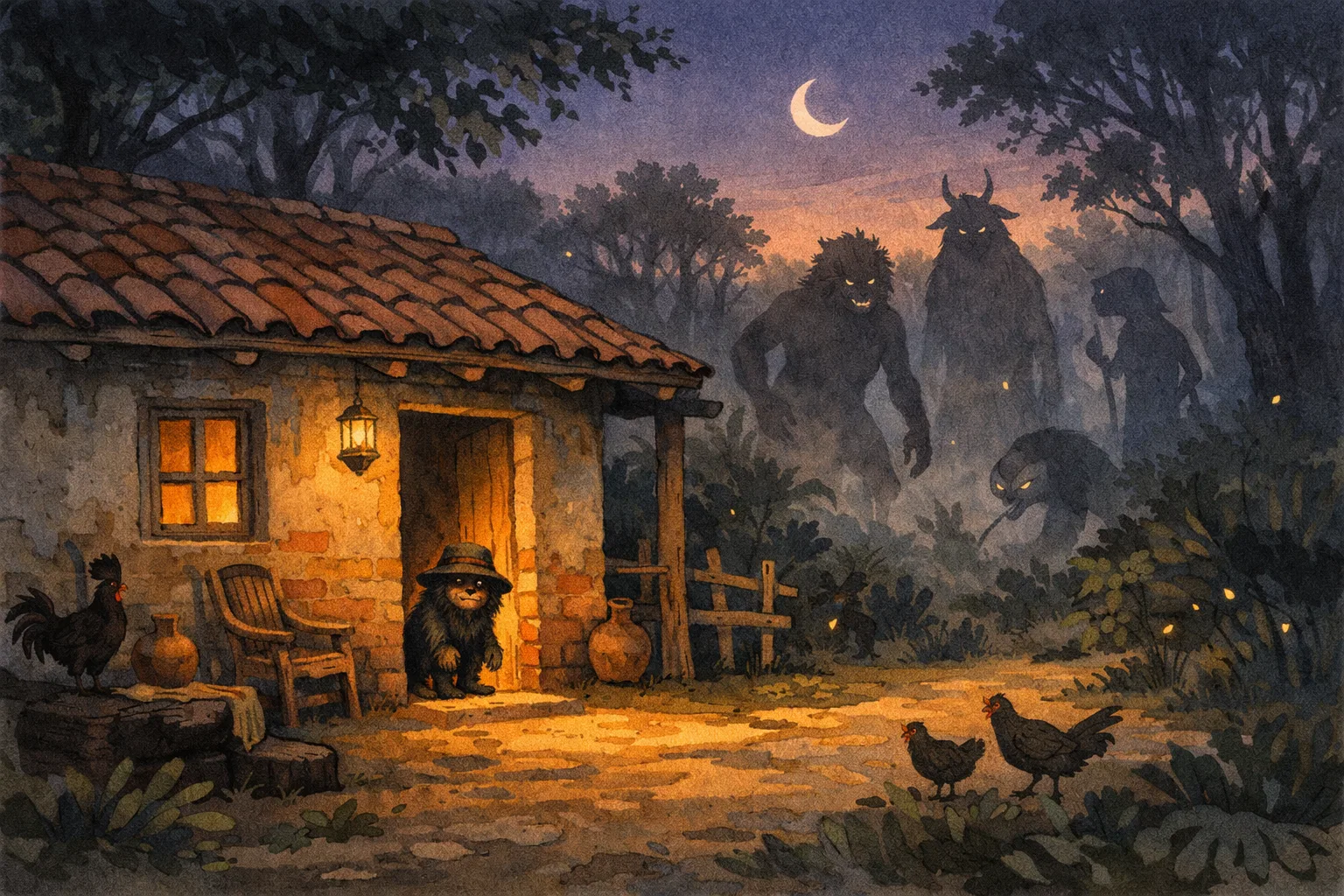
Pombero is probably Paraguay’s most famous folkloric being today. He is usually imagined as a small, elusive, hairy or goblin-like night figure associated with rural spaces, birds, animals, mischief, and household unease. In many retellings he whistles, moves silently, steals eggs or honey, frightens animals, unfastens livestock, tangles horses’ manes, and punishes those who offend him. Some accounts also describe offerings of tobacco, alcohol, honey, or other small gifts left to appease him.[Wikipedia]WikipediaOpen source on wikipedia.org.
Pombero’s power lies in his ambiguity. He is not simply evil. He may be a nuisance, a sexual threat in darker versions, a protector of birds and wild creatures, or a spirit whose favour helps guard a home. That range tells us a lot about rural folklore: the same being can explain practical anxieties, moralise behaviour, mark dangerous spaces, and offer a way of negotiating with the unseen.
Modern Paraguay has also turned Pombero into an artistic and tourist figure. Visit Paraguay lists Museo Pombero Róga in Atyrá, on Cerro Monte Alto, as a place combining nature, art, and culture, with the gallery of artist and sculptor Miguel Ángel Alarcón Pibernat. Recent local coverage describes the site as featuring figures such as Pombero, Jasy Jatere, and Kurupi in recycled art, showing how myth can move from whispered rural warning to public cultural attraction.[Visit Paraguay]visitparaguay.travelOpen source on visitparaguay.travel.
Pombero’s modern media life is just as telling. He has appeared in music, television-style paranormal programming, and a Paraguayan video game, Pombero – The Lord of Night. These adaptations should not be treated as ancient tradition in themselves, but they show how a rural night spirit can become a national pop-culture emblem.[Wikipedia]WikipediaOpen source on wikipedia.org.
Jasy Jatere and the folklore of childhood
Jasy Jatere is one of the most memorable figures in Paraguayan Guaraní tradition because he is tied to a very ordinary social situation: children wandering outside at the wrong time. He is commonly described as a small, beautiful or childlike figure connected with the midday rest period, with a magical staff or whistle, who lures children into the forest. In gentler versions he plays with them and feeds them fruit or honey; in harsher ones he blinds, abandons, imprisons, or hands them over to a more terrifying being.[Wikipedia]WikipediaJasy JatereJasy Jatere
The point is not that every family tells the story the same way. The point is that Jasy Jatere gives memorable shape to a parental warning: stay indoors, rest, do not wander into the heat or the bush, and do not ignore the rules of the household. That makes him part bogeyman, part nature spirit, part child’s nightmare, and part social tool.
He is also an example of why Paraguayan folklore resists tidy categories. Jasy Jatere can be counted among the seven cursed children of Tau and Kerana, but he is not always monstrous in appearance. He is frightening precisely because he appears attractive, playful, or childlike. The danger is not a roaring beast at the door; it is the beautiful figure who makes disobedience feel like an adventure.[The Asunción Times]asunciontimes.comseven monstrous brothers exploring the heart of guarani mythologyseven monstrous brothers exploring the heart of guarani mythology
The seven monstrous children of Tau and Kerana
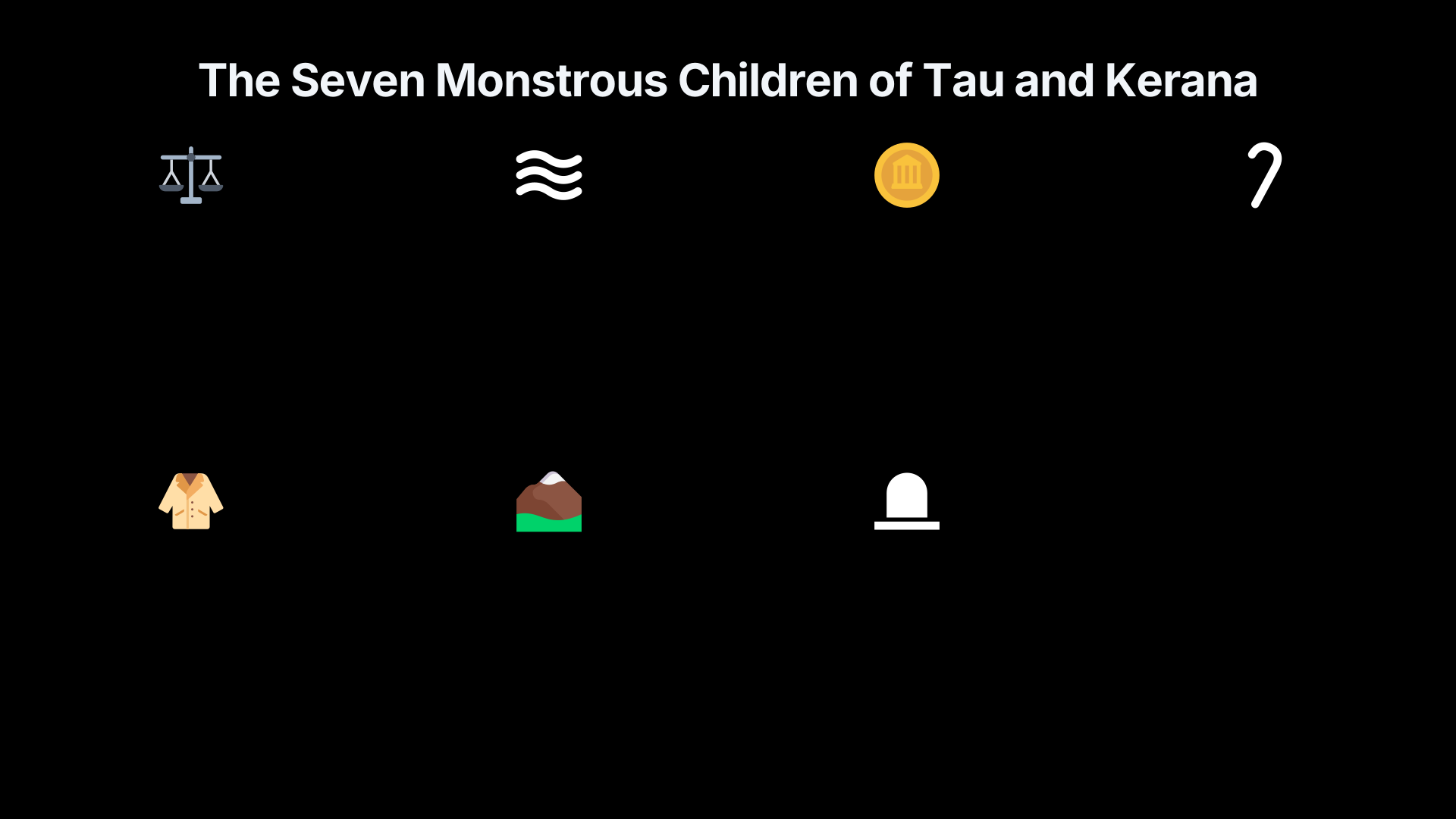
The story of Tau and Kerana offers Paraguay one of its clearest mythic frameworks. In popular retellings, Tau, often presented as a malevolent force, desires or abducts Kerana; their children are cursed into seven extraordinary beings, each linked to a domain of nature, fear, appetite, or taboo. The exact details vary, but the set is widely recognised in Paraguay and across Guaraní-speaking cultural regions.[The Asunción Times]asunciontimes.comseven monstrous brothers exploring the heart of guarani mythologyseven monstrous brothers exploring the heart of guarani mythology
The seven are often summarised as follows:
- Teju Jagua is linked with caves, fruit, and a hybrid reptilian or dog-headed form in modern lists.
- Mboi Tui is associated with waterways, wetlands, and aquatic life.
- Moñai is often tied to open fields, theft, or greed, depending on the version.
- Jasy Jatere belongs to the world of children, siesta, enchantment, and hidden treasure.
- Kurupi is a fertility and sexuality figure, often described in frankly sexual and predatory terms.
- Ao Ao is associated with hills, mountains, pursuit, and cannibal danger.
- Luison is tied to death, cemeteries, carrion, night, and later werewolf-like imagery.[The Asunción Times]asunciontimes.comseven monstrous brothers exploring the heart of guarani mythologyseven monstrous brothers exploring the heart of guarani mythology
This set is useful for readers because it shows how Paraguayan folklore organises fear. Water, hills, forests, sexuality, childhood, death, and hunger are all given a face. But the “seven monsters” label can flatten the tradition if taken too literally. In oral culture, these beings are not fixed characters from a single authorised text; they are flexible figures whose traits have been reshaped by local storytelling, Catholic influence, colonial encounter, print culture, schoolbooks, tourism, and the internet.
Luison, Kurupi and the darker side of legend
Two of Paraguay’s most disturbing folkloric beings are Luison and Kurupi. Luison is commonly described today as a night creature associated with death, cemeteries, carrion, and the fate of a seventh son. Some modern retellings give him werewolf-like features, and commentators often note that this likely reflects later European influence layered onto an older Guaraní figure of death and night.[Simons Paraguay]simonsparaguay.comseven monsters of guarani mythologyseven monsters of guarani mythology
Kurupi is even more difficult to handle for a general audience because he is strongly associated with sexuality, fertility, abduction, and sexual violence in many tellings. Modern summaries often describe him as a short, hairy being with an exaggerated sexual organ, feared as a threat to women. This is not a decorative monster detail; it belongs to a class of folklore that encodes anxieties about desire, pregnancy, assault, blame, secrecy, and social control.[Wikipedia]WikipediaOpen source on wikipedia.org.
These stories should be presented carefully. They are part of Paraguay’s folklore, but they are not harmless children’s tales in every version. Like many traditions around the world, they can preserve old fears and moral codes while also revealing uncomfortable assumptions about gender and responsibility. A modern reader can appreciate their cultural importance without treating every inherited message as admirable.
Sacred speech, plants and everyday ritual
Paraguayan folklore is not only about monsters. It also includes ritual knowledge, plant traditions, healing ideas, prayers, songs, and social customs. UNESCO’s intangible heritage listings for Paraguay show how everyday practices can carry deep cultural memory. The traditional knowledge surrounding tereré, the cold yerba mate drink associated with medicinal plants in Paraguay, was inscribed on UNESCO’s Representative List in 2020, while Guarania, a Paraguayan musical genre created in the early twentieth century, was inscribed in 2024 as “the sound of the Paraguayan soul”.[UNESCO Intangible Cultural Heritage]ich.unesco.orgOpen source on unesco.org.
These examples are not “myths” in the monster-story sense, but they matter for a country-level folklore page because they show the wider field of living tradition: what people drink, sing, remember, prepare, transmit, and recognise as shared heritage. Folklore is not only what people once believed; it is also what communities keep doing and retelling.
The plant world is especially important in Guaraní-rooted tradition. Stories of forest beings, bird protectors, medicinal knowledge, and sacred or dangerous landscapes all reflect a worldview in which nature is socially and spiritually charged. Recent reporting on Guaraní preservation in Paraguay notes concepts of spiritual guardianship of nature and links between language, reciprocity, and respect for the land.[AP News]apnews.comHistorically marginalized, Guaraní is deeply tied to national identity and cultural heritage, evoking strong emotional and spiritual reso…

Mission towns, colonial change and mixed tradition
Paraguayan folklore cannot be understood as purely pre-colonial or purely Spanish. It developed through long contact among Guaraní communities, Spanish colonial society, Catholic missions, rural mestizo culture, and later national institutions. The Jesuit missions in the wider region played a major role in writing, teaching, music, religious conversion, and the reshaping of Guaraní cultural life; two former Jesuit missions in Paraguay, La Santísima Trinidad de Paraná and Jesús de Tavarangue, are UNESCO World Heritage Sites.[Wikipedia]WikipediaCulture of ParaguayCulture of Paraguay
That history helps explain why Paraguayan legends often feel layered. Luison may carry traces of both an older death-spirit tradition and European werewolf motifs. Pombero may be read as a Guaraní forest being, a rural household spirit, a moral warning, or a modern national mascot. Sacred speech recorded in Ayvu Rapyta sits closer to Indigenous religious knowledge, while public festivals, music, and tourist sites may present tradition through a national or commercial frame.[spl.gov.py]spl.gov.pyexplorando el ayvu rapyta un acercamiento a la religiosidad mbya guaraniexplorando el ayvu rapyta un acercamiento a la religiosidad mbya guarani
The result is not a diluted folklore but a mixed one. Paraguay’s legends have survived partly because they adapted: from oral performance to print, from family warning to school culture, from rural belief to museum sculpture, from sacred language to academic study, and from local fear to game, song, or internet discussion.
Haunted and sacred landscapes
Paraguayan folklore is strongly tied to landscape. Forests, rivers, hills, fields, abandoned buildings, cemeteries, and rural paths are the natural homes of its best-known beings. Pombero belongs to the night edge of the house and forest. Jasy Jatere appears when children leave the safe domestic world. Ao Ao roams hills and mountains. Mboi Tui belongs to waterways. Luison haunts burial places and the imagination of death.[The Asunción Times]asunciontimes.comseven monstrous brothers exploring the heart of guarani mythologyseven monstrous brothers exploring the heart of guarani mythology
This gives Paraguayan folklore a practical geography. The stories are not simply about “the supernatural”; they teach where not to go, when not to travel, what sounds to respect, how to behave around animals, why children must obey certain rules, and why the countryside is never merely empty space.
Modern heritage sites can turn this landscape into public culture. Pombero Róga in Atyrá is a clear example: it places mythic figures in a walkable artistic environment, using local landscape and recycled materials to translate oral legend into visual encounter. That kind of site changes the folklore’s function. What may once have been a warning whispered after dark becomes a daytime cultural attraction, but the underlying figures remain recognisable.[Visit Paraguay]visitparaguay.travelOpen source on visitparaguay.travel.
What is old tradition, and what is modern retelling?
A careful reader should separate several layers of Paraguayan folklore:
Older Indigenous and oral traditions include sacred narratives, songs, prayers, and cosmological material transmitted through Guaraní-speaking communities. Cadogan’s Ayvu Rapyta is central here because it records Mbyá-Guaraní mythic and religious texts rather than simply retelling popular monsters for entertainment.[Search UW-Madison Libraries]search.library.wisc.eduOpen source on wisc.edu.
Rural Paraguayan folk belief includes figures such as Pombero, Jasy Jatere, Luison, and Kurupi as told in family, village, and countryside settings. These stories are often practical: they warn children, explain misfortune, regulate behaviour, or encode respect for animals and places.[Wikipedia]WikipediaOpen source on wikipedia.org.
Literary and educational retellings organise fluid oral material into more fixed forms. Once a being appears in schoolbooks, illustrated collections, national folklore summaries, or tourism writing, it becomes easier to recognise, but also easier to simplify.
Tourist and pop-culture adaptations include museums, sculptures, music, television, video games, and online legend pages. These can keep folklore visible, but they may also emphasise the most marketable or frightening version of a figure. Pombero’s recent life in art spaces and games is a good example of a living tradition being remade for modern audiences.[The Asunción Times]asunciontimes.compombero roga mythology and art in atyra paraguays cultural heartlandpombero roga mythology and art in atyra paraguays cultural heartland
The safest approach is not to ask which version is “the real one” as if folklore were a single official script. A better question is: who is telling this version, in what setting, and for what purpose?

How Paraguay understands these legends today
Today, Paraguayan folklore sits between pride, belief, entertainment, scholarship, and preservation. Some people encounter Pombero or Jasy Jatere as childhood warnings. Others meet them through school, art, tourism, online videos, music, or games. Scholars and cultural institutions treat Guaraní language and oral tradition as heritage requiring documentation and safeguarding, while families and communities continue to transmit stories in ordinary speech.[AP News]apnews.comHistorically marginalized, Guaraní is deeply tied to national identity and cultural heritage, evoking strong emotional and spiritual reso…
The current pressure point is language. If Guaraní weakens as a living spoken language, the texture of the folklore changes too. Translated summaries can preserve plots, but they may lose wordplay, tone, rhythm, humour, spiritual vocabulary, and the emotional weight that speakers associate with Guaraní. Recent work on Guaraní in technology and language preservation argues that oral practice itself must be taken seriously, not treated merely as something to be converted into text.[arXiv]arxiv.orgOpen source on arxiv.org.
That is why Paraguay’s folklore matters beyond its monsters. These legends are part of a broader cultural system in which speech, land, family, fear, humour, and identity are deeply linked. Pombero’s whistle, Jasy Jatere’s lure, Luison’s cemetery shadow, and the sacred speech recorded in Guaraní tradition all point to the same larger fact: in Paraguay, folklore is not a decorative afterthought to national culture. It is one of the ways the country remembers who speaks, who listens, where danger lives, and how the visible world is never quite the whole story.
Amazon book picks
Further Reading
Books and field guides related to Why Paraguay's Old Spirits Still Feel Alive. Use these as the next step if you want deeper reading beyond the article.
The Book of Imaginary Beings
Appeals to readers exploring legendary creatures of South America.
eBay marketplace picks
Marketplace Samples
Example marketplace items related to this page. Use the search link to explore similar finds on eBay.
Endnotes
1.
Source: openfactbook.org
Title: Open Fact Book Paraguay
Link:https://openfactbook.org/countries/paraguay/
Source snippet
Paraguay - Country Profile | OpenFactBook World FactbookLanguages: Spanish (official) and Guarani (official) 46.3%, only Guar...
2.
Source: spl.gov.py
Title: explorando el ayvu rapyta un acercamiento a la religiosidad mbya guarani
Link:https://spl.gov.py/es/explorando-el-ayvu-rapyta-un-acercamiento-a-la-religiosidad-mbya-guarani/
3.
Source: Wikipedia
Link:https://en.wikipedia.org/wiki/Pombero
4.
Source: Wikipedia
Title: Jasy Jatere
Link:https://en.wikipedia.org/wiki/Jasy_Jatere
5.
Source: Wikipedia
Link:https://en.wikipedia.org/wiki/Kurupi
6.
Source: ich.unesco.org
Link:https://ich.unesco.org/en/RL/practices-and-traditional-knowledge-of-terere-in-the-culture-of-poha-nana-guarani-ancestral-drink-in-paraguay-01603
7.
Source: ich.unesco.org
Link:https://ich.unesco.org/en/RL/guarania-sound-of-paraguayan-soul-02128
8.
Source: Wikipedia
Title: Culture of Paraguay
Link:https://en.wikipedia.org/wiki/Culture_of_Paraguay
9.
Source: arxiv.org
Link:https://arxiv.org/abs/2603.05743
10.
Source: Wikipedia
Title: Guarani mythology
Link:https://en.wikipedia.org/wiki/Guarani_mythology
11.
Source: Wikipedia
Title: Lists of Intangible Cultural Heritage elements
Link:https://en.wikipedia.org/wiki/Lists_of_Intangible_Cultural_Heritage_elements
12.
Source: Wikipedia
Title: Ayvu Rapyta
Link:https://en.wikipedia.org/wiki/Ayvu_Rapyta
13.
Source: Wikipedia
Title: Languages of Paraguay
Link:https://en.wikipedia.org/wiki/Languages_of_Paraguay
14.
Source: unesdoc.unesco.org
Link:https://unesdoc.unesco.org/ark%3A/48223/pf0000162984
15.
Source: ich.unesco.org
Title: paraguay PY
Link:https://ich.unesco.org/en/state/paraguay-PY
16.
Source: ich.unesco.org
Link:https://ich.unesco.org/en/Decisions/19.COM/7.b.1
17.
Source: ich.unesco.org
Link:https://ich.unesco.org/en/video/72556
18.
Source: ich.unesco.org
Title: 43741 EN.doc
Link:https://ich.unesco.org/doc/src/43741-EN.doc
19.
Source: ine.gov.py
Link:https://www.ine.gov.py/
20.
Source: arxiv.org
Link:https://arxiv.org/html/2501.09943v2
21.
Source: constituteproject.org
Title: Paraguay 2011
Link:https://www.constituteproject.org/constitution/Paraguay_2011
Source snippet
2011) ConstitutionParaguay is a multicultural and bilingual country. Castilian and Guarani are official languages. The law will establish...
22.
Source: apnews.com
Link:https://apnews.com/article/de2b38ee8820e9f608a54b72600068c8
Source snippet
Historically marginalized, Guaraní is deeply tied to national identity and cultural heritage, evoking strong emotional and spiritual reso...
23.
Source: asunciontimes.com
Title: seven monstrous brothers exploring the heart of guarani mythology
Link:https://asunciontimes.com/culture/paraguayan-history/seven-monstrous-brothers-exploring-the-heart-of-guarani-mythology/
24.
Source: simonsparaguay.com
Title: seven monsters of guarani mythology
Link:https://simonsparaguay.com/seven-monsters-of-guarani-mythology/
25.
Source: search.library.wisc.edu
Link:https://search.library.wisc.edu/catalog/999720046602121
26.
Source: visitparaguay.travel
Link:https://visitparaguay.travel/places/museo-pombero-roga
27.
Source: asunciontimes.com
Title: pombero roga mythology and art in atyra paraguays cultural heartland
Link:https://asunciontimes.com/lifestyle/exploring-paraguay/pombero-roga-mythology-and-art-in-atyra-paraguays-cultural-heartland/
28.
Source: folklore.usc.edu
Title: jasy jatere
Link:https://folklore.usc.edu/jasy-jatere/
29.
Source: theunbrief.substack.com
Title: unesco intangible cultural heritage f83
Link:https://theunbrief.substack.com/p/unesco-intangible-cultural-heritage-f83
30.
Source: simonsparaguay.com
Title: the guarani creation myth
Link:https://simonsparaguay.com/the-guarani-creation-myth/
31.
Source: villains.fandom.com
Link:https://villains.fandom.com/wiki/Kurupi
32.
Source: mythus.fandom.com
Link:https://mythus.fandom.com/wiki/Pombero
33.
Source: monster.fandom.com
Link:https://monster.fandom.com/wiki/Pombero
34.
Source: en.wikisource.org
Link:https://en.wikisource.org/wiki/The_World_Factbook_%281982%29/Paraguay
35.
Source: asunciontimes.com
Title: the pombero lord of the night guardian of the guarani wilds
Link:https://asunciontimes.com/culture/paraguayan-history/the-pombero-lord-of-the-night-guardian-of-the-guarani-wilds/
Additional References
36.
Source: youtube.com
Title: GUARANI MYTHOLOGY: The Curse of Tau and Kerana and Their Demonic Children
Link:https://www.youtube.com/watch?v=oCqkfdasiZk
Source snippet
4 Horror Legends from Paraguay That Will Give You Nightmares...
37.
Source: youtube.com
Title: Myth or reality? The story behind the ‘curse’ of the seventh son
Link:https://www.youtube.com/watch?v=_LsXB8TQGzA
Source snippet
What is the Jasy Jatere? The Guarani Legend You Must Know...
38.
Source: reddit.com
Link:https://www.reddit.com/r/HighStrangeness/comments/k5w5ts/a_small_goblinlike_creature_known_as_pombero/
39.
Source: elpais.com
Link:https://elpais.com/america-futura/2023-08-25/el-guarani-paraguayo-la-lengua-de-la-resistencia.html
40.
Source: amazon.nl
Link:https://www.amazon.nl/El-Pombero-Una-leyenda-paraguaya/dp/1733921702?tag=searcht-20
41.
Source: scribd.com
Link:https://www.scribd.com/document/961047360/Jasy-Jatere
42.
Source: scribd.com
Link:https://www.scribd.com/document/960657057/Monograph-Work-Guarani
43.
Source: scribd.com
Link:https://www.scribd.com/document/969554230/THE-7-MYTHS-OF-PARAGUAY
44.
Source: instagram.com
Link:https://www.instagram.com/reel/DT8Xr-pClZH/
45.
Source: siwarmayu.com
Link:https://siwarmayu.com/ita-haenoso-the-stone-is-no-longer-alone-miguelangel-meza/
Topic Tree
Follow this branch
Related pages 192
- Afghan Folklore
- Albanian Folklore
- Algerian Folklore
- Australian Folklore
- Azerbaijan Folklore
- +187 more in sidebar