Where Britain's Old Stories Still Haunt the Map
Folklore in the United Kingdom is not one single mythology but a crowded, changing map of local stories: Arthurian kings and Welsh wonder-tales, Scottish fairy hills, English black dogs, Northern Irish giants, haunted castles, midsummer customs, midwinter horse-skulls, witch marks over doorways, and modern monsters such as Nessie.
Page outline Jump by section
Introduction
The strongest way to understand UK folklore is to treat it as layered culture. Some traditions survive in medieval manuscripts, some in antiquarian collections, some in museum archives, some in seasonal performance, and some in tourism or popular media. A place such as Tintagel can be both a real Cornish archaeological site and an Arthurian stage; the Giant’s Causeway can be both a volcanic formation and Finn McCool’s handiwork in story. That tension between evidence, belief and retelling is the heart of British and Northern Irish folklore.[english-heritage.org.uk]english-heritage.org.ukOpen source on english-heritage.org.uk.
Why UK folklore is so regional
The United Kingdom contains England, Scotland, Wales and Northern Ireland, each with its own languages, histories, religious changes, landscapes and storytelling networks. That is why “UK folklore” works best as an umbrella. A reader looking for a single pantheon like the Olympian gods will be disappointed; a reader looking for haunted roads, named hills, household spirits, fairy abductions, giants, saints, seasonal rites and legendary kings will find an unusually rich field.
Locality is the point. English Heritage notes that legends are often tied to recognisable places, such as Sherwood Forest for Robin Hood, Tintagel for Arthur, Stonehenge, or Dover Castle for stories of Sir Gawain’s skull. This place-based quality makes folklore feel less like distant fantasy and more like a second map laid over the ordinary one. A road becomes a black dog’s route; a winter orchard becomes a ritual site; a ruin becomes a gateway to a heroic past.[English Heritage]english-heritage.org.ukwhere do myths legends and folktales come fromwhere do myths legends and folktales come from
The regional texture also explains why the same kind of being can change character from place to place. Fairies in lowland English story, Scottish Gaelic tradition, Welsh wonder-tales and Ulster belief are not interchangeable. They may heal, steal, punish, bless, mislead or guard. The same is true of ghosts, giants and witches: each tradition borrows shared motifs, then makes them local.
Arthur, Robin Hood and the making of national legend
Two of the UK’s most internationally famous legendary figures, King Arthur and Robin Hood, show how folklore often grows through layers: oral tale, manuscript, literary invention, antiquarian enthusiasm, theatre, children’s books, tourism and film.
Arthur is the larger, more mythic case. Geoffrey of Monmouth’s 12th-century Historia Regum Britanniae gave medieval Europe an influential pseudo-history of Britain, tracing the island’s story back to Brutus of Troy and giving Arthur a grand narrative frame. The National Library of Wales describes Geoffrey’s Latin work, written around 1135, as “highly influential” and notes its Welsh translation as Brut y Brenhinedd.[library.wales]library.walesOpen source on library.wales.
Arthurian legend did not begin and end with Geoffrey. Welsh tradition, the Mabinogion, later French romance, Malory’s Le Morte d’Arthur, Victorian medievalism and modern fantasy all reshaped the material. Wales.com presents the Mabinogion as a 19th-century anthology of eleven older Welsh tales transmitted by storytellers before surviving in medieval manuscripts such as the White Book of Rhydderch and Red Book of Hergest.[wales.com]wales.comThe timeless magic of The MabinogionThe timeless magic of The Mabinogion
Tintagel in Cornwall shows how legend and heritage can become inseparable, and sometimes uncomfortable. English Heritage states that Tintagel was a stronghold of Cornish rulers in the 5th to 7th centuries, and that Geoffrey of Monmouth wrote in the 12th century that Arthur was conceived there. Later tradition expanded this: around 1480 William Worcestre named Tintagel as Arthur’s birthplace as well as his place of conception, and by 1650 “King Arthur’s Castle” was being used.[English Heritage]english-heritage.org.ukOpen source on english-heritage.org.uk.
Robin Hood is different. His power comes less from cosmic kingship than from outlaw justice, woodland freedom and social grievance. The historical “real Robin” remains elusive, but the legend thrives because it is adaptable: medieval outlaw ballads, May games, printed chapbooks, children’s editions, political symbolism and Hollywood have all remade him. History Today’s 2022 discussion of the search for the “real” Robin Hood captures the core problem: archival hunting is fascinating, but the legend cannot be reduced to a single provable person.[History Today]historytoday.comHistory Today Absolute LegendHistory Today Absolute Legend
Together, Arthur and Robin Hood show a key rule for UK folklore: age matters, but transmission matters more. A legend may begin in medieval writing, draw on oral motifs, gather regional associations, then become “traditional” because communities keep retelling it.
Fairies were not always tiny, sweet or harmless
Modern popular culture often turns fairies into delicate winged creatures, but older British and Irish fairy traditions are far stranger and more dangerous. Fairies might be neighbours, ancestors, fallen spirits, hidden peoples, land powers, healers, kidnappers or forces of illness. They belong to everyday anxieties as much as enchanted beauty.
In early modern England, fairy belief crossed into witchcraft, healing and accusations of supernatural harm. Darren Oldridge’s study of fairies and the Devil in early modern England notes that people could be described as “fairy-stricken”, “fairy-pinched” or “haunted by fairies”, and that such beliefs became especially urgent in witchcraft allegations.[Taylor & Francis Online]tandfonline.comOpen source on tandfonline.com.
Scottish Gaelic fairy lore is particularly important because it preserved a strong sense of fairies as a hidden society, often living in hills or mounds and interacting with humans in morally ambiguous ways. Historic Environment Scotland’s 2025 article on Gaelic fairy folklore explicitly warns readers not to assume they know what fairies are, presenting them as unsettling figures rather than harmless decorations.[Historic Environment Scotland Blog]blog.historicenvironment.scotOpen source on historicenvironment.scot.
This is why “fairy” in UK folklore should not be treated as a children’s category. Fairy stories often ask adult questions: What happens when someone disappears? Why has an animal sickened? Why is a child not thriving? Why is a musician, midwife or healer suddenly gifted? Who owns a landscape humans use but do not fully control?
Haunted places, black dogs and the geography of fear
Ghost traditions in the UK are often intensely local. A castle, pub, lane, churchyard, bridge or field may have its own apparition, and the story usually tells people how to feel about the place: avoid it, respect it, remember a crime, or notice a boundary between the living and the dead.
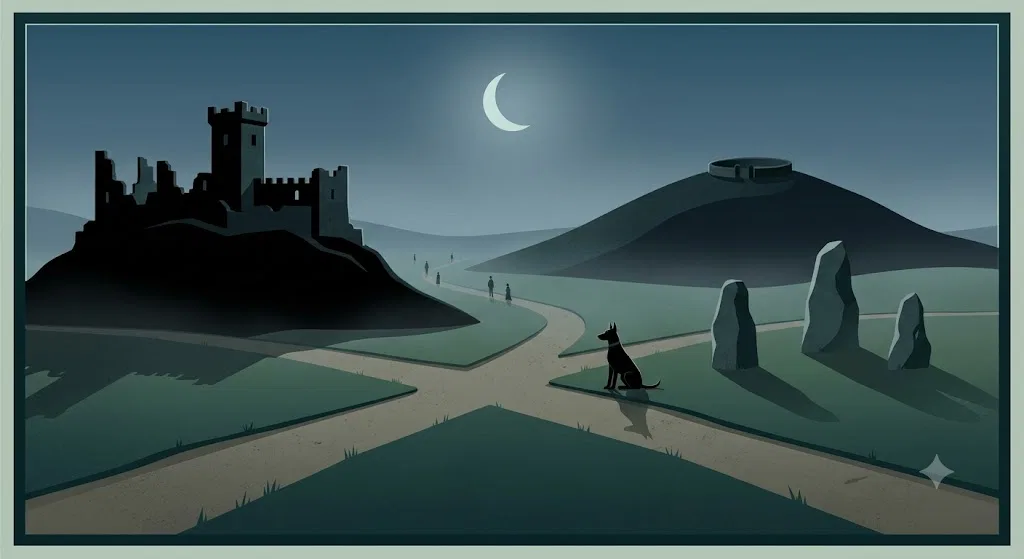
One of the most distinctive British supernatural motifs is the black dog. These spectral hounds appear across England and beyond, often on roads, at crossroads, near execution sites, around churchyards or on old tracks. They may be omens of death, guardians, demonic beasts or ambiguous watchers. The East Anglian Black Shuck, the Yorkshire Barghest and the church grim belong to this wider family of frightening canine folklore.[Wikipedia]WikipediaBlack dog (folkloreBlack dog (folklore
Black dog stories are powerful because they join landscape, weather, fear and memory. A road at night becomes a testing place. A churchyard becomes guarded territory. A storm becomes the setting for supernatural intrusion. The famous Suffolk tale of a black dog bursting into Bungay and Blythburgh churches during a thunderstorm in 1577 survives partly because it was printed in Abraham Fleming’s pamphlet A Strange and Terrible Wonder, showing how oral terror could become textual folklore.[Tetrapod Zoology]tetzoo.comTetrapod Zoology Legend of the Black DogTetrapod Zoology Legend of the Black Dog
Haunting traditions also remind readers that folklore is not simply “old religion” surviving unchanged. Many ghost stories are moral tales, entertainment, local branding, family memory, tourist narrative and genuine belief all at once. A haunted castle may preserve a story of injustice; a pub ghost may be a marketing asset; a road apparition may be an oral warning about danger after dark.
Monsters and cryptids: Nessie and the modern folklore machine
The Loch Ness Monster is one of the world’s best-known modern folklore creatures. Nessie is often presented as ancient, but the modern monster story took shape in the 20th century, especially after 1933 sightings and the famous 1934 “surgeon’s photograph”, later exposed as a hoax. National Geographic summarises the modern legend as beginning with 1933 eyewitness claims and later unravelling through disputed evidence and photographic controversy.[National Geographic]nationalgeographic.comloch ness monster legendloch ness monster legend
That does not make Nessie culturally trivial. Quite the opposite. Nessie shows how folklore works in the age of newspapers, photography, sonar, tourism, television and now AI-generated imagery. The creature sits between older water-monster motifs and modern cryptid culture, where anecdote, scepticism, local economy and media spectacle reinforce one another.
The loch itself helps the story. NatureScot notes that Loch Ness is Scotland’s largest loch by volume and contains more water than all English and Welsh lakes combined, a fact that gives the imagination plenty of dark space to work with.[NatureScot]nature.scotfreshwater lochsfreshwater lochs
Nessie is best understood not as a solved zoological question but as a living case study in modern legend. The evidence for an unknown large animal remains unconvincing, yet the story keeps adapting. Every new technology — camera, sonar, DNA sampling, webcam, AI image detection — becomes part of the folklore rather than ending it.
Sacred landscapes and legendary stones
The UK’s folklore is deeply attached to landscape: stones, hills, caves, wells, islands, causeways, barrows and ruins. These places often long pre-date the stories now attached to them, but folklore gives them narrative life.
Stonehenge is a good example. Archaeology explains it as a prehistoric monument, but folklore gave it other makers and meanings: giants, Merlin, the Devil, uncountable stones and magical movement. English Heritage’s glossary notes that the Heel Stone may derive its name from a legend in which the Devil threw a stone at a friar, leaving the friar’s heel imprint.[English Heritage]english-heritage.org.ukOpen source on english-heritage.org.uk.
Glastonbury Tor is another layered site. The National Trust describes Glastonbury’s long tradition as the Isle of Avalon, where Arthur was said to have gone after his last battle, and records that monks at Glastonbury Abbey claimed to have found Arthur’s grave in 1191. The same place also carries Christian pilgrimage, Joseph of Arimathea legends, St Michael associations and later esoteric reinterpretations.[National Trust]nationaltrust.org.ukNational Trust History and legends of Glastonbury TorNational Trust History and legends of Glastonbury Tor
The Giant’s Causeway in Northern Ireland shows folklore and geology side by side. The National Trust tells the popular legend of Finn McCool building a causeway across the Irish Sea to face the Scottish giant Benandonner, who then tears it up while fleeing back to Scotland. Scientific accounts explain the basalt columns through volcanic activity, but the giant story remains central to how many visitors first encounter the site.[National Trust]nationaltrust.org.ukOpen source on nationaltrust.org.uk.
These examples show why folklore does not need to defeat science to matter. The story and the geology answer different questions. Science explains how the stones formed; folklore explains why people felt the need to make them memorable, meaningful and human.
Seasonal customs: when folklore becomes performance
Not all folklore is a story told by the fireside. Much of it is danced, sung, worn, processed through streets, shouted in orchards or performed at thresholds. Seasonal custom is one of the most vivid parts of UK folk culture because it keeps tradition public.
Wassailing is a good example of a custom with old roots and modern revival. It may involve singing to apple trees, pouring cider on their roots, hanging toast in branches, making noise to drive away harmful forces, and wishing health to the orchard. Tradfolk links the word to Old English wæs hæil, meaning a wish of health, and describes communal drinking, singing, dancing and offerings to tree roots.[Tradfolk]tradfolk.cowhere to wassail this yearwhere to wassail this year
The Mari Lwyd in Wales is even more visually striking: a horse skull or horse-head figure, decorated and carried by a hidden performer, visiting houses during the Christmas season. Amgueddfa Cymru, Museum Wales, describes it as one of Wales’s best-known customs, especially popular in South Wales in the 19th century, involving a decorated horse skull with bottle eyes, ribbons and a snapping jaw.[Museum Wales]museum.walesOpen source on museum.wales.
The Mari Lwyd also illustrates how customs decline, survive and revive. Museum Wales notes a general decline in the 20th century, with one reason often given as the decrease in Welsh speakers, since the contest traditionally depended on sung Welsh exchange. Modern performances may be heritage events, community rituals, artistic inspiration or playful seasonal spectacle.[Museum Wales]museum.walesOpen source on museum.wales.
Morris dancing, mummers’ plays, hobby horses, bonfire customs and May Day rites likewise show that folklore is not frozen. The Museum of English Rural Life’s collections include photographs of Morris dancing, mummers, charity doles and other folk customs from the 1920s and 1930s, showing how museums preserve evidence of performance traditions that were themselves already changing.[The Museum of English Rural Life]merl.reading.ac.ukOpen source on reading.ac.uk.
Witches, protection marks and everyday supernatural defence
Witchcraft in UK folklore is not only about accused witches. It is also about the practical steps people took to protect homes, barns, churches and bodies from harm. This is where folklore becomes visible in architecture.
So-called witch marks, more accurately ritual protection or apotropaic marks, are carved symbols found on stone or wood, often near doors, windows and fireplaces. Historic England explains that these marks were intended to avert evil, including witches and evil spirits, and appear in medieval churches, houses, barns and caves.[Historic England]historicengland.org.ukOpen source on historicengland.org.uk.
The National Trust also stresses that “witch marks” have little to do with witches practising magic; rather, they were believed to protect a building and those inside from demons, witches or the evil eye. This distinction matters because it shifts the reader’s attention from lurid witch stereotypes to everyday fear and household protection.[National Trust]nationaltrust.org.ukOpen source on nationaltrust.org.uk.
Recent discoveries keep changing the public picture. In 2024, English Heritage announced a significant group of ritual protection marks at Gainsborough Old Hall in Lincolnshire, including daisy wheels and other symbols in the servants’ wing. The discovery showed that historic buildings can still hold evidence of once-common supernatural precautions hidden in plain sight.[The Guardian]theguardian.comOpen source on theguardian.com.
These marks are among the most tangible forms of folklore in the UK. They are not merely stories about belief; they are belief scratched into fabric, threshold and timber.
Archives, collectors and the problem of “old tradition”
Because folklore is often oral, seasonal or local, much of what survives depends on collectors, museums and archives. That creates both opportunity and caution. A collected tale may preserve something precious, but it also reflects who collected it, when, from whom, in what language, and for what purpose.
The British Library states that it holds a large oral history collection covering diverse aspects of British life, work, culture, memory and experience. The Folklore Society, founded in London in 1878, is one of the oldest organisations in the world devoted to folklore study. UCL’s Folklore Society Library includes around 15,000 books, 5,000 pamphlets and 100 periodicals, with material from the late 16th century to the present, especially strong in the 19th and early 20th centuries.[bl.uk]bl.ukOpen source on bl.uk.
The National Library of Scotland and other institutions also hold manuscript and printed evidence of regional tradition. Its catalogue includes 19th-century material connected with folk tales and Gaelic mythology, while digitised works such as Folk Tales and Fairy Lore in Gaelic and English show the importance of bilingual and regional collection.[manuscripts.nls.uk]manuscripts.nls.ukOpen source on nls.uk.
The challenge is to avoid treating every Victorian or Edwardian collection as a transparent window into remote antiquity. Some collectors romanticised rural life; some standardised local variants; some imposed theories about pagan survivals; some preserved material that would otherwise have vanished. Good folklore reading asks not just “How old is this story?” but “When was it recorded, who told it, who shaped it, and how has it been reused?”
Modern reinterpretation: folklore as heritage, tourism and pop culture
UK folklore is very much alive, but not always in the form people expect. A revived wassail, a ghost tour, a fantasy novel, a museum display, a local festival, a TikTok monster sighting, a heritage trail and a school retelling of the Mabinogion can all be part of the same ecosystem.
Modern reinterpretation can be valuable when it keeps traditions visible and locally meaningful. It can also flatten them. Tintagel’s Arthurian presentation, for instance, has drawn criticism from some Cornish historians who feared that fantasy branding could overshadow the site’s real early medieval and Cornish significance. The debate is useful because it shows that folklore heritage is not neutral: it decides which pasts are foregrounded and which are pushed aside.[The Guardian]theguardian.comThe Guardian English Heritage turning Tintagel into 'fairytale theme parkThe Guardian English Heritage turning Tintagel into 'fairytale theme park
Tourism can similarly both preserve and distort. The Giant’s Causeway legend of Finn McCool helps visitors remember the place, but the site also needs geological care; in 2025 the National Trust warned that visitors wedging coins into cracks were damaging the basalt columns. A folk-like visitor habit had become a conservation problem.[The Guardian]theguardian.comOpen source on theguardian.com.
Modern folklore also appears in new anxieties. Nessie now has to exist in a world of AI-generated images and online hoaxes. Seasonal customs are revived in cities as well as villages. Fairy lore becomes fantasy fiction, pagan spirituality, children’s culture and heritage interpretation. The result is not a decline from “authentic” past to “fake” present, but a constant reshaping.

How to read UK folklore well
The most useful approach is neither blind belief nor smug dismissal. Folklore is not valuable only if it is factually true, and it is not meaningless because supernatural claims are unproven. It is evidence of imagination, fear, social memory, place-making and identity.
A few practical distinctions help:
Old oral tradition is not the same as medieval literature. Arthurian legend includes Welsh material, Geoffrey of Monmouth, French romance, Malory and modern adaptation. Each layer matters, but they are not the same kind of evidence.
A recorded custom is not necessarily unchanged from antiquity. Wassailing, Mari Lwyd, Morris dancing and mumming have histories of decline, revival, reform and local invention.
A haunted place may preserve more than a ghost story. It may encode a crime, a boundary, a family memory, a moral warning, a tourist economy or a community’s sense of itself.
Modern folklore is still folklore. Nessie, internet-era sightings, revived folk festivals and pop-culture fairies are not outside the tradition. They show how traditional patterns adapt to new media.
The United Kingdom’s folklore is therefore best read as a living archive of stories attached to place. Its creatures and customs are memorable, but its deeper subject is relationship: between people and landscape, past and present, belief and performance, evidence and imagination.
Amazon book picks
Further Reading
Books and field guides related to Where Britain's Old Stories Still Haunt the Map. Use these as the next step if you want deeper reading beyond the article.
The Penguin Guide to the Superstitions of Britain and Ireland
Explains customs, beliefs and folk traditions throughout the UK.
The Mammoth Book of British Kings and Queens
Provides historical background to many legendary figures.
eBay marketplace picks
Marketplace Samples
Live-tested eBay searches with available results related to this page.

Endnotes
1.
Source: library.wales
Link:https://www.library.wales/discover-learn/digital-exhibitions/manuscripts/the-middle-ages/history-of-the-kings
2.
Source: wales.com
Title: The timeless magic of The Mabinogion
Link:https://www.wales.com/about/history-and-heritage/welsh-traditions-myths-and-legends/timeless-magic-mabinogion
3.
Source: Wikipedia
Title: Black dog (folklore)
Link:https://en.wikipedia.org/wiki/Black_dog_%28folklore%29
4.
Source: tradfolk.co
Title: where to wassail this year
Link:https://tradfolk.co/customs/wassailing/where-to-wassail-this-year/
5.
Source: museum.wales
Link:https://museum.wales/articles/1187/Christmas-Traditions-The-Mari-Lwyd/
6.
Source: manuscripts.nls.uk
Link:https://manuscripts.nls.uk/subjects/464
7.
Source: archive.org
Link:https://archive.org/details/folktalesfairylo00macd
8.
Source: Wikipedia
Title: Green children of Woolpit
Link:https://en.wikipedia.org/wiki/Green_children_of_Woolpit
9.
Source: Wikipedia
Title: Matter of Britain
Link:https://en.wikipedia.org/wiki/Matter_of_Britain
10.
Source: Wikipedia
Title: Green Man (folklore)
Link:https://en.wikipedia.org/wiki/Green_Man_%28folklore%29
11.
Source: Wikipedia
Title: British people
Link:https://en.wikipedia.org/wiki/British_people
12.
Source: Wikipedia
Title: English folklore
Link:https://en.wikipedia.org/wiki/English_folklore
13.
Source: Wikipedia
Link:https://en.wikipedia.org/wiki/Mabinogion
14.
Source: Wikipedia
Title: Geoffrey of Monmouth
Link:https://en.wikipedia.org/wiki/Geoffrey_of_Monmouth
15.
Source: Wikipedia
Title: Robin Hood
Link:https://en.wikipedia.org/wiki/Robin_Hood
16.
Source: Wikipedia
Link:https://en.wikipedia.org/wiki/University
17.
Source: Wikipedia
Link:https://en.wikipedia.org/wiki/Loch
18.
Source: Wikipedia
Title: Loch Ness Monster
Link:https://en.wikipedia.org/wiki/Loch_Ness_Monster
19.
Source: Wikipedia
Title: Northern Trains
Link:https://en.wikipedia.org/wiki/Northern_Trains
20.
Source: Wikipedia
Link:https://en.wikipedia.org/wiki/Banshee
21.
Source: Wikipedia
Title: Glastonbury Tor
Link:https://en.wikipedia.org/wiki/Glastonbury_Tor
22.
Source: Wikipedia
Title: Tintagel Castle
Link:https://en.wikipedia.org/wiki/Tintagel_Castle
23.
Source: Wikipedia
Link:https://en.wikipedia.org/wiki/Stonehenge
24.
Source: tradfolk.co
Title: Folk Customs and Traditions
Link:https://tradfolk.co/category/customs/
25.
Source: nls.uk
Link:https://www.nls.uk/collections/stories/
26.
Source: folklore-society.com
Link:https://www.folklore-society.com/
27.
Source: wales.com
Link:https://www.wales.com/about/history-and-heritage/welsh-traditions-myths-and-legends/mari-lwyd
28.
Source: archive.org
Link:https://archive.org/details/folklore01folkuoft
29.
Source: glastonbury.uk
Title: avalon tor tor intro
Link:https://glastonbury.uk/visit/history-myth/avalon-landmarks/avalon-tor-tor-intro
30.
Source: mabinogion.info
Link:https://www.mabinogion.info/
31.
Source: english-heritage.org.uk
Link:https://www.english-heritage.org.uk/visit/places/tintagel-castle/history-and-legend/history/
32.
Source: nationaltrust.org.uk
Link:https://www.nationaltrust.org.uk/visit/northern-ireland/giants-causeway/history-of-giants-causeway
33.
Source: bl.uk
Link:https://www.bl.uk/collection/explore-the-collection
34.
Source: english-heritage.org.uk
Title: where do myths legends and folktales come from
Link:https://www.english-heritage.org.uk/visit/inspire-me/blog/articles/where-do-myths-legends-and-folktales-come-from/
35.
Source: english-heritage.org.uk
Link:https://www.english-heritage.org.uk/visit/places/stonehenge/history-and-stories/history/stonehenge-glossary/
36.
Source: english-heritage.org.uk
Link:https://www.english-heritage.org.uk/visit/places/tintagel-castle/
37.
Source: historytoday.com
Title: History Today Absolute Legend
Link:https://www.historytoday.com/archive/review/absolute-legend
38.
Source: tandfonline.com
Link:https://www.tandfonline.com/doi/full/10.1080/0268117X.2016.1147977
39.
Source: blog.historicenvironment.scot
Link:https://blog.historicenvironment.scot/2025/06/scary-fairies-scotlands-gaelic-fairy-folklore/
40.
Source: tetzoo.com
Title: Tetrapod Zoology Legend of the Black Dog
Link:https://tetzoo.com/blog/2022/8/13/legend-of-the-black-dog
41.
Source: nationalgeographic.com
Title: loch ness monster legend
Link:https://www.nationalgeographic.com/history/article/loch-ness-monster-legend
42.
Source: nature.scot
Title: freshwater lochs
Link:https://www.nature.scot/landscapes-and-habitats/habitat-types/lochs-rivers-and-wetlands/freshwater-lochs
43.
Source: nationaltrust.org.uk
Title: National Trust History and legends of Glastonbury Tor
Link:https://www.nationaltrust.org.uk/visit/somerset/glastonbury-tor/history-of-glastonbury-tor
44.
Source: theguardian.com
Link:https://www.theguardian.com/science/2026/jun/15/globally-significant-volcanic-event-giants-causeway-scientists
45.
Source: merl.reading.ac.uk
Link:https://merl.reading.ac.uk/collections/long-photographic-collection/
46.
Source: historicengland.org.uk
Link:https://historicengland.org.uk/whats-new/features/discovering-witches-marks/what-are-witches-marks/
47.
Source: nationaltrust.org.uk
Link:https://www.nationaltrust.org.uk/discover/history/warding-off-evil-with-witch-marks
48.
Source: theguardian.com
Link:https://www.theguardian.com/culture/2024/oct/29/witches-marks-discovered-english-heritage-gainsborough-old-hall
49.
Source: nationalfolkloresurvey.co.uk
Link:https://www.nationalfolkloresurvey.co.uk/about
50.
Source: theguardian.com
Title: The Guardian English Heritage turning Tintagel into ‘fairytale theme park’
Link:https://www.theguardian.com/uk-news/2016/mar/22/english-heritage-turning-tintagel-into-fairytale-theme-park
51.
Source: theguardian.com
Link:https://www.theguardian.com/uk-news/2025/may/28/giant-causeway-damage-coins
52.
Source: northernrailway.co.uk
Link:https://www.northernrailway.co.uk/
53.
Source: nationalgeographic.com
Title: cryptid tourism loch ness monster yeti lucrative industry
Link:https://www.nationalgeographic.com/travel/article/cryptid-tourism-loch-ness-monster-yeti-lucrative-industry
54.
Source: historicengland.org.uk
Title: Historic England
Link:https://historicengland.org.uk/
55.
Source: facebook.com
Link:https://www.facebook.com/StonehengeEH/photos/for-all-hallows-eve-were-sharing-the-legend-of-the-heel-stone-the-huge-unshaped-/744342407730786/
56.
Source: facebook.com
Link:https://www.facebook.com/NationalTrustLondonandSouthEast/photos/witch-marks-are-etched-symbols-usually-found-next-to-windows-doorways-and-firepl/1307743324730249/
57.
Source: merl.reading.ac.uk
Title: reading.ac.uk FOL K AND CUSTOMS
Link:https://merl.reading.ac.uk/explore/online-exhibitions/folk-and-customs/
58.
Source: sites.pitt.edu
Link:https://sites.pitt.edu/~dash/scotland.html
59.
Source: english-heritage.org.uk
Link:https://www.english-heritage.org.uk/visit/inspire-me/tellingtales/
60.
Source: dictionary.cambridge.org
Link:https://dictionary.cambridge.org/dictionary/english/loch
61.
Source: dictionary.cambridge.org
Link:https://dictionary.cambridge.org/dictionary/english/historic
62.
Source: thebrunelmuseum.com
Title: may day
Link:https://thebrunelmuseum.com/events/event/may-day/
63.
Source: historicenvironment.scot
Link:https://www.historicenvironment.scot/
64.
Source: theguardian.com
Title: king arthur tintagel english heritage
Link:https://www.theguardian.com/artanddesign/jonathanjonesblog/2016/mar/23/king-arthur-tintagel-english-heritage
65.
Source: discoverbritain.com
Link:https://www.discoverbritain.com/heritage/mythology/
66.
Source: onthegotours.com
Link:https://www.onthegotours.com/uk/England/Best-Places-To-Visit/Stonehenge
67.
Source: mythus.fandom.com
Title: Church grim
Link:https://mythus.fandom.com/wiki/Church_grim
68.
Source: visitsomerset.co.uk
Link:https://www.visitsomerset.co.uk/things-to-do/attractions/history-and-heritage/national-trust-glastonbury-tor
69.
Source: dailyartmagazine.com
Link:https://www.dailyartmagazine.com/stonehenge/
70.
Source: bl.uk
Link:https://www.bl.uk/
71.
Source: bl.uk
Title: king arthur fable fact and fiction
Link:https://www.bl.uk/stories/blogs/posts/king-arthur-fable-fact-and-fiction
72.
Source: bl.uk
Title: british library celebrates fairy tales in a major new exhibition
Link:https://www.bl.uk/about/press/releases/british-library-celebrates-fairy-tales-in-a-major-new-exhibition
73.
Source: nationaltrust.org.uk
Link:https://www.nationaltrust.org.uk/visit/somerset/glastonbury-tor
74.
Source: englandinparticular.info
Link:https://englandinparticular.info/new/n-wass.html
Additional References
75.
Source: youtube.com
Title: 25 Creatures in Scottish Folklore and Myth
Link:https://www.youtube.com/watch?v=BeqjMJMLCHQ
Source snippet
British folklore legends myths documentary Somerset Myths & Legends | English Folklore Documentary The Jolly Reiver...
76.
Source: youtube.com
Title: How England Lost Its Mythology
Link:https://www.youtube.com/watch?v=ImMekbeYvMk
Source snippet
Legends, Tales, and Myths of Ancient and Modern England | Full Mythology Documentary...
77.
Source: visitscotland.com
Link:https://www.visitscotland.com/things-to-do/landscapes-nature/lochs
78.
Source: toursofwales.co.uk
Link:https://toursofwales.co.uk/wandering-bard/a-brief-history-of-the-mabinogion-from-culture-trip/
79.
Source: facebook.com
Link:https://www.facebook.com/natgeotravel/videos/according-to-legend-this-causeway-in-northern-ireland-was-built-by-a-giant-named/10155248437343992/
80.
Source: facebook.com
Link:https://www.facebook.com/bbcsomerset/posts/an-english-may-day-tradition-morris-dancers-gathered-at-dawn-on-ham-hill-near-ye/934067498729287/
81.
Source: lasmithwriter.com
Link:https://lasmithwriter.com/anglo-saxon-elves/
82.
Source: sjgames.com
Link:https://www.sjgames.com/gurps/roleplayer/Roleplayer30/GhostDogs.html
83.
Source: instagram.com
Link:https://www.instagram.com/british_airways/?hl=en
84.
Source: tripadvisor.com
Link:https://www.tripadvisor.com/Airline_Review-d8729039-Reviews-or60-British-Airways
Topic Tree
Follow this branch
Related pages 192
- Afghan Folklore
- Albanian Folklore
- Algerian Folklore
- Australian Folklore
- Azerbaijan Folklore
- +187 more in sidebar