Within Lesotho Folklore
Why Did the Monster Swallow the World?
The great swallowing monster is one of the most vivid Basotho tales, mixing terror, rescue, rebirth, and suspicion of the hero.
On this page
- The monster, the hero, and the rescue from within
- Older Basotho collections and southern African parallels
- Modern retellings, dinosaurs, and cultural memory
Page outline Jump by section
Introduction
The story of Khodumodumo, the great swallowing monster, is one of the most famous and enduring tales in Basotho oral tradition. At its simplest, it is a monster story: a vast creature devours people, animals, and entire communities until only a single survivor remains. Yet the tale is remembered not merely because of its terror, but because of what follows. A miraculous hero confronts the monster, enters its body, cuts it open from within, and restores the swallowed world. The rescued people then turn against their saviour, adding a darker and more memorable ending than many monster-slaying legends.[Internet Sacred Text Archive]sacred-texts.comIt swallowed every living creatureInternet Sacred Text ArchiveChapter XIV: The Swallowing MonsterOnce upon a time there appeared in our country a huge, shapeless thing cal…
In Lesotho, the story occupies a special place because it combines several powerful themes at once: destruction and rebirth, loneliness and survival, heroic courage, and the uneasy relationship between extraordinary individuals and ordinary society. It is also one of the best-attested Basotho folktales, having been collected in the early twentieth century and repeatedly retold in books, schools, folklore studies, and modern popular culture.[Internet Archive]archive.orgInternet ArchiveThe treasury of Ba-suto lore; being original Se-suto texts…13 May 2013 — The treasury of Ba-suto lore; being original…
Why Did the Monster Swallow the World?
According to classic Basotho versions, Khodumodumo appeared as a gigantic, shapeless devouring being that consumed every living thing in its path. Villages vanished. Cattle disappeared. Entire populations were swallowed. The creature became larger and more powerful with every victim. In some accounts it is called Khodumodumo; in others it appears under related names such as Kammapa or Kholomodumo.[sacred-texts.com]sacred-texts.comIt swallowed every living creatureInternet Sacred Text ArchiveChapter XIV: The Swallowing MonsterOnce upon a time there appeared in our country a huge, shapeless thing cal…
Unlike many European dragons, Khodumodumo is not usually portrayed as a treasure-guardian or a cunning villain with clear motives. Its defining feature is appetite. It devours because devouring is its nature. The monster functions less as a character than as a force of overwhelming destruction, an embodiment of catastrophe that threatens the existence of the entire human community.[Internet Sacred Text Archive]sacred-texts.comIt swallowed every living creatureInternet Sacred Text ArchiveChapter XIV: The Swallowing MonsterOnce upon a time there appeared in our country a huge, shapeless thing cal…
The image is strikingly simple and memorable. The world is not merely attacked; it is swallowed. People do not just die; they remain trapped inside the monster. This detail becomes crucial to the story’s second half.
The Monster, the Hero, and the Rescue from Within
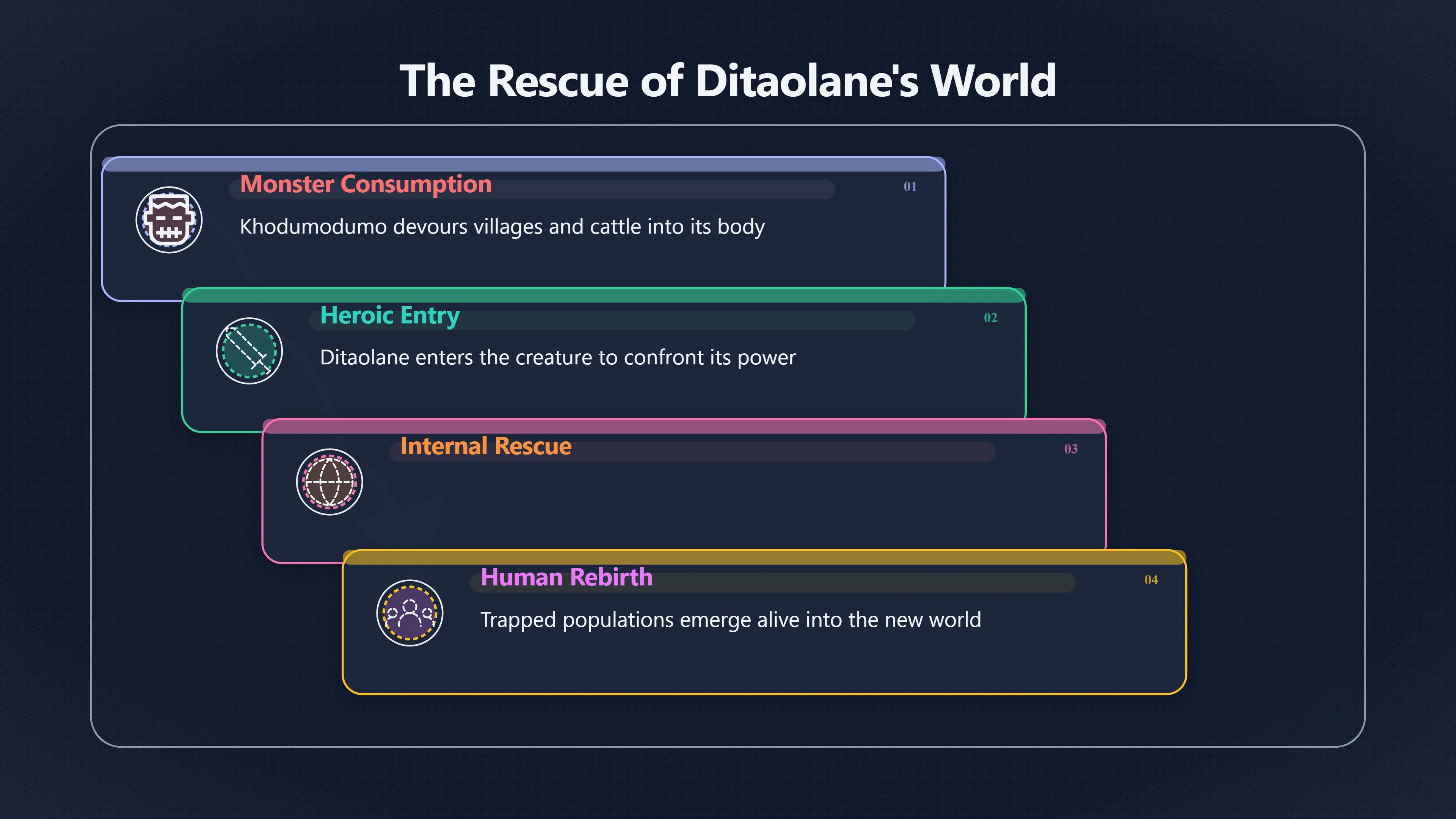
As the monster consumes the world, one woman survives by hiding. In Basotho versions recorded by folklorists, she later gives birth to an extraordinary child. The boy emerges already marked as special, often associated with divination and supernatural knowledge. He is commonly known as Ditaolane (sometimes rendered Litaolane in other retellings). Remarkably, he grows to adulthood almost immediately after birth.[Wikipedia]WikipediaOpen source on wikipedia.org.
When Ditaolane learns what has happened to humanity, he sets out to confront Khodumodumo. The encounter does not follow the familiar pattern of a knight killing a monster from outside. Instead, the hero is swallowed as well. This apparent defeat becomes the key to victory. Armed with a knife or blade, he cuts his way through the creature from the inside.[Internet Sacred Text Archive]sacred-texts.comIt swallowed every living creatureInternet Sacred Text ArchiveChapter XIV: The Swallowing MonsterOnce upon a time there appeared in our country a huge, shapeless thing cal…
The moment is one of the most dramatic scenes in southern African folklore. As the monster’s body is opened, all those trapped within emerge alive. Humanity is effectively reborn from the belly of the beast. The tale therefore combines monster-slaying with themes of rescue, renewal, and collective restoration.[Internet Sacred Text Archive]sacred-texts.comIt swallowed every living creatureInternet Sacred Text ArchiveChapter XIV: The Swallowing MonsterOnce upon a time there appeared in our country a huge, shapeless thing cal…
The image of people returning from inside the monster has fascinated generations of storytellers and scholars. It resembles myths of descent into darkness and return, but in the Basotho version the emphasis remains on the recovery of an entire community rather than the hero alone. The monster’s death is simultaneously the world’s restoration.[Internet Sacred Text Archive]sacred-texts.comIt swallowed every living creatureInternet Sacred Text ArchiveChapter XIV: The Swallowing MonsterOnce upon a time there appeared in our country a huge, shapeless thing cal…
Why the Story Does Not End with the Victory
One reason the tale remains memorable is that the rescue is not the conclusion.
After being freed, the people become suspicious of Ditaolane. If he was powerful enough to kill the creature that defeated everyone else, perhaps he is dangerous himself. In various versions they attempt to destroy him, ambush him, or otherwise remove him. The hero who saved society becomes feared by the society he saved.[Wikipedia]WikipediaOpen source on wikipedia.org.
This ending transforms the story from a simple adventure into a moral and social reflection. Folklorists have often noted that many heroic tales conclude with celebration and reward. The Khodumodumo cycle instead explores mistrust, jealousy, and fear of exceptional power. The community survives, but it does not necessarily learn gratitude.[Wikipedia]WikipediaOpen source on wikipedia.org.
For modern readers, this final twist is often the most surprising part of the narrative. It gives the story an emotional complexity that helps explain why it has remained culturally important long after its original oral performances.
Older Basotho Collections and Southern African Parallels
The swallowing-monster story is not a recent invention. One of its most important written sources is Édouard Jacottet’s early twentieth-century collection The Treasury of Ba-Suto Lore, which preserved numerous Basotho oral narratives, including versions of the swallowing monster cycle. The existence of these published texts demonstrates that the story was already well established in Basotho tradition by the late nineteenth and early twentieth centuries.[Internet Archive]archive.orgInternet ArchiveThe treasury of Ba-suto lore; being original Se-suto texts…13 May 2013 — The treasury of Ba-suto lore; being original…
Researchers have also noted that closely related swallowing-monster stories occur across a wide area of southern Africa among several Bantu-speaking peoples. Similar narrative structures appear in Sotho, Tswana, Zulu, Xhosa, Venda, Tsonga, and other traditions. Because these stories share distinctive details, some scholars argue that the narrative pattern may be extremely old, perhaps reflecting a heritage that predates the separation of several southern African language communities.[Academia]academia.eduAcademia(PDF) The Swallowing Monster in Southern African FolkloreThe swallowing monster story, known as Khodumodumo, is a significant cul…
The Basotho version remains distinctive, however, because of its particular hero, its detailed rescue-from-within episode, and its unusually pessimistic ending. These features have given the story a strong identity within Lesotho’s cultural memory even while it participates in a much wider regional tradition.[Academia]academia.eduAcademia(PDF) The Swallowing Monster in Southern African FolkloreThe swallowing monster story, known as Khodumodumo, is a significant cul…
Monster, Symbol, or Memory?
No single interpretation explains Khodumodumo completely.
Some readers understand the monster as a symbolic representation of famine, war, disease, or other disasters capable of destroying entire communities. Others see it as an expression of a more universal human fear: being consumed by forces beyond individual control. The story itself does not provide a definitive explanation, which is one reason it has remained adaptable across generations.[Academia]academia.eduAcademia(PDF) The Swallowing Monster in Southern African FolkloreThe swallowing monster story, known as Khodumodumo, is a significant cul…
The monster’s shapelessness is significant. Unlike creatures with a fixed appearance, Khodumodumo can represent many kinds of threat. It is large enough to contain an entire society and vague enough to absorb new meanings as circumstances change.[Internet Sacred Text Archive]sacred-texts.comIt swallowed every living creatureInternet Sacred Text ArchiveChapter XIV: The Swallowing MonsterOnce upon a time there appeared in our country a huge, shapeless thing cal…
The rescue from the monster’s belly has likewise been interpreted as a form of rebirth imagery. People disappear into darkness and emerge into a renewed world. Whether listeners understood the episode literally, symbolically, or simply as a thrilling adventure, the image remains one of the most powerful in Basotho storytelling.[Internet Sacred Text Archive]sacred-texts.comIt swallowed every living creatureInternet Sacred Text ArchiveChapter XIV: The Swallowing MonsterOnce upon a time there appeared in our country a huge, shapeless thing cal…
Modern Retellings, Dinosaurs, and Cultural Memory
Today Khodumodumo survives in several different forms. The story appears in folklore collections, children’s retellings, educational materials, academic studies, websites devoted to world mythology, and discussions of African monsters. Modern retellings often simplify the narrative, focusing on the battle between the monster and Ditaolane while omitting some of the darker aftermath.[Wikipedia]WikipediaOpen source on wikipedia.org.
In popular culture, the creature has sometimes been compared to dinosaurs or giant prehistoric beasts because of its enormous size and appetite. These comparisons are modern imaginative reinterpretations rather than part of the traditional Basotho tale itself. The older folklore generally describes the monster as vast and devouring but does not present it as a dinosaur in the modern scientific sense.[Internet Sacred Text Archive]sacred-texts.comIt swallowed every living creatureInternet Sacred Text ArchiveChapter XIV: The Swallowing MonsterOnce upon a time there appeared in our country a huge, shapeless thing cal…
The story’s continuing appeal comes from its vivid simplicity. A monster swallows the world. A miraculous hero enters the darkness. The lost people return. Then the rescued community reveals its own flaws. Few folktales combine cosmic danger, dramatic action, and human ambiguity so effectively.
For that reason, Khodumodumo remains one of the most recognisable legendary beings associated with Lesotho and one of the strongest examples of how Basotho oral tradition can be both entertaining and deeply reflective at the same time.[sacred-texts.com]sacred-texts.comIt swallowed every living creatureInternet Sacred Text ArchiveChapter XIV: The Swallowing MonsterOnce upon a time there appeared in our country a huge, shapeless thing cal…
Amazon book picks
Further Reading
Books and field guides related to Why Did the Monster Swallow the World?. Use these as the next step if you want deeper reading beyond the article.
The Heritage of the Basotho
Provides Basotho cultural context behind famous folktales.
eBay marketplace picks
Marketplace Samples
Live-tested eBay searches with available results related to this page.
Endnotes
1.
Source: Wikipedia
Link:https://en.wikipedia.org/wiki/Ditaolane
2.
Source: archive.org
Link:https://archive.org/details/treasuryofbasuto01jaco
Source snippet
Internet ArchiveThe treasury of Ba-suto lore; being original Se-suto texts...13 May 2013 — The treasury of Ba-suto lore; being original...
Published: May 2013
3.
Source: academia.edu
Link:https://www.academia.edu/50086012/The_Swallowing_Monster_in_Southern_African_Folklore_Need_for_Morphological_Investigation
Source snippet
Academia(PDF) The Swallowing Monster in Southern African FolkloreThe swallowing monster story, known as Khodumodumo, is a significant cul...
4.
Source: Wikipedia
Link:https://en.wikipedia.org/wiki/Kamappa
Source snippet
KamappaIt is described as a shapeless, gluttonous monster that swallows everything living it comes by and gets larger and larger the m...
5.
Source: sacred-texts.com
Title: It swallowed every living creature
Link:https://sacred-texts.com/afr/mlb/mlb16.htm
Source snippet
Internet Sacred Text ArchiveChapter XIV: The Swallowing MonsterOnce upon a time there appeared in our country a huge, shapeless thing cal...
6.
Source: abookofcreatures.com
Link:https://abookofcreatures.com/2015/12/18/khodumodumo/
Source snippet
18 Dec 2015 — The swallowing monster of the Basuto people of South Africa and Lesotho is called Khodumodumo. The name of Khodumodumo is a...
7.
Source: youtube.com
Link:https://www.youtube.com/watch?v=8bDl9vl2YGs
Source snippet
The World Eater - African - Extra MythologyKammapa could be based on a volcanic eruption - a large, glossy, shapeless dark form sliding d...
Additional References
8.
Source: gateway-africa.com
Link:https://www.gateway-africa.com/stories/Kammapa.html
Source snippet
Kammapa Monster, Sesuto Tribe StoryOnce there was a terrible monster, named Kammapa, that devoured all humans in Africa. Eventually the o...
9.
Source: freebookapalooza.blogspot.com
Link:https://freebookapalooza.blogspot.com/2016/06/jacottet-treasury-of-basuto-lore.html
Source snippet
Jacottet. The Treasury of Basuto LoreToday's free book is The Treasury of Basuto Lore by E. Jacottet. The Basotho (Basuto) are one of the...
10.
Source: reddit.com
Link:https://www.reddit.com/r/Africa/comments/lh28pl/kammapathe_world_eater_a_sotho_myth/
Source snippet
Kammapa-The World Eater (A Sotho Myth): r/AfricaThe following is a myth from the Sotho people of Southern Africa. It features an all-con...
11.
Source: unisapressjournals.co.za
Link:https://unisapressjournals.co.za/index.php/SAJFS
12.
Source: medium.com
Link:https://medium.com/greener-pastures-magazine/the-hero-south-africa-needs-but-not-the-one-it-deserves-0541c9a8468d
13.
Source: pinterest.com
Link:https://www.pinterest.com/pin/the-khodumodumo-was-a-cryptid-reported-from-south-africa-in-around-the-1930s-with-a-name-said–618330223846921503/
Source snippet
s a nocturnal animal which silently broke into livestock...Read more...
14.
Source: tumblr.com
Link:https://www.tumblr.com/bestiarium/703618556891480064/the-khodumodumo-sotho-mythology-the-sotho-people
Source snippet
nd humans. Entire villages disappeared into its gaping maw when...
15.
Source: abookofcreatures.com
Link:https://abookofcreatures.com/tag/african-folklore/page/4/
Source snippet
modumo is an archaic Sesotho term.Read more...
16.
Source: open.spotify.com
Link:https://open.spotify.com/episode/5wjfSFG3Qzs7CiphlHekRG
Source snippet
Mythology28 Jul 2020 — From South Africa's Kingdom of the Sky comes the story of Kammapa: a shapeless, ravenous beast that nearly swallow...
17.
Source: youtube.com
Link:https://www.youtube.com/watch?v=74ZX0pveSAI
Source snippet
Bantu Myths: The African Roots of Brer Rabbit...
Topic Tree