Within Kenya Folklore
Inside Kenya's Sacred Kaya Forests
The Kaya forests show how ancestral belief, ritual authority and conservation can belong to the same tradition.
On this page
- Fortified villages and ancestral memory
- Elders, rituals and community rules
- World Heritage and living tradition
Page outline Jump by section
Introduction
The Kaya forests of Kenya’s coast are among the clearest examples of a sacred landscape that is still alive rather than simply remembered. To the Mijikenda peoples, the Kayas are not just patches of woodland or archaeological sites. They are ancestral places where history, spiritual authority, community law, ritual practice and environmental protection come together. What makes them especially important in Kenyan folklore is that stories about ancestors, sacred power and communal identity are tied to real places that continue to be respected and used today. UNESCO describes the Kayas as former fortified settlements that became revered as the abodes of ancestors, maintained through the authority of councils of elders.[UNESCO World Heritage Centre]whc.unesco.orgUNESCO World Heritage CentreSacred Mijikenda Kaya ForestsThe kayas, created as of the 16th century but abandoned by the 1940s, are now re…

For readers interested in folklore, the Kayas demonstrate how sacred places can preserve traditions for centuries. Rather than existing only in tales, ancestral beliefs remain embedded in forests, pathways, ritual sites and community customs. The result is a landscape where memory, belief and governance are inseparable.
Fortified Villages and Ancestral Memory
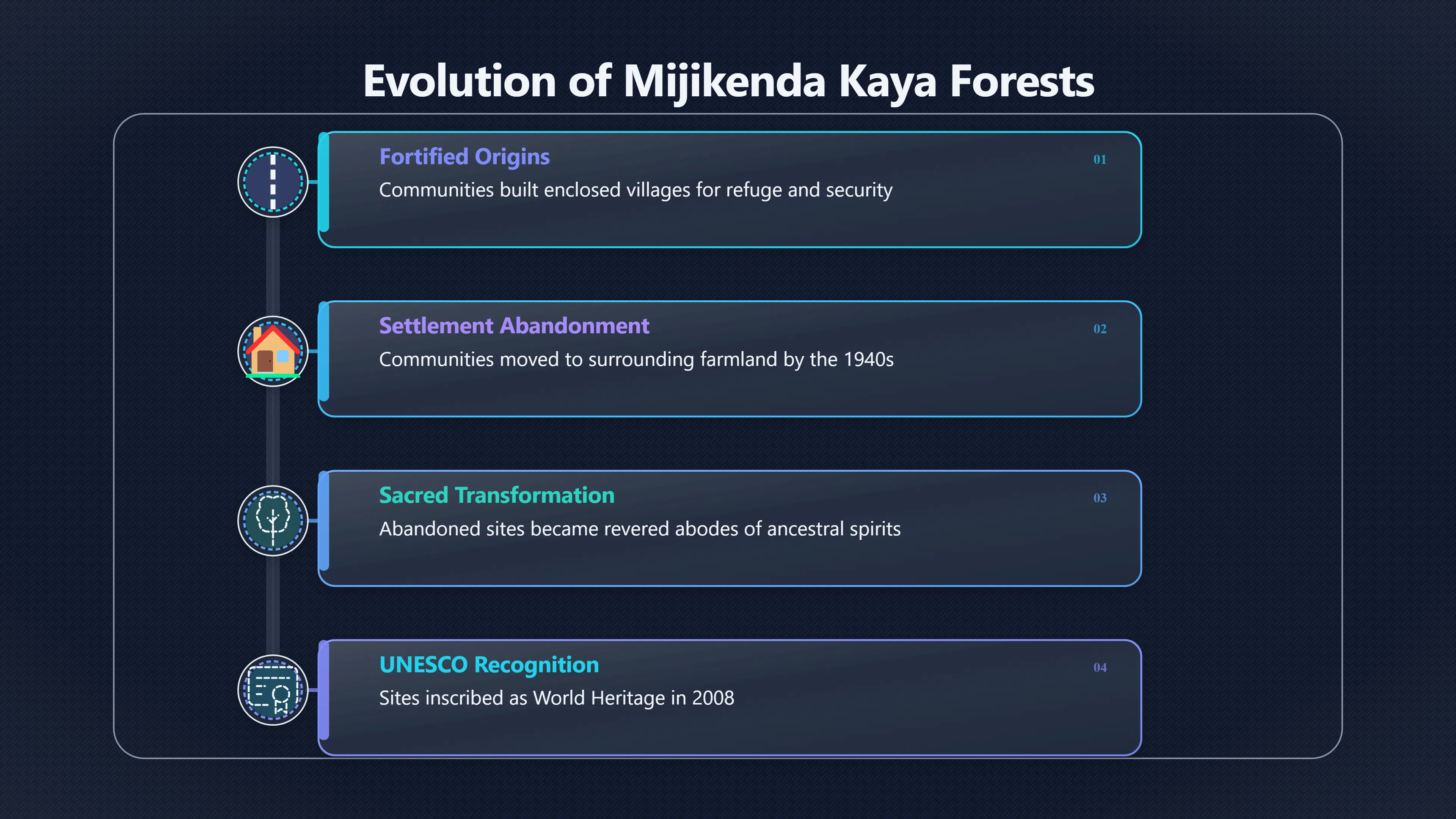
The word “Kaya” originally referred to a fortified settlement. Between roughly the sixteenth century and the nineteenth century, Mijikenda communities established enclosed villages within coastal forests, protected by dense vegetation and defensive barriers. These settlements were places of refuge during periods of migration and insecurity. Over time, many communities moved out into surrounding farmland, but the old settlement sites retained profound significance.[UNESCO World Heritage Centre]whc.unesco.orgUNESCO World Heritage CentreSacred Mijikenda Kaya ForestsThe kayas, created as of the 16th century but abandoned by the 1940s, are now re…
As the villages were abandoned, the forests surrounding them became sacred. The Kayas came to be regarded as the dwelling places of ancestors and as repositories of communal memory. The physical remains of gates, paths and settlement areas connected living communities to the generations that founded them. UNESCO’s nomination records describe the sites as containing traces of historic fortified settlements that continue to serve as centres of ritual and cultural activity.[UNESCO World Heritage Centre]whc.unesco.orgUNESCO World Heritage CentreTHE SACRED MIJIKENDA KAYA FORESTS11 Jan 2008 — They contain the traces of historic fortified settlements of t…
This transformation from settlement to sacred landscape is central to their folklore. The forests are not valued because dramatic legends happened there; rather, they are respected because they embody the continuing presence of ancestors. Oral traditions connect particular Kayas with migration histories, origin narratives and memories of the ancestral homeland often called Shungwaya in Mijikenda tradition.[OpenEdition Journals]journals.openedition.orgOpenEdition JournalsListing The Sacred Mijikenda kaya Forests as UNESCO…It is believed that kaya forests once contained hidden fortifi…
The forests therefore function as living archives. They preserve not only physical traces of the past but also stories about who the community is, where it came from and why particular customs matter.
Elders, Rituals and Community Rules
One reason the Kayas remain living sacred landscapes is that they continue to be governed through customary authority. Councils of elders have traditionally acted as custodians, controlling access, supervising rituals and enforcing community rules linked to the sacred status of the forests. UNESCO notes that the Kayas are maintained by councils of elders and that associated traditions form part of Mijikenda systems of ethics and governance.[unesco.org]whc.unesco.orgUNESCO World Heritage CentreSacred Mijikenda Kaya ForestsThe kayas, created as of the 16th century but abandoned by the 1940s, are now re…
These practices extend far beyond occasional ceremonies. Traditions associated with the Kayas include:
- Prayers and blessings.
- Oath-taking and reconciliation rituals.
- Naming ceremonies.
- Initiation rites.
- Marriage and coronation traditions.
- Burial-related customs.
- Rituals concerned with health, well-being and social harmony.[UNESCO Intangible Cultural Heritage]ich.unesco.orgUNESCO Intangible Cultural HeritageTraditions and practices associated with the Kayas in…These traditions and practices constitute the…
In folklore terms, the forests are also places where spiritual power is believed to reside. Traditional accounts describe the Kayas as ancestral domains where respect for sacred rules maintains balance between the living community and the spirit world. Stories and beliefs associated with the forests often warn against inappropriate behaviour, unauthorised tree cutting or disrespect toward sacred areas. Such narratives reinforce conservation and social order by embedding moral lessons within local belief systems.[Sacred Land]sacredland.orgSacred Land4The Sacred Mijikenda Kaya Forests of Coastal Kenya…by AN Githitho · Cited by 55 — The main objective of the traditional management of…
What is striking is that these rules have practical effects. Traditional restrictions on resource use helped preserve forest cover for centuries. Access to timber, plants and other resources was regulated through customary law, and exploitation for commercial purposes was often prohibited. The sacred character of the landscape became a mechanism for environmental protection.[Panorama Solutions]panorama.solutionsIntegrated protection of the cultural and natural heritage…6 Oct 2020 — The Kayas and the sacred forests of the Mijikenda community ar…
Why the Forest Itself Is Sacred
Many sacred places are marked by temples, monuments or shrines. In the Kayas, the forest itself is the sacred space.
The woodland surrounding each former settlement acts as a boundary between everyday life and ancestral territory. Entering a Kaya traditionally involved passing through specific routes and observing established customs. The dense vegetation helped create an atmosphere of separation and sanctity, reinforcing the idea that the site belonged to both the living and the ancestors.[Wikipedia]WikipediaKaya (MijikendaKaya (Mijikenda
This sacred status also explains why the Kayas became important centres of biodiversity. Because cutting, clearing and commercial extraction were restricted, many forests preserved plant and animal communities that disappeared elsewhere along the coast. Researchers and heritage organisations frequently describe the Kayas as examples of “biocultural” heritage, where cultural traditions and ecological conservation support one another.[panorama.solutions]panorama.solutionsIntegrated protection of the cultural and natural heritage…6 Oct 2020 — The Kayas and the sacred forests of the Mijikenda community ar…
The folklore and the environment cannot easily be separated. The stories, rituals and taboos help protect the forest, while the survival of the forest gives those traditions a physical home.
World Heritage and Living Tradition
International recognition arrived in 2008 when the Sacred Mijikenda Kaya Forests were inscribed on the UNESCO World Heritage List. The inscription covers a group of Kaya sites distributed along roughly 200 kilometres of Kenya’s coast and recognises their exceptional cultural value as sacred landscapes connected to Mijikenda history and identity.[unesco.org]whc.unesco.orgUNESCO World Heritage CentreSacred Mijikenda Kaya ForestsThe kayas, created as of the 16th century but abandoned by the 1940s, are now re…
Yet UNESCO recognition did not turn the Kayas into museum pieces. A key feature of their significance is that they remain connected to living communities. UNESCO has also recognised the traditions and practices associated with the Kayas as intangible cultural heritage, highlighting their continuing role in governance, ritual life and cultural transmission.[UNESCO Intangible Cultural Heritage]ich.unesco.orgUNESCO Intangible Cultural HeritageTraditions and practices associated with the Kayas in…These traditions and practices constitute the…
At the same time, the forests face pressures from urban growth, agricultural expansion, land disputes, commercial exploitation and the gradual erosion of traditional knowledge. Conservation efforts increasingly combine customary authority with legal protection and heritage management. National Museums of Kenya, local communities and international organisations have all been involved in safeguarding both the forests and the traditions that give them meaning.[or.ke]museums.or.keNational Museums of KenyaKaya Kauma ProjectThe Sacred Mijikenda Kaya Forests is a UNESCO World Heritage site comprised of 11 separate sit…
The challenge is not simply protecting trees. It is preserving a relationship between landscape, memory and belief that has shaped Mijikenda cultural life for centuries.
What the Kaya Forests Reveal About Kenyan Folklore
The Kaya forests illustrate a feature found throughout many of Kenya’s traditional cultures: sacred geography. Folklore is not confined to stories told about a place; it often lives within the place itself.
In the Kayas, ancestral memory is embedded in forest paths, ritual spaces and community regulations. Elders do not merely recount tradition; they actively administer it. The forests are not only symbols of the past but institutions that continue to influence identity, authority and environmental stewardship.[panorama.solutions]panorama.solutionsIntegrated protection of the cultural and natural heritage…6 Oct 2020 — The Kayas and the sacred forests of the Mijikenda community ar…
For that reason, the Kayas stand among the most important sacred landscapes in Kenya. They show how folklore, ritual authority and conservation can operate as parts of a single tradition, preserving both cultural memory and the natural environment through the same enduring system of belief.[panorama.solutions]panorama.solutionsIntegrated protection of the cultural and natural heritage…6 Oct 2020 — The Kayas and the sacred forests of the Mijikenda community ar…
Amazon book picks
Further Reading
Books and field guides related to Inside Kenya's Sacred Kaya Forests. Use these as the next step if you want deeper reading beyond the article.
Facing Mount Kenya
Provides broader understanding of sacred landscapes and tradition in Kenya.
African Religions and Philosophy
Explains ancestor veneration, sacred places and community belief systems.
Myths and Legends of the Bantu
Places Mijikenda traditions within wider Bantu folklore.
eBay marketplace picks
Marketplace Samples
Live-tested eBay searches with available results related to this page.



Endnotes
1.
Source: whc.unesco.org
Link:https://whc.unesco.org/en/list/1231/
Source snippet
UNESCO World Heritage CentreSacred Mijikenda Kaya ForestsThe kayas, created as of the 16th century but abandoned by the 1940s, are now re...
2.
Source: whc.unesco.org
Link:https://whc.unesco.org/uploads/nominations/1231rev.pdf
Source snippet
UNESCO World Heritage CentreTHE SACRED MIJIKENDA KAYA FORESTS11 Jan 2008 — They contain the traces of historic fortified settlements of t...
3.
Source: journals.openedition.org
Link:https://journals.openedition.org/africanistes/4971?lang=en
Source snippet
OpenEdition JournalsListing The Sacred Mijikenda kaya Forests as UNESCO...It is believed that kaya forests once contained hidden fortifi...
4.
Source: Wikipedia
Title: Kaya (Mijikenda)
Link:https://en.wikipedia.org/wiki/Kaya_%28Mijikenda%29
5.
Source: ich.unesco.org
Link:https://ich.unesco.org/en/RL/traditions-and-practices-associated-with-the-kayas-in-the-sacred-forests-of-the-mijikenda-00313
Source snippet
UNESCO Intangible Cultural HeritageTraditions and practices associated with the Kayas in...These traditions and practices constitute the...
6.
Source: panorama.solutions
Link:https://panorama.solutions/en/solution/integrated-protection-cultural-and-natural-heritage-sacred-mijikenda-kaya-forests
Source snippet
Integrated protection of the cultural and natural heritage...6 Oct 2020 — The Kayas and the sacred forests of the Mijikenda community ar...
7.
Source: ich.unesco.org
Link:https://ich.unesco.org/en/USL/traditions-and-practices-associated-with-the-kayas-in-the-sacred-forests-of-the-mijikenda-00313
Source snippet
UNESCO Intangible Cultural HeritageTraditions and practices associated with the Kayas in...The identity of the Mijikenda is expressed th...
8.
Source: ich.unesco.org
Link:https://ich.unesco.org/en/video/41307
Source snippet
UNESCO Intangible Cultural HeritageVideo:The most notable rituals linked to the kayas relate to maintenance and enhancement of physical a...
9.
Source: iied.org
Link:https://www.iied.org/establishing-biocultural-heritage-territory-protect-kenyas-kaya-forests
Source snippet
Establishing a biocultural heritage territory to protect...The Mijikenda's sacred Kaya forests along the coast of Kenya are the site...
10.
Source: unesco.org
Link:https://www.unesco.org/en
Source snippet
Building Peace through Education, Science and...Learn more about UNESCO's role, vision and results. UNESCO is the United Nation...
11.
Source: whc.unesco.org
Link:https://whc.unesco.org/en/list/
Source snippet
Heritage ListThe World Heritage List includes 1248 properties forming part of the cultural and natural heritage which the World Heritage...
12.
Source: whc.unesco.org
Link:https://whc.unesco.org/document/152118
Source snippet
Mijikenda Kaya Forests (Kenya) No 1231 revThe kayas are now seen as the abode of ancestors, are of symbolic significance and revered as s...
13.
Source: whc.unesco.org
Link:https://whc.unesco.org/en/list/1231/documents/
Source snippet
Mijikenda Kaya Forests - DocumentsSacred Mijikenda Kaya Forests. Disclaimer: The Nomination files produced by the States Parties are publ...
14.
Source: journals.openedition.org
Link:https://journals.openedition.org/africanistes/4971
Source snippet
The Sacred Mijikenda kaya Forests as UNESCO...by A Githitho · 2016 · Cited by 16 — Traditional cultural values and taboos were employed...
15.
Source: museums.or.ke
Link:https://museums.or.ke/sacred-mijikenda-kaya-forests/
Source snippet
National Museums of KenyaSacred Mijikenda Kaya ForestsThe Sacred Kaya Forests consist of 10 separate forest sites spread over some 200 km...
16.
Source: sacredland.org
Title: Sacred Land4
Link:https://sacredland.org/wp-content/uploads/2017/07/Mijikenda_Kaya.pdf
Source snippet
The Sacred Mijikenda Kaya Forests of Coastal Kenya...by AN Githitho · Cited by 55 — The main objective of the traditional management of...
17.
Source: kenya-delegation-unesco.org
Title: Kenya UNESCO Delegation Sacred Mijikenda Kaya Forests
Link:https://kenya-delegation-unesco.org/unesco-world-heritage-sites-in-kenya/sacred-mijikenda-kaya-forests/
Source snippet
Sacred Mijikenda Kaya Forests - Permanent Delegation of the...Belonging to the Mijikenda people of Kenyan coastal region, the Sacred Kay...
18.
Source: sacredland.org
Title: kaya forests kenya
Link:https://sacredland.org/kaya-forests-kenya/1000/
Source snippet
Kaya Forests – Kenya – Page 10001 Aug 2004 — In 2008 the “Sacred Kaya Mijikenda Forests” was inscribed on the UNESCO World Heritage List...
19.
Source: museums.or.ke
Link:https://museums.or.ke/kaya-kauma-project/
Source snippet
National Museums of KenyaKaya Kauma ProjectThe Sacred Mijikenda Kaya Forests is a UNESCO World Heritage site comprised of 11 separate sit...
20.
Source: culturalheritageonline.com
Title: Sacred Mijikenda Kaya Forests
Link:https://culturalheritageonline.com/places/sacred-mijikenda-kaya-forests/
Source snippet
CHO11 Jun 2026 — Eleven sacred forest enclosures along 200 km of the Kenyan coast the nine Mijikenda peoples mai...
21.
Source: museums.or.ke
Link:https://museums.or.ke/wp-content/uploads/2024/01/DISSEMINATION-REPORT-German-Commission-for-UNESCO-Project-1.pdf
Source snippet
report provides the results of a survey on the impacts of the COVID-19 pandemic on th...
22.
Source: worldheritageexplorer.org
Title: sacred mijikenda kaya forests
Link:https://www.worldheritageexplorer.org/sites/sacred_mijikenda_kaya_forests.html
Source snippet
The kayas, created as of the 16th century but abandoned by the 1940s, are now regarded as the abodes of ancestors and are revered as sacr...
Additional References
23.
Source: africanworldheritagesites.org
Link:https://www.africanworldheritagesites.org/cultural-places/traditional-cultural-landscapes/kaya-forests.html
Source snippet
Sacred Mijikenda Kaya Forests (Kenya)The Sacred Mijikenda Kaya Forests comprise ten separate sites located along the low range of hills a...
24.
Source: kaaribu.com
Link:https://kaaribu.com/attraction/kaya-kinondo
Source snippet
Kaya Kinondo Sacred Forest Tour – Diani Cultural ExperiencePart of the UNESCO-recognized Sacred Mijikenda Kaya Forests, Kaya Kinondo offe...
25.
Source: researchgate.net
Link:https://www.researchgate.net/publication/370854110_Kaya_forests_nucleus_of_cultural_and_biological_diversity_and_functionality
Source snippet
Kaya forests: nucleus of cultural and biological diversity...7 Jul 2023 — In total, about 145 forest patches still exist in the coastal...
26.
Source: news.mongabay.com
Title: kenyas mijikenda people revive sacred homesteads to protect the forest
Link:https://news.mongabay.com/2018/10/kenyas-mijikenda-people-revive-sacred-homesteads-to-protect-the-forest/
Source snippet
Mongabay NewsKenya's Mijikenda people revive sacred homesteads to...Oct 1, 2018 — Kenya's Mijikenda indigenous people have long revered...
27.
Source: culturalsurvival.org
Link:https://www.culturalsurvival.org/publications/cultural-survival-quarterly/sacred-groves-threatened-development-kaya-forests-kenya
Source snippet
Sacred Groves Threatened by Development: The Kaya...25 Mar 2010 — The sacred forests of the Mijikenda people are called kaya (plural mak...
28.
Source: mmsadvocates.co.ke
Title: kayas their cultural religious significance in kwale county
Link:https://mmsadvocates.co.ke/kayas-their-cultural-religious-significance-in-kwale-county/
Source snippet
KAYAS: Their Cultural & Religious Significance in Kwale...16 Feb 2026 — The Kayas are a collection of over 50 relicts, forested sites al...
29.
Source: kenyanhistory.com
Title: For centuries, the kayas were fortified villages, survived
Link:https://kenyanhistory.com/mijikenda-myth-memory-and-the-search-for-origins/
Source snippet
Mijikenda: Myth, Memory, and the Search for Origins -29 Aug 2025 — kaya forests of the Mijikenda, the last sacred groves on the southern...
30.
Source: researchgate.net
Link:https://www.researchgate.net/publication/389554260_Land_use_and_land_cover_changes_in_the_Mijikenda_Kaya_sacred_forests_of_Coastal_Kenya_impacts_on_culture_and_conservation_of_UNESCO_World_Heritage_Sites
Source snippet
Land use and land cover changes in the Mijikenda Kaya...4 Mar 2025 — Over the past 30 years, the sacred Mijikenda Kaya forests have expe...
31.
Source: youtube.com
Link:https://www.youtube.com/watch?v=vwM1RV_j2Q4
Source snippet
Restoring Sacred Kaya Forests through Community Empowerment (Kenya)...
32.
Source: youtube.com
Title: Restoring Sacred Kaya Forests through Community Empowerment (Kenya)
Link:https://www.youtube.com/watch?v=peW6n9fcwbw
Source snippet
Kaya Connect- Restoring the Eastern Africa Coastal Forest Biodiversity Hotspot Documentary...
Topic Tree