Within Uzbek Folklore
What Supernatural Beings Haunt Uzbek Tales?
Uzbek tales mix giants, fairy spirits, witches and jinn-like beings into stories about danger, cleverness and moral testing.
On this page
- Giants and monstrous opponents
- Fairies, witches and magical helpers
- Jinn like beings and local belief
Page outline Jump by section
Introduction
Uzbek supernatural tales are populated by more than brave heroes and wicked rulers. They also feature giants, fairy-like spirits, witches, and jinn, creating a story world where ordinary people must navigate dangers that are both physical and supernatural. These beings are not random fantasy inventions. They reflect centuries of cultural exchange across Central Asia, combining older Turkic traditions, Persian storytelling motifs, and Islamic ideas about unseen beings. As a result, Uzbek tales often place human characters between two worlds: the everyday world of villages, families and rulers, and a hidden world inhabited by powerful supernatural creatures.[journalnx.com]repo.journalnx.comcomparison of demonological and mythological characters of…February 11, 2021 — Such demonological characters as “Jin”, “Ajina” play a…
Unlike the fixed pantheons found in some mythological traditions, Uzbek folklore presents these beings in many forms. A giant may be a monster guarding a distant kingdom in one tale and a terrifying wilderness creature in another. A fairy spirit may act as a helper, a bride, or a dangerous enchantress. Jinn may serve as invisible agents of fortune, temptation, illness or wonder. Together they reveal how Uzbek storytellers explored courage, morality, cleverness and fate through encounters with the supernatural.[conferencepublication.com]conferencepublication.comMYTHOLOGICAL BASIS OF HEROES IN UZBEK FAIRY TALES30 Nov 2021 — According to some scientific sources, fairies are one of the demonological…
Giants and Monstrous Opponents
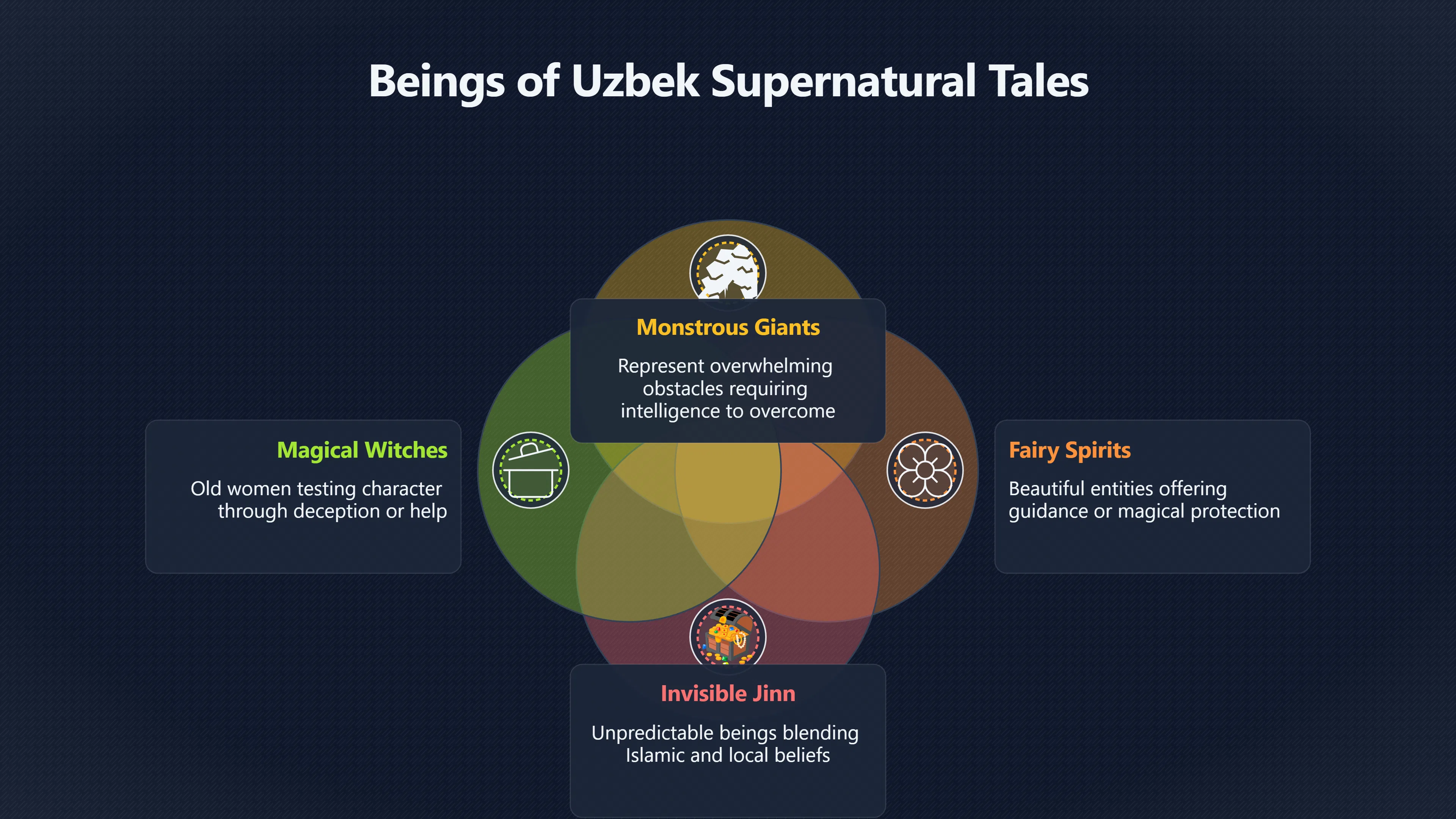
Among the most memorable creatures in Uzbek folk narratives are giants. These figures often appear as overwhelming opponents who stand between heroes and their goals. They belong to a wider Central Asian and Persianate storytelling tradition in which monstrous beings represent chaos, danger and the unknown. In many tales, the giant inhabits remote mountains, caves, forests or kingdoms beyond ordinary human space. Defeating such a creature demonstrates not merely physical strength but intelligence and moral worth.[scispace.com]scispace.comgiant, fairy, dragon related to Avesto mythsHistory of Myths and Mythological Images in Uzbek LiteratureThese include works of Uzbek classical literature, mythological image…
One recurring giant figure is the dev, a monstrous being known across much of Central Asian folklore. The dev is usually portrayed as powerful, frightening and hostile to humans. Heroes frequently overcome these monsters through cunning rather than force alone. The contrast between the giant’s brute strength and the hero’s ingenuity is a central lesson of many Uzbek fairy tales.[SciSpace]scispace.comgiant, fairy, dragon related to Avesto mythsHistory of Myths and Mythological Images in Uzbek LiteratureThese include works of Uzbek classical literature, mythological image…
Some traditions also preserve stories of more localised monstrous beings. Folklore recorded in Central Asia includes the figure known as Ajina, sometimes described in Uzbek and neighbouring traditions as a giant or demonic creature associated with abandoned places, darkness and fear. Such beings function partly as entertainment and partly as cautionary figures used to warn children away from dangerous locations.[The Times Of Central Asia]timesca.comThe Times Of Central Asia Gods and Demons of Central AsiaThe Times Of Central AsiaGods and Demons of Central AsiaAugust 22, 2024 — 22 Aug 2024 — In Tajik and Uzbek folklore, Ajina, a goat-headed…
The giant’s role is therefore symbolic as well as dramatic. He marks the boundary between civilisation and wilderness. When the hero defeats him, order is restored and the human world is made safe again.
Fairies, Witches and Magical Helpers
If giants often embody danger, fairy-like beings frequently represent mystery and possibility. Uzbek folklore contains many references to beautiful supernatural figures commonly described by scholars as fairy beings. These figures derive from ancient Iranian and Central Asian traditions and survived into later Islamic-era storytelling. They appear in both folktales and ritual folklore, demonstrating that they occupied an important place in popular imagination.[ResearchGate]researchgate.netBased on the analysis of ethno-folkloric materials,ResearchGate(PDF) Uzbek mythology and shamanismOctober 16, 2020 — This article is devoted to the analysis of Uzbek mythological notions r…
These fairy figures are usually portrayed as exceptionally beautiful and powerful. They may inhabit hidden realms, mountains, gardens or distant magical kingdoms. In some stories they assist worthy heroes, offering guidance, magical objects or supernatural protection. In others they become the object of a hero’s quest, with the narrative centred on winning or rescuing a fairy bride.[conferencepublication.com]conferencepublication.comMYTHOLOGICAL BASIS OF HEROES IN UZBEK FAIRY TALES30 Nov 2021 — According to some scientific sources, fairies are one of the demonological…
An especially interesting feature of Uzbek fairy traditions is their fluid nature. Folklore studies note that fairy beings can appear in human form, as birds, animals, flames or other transformed shapes. Shape-shifting allows them to move between the visible and invisible worlds, reinforcing their status as creatures who belong to neither realm completely.[conferencepublication.com]conferencepublication.comMYTHOLOGICAL BASIS OF HEROES IN UZBEK FAIRY TALES30 Nov 2021 — According to some scientific sources, fairies are one of the demonological…
Witches and magical old women also appear throughout Uzbek tales. Unlike the fairy, whose beauty often signals supernatural power, the witch figure is frequently associated with testing, deception or dangerous knowledge. Yet these characters are not always purely evil. As in many Eurasian storytelling traditions, an old magical woman may become either a threat or a helper depending on how the hero behaves. Respect, humility and kindness often determine the outcome of the encounter.[pitt.libguides.com]pitt.libguides.comWitches appear in many forms throughout all sorts of fairy and folk tales: powerful women who can help or harm.Read more…
These stories reveal an important theme in Uzbek folklore: supernatural power itself is not automatically good or evil. What matters is the relationship between the human character and the unseen world.
Jinn-Like Beings and Local Belief
The arrival and spread of Islam across Central Asia introduced another powerful category of supernatural being into Uzbek folklore: the jinn. Unlike fairy-tale giants, jinn occupied a more ambiguous position because many listeners regarded them not merely as story characters but as beings that might genuinely exist in the unseen world. Islamic tradition describes jinn as intelligent creatures created separately from humans, and these ideas blended with older local beliefs.[repo.journalnx.com]repo.journalnx.comcomparison of demonological and mythological characters of…February 11, 2021 — Such demonological characters as “Jin”, “Ajina” play a…
In Uzbek folk narratives, jinn are often invisible, shape-shifting and morally unpredictable. They may reward, deceive, assist or harm humans. Some stories describe encounters between travellers and mysterious strangers who later prove to be supernatural beings. Others involve possession, enchantment or hidden treasures guarded by jinn. The uncertainty surrounding their motives makes them especially effective storytelling figures.[repo.journalnx.com]repo.journalnx.comcomparison of demonological and mythological characters of…February 11, 2021 — Such demonological characters as “Jin”, “Ajina” play a…
The boundary between fairy beings and jinn sometimes becomes blurred. Folklore research notes that popular traditions occasionally merged the two categories, especially when describing beautiful supernatural women who could fall in love with humans or interfere in human affairs. In some regional beliefs, fairy figures were understood as belonging to the same wider supernatural world as jinn.[repo.journalnx.com]repo.journalnx.comcomparison of demonological and mythological characters of…February 11, 2021 — Such demonological characters as “Jin”, “Ajina” play a…
This blending illustrates how Uzbek folklore evolved. Rather than replacing older traditions, Islamic concepts often merged with existing story patterns. The result was a rich supernatural landscape where ancient fairy spirits and Islamic jinn could coexist within the same narrative universe.[repo.journalnx.com]repo.journalnx.comcomparison of demonological and mythological characters of…February 11, 2021 — Such demonological characters as “Jin”, “Ajina” play a…
Why These Creatures Matter
Giants, fairies and jinn survive in Uzbek folklore because they do more than provide fantasy. Each type of being helps tell a different kind of story.
- Giants represent overwhelming obstacles and the triumph of courage and intelligence.
- Fairy spirits embody beauty, mystery, desire and supernatural assistance.
- Jinn explore the uncertain relationship between humanity and the unseen world.
- Witches and magical elders test character and reveal moral lessons.[conferencepublication.com]conferencepublication.comMYTHOLOGICAL BASIS OF HEROES IN UZBEK FAIRY TALES30 Nov 2021 — According to some scientific sources, fairies are one of the demonological…
Together these figures show how Uzbek storytellers explained danger, luck, love and fate. They also demonstrate the layered nature of Uzbekistan’s cultural history. Ancient Central Asian beliefs, Persian literary traditions and Islamic ideas did not simply replace one another; they blended into a distinctive folklore in which heroes continually cross the boundary between the human world and a realm filled with giants, fairy spirits and unseen beings.[researchgate.net]researchgate.netBased on the analysis of ethno-folkloric materials,ResearchGate(PDF) Uzbek mythology and shamanismOctober 16, 2020 — This article is devoted to the analysis of Uzbek mythological notions r…
Amazon book picks
Further Reading
Books and field guides related to What Supernatural Beings Haunt Uzbek Tales?. Use these as the next step if you want deeper reading beyond the article.
The Arabian Nights
Shares many supernatural storytelling themes found across Central Asian folklore.
Tales of the Dervishes
Contains supernatural and moral storytelling traditions from the wider region.

The Penguin Book of Dragons
Appeals to readers interested in legendary beings and folk monsters.
eBay marketplace picks
Marketplace Samples
Live-tested eBay searches with available results related to this page.
Endnotes
1.
Source: repo.journalnx.com
Link:https://repo.journalnx.com/index.php/nx/article/download/1497/1467/2933
Source snippet
comparison of demonological and mythological characters of...February 11, 2021 — Such demonological characters as “Jin”, “Ajina” play a...
Published: February 11, 2021
2.
Source: conferencepublication.com
Link:https://conferencepublication.com/index.php/aoc/article/download/1631/1719/4240
Source snippet
MYTHOLOGICAL BASIS OF HEROES IN UZBEK FAIRY TALES30 Nov 2021 — According to some scientific sources, fairies are one of the demonological...
3.
Source: ich.uz
Title: Uzbek national doston passed a long way of historical development.Read more
Link:https://ich.uz/en/materials/articles-books/411-article-3
Source snippet
Oral Folklore of Uzbekistan by the Example of Narrative ArtDostons are either folklore or literary treatment of heroic myths, legends and...
4.
Source: ich.uz
Link:https://ich.uz/en/ich-of-uzbekistan/national-list/domain-1/249-legends-stories
Source snippet
Legends and StoriesIt is one of the examples of intangible cultural heritage. Legend, being one of the most ancient genres of oral folk a...
5.
Source: scispace.com
Title: giant, fairy, dragon related to Avesto myths
Link:https://scispace.com/pdf/history-of-myths-and-mythological-images-in-uzbek-literature-775axkkcww.pdf
Source snippet
History of Myths and Mythological Images in Uzbek LiteratureThese include works of Uzbek classical literature, mythological image...
6.
Source: researchgate.net
Title: Based on the analysis of ethno-folkloric materials,
Link:https://www.researchgate.net/publication/348749572_Uzbek_mythology_and_shamanism
Source snippet
ResearchGate(PDF) Uzbek mythology and shamanismOctober 16, 2020 — This article is devoted to the analysis of Uzbek mythological notions r...
Published: October 16, 2020
7.
Source: pitt.libguides.com
Link:https://pitt.libguides.com/c.php?g=494797&p=3385701
Source snippet
Witches appear in many forms throughout all sorts of fairy and folk tales: powerful women who can help or harm.Read more...
8.
Source: sites.pitt.edu
Link:https://sites.pitt.edu/~dash/folktexts.html
Source snippet
and Mythology Electronic TextsIncluded here are a chronological listing of Andersen's folk-like fairy tales, electronic texts of most sto...
9.
Source: timesca.com
Title: The Times Of Central Asia Gods and Demons of Central Asia
Link:https://timesca.com/gods-and-demons-of-central-asia/
Source snippet
The Times Of Central AsiaGods and Demons of Central AsiaAugust 22, 2024 — 22 Aug 2024 — In Tajik and Uzbek folklore, Ajina, a goat-headed...
Published: August 22, 2024
10.
Source: inlibrary.uz
Link:https://inlibrary.uz/index.php/eijps/article/download/108189/109816/153025
Source snippet
Their plots demonstrate strong conflicts between good and evil, with magic and luck and...Read more...
11.
Source: wosjournals.com
Link:https://www.wosjournals.com/index.php/shokh/article/download/10376/10248
Source snippet
Russian and Uzbek folklore, demonstrating both universal and...Read more...
Additional References
12.
Source: science-technology.uz
Link:https://science-technology.uz/index.php/journal/article/download/24/21/41
Source snippet
MAGICAL ELEMENTS OF ENGLISH AND UZBEK FAIRY TALESAbstract: This article explores the magical elements in English and Uzbek fairy tales, c...
13.
Source: webofjournals.com
Link:https://webofjournals.com/index.php/9/article/download/5410/5438/10666
Source snippet
THE ROLE OF UZBEK FOLK TALES IN THE SPIRITUAL...This scientific article provides a comprehensive analysis of the role of Uzbek folk tale...
14.
Source: tourstouzbekistan.com
Link:https://www.tourstouzbekistan.com/en/blog/stories-and-legends-of-the-uzbek-people.html
Source snippet
Uzbek legends and mythesThis epic tale about the hero [Alpamysh]({{ 'alpamysh/' | relative_url }}) and his exploits, Tales has main place in Uzbek national folk art. Central...
15.
Source: factsanddetails.com
Link:https://factsanddetails.com/central-asia/Uzbekistan/sub8_3e/entry-4718.html
16.
Source: mentaljournal-jspu.uz
Link:https://mentaljournal-jspu.uz/index.php/mesmj/article/download/22/20/19
Source snippet
In no genre oral folk art there is no such wide scope for mocking vices and negative morals. An Uzbek.Read more...
17.
Source: irci.jp
Title: Uzbek folklore as an example of epic art
Link:https://www.irci.jp/rdb/item/7938
Source snippet
This article states that, like other major genres of folk art, they arose because of archaic folklore and ancient national history an...
18.
Source: a78cf8ac-3ef5-4670-8fcd-a900ec94fdfb.filesusr.com
Title: b06fdc 4a5bfdb342834434bcadf51792b7248c
Link:https://a78cf8ac-3ef5-4670-8fcd-a900ec94fdfb.filesusr.com/ugd/b06fdc_4a5bfdb342834434bcadf51792b7248c.pdf?index=true
Source snippet
FAIRY TALES AND THEIR CLASSIFICATION.The features of the genre as an example of artistic creativity of Uzbek folk tales are as follows: 1...
19.
Source: academia.edu
Link:https://www.academia.edu/113951201/Theme_Types_of_Uzbek_Folk_Tales_and_Their_Reflections_in_Translation
Source snippet
The names of the genres of myths and legends...Read more...
20.
Source: youtube.com
Title: Arabic Folklore’s Most Terrifying Creature: The Ghoul
Link:https://www.youtube.com/watch?v=ZdljTiX4aNk
Source snippet
Every Jinn Explained in 13 Minutes provides an overview of the origins of Peris (fairy beings) and other supernatural entities that heavi...
21.
Source: Wikipedia
Title: List of fairy tales
Link:https://en.wikipedia.org/wiki/List_of_fairy_tales
Source snippet
List of fairy talesFairy tales are stories that range from those in folklore to more modern stories defined as literary fairy tales.Re...
Topic Tree