Within Turkmen Folklore
How the Dutar Keeps Stories Alive
The dutar shows why Turkmen folklore is heard, sung and performed rather than simply read from a page.
On this page
- The instrument behind sung tradition
- Bards, poetry and performance skill
- Family teaching and living heritage
Page outline Jump by section
Introduction
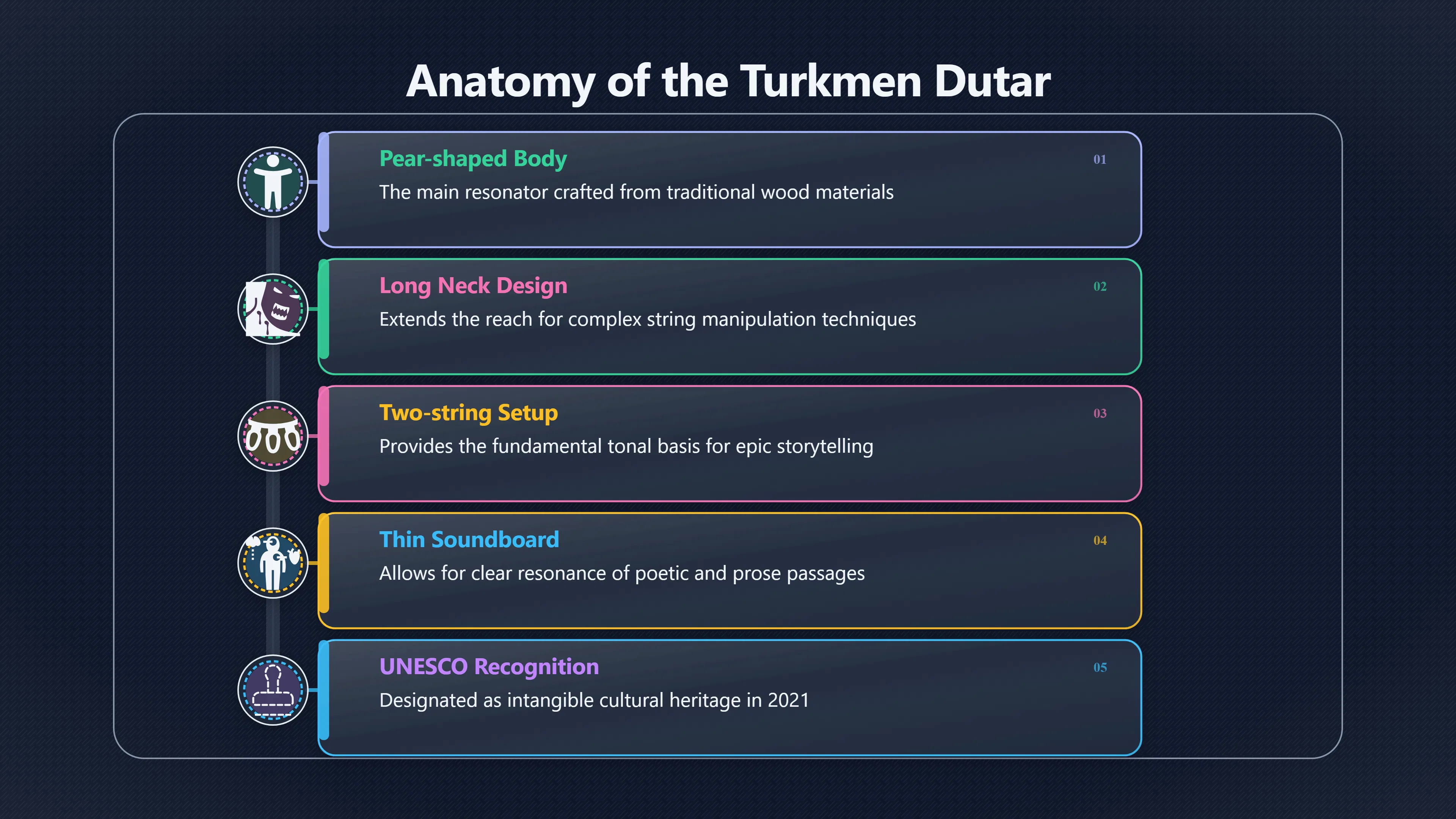
The dutar matters in Turkmen folklore because it turns stories into sound. In Turkmenistan, oral tradition is not only a matter of remembered plots or written-down legends; it is carried by voice, rhythm, instrumental skill and the relationship between performer and listeners. The dutar, a long-necked two-string lute with a pear-shaped body, is used across the main genres of Turkmen music and may be played alone or with singing, poetry and prose. UNESCO recognised Turkmen dutar making and performance with singing as intangible cultural heritage in 2021, underlining that the instrument is both a crafted object and a living storytelling medium.[UNESCO ICH]ich.unesco.orgDutar making craftsmanship and traditional music performing art combined with singing…

This page focuses on the dutar as a mechanism of folklore: how it helps singers hold long narratives in memory, shape emotion, mark climactic moments and pass oral culture through families, teachers and communities. It is not a full history of Turkmen music, nor a retelling of every epic. The key point is simpler and more revealing: in Turkmen tradition, a story can be something you hear unfolding through wood, strings, breath and a trained human voice.
The instrument behind sung tradition
The Turkmen dutar is usually described as a two-stringed lute with a long neck, a pear-shaped body and a thin wooden soundboard. UNESCO’s description stresses that it is not just an instrument but also a musical genre in its own right, used in the main forms of Turkmen music and singing. Its performance may be purely instrumental, or it may accompany singing, poetry and prose, which is exactly why it sits so close to oral folklore.[UNESCO ICH]ich.unesco.orgDutar making craftsmanship and traditional music performing art combined with singing…
That combination matters because Turkmen epic and tale performance often moves between different kinds of speech. A bard may recite prose to advance the action, sing poetic passages to heighten feeling, and use the dutar to hold the whole performance together. A study of Turkmen epic tradition notes that poetic lines and prose are the main components of epic tales: the poems are sung, while prose sections are recited in the manner of a particular local school.[Social Science Research]socialscienceresearch.orgSocial Science Research Turkmen Epos: Origin and Modern ConditionsSocial Science Research Turkmen Epos: Origin and Modern Conditions
The instrument therefore does more than decorate a story. It gives the performance its pacing. It can separate one emotional register from another: ordinary narration, lyrical reflection, heroic excitement, comic pause or dramatic climax. Research on Central Asian oral epics describes Turkmen narrative music as rich in linear melodies, often accompanied by dutar or related bowed instruments, with the well-known Dashoguz school marked by recitative and guttural declamation.[archive.unesco-ichcap.org]archive.unesco-ichcap.orgOral Traditions and Epics of Central Asia engOral Traditions and Epics of Central Asia eng
This helps explain why a written summary of a Turkmen epic can feel strangely thin. On the page, a plot may look like a sequence of adventures. In performance, the same material becomes a carefully voiced event. The listener hears when a hero speaks, when grief enters the tale, when a challenge becomes dangerous, and when the performer is moving towards a high point.
Bards, poetry and performance skill
The central performer in this world is the bard: a singer-storyteller trained to handle music, memory, poetry and social presence at once. In Turkmen epic performance, these storytellers are associated with long narrative repertoires, including heroic cycles such as Gorogly, romantic and heroic tales, legends with music, and musical settings of classical poetry.[Social Science Research]socialscienceresearch.orgSocial Science Research Turkmen Epos: Origin and Modern ConditionsSocial Science Research Turkmen Epos: Origin and Modern Conditions
Their skill lies partly in memory, but not in memory alone. Turkmen storytellers preserve large bodies of song and text, yet performance is also shaped by school, region, voice, repertoire and the performer’s sense of timing. The same study of Turkmen epic tradition identifies Dashoguz and Mary as important centres of epic storytelling and notes that local schools differ in repertoire, genre and performance features.[Social Science Research]socialscienceresearch.orgSocial Science Research Turkmen Epos: Origin and Modern ConditionsSocial Science Research Turkmen Epos: Origin and Modern Conditions
The dutar helps organise this complexity. It supports the singer’s voice, signals transitions and makes long-form storytelling listenable. Songs in epic performance are not random interruptions; they drive the musical drama of the tale. In the Turkmen epic tradition, a performance can move stage by stage towards a climax, with different types of epic song attached to different phases of the narrative.[Social Science Research]socialscienceresearch.orgSocial Science Research Turkmen Epos: Origin and Modern ConditionsSocial Science Research Turkmen Epos: Origin and Modern Conditions
This is why the dutar is so closely connected with famous Turkmen poetic culture. Magtymguly, the eighteenth-century poet now treated as a major national literary figure, has long been kept alive not only in manuscripts and printed editions but also through singers who set poems to dutar-accompanied performance. A Smithsonian-linked publication notes that many of his poems were traditionally sung by Turkmen bards while playing the two-stringed dutar.[ResearchGate]researchgate.netTurkmen instrument called "dutar." While many of Magtymguly's poemsResearchGate(PDF) Magtymguly: Poems from TurkmenistanJanuary 1, 2014 — 24 Mar 2019 — These poems were traditionally sung by Turkmen singe…

Why the sound changes the story
A Turkmen oral performance is not simply a delivery system for old words. The sound changes what the story feels like and what listeners remember. Music can slow a scene down, give weight to a moral choice, or turn a hero’s speech into something close to communal memory.
Three features are especially important.
First, the dutar gives the story a pulse. Long oral tales need structure that listeners can follow. Instrumental patterns, recurring melodic shapes and shifts between sung and spoken passages help the audience recognise movement through the story.
Second, the voice carries authority. A bard’s trained delivery can make an old tale feel present rather than archival. This is especially important in heroic material such as Gorogly, where the plot is inseparable from ideals of courage, loyalty and justice. UNESCO describes the epic art of Gorogly as an oral performing tradition about the legendary hero and his forty cavalrymen, linking it to Turkmen social values and identity.[UNESCO ICH]ich.unesco.orgOpen source on unesco.org.
Third, performance allows variation without breaking continuity. Oral traditions are stable enough to be recognised, but flexible enough to be renewed by performers. Research on Turkmen epic notes that storytellers could add episodes, complicate texts and introduce old or new songs, helping the tradition adapt while remaining recognisably part of the same story-world.[Social Science Research]socialscienceresearch.orgSocial Science Research Turkmen Epos: Origin and Modern ConditionsSocial Science Research Turkmen Epos: Origin and Modern Conditions
For a folklore reader, this is the crucial shift: the dutar is not a background prop. It is one of the tools by which Turkmen tales survive as living events rather than frozen texts.
Family teaching and living heritage
The survival of dutar storytelling depends on transmission. UNESCO and related heritage descriptions emphasise that dutar making, performance and associated knowledge are passed through family, community and master-apprentice teaching. Skills are learned through demonstration, oral explanation, imitation and repeated practice rather than through notation alone.[ichlinks.com]ichlinks.comOpen source on ichlinks.com.
This fits the wider character of Turkmen oral folklore. A learner does not simply memorise a script. They learn how to hold the instrument, accompany the voice, shape a phrase, move between prose and song, respect repertoire, and behave before listeners. The relationship between master and pupil is therefore cultural as well as technical.
Modern institutions have also entered the picture. Research on Turkmen epic tradition notes that the creation of a department for bardic art at the Turkmen National Conservatory gave mentoring traditions a new form: students study singing and instrumental skills for several years, receive formal diplomas, and still seek the blessing of mentors.[Social Science Research]socialscienceresearch.orgSocial Science Research Turkmen Epos: Origin and Modern ConditionsSocial Science Research Turkmen Epos: Origin and Modern Conditions
This mixture of family teaching, public performance and formal cultural policy shows how the dutar has changed without simply disappearing into the past. It can appear at celebrations, cultural festivals, conservatories, museums and diaspora events, while still carrying the older idea that folklore is something performed from person to person.
What the dutar reveals about Turkmen folklore
The dutar shows why Turkmen folklore cannot be understood only by reading summaries of myths and legends. It is a culture of performance, in which the sound of a story is part of its meaning. A heroic tale, a poetic lament, a comic episode or a remembered saying may all depend on timing, tone and the listener’s recognition of familiar musical cues.
It also shows how closely Turkmen folklore links craft and memory. The instrument has to be made, preserved, handled and taught; the songs have to be learned, adapted and performed; the audience has to know how to listen. UNESCO’s recognition of dutar craftsmanship and performance captures this double nature: the heritage lies both in the physical instrument and in the human practices surrounding it.[UNESCO ICH]ich.unesco.orgDutar making craftsmanship and traditional music performing art combined with singing…
Most importantly, the dutar keeps oral folklore social. A printed epic can preserve words, but a performed epic preserves relationships: between teacher and pupil, bard and audience, old repertoire and new occasion, local school and national heritage. In Turkmenistan, that is why the dutar remains more than a musical object. It is one of the sounds through which stories continue to live.
eBay marketplace picks
Marketplace Samples
Live-tested eBay searches with available results related to this page.



Endnotes
1.
Source: ich.unesco.org
Link:https://ich.unesco.org/en/RL/dutar-making-craftsmanship-and-traditional-music-performing-art-combined-with-singing-01565
Source snippet
Dutar making craftsmanship and traditional music performing art combined with singing...
2.
Source: unesco.org
Title: document 5621
Link:https://www.unesco.org/archives/multimedia/document-5621
Source snippet
The dutar instrument is a long-necked, two-stringed lute with a pear-shaped body...
3.
Source: archive.unesco-ichcap.org
Title: Oral Traditions and Epics of Central Asia eng
Link:https://archive.unesco-ichcap.org/eng/ek/sub8/pdf_file/08/Oral%20Traditions%20and%20Epics%20of%20Central%20Asia_eng.pdf
4.
Source: researchgate.net
Title: Turkmen instrument called “dutar.” While many of Magtymguly’s poems
Link:https://www.researchgate.net/publication/331977033_Magtymguly_Poems_from_Turkmenistan
Source snippet
ResearchGate(PDF) Magtymguly: Poems from TurkmenistanJanuary 1, 2014 — 24 Mar 2019 — These poems were traditionally sung by Turkmen singe...
Published: January 1, 2014
5.
Source: ich.unesco.org
Link:https://ich.unesco.org/en/RL/epic-art-of-gorogly-01028
6.
Source: ichlinks.com
Link:https://www.ichlinks.com/archive/elements/elementsV.do?elementsUid=13861173622724021651
7.
Source: ich.unesco.org
Link:https://ich.unesco.org/en/video/58130
8.
Source: ich.unesco.org
Title: turkmenistan TM
Link:https://ich.unesco.org/en/state/turkmenistan-TM
9.
Source: ich.unesco.org
Link:https://ich.unesco.org/doc/src/Signed%20periodic%20report%20-%20Periodic%20report-67058.pdf
10.
Source: ich.unesco.org
Link:https://ich.unesco.org/en/lists
11.
Source: ich.unesco.org
Title: 49033 EN
Link:https://ich.unesco.org/doc/src/49033-EN.pdf
12.
Source: ich.unesco.org
Title: 53491 EN
Link:https://ich.unesco.org/doc/src/53491-EN.pdf
13.
Source: ich.unesco.org
Link:https://ich.unesco.org/doc/src/ITH-10-5.COM-CONF.202-6-EN.pdf
14.
Source: ich.unesco.org
Title: 17331 EN
Link:https://ich.unesco.org/doc/src/17331-EN.pdf
15.
Source: ich.unesco.org
Link:https://ich.unesco.org/doc/src/Signed%20periodic%20report%20-%20Periodic%20report-67225.pdf
16.
Source: ich.unesco.org
Link:https://ich.unesco.org/doc/src/46297.pdf
17.
Source: researchgate.net
Link:https://www.researchgate.net/publication/331971829_Turkmenistan_Arts_from_the_Land_of_Magtymguly
18.
Source: researchgate.net
Link:https://www.researchgate.net/publication/331971738_Turkmenistan_Ancient_Arts_Today
19.
Source: socialscienceresearch.org
Title: Social Science Research Turkmen Epos: Origin and Modern Conditions
Link:https://socialscienceresearch.org/index.php/GJHSS/article/download/102781/29149/41034
20.
Source: theusajournals.com
Link:https://www.theusajournals.com/index.php/ajsshr/article/download/9874/9157/14927
21.
Source: bibliolore.org
Link:https://bibliolore.org/tag/turkmenistan/
Additional References
22.
Source: youtube.com
Title: Turkmen traditional music “ Jan-jan “ by Oghlan bakhshi-Turkmen dutar
Link:https://www.youtube.com/watch?v=iJJwvwd7zpA
Source snippet
"Oghlan Bakhshi" dutar performance TÜRKMEN MÜZİSYEN VE DUTAR USTASI OGHLAN BAKHSHI (GELENEKSEL TÜRKMEN MÜZİKLERİ) Altyazilimotorcu...
23.
Source: youtube.com
Link:https://www.youtube.com/watch?v=LFSJ2n7zPeM
Source snippet
Oghlan Bakhshi - Journey Across the Steppes of Central Asia & Iran...
24.
Source: youtube.com
Title: Oghlan Bakhshi
Link:https://www.youtube.com/watch?v=ryl5r89UBtg
Source snippet
Turkmen Folk Song "Ýetişermikä" #dutar #Turkmenmusic...
25.
Source: youtube.com
Title: Turkmen dutar performance “Humarala” by Oghlan Bakhshi
Link:https://www.youtube.com/watch?v=exlZCSNrboY
Source snippet
Turkmen traditional music " Jan-jan " by Oghlan bakhshi-Turkmen dutar...
26.
Source: youtube.com
Title: Turkmen Folk Song “Ýetişermikä” #dutar #Turkmenmusic
Link:https://www.youtube.com/watch?v=9iuS2lJBWvg
Source snippet
Turkmen dutar performance "Humarala" by Oghlan Bakhshi...
27.
Source: academia.edu
Link:https://www.academia.edu/36675752/Turkmenistan_Arts_from_the_Land_of_Magtymguly_T%C3%BCrkmenistan_Magtymgulyny%C5%88_mekanyny%C5%88_sungaty
28.
Source: instagram.com
Link:https://www.instagram.com/p/DMQRarLzLTh/
29.
Source: instagram.com
Link:https://www.instagram.com/reel/DVedlFbj3eu/
30.
Source: turkmenistaninfo.ru
Link:https://www.turkmenistaninfo.ru/?elem_id=page_6%2Fmagazine_282%2F2325&lang_id=en&page_id=6&type=article
31.
Source: iirmfa.edu.tm
Link:https://iirmfa.edu.tm/en/sahypa/hos-habar-yunesko-we-turkmen-saz-guraly-dutar_8523
Topic Tree