Barbados' Uncanny Folklore
Barbados has a compact but vivid folklore tradition shaped by plantation history, African-Caribbean memory, British colonial forms, Christian belief, folk medicine, music, masquerade and modern cultural revival.
Page outline Jump by section
What makes Barbadian folklore distinctive?
Barbadian folklore sits within the wider English-speaking Caribbean world, so it shares themes with Jamaica, Guyana, Trinidad, St Lucia and other islands: ghosts, shape-shifters, night spirits, charms, curses, haunted cemeteries and cautionary tales told to children. What makes Barbados distinctive is the way those traditions are tied to a small, densely settled coral island with a long sugar-plantation history, a strong culture of parish identity, and public performance forms that are recognisably Barbadian. The folklore is often not separated from music, festival, dance or social memory. A frightening creature in one setting may become a masquerade character, an art subject, a school resource, or a heritage performance in another.[thecommonwealth.org]thecommonwealth.orgCommonwealth BarbadosCommonwealth Barbados
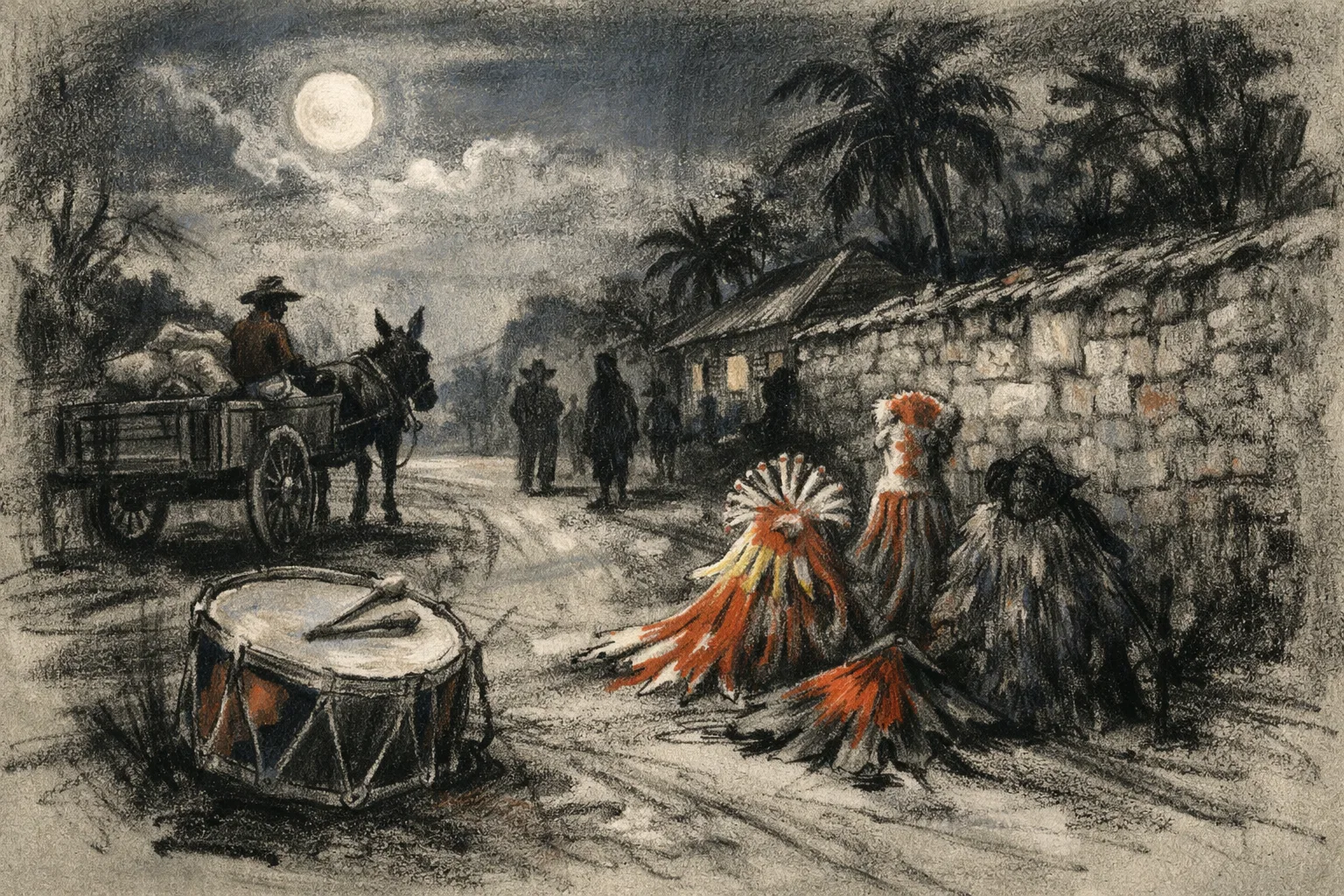
The most visible public face of Barbadian folk tradition is not a pantheon of gods, but a living set of characters and performances. The National Cultural Foundation’s teaching material places figures such as Mother Sally, Shaggy Bear, the Donkey Man and the stilt walker alongside more frightening beings such as the Steel Donkey, duppies, the Baccoo and the Heartman. That mixture is important: Barbados’ folklore includes both the festive and the fearful, both the comic body of masquerade and the night-time body of terror.[National Cultural Foundation]ncf.bbNational Cultural Foundationbajan folkwaysWe discuss these characters briefly below. Page 76. Bajan Folkways. 76. Steel Donkey. Previously described in…
Duppies: the everyday ghost world
The word “duppy” is widely used in the English-speaking Caribbean for a ghost or spirit, and Barbados is part of that shared tradition. In Barbadian usage, as elsewhere, duppy stories often cluster around night travel, lonely roads, old houses, burial places, family warnings and unexplained sounds. They are usually told as belief narratives rather than formal myths: someone saw something, heard something, was warned by an elder, or avoided a place after dark.[Wikipedia]WikipediaOpen source on wikipedia.org.
Duppy stories also show how folklore becomes archive. The Barbados Museum & Historical Society has used “Duppy Tales” as a public storytelling frame for episodes rooted in Barbadian history, including stories attached to places such as Joe’s River Mansion and to figures such as Yarico. That kind of museum retelling does not prove the supernatural claims; it shows that ghost stories remain a useful way to bring memory, place and unease into public conversation.[facebook.com]facebook.comDe Duppy TalesDe Duppy Tales
A useful way to read Barbadian duppy lore is as a map of emotional geography. Haunted houses, churchyards, cliffs and plantation landscapes are not just spooky settings. They are places where family death, slavery, abandonment, violence, romance, betrayal or social fear can be turned into a story that people remember. This is why a duppy tale may feel both entertaining and serious: it carries atmosphere, but it also carries local history.
The Steel Donkey and the sound of fear
The Steel Donkey is one of the most distinctively Barbadian supernatural creatures. In modern summaries of Barbadian folk characters, it is described as a frightening donkey-like being associated with fiery eyes, chains, night-time disturbance and the belief that curses could be placed on people. One widely repeated explanation links it to stones landing on houses without any visible thrower, a classic kind of “invisible agency” story in which an unexplained disturbance becomes proof of a hidden supernatural force.[National Cultural Foundation]ncf.bbNational Cultural Foundationbajan folkwaysWe discuss these characters briefly below. Page 76. Bajan Folkways. 76. Steel Donkey. Previously described in…
The creature also makes sense in a Caribbean comparison. The Steel Donkey resembles the Jamaican Rolling Calf and related chained, flaming, night-roaming animal spirits found across the region. The Barbadian version, however, uses the donkey rather than the calf as its central image, which gives the story a local texture: donkeys, carts, rural tracks and night sounds belong to the remembered landscape of older Barbados.[Storytelling Matters]storytellingmatters.wordpress.comsteel donkeysteel donkey
Today, the Steel Donkey has also moved into art, digital illustration and heritage display. That shift matters. A being once used to frighten children or explain frightening night events can become a symbol of cultural imagination. The fear is still part of the appeal, but it is now often handled with nostalgia, visual creativity and conscious cultural pride.[Gine On?! - Bajan Arts and Culture]gineon.comOpen source on gineon.com.
The Heartman, Baccoo and Old Hag
The Heartman is one of Barbados’ most chilling cautionary figures. He is commonly described as a man dressed in black, sometimes linked to a black hearse, who threatens children by cutting out hearts. The story’s social function is easy to recognise: it warns children against wandering, disobedience and danger, but it does so through a figure far darker than an ordinary moral lesson. In that sense, the Heartman belongs to a long international family of child-warning figures, but his costume, hearse imagery and Barbadian circulation give him local force.[National Cultural Foundation]ncf.bbNational Cultural Foundationbajan folkwaysWe discuss these characters briefly below. Page 76. Bajan Folkways. 76. Steel Donkey. Previously described in…
The Baccoo, sometimes spelled Baku in modern retellings, is more complex because it also appears in Guyanese and Trinidadian folklore. In Barbadian accounts it is often described as a small, magically powerful being, sometimes kept in a bottle and associated with wish-granting, payment, mischief or punishment. Modern Barbadian summaries connect it with stories about travelling sellers and debt, suggesting a folklore of obligation: if someone fails to pay what they owe, hidden forces may be sent after them.[National Cultural Foundation]ncf.bbNational Cultural Foundationbajan folkwaysWe discuss these characters briefly below. Page 76. Bajan Folkways. 76. Steel Donkey. Previously described in…
The Old Hag or soucouyant belongs to the wider Caribbean tradition of the skin-shedding night witch. In common versions, she appears by day as an old woman but travels by night as a ball of fire, entering houses through tiny openings to suck blood and leave marks. The Barbadian version is part of a regional belief complex rather than a Barbados-only invention, but it remains relevant because it links fears of illness, sleep, ageing, women’s hidden power, envy and night attack.[Gine On?! - Bajan Arts and Culture]gineon.comOpen source on gineon.com.
Obeah, healing and the misunderstood spiritual world
No account of Barbadian supernatural tradition can avoid Obeah, but it needs careful handling. Obeah is not simply “witchcraft”, despite the way colonial and later popular language often framed it. Scholars Jerome Handler and Kenneth Bilby describe Barbadian slave medicine as resting fundamentally on African beliefs and practices in which supernatural power played a major role, and they argue that Europeans often used “Obeah” as a catch-all label for supernatural-related practices they misunderstood or condemned.[jeromehandler.com]jeromehandler.comOn the Early Use and Origin of the Term 'ObeahOn the Early Use and Origin of the Term 'Obeah
Across the British Caribbean, Obeah has included healing, protection, charms, ritual knowledge, fear of harm, and accusations of spiritual attack. The Early Caribbean Digital Archive describes it as a creolised religious practice drawing on African religion and reinterpreted Christian elements, while later scholarship stresses that “Obeah” was often a category imposed through colonial policing as much as a neat self-description used by practitioners.[ecda.northeastern.edu]ecda.northeastern.eduWhat is Obeah? – ECDAWhat is Obeah? – ECDA
For Barbados, this matters because many folk beings sit near the boundary between story and spiritual power. A Steel Donkey might be described as a cursed creature; a Baccoo may be sent by someone with hidden knowledge; a duppy may be feared after death; a healer may be respected, feared or accused. The folklore is therefore not only entertainment. It records a world in which illness, luck, malice, protection and justice could be imagined as spiritual forces acting through people, objects, animals and places.
Tuk bands and masquerade: folklore in motion
Barbadian folklore is unusually visible in performance. Tuk bands, playing a Barbadian folk music often linked to the fusion of African drumming and British military-band influence, accompany folk characters such as Mother Sally, Shaggy Bear, the Donkey Man and the stilt walker. These figures are not ghosts in the ordinary sense, but they belong to traditional belief culture because they carry symbolic roles, embodied memory and older ideas about fertility, survival, disguise, labour and social satire.[National Cultural Foundation]ncf.bbNational Cultural Foundationbajan folkwaysWe discuss these characters briefly below. Page 76. Bajan Folkways. 76. Steel Donkey. Previously described in…
Mother Sally is especially memorable: a masked or costumed figure with exaggerated bodily features, often linked in explanations to fertility, comic performance and African-derived symbolism. Shaggy Bear is usually associated with a shaggy costume and energetic dancing; the Donkey Man evokes old transport and rural labour; the stilt walker turns height, balance and spectacle into a public display of daring. These characters show how Barbadian folklore can be funny, noisy and communal rather than only frightening.[National Cultural Foundation]ncf.bbNational Cultural Foundationbajan folkwaysWe discuss these characters briefly below. Page 76. Bajan Folkways. 76. Steel Donkey. Previously described in…
The point is not that every festival character has one fixed meaning. Meanings change depending on whether the figure appears in a village memory, a school resource, a tourist show, a Crop Over procession or an artist’s reinterpretation. What remains constant is the idea that the body in costume can carry history.
Crop Over: harvest, hardship and Mr Harding
Crop Over is Barbados’ major harvest festival, with roots in sugar-cane plantation celebrations and a modern national revival in the 1970s. It now includes music, costume, parades and large public events, but older Crop Over contained folk elements that were sharper and more socially revealing. One of the most striking was Mr Harding, an effigy made from cane trash and old clothes, traditionally burnt at the end of celebrations.[Wikipedia]WikipediaCrop OverCrop Over
Mr Harding has been interpreted in more than one way. Some accounts connect him with a cruel planter or overseer; others read him as a figure of “hard times”, the difficult period after the sugar crop ended when work and money were scarce. The International Journal of Intangible Heritage notes that research traces the figure at least as far back as 1868, with later references in 1897 and the 1930s. That gives Mr Harding stronger historical footing than many purely oral supernatural tales.[IJIH]ijih.orgOpen source on ijih.org.
Modern Crop Over still draws on folk memory, even when packaged as national celebration and tourism. Recent festival coverage has described processions including stilt walkers, Shaggy Bears, Mother Sally, tuk bands, Donkey Men, plantation workers, the Barbados Landship and Mr Harding imagery. This is folklore as public culture: no longer just a story told at home, but a performed national inheritance.[Barbados Today]barbadostoday.bbBarbados Today Culture, creativity on display at Crop Over GalaBarbados Today Culture, creativity on display at Crop Over Gala
The Barbados Landship: a national folk institution
The Barbados Landship is one of the country’s most important traditional cultural forms. It is a performance and social organisation whose members use naval ranks, uniforms, drills, dances and commands, often accompanied by tuk music. The form is usually linked to the post-emancipation period and to working-class African-Barbadian community organisation. The Barbados Landship Association claims 1863 as the date of official establishment, making it one of the island’s oldest surviving indigenous cultural institutions.[National Cultural Foundation]ncf.bbNational Cultural FoundationBarbados LandshipBarbados Landship is an indigenous cultural and social organisation, respected for retaining…
The Landship is folkloric not because it is “mythical”, but because it turns history into repeated, embodied performance. Its manoeuvres can be read as naval parody, African dance retention, community discipline, social welfare and memory of the Middle Passage. The International Journal of Intangible Heritage describes Landship performance as a combination of music, dance, costume, drama, street theatre, spectacle and audience participation.[IJIH]ijih.orgOpen source on ijih.org.
Its recent international recognition also matters. UNESCO’s listing of the social and cultural traditions associated with landships in Barbados on its intangible heritage framework highlights the Landship as a living tradition in need of safeguarding, not as a museum relic. That distinction is central to Barbados’ folklore more broadly: survival depends not only on recording old stories, but on keeping performance communities alive.[Intangible Cultural Heritage]ich.unesco.orgOpen source on unesco.org.
Haunted Barbados and the Chase Vault
The most famous haunted-place legend in Barbados is the Chase Vault at Christ Church Parish Church in Oistins. The story says that in the early nineteenth century, heavy lead coffins inside a sealed burial vault were repeatedly found moved or thrown about, even though the entrance appeared undisturbed. It is one of the Caribbean’s best-known “moving coffin” legends and has travelled far beyond Barbados in books, podcasts, travel writing and paranormal retellings.[Wikipedia]WikipediaChase VaultChase Vault
The evidence, however, is much less solid than the story. The first published version appeared in 1833 in James Edward Alexander’s Transatlantic Sketches, and later versions vary. Folklorists and sceptical investigators have pointed out that contemporary documentation is thin, details shift between tellings, and the legend may belong to a wider family of moving-coffin stories rather than to a securely verified event.[wikipedia.org]WikipediaChase VaultChase Vault
That does not make the Chase Vault irrelevant. Quite the opposite: it is a perfect example of how folklore works. The value of the story is not only whether the coffins moved. It is how a local churchyard story became a repeatable mystery, how nineteenth-century print culture spread it, how tourism preserved it, and how modern readers still weigh atmosphere against evidence. Barbados’ haunted landscape is built from that tension between place, memory and doubt.
Old tradition, tourist retelling and internet folklore
Barbadian folklore has changed because the settings of storytelling have changed. Older tales circulated through family warnings, village talk, plantation memory, schoolyard fear, night-time storytelling and festival practice. Today, the same beings appear in museum programmes, visual art exhibitions, social media posts, Halloween bus tours, tourism blogs and cultural education materials.[facebook.com]facebook.comDe Duppy TalesDe Duppy Tales
This does not automatically make modern versions “fake”. Folklore has always adapted. A Steel Donkey in a grandmother’s warning, a Steel Donkey in a digital sculpture and a Steel Donkey in an Instagram heritage post are different cultural objects, but they are connected. The key is to distinguish the layers: oral belief, documented festival practice, scholarly interpretation, tourism packaging and online invention. Some modern descriptions add dramatic details that may not be old; some simplify complicated spiritual traditions into spooky entertainment; others help younger Barbadians recognise names and figures that might otherwise fade.[Gine On?! - Bajan Arts and Culture]gineon.comOpen source on gineon.com.
The strongest Barbadian folklore pages and exhibitions tend to do three things at once: they entertain, they name the tradition’s historical roots, and they admit uncertainty where the evidence is uncertain. That balance is especially important for supernatural traditions, because treating every story as literal fact flattens folklore, while treating every story as nonsense misses why people kept telling it.

Why Barbados’ folklore still matters
Barbados’ folklore matters because it preserves ways of thinking that formal history often leaves out. Duppy tales remember fear and place. Obeah traditions reveal struggles over healing, power and colonial control. Crop Over characters record plantation labour, ridicule and survival. The Landship transforms imperial naval imagery into African-Barbadian community performance. The Steel Donkey and Heartman show how terror can discipline children, explain disorder and become cultural art.[jeromehandler.com]jeromehandler.comOn the Early Use and Origin of the Term 'ObeahOn the Early Use and Origin of the Term 'Obeah
It also matters because Barbados has had to decide what to do with fragile traditions in a modern, tourism-facing society. Some practices survive best on the street, some in schools, some in archives, some in festivals, and some in deliberately revived performances. The Barbados Museum & Historical Society, the National Cultural Foundation and Landship organisations all show different models of preservation: collecting artefacts, teaching folkways, staging performances, and turning oral tradition into public heritage.[barbmuse.org.bb]barbmuse.org.bbOpen source on barbmuse.org.bb.
The result is a folklore landscape that is small in geography but rich in layers. Barbados’ legends are not just a list of monsters. They are a living conversation between Africa and Britain, plantation and parish, Christianity and folk power, fear and comedy, oral memory and official heritage, old people’s warnings and young artists’ reinventions.
Amazon book picks
Further Reading
Books and field guides related to What Haunts Barbados After Dark?. Use these as the next step if you want deeper reading beyond the article.
The Jumbie God's Revenge
Introduces readers to Caribbean spirit traditions related to Barbadian lore.
Wide Sargasso Sea
Explores colonial memory and Caribbean cultural landscapes linked to folklore.
Anansi the Spider
Reflects African storytelling influences that shaped Caribbean folklore.
Caribbean Folk Tales
Provides broad folklore context that includes themes found in Barbados.
eBay marketplace picks
Marketplace Samples
Live-tested eBay searches with available results related to this page.
Endnotes
1.
Source: gineon.com
Link:https://gineon.com/virtualvisuals/
2.
Source: Wikipedia
Link:https://en.wikipedia.org/wiki/Duppy
3.
Source: facebook.com
Title: De Duppy Tales
Link:https://www.facebook.com/watch/barbadosmuseum/345687543306562/
4.
Source: youtube.com
Link:https://www.youtube.com/watch?v=jwyQ5gPhh8I
5.
Source: Wikipedia
Title: Tuk band
Link:https://en.wikipedia.org/wiki/Tuk_band
6.
Source: instagram.com
Link:https://www.instagram.com/reel/DCeuilKJXGz/?hl=en
7.
Source: Wikipedia
Link:https://en.wikipedia.org/wiki/Obeah
8.
Source: jeromehandler.com
Title: On the Early Use and Origin of the Term ‘Obeah’
Link:https://jeromehandler.com/wp-content/uploads/2009/07/Obeah_Origin-2001.pdf
9.
Source: ecda.northeastern.edu
Title: What is Obeah? – ECDA
Link:https://ecda.northeastern.edu/home/about-exhibits/obeah-narratives-exhibit/what-is-obeah/
10.
Source: Wikipedia
Title: Crop Over
Link:https://en.wikipedia.org/wiki/Crop_Over
11.
Source: ijih.org
Link:https://www.ijih.org/volumes/article/427
12.
Source: ijih.org
Link:https://www.ijih.org/volumes/article/610
13.
Source: Wikipedia
Title: Barbados Landship
Link:https://en.wikipedia.org/wiki/Barbados_Landship
14.
Source: ich.unesco.org
Link:https://ich.unesco.org/en/USL/the-social-and-cultural-traditions-associated-with-landships-in-barbados-02307
15.
Source: barbados.org
Link:https://barbados.org/blog/barbados-landship-steers-into-unescos-intangible-heritage/
16.
Source: Wikipedia
Title: Chase Vault
Link:https://en.wikipedia.org/wiki/Chase_Vault
17.
Source: barbados.org
Link:https://barbados.org/chase-vault.htm
18.
Source: barbmuse.org.bb
Link:https://www.barbmuse.org.bb/
19.
Source: barbmuse.org.bb
Link:https://www.barbmuse.org.bb/Discover/Collections
20.
Source: Wikipedia
Link:https://en.wikipedia.org/wiki/Barbados
21.
Source: facebook.com
Link:https://www.facebook.com/barbadosmuseum/videos/bmhs-duppy-tales-the-tale-of-yarico/363920741386417/
22.
Source: facebook.com
Link:https://www.facebook.com/VisitBarbados/posts/the-bajan-tuk-band-is-a-true-representation-of-barbados-colonial-history-the-tuk/876576511171072/
23.
Source: facebook.com
Link:https://www.facebook.com/barbadosmuseum/videos/bmhs-duppy-tales/1004921180012319/
24.
Source: facebook.com
Link:https://www.facebook.com/groups/Barbadosphoto/posts/10156450467134929/
25.
Source: facebook.com
Link:https://www.facebook.com/barbadosmuseum/videos/bmhs-duppy-tales-eps-2/927297627673738/
26.
Source: facebook.com
Link:https://www.facebook.com/BeautifulBarbados/posts/scary-bajan-urban-legends-in-beautifulbarbados-have-you-ever-heard-about-our-urb/1278754377740909/
27.
Source: facebook.com
Link:https://www.facebook.com/BarbadosNCF/posts/dis-is-we-ting-do-you-know-about-our-bajan-folk-charactersin-this-episode-of-we-/645015100991147/
28.
Source: facebook.com
Link:https://www.facebook.com/BarbadosToday/posts/once-feared-as-a-creature-of-chains-and-shadows-the-steel-donkey-is-rooted-in-or/1080850360907489/
29.
Source: facebook.com
Title: National Cultural Foundation
Link:https://www.facebook.com/BarbadosNCF/posts/you-remember-the-first-time-you-heard-that-infectious-sound-of-tuk-for-generatio/1439876041505045/
30.
Source: facebook.com
Link:https://www.facebook.com/NationBarbados/posts/-the-wait-is-over-crop-over-2026-officially-begins-this-saturday-at-queens-park-/1491775029649811/
31.
Source: facebook.com
Link:https://www.facebook.com/barbadosmuseum/posts/have-you-heard-about-the-burning-of-mr-harding-typically-he-was-a-masquerade-ent/10160350230903383/
32.
Source: facebook.com
Link:https://www.facebook.com/barbadosmuseum/posts/did-you-know-that-the-legend-of-moving-coffins-was-not-only-linked-to-the-vault-/496962255776041/
33.
Source: facebook.com
Link:https://www.facebook.com/groups/693756187445957/posts/3185190818302469/
34.
Source: facebook.com
Link:https://www.facebook.com/groups/ancient10/posts/508124845286194/
35.
Source: facebook.com
Link:https://www.facebook.com/groups/269202760462518/posts/1616675435715237/
36.
Source: facebook.com
Title: obeah myths and beliefs friday october 30 2pm
Link:https://www.facebook.com/BarbadosNCF/posts/obeah-myths-and-beliefs-friday-october-30-2pm/3487186074637633/
37.
Source: youtube.com
Link:https://www.youtube.com/watch?v=nyo-KIR-RWk
38.
Source: barbados.org
Link:https://barbados.org/
39.
Source: instagram.com
Title: DQUMISTjy Ka
Link:https://www.instagram.com/p/DQUMISTjyKa/
40.
Source: instagram.com
Title: DQZr ILfjsv8
Link:https://www.instagram.com/reel/DQZrILfjsv8/
41.
Source: instagram.com
Link:https://www.instagram.com/p/DXf_nmajQAJ/
42.
Source: instagram.com
Link:https://www.instagram.com/p/DRhp5JaEnWZ/
43.
Source: instagram.com
Link:https://www.instagram.com/p/DaS5qo9iHi1/
44.
Source: instagram.com
Link:https://www.instagram.com/p/DCH8sqOyEr3/
45.
Source: ijih.org
Link:https://www.ijih.org/retrieve/volumeDtl/427
46.
Source: youtube.com
Title: THE MERRYMEN OF BARBADOS
Link:https://www.youtube.com/watch?v=cblZwqKIdWE
Source snippet
This Is Crop Over | Mudda Sally...
47.
Source: youtube.com
Title: This Is Crop Over | Mudda Sally
Link:https://www.youtube.com/watch?v=1ggrcZjGGNY
Source snippet
This Is Crop Over | Stilt Walking...
48.
Source: youtube.com
Title: This Is Crop Over | Stilt Walking
Link:https://www.youtube.com/watch?v=vMnQP3H7TS8
Source snippet
The Barbados Landship...
49.
Source: youtube.com
Title: The Barbados Landship
Link:https://www.youtube.com/watch?v=oO8jX3x_oH8
Source snippet
The Heartman...
50.
Source: youtube.com
Title: The Heartman
Link:https://www.youtube.com/watch?v=YGOA0EwBjek
51.
Source: ncf.bb
Title: National Cultural Foundationbajan folkways
Link:https://ncf.bb/wp-content/uploads/2019/08/CULTURAL-KIT-FINISH-1512.pdf
Source snippet
We discuss these characters briefly below. Page 76. Bajan Folkways. 76. Steel Donkey. Previously described in...
52.
Source: ncf.bb
Link:https://ncf.bb/wp-content/uploads/2019/08/Landship-FINAL2-single-pages.pdf
Source snippet
National Cultural FoundationBarbados LandshipBarbados Landship is an indigenous cultural and social organisation, respected for retaining...
53.
Source: thecommonwealth.org
Title: Commonwealth Barbados
Link:https://thecommonwealth.org/our-member-countries/barbados
54.
Source: storytellingmatters.wordpress.com
Title: steel donkey
Link:https://storytellingmatters.wordpress.com/tag/steel-donkey/
55.
Source: tandfonline.com
Link:https://www.tandfonline.com/doi/full/10.1080/14788810.2015.1027852
56.
Source: barbadostoday.bb
Title: Barbados Today Culture, creativity on display at Crop Over Gala
Link:https://barbadostoday.bb/2026/06/23/culture-creativity-on-display-at-crop-over-gala/
57.
Source: ncf.bb
Title: crop over stalwarts to be honoured at ceremonial delivery of the last canes
Link:https://ncf.bb/2026/06/26/crop-over-stalwarts-to-be-honoured-at-ceremonial-delivery-of-the-last-canes/
58.
Source: tandfonline.com
Link:https://www.tandfonline.com/doi/abs/10.1080/0015587X.2019.1637561
59.
Source: skeptoid.com
Link:https://skeptoid.com/episodes/399
60.
Source: barbadostoday.bb
Title: btcolumn shaping of caribbean societies part 2
Link:https://barbadostoday.bb/2022/08/05/btcolumn-shaping-of-caribbean-societies-part-2/
61.
Source: thecoalpotandthepantry.wordpress.com
Title: caribbean folklore and mysteries
Link:https://thecoalpotandthepantry.wordpress.com/2016/10/02/caribbean-folklore-and-mysteries/
62.
Source: cemeteryparks.wordpress.com
Title: crypt of the moving coffins
Link:https://cemeteryparks.wordpress.com/2005/11/13/crypt-of-the-moving-coffins/
63.
Source: atlasobscura.com
Title: The Chase Vault
Link:https://www.atlasobscura.com/places/the-chase-vault-oistins-barbados
64.
Source: ebsco.com
Link:https://www.ebsco.com/research-starters/geography-and-cartography/barbados
Additional References
65.
Source: barbadosartists.bb
Link:https://www.barbadosartists.bb/ViewProfile.aspx?id=5882
66.
Source: reddit.com
Link:https://www.reddit.com/r/UnresolvedMysteries/comments/593ltg/does_anyone_have_answers_for_the_moving_coffins/
67.
Source: researchgate.net
Link:https://www.researchgate.net/publication/23248631Notes_and_documents-On_the_Early_Use_and_Origin_of_the_Term%27Obeah%27_in_Barbados_and_the_Anglophone_Caribbean
68.
Source: reddit.com
Link:https://www.reddit.com/r/Barbados/comments/21qhx2/son_of_a_bajan_with_a_question/
69.
Source: dannyechase.com
Link:https://dannyechase.com/blog/movingcoffins/
70.
Source: tripadvisor.com
Link:https://www.tripadvisor.com/ShowTopic-g147262-i230-k2846149-The_Truth_Origins_of_the_Crop_Over_Old_Plantation_Festival-Barbados.html
71.
Source: tiltingaxis.org
Link:https://tiltingaxis.org/on-duppies-and-the-archive
72.
Source: barbadosrevealed.com
Link:https://barbadosrevealed.com/things-to-do/culture-history/tuk-band-and-landship-barbados-living-folk-traditions
73.
Source: x.com
Link:https://x.com/Barbados
74.
Source: slaveryandfreedomlaws.lib.unb.ca
Link:https://slaveryandfreedomlaws.lib.unb.ca/laws/barbados-1819
Topic Tree
Follow this branch
Related pages 192
- Afghan Folklore
- Albanian Folklore
- Algerian Folklore
- Australian Folklore
- Azerbaijan Folklore
- +187 more in sidebar