Distinctive Folklore of Sierra Leone
Sierra Leone’s folklore is not a single myth cycle with one national pantheon. It is a living mix of oral storytelling, initiation societies, masked performance, ancestral and water-spirit belief, Islamic and Christian influence, Krio urban culture, and modern public heritage work.
Page outline Jump by section
Introduction
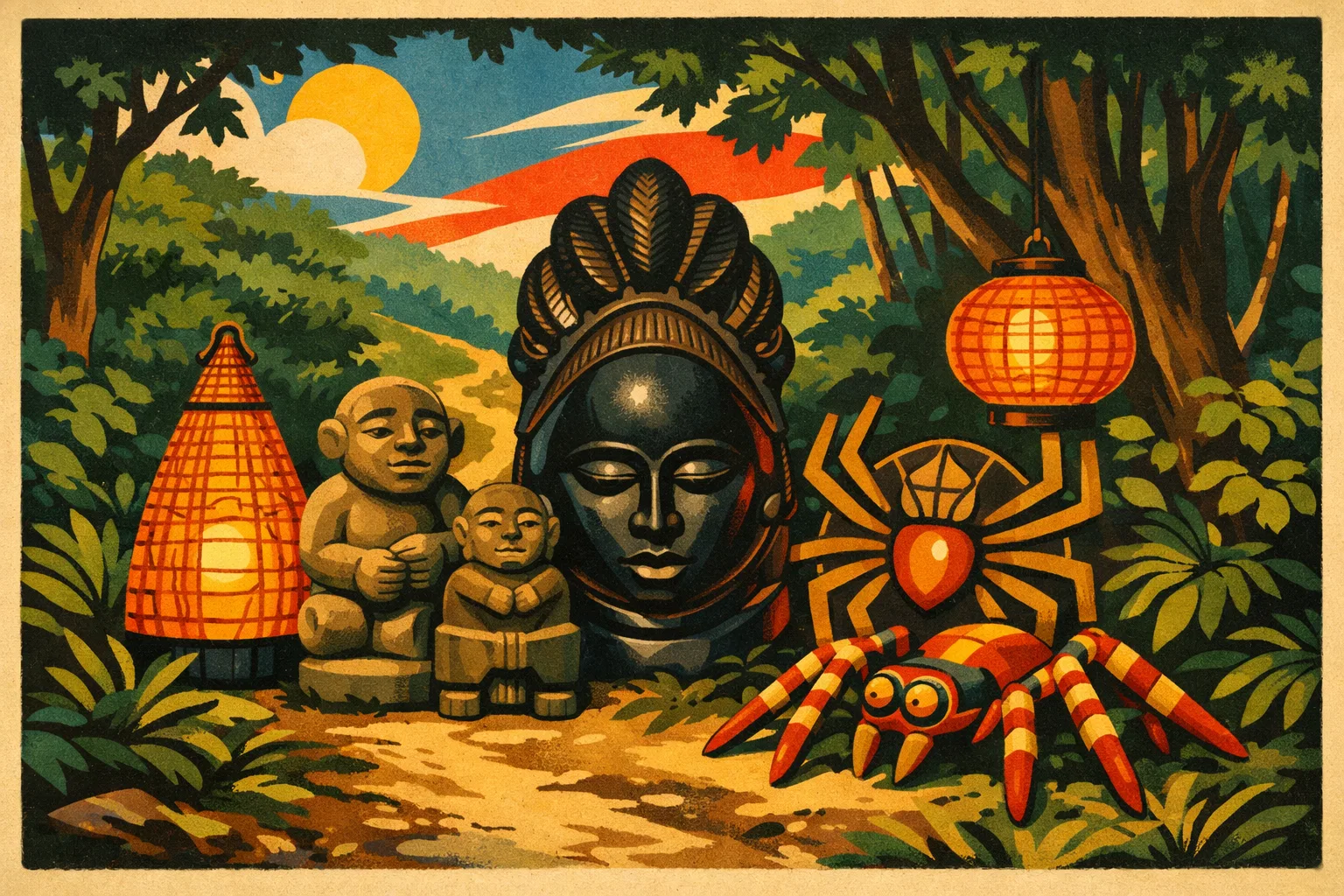
The best-attested examples include Mende and Temne storytelling, the trickster Spider, Sande/Bondo and Poro masquerades, Sowei helmet masks, Kabemba initiation masks, old stone figures known as Nomoli or Pomdo, Mami Wata water-spirit traditions, witchcraft accusation narratives, and Freetown’s lantern parades. Each belongs to a different social setting, so Sierra Leonean folklore is best understood as a set of overlapping local worlds rather than a single national script.
Why Sierra Leone’s folklore looks different from a “mythology”
Many popular introductions to folklore start with gods, heroes and monsters. Sierra Leone asks for a different starting point: performance, secrecy, initiation and storytelling. Much of the country’s best-documented belief culture belongs to communities where knowledge is transmitted through family narration, public dance, ritual training, specialist societies and local authority, not only through written texts.
Sierra Leone is multilingual and culturally diverse, with major communities including Temne, Mende, Limba, Kono, Sherbro, Krio and others. That matters because folklore is often local: a story collected in Mende country, a Temne Poro mask, a Krio street parade and a coastal water-spirit belief are all “Sierra Leonean”, but they do not have identical origins or meanings. Sierra Leone Heritage, a major digital museum and cultural project, reflects this variety through collections and glossary entries on Sande, Poro, Mami Wata, Nomoli, Kabemba, Odelay and the Lantern Parade, rather than presenting one unified national mythology.[sierraleoneheritage.org]sierraleoneheritage.orgGlossaryA Brief History of Sierra Leone National Museum. B. Balangi · Bangeon · Ka… A-Nowo. O. Odelay Society · Ojeh Society. P. Pomdo…
The country’s folklore is also shaped by movement. Freetown’s Krio culture was formed through the settlement of freed and recaptured Africans, Black Loyalists, Jamaican Maroons and others, while inland traditions connect Sierra Leone to wider Upper Guinea and Mano River cultural regions. That is why some traditions are deeply local, while others, such as Mami Wata water-spirit imagery or Spider trickster tales, form part of broader West African and Atlantic worlds.[Google Arts & Culture]artsandculture.google.comGoogle Arts & CultureParading Lanterns: A Unique Display of Competitive…The annual night parade of large illuminated floats (lanterns)…
Oral storytelling: Spider, Royal Antelope and the cleverness of small things
The most familiar doorway into Sierra Leonean folklore is the folktale. Collections from the twentieth century show a lively oral literature in which animals talk, tricksters scheme, social rules are tested and ordinary listeners are invited to judge cleverness, greed, foolishness and survival.
One of the most important published collections is Marion Kilson’s Royal Antelope and Spider: West African Mende Tales, published in 1976 with Mende and English texts. Its catalogue record identifies it directly as Mende folklore and tales from Sierra Leone.[Internet Archive]archive.orgOpen source on archive.org. Kilson’s later article “Spider and Royal Antelope in Sierra Leone” treats the Spider and Royal Antelope figures as representative of Sierra Leonean trickster traditions, especially in Mende storytelling.[JSTOR]jstor.orgOpen source on jstor.org.
Spider is especially important because he is small, vulnerable and socially disruptive. In many West African traditions, spider-tricksters win through language, cunning and appetite rather than strength. Sierra Leonean Spider tales therefore do not simply celebrate cleverness; they also test its limits. The trickster can expose greed or stupidity, but he can also behave badly himself. That moral slipperiness is part of the pleasure of the tale.
Older language collections also preserve story material. Northcote Whitridge Thomas’s 1916 Specimens of Languages from Sierra Leone is held by the Internet Archive and documents Sierra Leonean languages and texts at a time when colonial officials and anthropologists were recording oral material in print.[Internet Archive]archive.orgOpen source on archive.org. These sources are valuable, but they need careful reading: they preserve voices and stories, yet they were filtered through colonial-era collection practices, translation choices and the priorities of outside observers.
For a modern reader, the key point is that Sierra Leone’s folktales were not just entertainment for children. They were social teaching, memory, verbal art and community commentary. A story about an animal who cheats another animal can carry lessons about obligation, kinship, hunger, clever speech, farming life or the danger of refusing advice.
Masks that are more than costumes
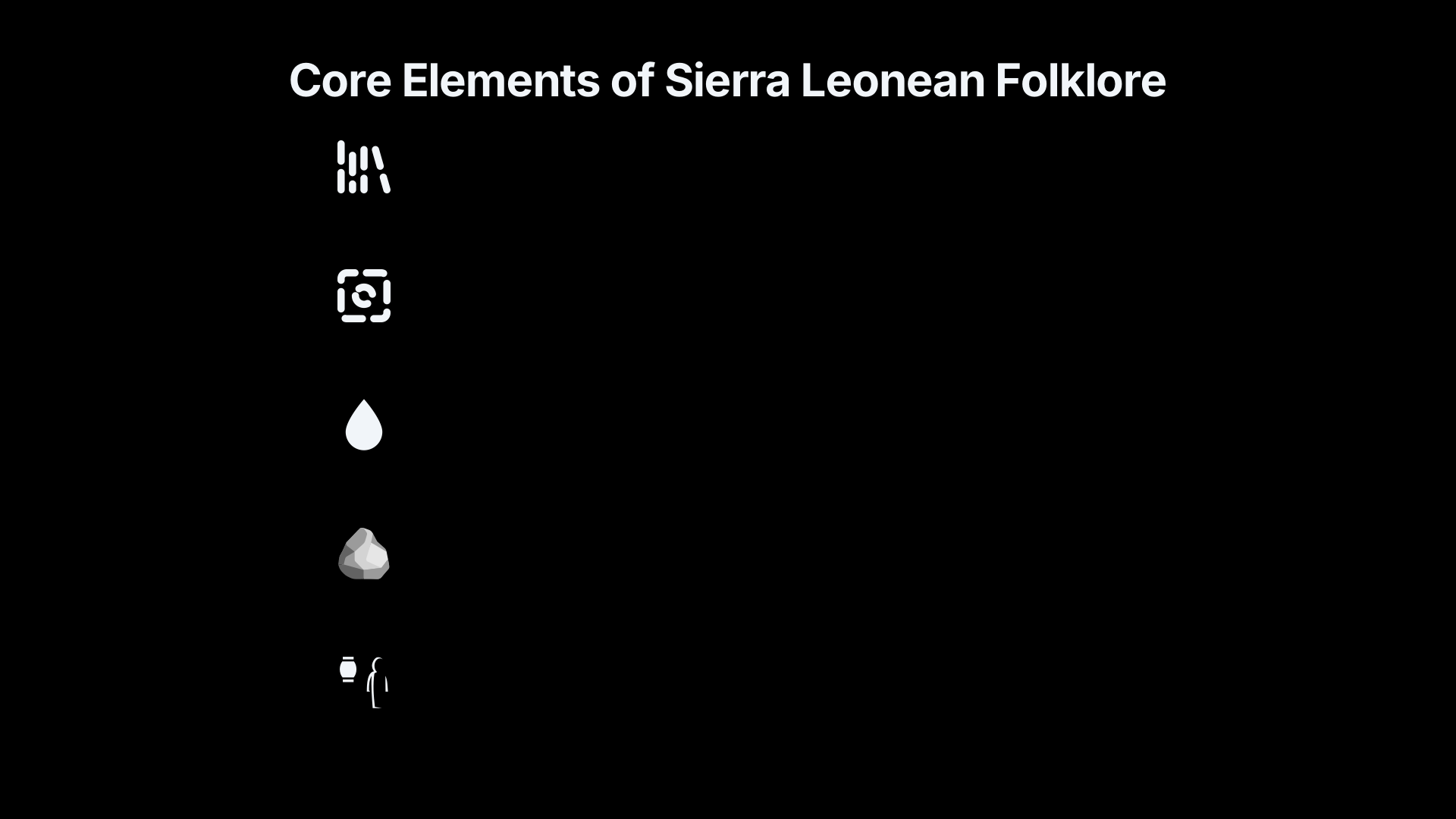
Masked performance is one of Sierra Leone’s most visible forms of belief culture. Museums often display the carved mask, but in its original setting the mask is only one part of a larger event: costume, music, dance, secrecy, social authority and the presence of a spirit or ancestral force.
Sowei masks and the public face of Sande/Bondo
The Sowei helmet mask is probably Sierra Leone’s best-known ritual art object internationally. British Museum records describe Sowei masks as carved wooden helmet masks used by the female Sande society among the Mende and by Bondo/Bundu societies among Temne-speaking communities. They are traditionally worn by a high-ranking dancer, known among the Mende as ndoli jowei and among the Temne as a-Nowo, with a raffia costume, polished black finish, neck rings, elaborate hair and a dignified facial expression. The mask is widely interpreted as representing ideals of womanhood.[British Museum]britishmuseum.orgOpen source on britishmuseum.org.
That description can sound like an art label, but it points to a deeper cultural role. Sande/Bondo is not merely a “mask society”; it has historically been tied to initiation, female solidarity, moral instruction, elder authority and community identity. Modern discussions must also acknowledge that Bondo/Sande initiation has been closely associated with female genital mutilation/cutting, a practice now addressed in human-rights, health and legal debates. A 2025 country-information report, citing contemporary reporting, notes that Bondo is defended by some as a place of sisterhood and cultural identity while also being central to debates over FGM/C in Sierra Leone.[ecoi.net]ecoi.net2025 05 Sierra Leone Bondo and Poro Society2025 05 Sierra Leone Bondo and Poro Society
This is where folklore needs careful language. The Sowei mask can be admired as art, studied as spiritual performance, and understood as part of women’s cultural authority, while still recognising that some associated practices are contested today. Treating the tradition seriously means neither romanticising it nor reducing it to controversy alone.
Poro, Kabemba and the “grandfather” of initiation
The male counterpart most often discussed alongside Sande/Bondo is Poro. Sierra Leone Heritage defines Poro as the men’s society responsible for organising initiation that prepares boys and young men for adult life. Earlier European writers often compared it to freemasonry and credited it with political force and respect for its laws, although such descriptions reflect outside interpretations as well as local realities.[sierraleoneheritage.org]sierraleoneheritage.orgPoro16 Jan 2026 — A name used throughout Sierra Leone for the men's society that is responsible for organising the initiation that prepar…
Among Temne material culture, the Kabemba or Ka-bemba mask is especially striking. Sierra Leone Heritage describes it as a mask worn during the initiation of Temne boys into Poro; “Ka-bemba” means grandfather or forefather, and the mask is associated with the figure who leads boys into and out of the society bush.[sierraleoneheritage.org]sierraleoneheritage.orgOpen source on sierraleoneheritage.org. This is folklore in a strong sense: the mask is not just a sculpture of an ancestor. It stages a relationship between the living, the young, the old, the initiated and the ancestral past.
The secrecy around Poro has also shaped the evidence. The Re-Entanglements project, which works with Northcote Thomas’s early twentieth-century Sierra Leone material, notes that Thomas published only a cursory section on Poro because of concerns about exposing sensitive information. It also highlights a 1914 photograph of Pa Kasi in present-day Tonkolili District, describing him not strictly as a masquerade but as a senior Poro official involved in initiation and the crowning of paramount chiefs.[Re-Entanglements]re-entanglements.netOpen source on re-entanglements.net.
That guardedness is part of the tradition’s structure. Some knowledge is public; some is restricted; some is deliberately withheld. A responsible public account should not pretend to reveal all secrets.
Stones in the ground: Nomoli, Pomdo and old spiritual power
Few Sierra Leonean objects feel as mysterious to modern readers as the carved stone figures known as Nomoli and Pomdo. They are often found buried in the ground, especially in the Upper Guinea region, and have been reinterpreted over centuries.
Sierra Leone Heritage defines Nomoli as ancient stone figure sculptures found buried in south-eastern Sierra Leone and presumed to have been made by earlier inhabitants of the region.[sierraleoneheritage.org]sierraleoneheritage.orgOpen source on sierraleoneheritage.org. Another Sierra Leone Heritage record describes a steatite, or soapstone, Nomoli figure and notes that the age of such figures is uncertain, though evidence suggests that they predate Portuguese encounters with coastal Sierra Leone in the fifteenth and sixteenth centuries. It adds that they are thought originally to have represented chiefs or leaders, but were later rediscovered and used as rice gods to encourage high yields.[sierraleoneheritage.org]sierraleoneheritage.orgOpen source on sierraleoneheritage.org.
The Metropolitan Museum of Art’s 2025 essay on Nomoli and Pomdo places these figures in the wider Upper Guinea coast and attributes many of them to the Sapi world, whose peoples flourished from as early as the eighth century to the mid-sixteenth century. The essay stresses that the figures were not one single style or tradition; they vary across artists, workshops, places and time, and their meanings were reshaped by later Mende and Kissi communities.[The Metropolitan Museum of Art]metmuseum.orgThe Metropolitan Museum of Art Nomoli and Pomdo Stone Figures of Upper GuineaThe Metropolitan Museum of Art Nomoli and Pomdo Stone Figures of Upper Guinea
For folklore, this afterlife is crucial. Nomoli and Pomdo are archaeological objects, but they are also remembered as powerful things. Their meanings have shifted from possible memorial or chiefly figures to spirit-stones, rice-protectors, ancestral objects and heritage icons. A 2025 Sierra Leone tourism ministry article about the return of a Nomoli artefact from the Netherlands describes such figures as tied to spiritual beliefs, ancestral worship and cultural identity, particularly among Mende and Limba communities.[Ministry of Tourism and Cultural Affairs]tourism.gov.slOpen source on tourism.gov.sl.
The important distinction is this: the stones may be old, but not every story about them is equally old. Some interpretations come from archaeology and art history; others come from local ritual use; others are modern heritage narratives; and some online versions exaggerate mystery for clicks. The most reliable account is not that “no one knows anything”, but that the figures have had several lives.
Water spirits, danger and desire
Mami Wata is one of the best-known water-spirit traditions across West Africa and the African diaspora, and Sierra Leone has its own place in that world. Sierra Leone Heritage’s glossary includes Mami Wata among its cultural terms, while a quoted Museum of Sierra Leone explanation describes her in Krio as a river or water spirit, half human and half fish, found in sea and rivers, able to bring fortune to those she favours and misfortune to those she rejects.[sierraleoneheritage.org]sierraleoneheritage.orgGlossaryA Brief History of Sierra Leone National Museum. B. Balangi · Bangeon · Ka… A-Nowo. O. Odelay Society · Ojeh Society. P. Pomdo…
Mami Wata is not only Sierra Leonean. The Fowler Museum’s exhibition material describes Mami Wata as a widespread African and diasporic water-spirit complex, and specifically notes headdresses and masks made in the 1970s and 1980s for Jolly masquerades in Freetown.[Fowler Museum at UCLA]fowler.ucla.edumami wata arts for water spirits in africa and its diasporasmami wata arts for water spirits in africa and its diasporas National Museums Scotland summarises the broader figure as commonly female above and fish or serpent below, associated with wealth, healing and good fortune but also danger and destruction.[National Museums Scotland]nms.ac.ukOpen source on nms.ac.uk.
This combination explains why water spirits endure in folklore. Rivers and seas give life, food, travel and trade, but they also drown, flood and conceal. A spirit who can enrich, seduce, punish or heal makes emotional sense in communities where water is practical, beautiful and dangerous at once.
There are also local Sierra Leonean links between water, beauty and female spiritual power beyond the generic Mami Wata label. A scholarly article on Mami Wata traditions notes a late nineteenth-century Sherbro-Bullom headdress from Sierra Leone connected to Tingoi or Njaloi, described as a primordial female water spirit embodying beauty, power and danger.[UW Staff]staff.washington.eduUW Staff Mami WataUW Staff Mami Wata This shows how a broad Atlantic figure such as Mami Wata can overlap with older or more local water-spirit ideas rather than simply replacing them.

Witchcraft belief and the social fear behind the supernatural
Witchcraft belief in Sierra Leone should not be treated as spooky entertainment. It is part of a real social world in which misfortune, sickness, envy, death and conflict may be explained through hidden human agency. Such beliefs can produce ritual responses and performances, but they can also lead to accusation, stigma and harm.
Travel writing and photojournalism sometimes frame Sierra Leonean witch-finding as exotic spectacle. A Bradt account of witch hunters in Shenge, for example, describes theatrical performance, face paint, grass skirts, wigs and public displays before cases are addressed.[Bradt Guides]bradtguides.comBradt Guides Witch hunting in Sherbro, Sierra LeoneBradt Guides Witch hunting in Sherbro, Sierra Leone Documentary photography projects similarly present traditional priests, healers, shrines and anti-witchcraft activity, though their language can lean towards the dramatic and should be read as journalistic or artistic rather than definitive ethnography.[LensCulture]lensculture.com99697 portrait of west africa s secre99697 portrait of west africa s secre
The reader-facing takeaway is not “Sierra Leone believes in witches” as a flat statement. The more accurate point is that witchcraft narratives provide a way of talking about invisible threat, moral suspicion and social breakdown. They can be folded into healing, performance and local justice, but they can also intensify fear and accusation. In a folklore page, that means the tradition belongs in the discussion, but it should be handled with human seriousness rather than horror-movie language.
Freetown’s lanterns: urban folklore in light, wire and paper
Not all Sierra Leonean folklore is rural, secret or ancient. Freetown’s lantern parade shows how urban popular tradition can become folklore through repetition, competition, memory and public spectacle.
Sierra Leone National Museum’s Google Arts & Culture exhibition describes the annual night parade of large illuminated floats as a feature of Freetown life for over a century, originally associated with the end of Ramadan and more recently held intermittently on the eve of Independence Day.[Google Arts & Culture]artsandculture.google.comGoogle Arts & CultureParading Lanterns: A Unique Display of Competitive…The annual night parade of large illuminated floats (lanterns)… A companion exhibition notes that lanterns were first mentioned in an 1895 local newspaper, which reported large lit paper boats paraded by Muslims through Freetown near the end of Ramadan.[Google Arts & Culture]artsandculture.google.comOpen source on google.com. Sierra Leone Heritage’s glossary adds the later popular account that Daddy Maggay introduced the festival from Banjul in the 1930s, first using small hand-held lanterns before the custom grew into large motorised carnival floats made from tissue paper, wood and wire.[sierraleoneheritage.org]sierraleoneheritage.orgOpen source on sierraleoneheritage.org.
The contradiction between “first mentioned in 1895” and “introduced in the 1930s” is not a failure of the tradition. It is the kind of layered origin story that public folklore often has. One date may record an early form; another may describe a revived, transformed or popularised version. What matters is that Freetown’s lanterns became a public canvas. They could depict mosques, ships, political figures, national events, global images and legendary scenes. One National Museum exhibition notes that twentieth-century lantern imagery drew on contemporary, historical and legendary sources, including St George and the Dragon.[Google Arts & Culture]artsandculture.google.comOpen source on google.com.
Lanterns are therefore folklore in a modern urban sense: handmade, competitive, communal, topical and memorable. They turn public streets into temporary story space.
What is old, what is collected, and what is modern retelling?
A common problem in writing about Sierra Leonean folklore is that very different kinds of evidence sit side by side. Some traditions are oral and long-standing; some were recorded by colonial officials; some are museum objects removed from performance; some are living but contested; some are revived as national heritage; and some circulate online with little support.
A useful way to read the material is to separate five layers:
Old oral and ritual traditions. Spider tales, initiation practices, ancestral masks and water-spirit beliefs have deep roots, but their exact age is often hard to prove because they were not created as written texts.
Colonial-era collections. Works such as Northcote Thomas’s 1916 language specimens and early photographs preserve valuable material, but they also reflect unequal colonial encounters, translation problems and selective access.[Internet Archive]archive.orgOpen source on archive.org.
Museum objects. Sowei, Kabemba, Nomoli and Pomdo objects in museums are crucial evidence, especially when records preserve local names and use. Yet a mask on a plinth is not the same thing as a spirit in performance, and a stone figure in a case may carry only part of its local meaning.[britishmuseum.org]britishmuseum.orgOpen source on britishmuseum.org.
Heritage revival and tourism. The lantern parade and the return of Nomoli artefacts show how folklore and material culture can be reframed as national heritage, public memory and tourism.[ntb.gov.sl]ntb.gov.slOpen source on ntb.gov.sl.
Internet-era mythmaking. Online articles sometimes turn Sierra Leonean traditions into “mysteries”, “ancient aliens”, generic mermaids or horror stories. Those versions may be entertaining, but they are weaker than museum records, oral-text collections, academic work and local heritage sources.
This distinction protects the traditions from two opposite mistakes: dismissing them as superstition, or inflating them into fantasy.
How Sierra Leonean folklore is understood today
Today, Sierra Leonean folklore survives in several forms at once. It appears in family storytelling, masked performance, initiation institutions, museum displays, heritage tourism, school and diaspora memory, music, visual art, online fiction and public debate. Some elements are celebrated as cultural identity; some are protected by secrecy; some are contested because of gender, health or human-rights concerns; and some are being reinterpreted by artists and heritage workers.
The most internationally recognisable image may be the Sowei mask, but it is only one doorway. Spider tales show the verbal wit of oral tradition. Kabemba and Poro material point to initiation, age and ancestral authority. Nomoli and Pomdo figures connect archaeology with spiritual reinterpretation. Mami Wata and related water spirits link Sierra Leone to wider coastal and Atlantic imagination. Freetown’s lanterns prove that folklore can be made from paper, wire, politics and city streets as much as from ancient tales.
Sierra Leone’s folklore is therefore best approached as a living cultural field rather than a fixed list of myths. Its stories and objects ask practical questions: who becomes an adult, who has authority, what does beauty mean, what does the land remember, why does misfortune strike, what can water give or take away, and how does a community turn memory into performance? Those questions are why the traditions still matter.
Amazon book picks
Further Reading
Books and field guides related to What Makes Sierra Leone's Folklore So Distinctive?. Use these as the next step if you want deeper reading beyond the article.
The Palm-Wine Drinkard
Reflects related West African supernatural and oral traditions.
Things Fall Apart
Offers insight into traditional West African social worlds and belief systems.
eBay marketplace picks
Marketplace Samples
Live-tested eBay searches with available results related to this page.
Endnotes
1.
Source: sierraleoneheritage.org
Link:https://www.sierraleoneheritage.org/glossary
Source snippet
GlossaryA Brief History of Sierra Leone National Museum. B. Balangi · Bangeon · Ka... A-Nowo. O. Odelay Society · Ojeh Society. P. Pomdo...
2.
Source: sierraleoneheritage.org
Link:https://sierraleoneheritage.org/v12.6/glossary/word.php?id=poro
Source snippet
Poro16 Jan 2026 — A name used throughout Sierra Leone for the men's society that is responsible for organising the initiation that prepar...
3.
Source: artsandculture.google.com
Link:https://artsandculture.google.com/story/parading-lanterns-a-unique-display-of-competitive-creativity-sierra-leone-national-museum/AwUBpH1uOO2WQA?hl=en
Source snippet
Google Arts & CultureParading Lanterns: A Unique Display of Competitive...The annual night parade of large illuminated floats (lanterns)...
4.
Source: fowler.ucla.edu
Title: mami wata arts for water spirits in africa and its diasporas
Link:https://fowler.ucla.edu/exhibitions/mami-wata-arts-for-water-spirits-in-africa-and-its-diasporas/
5.
Source: archive.org
Link:https://archive.org/details/royalantelopespi0000unse
6.
Source: jstor.org
Link:https://www.jstor.org/stable/40460803
7.
Source: archive.org
Link:https://archive.org/details/specimensoflangu00thom
8.
Source: sierraleoneheritage.org
Link:https://sierraleoneheritage.org/item/BM%3AAf.1954.23.3496/sowei-mask
9.
Source: ecoi.net
Title: 2025 05 Sierra Leone Bondo and Poro Society
Link:https://www.ecoi.net/en/file/local/2127196/2025_05_Sierra_Leone_Bondo_and_Poro_Society.pdf
10.
Source: sierraleoneheritage.org
Link:https://sierraleoneheritage.org/item/BM%3AAf.1953.25.1/kabemba-mask
11.
Source: sierraleoneheritage.org
Link:https://sierraleoneheritage.org/item/BM%3AAf.1952.7.15/kabemba-mask
12.
Source: re-entanglements.net
Link:https://re-entanglements.net/tag/sierra-leone/
13.
Source: re-entanglements.net
Title: sierra leone masquerades
Link:https://re-entanglements.net/sierra-leone-masquerades/
14.
Source: sierraleoneheritage.org
Link:https://sierraleoneheritage.org/glossary/nomoli
15.
Source: sierraleoneheritage.org
Link:https://www.sierraleoneheritage.org/item/BM%3AAf.1906.525.32/nomoli
16.
Source: tourism.gov.sl
Link:https://tourism.gov.sl/nomoli-returns-home-sierra-leone-reclaims-a-sacred-piece-of-its-heritage/
17.
Source: lensculture.com
Title: 99697 portrait of west africa s secre
Link:https://www.lensculture.com/projects/99697-portrait-of-west-africa-s-secre
18.
Source: artsandculture.google.com
Link:https://artsandculture.google.com/story/sierra-leone-39-s-lanterns-an-unrivalled-cultural-tradition-sierra-leone-national-museum/sAVR6ncpHq024Q?hl=en
19.
Source: sierraleoneheritage.org
Link:https://www.sierraleoneheritage.org/glossary/lantern-parade
20.
Source: artsandculture.google.com
Link:https://artsandculture.google.com/story/commemorating-legend-history-and-the-contemporary-world-through-lanterns/VgWxazF9lKnmvw
21.
Source: ntb.gov.sl
Link:https://ntb.gov.sl/culture-and-history/
22.
Source: sierraleoneheritage.org
Link:https://www.sierraleoneheritage.org/item/GLAMG%3AA.1985.13.k/sowei-mask
23.
Source: sierraleoneheritage.org
Link:https://sierraleoneheritage.org/item/BM%3AAf.1954.23.3497/sowei-mask
24.
Source: sierraleoneheritage.org
Link:https://sierraleoneheritage.org/v12.6/glossary/word.php?id=ndoli-jowei
25.
Source: sierraleoneheritage.org
Link:https://sierraleoneheritage.org/item/BM%3AAf.1901.722.10.a/sowei-mask
26.
Source: sierraleoneheritage.org
Link:https://sierraleoneheritage.org/item/BM%3AAf.1954.23.3501/kabemba-mask
27.
Source: sierraleoneheritage.org
Link:https://sierraleoneheritage.org/item/SLNM.1967.08.02/kabemba-mask
28.
Source: sierraleoneheritage.org
Link:https://sierraleoneheritage.org/v12.6/glossary/word.php?id=mende
29.
Source: archive.org
Link:https://archive.org/stream/guideafricafolktales/guideafricafolktales_djvu.txt
30.
Source: archive.org
Link:https://archive.org/details/anansiboxofstori0000kren
31.
Source: archive.org
Link:https://archive.org/details/specimensoflangu00thomuoft
32.
Source: archive.org
Title: weird tales presents web of the spider 2311 librivox
Link:https://archive.org/details/weird_tales_presents_web_of_the_spider_2311_librivox
33.
Source: archive.org
Link:https://archive.org/details/mendeofsierraleo0000kenn_g1t0
34.
Source: lnmm.gov.lv
Link:https://lnmm.gov.lv/en/latvian-national-museum-of-art/learn/explore-yourself/tukku-magi-rhythms/helmet-masks
35.
Source: re-entanglements.net
Link:https://re-entanglements.net/tag/masquerade/
36.
Source: re-entanglements.net
Title: n w thomas
Link:https://re-entanglements.net/category/n-w-thomas/
37.
Source: re-entanglements.net
Link:https://re-entanglements.net/tag/poro/
38.
Source: re-entanglements.net
Link:https://re-entanglements.net/tag/mamaka/
39.
Source: re-entanglements.net
Link:https://re-entanglements.net/category/masquerade/
40.
Source: high.org
Title: Helmet Mask
Link:https://high.org/collection/helmet-mask-6/
41.
Source: jstor.org
Link:https://www.jstor.org/stable/664104
42.
Source: youtube.com
Title: Sowei mask: spirit of Sierra Leone
Link:https://www.youtube.com/watch?v=jW8-Ni-MeN4
Source snippet
Lantern Parade...
43.
Source: youtube.com
Title: Lantern Parade
Link:https://www.youtube.com/watch?v=2n3Wsgt185E
44.
Source: britishmuseum.org
Link:https://www.britishmuseum.org/collection/object/E_Af1886-1126-1-a-b
45.
Source: metmuseum.org
Title: The Metropolitan Museum of Art Nomoli and Pomdo Stone Figures of Upper Guinea
Link:https://www.metmuseum.org/essays/nomoli-pomdo-stone-figures
46.
Source: nms.ac.uk
Link:https://www.nms.ac.uk/discover-catalogue/the-african-spiritual-tradition-of-mami-wata
47.
Source: staff.washington.edu
Title: UW Staff Mami Wata
Link:https://staff.washington.edu/ellingsn/Drewal-Mami_Wata-AfAr.2008.41.2.pdf
48.
Source: bradtguides.com
Title: Bradt Guides Witch hunting in Sherbro, Sierra Leone
Link:https://www.bradtguides.com/hunting-for-witches/
49.
Source: metmuseum.org
Title: Sande Helmet Mask
Link:https://www.metmuseum.org/art/collection/search/317846
50.
Source: metmuseum.org
Title: Mende or Sherbro artist
Link:https://www.metmuseum.org/art/collection/search/313757
51.
Source: Wikipedia
Title: Mami Wata
Link:https://en.wikipedia.org/wiki/Mami_Wata
52.
Source: Wikipedia
Title: Sande society
Link:https://en.wikipedia.org/wiki/Sande_society
53.
Source: wepa.unima.org
Title: sierra leone
Link:https://wepa.unima.org/en/sierra-leone/
54.
Source: abebooks.co.uk
Title: Royal Antelope and Spider
Link:https://www.abebooks.co.uk/first-edition/Royal-Antelope-Spider-West-African-Mende/31817065176/bd
Additional References
55.
Source: pressbooks.pub
Link:https://pressbooks.pub/africanguide/chapter/chapter-1/
56.
Source: instagram.com
Link:https://www.instagram.com/reel/DNYAS7DAmWE/?hl=en
57.
Source: kanaga-at.com
Link:https://www.kanaga-at.com/en/trip-info/sierra-leone-en/dances-of-the-bondo-masks-of-the-mende/
58.
Source: instagram.com
Link:https://www.instagram.com/p/DaDTrKjFv36/
59.
Source: facebook.com
Link:https://www.facebook.com/visitsierraleone/posts/did-you-know-that-among-the-mende-people-of-sierra-leone-masks-represent-more-th/1340838068085639/
60.
Source: ebbda.org
Link:https://ebbda.org/divination-in-russels-birthplace-sierra-leone/
61.
Source: si.edu
Link:https://www.si.edu/object/helmet-mask%3Anmafa
62.
Source: karmadrinks.co.uk
Link:https://karmadrinks.co.uk/blogs/news/mami-wata?srsltid=AfmBOoqkS109-RPXPFjum6PbpPl3QzDU3j4lmB8lDJtbNq9ZdFn0Z9JE
63.
Source: facebook.com
Link:https://www.facebook.com/groups/2733215083569300/posts/5339703352920447/
64.
Source: artic.edu
Link:https://www.artic.edu/videos/116/lecture-photographing-the-bundu-helmet-masks-of-the-mende-peoples-in-sierra-leone
Topic Tree
Follow this branch
Related pages 192
- Afghan Folklore
- Albanian Folklore
- Algerian Folklore
- Australian Folklore
- Azerbaijan Folklore
- +187 more in sidebar