Where Bolivia's Living Legends Still Speak
Bolivia’s folklore is not a single story-world but a meeting place of highland, valley and lowland traditions. Its best-known legends bring together Aymara and Quechua ideas of living landscapes, Catholic saints and devils, mining beliefs, Amazonian water guardians, public festivals, family rituals and modern retellings in tourism, schools and media.
Page outline Jump by section
Introduction
For a first-time reader, the most important point is this: Bolivian folklore is still lived, not merely remembered. In La Paz, people buy miniatures at the January Alasita festival in hope of abundance; in Oruro, masked dancers turn the struggle of devils, saints and underground powers into a vast public procession; in mining districts, offerings to the spirit of the mine remain part of working culture; and in lowland Bolivia, water-serpent stories continue to frame human responsibility towards rivers and reservoirs. UNESCO’s listings for Bolivia include the Carnival of Oruro, ritual journeys during Alasita, the Andean cosmovision of the Kallawaya, the Ichapekene Piesta of San Ignacio de Moxos, and Yampara music and dance traditions, showing how closely folklore, ritual, performance and community identity overlap.[Intangible Cultural Heritage]ich.unesco.orgIntangible Cultural HeritageBolivia (Plurinational State of)Latest news and events · Carnival of Oruro · UNESCO launches the platform 'Tr…
Why Bolivian folklore feels so layered
Bolivia’s legendary culture is shaped by geography. The Andean highlands around La Paz, Oruro and Potosí have strong Aymara and Quechua traditions, where mountains, earth, ancestors, mines and weather are often treated as spiritually charged. The valleys and southern regions have their own dance, music and saint-day traditions. The eastern lowlands and Amazonian regions add stories of forest, water, animals, transformation and mission-era Christianity. This matters because many “Bolivian myths” change meaning when moved from one region to another: a highland mining spirit, a La Paz abundance figure and a lowland water guardian belong to different social worlds.
The country’s folklore is also deeply syncretic, meaning that older Indigenous traditions and Catholic forms have been combined rather than simply replacing one another. UNESCO describes the Carnival of Oruro as a festival whose masks, textiles, embroidery, dances and music bear witness to both Indigenous and Spanish influences, while its safeguarding project emphasised transmission through dancers, musicians, artisans and local organisations.[Intangible Cultural Heritage]ich.unesco.orgThe sumptuous costumes, beautifully painted masks, folk dances and…
That mixture is not a vague “blend” but a lived system of interpretation. A devil mask at Oruro may evoke Christian imagery, Andean underworld figures, mining danger and national cultural pride at the same time. A miniature house bought at Alasita may look playful to a visitor, but for participants it belongs to a ritual economy of hope, blessing and future abundance. A mountain may be scenery in a tourist photograph, a protective ancestor in ritual practice, and a named character in local legend.
The earth, mountains and offerings are central
One of the strongest threads in Bolivian folk belief is the idea that the land is alive, reciprocal and morally demanding. In Andean contexts, Pachamama is widely understood as Mother Earth, associated with fertility, protection, harvests and the wider relationship between humans and the natural world. Contemporary reporting from Bolivia describes August rituals in which families and workers make burnt offerings with sweets, grains, coca leaves, alcohol and symbolic objects, often guided by ritual specialists, to thank and nourish Mother Earth after the dry season.[AP News]apnews.comThese practices reflect a deep connection between the people and natural elements, believed to possess spiritual energy or “ajayu.” Ritua…
These practices are not just “ancient survivals” displayed for tourists. They remain part of everyday decision-making for farmers, miners, urban families and business owners. Associated Press reporting from La Cumbre near La Paz describes people seeking health, work, protection and balance through offerings, while mountains are treated as protective presences within Aymara and Quechua worldviews.[AP News]apnews.comThese practices reflect a deep connection between the people and natural elements, believed to possess spiritual energy or “ajayu.” Ritua…
For folklore readers, this explains why Bolivian legends so often attach themselves to places. Mountains, lakes, mines and fields are not neutral backdrops. They are active participants in stories. A tale about a flower, a serpent, a saint, a mine spirit or a lost traveller is usually also a tale about how humans should behave towards the land and the powers believed to dwell within it.
Oruro: where devils, saints and national identity dance
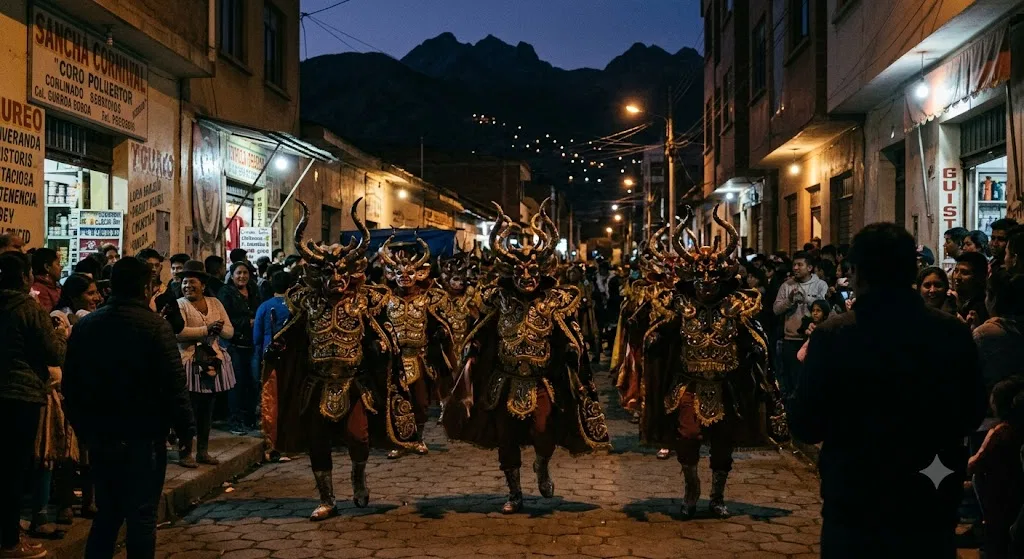
The Carnival of Oruro is probably Bolivia’s most internationally visible folklore event. UNESCO lists it as intangible cultural heritage and describes a ten-day celebration involving a wide range of popular arts, especially masks, textiles and embroidery. A UNESCO sustainable-development page notes that the carnival was inscribed on the Representative List in 2008 and that, each year, it displays a broad range of folk arts over six days.[Intangible Cultural Heritage]ich.unesco.orgIntangible Cultural HeritageCarnival of OruroThe Carnival, which takes place every year, lasts ten days and gives rise to a panoply of po…
At the centre of Oruro’s appeal is the famous devil-dance tradition. To an outsider, the horned masks and glittering costumes may look like carnival spectacle alone. Within Bolivian tradition, they carry a denser set of meanings: Catholic imagery of devils and the Virgin, Andean ideas of the underworld, mining-town history, pilgrimage, danger, devotion and public artistry. The festival is especially associated with the Virgin of the mine sanctuary and with Oruro’s identity as a mining city.
The Oruro Carnival also shows how folklore becomes national culture. It is not simply an old story being preserved unchanged. It is performed by organised dance groups, costume makers, musicians, families and neighbourhood associations; it is documented, promoted, argued over, transmitted and renewed. UNESCO’s safeguarding work explicitly treated the carnival as a living practice needing viable transmission mechanisms, not as a museum object frozen in the past.[Intangible Cultural Heritage]ich.unesco.orgThe sumptuous costumes, beautifully painted masks, folk dances and…

El Tío and the haunted moral world of the mines
Among Bolivia’s most distinctive supernatural figures is El Tío, the powerful spirit of the mine, especially associated with the silver mines of Cerro Rico at Potosí and mining culture across the Altiplano. He is often represented by a horned underground figure, given offerings by miners who seek protection, luck and permission to work safely in dangerous conditions. Accounts describe him as both guardian and threat: a force who may protect miners but can also punish disrespect.[Wikipedia]WikipediaOpen source on wikipedia.org.
El Tío is sometimes loosely translated as “the devil”, but that can mislead readers. His role is more complex than a simple Christian demon. He belongs to a mining cosmology where underground wealth, death, labour, danger and reciprocity are bound together. Some interpretations link him to the Andean figure Supay, whose meaning shifted under colonial Christianity from an ambivalent underworld being towards a more devil-like image.[Wikipedia]WikipediaOpen source on wikipedia.org.
This is a good example of why Bolivian folklore should not be treated as fantasy decoration. The mine spirit makes emotional sense in a workplace where collapse, illness and death have long been real risks. Offerings and stories create a language for negotiating fear, respect and survival underground. They also show how colonial history changed religious vocabulary without erasing older patterns of exchange with non-human powers.
Alasita and Ekeko: miniature wishes with serious meaning
Every year from 24 January, La Paz’s Alasita tradition centres on the buying, blessing and exchanging of miniatures: tiny houses, vehicles, banknotes, diplomas, food, tools and other desired goods. UNESCO describes the ritual journeys during Alasita as lasting two or three weeks, during which participants procure “good luck” miniatures. The tradition was inscribed on UNESCO’s Representative List in 2017.[Intangible Cultural Heritage]ich.unesco.orgIntangible Cultural HeritageRitual journeys in La Paz during AlasitaDuring the ritual journeys in La Paz during Alasita, which begin on 2…
The figure most associated with Alasita is Ekeko, commonly described as a god or spirit of abundance. He is usually shown as a small, smiling, heavily laden male figure carrying goods. Popular explanations often say that participants buy miniatures of what they hope to receive in real life, then have them blessed or ritually activated.[Bolivia es turismo]boliviaesturismo.comBolivia es turismo Alasitas Fair & The Ekeko – La PazBolivia es turismo Alasitas Fair & The Ekeko – La Paz
Alasita is sometimes presented as charming or quirky, but it is more than a market of toys. It turns desire into a public ritual. A miniature home can express economic aspiration; a tiny certificate can express hope for education or employment; small banknotes can express the wish for security. The custom also shows how Bolivian folk religion adapts to modern life. The objects change with the times, but the underlying ritual logic of abundance, exchange and blessing remains recognisable.
The Kallawaya show how healing, landscape and story overlap
Bolivia’s folklore is not limited to monsters and legends. Healing traditions also carry mythic and cosmological meaning. UNESCO lists the Andean cosmovision of the Kallawaya among Bolivia’s recognised intangible heritage elements. The Kallawaya are known for traditional healing, ritual knowledge and a worldview in which health is tied to landscape, plants, spiritual balance and inherited specialist knowledge.[Intangible Cultural Heritage]ich.unesco.orgIntangible Cultural HeritageBolivia (Plurinational State of)Latest news and events · Carnival of Oruro · UNESCO launches the platform 'Tr…
For readers interested in folklore, the Kallawaya matter because they blur modern categories. A healing practice may involve botanical knowledge, ritual performance, pilgrimage, prayer, diagnosis and oral transmission at once. It is neither simply “medicine” in the modern clinical sense nor merely “myth” in the sense of fictional story.
UNESCO’s Bolivia country page notes safeguarding activity related to Kallawaya communities, including documentation and transmission from elders to younger generations. That points to a wider issue in Bolivian folklore: many traditions depend on specialist memory, family apprenticeship and local language. Once those chains weaken, a tradition can survive as a tourist label while losing much of its practical and narrative depth.[Intangible Cultural Heritage]ich.unesco.orgIntangible Cultural HeritageBolivia (Plurinational State of)Latest news and events · Carnival of Oruro · UNESCO launches the platform 'Tr…
Lowland water beings: Jichi and the ethics of rivers
Bolivia’s eastern lowlands have their own powerful legendary beings. One of the most striking is Jichi, often described as a water guardian associated with rivers, lakes, reservoirs and wells in lowland Bolivia. Recent Bolivian and regional cultural writing presents Jichi as a serpent-like being who protects water sources and may leave if humans damage or misuse them, taking the water with him and bringing drought or hardship.[Diff]diff.wikimedia.orgOpen source on wikimedia.org.
This is folklore with an ecological edge. The Jichi story teaches that water is not just a resource to be consumed; it is inhabited, guarded and morally charged. In the Chiquitano region, a 2024 account recorded the legend around the Guapomó dam in San Ignacio de Velasco, where the being’s departure would mean the loss of water itself.[AWASQA]awasqa.orgjichi the water keeperjichi the water keeper
Jichi also shows why Bolivia’s folklore should not be reduced to Andean material. The lowlands have different landscapes, histories and Indigenous traditions. Their stories often centre on rivers, forest beings, animal transformations, drought, hunting and water management rather than mines, high mountains or urban markets.
Fear figures: Kharisiri and the body under threat
Not all Bolivian folklore is celebratory. The Kharisiri, also known in related Andean traditions by names such as Pishtaco or Lik’ichiri, is a feared figure said to steal human fat. Anthropological work has treated this being as more than a simple monster: Kharisiri stories express anxieties about outsiders, racialised power, extraction, medicine, religion and modern institutions.[ResearchGate]researchgate.netOpen source on researchgate.net.
In Bolivian highland accounts, the Kharisiri is often imagined as someone who does not quite belong: a stranger, priest-like figure, foreigner, traveller or socially suspicious person. Older versions have connected stolen fat with church uses such as candles or holy oil; newer versions may connect the theft with hospitals, machines, electricity or global markets.[Wikipedia]WikipediaOpen source on wikipedia.org.
The important point is not whether the creature is “real”, but what the tradition reveals. A fat-stealing figure is a frightening way to talk about exploitation: the vulnerable body is secretly drained for the benefit of powerful outsiders. In that sense, the Kharisiri belongs beside other world folklore about organ theft, witchcraft and predatory strangers, while remaining strongly rooted in Andean ideas about the body, fat, identity and social trust.
Flowers, mountains and origin legends
Bolivian folklore also includes gentler national and regional legends that explain natural symbols. One popular tale concerns the Kantuta, one of Bolivia’s national flowers. Retellings based on Antonio Díaz Villamil’s literary collection describe rival rulers, their sons, conflict, remorse and transformation, with the flower becoming a symbol of unity and hope.[BoliviaBella]boliviabella.comBolivia Bella The Legend of the Kantuta FlowerBolivia Bella The Legend of the Kantuta Flower
Such stories sit at the boundary between oral tradition, literary retelling and patriotic culture. They may be presented today as “ancient legends”, but many widely circulated versions have passed through schoolbooks, tourism pages and literary adaptation. That does not make them worthless; it means readers should understand them as national folklore in motion rather than as untouched pre-colonial texts.
Mountain legends work similarly. Peaks such as Illimani and Illampu are not only landmarks but characters in story-worlds, often linked with rivalry, punishment, tears, fertility or protection. These tales make geography memorable and morally meaningful: a mountain is not only high, beautiful or dangerous, but part of a narrative about how the present landscape came to be.
Mission towns and saint festivals in the lowlands
Bolivian folklore also developed through Catholic mission history, especially in the eastern lowlands. The Ichapekene Piesta of San Ignacio de Moxos, inscribed by UNESCO in 2012, is described as a syncretic festival that reinterprets a Moxeño founder myth around the Jesuit victory of Ignacio de Loyola while blending Indigenous beliefs and traditions.[Intangible Cultural Heritage]ich.unesco.orgOpen source on unesco.org.
This is a different form of folklore from the solitary monster or fireside legend. It is communal, musical, processional and historical. It preserves memory through performance: costumes, music, ritual roles, local organisation and repeated festival action. Its founder myth is not just a story told about the past; it is re-enacted as part of community identity.
The same broad point applies to Yampara Pujllay and Ayarichi, listed by UNESCO in 2014 as complementary musical and choreographic forms. These are not “myths” in the narrow sense, but they belong to the same world of transmitted symbolic culture, where seasonal timing, music, costume, dance and communal memory carry meaning.[Intangible Cultural Heritage]ich.unesco.orgOpen source on unesco.org.
How old are Bolivia’s folk traditions?
Some Bolivian traditions clearly draw on pre-colonial Indigenous worldviews, especially beliefs around Pachamama, mountain spirits, water beings, ritual reciprocity and the sacred quality of landscape. Others took shape through colonial Catholicism, mining labour, mission towns, urban markets and modern national identity. The safest answer is that Bolivia’s folklore is old in layers rather than old in one single way.
For example, Pachamama devotion is rooted in Andean Indigenous religion, but today it may be practised by Catholics, miners, farmers, business owners and urban families using contemporary ritual objects. Oruro’s Carnival draws on Indigenous and Catholic elements but is also a modern mass event with organised dance groups, heritage policy and national tourism. Alasita has Aymara roots, yet its miniatures can include modern goods such as cars, degrees and banknotes.[apnews.com]apnews.comThese practices reflect a deep connection between the people and natural elements, believed to possess spiritual energy or “ajayu.” Ritua…
This layered history is also why exact origins can be difficult to prove. Oral traditions change as they travel. Local stories may be documented late, reshaped by writers, translated into Spanish or English, standardised for schools, or simplified for visitors. A responsible reading of Bolivian folklore should therefore ask not only “How old is this?” but also “Who tells it, where, for what purpose, and in what form?”
What has changed in modern Bolivia?
Modern Bolivia has not abandoned folklore; it has multiplied its platforms. Traditions now move through festivals, school materials, museum displays, UNESCO dossiers, tourist writing, social media, journalism, academic work and community projects. This can strengthen visibility, but it can also flatten local variation.
One recent Wikimedia Diff article on illustrating Bolivian oral legends notes that myths and legends are part of the school curriculum and that both western and eastern regions have stories passed orally between generations, while also observing that oral transmission makes faithful recording difficult.[Diff]diff.wikimedia.orgOpen source on wikimedia.org.
Tourism also changes how folklore is framed. Oruro’s Carnival becomes a national spectacle; Alasita becomes a photogenic “festival of miniatures”; Jichi becomes an ecological legend; El Tío becomes a striking image from mine tours. These public versions can be useful introductions, but they may hide the local seriousness of the practices. A miner’s offering underground, a family’s August ritual for Mother Earth, or a community’s story about a water guardian may carry meanings that are not fully visible in a travel photograph.

Myths versus modern invention
Because Bolivian folklore is popular online, readers will often meet a mixture of well-attested traditions, tourist summaries, school retellings, literary versions and internet-era creature pages. The difference matters.
A strong tradition usually has several signs of depth: it is tied to a specific community or region; it appears in ritual, festival or oral transmission; it has credible documentation; and local people still recognise it as meaningful. Oruro, Alasita, Kallawaya practice, Ichapekene Piesta and Yampara music and dance all have strong institutional documentation through UNESCO.[Intangible Cultural Heritage]ich.unesco.orgIntangible Cultural HeritageBolivia (Plurinational State of)Latest news and events · Carnival of Oruro · UNESCO launches the platform 'Tr…
A weaker claim may still be interesting, but should be read with caution. Some online monster summaries exaggerate descriptions, detach beings from their communities, or turn moral and ecological stories into cryptid-style speculation. Jichi, for instance, is best understood as a lowland water-guardian tradition, not as evidence for a literal surviving monster. El Tío is best understood through mining culture and Andean-Catholic syncretism, not as a generic horror demon.
The main figures and traditions at a glance
Pachamama is the living Earth or Mother Earth in Andean belief, honoured through offerings, especially in agricultural and highland ritual contexts. In Bolivia today, August ceremonies remain highly visible and are linked with gratitude, protection, harvest cycles and the belief that natural forces have spiritual presence.[AP News]apnews.comThese practices reflect a deep connection between the people and natural elements, believed to possess spiritual energy or “ajayu.” Ritua…
El Tío is the spirit of the mine, especially associated with Potosí and the Bolivian Altiplano. He is feared and respected as a being who can grant protection and mineral luck, but who must be treated properly.[Wikipedia]WikipediaOpen source on wikipedia.org.
Ekeko is associated with abundance and Alasita. His miniature-laden image makes him one of Bolivia’s most recognisable folk figures, especially in La Paz.[Intangible Cultural Heritage]ich.unesco.orgIntangible Cultural HeritageRitual journeys in La Paz during AlasitaDuring the ritual journeys in La Paz during Alasita, which begin on 2…
Jichi is a lowland water guardian, often described as serpent-like and connected with the proper care of rivers, lakes and reservoirs.[AWASQA]awasqa.orgjichi the water keeperjichi the water keeper
Kharisiri is a feared fat-stealing figure of the Andean world, linked with anxieties about outsiders, extraction and bodily vulnerability.[ResearchGate]researchgate.netOpen source on researchgate.net.
The Carnival of Oruro is Bolivia’s great public theatre of devils, saints, dancers, musicians, masks and pilgrimage, recognised by UNESCO and rooted in both Indigenous and Catholic symbolism.[Intangible Cultural Heritage]ich.unesco.orgIntangible Cultural HeritageCarnival of OruroThe Carnival, which takes place every year, lasts ten days and gives rise to a panoply of po…
Why Bolivia’s folklore matters today
Bolivian folklore matters because it keeps asking practical human questions in memorable forms. How should people treat the land that feeds them? What happens when work takes place in dangerous underground spaces? How do communities turn fear into ritual? How do people express hope for a house, a job, a harvest or safe travel? How can a river be protected by story as well as law?
The answer is not one doctrine but many traditions. In the highlands, offerings to Mother Earth and mine spirits speak of reciprocity with powerful landscapes. In La Paz, Alasita turns private wishes into public miniature form. In Oruro, carnival masks make theology, history and performance visible in the street. In the lowlands, water beings such as Jichi warn that ecological care is a moral duty, not just a technical problem.
Bolivia’s folklore is therefore best read as a living cultural map. Its beings and rituals do not simply “explain” the past. They organise memory, dramatise risk, teach respect, mark belonging and help communities negotiate change. That is why these traditions remain compelling: they are strange, beautiful and sometimes frightening, but they are also practical ways of thinking about how to live in a demanding world.
Amazon book picks
Further Reading
Books and field guides related to Where Bolivia's Living Legends Still Speak. Use these as the next step if you want deeper reading beyond the article.
Open Veins of Latin America
Provides historical background for mining, identity and cultural memory.
eBay marketplace picks
Marketplace Samples
Live-tested eBay searches with available results related to this page.


Endnotes
1.
Source: ich.unesco.org
Link:https://ich.unesco.org/en/state/bolivia-plurinational-state-of-BO
Source snippet
Intangible Cultural HeritageBolivia (Plurinational State of)Latest news and events · Carnival of Oruro · UNESCO launches the platform 'Tr...
2.
Source: ich.unesco.org
Link:https://ich.unesco.org/en/RL/carnival-of-oruro-00003
Source snippet
Intangible Cultural HeritageCarnival of OruroThe Carnival, which takes place every year, lasts ten days and gives rise to a panoply of po...
3.
Source: ich.unesco.org
Link:https://ich.unesco.org/en/RL/ritual-journeys-in-la-paz-during-alasita-01182
Source snippet
Intangible Cultural HeritageRitual journeys in La Paz during AlasitaDuring the ritual journeys in La Paz during Alasita, which begin on 2...
4.
Source: ich.unesco.org
Link:https://ich.unesco.org/en/projects/action-plan-for-the-safeguarding-of-the-oruro-carnival-00010
Source snippet
The sumptuous costumes, beautifully painted masks, folk dances and...
5.
Source: unesco.org
Title: Carnival of Oruro
Link:https://www.unesco.org/tich4sd/en/bolivia/diablada
Source snippet
Carnival of Oruro - BoliviaBolivia. In 2008, the Carnival of Oruro in Bolivia was inscribed on UNESCO's Representative List of the...
6.
Source: Wikipedia
Link:https://en.wikipedia.org/wiki/El_T%C3%ADo
7.
Source: digitalcollections.sit.edu
Link:https://digitalcollections.sit.edu/cgi/viewcontent.cgi?article=2220&context=isp_collection
8.
Source: Wikipedia
Link:https://en.wikipedia.org/wiki/Supay
9.
Source: diff.wikimedia.org
Link:https://diff.wikimedia.org/2025/09/18/lets-illustrate-bringing-bolivian-oral-legends-to-life-on-wikipedia/
10.
Source: awasqa.org
Title: jichi the water keeper
Link:https://awasqa.org/jichi-the-water-keeper/?lang=en
11.
Source: researchgate.net
Link:https://www.researchgate.net/publication/290186206_Fear_and_loathing_on_the_kharisiri_trail_Alterity_and_identity_in_the_Andes
12.
Source: Wikipedia
Link:https://en.wikipedia.org/wiki/Pishtaco
13.
Source: boliviabella.com
Title: Bolivia Bella The Legend of the Kantuta Flower
Link:https://www.boliviabella.com/legend-of-the-kantuta.html
14.
Source: ich.unesco.org
Link:https://ich.unesco.org/en/RL/ichapekene-piesta-the-biggest-festival-of-san-ignacio-de-moxos-00627
15.
Source: ich.unesco.org
Link:https://ich.unesco.org/doc/src/ITH-12-7.COM-Decisions_-EN.doc
16.
Source: ich.unesco.org
Link:https://ich.unesco.org/en/RL/pujllay-and-ayarichi-music-and-dances-of-the-yampara-culture-00630
17.
Source: ich.unesco.org
Link:https://ich.unesco.org/en/decisions/9.COM/10.6
18.
Source: unesco.org
Title: the Oruro Carnival | Intangible Heritage
Link:https://www.unesco.org/archives/multimedia/document-616
19.
Source: ich.unesco.org
Link:https://ich.unesco.org/en/emblem/%20%3Cbr%3E?call=film&id=41423&include=film_inc.php&width=700
20.
Source: ich.unesco.org
Link:https://ich.unesco.org/en/video/41015
21.
Source: ich.unesco.org
Link:https://ich.unesco.org/en/decisions/7.COM/11.7
22.
Source: ich.unesco.org
Link:https://ich.unesco.org/en/video/9440
23.
Source: ich.unesco.org
Link:https://ich.unesco.org/en/decisions/12.COM/11.B.5
24.
Source: ich.unesco.org
Link:https://ich.unesco.org/en/video/17339
25.
Source: ich.unesco.org
Title: ritual journeys in la paz during alasita 01182
Link:https://ich.unesco.org/en/RL/ritual-journeys-in-la-paz-during-alasita-01182?RL=01182&id=41014&include=film_inc.php
26.
Source: ich.unesco.org
Title: search 00795
Link:https://ich.unesco.org/en/search-00795?call=film&id=17339&include=film_inc.php&width=700
27.
Source: ich.unesco.org
Title: 10 representative list 00748
Link:https://ich.unesco.org/en/10-representative-list-00748?id=00630&include=slideshow_inc.php
28.
Source: ich.unesco.org
Title: 11b representative list 00939
Link:https://ich.unesco.org/en/11b-representative-list-00939?id=01182&include=slideshow_inc.php
29.
Source: ich.unesco.org
Title: 11 representative list 00520
Link:https://ich.unesco.org/en/11-representative-list-00520?id=00627&include=slideshow_inc.php
30.
Source: ich.unesco.org
Link:https://ich.unesco.org/en/news/thirty-three-elements-inscribed-on-the-representative-list-of-the-intangible-cultural-heritage-of-humanity-00270
31.
Source: ich.unesco.org
Title: 16769 EN.doc
Link:https://ich.unesco.org/doc/src/16769-EN.doc
32.
Source: ich.unesco.org
Title: photo pop up 00973
Link:https://ich.unesco.org/en/photo-pop-up-00973?photoID=06027
33.
Source: ich.unesco.org
Title: photo pop up 00973
Link:https://ich.unesco.org/en/photo-pop-up-00973?photoID=10521
34.
Source: ich.unesco.org
Title: photo pop up 00973
Link:https://ich.unesco.org/en/photo-pop-up-00973?photoID=06088
35.
Source: ich.unesco.org
Link:https://ich.unesco.org/?call=film&id=09440&include=film_inc.php&width=700
36.
Source: ich.unesco.org
Title: bolivia plurinational state of BO
Link:https://ich.unesco.org/ar/state/bolivia-plurinational-state-of-BO?call=film&id=41015&include=film_inc.php&width=700
37.
Source: ich.unesco.org
Title: bolivia plurinational state of BO
Link:https://ich.unesco.org/en/state/bolivia-plurinational-state-of-BO?info=periodic-reporting
38.
Source: ich.unesco.org
Title: photo pop up 00973
Link:https://ich.unesco.org/en/photo-pop-up-00973?photoID=10519
39.
Source: ich.unesco.org
Title: ITH 12 7.CO M 11 +Add. EN.doc
Link:https://ich.unesco.org/doc/src/ITH-12-7.COM-11_%2BAdd.-EN.doc
40.
Source: ich.unesco.org
Title: el pujllay y el ayarichi musicas y danzas de la cultura yampara 00630
Link:https://ich.unesco.org/es/RL/el-pujllay-y-el-ayarichi-musicas-y-danzas-de-la-cultura-yampara-00630
41.
Source: ich.unesco.org
Link:https://ich.unesco.org/en/assistances/capacity-building-for-safeguarding-intangible-cultural-heritage-through-creation-of-community-based-inventory-for-luang-prabang-01448?call=film&id=41014&include=film_inc.php&width=700
42.
Source: ich.unesco.org
Title: ITH 14 9.CO M 10 EN.doc
Link:https://ich.unesco.org/doc/src/ITH-14-9.COM-10-EN.doc
43.
Source: Wikipedia
Title: Carnaval de Oruro
Link:https://en.wikipedia.org/wiki/Carnaval_de_Oruro
44.
Source: Wikipedia
Link:https://en.wikipedia.org/wiki/Pachamama
45.
Source: Wikipedia
Title: Cantua buxifolia
Link:https://en.wikipedia.org/wiki/Cantua_buxifolia
46.
Source: Wikipedia
Link:https://en.wikipedia.org/wiki/Alasitas
47.
Source: Wikipedia
Link:https://en.wikipedia.org/wiki/Diablada
48.
Source: apnews.com
Link:https://apnews.com/article/3ff0b82f0324e9fef5cd24a4b6a6552d
Source snippet
These practices reflect a deep connection between the people and natural elements, believed to possess spiritual energy or “ajayu.” Ritua...
49.
Source: boliviaesturismo.com
Title: Bolivia es turismo Alasitas Fair & The Ekeko – La Paz
Link:https://boliviaesturismo.com/en/feria-de-alasitas-el-ekeko-boliviaesturismo-la-paz-bolivia/
50.
Source: en.postposmo.com
Title: Bolivian myths
Link:https://en.postposmo.com/Bolivian-myths/
51.
Source: facebook.com
Link:https://www.facebook.com/BoliviaMarka/photos/beautiful-image-of-the-china-supay-a-symbolic-character-of-the-diablada-dance-pr/912672974191926/
52.
Source: ebsco.com
Link:https://www.ebsco.com/research-starters/social-sciences-and-humanities/pachamama
53.
Source: gringoinbolivia.wordpress.com
Link:https://gringoinbolivia.wordpress.com/2015/01/25/alasitas/
54.
Source: slideshare.net
Link:https://www.slideshare.net/slideshow/the-jichi/145253370
55.
Source: apnews.com
Link:https://apnews.com/article/pachamama-mother-earth-bolivia-aymara-spirituality-3ff0b82f0324e9fef5cd24a4b6a6552d
Additional References
56.
Source: youtube.com
Title: Oruro Carnival Blends Indigenous Culture and Catholic Devotion in Bolivia
Link:https://www.youtube.com/watch?v=P_hfXMttUSw
Source snippet
Bolivia's Alasitas Festival Honors Ekeko for Prosperity...
57.
Source: youtube.com
Title: Potosí: Where the Life Expectancy of Miners Doesn’t Exceed 45 Years
Link:https://www.youtube.com/watch?v=tHsR1sbsFms
Source snippet
Into the World's Most Dangerous Mine? Cerro Rico, Potosí Bolivia...
58.
Source: youtube.com
Title: The Legends of Bolivia That People Still Respect
Link:https://www.youtube.com/watch?v=VnnGzI6qHeE
Source snippet
Oruro Carnival Blends Indigenous Culture and Catholic Devotion in Bolivia...
59.
Source: facebook.com
Link:https://www.facebook.com/groups/252779587552494/posts/421590017338116/
60.
Source: amazon.com
Link:https://www.amazon.com/Myths-legends-Bolivian-Andes-literature-ebook/dp/B07825ZZFP?tag=searcht-20
61.
Source: instagram.com
Link:https://www.instagram.com/p/DYhWe6hjw_6/
62.
Source: instagram.com
Link:https://www.instagram.com/reel/DZ8rx9QpRBk/
63.
Source: facebook.com
Link:https://www.facebook.com/ChinaSupayDAU/videos/bloque-china-supay-de-la-diablada-art%C3%ADstica-urus-bordados-r%C3%ADos-y-su-arte-plasmad/9774611529266575/
64.
Source: scribd.com
Link:https://www.scribd.com/document/913735896/909fb5ee10c080117c4f6d8cc1ae51e065
65.
Source: amazon.nl
Link:https://www.amazon.nl/-/en/Chronicle-Press/dp/B0CHL96V7G?tag=searcht-20
Topic Tree
Follow this branch
Related pages 192
- Afghan Folklore
- Albanian Folklore
- Algerian Folklore
- Australian Folklore
- Azerbaijan Folklore
- +187 more in sidebar