Diverse Folklore of DR Congo
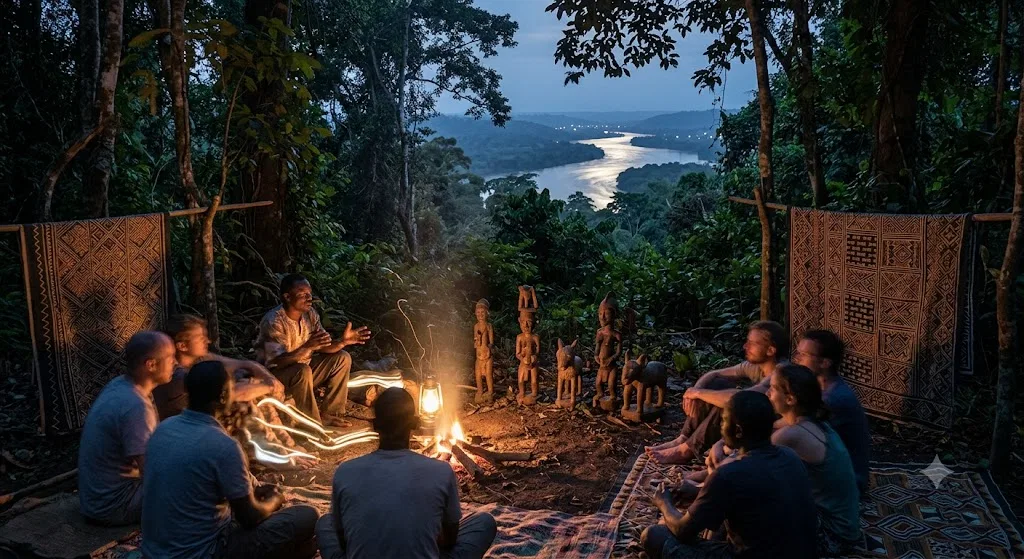
Folklore in the Democratic Republic of the Congo is not one single mythology. It is a wide field of oral stories, sacred objects, forest songs, royal histories, spirit beliefs and modern urban rumours shaped by one of Africa’s largest and most culturally diverse countries.
Page outline Jump by section
Introduction
The most important point for readers is that Congolese folklore is not best understood as a museum of strange tales. Much of it is practical and social: stories teach children how cleverness defeats force; ritual objects protect communities; songs speak to the forest as a living provider; memory boards help trained specialists recount political history; and modern “witch” narratives can have serious real-world consequences for vulnerable children.[si.edu]library.si.eduOpen source on si.edu.
Why DR Congo’s folklore is so varied
DR Congo covers rainforest, savanna, river systems, highlands and large cities, and its cultural history includes many peoples and political traditions. That is why a country-level folklore page has to be careful: a Kuba creation myth from the Kasai region, a Kongo ritual object from the west, and Mbuti forest songs from the Ituri rainforest are all Congolese in the broad national sense, but they do not come from the same community or carry the same meaning. The official tourism material for DR Congo emphasises the country’s many ethnic groups, historic kingdoms, arts and oral storytelling traditions, while museum and archive records show that Congolese heritage has often been collected, classified and interpreted through colonial-era institutions as well as by Congolese communities themselves.[drctourism.com]drctourism.comOpen source on drctourism.com.
This diversity also explains why “DR Congo folklore” can feel hard to summarise. Some traditions survive mainly as oral performance. Some are preserved through objects now held in museums. Some were written down by missionaries or anthropologists, whose accounts can be valuable but need cautious reading. John H. Weeks’s 1911 Congo Life and Folklore, for example, is an early English-language collection linked to Kongo-speaking communities in what is now DR Congo, but it belongs to a colonial missionary context and should not be treated as a neutral voice of “the Congo” as a whole.[Internet Archive]archive.orgOpen source on archive.org.
The historian Jan Vansina is especially important here because his work helped show that oral traditions can be studied as historical evidence when they are compared carefully, dated cautiously and read as performances shaped by the present as well as the past. Vansina’s early fieldwork among Kuba communities in the Belgian Congo fed into a wider method for using oral testimony in African history, rather than dismissing it as mere legend.[google.com]books.google.comBooks Kingdoms of the SavannaBooks Kingdoms of the Savanna
Creation stories and royal memory
One of the most widely repeated Congolese creation narratives outside the country is the Kuba or Bushongo story of the creator figure often called Bumba or Mbombo. In common retellings, the world begins in darkness and water; the creator brings forth the sun, moon, stars, animals and people in a dramatic act of bodily creation. The version now circulating online often traces back to older ethnographic publication, especially early twentieth-century work on Bushongo mythology, but modern readers should remember that retellings have been simplified and reshaped for general audiences.[oriire.com]oriire.comThe Bumba Creation Myth of the Bushongo (Kuba) PeopleThe Bumba Creation Myth of the Bushongo (Kuba) People
The story is memorable because it is not an abstract philosophical account of creation. It is physical, vivid and ordered: light appears, waters recede, animals emerge and human society follows. That makes it attractive to mythology anthologies, but within a Congolese frame it should also be read alongside Kuba political and historical traditions. Kuba identity has often been discussed through royal histories, court arts and oral accounts of kingship, not only through creation myth.[journals.uhk.cz]journals.uhk.czOpen source on uhk.cz.
Luba traditions offer another powerful example of folklore as history-making. Luba memory boards, known in museum catalogues as lukasa, are hand-held objects covered with beads, shells and carved forms. They are not “books” in the ordinary sense, but they help trained specialists recall histories, migrations, political relationships and sacred knowledge through touch, performance, song and speech. Smarthistory describes them as mnemonic devices used by experts in oral retelling, while the Metropolitan Museum of Art describes them as conceptual maps of Luba culture, political history and territorial knowledge.[Smarthistory]smarthistory.orgOpen source on smarthistory.org.
This changes how a reader might think about folklore. A Luba history is not simply a story passed vaguely from grandparent to child. In elite contexts it could be structured, trained and materialised through an object whose meaning depended on performance. The board did not “contain” one fixed text. It helped authorised people remember and interpret the past in ways that mattered for leadership, identity and social order.[Smarthistory]smarthistory.orgOpen source on smarthistory.org.
Spirits, protection and the power of objects
Kongo spiritual traditions, found across parts of western DR Congo and neighbouring regions, are among the best documented Congolese traditions in museum collections. The most recognisable objects are nkisi or minkisi, often translated imperfectly as “power figures” or “spirit containers”. Museums stress that these were not decorative curiosities. They were made to work: to protect, heal, witness oaths, resist harmful forces or help communities address disorder.[brooklynmuseum.org]brooklynmuseum.orgOpen source on brooklynmuseum.org.
A famous form is the nail-studded nkisi nkondi. To an uninformed viewer, the nails can look aggressive or macabre. Museum explanations give a better reading: nails or blades were driven into the figure as part of activating it, calling on it to intervene or record an appeal. The Brooklyn Museum describes such a figure as serving communities by fighting evil forces and offering protection, while Smarthistory explains the broader religious frame of sacred medicines and divine protection among Kongo peoples.[Brooklyn Museum]brooklynmuseum.orgOpen source on brooklynmuseum.org.
The Pitt Rivers Museum’s material on Mavungu, a Kongo religious object from DR Congo, is useful because it shows how specific spirit personalities could be associated with specific functions. Mavungu is presented as a particular spirit personality held to reside in a type of nkisi. That matters because it prevents a common mistake: treating all Kongo power objects as interchangeable “fetishes”, a loaded colonial term that flattens their local meanings.[PRM Oxford]prm.web.ox.ac.ukOpen source on ox.ac.uk.
These objects also reveal how Congolese folklore travelled into global art history. Many minkisi entered European and American collections during the colonial period or through art markets, often separated from the ritual specialists and communities that gave them meaning. Today, museum labels increasingly try to explain their social function, but the objects still carry a tension between living religious heritage, colonial collecting and modern display.[Smithsonian Institution]si.eduOpen source on si.edu.
Forest belief and Mbuti song
In the Ituri rainforest of north-eastern DR Congo, Mbuti traditions show a different kind of folklore: less centred on carved royal or ritual objects, and more on the forest as a living moral and spiritual environment. A Food and Agriculture Organization account describes the forest as the source of Mbuti existence: provider, sanctuary and sacred centre. Smithsonian Folkways describes Mbuti vocal music as closely tied to nomadic life and the forest that sustains people and animals.[FAOHome]fao.orgOpen source on fao.org.
The molimo tradition is one of the best-known examples. It is both a ritual and, in many descriptions, a trumpet-like instrument whose sound is associated with calling to or awakening the forest after misfortune. Popular accounts often make this sound mysterious, but the important point is simpler and more profound: the ritual expresses a relationship in which the forest is not just scenery or a resource, but a social and spiritual presence.[fao.org]fao.orgOpen source on fao.org.
For folklore readers, Mbuti material is a reminder that myth does not always appear as a named god with a fixed story. It may appear as song, hunting practice, mourning, food rules, sound, secrecy and a repeated way of addressing the landscape. That makes it harder to summarise in a monster-guide format, but it is central to understanding the belief culture of DR Congo’s rainforest peoples.[FAOHome]fao.orgOpen source on fao.org.
Animal tales and everyday moral lessons
Congolese folktales often use animals to teach social intelligence. Leopard, crocodile, gazelle, frog, rat, ant and other animals appear in stories where brute strength is not always enough and cleverness can overturn hierarchy. Modern DRC tourism material presents storytelling as a central cultural practice for preserving history, values and entertainment, while older collections such as Weeks’s Congo Life and Folklore preserve many tales from Kongo-speaking contexts.[drctourism.com]drctourism.comDRC Tourism Congolese Storytelling | Oral Traditions & GriotsDRC Tourism Congolese Storytelling | Oral Traditions & Griots
A typical animal tale does more than amuse. It lets a community talk about greed, deception, pride, marriage, obligation or survival without naming a neighbour directly. This is one reason animal trickster stories travel well across Central Africa: the plot can be localised, the animals can change, and the lesson can be adapted to the audience. Online collections of “Congolese folktales” can be useful for orientation, but they vary in quality and often retell stories without giving a clear collector, language, region or performance context.[Folktales Africa]folktales.africaOpen source on folktales.africa.
The safest way to read such tales is to ask three questions: who recorded or retold this version; which community or region is it linked to; and is it presented as an old oral text, a modern adaptation or a newly written story inspired by folklore? This distinction matters because DR Congo’s folklore is increasingly repackaged for children’s books, blogs, tourism, diaspora culture and visual projects, and not every attractive “Congolese legend” online is equally well attested.[folktales.africa]folktales.africaOpen source on folktales.africa.
Sacred landscapes and haunted places
DR Congo’s folklore is strongly tied to landscape: rivers, forests, lakes, rocks, savannas and ancestral places. The Congo River itself is not just geography in storytelling contexts; it is a route of trade, migration, danger, wealth and encounter. Lake and forest stories often involve spirit spouses, hidden beings or moral tests, though many modern online versions are difficult to verify as old oral tradition rather than recent creative retellings.[DRC Tourism]drctourism.comDRC Tourism Congolese Storytelling | Oral Traditions & GriotsDRC Tourism Congolese Storytelling | Oral Traditions & Griots
One of the more concrete landscape-linked traditions is the rock-art and mythology complex around Lovo in the Kongo cultural region. A 2018 scholarly article on Lovo rock images argues that history and myth intersect there, including cases where newcomers may come to venerate protective spirits associated with earlier inhabitants. This is exactly the kind of evidence that helps connect folklore to place without turning every striking landscape into a vague “haunted site”.[Sage Journals]journals.sagepub.comOpen source on sagepub.com.
Sacred landscape traditions also complicate national borders. Kongo, Luba, Lunda, Mongo, Kuba and forest traditions do not map neatly onto the modern state. Some extend into Angola, the Republic of the Congo, Zambia, the Central African Republic or beyond. For a DR Congo page, the focus should stay on communities and sites within the country, but shared regional histories are often essential for understanding why a belief or story appears on both sides of a border.[independance.africamuseum.be]independance.africamuseum.beOpen source on africamuseum.be.

Witchcraft beliefs and modern harm
Witchcraft is part of Congolese belief culture, but it must be handled carefully. It is not simply “folklore” in the harmless sense of old stories. In contemporary DR Congo, accusations of witchcraft against children have been documented as a serious child-protection issue. Save the Children’s report The Invention of Child Witches focuses on children accused of witchcraft in DR Congo, drawing on programme work with families, churches, communities and accused children. UNICEF’s broader study on children accused of witchcraft in Africa also warns that such beliefs and practices can lead to violence, abandonment and mistreatment.[Save the Children’s Resource Centre]resourcecentre.savethechildren.netOpen source on savethechildren.net.
The important distinction is between older ideas of hidden spiritual harm and the modern social pattern of accusing vulnerable children. A European Union country-information query summarising multiple sources notes that accusations in DR Congo have shifted in some urban contexts towards children, especially since the early 1990s, and links the phenomenon to social pressures, urban hardship and religious settings. UN media reporting has also described thousands of children in DR Congo as being accused of witchcraft, with hardship, conflict, urbanisation, displacement and family breakdown among the pressures around the phenomenon.[ECOI.net]ecoi.net2021 10 Q37 EASO COI Query Response Sorcery DRC2021 10 Q37 EASO COI Query Response Sorcery DRC
For a folklore reader, this is where curiosity has to become ethical. Witchcraft narratives can be studied as belief, rumour, social explanation and religious discourse, but accusations are not just stories. They can decide whether a child is protected, abused, expelled or forced onto the street. That makes this part of Congolese supernatural culture one of the clearest examples of folklore’s real social power.[savethechildren.net]resourcecentre.savethechildren.netOpen source on savethechildren.net.
Christianity, Kimbanguism and blended belief
DR Congo is now overwhelmingly shaped by Christianity, but older spiritual ideas have not simply disappeared. Instead, religious life has often involved overlap, tension and reinterpretation. Friends of the Congo summarises Congolese traditional rites and beliefs as involving a supreme god, lesser spiritual beings, spirits and ancestors, while also noting the importance of Catholic, Protestant, Kimbanguist and other religious communities in the country.[Friends of the Congo]friendsofthecongo.orgOpen source on friendsofthecongo.org.
Kimbanguism, founded by Simon Kimbangu in the colonial Belgian Congo, is especially important in modern Congolese religious history, although it is not “folklore” in the narrow sense. It shows how prophecy, healing, Christian language, anti-colonial experience and Congolese religious imagination could combine into a mass movement. In popular belief culture, this wider Christian environment also shapes how people interpret dreams, illness, misfortune, miracles, deliverance and accusations of witchcraft.[Friends of the Congo]friendsofthecongo.orgOpen source on friendsofthecongo.org.
This blending does not mean all Congolese traditions say the same thing. A Kongo nkisi, an independent church healing service, a village ancestor rite and an urban rumour about witchcraft belong to different contexts. But they share a broad concern with the invisible causes of visible events: sickness, success, infertility, conflict, protection, death and social disorder.[smarthistory.org]smarthistory.orgOpen source on smarthistory.org.
Folklore in museums, archives and modern media
Much of what outsiders know about Congolese folklore comes through archives and museums. The Smithsonian, the Brooklyn Museum, the Metropolitan Museum of Art, the Pitt Rivers Museum and the AfricaMuseum all hold or discuss objects and records connected to Congolese cultural traditions. These sources can be strong evidence, especially for material culture, but they also reflect histories of colonial collection, missionary interpretation and changing museum language.[si.edu]si.eduOpen source on si.edu.
Modern projects have also reimagined Congolese stories for new audiences. The Congo Tales project, for example, presents stories and myths from the Congo Basin through photography and multimedia storytelling. Such projects can be valuable because they make oral traditions visible to global audiences, but they should be read as modern artistic reinterpretations rather than direct windows into a timeless past.[Pieter Henket]pieterhenket.comOpen source on pieterhenket.com.
Music is another major living form of intangible culture. Congolese rumba, shared by DR Congo and the Republic of the Congo, was inscribed by UNESCO on the Representative List of the Intangible Cultural Heritage of Humanity. Rumba is not folklore in the old mythological sense, but it belongs to the wider field of living tradition: dance, performance, memory, urban identity and cultural transmission. UNESCO describes it as a musical genre and dance common in urban areas of both Congos, and later UNESCO commentary frames it as a bridge between the two countries’ cultural identities.[unesco.org]ich.unesco.orgOpen source on unesco.org.
How to tell old tradition from modern invention
A useful DR Congo folklore page has to be honest about evidence. Some traditions are well supported by museum records, ethnographic publications or community heritage work. Others are attractive internet stories with unclear origins. A tale labelled “Congolese” may be a genuine oral story, a literary retelling, a children’s adaptation, a pan-African motif relocated to DR Congo, or a completely modern invention using Congolese scenery.[folktales.africa]folktales.africaOpen source on folktales.africa.
Good signs of stronger evidence include a named community, region, collector, performer, language, object record, archive, museum catalogue or scholarly discussion. Luba lukasa boards, Kongo minkisi and Mbuti forest songs all have stronger evidential footing because they are documented across specialist and institutional sources. The Kuba Bumba or Mbombo creation story is also well known, but many online versions compress older accounts and should be treated as retellings rather than exact transcripts of a single fixed myth.[smarthistory.org]smarthistory.orgOpen source on smarthistory.org.
Weaker signs include vague labels such as “ancient Congo legend” with no community named, sensational claims about monsters or curses, and stories that appear only on modern content farms. This does not mean such stories are worthless; they may show how Congolese folklore is being imagined today. But they should not be presented as old, widely believed or nationally representative without better support.[Folktales Africa]folktales.africaOpen source on folktales.africa.
What readers should remember
The folklore of DR Congo is best understood as a living and layered cultural field. It includes spectacular creation stories, but also memory boards, healing objects, forest songs, animal fables, sacred landscapes and urban supernatural fears. Its traditions are regional rather than uniform, and many cross modern borders because cultural worlds are older than the nation-state.[Google Books]books.google.comBooks Kingdoms of the SavannaBooks Kingdoms of the Savanna
The most distinctive Congolese examples are not necessarily “monsters” in the internet sense. They are systems of relationship: between rulers and remembered ancestors, ritual specialists and protective spirits, hunters and the forest, storytellers and children, families and the unseen causes of misfortune. That is what gives DR Congo’s folklore its depth. It is not just a catalogue of strange beings; it is a set of ways people have explained power, danger, memory, morality and belonging.
Amazon book picks
Further Reading
Books and field guides related to What Makes DR Congo's Folklore So Varied?. Use these as the next step if you want deeper reading beyond the article.
African Folktales
Introduces major storytelling traditions that help explain the diversity of folklore found in DR Congo.
African Myths of Origin
Covers creation stories, oral traditions and mythic themes from across Africa, providing context for Congolese folklore.
The Palm-Wine Drinkard
Demonstrates how African oral traditions and supernatural storytelling operate in literary form.
African Religions and Philosophy
Provides background on spiritual ideas that intersect with folklore across Central Africa.
eBay marketplace picks
Marketplace Samples
Live-tested eBay searches with available results related to this page.
Endnotes
1.
Source: archive.org
Link:https://archive.org/details/congolifefolklor0000week
2.
Source: smarthistory.org
Link:https://smarthistory.org/lukasa-memory-board-luba-peoples/
3.
Source: library.si.edu
Link:https://library.si.edu/digital-library/book/congolifefolklor00week
4.
Source: unicef.org
Title: Children accused of witchcraft in Africa.pdf
Link:https://www.unicef.org/nigeria/media/1326/file/%20Children-accused-of-witchcraft-in-Africa.pdf.pdf
5.
Source: independance.africamuseum.be
Link:https://independance.africamuseum.be/en/exhibition/context/contexte-17pays-africains/country-rdcongo
6.
Source: whc.unesco.org
Link:https://whc.unesco.org/en/statesparties/cd
7.
Source: books.google.com
Title: Books Kingdoms of the Savanna
Link:https://books.google.com/books/about/Kingdoms_of_the_Savanna.html?id=hLIeAAAAIAAJ
8.
Source: journals.uhk.cz
Link:https://journals.uhk.cz/modernafrica/article/download/147/143/255
9.
Source: oriire.com
Title: The Bumba Creation Myth of the Bushongo (Kuba) People
Link:https://oriire.com/article/the-bumba-creation-myth-of-the-bushongo-kuba-people
10.
Source: Wikipedia
Title: Bushongo religion
Link:https://en.wikipedia.org/wiki/Bushongo_religion
11.
Source: smarthistory.org
Link:https://smarthistory.org/nkisi-nkondi-kongo-people/
12.
Source: si.edu
Link:https://www.si.edu/object/nmafa
13.
Source: folktales.africa
Link:https://folktales.africa/category/african-folktales/central-african-folktales/congolese-drc-folktales/
14.
Source: mythopia.io
Title: Congolese Folklore & Legends
Link:https://mythopia.io/tagged/553/congolese-folktales
15.
Source: ecoi.net
Title: 2021 10 Q37 EASO COI Query Response Sorcery DRC
Link:https://www.ecoi.net/en/file/local/2063478/2021_10_Q37_EASO_COI_Query_Response_Sorcery_DRC.pdf
16.
Source: ich.unesco.org
Link:https://ich.unesco.org/en/RL/congolese-rumba-01711
17.
Source: unesco.org
Title: nkumba rumba rich intangible cultural heritage congos
Link:https://www.unesco.org/en/articles/nkumba-rumba-rich-intangible-cultural-heritage-congos
18.
Source: ich.unesco.org
Link:https://ich.unesco.org/en/decisions/16.COM/8.B.8
19.
Source: ich.unesco.org
Title: democratic republic of the congo CD
Link:https://ich.unesco.org/en/state/democratic-republic-of-the-congo-CD
20.
Source: unesco.org
Link:https://www.unesco.org/en/countries/cd
21.
Source: omc.obta.al.uw.edu.pl
Link:https://www.omc.obta.al.uw.edu.pl/myth-survey/country/11
22.
Source: Wikipedia
Title: Mbokomu (deity)
Link:https://en.wikipedia.org/wiki/Mbokomu_%28deity%29
23.
Source: Wikipedia
Title: Witchcraft in Africa
Link:https://en.wikipedia.org/wiki/Witchcraft_in_Africa
24.
Source: Wikipedia
Title: History of the Democratic Republic of the Congo
Link:https://en.wikipedia.org/wiki/History_of_the_Democratic_Republic_of_the_Congo
25.
Source: Wikipedia
Title: Kongo religion
Link:https://en.wikipedia.org/wiki/Kongo_religion
26.
Source: Wikipedia
Title: Palo (religion)
Link:https://en.wikipedia.org/wiki/Palo_%28religion%29
27.
Source: Wikipedia
Link:https://en.wikipedia.org/wiki/Mbombo
28.
Source: Wikipedia
Link:https://en.wikipedia.org/wiki/Nkisi
29.
Source: Wikipedia
Link:https://en.wikipedia.org/wiki/Lukasa
30.
Source: Wikipedia
Title: Mbuti people
Link:https://en.wikipedia.org/wiki/Mbuti_people
31.
Source: Wikipedia
Title: Congolese rumba
Link:https://en.wikipedia.org/wiki/Congolese_rumba
32.
Source: Wikipedia
Title: Lists of Intangible Cultural Heritage elements
Link:https://en.wikipedia.org/wiki/Lists_of_Intangible_Cultural_Heritage_elements
33.
Source: independance.africamuseum.be
Link:https://independance.africamuseum.be/sites/independance.africamuseum.be/files/files/booklet_independance_en.pdf
34.
Source: africamuseum.be
Title: AFRICAMUSEUM Jaarverslag2024 EN web
Link:https://www.africamuseum.be/sites/default/files/media/about-us/annual-reports/doc/AFRICAMUSEUM_Jaarverslag2024_EN_web.pdf
35.
Source: africamuseum.be
Link:https://www.africamuseum.be/de/research/discover/human_sciences/culture_society/cb-pottery/references
36.
Source: africamuseum.be
Title: Jacky Maniacky
Link:https://www.africamuseum.be/en/staff/720
37.
Source: africamuseum.be
Link:https://www.africamuseum.be/sites/default/files/media/about-us/annual-reports/doc/jaarverslag2010.pdf
38.
Source: press.africamuseum.be
Title: be Reopening of the Africa Museum
Link:https://press.africamuseum.be/sites/default/files/media/Persdossier-UK%20web.pdf
39.
Source: archives.africamuseum.be
Link:https://archives.africamuseum.be/assets/pdf/HA_01_0331_JanVansina.pdf
40.
Source: africamuseum.be
Link:https://www.africamuseum.be/sites/default/files/media/docs/research/publications/rmca/online/monographies-provinces/equateur-pdf.pdf
41.
Source: africamuseum.be
Title: vol12 Mai Ndombe
Link:https://www.africamuseum.be/sites/default/files/media/docs/research/publications/rmca/online/monographies-provinces/vol12_Mai_Ndombe.pdf
42.
Source: ecoi.net
Link:https://www.ecoi.net/de/dokument/1227851.html
43.
Source: metmuseum.org
Title: The Metropolitan Museum of Art Memory Board (Lukasa)
Link:https://www.metmuseum.org/art/collection/search/690570
44.
Source: fao.org
Link:https://www.fao.org/4/y9882e/y9882e09.htm
45.
Source: brooklynmuseum.org
Link:https://www.brooklynmuseum.org/tr-TR/objects/2957
46.
Source: resourcecentre.savethechildren.net
Link:https://resourcecentre.savethechildren.net/document/invention-child-witches-social-cleansing-religious-commerce-and-difficulties-being-parent
47.
Source: drctourism.com
Link:https://drctourism.com/culture
48.
Source: drctourism.com
Title: DRC Tourism Congolese Storytelling | Oral Traditions & Griots
Link:https://drctourism.com/culture/storytelling-traditions-congo
49.
Source: prm.web.ox.ac.uk
Link:https://prm.web.ox.ac.uk/files/mavungupdf
50.
Source: folkways.si.edu
Link:https://folkways.si.edu/mbuti-pygmies-of-the-ituri-rainforest/world/music/album/smithsonian
51.
Source: friendsofthecongo.org
Title: congos traditions culture community and heritage
Link:https://friendsofthecongo.org/congos-traditions-culture-community-and-heritage/
52.
Source: melvinburgess.net
Title: Melvin Burgess Folk Stories from the Congo Archives
Link:https://melvinburgess.net/category/folk-stories-from-the-congo/
53.
Source: journals.sagepub.com
Link:https://journals.sagepub.com/doi/10.1177/1469605317751171
54.
Source: friendsofthecongo.org
Link:https://friendsofthecongo.org/congolese-culture/
55.
Source: pieterhenket.com
Link:https://www.pieterhenket.com/congotales
56.
Source: ofpra.gouv.fr
Link:https://www.ofpra.gouv.fr/libraries/pdf.js/web/viewer.html?file=%2Fsites%2Fdefault%2Ffiles%2Fofpra_flora%2F1511_cod_enfants_sorciers.pdf
57.
Source: afrolegends.com
Link:https://afrolegends.com/tag/rumba/
Additional References
58.
Source: youtube.com
Title: The Creation Story of the Bakuba Kingdom of the Congo
Link:https://www.youtube.com/watch?v=N7jaWIb2AVc
Source snippet
Kuba creation story myth Congo The Creation Story of the Bakuba Kingdom of the Congo kappa beach...
59.
Source: youtube.com
Title: Lukasa: The Indigenous African “Book” You Read by Touching
Link:https://www.youtube.com/watch?v=MPslYtOMv3c
Source snippet
Mbuti Pygmy ritual music (Congo) Molinga mourning song...
60.
Source: youtube.com
Title: Mbuti Pygmy ritual music (Congo) Molinga mourning song
Link:https://www.youtube.com/watch?v=IOrBlAK9MZw
Source snippet
The Creation Story of the Bakuba Kingdom of the Congo...
61.
Source: mcgill.ca
Link:https://www.mcgill.ca/humanrights/files/humanrights/liora_amsellem_-_accusations_of_witchcraft_against_children_in_the_democratic_republic_of_congo_and_the_law.pdf
62.
Source: anikefoundation.org
Link:https://anikefoundation.org/african-folktales
63.
Source: facebook.com
Link:https://www.facebook.com/fekaz.femi/posts/bambuti-also-called-mbuti-a-group-of-pygmies-of-the-ituri-forest-of-eastern-cong/10218910050176411/
64.
Source: instagram.com
Link:https://www.instagram.com/reel/DP4LGlCDMf9/?hl=en
65.
Source: researchgate.net
Link:https://www.researchgate.net/publication/338958125_Christian_Pastors_and_Alleged_Child_Witches_in_Kinshasa_DRC
66.
Source: 101lasttribes.com
Link:https://www.101lasttribes.com/countries/democratic_republic_congo.html
67.
Source: amazon.com
Link:https://www.amazon.com/stores/author/B001HCV892?tag=searcht-20
Topic Tree
Follow this branch
Related pages 192
- Afghan Folklore
- Albanian Folklore
- Algerian Folklore
- Australian Folklore
- Azerbaijan Folklore
- +187 more in sidebar