Within Polish Folklore
What Poland's Vampire Graves Really Reveal
Anti-revenant burials reveal how some Polish communities feared the unsafe dead without proving that vampires were real.
On this page
- Anti revenant burials and grave restraints
- Pień, Radom and the problem with vampire headlines
- Fear, illness and social exclusion after death
Page outline Jump by section
Introduction
Poland’s so-called “vampire graves” are among the most famous pieces of archaeological evidence linked to European beliefs about the restless dead. They are often presented in headlines as proof that people once hunted vampires. The reality is more interesting. These burials reveal how communities tried to manage fears about revenants—dead people believed capable of returning to harm the living—rather than providing evidence that anyone thought of vampires in the modern Dracula-like sense. Archaeology shows unusual burial practices, while folklore helps explain why those practices may have seemed necessary. Together, they offer a rare glimpse into how ordinary people responded to disease, unexplained deaths, social outsiders, and anxieties about what might happen after burial.[journals.lub.lu.se]journals.lub.lu.seThe problem of unusual funerary practices. (e.g….Read more…
Anti-revenant burials and grave restraints
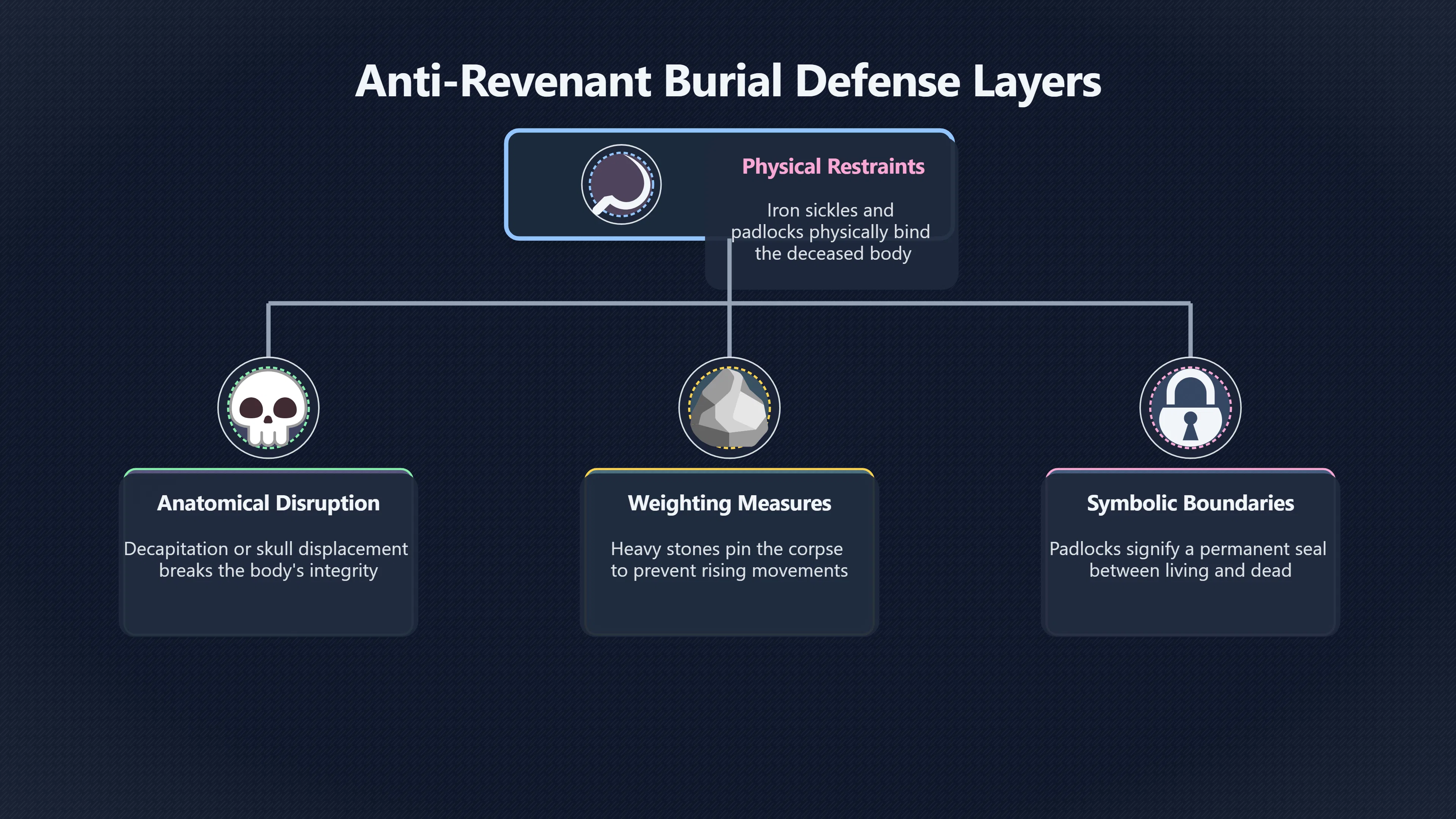
Across parts of Poland, archaeologists have uncovered burials containing features that differ from normal Christian funerary practice. These include bodies buried face-down, skulls separated from the body, stones placed on corpses, sickles positioned across the neck or abdomen, and iron objects intended to restrain the dead. Such graves are often described as “anti-vampire” burials, but many specialists prefer broader terms such as “anti-revenant” or “deviant” burials because the people involved may have feared several kinds of dangerous dead rather than a single vampire tradition.[lu.se]journals.lub.lu.seThe problem of unusual funerary practices. (e.g….Read more…
The logic behind these practices was practical within the belief system of the time. A sickle placed across the throat could symbolically or physically prevent a corpse from rising. Decapitation or placing the skull between the legs disrupted the body’s integrity. Heavy stones could pin a corpse down. Iron objects were widely believed in European folklore to possess protective powers against harmful supernatural forces.[lu.se]journals.lub.lu.seThe problem of unusual funerary practices. (e.g….Read more…
Importantly, these measures were not random acts of disrespect. They were often performed as part of burial itself, suggesting a community attempting to protect itself from a perceived danger while still carrying out a formal funeral. Archaeological evidence indicates that many individuals buried in this way were interred within ordinary cemeteries rather than isolated outside them.[Popular Archaeology]popular-archaeology.comresearchers investigate vampire remains in polish cemeteryPopular ArchaeologyResearchers Investigate 'Vampire' Remains in Polish…26 Nov 2014 — Potential 'vampires' buried in Poland with sickle…
Pień, Radom and the problem with vampire headlines
The village of Pień in northern Poland has become the best-known example. In 2022 archaeologists uncovered the grave of a young woman buried with an iron sickle laid across her neck and a padlock attached to her foot. Later discoveries at the same cemetery included a child buried face-down with a padlock nearby. These finds generated worldwide media attention and were widely described as “vampire burials.”[thehistoryblog.com]thehistoryblog.com“Vampire” woman buried with sickle over her neck3 Sept 2022 — A unique 17th century vampire burial has been unearthed in the village of P…
Yet the archaeological interpretation is more cautious. Researchers leading the excavation have argued that the burial reflects fear of a person returning from the grave, not evidence that the deceased was believed to drink blood. The padlock appears to have symbolised permanently closing the boundary between the dead and the living, while the sickle acted as a protective restraint.[atlasobscura.com]atlasobscura.comanti vampire graves polandAtlas ObscuraThe Truth Behind Poland's 'Anti-Vampire' Graves14 Aug 2023 — In late July 2023, archaeologists working on a 17th-century cem…
The Pień discoveries also illustrate a broader problem. Modern media often use the word “vampire” because it is familiar and dramatic, but historical beliefs were usually more varied. Polish traditions included stories of dangerous revenants, known in later accounts as undead individuals who could spread illness, misfortune, or death among relatives and neighbours. The archaeological evidence demonstrates fear of posthumous danger, but it cannot by itself identify exactly what stories people told about a particular deceased person.[jstor.org]jstor.orgVampires, criminals or slaves?Reinterpreting 'deviant…by L Gardeła · 2013 · Cited by 64 — Early medieval Poland; Slavs; deviant burials; criminals; slaves; vampires…
Other sites across Poland have produced similar evidence. Burials with severed heads, displaced skulls, stones, or other restraints have been documented from different regions and periods. Some discoveries near Drawsko attracted particular attention because several graves contained protective measures against the dead while remaining part of a normal cemetery population.[ABC News]abcnews.comABC NewsRoll Over Dracula: 'Vampire Cemetery' Found in Poland22 Jul 2013 — A chilling find has been made in Poland: at least 17 skeletons…

Fear, illness and social exclusion after death
One of the most important questions is why certain people became candidates for anti-revenant treatment. Archaeology cannot read minds, but it can reveal patterns.
Research on Polish burial populations suggests that individuals receiving unusual treatment were not simply foreigners or criminals. In some cases, they appear to have been local community members. A major study examining supposed anti-vampire burials found no simple connection between such graves and visible disease or disability. Many people with illnesses received ordinary burials, while only a small number were singled out for special treatment.[popular-archaeology.com]popular-archaeology.comresearchers investigate vampire remains in polish cemeteryPopular ArchaeologyResearchers Investigate 'Vampire' Remains in Polish…26 Nov 2014 — Potential 'vampires' buried in Poland with sickle…
That finding points toward social and cultural explanations. Across European folklore, people who died suddenly, violently, unusually, or outside expected social norms were often considered more likely to become dangerous after death. Suspected witches, suicides, outsiders, or people whose bodies behaved unexpectedly during decomposition could attract suspicion. In periods of epidemic disease or repeated misfortune, communities sometimes searched for explanations that made sense within existing belief systems.[JSTOR]jstor.orgVampires, criminals or slaves?Reinterpreting 'deviant…by L Gardeła · 2013 · Cited by 64 — Early medieval Poland; Slavs; deviant burials; criminals; slaves; vampires…
The reconstructed woman from Pień offers a human example. Analysis suggests she may have suffered from health problems that caused fainting, headaches, or unusual behaviour. Modern researchers stress that such conditions may have contributed to how neighbours perceived her. The reconstruction project deliberately sought to restore her individuality rather than present her as a monster, highlighting the gap between the fears of the past and the interpretations of today.[reuters.com]reuters.comScientists rebuild the face of 400-year-old Polish 'vampireBuried with a padlock on her foot and an iron sickle across her neck in an unmarked cemetery in Pien, northern Poland, Zosia was feared t…
What the graves can and cannot prove
The strongest evidence from Poland’s vampire graves is not that vampires existed, but that belief in dangerous revenants was real enough to shape burial behaviour. Archaeologists can document sickles, padlocks, decapitations, stones, and unusual body positions. Folklore and historical records show that many communities feared the dead returning to harm the living. Together, those lines of evidence reinforce one another.[lu.se]journals.lub.lu.seThe problem of unusual funerary practices. (e.g….Read more…
What they cannot prove is the exact content of every belief. A grave with a sickle does not tell us whether neighbours feared a blood-drinker, a wandering spirit, a witch returning after death, or some other local form of revenant. Nor can archaeology confirm the stories later attached to individual burials. The evidence reveals behaviour and belief, not supernatural reality.[JSTOR]jstor.orgVampires, criminals or slaves?Reinterpreting 'deviant…by L Gardeła · 2013 · Cited by 64 — Early medieval Poland; Slavs; deviant burials; criminals; slaves; vampires…
For that reason, Poland’s vampire graves are most valuable when viewed as evidence of culture rather than monsters. They show how folklore could influence real decisions, how fear shaped burial practices, and how communities attempted to protect themselves from dangers they believed might continue even after death. The graves sit at the intersection of archaeology, religion, medicine, social exclusion, and storytelling—making them one of the clearest material traces of revenant belief anywhere in Europe.[lu.se]journals.lub.lu.seThe problem of unusual funerary practices. (e.g….Read more…

Amazon book picks
Further Reading
Books and field guides related to What Poland's Vampire Graves Really Reveal. Use these as the next step if you want deeper reading beyond the article.
Vampires, Burial, and Death
Rating: 4.5/5 from 5 Google Books ratings
Explains anti-revenant burials and vampire beliefs in Europe.
Slavic Folklore
Provides background on Slavic beliefs about dangerous dead and spirits.
eBay marketplace picks
Marketplace Samples
Live-tested eBay searches with available results related to this page.


Endnotes
1.
Source: journals.lub.lu.se
Link:https://journals.lub.lu.se/lar/article/download/21626/19469
Source snippet
The problem of unusual funerary practices. (e.g....Read more...
2.
Source: jstor.org
Title: Vampires, criminals or slaves?
Link:https://www.jstor.org/stable/26160144
Source snippet
Reinterpreting 'deviant...by L Gardeła · 2013 · Cited by 64 — Early medieval Poland; Slavs; deviant burials; criminals; slaves; vampires...
3.
Source: academia.edu
Title: Gardeła L
Link:https://www.academia.edu/19826141/Garde%C5%82a_L_2015_Vampire_Burials_in_Medieval_Poland_An_Overview_of_Past_Controversies_and_Recent_Reevaluations_Lund_Archaeological_Review
Source snippet
(2015) Vampire Burials in Medieval Poland....... archaeology in Poland and of “anti-vampire” burials. has remained... vampires” in earl...
4.
Source: popular-archaeology.com
Title: researchers investigate vampire remains in polish cemetery
Link:https://popular-archaeology.com/article/researchers-investigate-vampire-remains-in-polish-cemetery/
Source snippet
Popular ArchaeologyResearchers Investigate 'Vampire' Remains in Polish...26 Nov 2014 — Potential 'vampires' buried in Poland with sickle...
5.
Source: thehistoryblog.com
Link:https://www.thehistoryblog.com/archives/65027
Source snippet
“Vampire” woman buried with sickle over her neck3 Sept 2022 — A unique 17th century vampire burial has been unearthed in the village of P...
6.
Source: portal.umk.pl
Title: New Face of the Vampire Woman
Link:https://portal.umk.pl/en/article/new-face-of-the-vampire-woman
Source snippet
NCU News4 Nov 2024 — An image of the so-called vampire woman from Pień was publicized by Oscar Nilsson, a sculptor and archeologist from...
7.
Source: researchgate.net
Link:https://www.researchgate.net/publication/366231907_multidisciplinary_study_of_anti-vampire_burials_from_early_medieval_Culmen_Poland_were_the_diseased_and_disabled_regarded_as_vampires
Source snippet
multidisciplinary study of anti-vampire burials from early...Among the individuals buried in anti-vampire graves (N=14), 11 had patholog...
8.
Source: researchgate.net
Link:https://www.researchgate.net/publication/366231907_A_Multidisciplinary_Study_of_Anti-Vampire_Burials_from_Early_Medieval_Culmen_Poland_Were_the_Diseased_and_Disabled_Regarded_as_Vampires
Source snippet
A Multidisciplinary Study of Anti-Vampire Burials from Early...We investigate if the diseased and disabled were buried in anti-vampire g...
9.
Source: reuters.com
Title: Scientists rebuild the face of 400-year-old Polish ‘vampire’
Link:https://www.reuters.com/science/scientists-rebuild-face-400-year-old-polish-vampire-2024-10-30/
Source snippet
Buried with a padlock on her foot and an iron sickle across her neck in an unmarked cemetery in Pien, northern Poland, Zosia was feared t...
10.
Source: people.com
Link:https://people.com/face-of-polish-vampire-recreated-400-years-after-she-was-padlocked-in-grave-8737449
Source snippet
Swedish archaeologist Oscar Nilsson, collaborating with Nicolaus Copernicus University, reconstructed Zosia's face using DNA, 3D printing...
11.
Source: academia.edu
Link:https://www.academia.edu/92803511/A_Multidisciplinary_Study_of_Anti_Vampire_Burials_from_Early_Medieval_Culmen_Poland_Were_the_Diseased_and_Disabled_Regarded_as_Vampires
Source snippet
We selected 574...Read more...
12.
Source: researchgate.net
Title: Map of the Drawsko 1 cemetery (Scale 1:100)
Link:https://www.researchgate.net/figure/Map-of-the-Drawsko-1-cemetery-Scale-1100-Burials-highlighted-in-red-represent-vampire_fig6_268803750
Source snippet
investigate if the diseased and disabled were buried in anti-vampire graves based on materials from early medieval Culmen i...
13.
Source: the-past.com
Title: archaeologists uncover 17th century vampire burial in poland
Link:https://the-past.com/news/archaeologists-uncover-17th-century-vampire-burial-in-poland/
Source snippet
Archaeologists uncover 17th-century 'vampire' burial in Poland23 Sep 2022 — Excavations in northern Poland have revealed the skeletal rem...
14.
Source: abcnews.com
Link:https://abcnews.com/International/roll-dracula-vampire-cemetery-found-poland/story?id=19739673
Source snippet
ABC NewsRoll Over Dracula: 'Vampire Cemetery' Found in Poland22 Jul 2013 — A chilling find has been made in Poland: at least 17 skeletons...
15.
Source: atlasobscura.com
Title: anti vampire graves poland
Link:https://www.atlasobscura.com/articles/anti-vampire-graves-poland
Source snippet
Atlas ObscuraThe Truth Behind Poland's 'Anti-Vampire' Graves14 Aug 2023 — In late July 2023, archaeologists working on a 17th-century cem...
Published: July 2023
Additional References
16.
Source: notesfrompoland.com
Title: remains of 17th century vampire child found in polish cemetery for the excluded
Link:https://notesfrompoland.com/2023/08/11/remains-of-17th-century-vampire-child-found-in-polish-cemetery-for-the-excluded/
Source snippet
Remains of 17th-century “vampire child” found in Polish...11 Aug 2023 — The remains of a 17th-century child who was buried with what are...
17.
Source: wsaw.com
Title: archaeologists discover anti vampire burial child dating back 13th century
Link:https://www.wsaw.com/2024/09/20/archaeologists-discover-anti-vampire-burial-child-dating-back-13th-century/
Source snippet
[https://www.wsaw.comArchaeologists](https://www.wsaw.comArchaeologists) discover 'anti-vampire' burial of a child...Sep 20, 2024 — Archeologists have uncovered similar “anti...
18.
Source: youtube.com
Link:https://www.youtube.com/watch?v=ySQxJrmv9zw
Source snippet
Archaeologists Found 400-Year-Old Vampire Burial in PolandThe team reconstructed zha's 400-year-old face revealing the human story buried...
19.
Source: nypost.com
Title: decapitated child skeletons point to medieval anti vampire ritual
Link:https://nypost.com/2024/09/17/lifestyle/decapitated-child-skeletons-point-to-medieval-anti-vampire-ritual/
Source snippet
Decapitated child skeletons point to medieval 'anti-vampire...Sep 17, 2024 — Archaeologists discover remains of decapitated 'vampire chi...
20.
Source: thetimes.co.uk
Title: vampires poland field archaeology secrets svm5mt26v
Link:https://www.thetimes.co.uk/article/vampires-poland-field-archaeology-secrets-svm5mt26v
Source snippet
Among them, a young woman, referred to as Zosia, was found with a sickle over her neck and a padlock on her toe, indicating community fea...
21.
Source: cbsnews.com
Title: vampire iron sickle face reconstructed poland
Link:https://www.cbsnews.com/news/vampire-iron-sickle-face-reconstructed-poland/
Source snippet
Archaeologists reconstruct face of 400-year-old "vampire"...30 Oct 2024 — Found in an unmarked cemetery in the village of Pien, the 400...
22.
Source: facebook.com
Link:https://www.facebook.com/radiopoland/posts/archaeologists-in-northern-poland-say-a-17th-century-cemetery-may-hold-the-count/1483597027109838/
Source snippet
Archaeologists in northern Poland say a 17th-century...The 'Vampire' Burial from Drawsko, Poland, dates back to the 17th century...
23.
Source: facebook.com
Link:https://www.facebook.com/groups/3233702136842171/posts/4202923633253345/
Source snippet
17th century anti-vampire burial in Poland discoveredA female vampire was discovered in Poland, buried in a 17th-century cemetery...
24.
Source: youtube.com
Title: Padlocked Souls: Poland’s Creepiest Child Vampire Rituals 🗝️🩸
Link:https://www.youtube.com/watch?v=VJHfLthTBj4
Source snippet
Poland vampire grave sickle archaeology revenant The “Vampire” Burial Found in Poland | Strangest Things | National Geographic UK Nationa...
25.
Source: archaeologymag.com
Title: medieval vampire burial unearthed in chelm
Link:https://archaeologymag.com/2024/09/medieval-vampire-burial-unearthed-in-chelm/
Source snippet
Medieval vampire burial unearthed in Chełm, Poland12 Sep 2024 — In a recent archaeological excavation on Góra Chełmska in Chełm, Poland...
Topic Tree