Where Spirits Live in Guinea Bissau
Folklore in Guinea-Bissau is best understood as living tradition rather than a single national mythology. The country’s stories, sacred places, initiation customs, spirit beliefs, masks, drums, animal symbolism and ancestor practices vary strongly by community, region and island.
Page outline Jump by section
Why Guinea-Bissau’s folklore is hard to reduce to one story
A reader looking for “the mythology of Guinea-Bissau” may expect a list of gods, monsters and heroic legends. The evidence points to something more local and more practical: traditions tied to specific peoples, villages, islands, shrines, initiation stages, mourning rites, animals, drums and sacred landscapes. Guinea-Bissau is ethnically and religiously diverse, with large Fula, Balanta, Mandinka, Manjaco, Papel and Bijagó communities, among others; Islam is especially associated with Fula and Mandinka areas in the north and north-east, while indigenous religious practices are found widely outside the north, often alongside Christian or Muslim identities.[Minority Rights Group]minorityrights.orgOpen source on minorityrights.org.
That diversity matters because folklore here is not simply “old stories people used to tell”. It is part of how communities mark adulthood, organise memory, communicate death, protect places, explain misfortune and negotiate authority. A sacred drum, a mask used in initiation, a taboo island, a shrine, or a story about a queen-priestess may all be “folklore” in the broad public sense, but locally they may be treated as religion, history, etiquette, law, identity or ancestral obligation.
The strongest caution is that outside sources often flatten Guinea-Bissau into picturesque fragments: “animism”, masks, island queens, matriarchy, hippos. Those fragments are real enough to be worth discussing, but they need context. Much of the country’s belief culture is oral, locally guarded, and not always intended for tourist explanation. The most responsible approach is therefore to describe traditions as traditions: meaningful cultural narratives and practices, not as confirmed supernatural facts and not as decorative curiosities.
The Bijagós: sacred islands, initiation and a landscape of spirits
The Bijagós Archipelago off Guinea-Bissau’s coast is the best-known folklore landscape in the country. UNESCO describes its newly listed World Heritage property as a chain of exceptionally preserved coastal and marine ecosystems, including mangroves, mudflats, intertidal zones, turtle nesting sites, manatees, dolphins and major migratory bird habitats. That ecological setting is not separate from local tradition: many accounts of Bijagó culture stress the close relationship between island society, animals, ancestors, ritual authority and sacred places.[UNESCO World Heritage Centre]whc.unesco.orgOpen source on unesco.org.
A key feature is the idea that some islands and places are not ordinary land. Travel and heritage accounts repeatedly describe certain Bijagós islands as sacred, seasonally used or restricted, with ceremonies connected to initiation and ancestral authority. This is one reason the archipelago is often presented as both a natural and cultural landscape: taboos, ritual restrictions and respect for particular places have helped shape how people move through the islands and how some sites are protected.[El País]elpais.comEl País Las islas Bijagós, el paraíso de Guinea-Bisáu que aún no conocesLa isla de Orango, en particular, evidencia un modelo de turismo sostenible impulsado por el Orango Parque Hotel, un proyecto español que…
Initiation is central to many public descriptions of Bijagó tradition. It is not just a ceremony of “coming of age” in a generic sense; it is a structured passage into social knowledge, responsibility and correct behaviour. Accounts of Poilão, for example, describe it as a sacred island used for initiation, where elders pass on knowledge about medicine, etiquette and community life. Such traditions make the landscape itself part of education: the young do not only hear stories about ancestors and spirits; they enter places where those stories are socially active.[Vogue]vogue.comOpen source on vogue.com.
Animal masks and the drama of becoming adult
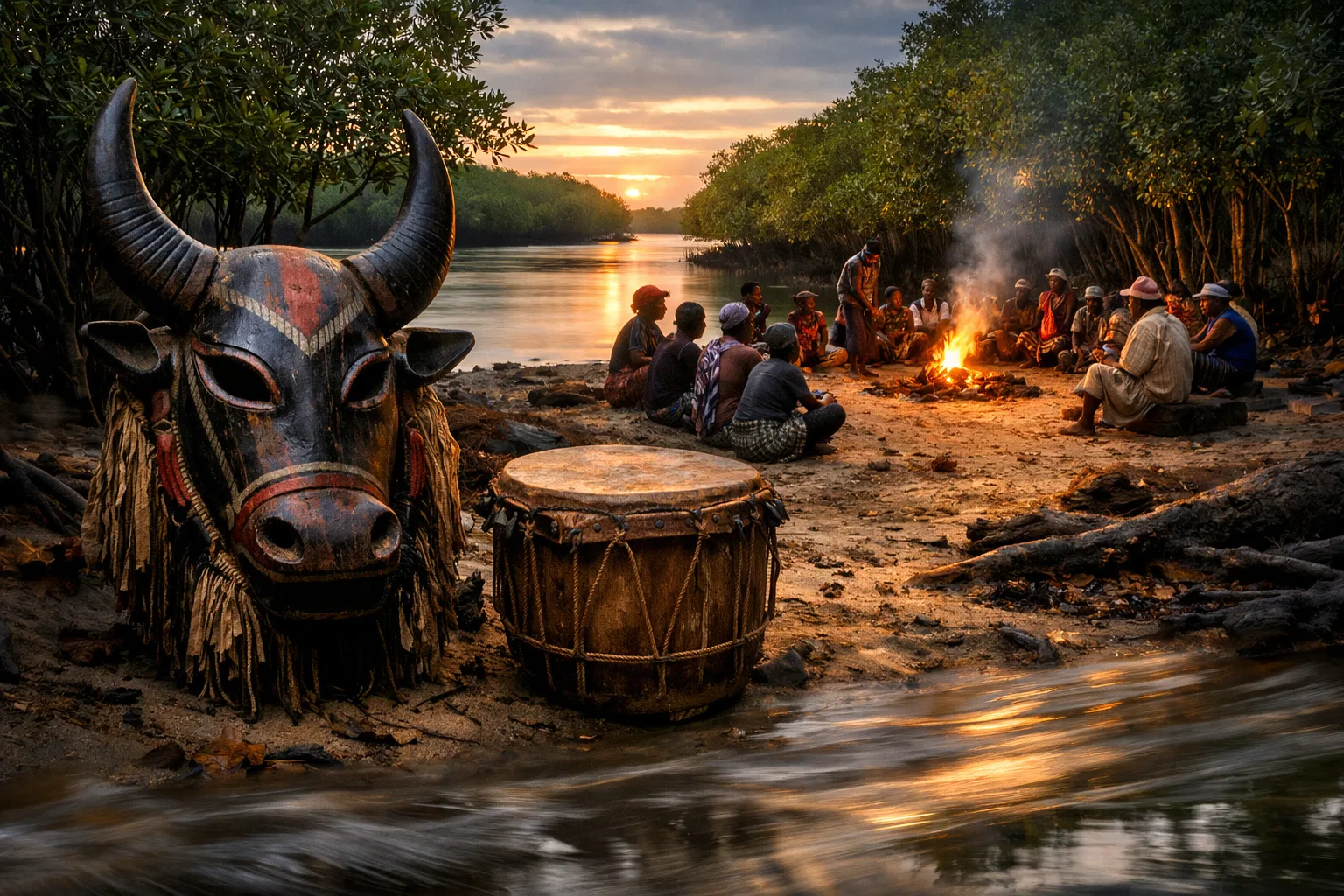
Bijagó masks are among the most visible forms of Guinea-Bissau’s ritual art. Museum collections give unusually concrete evidence here. The Brooklyn Museum’s twentieth-century ox mask from the Bijagós Islands is identified as an object used in young men’s initiation ceremonies; its label explains that the tethered ox image symbolises the initiate’s strength, which must be encouraged but also controlled.[Brooklyn Museum]brooklynmuseum.orgBrooklyn Museum Ox Mask (Dugn'be) · Brooklyn MuseumBrooklyn Museum Ox Mask (Dugn'be) · Brooklyn Museum
The British Museum holds a Bijagó buffalo mask made in the Bissagos Islands in or before 1956, with detachable horns, red, white and black pigment, raffia and fibre elements. That object record is useful because it shows that these traditions are not only tourist-era performances or recent internet folklore. They have been collected, catalogued and interpreted in major museum contexts for decades, although the colonial and postcolonial routes by which such objects entered museums must also be treated critically.[British Museum]britishmuseum.orgBritish Museummask | British MuseumBritish Museummask | British Museum
The meaning of the masks is not just “animal worship”. In initiation, animal forms can dramatise qualities that a person must learn to manage: force, danger, fertility, endurance, aggression, social control, and the boundary between wild and cultivated life. The ox mask is a good example because the museum label does not present it as a monster or god; it presents the animal image as a social metaphor for young men being trained into adulthood.[Brooklyn Museum]brooklynmuseum.orgBrooklyn Museum Ox Mask (Dugn'be) · Brooklyn MuseumBrooklyn Museum Ox Mask (Dugn'be) · Brooklyn Museum
This is where Guinea-Bissau’s folklore differs from many popular online monster lists. The memorable figures are often not named beasts roaming the countryside, but embodied ritual forms: masks, drums, animal symbols and sacred objects that appear in specific contexts. Their power comes from performance, secrecy, age-grade knowledge and community recognition, not from being written down as a fixed myth.
Queen Okinka Pampa: history, legend and sacred memory
The most famous legendary-historical figure associated with Guinea-Bissau’s folklore is Queen Okinka Pampa of Orango. Public accounts describe her as the last queen of the Bijagós of Orango, a political and spiritual figure who died in 1930 and whose memory remains attached to the royal mausoleum at Eticoga. Travel writing about Orango describes her as both a remembered ruler and a venerated figure in local sacred history, with stories that credit her with resisting Portuguese pressure and protecting island traditions.[Travel Tomorrow]traveltomorrow.comTravel Tomorrow Guinea Bissau: Back to the roots in OrangoTravel Tomorrow Guinea Bissau: Back to the roots in Orango
Her story sits on the border between history and legend. The historical frame is early twentieth-century colonial expansion into the archipelago; the legendary frame includes accounts of supernatural powers and continued veneration. One modern account explicitly calls her a woman “venerated for her supernatural powers” and connects her mausoleum with animist symbolism and island religious life. That does not mean every detail should be treated as literal fact. It means her memory has become a cultural focal point where politics, gender, religion and folklore meet.[Travel Tomorrow]traveltomorrow.comTravel Tomorrow Guinea Bissau: Back to the roots in OrangoTravel Tomorrow Guinea Bissau: Back to the roots in Orango
Okinka Pampa also helps explain why readers often hear about “matriarchy” in the Bijagós. Sources vary in how strongly they use that word, but many describe women in parts of the archipelago as having unusually strong roles in household decisions, courtship, divorce, ritual authority and social conflict. A careful reading should avoid turning this into a simple fantasy of “women rule everything”. It is better to say that some Bijagó communities have matrilineal or women-centred institutions that have attracted outside attention, and that Okinka Pampa has become the most famous symbolic figure for that tradition.[Travel Tomorrow]traveltomorrow.comTravel Tomorrow Guinea Bissau: Back to the roots in OrangoTravel Tomorrow Guinea Bissau: Back to the roots in Orango
For folklore readers, the important point is that Okinka Pampa is not merely a “forgotten queen” headline. She is a case study in how a real political past can become sacred memory. Her tomb, stories of resistance, gendered authority and association with ancestral protection all make her a living point of reference in the cultural imagination of Orango.
Drums, shrines and the sound of hidden communication
Not all Guinea-Bissau folklore is visual. The community drum known in one recent heritage essay as the bombolom is described as a sacred object used in coastal villages to send messages across distance, announce deaths and mourning ceremonies, and transmit coded meanings that only trained people can decipher.[polarjournal.org]polarjournal.orgOpen source on polarjournal.org.
That matters because it widens the idea of folklore beyond tales and creatures. A drumbeat can carry social knowledge just as a story can. It can mark death, summon attention, encode status, and connect dispersed people through sound. In a public folklore page, the drum is valuable because it shows how “tradition” can be practical and communicative rather than decorative.
The same heritage discussion also raises a modern issue: many objects from Guinea-Bissau are now held in European museums, especially in collections formed during colonial times. The author notes that even where there is no explicit evidence of illicit looting, colonial collecting took place in unequal conditions and often privileged aesthetic value over local meaning. This is crucial for readers of folklore, because a mask or drum in a museum may be visually striking while its deeper story lies in performance, ownership, sound, restriction and memory.[polarjournal.org]polarjournal.orgOpen source on polarjournal.org.
Witchcraft, spirits and explanations of misfortune
Guinea-Bissau also has documented witchcraft beliefs, especially in multi-ethnic settings where different religious and social worlds overlap. Anthropologist Magdalena Brzezińska’s article on witchcraft in Guinea-Bissau describes beliefs in invisible psychic aggression, contracts with nature spirits, attacks described through imagery of consuming a victim’s life force, and ideas that witches may transform into animals.[ResearchGate]researchgate.netOpen source on researchgate.net.
This material should be handled with care. Witchcraft beliefs are not “spooky entertainment” for outsiders; they can shape fear, accusation, illness interpretation and social trust. The point is not whether witches objectively exist, but how such beliefs help people explain harm that seems hidden, unfair or socially charged. In that sense, witchcraft belongs to folklore, religion and social life at the same time.[ResearchGate]researchgate.netOpen source on researchgate.net.
The animal-transformation theme is especially relevant to folklore readers because it resembles shape-shifting traditions found worldwide, yet the Guinea-Bissau material has its own local logic. In Brzezińska’s summary, transformation is not merely disguise; it may be imagined as a means of invisible or direct assault. That makes the belief different from a simple fairy-tale metamorphosis. It is tied to danger, moral suspicion and the unseen causes of misfortune.[ResearchGate]researchgate.netOpen source on researchgate.net.
Sacred animals and protected places
The best-known sacred animal story in modern accounts of Guinea-Bissau is probably the saltwater hippopotamus of Orango. Reports from Orango describe a local belief that harming or killing a hippo brings punishment, a tradition that is often linked to the unusual coexistence of people and hippos in the island landscape.[Travel Tomorrow]traveltomorrow.comTravel Tomorrow Guinea Bissau: Back to the roots in OrangoTravel Tomorrow Guinea Bissau: Back to the roots in Orango
This should not be romanticised as if belief alone solves conservation. Hippos still damage rice fields, and people still have to manage risk. But the tradition is a useful example of how folklore can affect behaviour towards animals. A creature can be dangerous, economically troublesome and sacred at the same time. That complexity is exactly what makes the Orango hippo tradition more interesting than a simple “sacred animal” label.[Travel Tomorrow]traveltomorrow.comTravel Tomorrow Guinea Bissau: Back to the roots in OrangoTravel Tomorrow Guinea Bissau: Back to the roots in Orango
The Bijagós also show how sacred geography and environmental protection can overlap. UNESCO’s natural listing focuses on ecosystems, species and habitat, but cultural accounts stress that some islands are restricted or ritually protected. For a folklore reader, the takeaway is that sacredness is not an abstract belief floating above the landscape; it can influence who enters a place, when ceremonies happen, which animals are touched, and how communities explain their obligations to land and sea.[UNESCO World Heritage Centre]whc.unesco.orgOpen source on unesco.org.
How folklore is changing today
Guinea-Bissau’s folklore is not frozen in a pre-modern past. It is being reshaped by tourism, migration, museums, conservation projects, Christianity, Islam, urban life, schooling and diaspora debate. The Bijagós in particular are now described in global travel media as a rare cultural landscape, which brings visibility but also the risk of simplifying sacred traditions into visitor experiences.[Vogue]vogue.comOpen source on vogue.com.
Museum and heritage debates are another form of change. When masks, drums and ritual objects move from village use to colonial collections, national museums, European ethnographic displays or art markets, their meaning changes. They may become evidence, art, heritage, property, memory or political argument. Recent heritage writing on Guinea-Bissau makes exactly this point by treating cultural objects as things with biographies that move through colonial and postcolonial contexts.[polarjournal.org]polarjournal.orgOpen source on polarjournal.org.
There is also a documentation problem. Guinea-Bissau’s traditions are rich, but English-language public material is uneven. The Bijagós receive far more attention than many mainland communities, partly because the archipelago is visually distinctive, ecologically important and attractive to travellers. That can distort the national picture. A balanced folklore page should therefore treat the Bijagós as a major anchor, not as the whole of Guinea-Bissau.

What to remember about Guinea-Bissau folklore
The most useful way to understand Guinea-Bissau folklore is through lived relationships: people and ancestors, islands and taboos, animals and moral rules, drums and distance, masks and initiation, queens and sacred memory. Its most memorable traditions are not always written as tidy myths. They often appear as performances, ritual objects, restricted places, spirit beliefs and stories attached to named landscapes.
The Bijagós Archipelago provides the clearest entry point, especially through initiation masks, sacred islands, women-centred authority, Queen Okinka Pampa and the Orango hippos. But the wider country includes many other traditions shaped by Balanta, Fula, Mandinka, Manjaco, Papel and other communities, as well as by the long coexistence of indigenous religions, Islam and Christianity. Guinea-Bissau’s folklore is therefore less a single pantheon than a living map of local memory, spiritual authority and cultural adaptation.
Amazon book picks
Further Reading
Books and field guides related to Where Spirits Live in Guinea-Bissau. Use these as the next step if you want deeper reading beyond the article.

African traditional religions in contemporary society
First published 1991. Subjects: Religion, Study and teaching, Congresses, Étude et enseignement, PRO Shaw, Gwendolyn Dubois, 1968- (donor).
eBay marketplace picks
Marketplace Samples
Live-tested eBay searches with available results related to this page.

Endnotes
1.
Source: thearda.com
Title: ARDANational Profiles | World Religion
Link:https://www.thearda.com/world-religion/national-profiles?u=100c
2.
Source: whc.unesco.org
Link:https://whc.unesco.org/en/list/1431/
3.
Source: unesco.org
Title: strengthens its support guinea bissau protection bijagos islands
Link:https://www.unesco.org/en/articles/unesco-strengthens-its-support-guinea-bissau-protection-bijagos-islands
4.
Source: vogue.com
Link:https://www.vogue.com/article/bijagos-islands-guinea-bisseau-guide
5.
Source: polarjournal.org
Link:https://polarjournal.org/2024/09/21/guinea-bissau-cultural-heritage-materiality-frontier-and-communication/
6.
Source: researchgate.net
Link:https://www.researchgate.net/publication/289900655_Contracts_with_spirits_and_crocodiles_magically_transformed_Witchcraft_in_Guinea-Bissau
7.
Source: ich.unesco.org
Title: oral traditions and expressions 00053
Link:https://ich.unesco.org/en/oral-traditions-and-expressions-00053
8.
Source: whc.unesco.org
Link:https://whc.unesco.org/document/222005
9.
Source: ich.unesco.org
Title: guinea bissau GW
Link:https://ich.unesco.org/en/state/guinea-bissau-GW
10.
Source: whc.unesco.org
Link:https://whc.unesco.org/en/list/
11.
Source: ich.unesco.org
Link:https://ich.unesco.org/en/lists
12.
Source: unesco.org
Title: committee 2025
Link:https://www.unesco.org/en/world-heritage/committee-2025
13.
Source: ich.unesco.org
Title: 00264 EN
Link:https://ich.unesco.org/doc/src/00264-EN.pdf
14.
Source: whc.unesco.org
Link:https://whc.unesco.org/en/activities/pattern%3D%26id_keywords%3D%26order%3Ddefault%26submit%3DSearch%26order%3Ddmd%26mode%3Dtable%26featured%3D1
15.
Source: unesdoc.unesco.org
Link:https://unesdoc.unesco.org/ark%3A/48223/pf0000221269
16.
Source: ich.unesco.org
Title: LHE 25 20.CO M 4 EN.docx
Link:https://ich.unesco.org/doc/src/LHE-25-20.COM-4_EN.docx
17.
Source: whc.unesco.org
Link:https://whc.unesco.org/document/152465
18.
Source: unesdoc.unesco.org
Link:https://unesdoc.unesco.org/ark%3A/48223/pf0000398119
19.
Source: ich.unesco.org
Link:https://ich.unesco.org/
20.
Source: unesdoc.unesco.org
Link:https://unesdoc.unesco.org/ark%3A/48223/pf0000221214
21.
Source: ich.unesco.org
Title: 00010 EN
Link:https://ich.unesco.org/doc/src/00010-EN.pdf
22.
Source: whc.unesco.org
Link:https://whc.unesco.org/en/activities/search_region%3D2%26mode%3Dtable
23.
Source: unesdoc.unesco.org
Link:https://unesdoc.unesco.org/ark%3A/48223/pf0000395250
24.
Source: researchgate.net
Link:https://www.researchgate.net/publication/324666891_Catching_them_Young_African_Youth_Folktale_and_the_Communication_of_Universal_Moral_Values
25.
Source: researchgate.net
Title: 328586892 Traditional religion in Guinea Bissau political culture
Link:https://www.researchgate.net/publication/328586892_Traditional_religion_in_Guinea_Bissau_political_culture
26.
Source: minorityrights.org
Link:https://minorityrights.org/country/guinea-bissau/
27.
Source: elpais.com
Title: El País Las islas Bijagós, el paraíso de Guinea-Bisáu que aún no conoces
Link:https://elpais.com/elviajero/viajes/2024-07-11/las-islas-bijagos-el-paraiso-de-guinea-bisau-que-aun-no-conoces.html
Source snippet
La isla de Orango, en particular, evidencia un modelo de turismo sostenible impulsado por el Orango Parque Hotel, un proyecto español que...
28.
Source: brooklynmuseum.org
Title: Brooklyn Museum Ox Mask (Dugn’be) · Brooklyn Museum
Link:https://www.brooklynmuseum.org/ko-KR/objects/148087
29.
Source: britishmuseum.org
Title: British Museummask | British Museum
Link:https://www.britishmuseum.org/collection/object/E_Af1960-18-1-a-c
30.
Source: traveltomorrow.com
Title: Travel Tomorrow Guinea Bissau: Back to the roots in Orango
Link:https://traveltomorrow.com/orango-guinea-bissau-back-to-the-roots/
31.
Source: Wikipedia
Title: Okinka Pampa
Link:https://en.wikipedia.org/wiki/Okinka_Pampa
32.
Source: beingafrican.org
Link:https://beingafrican.org/guinea-bissau/
33.
Source: worldfactbook.co
Link:https://worldfactbook.co/country.php?slug=guinea-bissau
34.
Source: Wikipedia
Title: Bijagós Islands
Link:https://en.wikipedia.org/wiki/Bijag%C3%B3s_Islands
35.
Source: brooklynmuseum.org
Link:https://www.brooklynmuseum.org/objects/148087
36.
Source: orangohotel.com
Link:https://www.orangohotel.com/en/projects/
37.
Source: borisgershman.com
Link:https://www.borisgershman.com/research/witchcraft/witchcraft.pdf
38.
Source: kids.kiddle.co
Title: Okinka Pampa
Link:https://kids.kiddle.co/Okinka_Pampa
39.
Source: openfactbook.org
Link:https://openfactbook.org/countries/guinea-bissau/
40.
Source: zyama.com
Link:https://www.zyama.com/bijago/
41.
Source: bijagos.com
Link:https://bijagos.com/
42.
Source: ebsco.com
Link:https://www.ebsco.com/research-starters/geography-and-cartography/guinea-bissau
Additional References
43.
Source: youtube.com
Title: Rubane Island: A Sacred Journey into the Bijagós Archipelago
Link:https://www.youtube.com/watch?v=KIsHJPEF4u8
Source snippet
Guinea-Bissau's Bijagos Archipelago enters UNESCO world heritage list • FRANCE 24 English...
44.
Source: youtube.com
Title: Canhabaque: The Hidden Soul of Guinea-Bissau’s Bijagós Islands
Link:https://www.youtube.com/watch?v=8qp1d0tG6Ps
Source snippet
Rubane Island: A Sacred Journey into the Bijagós Archipelago...
45.
Source: youtube.com
Title: Sacred Lands Of The Bissagos Islands | West Africa’s
Link:https://www.youtube.com/watch?v=2DZ6Arcy53c
Source snippet
Canhabaque: The Hidden Soul of Guinea-Bissau's Bijagós Islands...
46.
Source: facebook.com
Link:https://www.facebook.com/okayafrica/posts/waahdean-found-out-he-originates-from-guinea-bissau-and-hes-definitely-going-to-/1558274565662757/
47.
Source: facebook.com
Link:https://www.facebook.com/truftz/posts/celebrating-matriarchy-through-film-a-glimpse-into-orango-islands-women-led-soci/797298419311306/
48.
Source: spiritlandofafrica.com
Link:https://www.spiritlandofafrica.com/products/list/bidjogo–guinea-bissau/
49.
Source: betbi.org
Link:https://www.betbi.org/art/collection/bidjogo-shark-mask
50.
Source: responsibletravel.com
Link:https://www.responsibletravel.com/holidays/guinea-bissau/travel-guide/the-bijagos-archipelago
51.
Source: nadia-ferroukhi.com
Link:https://nadia-ferroukhi.com/project/guinee-bissau-bijago/
52.
Source: everyculture.com
Link:https://www.everyculture.com/Ge-It/Guinea-Bissau.html
Topic Tree
Follow this branch
Related pages 192
- Afghan Folklore
- Albanian Folklore
- Algerian Folklore
- Australian Folklore
- Azerbaijan Folklore
- +187 more in sidebar