Within Brazil Folklore
How Brazil Made Folklore Public Culture
Brazil has turned folklore into public heritage through official celebration, performance traditions and modern media retellings.
On this page
- Folklore Day and national cultural identity
- Bumba meu boi and performance as heritage
- Children's books, television and streaming fantasy
Page outline Jump by section
Introduction
Brazil is unusual among countries with rich folklore traditions because it has not left folklore solely in the hands of storytellers, families or local communities. Instead, it has actively brought folklore into public life through national commemorations, school programmes, heritage policies, festivals, television, publishing and, more recently, streaming media. As a result, legendary figures such as Saci, Curupira and Cuca are familiar not only from oral tradition but also from classrooms, children’s books, public celebrations and popular entertainment.
This public embrace of folklore reflects a broader idea of Brazilian cultural identity: that traditional stories, performances and local beliefs are part of the nation’s living heritage rather than relics of the past. Official recognition, especially through Folklore Day and heritage protection programmes, has helped transform folklore from a regional or rural practice into a visible element of national culture.[UNESCO Intangible Cultural Heritage]ich.unesco.orgUNESCO Intangible Cultural HeritageCultural Complex of Bumba-meu-boi from MaranhãoThe Cultural Complex of Bumba-meu-boi from Maranhão is…
Folklore Day and national cultural identity
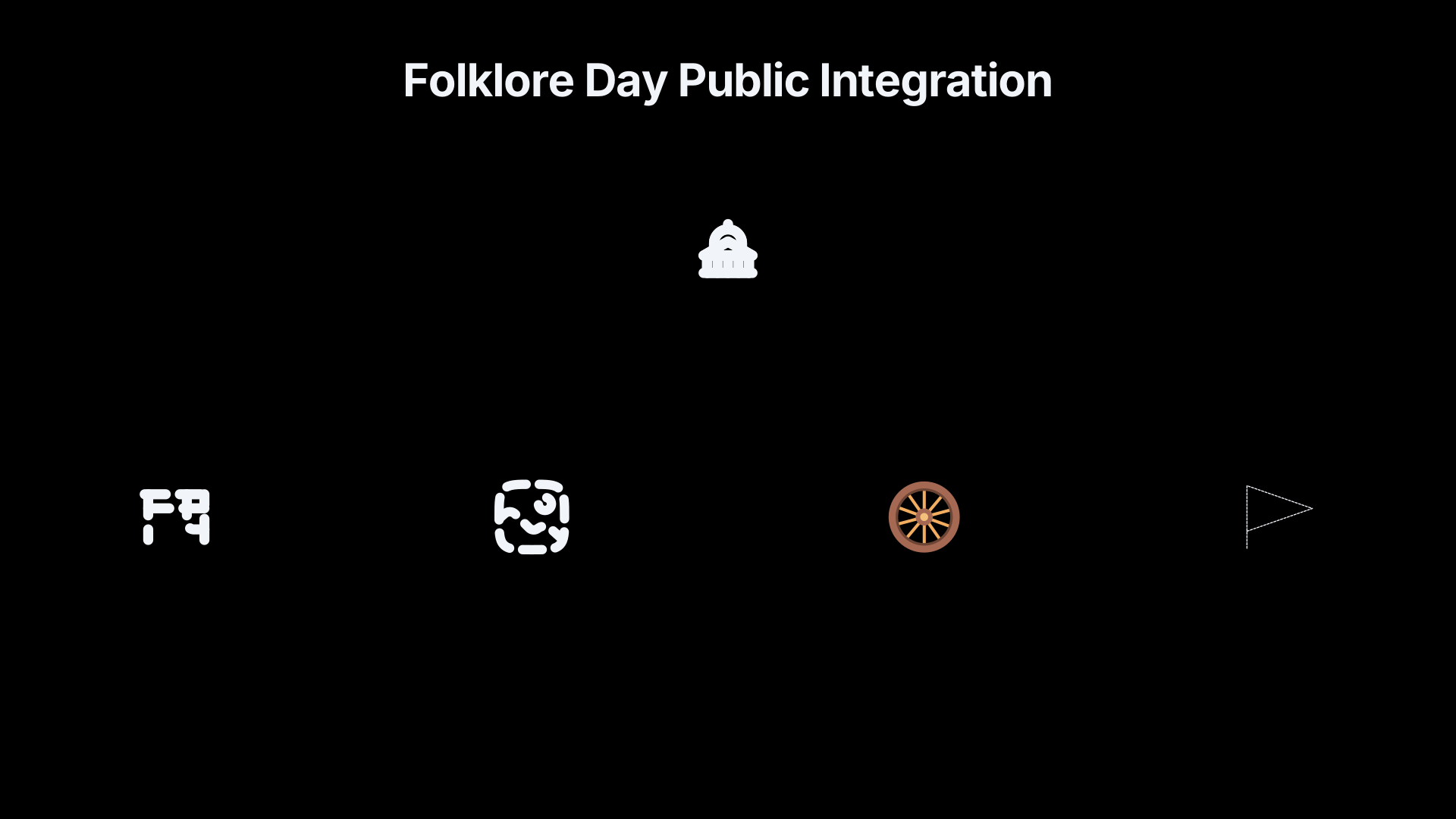
One of the clearest examples of folklore becoming public culture is Brazil’s Folklore Day, observed annually on 22 August. The date was formally established by federal decree in 1965, giving folklore an official place in the country’s cultural calendar. The decision reflected a growing belief among educators, folklorists and cultural institutions that traditional stories, customs and performances deserved preservation and public recognition.
The celebration is notable because it treats folklore as a collective cultural resource rather than simply entertainment. Schools frequently organise exhibitions, storytelling sessions, costume events and lessons focused on folk characters. Municipal cultural departments and museums often stage performances or educational programmes tied to regional traditions. Through these activities, folklore becomes part of civic life and cultural education.
The officialisation of Folklore Day also helped broaden the definition of folklore itself. Rather than focusing only on supernatural beings and legends, public programmes commonly include songs, dances, crafts, regional celebrations and oral history. In practice, this means that folklore is presented as a living expression of Brazilian diversity, linking Indigenous traditions, African cultural influences, Portuguese heritage and later regional developments into a shared national narrative.
This process has not been free of debate. Some scholars have argued that institutional celebrations can simplify complex local traditions into easily recognisable national symbols. Yet the continuing popularity of Folklore Day demonstrates how successfully folklore has been incorporated into Brazilian public culture. Stories once tied to particular regions are now widely recognised across the country, helping create a common cultural vocabulary while still allowing local variations to survive.
Bumba-meu-boi and performance as heritage
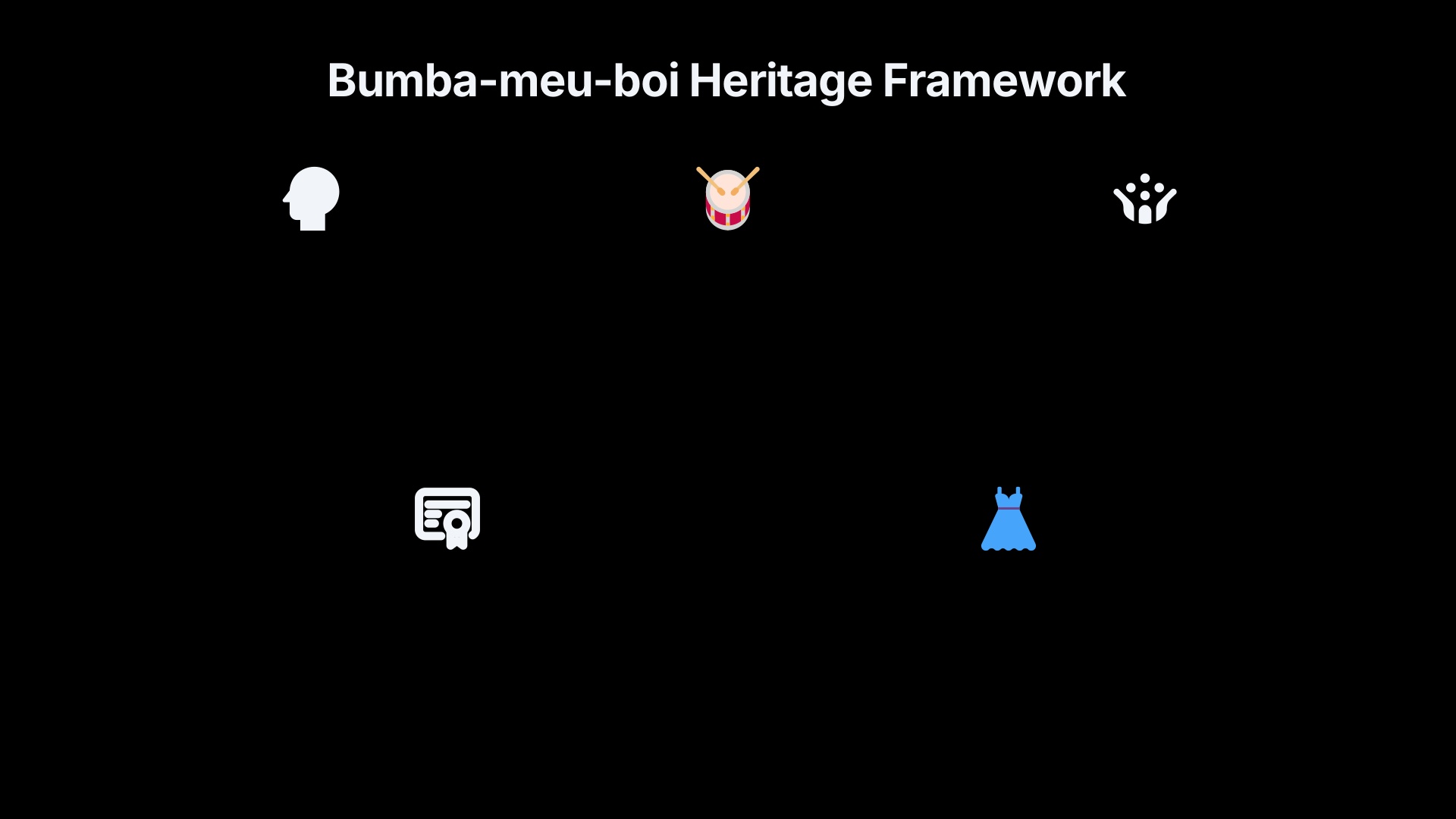
If Folklore Day represents official recognition, Bumba-meu-boi demonstrates how folklore can become a major public performance tradition.
Bumba-meu-boi is a dramatic folk celebration built around the symbolic death and resurrection of an ox. The performance combines music, dance, theatre, costume, religious devotion and community participation. Although related forms exist in several parts of Brazil, the version associated with Maranhão has become one of the country’s most celebrated examples of living folklore. UNESCO describes it as a complex cultural practice in which artistic performance, spirituality and social life are closely intertwined.[UNESCO Intangible Cultural Heritage]ich.unesco.orgUNESCO Intangible Cultural HeritageCultural Complex of Bumba-meu-boi from MaranhãoThe Cultural Complex of Bumba-meu-boi from Maranhão is…
What makes Bumba-meu-boi particularly important to Brazil’s public culture is the way it bridges folklore and heritage policy. The performance is not treated merely as a colourful festival. It has become an officially protected cultural expression supported through documentation, preservation and educational initiatives. UNESCO added the Cultural Complex of Bumba-meu-boi from Maranhão to its Representative List of the Intangible Cultural Heritage of Humanity in 2019, recognising both its cultural significance and the efforts of practitioners to sustain the tradition.[UNESCO Intangible Cultural Heritage]ich.unesco.orgUNESCO Intangible Cultural HeritageCultural Complex of Bumba-meu-boi from MaranhãoThe Cultural Complex of Bumba-meu-boi from Maranhão is…
The story at the centre of the celebration varies by region, but commonly involves the killing and miraculous revival of a prized ox. Around this narrative gather musicians, dancers, costumed performers, community groups and audiences. The result is less a single play than a large-scale public expression of identity. UNESCO notes that each year’s celebration is recreated through new songs, costumes and performances while retaining its traditional core.[UNESCO]unesco.orgdocument 4921Cultural Complex of Bumba-meu-boi From Maranhão20 Nov 2019 — The cultural complex of Bumba-meu-boi from Maranhão is a ritualistic p…
Bumba-meu-boi also illustrates how Brazilian folklore often combines multiple cultural influences. Scholars and cultural organisations frequently describe it as bringing together Indigenous, African and European traditions within a single performance framework. The celebration’s continuing vitality shows that folklore in Brazil is not simply preserved in archives; it remains a participatory form of cultural life.[rioandlearn.com]rioandlearn.comRio & LearnBumba Meu Boi: A Fun and Colorful Festival from Brazil!Bumba Meu Boi (which translates to “Beat My Bull”) is a traditional Bra…
Children’s books, television and streaming fantasy
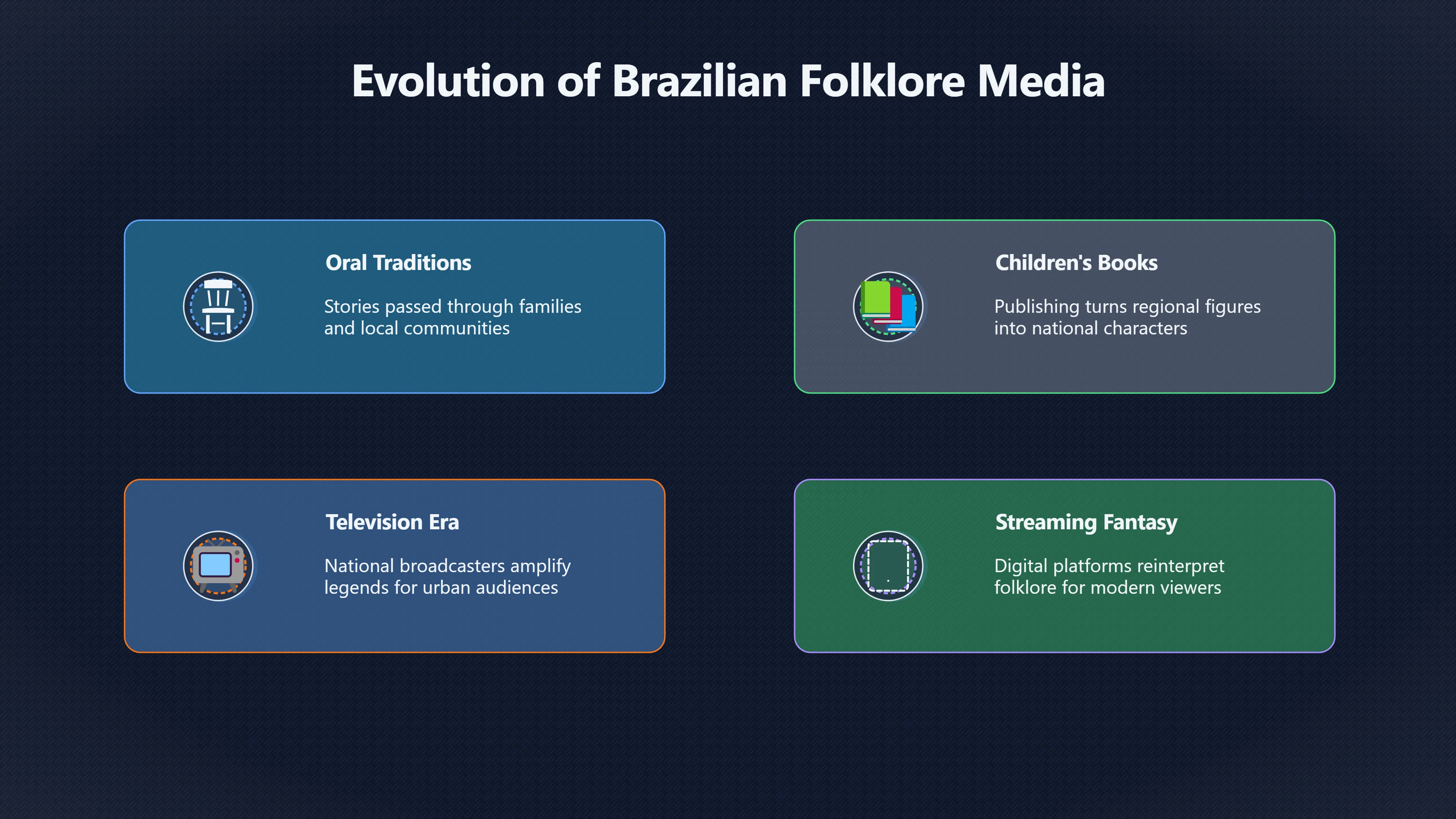
Public culture has expanded Brazilian folklore far beyond festivals and heritage programmes. During the twentieth century, children’s literature and television played a crucial role in turning regional folk figures into national characters.
The most influential example was the adaptation of folklore into children’s publishing and educational media. Figures such as Saci, Cuca and Curupira became familiar to generations of Brazilian children through books, illustrated stories and television programmes. These adaptations often softened frightening or morally ambiguous elements while keeping the characters recognisable. As a result, folklore moved from oral storytelling into mass culture.
Television greatly amplified this process. National broadcasters introduced folklore-inspired characters to audiences far from the regions where the stories originally circulated. For many urban Brazilians, encounters with legendary beings increasingly came through television rather than family storytelling. This shift changed the way folklore was experienced but also helped keep traditional characters relevant in a rapidly modernising society.
The digital era has created another transformation. Streaming platforms, fantasy series, animation and online fan communities have reinterpreted Brazilian folklore for contemporary audiences. Forest guardians, witches and supernatural tricksters now appear in genres ranging from children’s adventure to dark fantasy. Modern adaptations frequently emphasise environmental themes, cultural identity or social commentary, reflecting current concerns while drawing on older traditions.
This media visibility has produced an interesting paradox. Some modern viewers first encounter Brazilian folklore through fictional adaptations rather than traditional storytelling. Yet those adaptations often inspire renewed interest in the older legends behind the characters. In this way, public culture does not simply replace folklore; it creates new pathways into it.
Why folklore remains visible in modern Brazil
Many countries possess rich folklore traditions, but relatively few have integrated them so thoroughly into public institutions, education and popular media. Brazil’s experience shows how folklore can function simultaneously as heritage, entertainment, education and cultural identity.
Folklore Day provides official recognition. Heritage programmes protect major performance traditions such as Bumba-meu-boi. Schools introduce children to folk characters. Television and streaming services continually reinvent legendary figures for new audiences. Together, these mechanisms have helped folklore remain a visible part of contemporary life rather than a disappearing remnant of the past.
The result is a distinctive cultural landscape in which stories of forest spirits, tricksters, enchanted animals and supernatural beings continue to circulate alongside modern media and public policy. In Brazil, folklore is not only remembered—it is actively performed, taught, celebrated and reinvented.[unesco.org]ich.unesco.orgUNESCO Intangible Cultural HeritageCultural Complex of Bumba-meu-boi from MaranhãoThe Cultural Complex of Bumba-meu-boi from Maranhão is…
Amazon book picks
Further Reading
Books and field guides related to How Brazil Made Folklore Public Culture. Use these as the next step if you want deeper reading beyond the article.
The Hero with a Thousand Faces
Useful background on the persistence of myth in modern culture.
eBay marketplace picks
Marketplace Samples
Live-tested eBay searches with available results related to this page.
Endnotes
1.
Source: ich.unesco.org
Link:https://ich.unesco.org/en/RL/cultural-complex-of-bumba-meu-boi-from-maranhao-01510
Source snippet
UNESCO Intangible Cultural HeritageCultural Complex of Bumba-meu-boi from MaranhãoThe Cultural Complex of Bumba-meu-boi from Maranhão is...
2.
Source: unesco.org
Title: document 4921
Link:https://www.unesco.org/archives/multimedia/document-4921
Source snippet
Cultural Complex of Bumba-meu-boi From Maranhão20 Nov 2019 — The cultural complex of Bumba-meu-boi from Maranhão is a ritualistic p...
3.
Source: ich.unesco.org
Link:https://ich.unesco.org/en/Decisions/14.COM/10.b.6
Source snippet
UNESCO Intangible Cultural HeritageDecision of the Intergovernmental Committee: 14.COM 10.b.6R.2: The inscription of Bumba-meu-boi would...
4.
Source: unesco.org
Title: bumba meu boi brazil now intangible cultural heritage humanity
Link:https://www.unesco.org/en/articles/bumba-meu-boi-brazil-now-intangible-cultural-heritage-humanity
Source snippet
Bumba Meu Boi from Brazil is now an Intangible Cultural...Dec 12, 2019 — The Bumba Meu Boi Cultural Complex from Brazil was recognized t...
5.
Source: ich.unesco.org
Link:https://ich.unesco.org/en/video/50596
Source snippet
unesco.orgVideo: Cultural Complex of Bumba-meu-boi from MaranhãoVideo: Cultural Complex of Bumba-meu-boi from Maranhão. Cultural Complex...
6.
Source: ich.unesco.org
Link:https://ich.unesco.org/en/video/50628
Source snippet
Cultural Complex of Bumba-meu-boi from Maranhão. Cultural Complex of Bumba-meu-boi from Maranhão (Brazil)Read more...
7.
Source: unesco.org
Link:https://www.unesco.org/pt/articles/bumba-meu-boi-do-maranhao-agora-e-patrimonio-cultural-imaterial-da-humanidade
Source snippet
Bumba Meu Boi do Maranhão agora é Patrimônio Cultural...Dec 12, 2019 — O Complexo Cultural do Bumba Meu Boi do Maranhão foi reconhecido...
8.
Source: ich.unesco.org
Title: brazil BR
Link:https://ich.unesco.org/en/state/brazil-BR?call=film&id=50596&include=film_inc.php&width=700
Source snippet
pageCultural Complex of Bumba-meu-boi from Maranhão (Brazil) Representative List - 2019. Tap to unmute. Your browser can't play this vide...
9.
Source: ich.unesco.org
Title: cultural complex of bumba meu boi from maranho 01510
Link:https://ich.unesco.org/en/RL/cultural-complex-of-bumba-meu-boi-from-maranho-01510?call=film&id=48607&include=film.inc.php&width=700
Source snippet
the Lists of Intangible Cultural...Cultural Complex of Bumba-meu-boi from Maranhão (Brazil) Representative List - 2019. Video thumbnail...
10.
Source: rioandlearn.com
Link:https://rioandlearn.com/bumba-meu-boi/
Source snippet
Rio & LearnBumba Meu Boi: A Fun and Colorful Festival from Brazil!Bumba Meu Boi (which translates to “Beat My Bull”) is a traditional Bra...
11.
Source: anba.com.br
Title: bumba meu boi heritage listed
Link:https://anba.com.br/en/bumba-meu-boi-heritage-listed/
Source snippet
Agência de Notícias Brasil-ÁrabeBumba Meu Boi heritage-listed12 Dec 2019 — Bumba Meu Boi heritage-listed. The folk festivity in Maranhão...
12.
Source: portalpadrao.ufma.br
Link:https://portalpadrao.ufma.br/universidadefm/noticias/unesco-entrega-certificado-que-reconhece-o-bumba-meu-boi-do-maranhao-como-patrimonio-cultural-imaterial-da-humanidade
Source snippet
entrega certificado que reconhece o Bumba Meu...Aug 15, 2025 — O Complexo Cultural do Bumba Meu Boi do Maranhão recebeu oficialmente o t...
Additional References
13.
Source: bcr.iphan.gov.br
Link:https://bcr.iphan.gov.br/midias-registro/bumba-meu-boi-patrimonio-cultural-imaterial-da-humanidade/
Source snippet
Vídeo produzido para anunciar a candidatura do Complexo Cultural do Bumba Meu Boi do Maranhão a Patrimônio Cultural Imaterial da Humanida...
14.
Source: mash-up.co
Link:https://mash-up.co/en/bumba-meu-boi-brazilian-tradition/
Source snippet
IPHAN in 2011, and in 2019, UNESCO recognized it as a Cultural Heritage of Humanity.Read more...
15.
Source: agenciabrasil.ebc.com.br
Title: maranhaos bumba meu boi now cultural heritage humanity
Link:https://agenciabrasil.ebc.com.br/en/geral/noticia/2019-12/maranhaos-bumba-meu-boi-now-cultural-heritage-humanity
Source snippet
ebc.com.brMaranhão's Bumba Meu Boi now cultural heritage of humanityDec 12, 2019 — The Bumba Meu Boi cultural complex of the Brazilian st...
16.
Source: aventuradobrasil.com
Title: unique unesco world heritage in brazil part 3
Link:https://www.aventuradobrasil.com/blog/unique-unesco-world-heritage-in-brazil-part-3/
Source snippet
Intangible Cultural Heritage of UNESCO in Brazil21 Aug 2020 — Intangible cultural heritage includes cultural expressions such as music, t...
17.
Source: facebook.com
Link:https://www.facebook.com/carlosbrandaoma/videos/-agora-%C3%A9-oficial-o-complexo-cultural-do-bumba-meu-boi-do-maranh%C3%A3o-foi-reconhecid/1830370218363450/
Source snippet
como Patrimônio Cultural Imaterial da Humanidade. Esse título foi...
18.
Source: portal.iphan.gov.br
Title: iphan.gov.br PHA N
Link:https://portal.iphan.gov.br/uploads/ckfinder/arquivos/Certidao_bumba_meu_boi.pdf
Source snippet
cultural: Complexo Cultural do Bumba-meu-boi do. Maranhão. Descrição: O Bumba-meu-boi é uma festa tradicional que acontece...
19.
Source: anba.com.br
Link:https://anba.com.br/bumba-meu-boi-vira-patrimonio-cultural-da-humanidade/
Source snippet
Bumba Meu Boi vira Patrimônio Cultural da HumanidadeDec 13, 2019 — O Complexo Cultural do Bumba Meu Boi do Maranhão foi consagrado como P...
20.
Source: youtube.com
Title: Iara – Legends and Myths of Brazilian Folklore
Link:https://www.youtube.com/watch?v=KP6dm4ZGFj0
Source snippet
THE ENCHANTED RIVER DOLPHIN | The Most Seductive Legend of Brazilian Folklore...
21.
Source: rioonwatch.org
Link:https://rioonwatch.org/?p=76577
Source snippet
Bumba-meu-boi Brilho de Lucas Keeps Maranhão Folklore...19 Nov 2023 — According to the most widespread legend in Maranhão, Mother Catiri...
22.
Source: Wikipedia
Title: Bumba Meu Boi
Link:https://en.wikipedia.org/wiki/Bumba_Meu_Boi
Source snippet
Bumba Meu BoiBumba Meu Boi is an interactive play celebrated in Brazil. It originated in the 18th century. It is a form of social crit...
Topic Tree