Within Niger Folklore
How Did Hauka Spirits Mock Colonial Power?
The Hauka made colonial power strange, bodily and performable through spirits who mimicked officials, soldiers and modern authority.
On this page
- Songhay Zarma roots and migrant settings
- Colonial officials as possessing spirits
- Film, scholarship and modern cultural memory
Page outline Jump by section
Introduction
Among the spirit traditions associated with Niger’s Songhay-Zarma world, none has attracted more attention—or more controversy—than the Hauka. Emerging during the colonial period, Hauka possession rituals transformed the figures of European rule into spirits that could enter human bodies. Governors, military officers, engineers, doctors, railway workers and policemen appeared not simply as political authorities but as supernatural forces whose power could be enacted, mocked and appropriated through ritual performance. Far from being a simple imitation of Europeans, Hauka ceremonies turned colonial authority into something strange, dramatic and spiritually manageable. For many Songhay-Zarma participants, the rituals offered a way to make sense of rapid social change, labour migration, racial hierarchies and the unsettling presence of foreign power.[africabib.org]africabib.orgspirit possession, power and the Hauka in West Africaby P Stoller · 1995 · Cited by 806 — The author uses the example of the Hau…
The Hauka tradition occupies a distinctive place in Niger’s cultural memory because it sits at the intersection of folklore, religion, history and politics. It is remembered both as a possession cult rooted in older Songhay spirit traditions and as a uniquely colonial phenomenon that reflected the experience of living under European domination. Its legacy extends beyond ritual practice into anthropology, film and debates about how Africans represented colonial rule in their own cultural forms.[africabib.org]africabib.orgspirit possession, power and the Hauka in West Africaby P Stoller · 1995 · Cited by 806 — The author uses the example of the Hau…
Songhay-Zarma Roots and Migrant Settings
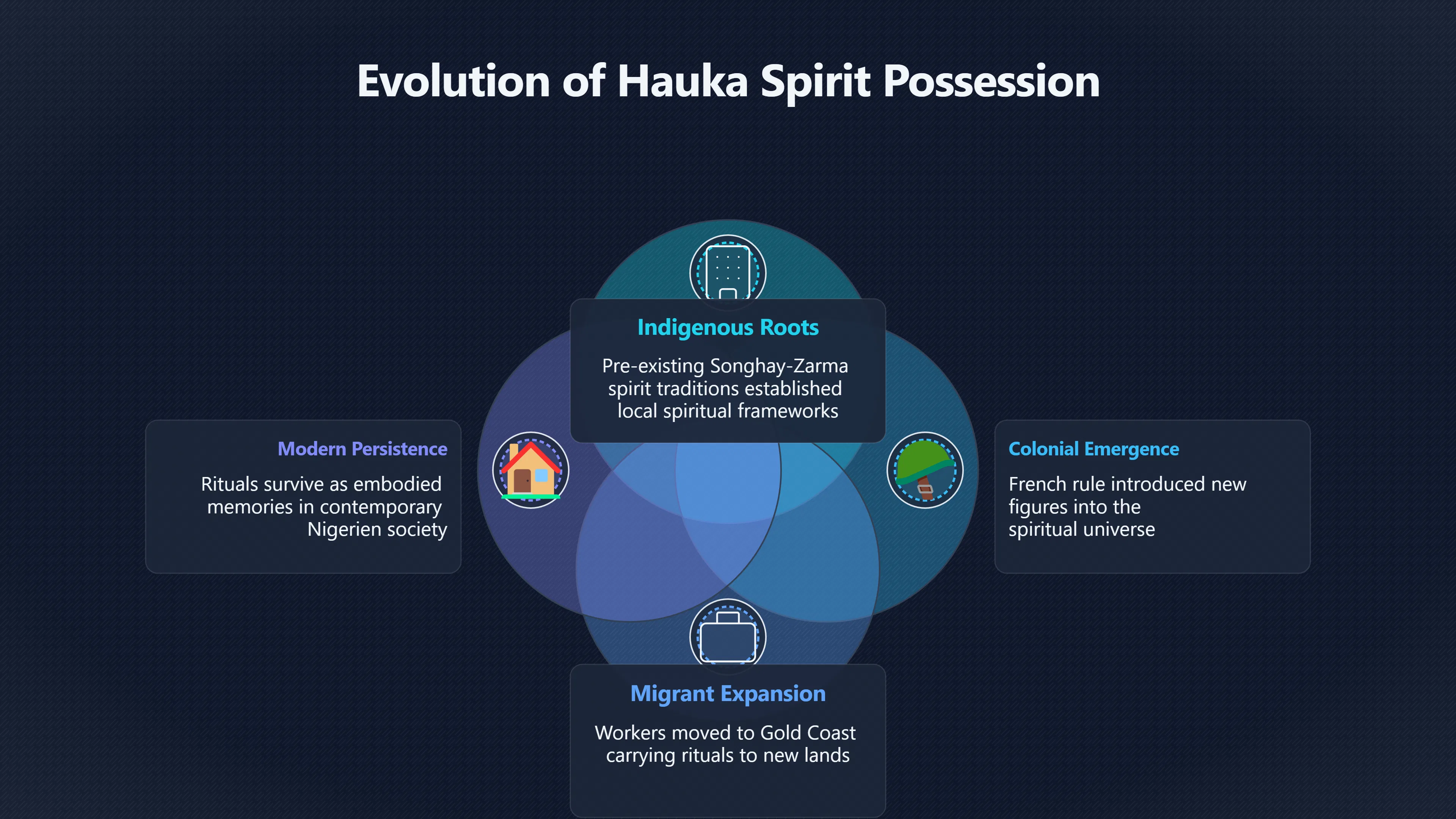
The Hauka did not appear in a cultural vacuum. Songhay-Zarma communities of western Niger had long traditions of spirit possession before the arrival of French colonial rule. These traditions involved relationships between humans and powerful spirit beings associated with landscapes, ancestors, historical memories and social forces. Possession ceremonies provided explanations for illness, misfortune and disruption while also creating spaces for healing and communal negotiation. The Hauka emerged from within this broader spiritual environment rather than replacing it.[africabib.org]africabib.orgspirit possession, power and the Hauka in West Africaby P Stoller · 1995 · Cited by 806 — The author uses the example of the Hau…
Most scholars place the emergence of the first Hauka mediums in the 1920s, after French colonial control in Niger had become firmly established. According to historical accounts reconstructed by anthropologists, the movement arose among Songhay-speaking communities who were experiencing profound changes brought by taxation, forced labour, military recruitment and colonial administration. New forms of authority entered daily life, often backed by violence and coercion. Hauka spirits embodied these forces in a form that could be ritually encountered.[academia.edu]academia.eduSpirit Possession, Power, and the Hauka in West AfricaSpirit Possession, Power, and the Hauka in West AfricaJanuary 1, 1998 — The study reveals that the Hauka movement emerged in the…
Migration played a crucial role in the spread of the movement. Large numbers of Songhay-Zarma workers travelled from Niger to other parts of West Africa in search of employment, especially to the British colony of the Gold Coast, present-day Ghana. There the migrants encountered new colonial systems, urban labour markets and unfamiliar social pressures. Hauka possession travelled with them, adapting to these new environments while retaining strong connections to Nigerien cultural traditions.[researchgate.net]researchgate.netSpirit Possession, Power, and the Absent Presence of IslamIt concerns the hauka spirit-possession cult of Songhay-Zerma migra…
This migrant context helps explain why Hauka spirits often reflected a wide range of colonial authorities rather than a single local official. The spirit world expanded to include soldiers, doctors, railway personnel, administrators and other representatives of modern state power. As colonial institutions became more visible in everyday life, they also became part of the symbolic universe of possession.[google.com]books.google.comIn this innovative book, Stoller argues that mimicry is about power. To copy something is to…Read more…
Why Colonial Officials Became Spirits
The most distinctive feature of the Hauka tradition is that colonial officials themselves became spirits.
In Hauka ceremonies, mediums entered trance states and took on the identities of powerful colonial figures. Participants might become possessed by a governor, military commander, doctor or policeman. The possessed medium often adopted characteristic gestures, postures, commands and speech patterns associated with these authorities. Rituals reproduced the atmosphere of military parades, inspections and bureaucratic discipline, but in exaggerated and often unsettling forms.[wcupa.edu]digitalcommons.wcupa.eductsmfaculty booksSpirit Possession, Power, and the Hauka in West Africaby P Stoller · 1995 · Cited by 806 — Embodying Colonial Memories is the first in-de…
To outside observers, this looked like mimicry. Yet scholars have repeatedly argued that simple imitation does not fully explain what was happening. Paul Stoller, whose work remains among the most influential studies of the Hauka, argues that mimicry was linked to power itself. By ritually reproducing colonial authority, participants attempted to grasp, redirect or domesticate its force. In this interpretation, copying was not passive submission but an effort to master something that had become overwhelmingly present in everyday life.[Google Books]books.google.comIn this innovative book, Stoller argues that mimicry is about power. To copy something is to…Read more…
The ceremonies often carried a strong element of parody. Colonial authority appeared exaggerated, theatrical and bodily. European power, usually presented as rational and disciplined, became emotional, excessive and vulnerable when performed through possession. This inversion allowed participants to explore the contradictions of colonial rule in ways that ordinary political speech could not.[wcupa.edu]digitalcommons.wcupa.eductsmfaculty booksSpirit Possession, Power, and the Hauka in West Africaby P Stoller · 1995 · Cited by 806 — Embodying Colonial Memories is the first in-de…
At the same time, many researchers caution against reducing Hauka practice to straightforward anti-colonial protest. James Ferguson and others have argued that mimicry could also express aspirations toward participation in colonial society. Colonial institutions were not merely feared; they could also represent prestige, employment and social advancement. Hauka rituals therefore reflected a complex mixture of attraction, anxiety, criticism and adaptation.[Wikipedia]WikipediaOpen source on wikipedia.org.
This ambiguity is one reason the Hauka remain so fascinating. The spirits embodied colonial power while simultaneously destabilising it. They transformed rulers into ritual characters and converted political domination into something that could be enacted within a local religious framework.[africabib.org]africabib.orgspirit possession, power and the Hauka in West Africaby P Stoller · 1995 · Cited by 806 — The author uses the example of the Hau…
How Possession Turned History into Memory
One reason Hauka traditions occupy such an important place in Songhay-Zarma memory is that they preserved experiences of colonialism in embodied form.
Historical memories are often recorded in documents, archives or written histories. Hauka rituals worked differently. Colonial encounters were remembered through movement, gesture, costume, trance and performance. The body itself became a repository of memory. Scholars have described this process as “embodied memory,” because historical experiences were not merely narrated but physically reenacted.[africabib.org]africabib.orgspirit possession, power and the Hauka in West Africaby P Stoller · 1995 · Cited by 806 — The author uses the example of the Hau…
This helps explain why Hauka ceremonies survived beyond the colonial era. Even after independence, the spirits continued to appear in some communities. Their persistence suggests that the rituals were never solely about particular colonial officials. They had become a broader way of thinking about authority, power and social change. In postcolonial Niger, Hauka practices sometimes adapted to new political realities while retaining memories of the colonial past.[africabib.org]africabib.orgspirit possession, power and the Hauka in West Africaby P Stoller · 1995 · Cited by 806 — The author uses the example of the Hau…
Anthropologists studying Hauka communities in later decades observed that the spirits continued to provide frameworks for discussing state power and social transformation. Colonial figures remained symbolically important because they represented a dramatic historical rupture that had reshaped local society.[Africabib]africabib.orgspirit possession, power and the Hauka in West Africaby P Stoller · 1995 · Cited by 806 — The author uses the example of the Hau…
Film, Scholarship and the Debate Over Representation
Public awareness of the Hauka outside West Africa was shaped largely by the French ethnographer and filmmaker Jean Rouch. His 1955 film Les maîtres fous (“The Mad Masters”) documented a Hauka possession ceremony among Songhay-Zarma migrants in the Gold Coast. The film became one of the most famous—and controversial—works in the history of ethnographic cinema.[wikipedia.org]WikipediaLes maîtres fousLes maîtres fous
Rouch presented the ritual as a response to the pressures of colonial life. The film showed participants entering trance, embodying colonial officials and performing dramatic possession rituals. For many viewers, it provided a rare glimpse into a cultural practice that challenged conventional distinctions between politics, religion and performance.[africanmedia.msu.edu]africanmedia.msu.eduMaitres Fous, Les (1955)22 Mar 2010 — Rouch regarded the cult as a means of coping with colonial life and did not present it in the relig…
The reaction was sharply divided. Colonial authorities were disturbed by the apparent mockery of European power. Some African intellectuals objected because they felt the film encouraged exotic stereotypes about Africans. Others defended it as an important record of a creative cultural response to colonial domination. The film was banned in some contexts and remains the subject of debate among anthropologists, historians and film scholars.[wikipedia.org]WikipediaLes maîtres fousLes maîtres fous
The controversy reveals a larger question that continues to surround the Hauka: how should outsiders interpret rituals that combine humour, fear, imitation, spirituality and political commentary? Different scholars have offered different answers. Some emphasise resistance, others adaptation, psychological coping, social critique or the pursuit of status within colonial systems. The persistence of these debates reflects the complexity of the tradition itself.[africanfilmny.org]africanfilmny.orgAfrican Film FestivalThe Poesis of Mimesis in Les Maîtres FousBy choosing not to relegate Hauka practice strictly to the realm of politic…
How the Hauka Are Remembered Today
The Hauka no longer occupy the public visibility they once possessed during the late colonial era, yet they remain a significant part of Niger’s cultural and intellectual history. Researchers note that some forms of Hauka practice survived into the twenty-first century, particularly in limited ritual settings, even as urbanisation, religious reform movements and changing social conditions reduced their prominence.[Wikipedia]WikipediaOpen source on wikipedia.org.
Today the Hauka are remembered less as a dominant religious movement than as a remarkable example of how communities transformed historical experience into ritual expression. In Songhay-Zarma memory, colonial power was not only something imposed from above. Through the language of spirits, possession and performance, it became something that could be interpreted, challenged, dramatised and incorporated into local understandings of the world.[africabib.org]africabib.orgspirit possession, power and the Hauka in West Africaby P Stoller · 1995 · Cited by 806 — The author uses the example of the Hau…
That is what makes the Hauka distinctive within Niger’s wider folklore landscape. The tradition did not simply tell stories about colonialism. It turned colonial authority itself into a cast of supernatural characters. By making governors, soldiers and officials into possessing spirits, Songhay-Zarma communities created one of the most original ritual responses to empire anywhere in Africa—a form of cultural memory in which history was not only remembered but performed.[google.com]books.google.comIn this innovative book, Stoller argues that mimicry is about power. To copy something is to…Read more…
Amazon book picks
Further Reading
Books and field guides related to How Did Hauka Spirits Mock Colonial Power?. Use these as the next step if you want deeper reading beyond the article.
The Colonizer and the Colonized
Directly informs interpretations of colonial power and resistance.
eBay marketplace picks
Marketplace Samples
Live-tested eBay searches with available results related to this page.

Endnotes
1.
Source: africabib.org
Link:https://www.africabib.org/rec.php?RID=124976263
Source snippet
spirit possession, power and the Hauka in West Africaby P Stoller · 1995 · Cited by 806 — The author uses the example of the Hau...
2.
Source: books.google.com
Link:https://books.google.com/books/about/Embodying_Colonial_Memories.html?id=KqOscLnNC10C
Source snippet
In this innovative book, Stoller argues that mimicry is about power. To copy something is to...Read more...
3.
Source: digitalcommons.wcupa.edu
Title: ctsmfaculty books
Link:https://digitalcommons.wcupa.edu/ctsmfaculty_books/29/
Source snippet
Spirit Possession, Power, and the Hauka in West Africaby P Stoller · 1995 · Cited by 806 — Embodying Colonial Memories is the first in-de...
4.
Source: researchgate.net
Link:https://www.researchgate.net/publication/227786666_Spirit_Possession_Power_and_the_Absent_Presence_of_Islam_Re-viewing_Les_Maitres_Fous
Source snippet
Spirit Possession, Power, and the Absent Presence of IslamIt concerns the hauka spirit-possession cult of Songhay-Zerma migra...
5.
Source: journals.openedition.org
Title: Open Edition Journals Ancestors from the East, Spirits from the West
Link:https://journals.openedition.org/africanistes/2323?lang=en
Source snippet
widespread phenomenon intersects interestingly with a cult of spirit possession like hawka, originating in the oral cul...
6.
Source: academia.edu
Title: Spirit Possession, Power, and the Hauka in West Africa
Link:https://www.academia.edu/114452192/Embodying_Colonial_Memories_Spirit_Possession_Power_and_the_Hauka_in_West_Africa
Source snippet
Spirit Possession, Power, and the Hauka in West AfricaJanuary 1, 1998 — The study reveals that the Hauka movement emerged in the...
Published: January 1, 1998
7.
Source: Wikipedia
Link:https://en.wikipedia.org/wiki/Hauka
8.
Source: Wikipedia
Title: Les maîtres fous
Link:https://en.wikipedia.org/wiki/Les_ma%C3%AEtres_fous
9.
Source: proquest.com
Link:https://www.proquest.com/scholarly-journals/embodying-colonial-memories-spirit-possession/docview/209758657/se-2
Source snippet
Embodying Colonial Memories: Spirit Possession,In examining the role of the Hauka (Songhay spirit mediums) in the political history of Ni...
10.
Source: api.pageplace.de
Link:https://api.pageplace.de/preview/DT0400.9781136652592_A24439317/preview-9781136652592_A24439317.pdf
Source snippet
MemoriesThe Hauka, Songhay spirits that mimic Nigerien colonial culture, "com- missioned" this book in Tillaberi, Niger in June of 1987...
11.
Source: Wikipedia
Title: Jean Rouch
Link:https://en.wikipedia.org/wiki/Jean_Rouch
12.
Source: africanmedia.msu.edu
Link:https://africanmedia.msu.edu/showfilm.php?id=19611
Source snippet
Maitres Fous, Les (1955)22 Mar 2010 — Rouch regarded the cult as a means of coping with colonial life and did not present it in the relig...
13.
Source: researchgate.net
Link:https://www.researchgate.net/publication/230331355_Embodying_Colonial_Memories_Spirit_Possession_Power_and_the_Hauka_In_West_Africa
Source snippet
Spirit Possession, Power, and the Hauka In West AfricaEmbodying Colonial Memories: Spirit Possession, Power, and the Hauka In West Africa...
14.
Source: journals.openedition.org
Link:https://journals.openedition.org/africanistes/2323
Source snippet
A Tidjani Alou · 2010 · Cited by 1 — For Stoller ((1995: 94) ”Hauka possession was - and of course is - much more than sp...
15.
Source: journals.openedition.org
Link:https://journals.openedition.org/etnografica/3517
Source snippet
Paul Stoller, Embodying Colonial Memories: Spirit Possession, Power and the Hauka in West Africa, Londres, Routledge, 1995.Read more...
16.
Source: taylorfrancis.com
Title: Taylor & Francis Embodying Colonial Memories
Link:https://www.taylorfrancis.com/books/mono/10.4324/9781315021669/embodying-colonial-memories-paul-stoller
Source snippet
The author considers spirit possession as a set...
17.
Source: thesis.eur.nl
Link:https://thesis.eur.nl/pub/54466
Source snippet
Erasmus University Thesis RepositoryAn Examinations of the Hauka Movement in its Colonial...by E Koenig · 2019 — This thesis examines th...
18.
Source: africanfilmny.org
Link:https://africanfilmny.org/articles/the-poesis-of-mimesis-in-les-maitres-fous-looking-back-at-the-conspiratorial-ethnography-of-jean-rouch/
Source snippet
African Film FestivalThe Poesis of Mimesis in Les Maîtres FousBy choosing not to relegate Hauka practice strictly to the realm of politic...
Additional References
19.
Source: freiburger-filmforum.de
Link:https://www.freiburger-filmforum.de/program/les-maitres-fous/
Source snippet
Les Maîtres FousIn diesem Film, einem der bedeutendsten von Jean Rouch, steht ein Ritual im Mittelpunkt das in der Kolonialzeit im heutig...
20.
Source: swiki.hfbk-hamburg.de
Link:https://swiki.hfbk-hamburg.de/Lebensreform/39.version?id=4
Source snippet
Rouch: Les Maitres Fous (Version 4)As Jean Rouch says of the Hauka possession ceremonies, "ce jeu violent n'est que le reflet de notre ci...
21.
Source: persee.fr
Title: Persée Paul Stoller, Embodying Colonial Memories
Link:https://www.persee.fr/doc/hom_0439-4216_1999_num_39_149_453537
Source snippet
JP Olivier de Sardan · 1999 — Embodying Colonial Memories. Spirit Possession, Power and the Hauka in West Africa... An Ethn...
22.
Source: amazon.com.be
Link:https://www.amazon.com.be/-/en/Paul-Stoller/dp/0415908779?tag=searcht-20
Source snippet
Possession, Power, and the Hauka in West Africa...A study of the West African Hauka - spirits that grotesquely mimic and mock "Europeans...
23.
Source: youtube.com
Title: Jean Rouch and His Camera in the Heart of Africa
Link:https://www.youtube.com/watch?v=3jzAegaqqf4
Source snippet
Jean Rouch Les maîtres fous Claire Simon à propos des Maîtres fous de Jean Rouch LaCinetek...
24.
Source: youtube.com
Title: Bori Niger, spirit possession ceremonies in Hausa land
Link:https://www.youtube.com/watch?v=uCL2VuMMPHA
Source snippet
Jean Rouch and His Camera in the Heart of Africa - PREVIEW...
25.
Source: imdb.com
Link:https://www.imdb.com/title/tt0048363/
Source snippet
The Mad Masters (Short 1955)A documentary short depicting a Hauka ceremony where young workers are possessed by British colonial officers...
26.
Source: thesis.eur.nl
Title: Koenig E
Link:https://thesis.eur.nl/pub/54466/Koenig-E.-.pdf
Source snippet
Power and Futility of Resistanceby E Koenig · 2019 — Academic works concerning mimicry, spirit possession, colonial resistance and embodi...
27.
Source: go.gale.com
Link:https://go.gale.com/ps/i.do?id=GALE%7CA155837673&issn=13590987&it=r&linkaccess=abs&p=AONE&sid=googleScholar&sw=w&v=2.1
Source snippet
possession, power, and the absent presence of Islam: re-...It concerns the hauka spirit-possession cult of Songhay-Zerma migrants from t...
28.
Source: youtube.com
Title: Holey en milieu Songhay
Link:https://www.youtube.com/watch?v=8mD79uEvkec
Source snippet
Bori Niger, spirit possession ceremonies in Hausa land...
Topic Tree