Where Samoa's Stories Live in the Land
Samoa’s folklore is not a single book of myths but a living story-world carried through family memory, chiefly genealogy, landscape, performance, tattooing, church history, tourism, and modern Pacific media.
Page outline Jump by section
What makes Samoan folklore distinctive?
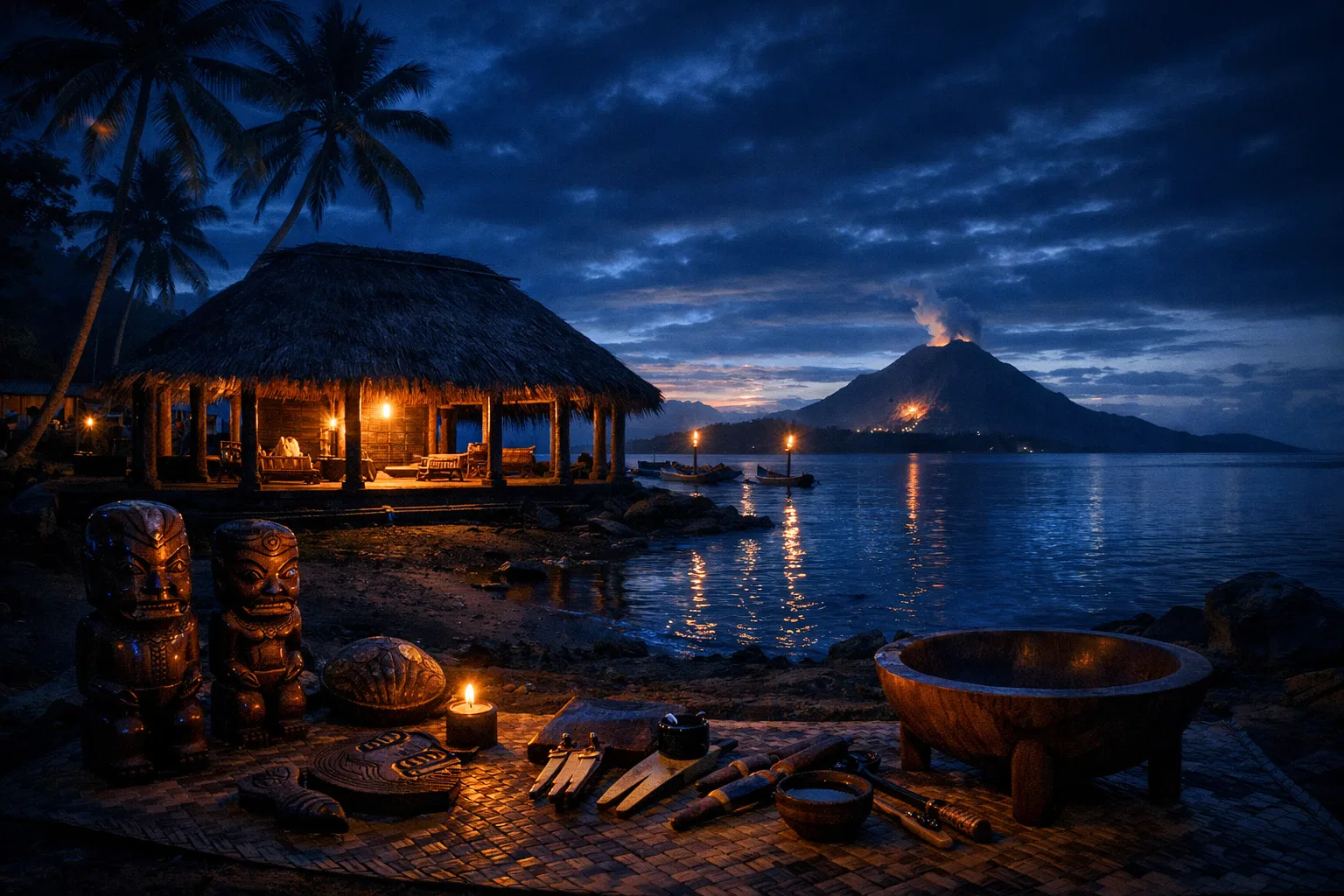
Samoan folklore is deeply tied to place. A spring pool, a beach, a village, a lava outcrop, a tattooing lineage, or a chiefly title may carry a story that is still meaningful because it explains why that place or title matters. Scholarly work on Samoan oral tradition stresses that ancient stories are not just decorative tales; they are part of how Samoan communities understand land, belonging, memory, and social obligation.[ResearchGate]researchgate.netResearch Gate(PDF) Oral Traditions, Cultural Significance of StorytellingResearch Gate(PDF) Oral Traditions, Cultural Significance of Storytelling
That makes Samoa different from a mythology tradition encountered only as literature. Many stories live in named localities. Falealupo, at the western end of Savai‘i, is associated with Nafanua and with an entrance to Pulotu, the spirit world. Matavai in Safune is associated with Sina and the Eel through the freshwater pool commonly linked to the tale. To read Samoan folklore well, a visitor has to notice that the landscape is often part of the evidence: the story is attached to a known place, recited in family or village memory, and sometimes turned into a cultural or visitor site.[wikipedia.org]WikipediaOpen source on wikipedia.org.
Samoa also has a strong tradition of oral storytelling. The storytelling practice often called fāgogo is described in recent educational and cultural writing as a way families pass on traditional knowledge, moral instruction, history, humour, and language. One academic article on Samoan pedagogy describes it as flowing from a wider oral literature “reservoir” of genealogies, songs, traditions, and stories, while a recent ABC Pacific feature presents it as a continuing method used by families and educators rather than a vanished custom.[ABC News]abc.net.auABC News Samoan storytelling method Fāgogo passes on traditionalABC News Samoan storytelling method Fāgogo passes on traditional
The creation stories: Tagaloa, islands, and human origins
One of the central figures in Samoan mythology is Tagaloa, commonly presented as a high creator deity. A National Park Service account of a Samoan creation legend describes Tagaloa creating islands and then transforming lifeless worms from decaying vine leaves into human beings. In that version, the geography of the Samoan archipelago is part of the mythic act: Savai‘i, Manu‘a, Tutuila and other places are not neutral scenery but stages in the making of the world.[National Park Service]nps.govOpen source on nps.gov.
Older European missionary and ethnographic sources, such as George Turner’s nineteenth-century Samoa, A Hundred Years Ago and Long Before, remain important because they recorded many traditions early in written form. They also need careful handling. Turner was a missionary writing from within a Christian and colonial-era framework, so his work is useful as an early source but not a transparent window into pre-Christian Samoa. Modern researchers and cultural projects generally read such accounts alongside oral testimony, local knowledge, later Samoan publications, and heritage collections.[Project Gutenberg]gutenberg.orgOpen source on gutenberg.org.
The creation stories are not simply “how the world began” narratives. They also place Samoa within a wider Polynesian world. Samoa’s myths share figures, patterns, and motifs with other Polynesian traditions, but the Samoan versions give local importance to Samoan islands, chiefs, spirit places, and genealogical relationships. This is one reason broad Polynesian comparison is useful, but only up to a point: the most meaningful details often sit in the local Samoan version.[Samoa Travel]samoa.travelOpen source on samoa.travel.
Nafanua: warrior, guardian, and political memory
Nafanua is one of the most powerful figures in Samoan legendary tradition. The National Park Service tells her story as that of a formidable warrior associated with Savai‘i, angered by the humiliation of her uncle during conflict and drawn into the struggle against oppression. In many retellings, she is both terrifying and protective: a war figure whose violence is framed as a means of ending disorder and restoring balance.[National Park Service]nps.govOpen source on nps.gov.
Her home is usually associated with Falealupo on Savai‘i. That link matters because Falealupo is also connected with Pulotu, the spirit world, and with stories about chiefs seeking Nafanua’s blessing before military action. The same cluster of traditions helps explain why Nafanua is not just a “war goddess” in a simple fantasy sense. She belongs to a landscape of chiefly authority, sacred place, conflict, prophecy, and the transition between old religion and Christianity.[Wikipedia]WikipediaOpen source on wikipedia.org.
One of the most striking Nafanua traditions concerns prophecy. A later Christianised interpretation holds that she foretold a heavenly crown or coming power, which some Samoan accounts connect to the arrival of Christianity and to Malietoa’s acceptance of the new faith. Historians are more cautious than devotional retellings: research on John Williams and Malietoa argues that the usual story of Samoa’s conversion is more complicated than a single dramatic encounter in 1830, and that Christianity was already present in some form before Williams’ famous arrival.[sadil.ws]sadil.wsSamoa Digital Library Malietoa, Williams and Samoa's Embrace of ChristianitySamoa Digital Library Malietoa, Williams and Samoa's Embrace of Christianity
That tension is important. Folklore here is not “false history”; it is cultural memory shaped by later events. Nafanua’s prophecy tradition helped Samoans interpret the arrival of Christianity through an older sacred framework, making the new religion intelligible within existing ideas of chiefly power, divine signs, and national destiny.
Sina and the Eel: why a coconut has a face
The best-known Samoan tale for many outsiders is Sina and the Eel. In a National Park Service version, Sina is a beautiful Samoan girl whose fame reaches the Tui Fiti, the King of Fiji. He changes into an eel, travels to Samoa, becomes attached to Sina, and eventually asks her to bury his head. From it grows the first coconut tree. The “face” on the coconut then becomes a reminder of the eel, and drinking from the coconut becomes part of the tale’s emotional logic.[National Park Service]nps.govNational Park Service Sina and Her EelNational Park Service Sina and Her Eel
The tale is memorable because it explains an everyday object through a strange, intimate story. It is an origin myth for the coconut, but it is also a story about desire, transformation, pursuit, pity, death, and renewal. It shows how a useful plant can be given a social and emotional biography: the coconut is not merely food, drink, oil, fibre, and building material, but a gift with a story attached.[Wikipedia]WikipediaSina and the EelSina and the Eel
The story also has regional variants. Versions of a woman and an eel or divine lover appear across parts of Polynesia, with local names and details changing from island to island. That variation is not a flaw. It is how oral tradition works: a tale travels, settles into local geography, and takes on new accents. In Samoa, one important place associated with the story is the Mata o le Alelo pool at Matavai in Safune, Savai‘i, which is presented in several sources as a physical landmark connected to the legend.[Wikipedia]WikipediaSina and the EelSina and the Eel
The story has also entered modern popular culture. Disney’s Moana drew loosely on Polynesian motifs, and commentators have noted echoes of the coconut-origin story in the film’s Maui sequence, though the film is a broad fictional synthesis rather than a faithful Samoan retelling. That distinction matters: modern media can renew curiosity, but it can also blur local traditions into a generalised “Polynesian mythology” if viewers do not look back to specific Samoan versions.[Wikipedia]WikipediaSina and the EelSina and the Eel
Aitu, Teine Sā, and the continuing life of spirit belief
Samoan supernatural tradition includes aitu, spirit beings often translated in English as ghosts, spirits, or sometimes demons, though no single English word captures the range. A National Park Service page on To‘aga in American Samoa notes that many Samoans tell serious stories of frightening encounters with aitu, and that local warnings about places such as To‘aga beach after sundown or at high noon were respected during park studies.[National Park Service]nps.govNational Park Service The To'aga AituNational Park Service The To'aga Aitu
Academic work from the 1970s also records that aitu beliefs persisted in both Samoas, with particular strength in Western Samoa at the time of study. More recent personal essays and Pacific cultural writing show that such beliefs have not simply disappeared, although they are now often discussed alongside Christianity, migration, modern schooling, and changing family life.[JSTOR]jstor.orgOpen source on jstor.org.
Among the most vivid spirit traditions are the Teine Sā, often described as sacred or dangerous female spirits. Contemporary Samoan writers discuss them as beings who move between human and spiritual worlds, linked to warnings about beauty, hair, night travel, respect, and women’s conduct. Online retellings vary in reliability, so the safest reading is not to treat every dramatic detail as ancient fact. What is well attested is the broader pattern: Samoan families and communities have used spirit stories to mark danger, enforce social boundaries, explain sickness or misfortune, and remind people that some places and behaviours require respect.[E-Tangata]e-tangata.co.nzteine sa the feminist icons of samoateine sa the feminist icons of samoa
These stories are sometimes compared with fairy or ghost traditions elsewhere, but the comparison can mislead. Aitu are not merely “Samoan ghosts” in a Halloween sense. They belong to a world in which ancestry, place, sickness, morality, and sacred power overlap. Even when people tell the stories playfully or sceptically today, the emotional force often comes from the possibility that the old warnings still matter.
Tattoo legends: Taema, Tilafaiga, and sacred marks on the body
Samoan tattooing is one of the places where folklore, body art, social rank, endurance, and cultural identity meet. The widely told origin legend says that the sisters Taema and Tilafaiga brought tattooing to Samoa from Fiji, carrying the tools and singing that women should be tattooed. As they neared Samoa, the words were reversed, explaining why the male tattoo became so culturally prominent in Samoa.[National Park Service]nps.govNational Park Service Samoan Art in the Tatau (TattooNational Park Service Samoan Art in the Tatau (Tattoo
The story has many versions. Some accounts say the sisters dived for a clam and came up singing the reversed instruction; others stress their divine or semi-divine status, their connection to Fiji, or Tilafaiga’s later link to Nafanua. The Australian Museum’s account notes that when the twins returned, Tilafaiga became associated with war while Taema became a tattooist and teacher of the art.[The Australian Museum]australian.museumThe Australian Museum The Meaning of Ta TauThe Australian Museum The Meaning of Ta Tau
The legend matters because Samoan tattooing is not simply decorative. The National Park Service describes the tatau as carrying meanings of community, power, status, respect, honour, and pride, and warns that using the designs without cultural connection can be disrespectful. Recent journalism has also highlighted the role of women in the practice’s revival and interpretation, showing that the old origin story continues to shape present debates about gender, authority, and cultural transmission.[National Park Service]nps.govNational Park Service Samoan Art in the Tatau (TattooNational Park Service Samoan Art in the Tatau (Tattoo
For readers new to Samoa, this is one of the clearest examples of folklore as living heritage. A myth explains where an art came from; the art marks real bodies; the marked body carries family and community meaning; and modern Samoans continue to argue, renew, protect, and reinterpret the tradition.
Sacred and story-rich places
Many Samoan stories are inseparable from named places. Falealupo is one of the richest examples, associated with Nafanua, Pulotu, tattooing traditions, and other legendary material. The Fafā-o-Sauali‘i rocks at the far end of the peninsula are described in legend as an entrance to the underworld, where spirits of the dead reside.[Wikipedia]WikipediaOpen source on wikipedia.org.
Safune’s Mata o le Alelo pool is another example: a physical site linked to Sina and the Eel, now also part of the visitor map of Samoan legend. Such places are not merely tourist curiosities. They show how story can protect memory by fixing it to a spring, reef, stone, beach, or village boundary.[Wikipedia]WikipediaSina and the EelSina and the Eel
Samoa’s official visitor material also makes this connection between story and place. It presents myths, legends, historic sites, artefacts, museums, archaeological places, dance, music, craft, and tattooing as interwoven ways of encountering Samoan culture. That public framing is modern and visitor-facing, but it reflects a deeper truth: Samoan folklore has always travelled through more than words.[Samoa Travel]samoa.travelOpen source on samoa.travel.
How Christianity changed the older story-world
Samoa today is overwhelmingly Christian, and Christianity has shaped public life, family practice, and interpretations of older stories. The usual historical shorthand says that John Williams of the London Missionary Society brought Christianity to Samoa in 1830, but historians have complicated that account by pointing out earlier contact, local agency, and the limited time Williams himself spent in Samoa.[openedition.org]books.openedition.orgOpen source on openedition.org.
For folklore, the key point is not that Christianity simply erased older beliefs. Some deities and ritual systems were rejected or reinterpreted, but many stories survived as legends, family histories, place traditions, moral tales, children’s stories, tourist narratives, literature, and cultural identity markers. Nafanua’s prophecy is a prime example: an older sacred figure becomes part of a Christian national memory rather than disappearing from it.[Samoan Mythology]samoanmythology.netSamoan Mythology TS Nafanuas ProphecySamoan Mythology TS Nafanuas Prophecy
Aitu beliefs show a different kind of survival. Many Samoans are Christian and still know stories of spirits, warnings, haunted places, or sickness explained through spiritual encounter. That does not mean every Samoan believes the same thing, or that old religion continues unchanged. It means the supernatural imagination has adapted, sometimes living quietly inside family cautionary tales, night-time warnings, and local explanations of unusual events.[National Park Service]nps.govNational Park Service The To'aga AituNational Park Service The To'aga Aitu
How reliable are the sources?
Samoan folklore is well attested, but unevenly recorded. Some material comes from early missionaries such as George Turner, whose accounts are valuable but shaped by nineteenth-century assumptions. Some comes from academic work on oral tradition, religion, place, and education. Some comes from official heritage, tourism, museum, and National Park Service pages. Some comes from contemporary Samoan writers, performers, and digital storytellers. The strongest reading uses these sources together rather than allowing one type to dominate.[gutenberg.org]gutenberg.orgOpen source on gutenberg.org.
There are also active efforts to preserve oral traditions in print and digital form. Library records for Samoa Ne‘i Galo describe it as a compilation of oral traditions and legends of Samoa, and a 2023 bookseller catalogue lists later volumes published by Samoa’s Ministry of Education, Sports and Culture with subject headings including legends, folklore, and oral tradition.[HathiTrust]catalog.hathitrust.orgOpen source on hathitrust.org.
A useful rule for readers is to ask what kind of retelling they are looking at. A village elder’s account, a missionary book, a museum label, a tourist page, a children’s animation, a diaspora blog, and a television fantasy series may all preserve something, but they do not have the same purpose. Old oral tradition, Christianised interpretation, cultural heritage work, commercial tourism, and modern creative adaptation can overlap in the same story.
Samoa’s folklore today
Samoan folklore today lives in several places at once. It is in family storytelling, school projects, tattooing practice, church-inflected memory, heritage publishing, village landscapes, tourist interpretation, Pacific literature, and digital media. The Digital Fāgogo Collective, for example, describes its mission as preserving and sharing Samoan tales, fables, and history in English for the Samoan diaspora, while newer animation projects use modern formats to keep oral storytelling accessible to younger audiences.[The Digital Fāgogo Collective]fagogo.orgOpen source on fagogo.org.
Modern reinterpretation can be powerful when it keeps the local texture. Stories such as Sina and the Eel, Nafanua, Taema and Tilafaiga, and the Teine Sā remain compelling because they answer recognisable human questions: where did this food come from, why does this place feel sacred, what makes a leader legitimate, what do bodies carry, why do some warnings survive, and how does a Christian society remember older gods and spirits?
The most honest way to approach Samoan folklore is therefore neither as fantasy nor as fossil. It is a living cultural archive: old in roots, varied in telling, reshaped by Christianity and migration, and still attached to the places, names, bodies, and family memories that give Samoa’s stories their force.

Amazon book picks
Further Reading
Books and field guides related to Where Samoa's Stories Live in the Land. Use these as the next step if you want deeper reading beyond the article.
The Oxford Companion to World Mythology
Places Samoan traditions within global mythology.
Tales of the Tikongs
Offers insight into Pacific storytelling traditions and cultural identity.
eBay marketplace picks
Marketplace Samples
Live-tested eBay searches with available results related to this page.

Endnotes
1.
Source: samoa.travel
Link:https://www.samoa.travel/discover/our-culture/our-stories/
2.
Source: samoa.travel
Link:https://www.samoa.travel/discover/our-culture/
3.
Source: researchgate.net
Title: Research Gate(PDF) Oral Traditions, Cultural Significance of Storytelling
Link:https://www.researchgate.net/publication/342222568_Oral_Traditions_Cultural_Significance_of_Storytelling_and_Samoan_Understandings_of_Place_or_Fanua
4.
Source: Wikipedia
Link:https://en.wikipedia.org/wiki/Nafanua
5.
Source: Wikipedia
Link:https://en.wikipedia.org/wiki/Falealupo
6.
Source: gutenberg.org
Link:https://www.gutenberg.org/ebooks/14224
7.
Source: samoa.travel
Link:https://www.samoa.travel/discover/our-history/early-samoa/
8.
Source: pulotu.com
Title: Culture Samoa
Link:https://pulotu.com/culture/samoan
9.
Source: books.openedition.org
Link:https://books.openedition.org/pacific/126?lang=en
10.
Source: Wikipedia
Title: Sina and the Eel
Link:https://en.wikipedia.org/wiki/Sina_and_the_Eel
11.
Source: jstor.org
Link:https://www.jstor.org/stable/20704808
12.
Source: australian.museum
Title: The Australian Museum The Meaning of Ta Tau
Link:https://australian.museum/about/history/exhibitions/body-art/the-meaning-of-ta-tau-samoan-tattoing/
13.
Source: Wikipedia
Link:https://en.wikipedia.org/wiki/Veiqia
14.
Source: catalog.hathitrust.org
Link:https://catalog.hathitrust.org/Record/102268826
15.
Source: researchgate.net
Link:https://www.researchgate.net/publication/376669974_Fagogo-A_Literary_Cultural_Perspective
16.
Source: researchgate.net
Link:https://www.researchgate.net/publication/233466481_Malietoa_Williams_and_Samoa%27s_Embrace_of_Christianity
17.
Source: Wikipedia
Title: Samoan mythology
Link:https://en.wikipedia.org/wiki/Samoan_mythology
18.
Source: Wikipedia
Link:https://en.wikipedia.org/wiki/Tilafaiga
19.
Source: Wikipedia
Title: John Williams (missionary)
Link:https://en.wikipedia.org/wiki/John_Williams_%28missionary%29
20.
Source: digitalcollections.sit.edu
Title: Sammy. Myths and Legends 1
Link:https://digitalcollections.sit.edu/context/isp_collection/article/2085/viewcontent/Sammy.Myths_and_Legends_1.pdf
21.
Source: digitalcollections.sit.edu
Title: isp collection
Link:https://digitalcollections.sit.edu/isp_collection/1057/
22.
Source: digitalcollections.sit.edu
Link:https://digitalcollections.sit.edu/cgi/viewcontent.cgi?article=2508&context=isp_collection
23.
Source: archive.org
Link:https://archive.org/details/samoaahundredye00turngoog
24.
Source: jstor.org
Link:https://www.jstor.org/stable/20702025
25.
Source: jstor.org
Link:https://www.jstor.org/stable/40346686
26.
Source: jstor.org
Link:https://www.jstor.org/stable/community.34589856
27.
Source: catalog.hathitrust.org
Link:https://catalog.hathitrust.org/Record/003023320
28.
Source: nps.gov
Title: National Park Service Sina and Her Eel
Link:https://www.nps.gov/npsa/learn/historyculture/sinatuna.htm
29.
Source: abc.net.au
Title: ABC News Samoan storytelling method Fāgogo passes on traditional
Link:https://www.abc.net.au/pacific/programs/pacific-prepared/learning-traditional-knowledge/103056094
30.
Source: sadil.ws
Link:https://sadil.ws/bitstream/handle/123456789/2790/111.pdf?sequence=1
31.
Source: nps.gov
Link:https://www.nps.gov/npsa/learn/historyculture/legendpo.htm
32.
Source: ehrafworldcultures.yale.edu
Link:https://ehrafworldcultures.yale.edu/cultures/ou08/documents/016
33.
Source: nps.gov
Link:https://www.nps.gov/npsa/learn/historyculture/nafanua.htm
34.
Source: sadil.ws
Title: Samoa Digital Library Malietoa, Williams and Samoa’s Embrace of Christianity
Link:https://sadil.ws/bitstream/handle/123456789/1617/Malietoa%2C%20Williams%20and%20Samoa%E2%80%99s%20Embrace%20of%20Christianity..pdf?isAllowed=y&sequence=1
35.
Source: tandfonline.com
Link:https://www.tandfonline.com/doi/abs/10.1080/00223340902900761
36.
Source: nps.gov
Title: National Park Service The To’aga Aitu
Link:https://www.nps.gov/npsa/learn/historyculture/toagaaitu.htm
37.
Source: e-tangata.co.nz
Title: teine sa the feminist icons of samoa
Link:https://e-tangata.co.nz/reflections/teine-sa-the-feminist-icons-of-samoa/
38.
Source: nps.gov
Title: National Park Service Samoan Art in the Tatau (Tattoo)
Link:https://www.nps.gov/teachers/classrooms/samoan-art-in-the-tatau-tattoo.htm
39.
Source: samoanmythology.org
Title: Taema and Tilafaiga: the Twins
Link:https://samoanmythology.org/ta-taema/
40.
Source: abc.net.au
Title: tatau ancient artform samoa pacific tattooing women revival au
Link:https://www.abc.net.au/pacific/tatau-ancient-artform-samoa-pacific-tattooing-women-revival-au/103669512
41.
Source: samoanmythology.net
Title: Samoan Mythology TS Nafanuas Prophecy
Link:https://samoanmythology.net/ts-nafanuas-prophecy/
42.
Source: fagogo.org
Link:https://www.fagogo.org/
43.
Source: books.google.com
Title: Sina and the Eel
Link:https://books.google.com/books/about/Sina_and_the_Eel.html?id=D3QMvgAACAAJ
44.
Source: samoanmythology.org
Link:https://samoanmythology.org/
45.
Source: samoanmythology.org
Title: The Creation
Link:https://samoanmythology.org/ts-the_creation/
46.
Source: sadil.ws
Link:https://sadil.ws/handle/123456789/361
47.
Source: sadil.ws
Link:https://sadil.ws/bitstream/handle/123456789/869/A-view-from-the-West-Samoa-in-the-Culture-History-of-Uvea-_Wallis_-and-Futuna-_West-Polynesia_.pdf?sequence=1
48.
Source: thecoconet.tv
Link:https://www.thecoconet.tv/coco-talanoa/entertainment/fagogo-aitu-and-teine-sa/
49.
Source: thecoconet.tv
Title: Teine Sā
Link:https://www.thecoconet.tv/im%3A23351/all-videos/
50.
Source: religion.fandom.com
Title: Sina and the Eel
Link:https://religion.fandom.com/wiki/Sina_and_the_Eel
51.
Source: somedayfaraway.com
Link:https://somedayfaraway.com/samoa/
52.
Source: samoanmythology.net
Link:https://samoanmythology.net/
53.
Source: nla.gov.au
Link:https://nla.gov.au/nla.cat-vn2376643
54.
Source: catalogue.nla.gov.au
Link:https://catalogue.nla.gov.au/catalog/1988495
55.
Source: samoalawreform.gov.ws
Link:https://www.samoalawreform.gov.ws/wp-content/uploads/2023/10/Final-Report-Eng-12.pdf
Additional References
56.
Source: youtube.com
Title: Piecing together the myth of the SAMOAN God TAGALOA in 4.52 minutes!
Link:https://www.youtube.com/watch?v=Yu2rZk_BWNk
Source snippet
The Legend of Sina and Tuna - beautiful animation...
57.
Source: youtube.com
Title: Women of Power
Link:https://www.youtube.com/watch?v=ciuAo9mPe4Y
Source snippet
Piecing together the myth of the SAMOAN God TAGALOA in 4.52 minutes...
58.
Source: facebook.com
Link:https://www.facebook.com/groups/725919078266734/posts/1153287542196550/
59.
Source: nus.edu.ws
Link:https://nus.edu.ws/wp-content/uploads/2025/03/Chapter-4-2.pdf
60.
Source: samoatourism.org
Link:https://www.samoatourism.org/articles/136/culture-heritage
61.
Source: facebook.com
Link:https://www.facebook.com/SamoaTourismAuthority/posts/discover-the-story-behind-one-of-samoas-most-mysterious-and-legendary-cultural-s/1463099779195749/
62.
Source: facebook.com
Link:https://www.facebook.com/groups/725919078266734/posts/870614490463858/
63.
Source: academia.edu
Link:https://www.academia.edu/43297003/Eve_the_Serpent_and_a_Samoan_Love_Story_A_F%C4%81gogo_Reading_of_Genesis_3_1_19_and_Its_Implications_for_Animal_Studies_Books_and_Culture
64.
Source: facebook.com
Link:https://www.facebook.com/FreshTV2/posts/find-out-more-about-the-background-of-samoas-famous-aitu-the-teine-sa-and-unders/4414793771881591/
65.
Source: facebook.com
Link:https://www.facebook.com/savalinews/posts/keeping-samoas-oral-traditions-and-legends-alive-by-jasmine-netzler-iose-a-doubl/997558145209360/
Topic Tree
Follow this branch
Related pages 192
- Afghan Folklore
- Albanian Folklore
- Algerian Folklore
- Australian Folklore
- Azerbaijan Folklore
- +187 more in sidebar