Living Folklore of Benin
Benin’s folklore is best understood as a living web of story, ritual, place and public performance rather than a shelf of old myths.
Page outline Jump by section
Why Benin is so closely associated with Vodun
For many outsiders, Benin is “the home of voodoo”, but that phrase can mislead as much as it helps. Vodun is not a single horror-movie idea about dolls or curses. In Benin, it is a broad religious and cultural world of deities, ancestors, rituals, divination, music, dance, healing, social obligations and sacred places. UNESCO’s current heritage material describes Vodun as a West African tradition that combines beliefs in deities, social practices through rituals and a way of life; it also notes that deities are often organised around natural elements such as water, earth, air and fire, with ancestors occupying a central place in relations between the living and the dead.[Intangible Cultural Heritage]ich.unesco.orgIntangible Cultural Heritage BeninIntangible Cultural Heritage Benin
This is why Benin’s folklore cannot be separated neatly from religion. A forest may be a place of biodiversity, a ritual site, a historical memory and a legend all at once. A mask may be performance art to one viewer, a protective presence to another and a marker of community authority to a third. Smithsonian Folklife researchers working on Benin have stressed that Vodun-related knowledge often involves secrecy and restricted instruction: herbal medicine, dance, language and ritual knowledge may be learned through years of initiation rather than published in public handbooks.[Smithsonian Folklife Festival]festival.si.edunavigating secrets and the senses in beninnavigating secrets and the senses in benin
Modern statistics also need careful handling. The most recent census figures cited by the US State Department come from 2013 and list 11.6 per cent of the population as Vodun adherents, alongside larger Christian and Muslim communities; other sources note that many Beninese people combine Christian, Muslim and traditional practices in family and local life, so formal affiliation can understate Vodun’s wider cultural reach.[State.gov]state.govOpen source on state.gov.
The main stories and beings readers should know
Benin’s legendary landscape is not built around one national monster or one written epic. It is more like a set of overlapping local worlds: Fon and Yoruba traditions in the south and centre, Ogu and related masked traditions around Porto-Novo and the coast, palace memory in Abomey, and other regional traditions across the country. The best-attested themes are spirits, ancestors, animals, sacred trees, serpents, witches, diviners, royal founders and masked beings who police the boundary between the human and unseen worlds.
A useful starting point is the Fon-Dahomean creation world associated with Mawu-Lisa, often described in accessible mythology sources as a paired or dual creator figure linked with complementary cosmic forces. Popular retellings sometimes simplify the tradition into a single creation myth, but the wider religious setting is more complex: deities, ancestors and ritual specialists form an active social world, and stories change across communities and across the Fon, Yoruba and wider West African religious landscape.[Mythopedia]mythopedia.commawu lisamawu lisa
Fa divination is another central tradition. Smithsonian Folklife describes Fa, also known as Ifa in related regional systems, as a key component of Vodun practice in Benin, particularly associated with Fon and Yoruba communities. It is not simply fortune-telling in the casual sense. In practice, it can be a way of diagnosing disorder, choosing ritual action, interpreting destiny and restoring balance between a person, family, ancestors and deities. A recent scholarly article on Fa in Benin argues that its value is not only “knowledge” of hidden things but the pursuit of well-being, social balance and what practitioners may understand as a cooler, better life.[Smithsonian Institution]si.eduOpen source on si.edu.
Animal tales remain important too. Reporting on storytelling projects in Benin describes a rich oral seam of spirits, talking animals, magical beings, kings, queens, heroes, villains and witches, traditionally passed on by travelling storytellers and elders. These tales are not always tied to formal religious ceremonies; many work like moral fables, warnings, comic reversals or explanations for ordinary rules, such as why children are told not to whistle at night.[Vanguard News]vanguardngr.comOpen source on vanguardngr.com.

Zangbeto, Gelede and the power of masks
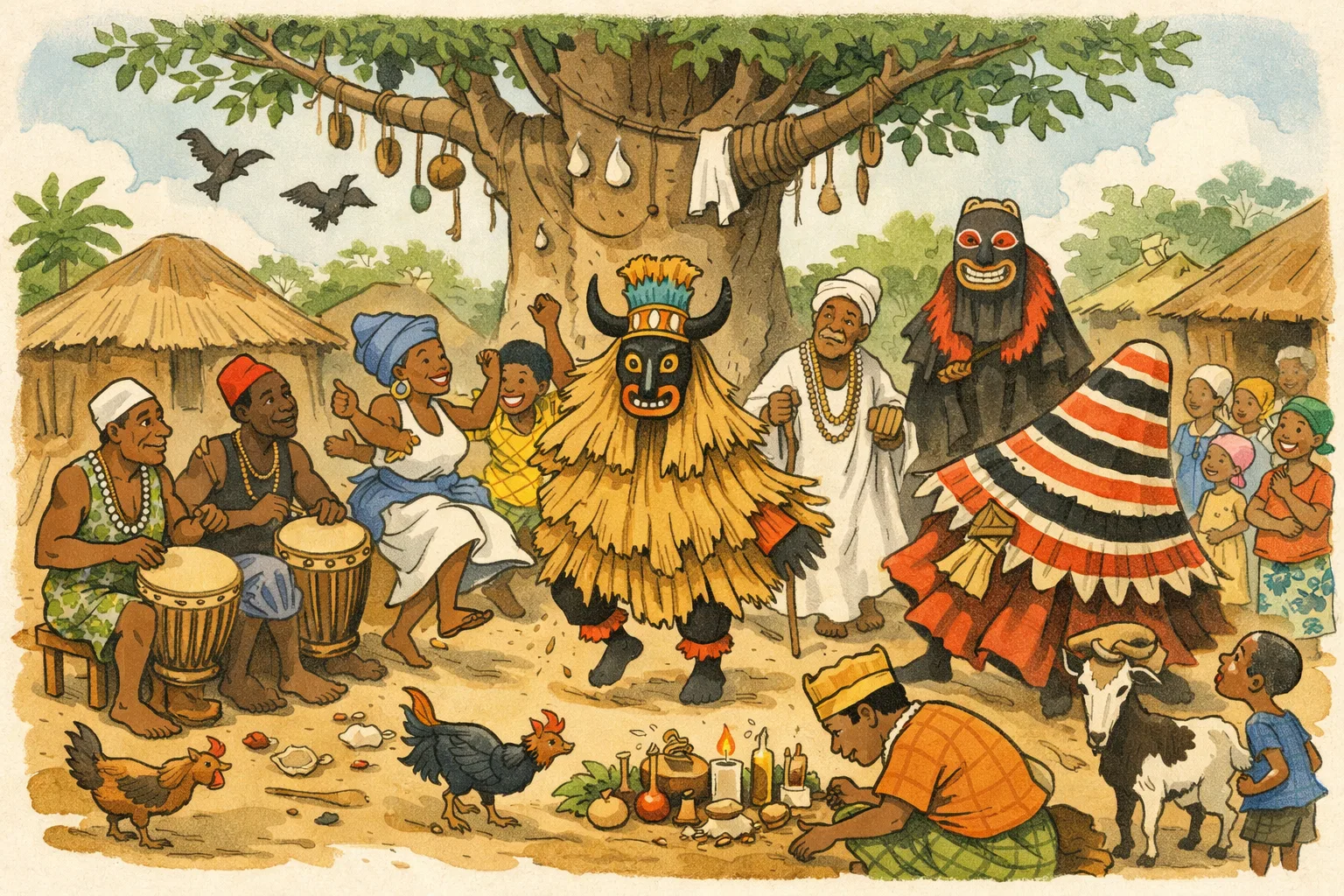
Benin’s masked traditions are among its most vivid forms of folklore because they make the unseen world public. The point is not merely disguise. In many traditions, the mask is treated as a social and spiritual presence: a guardian, ancestor, judge, warning, purifier or teacher.
Zangbeto is one of the best-known examples. Reuters described performers at Benin’s national Vodun holiday as “guardians of the night” in swirling costumes like bright haystacks, while other accounts identify Zangbeto with night protection, community order and the detection of thieves or harmful forces. The tradition is especially associated with southern Benin and neighbouring coastal cultures, including Ogu communities across Benin, Togo and Nigeria. It is often explained to visitors as a spiritual night-watchman, but locally it also carries ideas of law, secrecy, fear, spectacle and communal discipline.[Reuters]reuters.comVoodoo dances and rituals wow tourists at Benin festivalVoodoo dances and rituals wow tourists at Benin festival
Gelede is better documented in global heritage terms. UNESCO lists the Oral Heritage of Gelede as an intangible cultural heritage tradition of Benin, Nigeria and Togo. It is performed after harvests and at important moments such as droughts or epidemics, and it combines carved masks, dance and oral performance. Its social focus is often described as honouring women, mothers and powerful female spiritual forces, while also entertaining and instructing the community.[Intangible Cultural Heritage]ich.unesco.orgOpen source on unesco.org.
These traditions show why “monster” is often the wrong word for Beninese folklore. A Zangbeto may frighten, chase, whirl or judge, but it is not simply a creature from a scary story. A Gelede mask may be comic, beautiful, critical or sacred. The drama comes from a deeper question: what happens when a community gives visible form to powers that are normally hidden?
Ouidah: sacred forests, pythons and the memory of Vodun
Ouidah is one of the most important places for understanding Benin’s folklore because it gathers together several layers of tradition: Vodun practice, Atlantic slave-trade memory, sacred landscape, tourism and state-sponsored heritage. The annual Vodun Days now place Ouidah at the centre of public celebration, with official festival material for 2026 describing processions, Zangbeto and Egungun appearances, deity ceremonies and concerts between 8 and 10 January. Reuters and AP coverage of recent festivals likewise presents the event as both worship and public cultural performance, drawing devotees, tourists and members of the African diaspora.[vodundays.bj]vodundays.bjOpen source on vodundays.bj.
The Sacred Forest of Kpassè is a striking example of local legend attached to place. Ouidah tourism material says King Kpassè, associated with the Houéda kingdom, is said to have transformed himself into an iroko tree rather than be captured during the Fon invasion of 1727. Whether read as sacred history, local legend or heritage narrative, the story makes the forest more than scenery: the grove becomes a living royal presence and a site where memory, trees, kingship and spirit power meet.[Ouidah Origins]ouidahorigins.comOuidah Origins Explore the sacred forest of Kpassè in OuidahOuidah Origins Explore the sacred forest of Kpassè in Ouidah
Ouidah’s Temple of Pythons adds another important strand. Benin tourism material presents the temple as a place where royal pythons and boas are objects of veneration, with ceremonies attached to the death of a python and a major purification festival held every seven years. Atlas Obscura, while more travel-oriented, similarly identifies the temple as a site of historical and modern spiritual practice where snakes are important to Vodun followers.[benintourisme.net]benintourisme.netThe Temple of the PythonsThe Temple of the Pythons
For readers, the key is to avoid flattening these places into curiosities. The snake, the tree and the masked guardian are not isolated “weird attractions”. They are part of a broader Beninese pattern in which nature, ancestry, place and ritual authority are deeply connected.
Abomey and royal folklore written on walls
The Royal Palaces of Abomey show how Beninese folklore can be visual, political and historical at the same time. UNESCO describes the site as the remains of the powerful Kingdom of Abomey, whose kings built palaces within a walled royal compound using traditional materials and polychrome bas-reliefs. These bas-reliefs are not decoration in the shallow sense. They are symbolic records of power, warfare, royal identity, myths and social memory.[UNESCO World Heritage Centre]whc.unesco.orgOpen source on unesco.org.
The Getty Conservation Institute’s work on Abomey is especially valuable for folklore readers because it explains the bas-reliefs as a coded language through which Dahomean kings spoke to their subjects. The Getty publication says these visual stories represented and preserved the history, myths, legends and cultural memory of the Fon people, quoting Beninese historian Nondichao Bachalou’s view that the bas-reliefs are a remaining “written” history.[Getty]getty.eduPalace Sculptures of AbomeyPalace Sculptures of Abomey
That matters because oral tradition is sometimes wrongly treated as vague or unrecorded. In Abomey, story moved between speech, ritual, architecture, textile, royal emblem and wall image. The lion, shark, bird, weapon or animal symbol could carry royal meaning. A palace relief could work like a public memory device, turning political history into something closer to legend without ceasing to be history.
Abomey also complicates romantic readings of folklore. The Kingdom of Dahomey was a real political and military power, and its heritage includes court ritual, conquest, slave-trade history, colonial war, sacred kingship and modern restitution debates. Recent reporting on Benin’s cultural renewal notes the return of looted royal objects from France and new museum projects connected with Vodun and national memory. Folklore here is not a harmless fantasy world; it is tied to power, loss, recovery and national identity.[Financial Times]ft.comFinancial Times Restitution, wrangling and renewal in BeninFinancial Times Restitution, wrangling and renewal in Benin
Sacred forests are not just backdrops for stories
Benin’s sacred forests are among the clearest examples of folklore shaping behaviour in the physical world. A 2012 case study for the Satoyama Initiative described Benin as containing scattered sacred forests and tree groves with religious, ethnobotanical and conservation significance. These forests are used for ritual practice and traditional medicine, but many are under pressure from population growth, farming and urbanisation.[IPSI]satoyamainitiative.orgOpen source on satoyamainitiative.org.
Recent journalism has made the same point in more immediate terms. National Catholic Reporter, using AP material, reported in 2023 that Benin is home to thousands of sacred forests that Vodun believers see as homes for spirits, while also noting threats from anti-Vodun attacks, agriculture and urban expansion.[National Catholic Reporter]ncronline.orgOpen source on ncronline.org.
This is where folklore becomes practical. A grove protected by a spirit story may also protect old trees, medicinal plants and community memory. A taboo on cutting certain trees can function as environmental conservation, even if local people explain it through respect for a deity or ancestor rather than modern ecological language. A 2023 economics paper on African traditional religions and forest cover used Benin as a major case study and found evidence linking adherence to African traditional religions with positive forest-cover outcomes, while also studying the historical influence of the Dahomey region.[arXiv]arxiv.orgarXiv Sacred Ecology: The Environmental Impact of African Traditional ReligionsarXiv Sacred Ecology: The Environmental Impact of African Traditional Religions
The lesson is not that every sacred forest is automatically safe. Many are shrinking. But Benin shows how story, taboo, ritual authority and ecology can reinforce one another, and how losing a sacred grove can mean losing both biodiversity and a local archive of legend.

Oral storytelling beyond temples and festivals
The most public images of Beninese folklore are masks, shrines and ceremonies, but domestic and village storytelling is just as important. Oral tales teach children about danger, generosity, cleverness, obedience, hunger, envy, death and the consequences of foolish action. They often use animals, tricksters, talking beings and magical reversals because these are memorable ways to teach social lessons.
Reports on storytelling preservation in Benin describe concern that old tales are fading as younger audiences move towards television, phones and urban entertainment. Yet the same reporting shows that public storytelling events can still captivate young listeners, especially when a familiar warning or taboo is suddenly given a story-shaped explanation.[Vanguard News]vanguardngr.comOpen source on vanguardngr.com.
This part of Benin’s folklore is harder to catalogue than a palace or annual festival. Tales vary by language, family, region and teller. A story may not have one “correct” version. That flexibility is not a weakness; it is how oral tradition survives. It can absorb new jokes, local worries, religious change and moral emphasis while keeping older narrative bones.
For readers searching online, this also means caution is needed. Many modern websites retell “Beninese folktales” in simplified form, sometimes without naming collectors, languages, communities or dates. Such retellings can be useful introductions, but they should not be mistaken for exact transcripts of old oral performance.
How Benin’s folklore changed over time
Benin’s folklore has never been frozen. It changed through the rise of Dahomey, regional trade, Yoruba-Fon exchange, Atlantic slavery, colonial rule, Christian and Muslim expansion, Marxist-era suppression, democratic revival, tourism and digital media.
One major change is public recognition. Vodun was formally recognised in Benin in the 1990s, and the 10 January festival became a major national and international marker of traditional religion. Reuters’ 2016 photo essay noted that the annual Ouidah gathering on 10 January had already been a national holiday for more than 20 years, while more recent reporting describes the government’s rebranding of the event as Vodun Days to attract tourists and present Vodun as cultural heritage rather than superstition.[Reuters]widerimage.reuters.comVoodoo festival of BeninVoodoo festival of Benin
Another change is global reinterpretation. Vodun travelled across the Atlantic with enslaved Africans and contributed to related traditions in Haiti, Cuba, Brazil, Louisiana and elsewhere. That diaspora history has made Benin a symbolic “return” point for many visitors of African descent. AP’s 2025 coverage quotes Ouidah’s mayor describing the festival as a return to the source for Africans and Afro-descendants, which shows how folklore, pilgrimage, heritage tourism and historical trauma now overlap in the city.[AP News]apnews.comOpen source on apnews.com.
A third change is museumisation. Sacred objects, royal symbols, masks and shrines may be presented in museums, festivals and heritage trails, sometimes in ways that make them more accessible but also change their setting. The challenge is to respect the difference between a living ritual object, a festival performance, a museum exhibit, a tourist guide’s story and an internet retelling.
What is old tradition, and what is modern packaging?
A fair account of Benin’s folklore needs to separate four layers that are often mixed together.
Old oral and ritual tradition includes local myths, family stories, divination systems, sacred grove practices, mask societies and ancestor veneration passed through communities over generations. These traditions may be old without being easy to date precisely, because many were transmitted orally or through restricted initiation.
Royal and court tradition includes the symbolic culture of Abomey: palace bas-reliefs, royal emblems, court art, ritual memory and stories attached to kings. This material is unusually well anchored because it survives in architecture, museum collections and conservation records.[UNESCO World Heritage Centre]whc.unesco.orgOpen source on unesco.org.
Heritage and tourism retelling includes festival programmes, guided tours, official tourism pages and staged performances. These can be valuable and often draw on real tradition, but they also select, simplify and present material for visitors. Ouidah’s Vodun Days are both a devotional event and a curated cultural attraction.[Vodun days]vodundays.bjOpen source on vodundays.bj.
Internet-era folklore includes viral posts, travel blogs, sensational “dark tourism” articles and generic lists of African monsters. These are the least reliable unless they cite local experts, archives, museums or field research. They can spread interest, but they can also exaggerate danger, turn sacred practice into spectacle or confuse Beninese traditions with unrelated horror imagery.
The safest approach is to ask: who is telling this story, where is it located, what community does it belong to, is it ritual practice or tourist performance, and does a museum, scholar, local institution or credible reporter support the account?
How Benin’s folklore is understood today
Today, Benin’s folklore is not a leftover from the past. It is a living part of national identity, religious practice, tourism, environmental protection, artistic expression and diaspora connection. It is also contested. Some Beninese people practise Vodun openly; others identify mainly as Christian or Muslim while still respecting traditional customs; some reject Vodun; some see it as cultural heritage rather than personal religion.
The most visible trend is pride and reframing. Recent Reuters coverage of Vodun Days said the festival seeks to dispel negative stereotypes about Vodun, presenting it as a centuries-old religion centred on deities and spirits rather than the harmful clichés familiar from foreign films. AP coverage similarly describes the Ouidah festival as a space where traditional ceremonies, dances and rituals are presented to both followers and visitors.[Reuters]reuters.comOpen source on reuters.com.
For curious readers, Benin offers a particularly rich folklore landscape because the traditions are not hidden only in books. They can be encountered in oral tales, palace walls, sacred forests, python temples, masked performances, divination practices, festival processions and contemporary debates about heritage. The best way to understand them is neither to romanticise nor dismiss them, but to see them as living cultural systems: story-worlds that still help people think about nature, power, danger, healing, memory and belonging.
Amazon book picks
Further Reading
Books and field guides related to What Makes Benin's Folklore So Alive?. Use these as the next step if you want deeper reading beyond the article.
The Voodoo Encyclopedia
Covers beliefs, rituals, spirits, history and folklore connected to Benin's best-known cultural tradition.
The Hero with a Thousand Faces
Useful for readers interested in how myths, legends and folklore function across cultures.
The Royal Kingdoms of Ghana, Mali, and Songhay
Helps readers place West African oral traditions and cultural heritage in historical context.
African Religions and Philosophy
Explains the wider religious worldview behind folklore, ancestors, ritual and oral traditions.
eBay marketplace picks
Marketplace Samples
Live-tested eBay searches with available results related to this page.



Endnotes
1.
Source: ich.unesco.org
Link:https://ich.unesco.org/en/assistances/vodun-beliefs-social-practices-and-ways-of-living-02386
2.
Source: whc.unesco.org
Link:https://whc.unesco.org/en/list/323/
3.
Source: ich.unesco.org
Title: Intangible Cultural Heritage Benin
Link:https://ich.unesco.org/es/estado/benin-BJ?info=proyectos
4.
Source: state.gov
Link:https://www.state.gov/reports/2023-report-on-international-religious-freedom/benin
5.
Source: mythopedia.com
Title: mawu lisa
Link:https://mythopedia.com/topics/mawu-lisa/
6.
Source: reuters.com
Title: Voodoo dances and rituals wow tourists at Benin festival
Link:https://www.reuters.com/world/africa/voodoo-dances-rituals-wow-tourists-benin-festival-2023-01-11/
7.
Source: ich.unesco.org
Link:https://ich.unesco.org/en/RL/oral-heritage-of-gelede-00002
8.
Source: reuters.com
Link:https://www.reuters.com/world/africa/benin-festival-seeks-dispel-voodoo-stereotypes-2025-01-14/
9.
Source: benintourisme.net
Title: The Temple of the Pythons
Link:https://www.benintourisme.net/en/news/pythons-benin
10.
Source: getty.edu
Title: Palace Sculptures of Abomey
Link:https://www.getty.edu/conservation/publications_resources/pdf_publications/pdf/palace1.pdf
11.
Source: satoyamainitiative.org
Link:https://satoyamainitiative.org/case_studies/benins-experience-in-the-management-of-sacred-forests-for-biodiversity-conservation/
12.
Source: arxiv.org
Title: arXiv Sacred Ecology: The Environmental Impact of African Traditional Religions
Link:https://arxiv.org/abs/2401.13673
13.
Source: widerimage.reuters.com
Title: Voodoo festival of Benin
Link:https://widerimage.reuters.com/story/voodoo-festival-of-benin
14.
Source: ich.unesco.org
Title: benin BJ
Link:https://ich.unesco.org/en/state/benin-BJ
15.
Source: unesco.org
Link:https://www.unesco.org/es
16.
Source: ich.unesco.org
Link:https://ich.unesco.org/en/video/41389
17.
Source: ich.unesco.org
Title: 00010 EN
Link:https://ich.unesco.org/doc/src/00010-EN.pdf
18.
Source: ich.unesco.org
Link:https://ich.unesco.org/en/lists
19.
Source: ich.unesco.org
Title: 47498 EN
Link:https://ich.unesco.org/doc/src/47498-EN.pdf?v=1588175678
20.
Source: ich.unesco.org
Title: photo pop up 00973
Link:https://ich.unesco.org/en/photo-pop-up-00973?photoID=07713
21.
Source: ich.unesco.org
Title: 00184 EN DOC.doc
Link:https://ich.unesco.org/doc/src/00184-EN-DOC.doc
22.
Source: ich.unesco.org
Title: 00264 EN
Link:https://ich.unesco.org/doc/src/00264-EN.pdf
23.
Source: ich.unesco.org
Title: 00074 EN
Link:https://ich.unesco.org/doc/src/00074-EN.pdf
24.
Source: ich.unesco.org
Title: 00290 EN PDF+Corr
Link:https://ich.unesco.org/doc/src/00290-EN-PDF%2BCorr.pdf?v=1268152635
25.
Source: folktales.africa
Title: three beninese folktales that teach lessons on life loss and companionship
Link:https://folktales.africa/three-beninese-folktales-that-teach-lessons-on-life-loss-and-companionship/
26.
Source: folktales.africa
Title: the dahomean creation story of mawu lisa and their children
Link:https://folktales.africa/the-dahomean-creation-story-of-mawu-lisa-and-their-children/
27.
Source: getty.edu
Link:https://www.getty.edu/conservation/publications_resources/pdf_publications/pdf/palace4.pdf
28.
Source: getty.edu
Link:https://www.getty.edu/conservation/publications_resources/pdf_publications/pdf/palace2.pdf
29.
Source: reuters.com
Link:https://www.reuters.com/video/watch/idRW308514012025RP1/
30.
Source: vodundays.bj
Link:https://vodundays.bj/en/
31.
Source: festival.si.edu
Title: navigating secrets and the senses in benin
Link:https://festival.si.edu/blog/navigating-secrets-and-the-senses-in-benin
32.
Source: minorityrights.org
Link:https://minorityrights.org/country/benin/
33.
Source: si.edu
Link:https://www.si.edu/object/introduction-fa-divination-benin%3Aposts_3cef92c37c7aec496ccb3839e6efceb6
34.
Source: vanguardngr.com
Link:https://www.vanguardngr.com/2018/08/once-upon-a-time-preserving-folk-tales-in-benin/
35.
Source: apnews.com
Title: benin voodoo festival ouidah 465e798bd2271ca5c4213416986d701a
Link:https://apnews.com/article/benin-voodoo-festival-ouidah-465e798bd2271ca5c4213416986d701a
36.
Source: ouidahorigins.com
Title: Ouidah Origins Explore the sacred forest of Kpassè in Ouidah
Link:https://ouidahorigins.com/en/pillars/the-sacred-forest
37.
Source: ft.com
Title: Financial Times Restitution, wrangling and renewal in Benin
Link:https://www.ft.com/content/af133939-e6da-411b-9404-217d2a6ae6a2
38.
Source: ncronline.org
Link:https://www.ncronline.org/news/benin-voodoos-birthplace-believers-bemoan-steady-shrinkage-forests-they-revere-sacred
39.
Source: taipeitimes.com
Link:https://www.taipeitimes.com/News/feat/archives/2024/01/18/2003812256
40.
Source: apnews.com
Link:https://apnews.com/article/465e798bd2271ca5c4213416986d701a
41.
Source: facebook.com
Link:https://www.facebook.com/poaenglish/posts/vodun-days-have-kicked-off-in-ouidah-benin-celebrating-the-countrys-spiritual-an/122167323788683092/
42.
Source: facebook.com
Link:https://www.facebook.com/ntanetworknews/posts/vodun-days-festival-in-the-republic-of-beninthousands-of-people-from-around-the-/1191048416533506/
43.
Source: facebook.com
Title: Vodun Days
Link:https://www.facebook.com/adacbenin/posts/vodun-days-programmation-concertedjooor-bobo-w%C3%AA-sera-%C3%A0-ouidah-pour-les-vodundays/885206010468924/
44.
Source: festival.si.edu
Link:https://festival.si.edu/blog/introduction-to-fa-divination-of-benin
45.
Source: si.edu
Link:https://www.si.edu/object/archives/components/sova-eepa-1973-001-ref23788
46.
Source: reutersconnect.com
Title: d GFn On Jld XRlcn Mu Y29t LDIw Mj Y6bm V3c21s X1JDMj VYSUFIVEh TWQ
Link:https://www.reutersconnect.com/item/benin-celebrates-its-annual-voodoo-festival-vodun-days-in-ouidah/dGFnOnJldXRlcnMuY29tLDIwMjY6bmV3c21sX1JDMjVYSUFIVEhTWQ
47.
Source: reutersconnect.com
Title: d GFn On Jld XRlcn Mu Y29t LDIw Mj Y6bm V3c21s X1JDMl BYSUFYWEMx Rg
Link:https://www.reutersconnect.com/item/benin-celebrates-its-annual-voodoo-festival-vodun-days-in-ouidah/dGFnOnJldXRlcnMuY29tLDIwMjY6bmV3c21sX1JDMlBYSUFYWEMxRg
48.
Source: Wikipedia
Link:https://en.wikipedia.org/wiki/Zangbeto
49.
Source: Wikipedia
Link:https://en.wikipedia.org/wiki/Mawu
50.
Source: Wikipedia
Title: Royal Palaces of Abomey
Link:https://en.wikipedia.org/wiki/Royal_Palaces_of_Abomey
51.
Source: Wikipedia
Link:https://en.wikipedia.org/wiki/Dahomey
52.
Source: apnews.com
Link:https://apnews.com/video/benin-dan-ikpoyi-fairs-and-festivals-a14d09c8ad364a01a4c40946a515af1e
53.
Source: ayiffatourisme.com
Title: Sacred Forest of Kpassè
Link:https://ayiffatourisme.com/en/visiter-la-foret-sacree-de-kpasse
54.
Source: ouidahorigins.com
Link:https://ouidahorigins.com/en/remanences/ouidah-lieux-memoire-vodun-benin
55.
Source: flyingfourchette.com
Link:https://www.flyingfourchette.com/2014/01/12/benin/
Additional References
56.
Source: youtube.com
Title: Exploring Ancient Rituals: Voodoo Traditions in Togo & Benin
Link:https://www.youtube.com/watch?v=dHYcKocjzW0
Source snippet
The Mystical Rituals of Place Dancoli, Benin: Voodoo Without Priests...
57.
Source: youtube.com
Title: The Mystical Rituals of Place Dancoli, Benin: Voodoo Without Priests
Link:https://www.youtube.com/watch?v=cp_OXKY20jE
Source snippet
Benin Voodoo Festival: remembering enslaved ancestors...
58.
Source: youtube.com
Title: Inside the Secret Voodoo Rituals of Benin’s Samba Tribe
Link:https://www.youtube.com/watch?v=G87p-TwqIoU
Source snippet
Exploring Ancient Rituals: Voodoo Traditions in Togo & Benin...
59.
Source: facebook.com
Link:https://www.facebook.com/groups/PDHeroes/posts/5700160076719417/
60.
Source: silvertraveladvisor.com
Link:https://silvertraveladvisor.com/reviews/a-forest-full-of-voodoo-deities/
61.
Source: coursehero.com
Link:https://www.coursehero.com/file/73211727/Copy-of-African-Culture/
62.
Source: academia.edu
Link:https://www.academia.edu/11104096/African_Traditional_Religions_Mawus_Legacy_and_Womens_Power_in_Haitian_Vodou_and_the_Diaspora
63.
Source: facebook.com
Link:https://www.facebook.com/groups/275114380263865/posts/942837336824896/
64.
Source: visitbeninrepublic.com
Link:https://visitbeninrepublic.com/art-culture/
65.
Source: africanlanders.com
Link:https://africanlanders.com/en/benin-en/benin-ouidah-the-last-stop-for-the-slaves-before-crossing-the-door-of-no-return/
Topic Tree
Follow this branch
Related pages 192
- Afghan Folklore
- Albanian Folklore
- Algerian Folklore
- Australian Folklore
- Azerbaijan Folklore
- +187 more in sidebar