Within Serbian Folklore
Why Serbian Fairies and Dragons Are Dangerous
Vile and dragons show a wilder side of Serbian belief, where beauty, danger, storms and heroic power overlap.
On this page
- Vile in mountains, forests and waters
- Dragons as lovers, threats and ancestors
- Rules, territory and respect in wild places
Page outline Jump by section
Introduction
In Serbian folklore, some of the most fascinating supernatural beings do not haunt houses or churchyards. They belong to mountains, forests, rivers, caves and storm-filled skies. Two figures dominate this wilder landscape: the vila, a powerful fairy-like being linked to untamed nature, and the dragon, a creature that can be protector, lover, ancestor or threat depending on the story. Together they reveal an important theme in Serbian tradition: beautiful places are often dangerous places, and the natural world deserves respect rather than casual possession.[Wikipedia]WikipediaVila (fairyVila (fairy
Unlike modern fantasy fairies, Serbian vile are not tiny winged helpers. They are powerful female spirits associated with mountains, woodland clearings, springs, clouds and remote places. Dragons, meanwhile, are often far more complex than simple monsters. In many Serbian tales they defend territory, fall in love with human women, father heroic descendants and battle destructive storm beings.[wikipedia.org]WikipediaVila (fairyVila (fairy
Why Serbian Fairies and Dragons Are Dangerous
The danger of these beings comes less from outright evil than from crossing boundaries. Serbian folk belief often treats wilderness as a realm with its own rules. A traveller who enters a mountain meadow, approaches a hidden spring or wanders into a forest clearing may unknowingly step into territory claimed by supernatural powers.[Wikipedia]WikipediaVila (fairyVila (fairy
Vile and dragons are therefore guardians as much as threats. They reward courage, beauty, loyalty and respect, yet punish arrogance, intrusion and broken promises. Many stories revolve around a simple lesson: humans are not masters of every landscape. Some places belong to older powers.[Wikipedia]WikipediaVila (fairyVila (fairy
Vile in Mountains, Forests and Waters
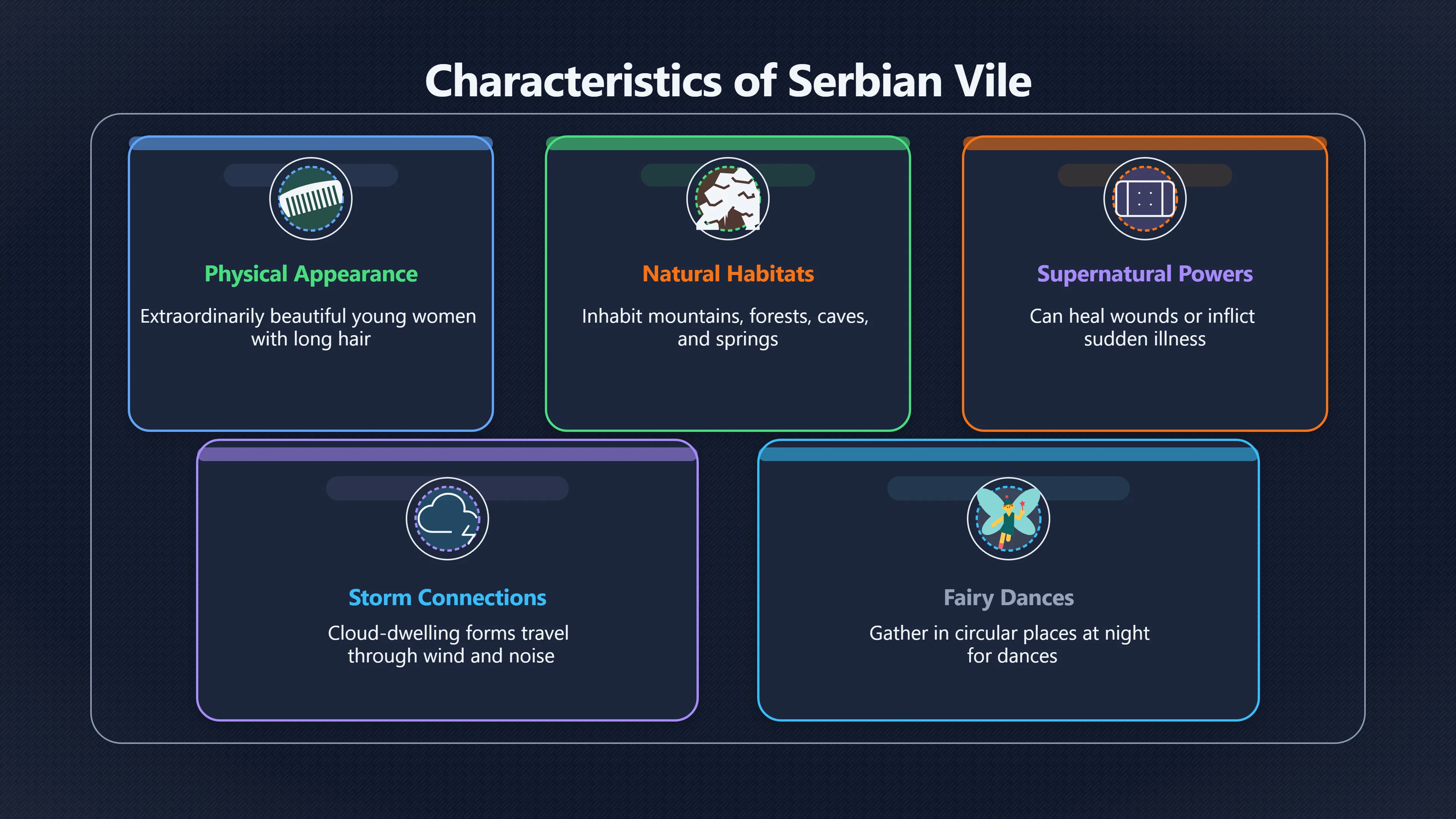
Serbian tradition places vile in precisely the kinds of locations that people historically regarded as beautiful but risky: high mountains, deep forests, caves, rivers, lakes and springs. Ethnographic and folkloric sources describe several categories of vile, including woodland, mountain, water and cloud-dwelling forms.[Wikipedia]WikipediaVila (fairyVila (fairy
They are usually imagined as extraordinarily beautiful young women with long hair and dazzling appearance. Yet their beauty conceals immense power. Vile can heal wounds, guide heroes and grant supernatural assistance, but they can also inflict illness, misfortune or death. Their moods are unpredictable because they are not moral figures in a human sense; they act according to the rules of their own realm.[Wikipedia]WikipediaVila (fairyVila (fairy
One recurring motif involves fairy dances. Serbian and wider South Slavic traditions speak of circular places where vile gather at night. Entering such a dance uninvited, disturbing it, or failing to show proper respect can bring terrible consequences. The circle itself becomes a warning marker in the landscape: a seemingly ordinary patch of ground may hide supernatural ownership.[Wikipedia]WikipediaVila (fairyVila (fairy
Another striking feature is the connection between vile and storms. Cloud-dwelling vile are sometimes imagined travelling through the sky amid wind and noise. This links them to weather, mountain peaks and the unpredictable forces of nature. Their presence explains why a calm landscape can suddenly become threatening.[Wikipedia]WikipediaVila (fairyVila (fairy
Dragons as Lovers, Threats and Ancestors
The Serbian dragon, often called a zmaj in folklore, occupies a very different role from the treasure-hoarding dragons of many Western European tales. Rather than living only as monsters to be slain, Serbian dragons frequently interact with human communities. They may protect villages, defend territory or form relationships with human beings.[Wikipedia]WikipediaSlavic dragonSlavic dragon
One of the most persistent themes is the dragon lover. Folk tales and epic traditions describe dragons taking the form of handsome men and visiting women. These relationships are rarely straightforward romances. They often carry an air of danger, secrecy and supernatural destiny. In some stories the woman becomes withdrawn or strangely transformed by the connection, while in others the union produces extraordinary children.[Wikipedia]WikipediaSlavic dragonSlavic dragon
This belief helps explain why dragons are sometimes treated as ancestors rather than enemies. Certain legendary heroes were said to possess dragon blood or dragon parentage. Such stories transformed unusual strength, bravery or leadership into signs of supernatural descent. The dragon became a source of heroic power embedded within human society.[fairytalez.com]fairytalez.comSerbian Folk Tales & Folklore: 19 StoriesThe vila (plural: vile) are the most distinctive – beautiful fairy women who live in m…
At the same time, not every dragon-like being was benevolent. Serbian folklore also preserves traditions of destructive dragon figures associated with storms, hail, caves and mountain strongholds. These beings could threaten crops, livestock and human life. The distinction between protective dragons and destructive dragon-like monsters reflects a broader Serbian tendency to see nature as containing both guardians and destroyers.[Wikipedia]WikipediaSlavic dragonSlavic dragon
Rules, Territory and Respect in Wild Places
Many Serbian stories about vile and dragons function almost like unwritten rules for moving through dangerous landscapes. A mountain spring, forest glade or cave is not merely geography; it may be someone else’s domain.[Wikipedia]WikipediaVila (fairyVila (fairy
Several recurring principles appear across the traditions:
- Do not disturb places associated with supernatural gatherings.
- Show respect when entering remote natural locations.
- Avoid boasting, mocking or challenging unseen powers.
- Recognise that beauty in nature may conceal danger.
- Understand that favours from supernatural beings often carry obligations.[Wikipedia]WikipediaVila (fairyVila (fairy
These beliefs helped communities explain accidents, sudden illnesses, storms and unexplained events in isolated landscapes. More importantly, they encouraged caution. A dangerous mountain path or hidden river pool became memorable when linked to a fairy or dragon story. Folklore transformed practical environmental awareness into narrative form.[Wikipedia]WikipediaVila (fairyVila (fairy
Heroes Between the Human and Wild Worlds
Serbian epic poetry frequently places heroes in relationships with vile. A hero may receive protection, advice, healing or magical assistance from a fairy patron. In some traditions a vila becomes a blood sister or supernatural ally who helps a warrior survive impossible situations.[Wikipedia]WikipediaVila (fairyVila (fairy
These stories are significant because they place the hero between civilisation and wilderness. The hero is neither fully part of the human world nor fully part of the supernatural one. Success depends on understanding both. A warrior who earns the friendship of a vila gains access to the power of mountains, storms and wild nature itself.[Wikipedia]WikipediaVila (fairyVila (fairy
Dragons occupy a similar role. Heroes of dragon descent stand at the border between ordinary humanity and supernatural power. Rather than representing chaos alone, dragons become a source of legitimacy and strength. This idea helped connect famous figures in oral tradition to the larger forces shaping the Serbian landscape.[Fairytalez]fairytalez.comSerbian Folk Tales & Folklore: 19 StoriesThe vila (plural: vile) are the most distinctive – beautiful fairy women who live in m…
How These Traditions Are Understood Today
Modern Serbians generally encounter vile and dragons through folklore collections, epic poetry, children’s literature, museums, local legends and popular culture rather than through active belief. Yet the creatures remain powerful symbols because they express enduring attitudes toward nature and place.[Wikipedia]WikipediaSerbian folkloreFebruary 18, 2008 — Serbian folklore is the folk traditions among ethnic Serbs. The earliest examples of Serbian folklore are seen in the…
The vila continues to embody the beauty and unpredictability of mountains, forests and waters. The dragon continues to represent power that can either protect or destroy. Together they preserve an older understanding of the Serbian landscape: wild places are not empty. They possess character, memory and agency in story, and those who enter them must do so with respect.[wikipedia.org]WikipediaVila (fairyVila (fairy
Amazon book picks
Further Reading
Books and field guides related to Why Serbian Fairies and Dragons Are Dangerous. Use these as the next step if you want deeper reading beyond the article.
The Vampire
Explains the Balkan roots of vampire traditions central to Serbian folklore.

Russian Fairy Tales (Illustrated by Ivan Bilibin)
Offers useful comparisons for fairy-like beings across Slavic traditions.
eBay marketplace picks
Marketplace Samples
Live-tested eBay searches with available results related to this page.

Endnotes
1.
Source: Wikipedia
Title: Vila (fairy)
Link:https://en.wikipedia.org/wiki/Vila_%28fairy%29
2.
Source: fairytalez.com
Link:https://fairytalez.com/region/serbian/
Source snippet
Serbian Folk Tales & Folklore: 19 StoriesThe vila (plural: vile) are the most distinctive – beautiful fairy women who live in m...
3.
Source: Wikipedia
Title: Slavic dragon
Link:https://en.wikipedia.org/wiki/Slavic_dragon
4.
Source: scribd.com
Link:https://www.scribd.com/document/206898642/Fairies-Dragons-Witchblood-Rade-Ristic
Source snippet
Serbian Dragons and Witchcraft Myths | PDF | FairiesThe document discusses Serbian folk beliefs about dragons, faeries, and witches. Acco...
5.
Source: Wikipedia
Title: Serbian folklore
Link:https://en.wikipedia.org/wiki/Serbian_folklore
Source snippet
February 18, 2008 — Serbian folklore is the folk traditions among ethnic Serbs. The earliest examples of Serbian folklore are seen in the...
Published: February 18, 2008
6.
Source: Wikipedia
Link:https://en.wikipedia.org/wiki/[Serbia
Source snippet
SerbiaSerbia is an upper-middle income economy and provides universal health care and free primary and secondary education to its citi...
7.
Source: Wikipedia
Title: Serbian language
Link:https://en.wikipedia.org/wiki/Serbian_language
Source snippet
Serbian languageSerbian is the standard variety of the Serbo-Croatian language mainly used by Serbs. It is the national official langu...
8.
Source: Wikipedia
Link:https://en.wikipedia.org/wiki/Serbs
Source snippet
SerbsSerbs are predominantly Eastern Orthodox Christians, traditionally affiliated with the Serbian Orthodox Church, and speak the Ser...
9.
Source: scribd.com
Link:https://www.scribd.com/document/273399267/Magical-Beings-of-Serbian-Mythology
Source snippet
She is often encountered in Serbian folk songs, stories, adages etc. Dragons in...
10.
Source: folklorethursday.com
Title: serbian folklore his majesty the zmaj and her majesty the vila
Link:https://folklorethursday.com/regional-folklore/serbian-folklore-his-majesty-the-zmaj-and-her-majesty-the-vila/
Source snippet
Slavic Mythology of Zmaj and Vila: Dragons, Nymphs and...3 Nov 2016 — At the very top of the Serbian mythological pantheon sit two very...
Additional References
11.
Source: facebook.com
Link:https://www.facebook.com/groups/1022560929298411/posts/1100790511475452/
Source snippet
Vila mythical creatures in Serbian folkloreThey are associated with nature, forests, and meadows, and are believed to have magical powers...
12.
Source: serbonika.com
Link:https://serbonika.com/blog/serbian-language/introduction-to-serbian-language/
Source snippet
It shares many common features with Russian, Czech, Polish, Bulgarian, Slovak, Slovenian, and all the other Slavic languages.Read more...
13.
Source: allgoodtales.com
Link:https://allgoodtales.com/storytelling-traditions-across-world-serbia/
Source snippet
Her Majesty The Vila. there is a differentiation between the two types of dragon-like creatures: Zmaj and Aždaja...
14.
Source: facebook.com
Title: In folk tales, there is often a moment when vila’s hair gets tangled
Link:https://www.facebook.com/SlavicSpirituality/posts/in-serbian-mythology-it-is-said-that-the-life-force-of-a-vila-fairy-is-in-her-ha/845793017568672/
Source snippet
In Serbian mythology, it is said that the life force of a vila...In Serbian mythology, it is said that the life force of a vila (fairy)...
15.
Source: mythus.fandom.com
Title: Myth and Folklore List of Slavic creatures | Myth and Folklore Wiki
Link:https://mythus.fandom.com/wiki/List_of_Slavic_creatures
Source snippet
It is over one hundred years old. Usually they have an odd number of heads, rarely two. They spit fire, have a...Read more...
16.
Source: mythsterhood.com
Title: This is usually the offspring of a zmej with a human
Link:https://mythsterhood.com/mythsterhood-episode-17-dragons-of-the-balkan/
Source snippet
Episode 17: Dragons of the Balkans - Mythsterhood22 Feb 2021 — Serbian mythology, where there's a special kind of zmej called...
17.
Source: belgradelanguageschool.com
Link:https://belgradelanguageschool.com/discover-the-6-most-popular-serbian-mythical-creatures/
Source snippet
Belgrade Language SchoolDiscover The 6 Most Popular Serbian Mythical CreaturesIn Serbian mythology, Vile or fairies are beautiful, supern...
18.
Source: danubeonthames.wordpress.com
Title: Danube on Thames Dragons in Serbian Mythology
Link:https://danubeonthames.wordpress.com/serbia/summer-school-2016/dragons-in-serbian-mythology/
Source snippet
Danube on ThamesDragons in Serbian Mythology - Danube on ThamesA dragon is called zmaj (змaј). These creatures have been described as hav...
19.
Source: reddit.com
Title: According to a legend in our
Link:https://www.reddit.com/r/AskBalkans/comments/s6xd0z/have_you_heard_of_the_mythical_creatures_vile_and/
Source snippet
Have you heard of the mythical creatures "Vile" and are...I'm from Niš, and our city is also called Vilin Grad (The Fairy's City) accord...
20.
Source: loecsen.com
Link:https://www.loecsen.com/en/learn-serbian
Source snippet
▷ The best Serbian course for beginners | FreeLoecsen offers a structured Serbian course for beginners, designed to reach the skills expe...
Topic Tree