Where Folklore Dances in the Street
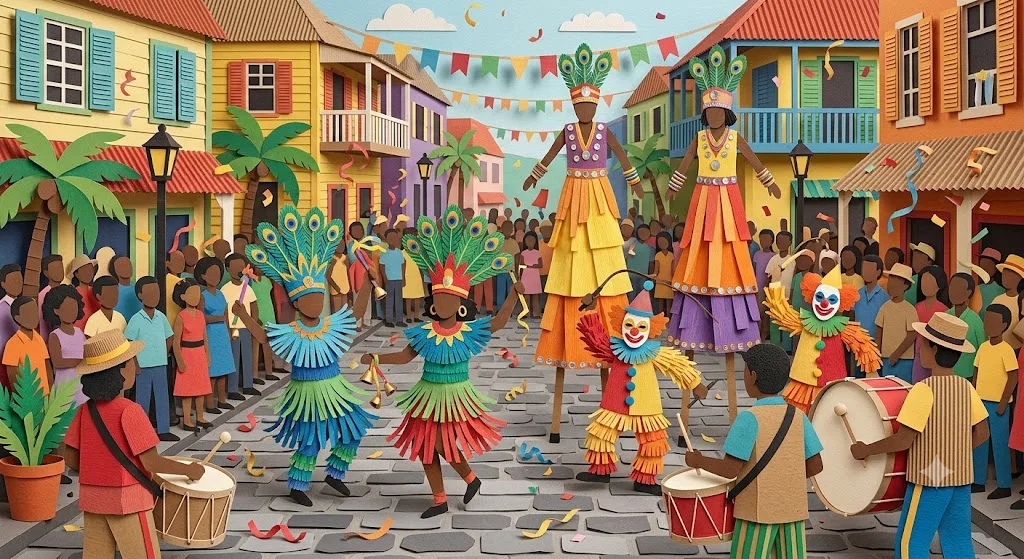
Folklore in Saint Kitts and Nevis is best understood not as a single book of myths, but as a living performance culture: Christmas Sports, masquerade dancing, Bull plays, Mummies, Moko-Jumbies, clowns, fife-and-drum music, comic street drama, ghostly jumbie talk, and local legends attached to estates, gullies, forts and old village memory.
Page outline Jump by section
Introduction
Folklore in Saint Kitts and Nevis is best understood not as a single book of myths, but as a living performance culture: Christmas Sports, masquerade dancing, Bull plays, Mummies, Moko-Jumbies, clowns, fife-and-drum music, comic street drama, ghostly jumbie talk, and local legends attached to estates, gullies, forts and old village memory. Its strongest evidence is not in medieval manuscripts or fixed “mythology”, but in performance, oral tradition, archives, carnival history, heritage festivals and the work of collectors who recorded Kittitian and Nevisian folk drama in the twentieth century. The result is a creole tradition: African, European, Indigenous Caribbean and later popular influences reshaped by plantation life, slavery, emancipation, migration and modern tourism.[sknhcottawa.gov.kn]sknhcottawa.gov.knOpen source on sknhcottawa.gov.kn.
The most distinctive national tradition is the masquerade complex: costumed dancers, mock combats, comic reversals and street performances that once marked the Christmas season and now also appear in Carnival, Nevis Culturama, cultural exhibitions and tourism settings. Some customs are strongly attested; others survive mainly as fragments, memories, revival performances or local explanations. That distinction matters, because Saint Kitts and Nevis has both old oral-performance folklore and modern heritage presentation of that folklore.[unesco.org]ich.unesco.orgOpen source on unesco.org.
Why the folklore looks like performance, not pantheon
A reader looking for “Saint Kitts and Nevis mythology” may expect a neat list of gods, monsters and sacred stories. The country’s better-documented folklore works differently. Its core is public, rhythmic and theatrical: people dress up, parade, dance, tease, fight mock battles, crack whips, play drums, sing and turn social memory into spectacle. The official culture pages of the federation describe Christmas Carnival as a time when Clowns, Moko-Jumbies, Masquerade, Bull and Actors parade in an expression of island pride; Nevis Culturama is similarly framed around heritage, dance, music and traditional folk forms.[sknhcottawa.gov.kn]sknhcottawa.gov.knOpen source on sknhcottawa.gov.kn.
This emphasis comes from history. Saint Kitts and Nevis were plantation colonies where enslaved Africans, their descendants, European settlers and later working-class communities created cultural forms under unequal power. Folklore did not merely “preserve the past”; it created moments when ordinary people could mock authority, rework imported customs, hold onto African-derived rhythms and masking, and turn plantation society upside down for a few days. The National Archives’ account of the survival of Christmas Sports describes them as a time when estate workers could “let go”, make fun of planters and overseers, and release tensions built up through the year.[historicstkitts.kn]historicstkitts.knHistoric St. KittsHistoric St. Kitts
That is why the folklore often feels half festive, half dangerous. The Bull runs wild; the Clowns crack whips; Mummies stage confrontations; masqueraders move from courtly dance into “Wild Mas”. These are not simply entertainments for visitors. They are dramatic ways of remembering hierarchy, resistance, imitation, ridicule and survival.[sknhcottawa.gov.kn]sknhcottawa.gov.knOpen source on sknhcottawa.gov.kn.
Masquerade: the national emblem of movement and mixture
Masquerade is the best-known and most publicly celebrated folklore form in Saint Kitts and Nevis. The High Commission’s cultural account describes it as a Kittitian and Nevisian art form that has developed over roughly 300 years, with performers wearing tall peacock-feathered headdresses, masks, fringed aprons, bangles, mirrors and ribbons. The dance sequence itself mixes European and African elements: quadrille, waltz, jig, rhumba, fertility dance, “Fine” dance, “Wild Mas” and other named movements.[sknhcottawa.gov.kn]sknhcottawa.gov.knOpen source on sknhcottawa.gov.kn.
The power of masquerade lies in that mixture. A slow, formal couple dance may sit beside a more vigorous African-Caribbean warlike movement; refined costume details may sit beside drumming, stamping and athletic display. The result is not a museum specimen of one culture, but a creole performance built from collision, adaptation and invention. Heritage sources also stress the music: fife, kettle drum, big drum and related rhythm patterns accompany the dancers.[SKNVibes]sknvibes.comSt. Kitts Drama & Folklore Groups Migration of people from St KittsSt. Kitts Drama & Folklore Groups Migration of people from St Kitts
Masquerade is also now part of national cultural policy. UNESCO’s intangible cultural heritage pages identify “The Masquerade traditions of Saint Kitts and Nevis” as a safeguarding focus, describing dance performances accompanied by kettle drum, bass drum and fife and linking the practice to the lived experiences of practitioners. A related UNESCO project page records work on revitalising traditional masquerade performing arts and costume making.[Intangible Cultural Heritage]ich.unesco.orgOpen source on unesco.org.
The important point for folklore readers is that masquerade is not only a costume. It is a whole system: costume making, dance knowledge, music, seasonal timing, neighbourhood pride, performer lineages, school teaching, festival use and tourist display. That is why debates about “preservation” are not abstract. If the dance steps, instruments, costume skills and local meanings weaken, the costume alone cannot carry the tradition.

Christmas Sports and the older street theatre
Long before the modern National Carnival became the dominant December spectacle, Christmas Sports provided a seasonal world of folk drama and street performance. The National Archives says that, for two weeks at Christmas, St Kitts came alive with big drum, string band and fife as Masqueraders, Actors, Mummies, Moco Jombie, Clowns and the Bull visited town and country. Some older forms, including David and Goliath, the Cake Walk and Neaga Business, are described as having disappeared.[historicstkitts.kn]historicstkitts.knHistoric St. KittsHistoric St. Kitts
Scholarly work confirms how rich this folk-play tradition was. Peter Millington and Caspar James describe St Kitts and Nevis as having “a rich and varied folk play tradition” forming part of the Christmas Sports, and they note that Dorothy Harding’s 1901 description of Christmas customs included “mystery plays” such as David and Goliath and The Mongoose Play. They also identify Roger Abrahams’ 1960s fieldwork as the first in-depth study of the folk plays, collecting scripts and performances including Cowboys and Indians and the still-popular Bull Play.[White Rose Research Online]eprints.whiterose.ac.ukWhite Rose Research Online
The Christmas Sports also changed over time. The National Archives account says migration to Bermuda, the Dominican Republic and later England reduced the pool of performers; the introduction of Carnival in the Trinidadian style pushed older Christmas Sports into the background; and later independence-era identity building, tourism, school teaching and official cultural work helped them survive in more organised form. By the 1990s, folklore groups were being registered, hired for hotels and cruise arrivals, and integrated into the Carnival parade.[historicstkitts.kn]historicstkitts.knHistoric St. KittsHistoric St. Kitts
That history gives the tradition a double character. On one hand, it is old community folklore. On the other, it is now a staged, managed and sometimes commercial heritage product. Both are real, but they are not identical.
The Bull, Mummies and Moko-Jumbies
The Bull is one of the most vivid Kittitian and Nevisian folk characters. In official cultural retelling, the performer wears red and a bull headdress and acts out a story linked to a 1917 incident at Belmont estate: a manager’s prize bull falls ill, then miraculously revives, and the revival is re-enacted in comic chaos as the bull runs among spectators.[sknhcottawa.gov.kn]sknhcottawa.gov.knOpen source on sknhcottawa.gov.kn.
That plot explains why the Bull is not just an animal costume. It is a miniature folk drama about sickness, revival, panic, laughter and public disorder. In a plantation society, an estate animal and an estate manager’s property become material for working-class street theatre. The Bull’s “wildness” lets the performer disturb normal order while still remaining within a recognised festive frame.
The Mummies preserve another layer of cultural movement. The National Archives explains that the Mummies once had a cast of thirteen characters, including Captain or Fool, Saints David, Andrew, George and Patrick, Slasher, the Turkish Knight, Hector, the Black Prince of Palestine, the Egyptian King, Giant or Dragon, Doctor and Woman. The name is connected not to Egyptian mummies, but to English mummers’ plays that travelled into Caribbean and Newfoundland Christmas customs. In St Kitts, the play features confrontations ending in stick fights and is accompanied by fife and drum.[historicstkitts.kn]historicstkitts.knHistoric St. KittsHistoric St. Kitts
This is a good example of why Saint Kitts and Nevis folklore cannot be reduced to one ancestry. Millington and James note that the Mummies plays recorded by Abrahams on both islands are textually close to British and Irish mummers’ plays, while still being performed in Caribbean settings with local performers, music and meanings.[White Rose Research Online]eprints.whiterose.ac.ukWhite Rose Research Online
Moko-Jumbies bring the supernatural more directly into the street. On the islands they are stilt dancers in long colourful gowns, often explained through African-derived ideas of towering spirit figures, guardians or beings able to see beyond ordinary human level. The High Commission notes competing explanations for the name: one links Moko to an African god of vengeance, while another connects it to the macaw palm and its tall, thorny form. Historic St Kitts also records uncertainty around the name and mentions both a “jombie vampire” story and possible links to people from the Moco ethnic group near Old Calabar in present-day Nigeria.[sknhcottawa.gov.kn]sknhcottawa.gov.knOpen source on sknhcottawa.gov.kn.
For readers, the useful takeaway is that Moko-Jumbies are both folklore beings and performers. They are not simply “ghosts on stilts”; they are a Caribbean masquerade form in which height, costume, dance and spirit-language combine.
Jumbies, soucouyants and the wider Caribbean night-world
Saint Kitts and Nevis shares many supernatural ideas with the wider eastern Caribbean. “Jumbie” or related spellings commonly refer to spirits, ghosts or dangerous supernatural beings in Caribbean folklore. In popular and literary explanations of Caribbean folklore, jumbies are often restless or malevolent spirits, while soucouyants are usually described as skin-shedding, blood-sucking beings who travel by night as a ball of fire.[Kirkus Reviews]kirkusreviews.comKirkus Reviews Exploring Caribbean Folklore with Tracey BaptisteKirkus Reviews Exploring Caribbean Folklore with Tracey Baptiste
For Saint Kitts and Nevis specifically, the stronger documentation connects jumbie language to performance traditions such as Moko-Jumbies and to local explanations of figures like the “sukinaw”, described by Historic St Kitts as a jombie vampire associated with a macaw tree. This is thinner evidence than the documentation for masquerade, Mummies or the Bull, so it should be treated carefully: jumbie belief clearly belongs to the regional cultural vocabulary, but many online lists blur island-specific variants into a general Caribbean monster catalogue.[historicstkitts.kn]historicstkitts.knHistoric St. KittsHistoric St. Kitts
That does not make the supernatural material unimportant. It means the best way to read it is as a shared Caribbean night-world that local communities adapt. Jumbies belong around thresholds: night roads, trees, estates, burial places, gullies, abandoned buildings and warnings to children. They help explain danger, grief, illness, uncanny sounds and the moral risk of moving through the landscape at the wrong time. But unless a source clearly anchors a tale to Saint Kitts or Nevis, it is safer to call it regional Caribbean folklore rather than a uniquely Kittitian or Nevisian legend.
Nevis Culturama and the revival of tradition
Nevis has its own major cultural frame: Culturama. Its official festival site states that its purpose is to preserve Nevis’ rich cultural heritage while also bringing economic benefits to the island. Tourism and festival sources describe Culturama as a late July to early August celebration rooted in heritage, with music, dance, parades, local food and cultural exhibitions.[culturamanevis.com]culturamanevis.comNevis Culturama Festival – De Caribbean Greatest Summer LimeNevis Culturama Festival – De Caribbean Greatest Summer Lime
The origin story of Culturama is explicitly about folklore decline. NevisPages’ account says the idea was conceived in February 1974 at a meeting of the Nevis Dramatic and Cultural Society, where the main concern was the decline of customary folklore troupes in the Christmas festival. Calvin “Cabu” Howell is credited with spearheading efforts to revive, preserve and promote traditional customs and folk art.[NevisPages.com]nevispages.comNevis Pages.com About Culturama – Nevis Pages.comNevis Pages.com About Culturama – Nevis Pages.com
That makes Culturama more than a summer party. It is a deliberate cultural rescue project. It moved some emphasis away from a fading Christmas-only cycle and gave Nevisian folklore a new public platform tied to Emancipation-season heritage, local pride and contemporary festival culture. The High Commission notes that Culturama includes folk dances such as masquerade, Moko-Jumbies on stilts, Cowboys and Indians and Plait the Ribbon.[sknhcottawa.gov.kn]sknhcottawa.gov.knOpen source on sknhcottawa.gov.kn.
This revival pattern is common in postcolonial folklore: a tradition that once belonged to informal seasonal life becomes endangered, then returns through schools, festivals, cultural departments, tourism boards and national heritage projects. The gain is visibility and survival; the risk is that a once unruly street tradition can become tidier, more stage-ready and less socially biting.
Haunted landscapes, old estates and historical legend
Saint Kitts and Nevis also has legends attached to landscape and history, though the evidence varies sharply. Bloody Point in St Kitts is a historical site linked to the massacre of the Kalinago in the early colonial period. Historic St Kitts places it west of Challengers Village and says its name comes from the Kalinago massacre in the vicinity; the same page describes the early English and French settlements and growing hostility towards Tegreman and his people.[historicstkitts.kn]historicstkitts.knOpen source on historicstkitts.kn.
Because Bloody Point is a real historical trauma, it should not be treated as a ghost-story attraction first. It is a place where history, memory and later storytelling meet. Like many violent landscapes, it can accumulate legend, but its cultural importance begins with Indigenous dispossession and colonial violence, not with supernatural entertainment.
Nevis has another useful case: the Jamestown story. A University of Southampton archaeological discussion examines the popular idea that a capital called Jamestown was submerged by an earthquake and tidal wave. The author argues that secure evidence for a catastrophic submerged town is lacking and suggests that the story’s origins may lie in an 1871 account by John Alexander Burke Isles, whose Victorian prose turned disaster into dramatic local history. The paper notes that fissures described as earthquake traces may have been gullies caused by runoff from Mount Nevis.[University of Southampton]southampton.ac.ukUniversity of Southampton Chapter twoUniversity of Southampton Chapter two
This is exactly the kind of distinction a folklore page should make. A legend can be culturally important even when its literal historical claim is doubtful. Jamestown matters because it shows how disaster memory, colonial writing, archaeology and local imagination can combine into a powerful place-story.
Old plantation ruins on Nevis, including estates promoted on heritage trails, also attract ghostly language in travel writing, but much of that material is atmospheric rather than well-attested oral tradition. It is better read as a modern haunted-ruins mode layered onto real plantation history, rather than as firm evidence of a long, specific ghost cult.[Uncommon Caribbean]uncommoncaribbean.comUncommon Caribbean Haunted Plantation Ruins of the Caribbean, NevisUncommon Caribbean Haunted Plantation Ruins of the Caribbean, Nevis
What is old, what is revived, and what is modern packaging?
The clearest old traditions in Saint Kitts and Nevis are the Christmas Sports, masquerade dance, Mummies, Bull, Clowns, Actors, Moko-Jumbies and related musical practices. They are documented by local heritage bodies, twentieth-century collectors, National Archives material and modern cultural institutions. Their roots stretch back through slavery, post-emancipation working-class life, European folk drama, African-Caribbean masking and regional carnival exchange.[White Rose Research Online]eprints.whiterose.ac.ukWhite Rose Research OnlineWhite Rose Research Online
The revived traditions are also important. Culturama, school teaching, cultural department projects, UNESCO safeguarding, exhibitions at places such as Shadwell Greathouse and tourism performances have helped keep these forms visible. A 2026 government report on a Masquerade Traditions Art Exhibition notes that Mocko Jumbies, the Police character in the Bull Play and a textile Masquerade scene were displayed as part of work involving the Department of Cultural Heritage, archives and the Digital Library of the Caribbean.[SKNIS]sknis.gov.knOpen source on sknis.gov.kn.
The more uncertain material includes island-specific claims about jumbies, soucouyants, haunted estates and internet ghost stories. These may reflect real oral themes, but online retellings often merge Saint Kitts and Nevis with wider Caribbean folklore without showing where a specific variant was collected. The safest approach is to treat jumbies and soucouyants as part of the shared Caribbean supernatural vocabulary, while giving priority to locally documented forms when describing national folklore.[kirkusreviews.com]kirkusreviews.comKirkus Reviews Exploring Caribbean Folklore with Tracey BaptisteKirkus Reviews Exploring Caribbean Folklore with Tracey Baptiste
That balance makes the folklore more interesting, not less. Saint Kitts and Nevis does not need invented monsters to be compelling. Its most powerful traditions already contain masks, spirits, comic violence, mock resurrection, plantation satire, migration memory, African-Caribbean rhythm, European folk-play fragments and living performers who still carry the old forms into the street.
Amazon book picks
Further Reading
Books and field guides related to Where Folklore Dances in the Street. Use these as the next step if you want deeper reading beyond the article.
Caribbean Folklore
Directly addresses folklore forms relevant to Saint Kitts and Nevis.
A Brief History of the Caribbean
Explains the historical forces shaping Caribbean folklore.
The Encyclopedia of Caribbean Religions
Provides cultural and spiritual background to folk traditions.
Caribbean Cultural Traditions
Introduces performance, folklore and festival traditions across the region.
eBay marketplace picks
Marketplace Samples
Live-tested eBay searches with available results related to this page.
Endnotes
1.
Source: sknhcottawa.gov.kn
Link:https://sknhcottawa.gov.kn/culture/
2.
Source: eprints.whiterose.ac.uk
Title: White Rose Research Online
Link:https://eprints.whiterose.ac.uk/id/eprint/76599/1/Millington%26James2011.pdf
3.
Source: historicstkitts.kn
Title: Historic St. Kitts
Link:https://www.historicstkitts.kn/items-of-interest
4.
Source: ich.unesco.org
Link:https://ich.unesco.org/en/assistances/the-masquerade-traditions-of-saint-kitts-and-nevis-02455
5.
Source: nevispages.com
Title: Nevis Pages.com About Culturama – Nevis Pages.com
Link:https://www.nevispages.com/culturama/about-culturama/
6.
Source: sknis.gov.kn
Link:https://www.sknis.gov.kn/2026/06/25/st-kitts-nevis-artpieces-and-literature-showcased-in-masquerade-traditions-exhibtion/
7.
Source: culturamanevis.com
Title: Nevis Culturama Festival – De Caribbean Greatest Summer Lime
Link:https://www.culturamanevis.com/
8.
Source: historicstkitts.kn
Title: Historic St. Kitts
Link:https://www.historicstkitts.kn/events/the-christmas-sport-last-week-of-december
9.
Source: sknvibes.com
Title: St. Kitts Drama & Folklore Groups Migration of people from St Kitts
Link:https://www.sknvibes.com/islandfacts/sitepage.cfm?p=158
10.
Source: ich.unesco.org
Link:https://ich.unesco.org/en/projects/revitalisation-of-traditional-masquerade-performing-arts-and-costume-making-00094
11.
Source: caribbeanreads.com
Title: Caribbean Reads Soucouyant
Link:https://www.caribbeanreads.com/soucouyant/
12.
Source: historicstkitts.kn
Link:https://www.historicstkitts.kn/places/bloody-point
13.
Source: historicstkitts.kn
Title: Events The Christmas Sport
Link:https://www.historicstkitts.kn/events
14.
Source: historicstkitts.kn
Link:https://www.historicstkitts.kn/places?start=20
15.
Source: sknvibes.com
Link:https://www.sknvibes.com/islandfacts/sitepage.cfm?p=163
16.
Source: sknvibes.com
Link:https://www.sknvibes.com/islandfacts/sitepage.cfm?p=164
17.
Source: ich.unesco.org
Title: saint kitts and nevis KN
Link:https://ich.unesco.org/en/state/saint-kitts-and-nevis-KN
18.
Source: ich.unesco.org
Title: saint kitts and nevis KN
Link:https://ich.unesco.org/en/state/saint-kitts-and-nevis-KN?cp=KN&info=projects&topic=en-state
19.
Source: sknis.gov.kn
Link:https://www.sknis.gov.kn/2018/10/17/national-carnival-museum-in-st-kitts-nevis-to-showcase-rich-cultural-traditions-while-inspiring-a-new-generation/
20.
Source: buckleysboyz.page.tl
Title: tl Carnival Folklore
Link:https://buckleysboyz.page.tl/Culture.htm
21.
Source: youtube.com
Link:https://www.youtube.com/watch?v=RrmoAOYgUds
Source snippet
ST KITTS AND NEVIS - INTANGIBLE CULTURAL HERITAGE, TRADITIONAL DANCE AND MUSIC HIGHLIGHTS...
22.
Source: youtube.com
Title: ST KITTS AND NEVIS
Link:https://www.youtube.com/watch?v=gy7Cymw2ZRE
Source snippet
MASQUERADE - CULTURE BEAT SKN TV_0015...
23.
Source: youtube.com
Link:https://www.youtube.com/watch?v=JkqNYYiKC_4
Source snippet
Dancers in St Kitts...
24.
Source: kirkusreviews.com
Title: Kirkus Reviews Exploring Caribbean Folklore with Tracey Baptiste
Link:https://www.kirkusreviews.com/news-and-features/articles/exploring-caribbean-folklore-tracey-baptiste/
25.
Source: nevisisland.com
Link:https://www.nevisisland.com/culturama
26.
Source: southampton.ac.uk
Title: University of Southampton Chapter two
Link:https://www.southampton.ac.uk/assets/imported/transforms/content-block/UsefulDownloads_Download/4B532860420C4E4EA83B3291B94EBA40/nevis_2002_Theme_two.pdf
27.
Source: uncommoncaribbean.com
Title: Uncommon Caribbean Haunted Plantation Ruins of the Caribbean, Nevis
Link:https://www.uncommoncaribbean.com/nevis/haunted-plantation-caribbean/
28.
Source: facebook.com
Link:https://www.facebook.com/groups/269202760462518/posts/1221787121870739/
29.
Source: eprints.whiterose.ac.uk
Link:https://eprints.whiterose.ac.uk/76599/1/Millington%26James2011.pdf
30.
Source: nevisheritage.org
Link:https://www.nevisheritage.org/archives
31.
Source: daily.jstor.org
Title: st kitts and nevis
Link:https://daily.jstor.org/st-kitts-and-nevis/
Additional References
32.
Source: facebook.com
Link:https://www.facebook.com/groups/187425044711620/posts/24586202904407161/
33.
Source: tripadvisor.co.uk
Link:https://www.tripadvisor.co.uk/Attraction_Review-g147374-d147556-Reviews-Brimstone_Hill_Fortress_National_Park-St_Kitts_St_Kitts_and_Nevis.html
34.
Source: facebook.com
Link:https://www.facebook.com/groups/269202760462518/posts/1095981537784632/
35.
Source: facebook.com
Link:https://www.facebook.com/groups/191766699268/posts/10160872753724269/
36.
Source: facebook.com
Link:https://www.facebook.com/ScnTrust/posts/christmas-sports-in-st-kitts-nevislong-before-the-birth-of-carnival-christmas-sp/1490629047803586/
37.
Source: nevisheritage.org
Link:https://www.nevisheritage.org/discover
38.
Source: facebook.com
Link:https://www.facebook.com/nevis.island/posts/explore-one-of-nevis-most-spectacular-folklore-traditions-the-moko-jumbie-%EF%B8%8F-%EF%B8%8F-ne/991812889615789/
39.
Source: facebook.com
Link:https://www.facebook.com/groups/191766699268/posts/10158585025189269/
40.
Source: hnoc.org
Link:https://hnoc.org/publishing/first-draft/four-real-new-orleans-legends-put-ghost-stories-shame
41.
Source: instagram.com
Link:https://www.instagram.com/reel/DMnsrvdJYM1/
Topic Tree
Follow this branch
Related pages 192
- Afghan Folklore
- Albanian Folklore
- Algerian Folklore
- Australian Folklore
- Azerbaijan Folklore
- +187 more in sidebar