Why Are Latvia's Songs Filled With Gods and Spirits?
Latvian folklore is unusually song-shaped. Its best-known foundation is the vast body of short traditional folk songs known as dainas, which preserve images of the sun, fate, work, family, animals, fields, seasonal turning points and old religious ideas in compact poetic form.
Page outline Jump by section
Introduction
Latvian folklore is unusually song-shaped. Its best-known foundation is the vast body of short traditional folk songs known as dainas, which preserve images of the sun, fate, work, family, animals, fields, seasonal turning points and old religious ideas in compact poetic form. Yet Latvia’s tradition is not only lyrical or gentle: it also includes night demons that press on sleepers, witches blamed for stealing milk, fairy-like beings who help or harm children, sacred stones and groves, haunted caves, legendary lovers, and modern revivals of pre-Christian belief. The result is a folklore culture where household life, landscape, song and national identity are tightly bound together. UNESCO’s recognition of the Cabinet of Folksongs and the Baltic song and dance celebration tradition reflects how central these traditions remain to Latvian cultural memory today.[unesco.org]unesco.orgDainu SkapisA massive collecting effort of Latvian folk songs took place during the latter half of the 19th century, coinciding with…Read more…
Latvian folklore matters because it is not just a collection of old stories. It helped Latvians imagine themselves as a people during the nineteenth-century national awakening, survived through occupation and censorship, and still appears in festivals, tourism, archives, revival religion, music, crafts and family customs. A reader looking for “Latvian mythology” will often find lists of deities; a better way in is to see how those beings lived in songs, calendar rites, birth customs, farm beliefs and local legends.[unesco.org]unesco.orgDainu SkapisA massive collecting effort of Latvian folk songs took place during the latter half of the 19th century, coinciding with…Read more…
Why Latvian Folklore Begins With Songs
The single most important gateway into Latvian folklore is the daina: a short, memorable folk song, often built around daily life, nature and ritual moments. The Latvian Cultural Canon describes Latvian folk songs as a poetic expression of daily life over centuries, compressed into brief melodic phrases. That compactness matters. Instead of long mythic epics with fixed plots, Latvian tradition often preserves fragments: a sun goddess crossing the sky, a fate goddess present at birth, a thunder god in the heavens, or a household moment made sacred by song.[Kultūras Kanons]kulturaskanons.lvOpen source on kulturaskanons.lv.
The most famous material witness to this tradition is the Cabinet of Folksongs, compiled by Krišjānis Barons. UNESCO records that a major collecting effort took place in the second half of the nineteenth century, during the wider period of European national awakenings, and that Barons assembled, classified and published nearly 218,000 song texts between 1894 and 1915. The Cabinet was later inscribed on UNESCO’s Memory of the World Register, not because every song is ancient in a simple sense, but because the collection became a central archive of Latvian cultural identity.[UNESCO]unesco.orgDainu SkapisA massive collecting effort of Latvian folk songs took place during the latter half of the 19th century, coinciding with…Read more…
This helps explain a common confusion. Latvian mythology is not preserved in one neat “holy book”. It is reconstructed from scattered sources: folk songs, charms, legends, tales, customs, place names, later scholarly interpretation and historical records. The Archives of Latvian Folklore, founded in 1924, now holds more than three million folklore items, including manuscripts, sound and video recordings, photographs and the Cabinet of Dainas itself. The digital archive makes songs, legends, tales and other genres accessible for modern readers and researchers, so Latvian folklore is both old oral heritage and an actively curated public record.[LU LFMI]lulfmi.lvOpen source on lulfmi.lv.
Gods, Fate and the Everyday Sacred
Latvian mythic beings often appear close to ordinary life rather than far away in a separate heroic age. The divine world is strongly associated with the sky, the sun, thunder, birth, fate, fertility and the farm. Scholars of Latvian mythology often emphasise that folk songs are especially important for studying celestial deities and fate goddesses, while narrative legends and tales may contain more international motifs that travelled across Europe.[ResearchGate]researchgate.net329905710 Latvian Folklore Studies and Mythology329905710 Latvian Folklore Studies and Mythology
The most approachable figure is Laima, widely understood as a goddess of fate, fortune and birth. In tradition she is closely linked with childbirth and the shaping of a person’s destiny. Accounts of Latvian mythology describe women praying to Laima, making offerings and reserving a place for her after successful birth rituals. This is not simply “mythology” in the fantasy sense; it reflects how major life passages were imagined as moments when unseen powers were especially near.[Wikipedia]WikipediaLatvian mythologyLatvian mythology
Māra is more complicated. Some interpretations connect her with a pre-Christian earth or chthonic figure; others see her as strongly shaped by the Christian Virgin Mary. That uncertainty is important. Latvian folklore often preserves layered belief, where older concepts, Catholic or Lutheran language, household magic and later national interpretation overlap. Treating every named figure as a straightforward ancient goddess can flatten the evidence; treating everything as Christian borrowing can also miss the depth of local tradition.[Wikipedia]WikipediaLatvian mythologyLatvian mythology
Other major names include Dievs, often translated as God and associated with the sky or cosmic order; Saule, the sun; Pērkons, thunder; and Jumis, linked with harvest fertility. Pērkons belongs to the wider Baltic thunder-god pattern, related in comparison to Lithuanian and other Indo-European thunder figures, but in Latvia his strongest evidence is often song-based and symbolic rather than epic. Jumis, by contrast, belongs very directly to fields and crops: the last grain, double ears and harvest customs express the idea of fertility being left in or invited back to the land.[pantheon.org]pantheon.orgOpen source on pantheon.org.
Creatures That Trouble the House, Barn and Bed
Latvian supernatural tradition is often domestic. The haunted place is not always a castle; it may be a bed, a cowshed, a bathhouse, a field edge or the road home at dusk. Many beings explain frightening or uncertain experiences: sleep paralysis, illness, failing livestock, spoiled milk, a child’s danger, or the sense of being led astray.
One of the most memorable figures is the lietuvēns, a being associated with night oppression. Folklore descriptions link it with the soul of a murdered person or an unbaptised child, and it is said to press, ride or strangle sleeping people and animals. Modern readers will recognise in this a traditional explanation for sleep paralysis: the terrifying feeling of being awake but unable to move, with pressure on the chest. Latvian belief gives the experience a name, a story and protective actions, such as signs or movements used to drive the being away.[Wikipedia]WikipediaOpen source on wikipedia.org.
Lauma is another important figure, but she should not be reduced to a simple “fairy”. In Baltic tradition she can appear as a female supernatural being connected with birth, weaving, children, forests, water and later witch-like features. One modern scholarly study of Latvian laumas argues that the tradition changed over time: laumas were drawn into witchcraft belief systems and, in some contexts, “witchised” into beings resembling dairy witches or harmful female figures. This is a useful example of folklore changing under social pressure rather than staying frozen from pagan antiquity.[LLTI]llti.ltLatvian Laumas: Reflections on the Witchisation of TraditionLatvian Laumas: Reflections on the Witchisation of Tradition
Witches in Latvian folklore are especially rich because they sit at the crossing point of oral legend, folk belief, church influence, early modern witch trials and later scholarship. The Institute of Literature, Folklore and Art notes the complexity of Latvian witch folklore, including work on night witches, milk witches and demonic witches. Research summaries also point out that Soviet ideology discouraged sustained study of charms, folk belief and witch accusations for decades, which affected how the field developed.[LU LFMI]lulfmi.lvOpen source on lulfmi.lv.

Seasonal Customs: The Year Turns Through Fire, Song and Food
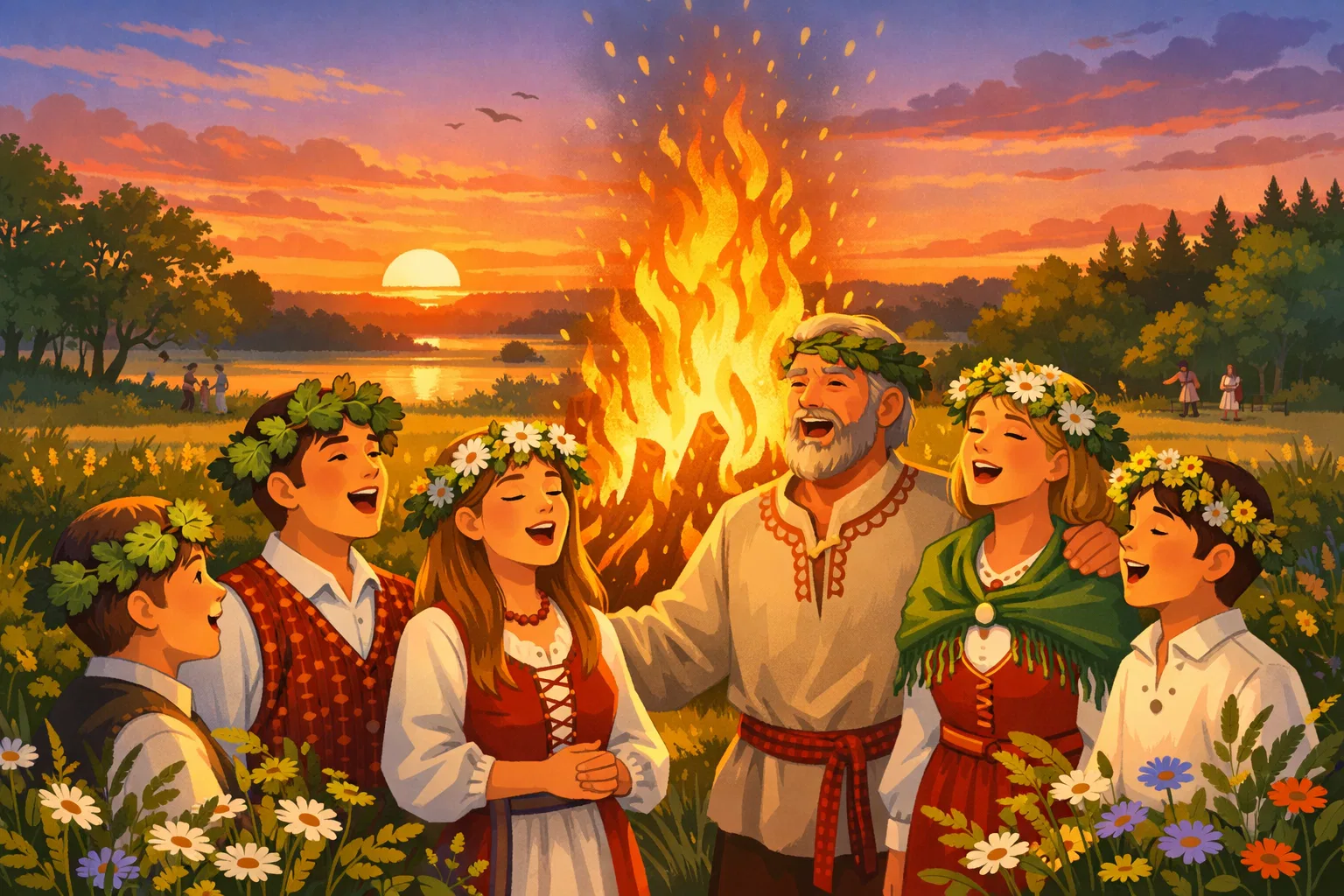
Latvian folklore is easiest to see in public during seasonal festivals. The best-known is the summer solstice celebration, held on the night of 23 to 24 June. Latvia’s official tourism portal calls Jāņi or Līgo the most Latvian holiday of all, describing garlands, beer, caraway cheese, singing, dancing and sauna customs. Public Broadcasting of Latvia likewise describes bonfires, singing, dancing, Midsummer cheese and the expectation that people stay awake to greet the sunrise.[Latvia Travel]latvia.travelOpen source on latvia.travel.
The festival’s power comes from its mixture of Christian calendar date, older seasonal symbolism and modern national feeling. Fire, plants, song and dawn all matter. Wreaths and greenery mark fertility and renewal; bonfires gather communities and symbolically protect the boundary between ordinary time and the charged night of midsummer; singing turns private celebration into shared tradition. The same holiday is also a good reminder that living folklore is not museum theatre. People may celebrate for family, fun, identity, spirituality, rural nostalgia or all of these at once.[Latvia Travel]latvia.travelOpen source on latvia.travel.
The large National Song and Dance Celebration carries seasonal and folk culture into a different scale. UNESCO describes the Baltic song and dance celebrations as a repository and showcase for performing folk art, culminating in large festivals every fifth year in Latvia and Estonia and every fourth year in Lithuania. Latvia’s own festival history describes a 150-year tradition that includes choirs, folk dance, brass bands, instrumental music, craft exhibitions and folklore ensembles.[UNESCO Intangible Cultural Heritage]ich.unesco.orgUNESCO Intangible Cultural HeritageBaltic song and dance celebrationsA repository and a showcase for the region's tradition of performing…
This is where folklore becomes mass civic ritual. The Latvian tourism portal describes the Song and Dance Celebration as rooted in folklore heritage and professional music, and as a symbol of national unity and identity. It usually gathers more than 30,000 participants, while official festival material says the first festival in 1873 had about 1,000 singers and the 2023 celebration involved preparation by around 40,000 participants. The songs may be arranged, staged and modernised, but the emotional logic is recognisably folkloric: many voices making a nation audible to itself.[Latvia Travel]latvia.travelOpen source on latvia.travel.
Sacred Landscapes and Legendary Places
Latvian folklore is deeply tied to place. Sacred hills, stones, caves, springs, groves and named landscape features carry stories about worship, danger, healing, devils, gods and the dead. A study of holy places and cult stones in Latvia notes sacred hill names such as “God’s Hill”, “Holy Hill” and “Devil’s Hill”, with many sacred hills especially in Kurzeme in western Latvia. Broader Baltic sacred-place research also shows that groves, waters, stones and springs are common types of holy place, though legends often do not clearly identify which deity, if any, was worshipped there.[RMK]rmk.eeHoly places und cult stones in LatviaHoly places und cult stones in Latvia
Pokaiņi Forest is a good example of how old landscape feeling and modern legend can blend. Latvia’s official tourism site presents it as a picturesque forest and ancient holy site known for wondrous legends, unusual stone groupings, piles, walls and so-called stone rivers. Tourist retellings often describe the place as energetic or mysterious, but modern scholarship on post-Soviet holy places warns that some “ancient” sacred landscapes are also shaped by recent national, spiritual and alternative-healing movements. Pokaiņi is therefore best read as both a landscape of legend and a modern sacred-tourism site, not as a simple untouched survival from prehistory.[Latvia Travel]latvia.travelOpen source on latvia.travel.
Gutman’s Cave and the Rose of Turaida show another kind of legend: a tragic local story that became literary, moral and touristic heritage. The legend centres on Maija, known as the Rose of Turaida, whose death in 1620 became associated with love, honour and sacrifice. Accounts note that nineteenth-century publication of court-related material and later poems, plays and other artworks helped turn the story into a national romantic legend. Sigulda tourism now presents the Turaida Rose legend as a named heritage route, while European Heritage Days material describes it as a story kept alive for future generations.[wikipedia.org]WikipediaLegend of Turaida RoseLegend of Turaida Rose
Folklore, Nationhood and Revival
Latvian folklore became politically powerful in the nineteenth century because collecting songs, tales and customs helped define Latvians as a cultural nation. UNESCO’s account of the Cabinet of Folksongs explicitly links the major collecting effort to the period of national awakening. The archive was not merely antiquarian; it made peasant songs, oral tradition and local memory into evidence of a people with a distinctive voice.[UNESCO]unesco.orgDainu SkapisA massive collecting effort of Latvian folk songs took place during the latter half of the 19th century, coinciding with…Read more…
That role continued under Soviet rule in more complicated ways. The Archives of Latvian Folklore describes the folklore movement of the 1970s to 1991 as developing during stagnation and decline of the Soviet Union, when aspirations for Latvian culture, way of life and aesthetics intertwined with the political goals of independence. Folk music, costume, seasonal rites and old songs could therefore carry meanings that were cultural on the surface and political underneath.[Latviešu Folkloras Krātuve]lfk.lvOpen source on lfk.lv.
The modern religious movement Dievturība shows another path from folklore to identity. It was formed in the first half of the twentieth century as a reconstructed Latvian ethnic religion rooted in folk songs, mythology and national ideology. Research on contemporary Dievturi describes the movement as treating Latvian folklore not only as traditional culture but as a source for religious practice; other scholarship calls it a reconstructed indigenous religious tradition, revived especially around the late Soviet and post-Soviet periods.[dom.lndb.lv]dom.lndb.lvContemporary “Dievturi” Movement in LatviaContemporary “Dievturi” Movement in Latvia
This distinction matters for readers. Old Latvian folklore, modern Dievturība, nationalist symbolism, New Age sacred landscapes and tourist legends are related, but they are not the same thing. A folk song about Laima may preserve old motifs; a twentieth-century religious ritual may reorganise those motifs into a modern system; a tourist site may turn them into visitor experience; an internet post may simplify them into “Latvian pagan mythology”. Good interpretation asks not only “what is the story?” but “who is telling it, when, and for what purpose?”
What Is Old, What Is Collected, and What Is Modern?
Latvian folklore is well attested, but not always in the way people expect. The strongest evidence is not a continuous written pagan scripture, but a huge body of collected oral tradition, especially songs and beliefs written down from the nineteenth century onwards, combined with earlier historical references and later scholarship. Information on Latvian mythology as everyday belief can be traced in historical sources from the thirteenth century, when German expansion, clergy and chroniclers began recording observations about local customs, but those sources are external, partial and often hostile.[folklore.ee]folklore.eeOpen source on folklore.ee.
The nineteenth- and twentieth-century collections are much richer, but they also come with filters. Collectors chose, classified and published material; national awakening shaped what seemed valuable; Soviet conditions shaped what could be studied; modern archives and digital platforms now shape what is easiest to find. The Archives of Latvian Folklore and its digital resources are therefore not passive storehouses. They are part of the history of how Latvia remembers, organises and reinterprets tradition.[LU LFMI]lulfmi.lvOpen source on lulfmi.lv.
This is why Latvian folklore rewards careful reading. Some motifs are widely Baltic or European: thunder gods, fate at birth, harmful witches, fairy women, haunted caves, sacred stones and midsummer fire all have neighbours and parallels. Others feel distinctively Latvian because of their local names, song forms, regional variants and role in national culture. The point is not to prove that every being or ritual is uniquely Latvian; it is to understand how Latvia’s communities made these inherited motifs their own.
How Latvian Folklore Is Understood Today
Today, Latvian folklore lives in several overlapping worlds. It is archival heritage, studied through institutions and digital collections. It is public culture, performed in song and dance festivals. It is family practice, especially around midsummer. It is spiritual resource for some Dievturi and people interested in ancestral religion. It is also a tourism language for forests, caves, castles and sacred stones.[lulfmi.lv]lulfmi.lvOpen source on lulfmi.lv.
For a curious reader, the most useful mental map is this: Latvian folklore is less a single mythology than a living field of songs, customs, beings and places. Its deities are often glimpsed in compact verses rather than narrated in long myths. Its monsters and spirits often explain household vulnerability. Its festivals turn old seasonal symbols into national celebration. Its landscapes make stones, caves, hills and forests feel storied. Its modern revivals show how folklore can become identity, religion, art and politics.
That layered quality is exactly what makes Latvian folklore compelling. It is old, but not untouched. It is national, but full of regional and family variation. It is poetic, but practical. It can be sung by tens of thousands, whispered as a charm, archived on a manuscript slip, performed at a festival, attached to a forest path, or retold as a ghostly story about the pressure on a sleeper’s chest. In Latvia, folklore is not only about supernatural beings; it is a way of connecting memory, land, language and community.
Amazon book picks
Further Reading
No matched book cards were available for Why Are Latvia's Songs Filled With Gods and Spirits?, so this fallback keeps a direct Amazon reading path visible.
Topical books
Latvian cultural identity books
Browse books, explainers and reference titles related to this topic.
Search AmazonRelated search
Latvian cultural identity guide
Browse books, explainers and reference titles related to this topic.
Search AmazonRelated search
Dievturība religion guide
Browse books, explainers and reference titles related to this topic.
Search AmazonEndnotes
1.
Source: unesco.org
Title: Dainu Skapis
Link:https://www.unesco.org/en/memory-world/dainu-skapis-cabinet-folksongs
Source snippet
A massive collecting effort of Latvian folk songs took place during the latter half of the 19th century, coinciding with...Read more...
2.
Source: ich.unesco.org
Link:https://ich.unesco.org/en/RL/baltic-song-and-dance-celebrations-00087
Source snippet
UNESCO Intangible Cultural HeritageBaltic song and dance celebrationsA repository and a showcase for the region's tradition of performing...
3.
Source: latvia.travel
Link:https://www.latvia.travel/en/nationwide-latvian-song-and-dance-festival
4.
Source: lulfmi.lv
Link:https://lulfmi.lv/en/archives-of-latvian-folklore
5.
Source: researchgate.net
Title: 329905710 Latvian Folklore Studies and Mythology
Link:https://www.researchgate.net/publication/329905710_Latvian_Folklore_Studies_and_Mythology
6.
Source: folklore.ee
Link:https://www.folklore.ee/rl/pubte/ee/bif/bif1/kokare.html
7.
Source: Wikipedia
Title: Latvian mythology
Link:https://en.wikipedia.org/wiki/Latvian_mythology
8.
Source: pantheon.org
Link:https://pantheon.org/articles/p/perkons.html
9.
Source: Wikipedia
Link:https://en.wikipedia.org/wiki/Lietuv%C4%93ns
10.
Source: llti.lt
Title: Latvian Laumas: Reflections on the Witchisation of Tradition
Link:https://www.llti.lt/failai/laime%281%29.pdf
11.
Source: lulfmi.lv
Link:https://lulfmi.lv/en/news/klaja-nak-pirmais-izdevums-serija-latviesu-teiku-tipu-un-motivu-raditajs
12.
Source: latvia.travel
Link:https://www.latvia.travel/en/summer-solstice-celebrations
13.
Source: rmk.ee
Title: Holy places und cult stones in Latvia
Link:https://rmk.ee/wp-content/uploads/2024/11/Parandkultuur_III_Andris_Grinbergs.pdf
14.
Source: latvia.travel
Link:https://www.latvia.travel/en/sight/pokaini-forest
15.
Source: researchgate.net
Link:https://www.researchgate.net/publication/270415228_The_Mythology_of_Ethnic_Identity_and_the_Establishing_of_Modern_Holy_Places_in_Post-Soviet_Latvia
16.
Source: Wikipedia
Title: Legend of Turaida Rose
Link:https://en.wikipedia.org/wiki/Legend_of_Turaida_Rose
17.
Source: tourism.sigulda.lv
Title: aizrauj!15. Legend of the Turaida Rose
Link:https://tourism.sigulda.lv/15-legenda-par-turaidas-rozi/?lang=en
18.
Source: dom.lndb.lv
Title: Contemporary “Dievturi” Movement in Latvia
Link:https://dom.lndb.lv/data/obj/file/29638545.pdf
19.
Source: researchgate.net
Title: 365386590 Latvian Laumas Reflections on the Witchisation of Tradition
Link:https://www.researchgate.net/publication/365386590_Latvian_Laumas_Reflections_on_the_Witchisation_of_Tradition
20.
Source: researchgate.net
Link:https://www.researchgate.net/publication/322028378_The_Song_and_dance_celebration_tradition_as_a_brand_of_the_singing_nations_of_the_baltic_countries_Similarities_and_differences
21.
Source: researchgate.net
Title: 330205165 Latvian Religion Dievturiba
Link:https://www.researchgate.net/publication/330205165Latvian_Religion-_Dievturiba
22.
Source: researchgate.net
Link:https://www.researchgate.net/publication/26428221_Folklore_and_Identity_the_Situation_of_Latvia
23.
Source: Wikipedia
Link:https://en.wikipedia.org/wiki/Latvia
24.
Source: Wikipedia
Title: The Cabinet of Folksongs
Link:https://ig.wikipedia.org/wiki/The_Cabinet_of_Folksongs
25.
Source: Wikipedia
Title: Cabinet of Folksongs
Link:https://en.wikipedia.org/wiki/Cabinet_of_Folksongs
26.
Source: Wikipedia
Link:https://en.wikipedia.org/wiki/J%C4%81%C5%86i
27.
Source: Wikipedia
Link:https://en.wikipedia.org/wiki/Lauma
28.
Source: Wikipedia
Title: Latvian Song and Dance Festival
Link:https://en.wikipedia.org/wiki/Latvian_Song_and_Dance_Festival
29.
Source: Wikipedia
Link:https://en.wikipedia.org/wiki/Dievtur%C4%ABba
30.
Source: unesco.org
Title: document 2621
Link:https://www.unesco.org/archives/multimedia/document-2621
31.
Source: media.unesco.org
Title: dainu skapis cabinet of folksongs
Link:https://media.unesco.org/sites/default/files/webform/mow001/dainu_skapis_-_cabinet_of_folksongs.pdf
32.
Source: ich.unesco.org
Title: xxvii nationwide song and xvii dance festival 00309
Link:https://ich.unesco.org/fr/activites/xxvii-nationwide-song-and-xvii-dance-festival-00309
33.
Source: unesco.org
Title: document 1742
Link:https://www.unesco.org/archives/multimedia/document-1742
34.
Source: ich.unesco.org
Title: photo pop up 00973
Link:https://ich.unesco.org/en/photo-pop-up-00973?photoID=05376
35.
Source: ich.unesco.org
Title: living heritage experience and covid 19 pandemic 01124
Link:https://ich.unesco.org/en/living-heritage-experience-and-covid-19-pandemic-01124?id=41667&include=film_inc.php
36.
Source: unesco.lv
Link:https://www.unesco.lv/lv/media/177/download?attachment=
37.
Source: dziesmusvetki.lndb.lv
Link:https://dziesmusvetki.lndb.lv/en/
38.
Source: folklore.ee
Link:https://www.folklore.ee/folklore/vol42/vaitkevicius.pdf
39.
Source: latvia.travel
Link:https://www.latvia.travel/en/node/5103
40.
Source: latvians.com
Link:https://latvians.com/index.php?en%2FCFBH%2FZimes%2Fzimes-00-sheet.ssi=
41.
Source: lfk.lv
Link:https://lfk.lv/the-folklore-movement-in-latvia/
42.
Source: kulturaskanons.lv
Link:https://kulturaskanons.lv/en/archive/latvju-dainas/
43.
Source: lfk.lv
Link:https://lfk.lv/krisjana-barona-konference/files/2014/abstracts_mapping_2014.pdf
44.
Source: dziesmusvetki.lv
Title: the song and dance celebration
Link:https://www.dziesmusvetki.lv/en/about-the-celebration/the-song-and-dance-celebration/
45.
Source: en.lfk.lv
Title: folksong cabinet
Link:https://en.lfk.lv/collection/folksong-cabinet
46.
Source: en.lfk.lv
Title: isfnr2024 program
Link:https://en.lfk.lv/isfnr2024-program
47.
Source: en.lfk.lv
Title: ISFNR 19th Congress Riga Latvia 2024
Link:https://en.lfk.lv/img/uploads/2024/06/ISFNR-19th-Congress-Riga-Latvia-2024.pdf
48.
Source: lfk.lv
Title: mapping the history of folklore studies 2017 sample
Link:https://lfk.lv/krisjana-barona-konference/files/2014/mapping_the_history_of_folklore_studies_2017_-_sample.pdf
49.
Source: en.lfk.lv
Title: lv Commerce and Traditions
Link:https://en.lfk.lv/img/uploads/2022/commerce-and-traditions-abstracts-2022-ii.pdf
50.
Source: en.lfk.lv
Title: lv Archives of Latvian Folklore
Link:https://en.lfk.lv/
51.
Source: youtube.com
Title: UNESC O un vērtības VII/ UNESCO and values VIIUNESCO un vērtības
Link:https://www.youtube.com/watch?v=Zqa2hZYbr1w
52.
Source: lulfmi.academia.edu
Link:https://lulfmi.academia.edu/Departments/Archives_of_Latvian_Folklore/Documents
53.
Source: tripadvisor.com
Title: Pokaiņi Forest
Link:https://www.tripadvisor.com/Attraction_Review-g2436447-d7263998-Reviews-Pokaini_Forest-Dobele_Zemgale_Region.html
54.
Source: traditionarchives.org
Link:https://www.traditionarchives.org/archives/latvia
55.
Source: atlasobscura.com
Title: the rose of turaida
Link:https://www.atlasobscura.com/places/the-rose-of-turaida
56.
Source: dervaderenerfdeel.wordpress.com
Title: latvian mythology
Link:https://dervaderenerfdeel.wordpress.com/2016/03/06/latvian-mythology/
57.
Source: kulturaskanons.lv
Link:https://kulturaskanons.lv/en/archive/jani/
58.
Source: kulturaskanons.lv
Link:https://kulturaskanons.lv/en/archive/dziesmu-svetki/
59.
Source: artandpopularculture.com
Title: Latvian mythology
Link:https://www.artandpopularculture.com/Latvian_mythology
60.
Source: scribd.com
Link:https://www.scribd.com/document/766828903/Latvian-mythology
61.
Source: instagram.com
Link:https://www.instagram.com/p/DMuTLJzMnUq/
62.
Source: unescoicdh.org
Link:https://www.unescoicdh.org/eng/sub.php?code1=00000004&code2=00000063&listCnt=10&menukey=289&mod=view&no=29280
63.
Source: incubator.wikimedia.org
Title: Cabinet of Folksongs
Link:https://incubator.wikimedia.org/wiki/Wp/wlx/Cabinet_of_Folksongs
64.
Source: religion.fandom.com
Title: Latvian mythology
Link:https://religion.fandom.com/wiki/Latvian_mythology
Additional References
65.
Source: youtube.com
Title: Latvian Folklore (Documentary with ENGLISH SUBTITLES)
Link:https://www.youtube.com/watch?v=z62Ai8vrebk
Source snippet
Witches and Their Secrets in Latvian Folklore...
66.
Source: youtube.com
Title: Latvian Dainas and Vedic Hymns — Similarities and Differences
Link:https://www.youtube.com/watch?v=0nmsXEHtpz4
Source snippet
Discover the secret goddess of the Baltics...
67.
Source: youtube.com
Title: Witches and Their Secrets in Latvian Folklore
Link:https://www.youtube.com/watch?v=BBKN3g2SDIU
Source snippet
Latvian Dainas and Vedic Hymns — Similarities and Differences...
68.
Source: youtube.com
Title: Discover the secret goddess of the Baltics
Link:https://www.youtube.com/watch?v=NWVvLeD5kd0
Source snippet
Fall Asleep to Baltic Sun Goddess Mythology | Sleep & Relaxation...
69.
Source: nacgavilet.lv
Link:https://www.nacgavilet.lv/en/about-the-celebration/
70.
Source: reddit.com
Link:https://www.reddit.com/r/mythology/comments/100yycy/accurate_sources_for_balticlatvian_paganism/
71.
Source: reddit.com
Link:https://www.reddit.com/r/latvia/comments/sk4b9h/baltic_latvian_mythology/
72.
Source: facebook.com
Link:https://www.facebook.com/groups/170790266633157/posts/1607077136337789/
73.
Source: wanderlustmagazine.com
Link:https://www.wanderlustmagazine.com/inspiration/latvia-midsummer-ligo-jani/
74.
Source: iesaisties.lv
Link:https://iesaisties.lv/?lang=en
Amazon book picks
Further Reading
Books and field guides related to Why Are Latvia's Songs Filled With Gods and Spirits?. Use these as the next step if you want deeper reading beyond the article.
Linguistics and Poetics of Latvian Folk Songs
Dainas are central to understanding Latvian folklore.
The Hero with a Thousand Faces
Helps general readers compare Latvian stories with world mythology.
Topic Tree
Follow this branch
Related pages 192
- Afghan Folklore
- Albanian Folklore
- Algerian Folklore
- Australian Folklore
- Azerbaijan Folklore
- +187 more in sidebar