Within Costa Rica Folklore
What Makes Sibö More Than a Myth?
Bribri and Cabécar stories of Sibö belong to living systems of language, land, ritual knowledge and cultural memory.
On this page
- Sibö in Bribri and Cabécar tradition
- Creation, land, food and social order
- Why Indigenous cosmology differs from ghost lore
Page outline Jump by section
Introduction
For many readers exploring Costa Rican folklore, the first encounters are often with ghostly figures such as the Cadejos or the Cegua. Yet some of the country’s oldest and most important traditional narratives belong to a very different category. Among the Bribri and Cabécar peoples of the Talamanca region, stories about Sibö are not simply myths in the sense of entertaining tales from a distant past. They form part of a living Indigenous worldview that explains how the world was created, how people should live, how food and land were given meaning, and why social obligations matter. These traditions remain connected to language, ceremony, community memory and ancestral territory today.[wikipedia.org]WikipediaTalamancan mythologyTalamancan mythology

Understanding Sibö therefore offers a different way of understanding Costa Rica’s traditional culture. Instead of haunted roads and supernatural warnings, these narratives focus on creation, responsibility, kinship, agriculture and the relationship between human beings and the natural world.[Wikipedia]WikipediaOpen source on wikipedia.org.
What Makes Sibö More Than a Myth?
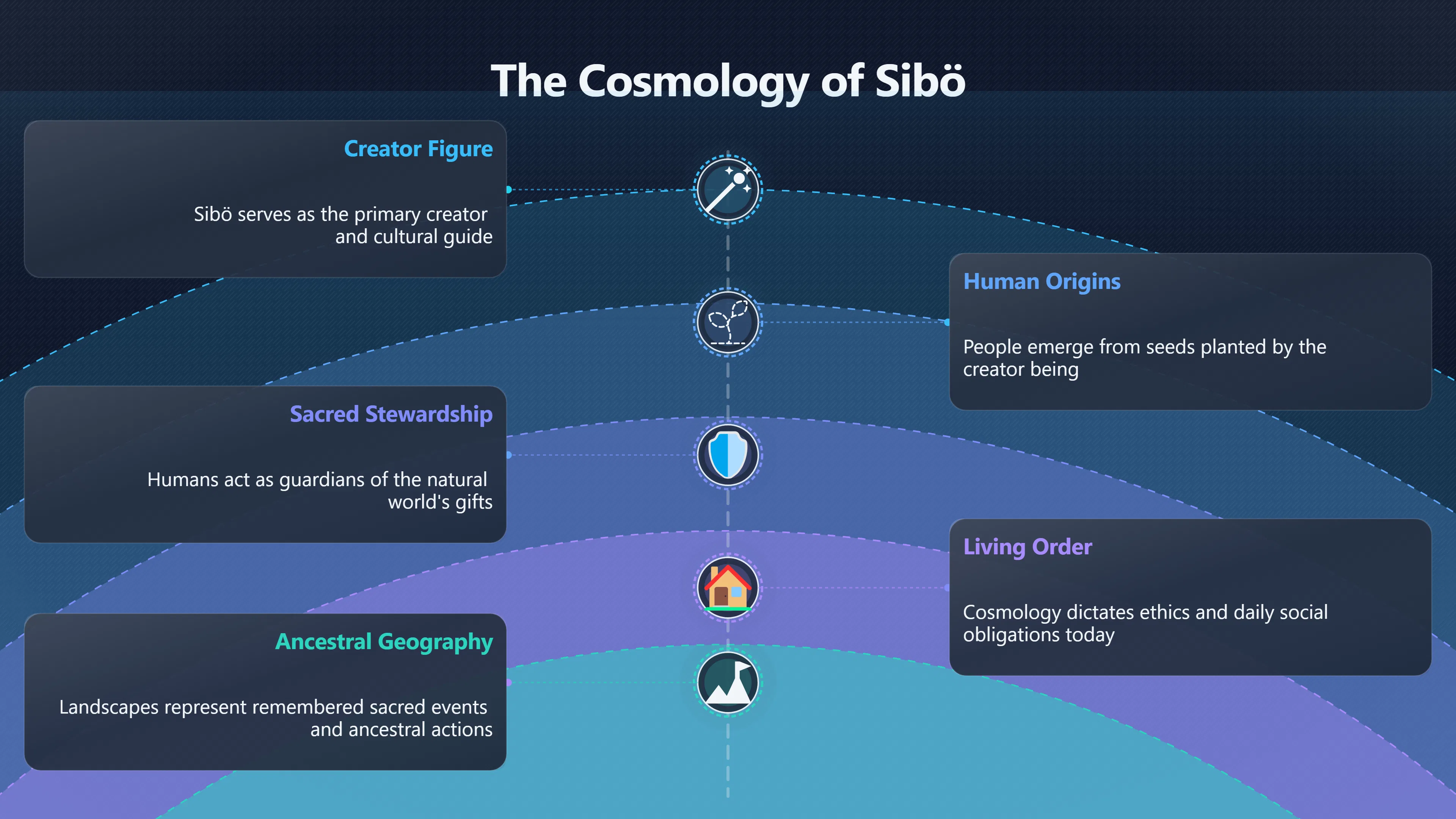
Sibö is the central creator figure in the traditional cosmology shared by the Bribri and Cabécar peoples of Talamanca in south-eastern Costa Rica. In oral traditions recorded by researchers and Indigenous knowledge keepers, Sibö is described as creator, teacher and cultural guide. He is not merely a distant god who formed the world and disappeared. He is remembered as the being who established the foundations of society and taught people how to live properly.[Wikipedia]WikipediaOpen source on wikipedia.org.
Traditional accounts portray Sibö as responsible for creating the earth and humanity. He is also credited with teaching which foods are safe to eat, how crops should be cultivated, how ritual specialists should perform their duties, and how moral and social rules should operate. Stories associated with Sibö explain the origins of clans, rules governing marriage, and the responsibilities people owe one another.[Wikipedia]WikipediaOpen source on wikipedia.org.
This role helps explain why many Bribri and Cabécar people do not separate cosmology, ethics and everyday life in the same way that outsiders often separate religion, folklore and social custom. The stories are not only about what happened at the beginning of time; they are also about how life should be organised in the present.[Wikipedia]WikipediaOpen source on wikipedia.org.
Sibö in Bribri and Cabécar Tradition
The Bribri and Cabécar are closely related Indigenous peoples whose territories lie in and around the Talamanca mountain region. Although they speak different languages, they share many religious beliefs, ceremonial practices and traditional narratives. Sibö occupies a central place in both traditions.[wikipedia.org]WikipediaTalamancan mythologyTalamancan mythology
One of the most important themes in these traditions is that humanity is part of a larger living order established by Sibö. In several recorded versions of creation narratives, people originate from seeds planted by the creator. Corn, a sacred crop throughout much of Indigenous Central America, plays a particularly important role in these accounts. Human beings are portrayed not as separate from nature but as emerging from the same life-giving processes that sustain plants and animals.[wikipedia.org]WikipediaOpen source on wikipedia.org.
Another recurring theme is stewardship. Sibö is often described as the guardian or owner of humanity, and human beings are expected to respect the gifts they have received from the natural world. This outlook has often been linked by researchers and Indigenous educators to traditional approaches to agriculture, forest use and environmental care in Talamanca.[Wikipedia]WikipediaOpen source on wikipedia.org.
Creation, Land, Food and Social Order
Creation stories associated with Sibö are not limited to the appearance of the earth itself. They also explain how particular landscapes, foods, plants and social institutions came into existence.
One well-known cycle of stories concerns the creation of the earth through the transformation of a sacred being associated with the figure Irìria. In traditional narratives, events involving Sibö and his relatives lead to the formation of the world as a place where people can plant, harvest and live. The earth is therefore not merely physical territory; it is a sacred inheritance linked to ancestral actions.[Wikipedia]WikipediaTalamancan mythologyTalamancan mythology
Food is equally important. Sibö is remembered as the teacher of cultivation and subsistence. Oral traditions explain how people learned which plants to grow and how agriculture should be organised. These stories are especially significant in a region where farming, forest knowledge and ecological understanding have long been central to community life.[Wikipedia]WikipediaOpen source on wikipedia.org.
The narratives also establish social order. Traditional accounts credit Sibö with setting rules concerning kinship, clan organisation and marriage. Such stories help explain why social obligations are often presented as part of a sacred order rather than merely human convention.[Wikipedia]WikipediaOpen source on wikipedia.org.

Why Cacao Holds a Sacred Place
Few elements of Bribri tradition are more widely known than the sacred importance of cacao. The significance of cacao is rooted in stories connected to Sibö and creation.
According to traditional teachings, the cacao tree originated through a transformation connected to a woman. Because of this sacred origin, women have special responsibilities regarding cacao preparation and ceremonial use. In many communities, women have traditionally held the authority to prepare the sacred cacao drink used during important rituals and life events.[study.com]study.comBribri People, History & CultureThe Bribri believe that the cacao tree was originally a woman, and Sibú turned it into a tree. For this r…
The story is much more than an explanation for a crop. It links food production, gender roles, ritual life and ancestry into a single symbolic system. Even today, visitors to Bribri communities often encounter explanations of cacao that draw directly on these traditional narratives rather than treating chocolate simply as an agricultural product.[Soul Life Travel]soullifetravel.netSoul Life TravelBribri Chocolate & Indigenous Culture in Costa RicaNovember 16, 2025 — 16 Nov 2025 — In Bribri worldview, cacao is sacred…
How Cosmology Shapes the Landscape
Sibö’s presence is not confined to ancient stories. Traditional architecture, sacred spaces and cultural practices frequently express aspects of the same worldview.
The traditional Bribri conical house, sometimes described as a representation of the universe, is often interpreted through stories associated with Sibö. In some explanations, structural elements symbolise beings that assisted in the creation of the world. The building itself becomes a model of cosmic order rather than merely a place to live.[Bribri Indigenous Territory]bribricostarica.comEach pillar is carefullyBribri Indigenous TerritorySacred Architecture & Ancestral CraftsJanuary 13, 2026 — For the Bribri, the eight pillars of their traditiona…
Likewise, rivers, mountains, forests and cultivated lands are often understood through narratives that connect physical places to ancestral events. The landscape of Talamanca is therefore not simply scenery but part of a remembered sacred geography.[Wikipedia]WikipediaTalamancan mythologyTalamancan mythology
Why Indigenous Cosmology Differs from Ghost Lore
Readers approaching Costa Rican folklore through famous supernatural legends may be tempted to place Sibö alongside ghosts, witches and monster stories. Doing so can obscure important differences.
Legends such as the Cegua or the Cadejos generally function as cautionary tales tied to particular behaviours, places or encounters. They are often episodic and focused on specific supernatural events. Sibö traditions, by contrast, form part of a broader cosmology that explains the origins and structure of existence itself.[Wikipedia]WikipediaOpen source on wikipedia.org.
Another difference is continuity. Many colonial and post-colonial legends have changed substantially over time and are often retold mainly as folklore. Stories about Sibö remain embedded within living Indigenous communities where they are connected to language, ritual knowledge, ecological practice and cultural identity. The traditions continue to be transmitted by elders, teachers and cultural specialists rather than surviving only as historical curiosities.[ucr.ac.cr]dipalicori.ucr.ac.crDipalicori BribriBribri - Dipalicori - Universidad de Costa Rica3 Nov 2020 — The Bribri language is spoken in two regions: on the Atlantic side…
For that reason, discussions of Sibö are often approached with particular respect. While outsiders may describe these narratives as mythology, many community members regard them as part of an ongoing body of ancestral knowledge that helps define who they are and how they relate to the world around them.[Ditsowou LODGE & TOURS]ditsowou.comel legado de sibö la fascinante espiritualidad de los bribris de talamanca 1Ditsowou LODGE & TOURSSibö's legacy: The fascinating spirituality of the Bribris…29 Aug 2023 — Sibö, the great spirit of the Bribris…

Sibö in Contemporary Costa Rica
Although Costa Rica is often internationally associated with beaches, rainforests and colonial-era legends, Indigenous creation traditions remain an essential part of the country’s cultural heritage. The Bribri and Cabécar peoples continue to maintain languages, ceremonies and oral traditions linked to Sibö despite centuries of external pressure and cultural change.[IWGIA]iwgia.org5084 iw 2023 costa ricaThe Indigenous World 2023: Costa RicaMar 27, 2023 — Eight Indigenous Peoples live in Costa Rica: the Huetar, Maleku, Bribri, Cabécar…
Today, Sibö appears in educational programmes, cultural revitalisation projects, Indigenous tourism initiatives and discussions about environmental stewardship. Yet the most important context remains within the communities themselves, where the stories continue to connect people to land, ancestry and collective memory.[soullifetravel.net]soullifetravel.netSoul Life TravelBribri Chocolate & Indigenous Culture in Costa RicaNovember 16, 2025 — 16 Nov 2025 — In Bribri worldview, cacao is sacred…
In the wider landscape of Costa Rican folklore, Sibö stands apart because the figure represents far more than a legendary character. Sibö is the centre of a living Indigenous cosmology that links creation, morality, agriculture, community and sacred geography into a coherent understanding of the world.[Wikipedia]WikipediaOpen source on wikipedia.org.
Amazon book picks
Further Reading
Books and field guides related to What Makes Sibö More Than a Myth?. Use these as the next step if you want deeper reading beyond the article.
Popol Vuh
Provides accessible entry into Indigenous Mesoamerican cosmology and creation narratives.
The Hero with a Thousand Faces
Explores archetypal structures found in traditional creation stories.
The Mythology Book
Places creator figures and cosmologies such as Sibö into a wider mythological context.
Gods and Myths of Northern Europe
Offers comparative understanding of living traditional cosmologies.
eBay marketplace picks
Marketplace Samples
Live-tested eBay searches with available results related to this page.
Endnotes
1.
Source: Wikipedia
Title: Talamancan mythology
Link:https://en.wikipedia.org/wiki/Talamancan_mythology
2.
Source: Wikipedia
Link:https://en.wikipedia.org/wiki/Sib%C3%BA
3.
Source: ditsowou.com
Title: el legado de sibö la fascinante espiritualidad de los bribris de talamanca 1
Link:https://www.ditsowou.com/en/post/el-legado-de-sib%C3%B6-la-fascinante-espiritualidad-de-los-bribris-de-talamanca-1
Source snippet
Ditsowou LODGE & TOURSSibö's legacy: The fascinating spirituality of the Bribris...29 Aug 2023 — Sibö, the great spirit of the Bribris...
4.
Source: Wikipedia
Link:https://en.wikipedia.org/wiki/Cab%C3%A9car_people
Source snippet
Cabécar peopleThe Cabécar are an Indigenous group of the remote Talamanca region of eastern Costa Rica. They speak Cabécar, a language...
5.
Source: digitalcommons.usf.edu
Link:https://digitalcommons.usf.edu/cgi/viewcontent.cgi?article=1136&context=jea
Source snippet
Digital Commons USFShocks and Bribri Agriculture Past and Presentby P Posas · Cited by 16 — In their creation story, the Bribri spring fr...
6.
Source: study.com
Link:https://study.com/academy/lesson/bribri-people-overview-history-culture.html
Source snippet
Bribri People, History & CultureThe Bribri believe that the cacao tree was originally a woman, and Sibú turned it into a tree. For this r...
7.
Source: iwgia.org
Title: 5084 iw 2023 costa rica
Link:https://iwgia.org/en/costa-rica/5084-iw-2023-costa-rica.html
Source snippet
The Indigenous World 2023: Costa RicaMar 27, 2023 — Eight Indigenous Peoples live in Costa Rica: the Huetar, Maleku, Bribri, Cabécar...
8.
Source: iwgia.org
Link:https://iwgia.org/en/costa-rica.html
9.
Source: terralingua.org
Link:https://terralingua.org/stories/strengthening-indigenous-cultural-heritage-through-capacity-building-in-costa-rica/
Source snippet
Strengthening Indigenous Cultural Heritage through...9 July 2015 — There are eight Indigenous groups in Costa Rica, numbering some 63,80...
Published: July 2015
10.
Source: Wikipedia
Title: Bribri language
Link:https://en.wikipedia.org/wiki/Bribri_language
Source snippet
Bribri languageAn estimate by the National Census of Costa Rica in 2011 found that Bribri is currently spoken by 54.7% of the 12,785 B...
11.
Source: Wikipedia
Title: Indigenous peoples of Costa Rica
Link:https://en.wikipedia.org/wiki/Indigenous_peoples_of_Costa_Rica
Source snippet
Indigenous peoples of Costa RicaCosta Rica. Languages. Bribri, Cabecar, Ngäbe, Maleku, Brunca, Terraba, Spanish (Chorotega and Huetar...
12.
Source: ditsowou.com
Link:https://www.ditsowou.com/en/post/el-chocolate-un-v%C3%ADnculo-sagrado-con-la-vida-espiritual-de-los-pueblos-ind%C3%ADgenas-1
Source snippet
Chocolate: A Sacred Link to the Spiritual Life of Indigenous...5 Jul 2023 — This article explores the social and historical process of c...
13.
Source: dipalicori.ucr.ac.cr
Title: Dipalicori Bribri
Link:https://dipalicori.ucr.ac.cr/en/lengua-cultura/bribri/
Source snippet
Bribri - Dipalicori - Universidad de Costa Rica3 Nov 2020 — The Bribri language is spoken in two regions: on the Atlantic side...
14.
Source: soullifetravel.net
Link:https://soullifetravel.net/bribri-chocolate-indigenous-culture-costa-rica/
Source snippet
Soul Life TravelBribri Chocolate & Indigenous Culture in Costa RicaNovember 16, 2025 — 16 Nov 2025 — In Bribri worldview, cacao is sacred...
Published: November 16, 2025
15.
Source: bribricostarica.com
Title: Each pillar is carefully
Link:https://bribricostarica.com/heritage/
Source snippet
Bribri Indigenous TerritorySacred Architecture & Ancestral CraftsJanuary 13, 2026 — For the Bribri, the eight pillars of their traditiona...
Published: January 13, 2026
16.
Source: immigrationexpertscr.com
Title: the secret languages of costa rica uncovering indigenous wisdom
Link:https://immigrationexpertscr.com/the-secret-languages-of-costa-rica-uncovering-indigenous-wisdom/
Source snippet
The Secret Languages of Costa RicaMar 15, 2024 — Costa Rica's indigenous languages, including Cabécar, Bribri, Guaymí, and Maleku, among...
17.
Source: dipalicori.ucr.ac.cr
Link:https://dipalicori.ucr.ac.cr/en/articulos/lengua/
Source snippet
Bribri, Cabécar, and Limonese Creole. While it is the Indigenous language with the greatest vitality in Costa Rica and with the highest...
18.
Source: whc.unesco.org
Link:https://whc.unesco.org/en/statesparties/cr
Source snippet
Rica - UNESCO World Heritage ConventionWorld Heritage Festival in Costa Rica. 19 Nov 2022 - 20 Nov 2022. Costa... Intangible Cultural He...
Additional References
19.
Source: gsevenier.free.fr
Link:https://gsevenier.free.fr/indigenesreportageENG.html
Source snippet
The Indigenous tribes of Costa RicaThe traditional houses of the indigenous people of Talamanca are built on the image of Sibo's house, r...
20.
Source: visitnuevoarenal.com
Link:https://visitnuevoarenal.com/costa-ricas-indigenous-peoples-guardians-of-biodiversity-and-cultural-resilience-on-their-international-day/
Source snippet
Guardians of Biodiversity and Cultural Resilience on Their...Apr 21, 2025 — Costa Rica's Indigenous groups—the Bribri, Cabécar, Maleku...
21.
Source: facebook.com
Title: costa rican legend of sibúsibú is the primary deity in the talamancan mythology
Link:https://www.facebook.com/OsaTropicalProperties/posts/costa-rican-legend-of-sib%C3%BAsib%C3%BA-is-the-primary-deity-in-the-talamancan-mythology-/4197336553642423/
Source snippet
Costa Rican Legend of Sibú Sibú is the primary deity in...12 May 2021 — In Bribri and Cabécar culture, Sibö is seen as the "owner" or "g...
Published: May 2021
22.
Source: misticopark.com
Title: exploring indigenous ethnicities costa rica territorial distribution
Link:https://misticopark.com/blog/cultural/exploring-indigenous-ethnicities-costa-rica-territorial-distribution/
Source snippet
8 Indigenous Groups of Costa Rica & Where They LiveSep 18, 2024 — While each group has its own cultural identity and language, the Bribri...
23.
Source: elcolectivo506.com
Title: can i get to know indigenous cultures during my visit to costa rica
Link:https://elcolectivo506.com/can-i-get-to-know-indigenous-cultures-during-my-visit-to-costa-rica/?lang=en
Source snippet
Can I get to know indigenous cultures during my visit...Mar 4, 2022 — eight indigenous groups, some of which have two different names—Br...
24.
Source: researchgate.net
Title: 272991989 Las lenguas indigenas de la Costa Rica actual
Link:https://www.researchgate.net/publication/272991989_Las_lenguas_indigenas_de_la_Costa_Rica_actual
Source snippet
(PDF) Las lenguas indígenas de la Costa Rica actualMar 17, 2026 — La población indígena costarricense asciende a 63,876 personas distribu...
25.
Source: thecostaricanews.com
Title: sibu cultural hero of the talamanquena mythology
Link:https://thecostaricanews.com/sibu-cultural-hero-of-the-talamanquena-mythology/
Source snippet
Sibú, Cultural Hero of the Talamanqueña Mythology11 Jul 2020 — Sibú is also a cultural hero, who taught the Bribris and Cabécares what pr...
26.
Source: facebook.com
Link:https://www.facebook.com/groups/costaricatravel/posts/9218177151562715/
Source snippet
(or Naso), Boruca, Ngäbe (or Guaymí), Huetar, and Chorotega.Read more...
27.
Source: ich.unesco.org
Link:https://ich.unesco.org/doc/src/Signed%20periodic%20report%20-%20Periodic%20report-50608.pdf
Source snippet
Report (Convention)Mar 14, 2021 — The UNESCO office in Costa Rica organized the Central-American Gathering of the Forgotten in memory of...
28.
Source: instagram.com
Link:https://www.instagram.com/reel/DRXeGwXjVsQ/?hl=en
Source snippet
id to be a female plant, born from an ancestral story. This is why...
Topic Tree