Where Mountains Turn Into Story
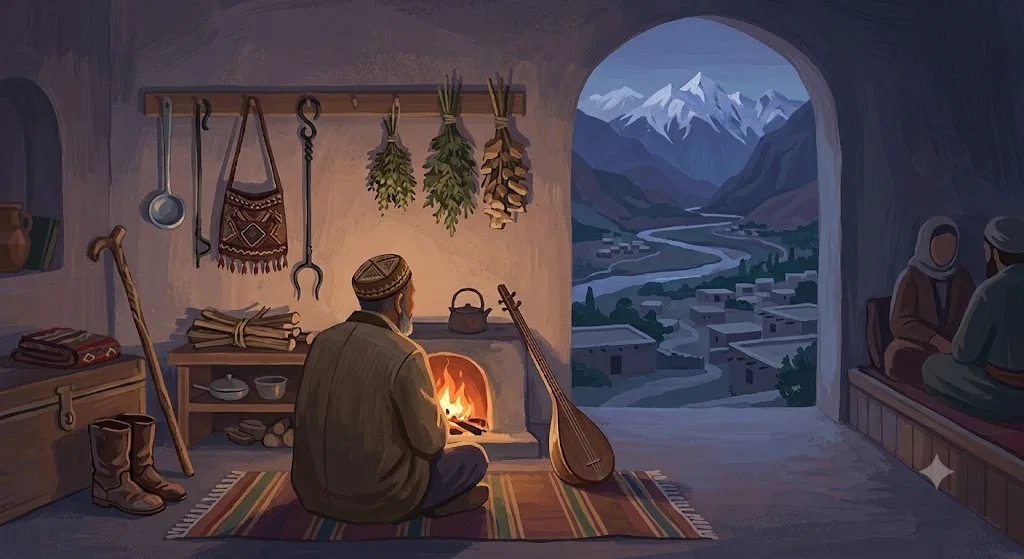
Tajikistan’s folklore is best understood as a mountain-and-river tradition shaped by Persian-language culture, Central Asian exchange, Islamic and pre-Islamic memory, and the practical rhythms of village life.
Page outline Jump by section
What makes Tajik folklore distinctive?
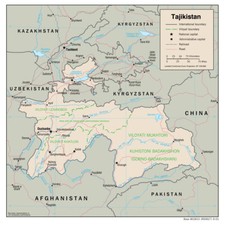
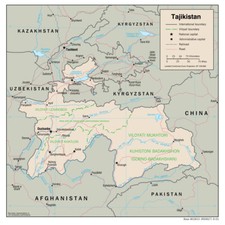
Tajik folklore sits at a crossroads. Tajik is a Persian language, and many Tajik tales share the wider Iranian world’s stock of heroic kings, demons, fairies, dragons, enchanted landscapes and moral tests. At the same time, Tajikistan’s geography gives those motifs a local flavour: high passes, remote valleys, springs, fortresses, winter gatherings, village shrines and borderland exchanges with Afghanistan, Uzbekistan, Kyrgyzstan and the wider Pamir region. Modern scholarship on Tajik epic stresses this mixture: Tajik versions of the Gurughli epic, for example, share a wider Central Asian story world but are shaped by Tajik culture and Iranian heroic traditions.[Cambridge University Press & Assessment]cambridge.orgOpen source on cambridge.org.
A useful way to read Tajik folklore is to separate four overlapping layers. First are old Iranian and Persianate themes, including epic heroes, cosmic renewal, demons and sacred kingship. Second are Islamic and local Muslim traditions, especially saints, shrines, blessings, moral teaching and sacred genealogy. Third are village oral traditions, including fairy tales, animal stories, proverbs, songs, anecdotes and seasonal customs. Fourth are modern heritage retellings, where older material is curated through museums, universities, tourism websites, UNESCO listings, digital archives and national culture projects. The Department of Folklore at the Rudaki Institute lists major collected categories such as animal tales, anecdotes, proverbs, quatrains and songs, showing how broad the Tajik folklore record is beyond famous myths alone.[izar.tj]izar.tjdepartment folkloredepartment folklore
This means readers should be cautious with over-neat claims. A legend on a travel site may preserve a genuine local motif, but it may also be a simplified tourist retelling. A scholarly article may document a performance tradition, but only for one region or one collected repertoire. A UNESCO page may show living heritage, but not every listed element is “folklore” in the narrow sense of supernatural tales. Tajik folklore is strongest when read as a living cultural field rather than a tidy pantheon.
The heroic heart: epics, bards and winter storytelling
One of the richest entrances into Tajik folklore is the oral epic. The Tajik Gurughli tradition belongs to the wider Köroğlu/Görogly family of Central Asian and western Asian heroic cycles, but in Tajik form it became a local performance tradition with its own language, heroes and cultural emphasis. Recent research in Iranian Studies describes Tajik Gurughli as widespread among Tajiks of the upper Oxus valleys of southern Tajikistan and adjoining Badakhshan, with performances formerly given by singers who travelled between settlements. Recitals could last for hours, often on long winter nights, accompanied by long-necked lutes.[Cambridge University Press & Assessment]cambridge.orgOpen source on cambridge.org.
The central Gurughli story has the quality of a fairy tale as much as an epic. The hero is associated with a miraculous birth from the grave, the legendary city of Chambul, adopted heroic companions, stolen horses, abductions, battles and feats of endurance. The tradition is closely related to neighbouring Uzbek and Turkmen versions, but scholars emphasise that the Tajik form is not a mere copy: it is recast through Tajik and Iranian heroic imagination.[Cambridge University Press & Assessment]cambridge.orgOpen source on cambridge.org.
Another major strand is the prestige of Persian epic literature, especially the world of the Shahnameh. Tajik culture has long claimed deep kinship with Persian literary heritage, and the heroic figures of that tradition help bridge written literature and popular story. In public culture, this matters because Tajikistan’s post-Soviet identity has often looked back to ancient Iranian, Samanid and Persianate heritage. That process can be culturally meaningful, but it can also become political: commentary on official identity-making has noted the state’s selective use of pre-Islamic and Persian symbols after independence.[The Guardian]theguardian.comThe Guardian Dictator-lit: The Tajiks in the Mirror of HistoryThe Guardian Dictator-lit: The Tajiks in the Mirror of History
The epic tradition matters because it shows folklore as performance, not just plot. A story’s meaning lies in the singer’s memory, voice, instrument, audience, season and setting. A written summary of Gurughli can tell readers what happens; it cannot fully reproduce the social event of an all-night recital.
Spirits, monsters and fairy-tale danger
Tajik fairy tales belong to the broader Persian and Central Asian wonder-tale world. Their supernatural beings often include giants, demons, fairies, dragons, enchanted animals, talking creatures, magical helpers and hidden souls. The figure of the div, familiar across Persianate folklore, is especially important as a type of monstrous or demonic opponent. In wider Iranian folklore, such beings may be giant, cruel, magical, night-associated, able to transform, and sometimes impossible to defeat unless the hero discovers the secret object or life-source on which their survival depends.[Wikipedia]WikipediaDiv (mythologyDiv (mythology
Fairy figures also appear in the wider Iranian imagination, though evidence for specific Tajik variants often comes through broader Persian or regional collections rather than tidy country-labelled sources. The important point is not to flatten them into modern “fairies” in the British sense. In Persianate tales, beautiful spirit-women, enchanted brides and supernatural helpers may be alluring, dangerous, morally ambiguous or bound to rules of secrecy and exchange. Some later retellings fold these beings into Islamic categories such as jinn, while older Iranian layers distinguish fair spirits from demonic opponents.[Tajiks of Afghanistan]tajiksofafghanistan.comTajiks of Afghanistan Persian Mythical CreaturesTajiks of Afghanistan Persian Mythical Creatures
Dragons and many-headed monsters also turn up in popular retellings of Tajik legend, especially in mountain settings. These accounts should be handled carefully: travel-oriented summaries often give simplified versions, but the motifs themselves are deeply at home in the region’s heroic and fairy-tale repertoire. A seven-headed dragon in a Pamir legend, for instance, is less useful as a claim about one fixed ancient text than as evidence of a recognisable story pattern: a brave youth, a monstrous threat, a magical weapon or insight, and victory through courage plus cleverness.[Travel Land]trvlland.comTravel Land Myths and Legends of TajikistanTravel Land Myths and Legends of Tajikistan
A major new development is access. The University of Central Asia’s 2024 Fairy Tales of Badakhshan publication contains twelve tales in original local languages with Tajik, Russian and English translations, making a regional oral tradition more available to readers who cannot work directly with Pamiri languages. This is exactly the kind of evidence that keeps folklore from becoming a vague “ancient beliefs” category: named collections, languages, translators and communities matter.[University of Central Asia]ucentralasia.orgfairy tales of badakhshanfairy tales of badakhshan
Sacred landscapes: springs, shrines, lakes and mountains
Tajik folklore is strongly attached to place. In the Pamirs and Gorno-Badakhshan, shrines and sacred sites are not just tourist stops; they are part of local religious identity, oral history and memory. Research on Badakhshan’s Ismaili sacred sites describes how local communities understand and attend to these places in the present, while scholarship on foundational legends notes that rural shrines in the Pamir can act as charters of identity and expressions of local Muslim piety.[yorku.ca]yorkspace.library.yorku.caOpen source on yorku.ca.
One vivid example is the Bibi Fatima hot spring in the Wakhan Valley. Travel Tajikistan’s official tourism material presents several origin legends, including a story in which a holy female figure causes water to appear by striking the ground, making the place liveable and sacred. Other local and travel accounts link the spring to the family of the Prophet Muhammad and to beliefs about blessing and fertility. The details vary, which is normal for living legend: what stays stable is the idea that hot water, mountain setting, healing reputation and sacred genealogy reinforce one another.[traveltajikistan.tj]traveltajikistan.tjOpen source on traveltajikistan.tj.
The Wakhan and Pamir landscape is also dense with shrines, old trees, petroglyphs and forts. A Pamirs cultural guide notes the shrine at Langar, old sacred trees and Bronze Age petroglyphs nearby, showing how Islamic, local and archaeological layers often sit close together in the same landscape. This does not mean every rock carving or ruin has one continuous meaning from prehistory to today; rather, Tajik sacred geography often works by accumulation. A place becomes powerful because different generations keep finding ways to tell stories about it.[Pamirs]pamirs.orgWakhan, IshkashimWakhan, Ishkashim
Lakes also attract legend. Iskanderkul, whose name is associated with Alexander the Great, is surrounded by stories about Alexander’s campaigns, resistance from mountain villagers, and the fate of his horse. The Embassy of Tajikistan in Germany presents a version in which a local village resists Alexander during campaigns in Sogdiana and Bactria; travel retellings add the more romantic motif of the horse appearing by moonlight. These are not historical proof of Alexander’s actions at the lake. They are examples of how a globally famous conqueror is absorbed into local landscape legend.[MFA Tajikistan]mfa.tjiskanderkul lakeiskanderkul lake
Spring, renewal and the ritual calendar
For many readers, the most visible living folklore of Tajikistan is not a monster story but a festival. Nowruz, the spring New Year celebrated across the Persianate and Central Asian world, has deep roots in Iranian seasonal tradition and remains one of Tajikistan’s most important public celebrations. UNESCO lists Nowruz among Tajikistan’s intangible cultural heritage elements, and Encyclopaedia Iranica treats it as a major Iranian festival with both pre-Islamic and Islamic-period histories.[unesco.org]ich.unesco.orgtajikistan TJtajikistan TJ
In Tajikistan, Nowruz is closely tied to agricultural renewal, prosperity, household preparation, music, food and symbolic acts. A University of Central Asia working paper on Tajik national festivals describes Nowruz as an extensive set of ritual actions performed to ensure prosperity and well-being in the coming year, with myths and symbols evolving around the festival. It also notes a spring sowing ritual in which the first wheat sower becomes the ceremonial head of Nowruz, a practice still described as reasonably common across Tajikistan.[University of Central Asia]ucentralasia.orgOpen source on ucentralasia.org.
Food is central to this spring ritual world. UNESCO’s 2025 inscription of the culture of sumanak or sumalak cooking for Tajikistan highlights a special dish prepared during the Navruz festival. This is a good reminder that folklore is not only spoken narrative: it can be stirred in a pot, sung around a kitchen, performed through communal labour, and remembered through taste.[UNESCO Intangible Cultural Heritage]ich.unesco.orgOpen source on unesco.org.
Nowruz also shows how old tradition changes under modern politics. A 2026 report on debate in Tajikistan around Nowruz and Islam describes the festival as both ancient custom and a national symbol, especially important in the post-Soviet construction of Tajik identity. For readers, the useful takeaway is that Tajik folklore is not separate from religion or state culture. It often lives in the negotiated space between family celebration, public heritage, Islamic practice, and national storytelling.[Asia News]asianews.itTajik Nowruz and Islam a mix of folklore and religion 65162Tajik Nowruz and Islam a mix of folklore and religion 65162
Music as folklore: Falak and Shashmaqom
Tajik folklore is deeply musical. Falak, inscribed by UNESCO in 2021, is described as traditional folklore music of Tajikistan’s mountain people, with meanings connected to heaven, fortune and the universe. It is strongly associated with expressive, philosophical singing and with the emotional life of mountain communities. For a folklore reader, Falak matters because it turns personal grief, longing, fate and spiritual reflection into a public art of voice and memory.[UNESCO Intangible Cultural Heritage]ich.unesco.orgIntangible Cultural Heritage FalakIntangible Cultural Heritage Falak
Shashmaqom, shared by Tajikistan and Uzbekistan and listed by UNESCO in 2008, is a more formal classical tradition, combining vocal and instrumental music, melodic and rhythmic systems and poetry. It is not folklore in the narrow sense of a peasant fairy tale, but it belongs on a Tajik folklore page because it helps show the continuum between oral performance, poetry, ritual prestige and shared Central Asian cultural memory.[UNESCO Intangible Cultural Heritage]ich.unesco.orgOpen source on unesco.org.
The connection between music and story is especially clear in epic performance. Gurughli singers did not merely recite; they performed with instruments, memory, musical phrasing and audience expectation. In this sense, Tajik folklore is not divided neatly into “songs” and “stories”. A heroic tale may be a musical event; a festival dish may be accompanied by song; a shrine visit may include devotional performance; a proverb may preserve social memory in miniature.
How old is Tajik folklore, and how well attested is it?
The honest answer is mixed. Some motifs are very old because they belong to the wider Iranian and Central Asian storehouse: spring renewal, heroic kingship, demons, dragons, fairy brides, sacred water and miraculous birth. But the age of a motif is not the same as the age of a particular Tajik version. Many Tajik oral texts were recorded in the Soviet period, and some traditions are best documented from twentieth-century collecting or recent scholarship rather than from ancient manuscripts.[meap.library.ucla.edu]meap.library.ucla.eduOpen source on ucla.edu.
The archival base is real and important. The Rudaki Institute’s folklore archive in Dushanbe is described by preservation projects as one of the few existing repositories of Tajikistan’s expressive culture, with materials documenting Soviet folklore collecting expeditions in the Tajik SSR and neighbouring Persian-speaking regions from the early 1920s to the end of the Soviet period. A digitisation project focuses particularly on print materials from the 1950s to the 1970s.[Culture in Crisis]cultureincrisis.orgOpen source on cultureincrisis.org.
This archive record helps correct two common mistakes. The first is romanticising everything as “ancient”. Some traditions may preserve ancient patterns, but the form we can study is often a modern or recently recorded performance. The second mistake is dismissing tourist legends or family customs as “not real folklore” because they are modern. Folklore often survives by being retold in new settings: schoolbooks, local festivals, heritage videos, tourism pages, academic editions and family kitchens.

Folklore, national identity and modern reinvention
Tajikistan’s folklore has become part of how the country explains itself after the Soviet period and the civil war of the 1990s. The state and cultural institutions have often emphasised ancient Iranian heritage, the Samanid past, Persian literary greatness, Nowruz and major poets as symbols of continuity. This does not make the heritage false, but it does mean readers should notice when folklore is being used for modern identity work.[The Guardian]theguardian.comThe Guardian Dictator-lit: The Tajiks in the Mirror of HistoryThe Guardian Dictator-lit: The Tajiks in the Mirror of History
UNESCO listings are one visible sign of modern heritage framing. Tajikistan’s intangible cultural heritage entries include Nowruz, Falak, Shashmaqom, the culture of sumanak cooking, craft traditions and other practices. These listings help protect and promote living traditions, but they also reshape how people talk about them: a local ritual becomes a national asset; a village practice becomes a heritage element; a performance becomes something filmed, described and archived for international audiences.[UNESCO Intangible Cultural Heritage]ich.unesco.orgtajikistan TJtajikistan TJ
Recent digital and academic projects are also changing access. Badakhshan fairy tales are appearing in multilingual editions; folklore archives are being surveyed and digitised; and new research on Gurughli is reassessing how Tajik epic relates to neighbouring traditions. The result is a folklore field that is becoming more visible, but also more dependent on careful source reading. The best modern accounts distinguish between a locally attested tale, a literary retelling, a Soviet-collected text, a tourist legend and a state heritage narrative.[ucentralasia.org]ucentralasia.orgfairy tales of badakhshanfairy tales of badakhshan
What readers should remember
Tajik folklore is not a single mythology with a fixed cast of gods. It is a living body of stories, performances, rituals and sacred places shaped by Persianate culture, mountain life, Islam, pre-Islamic memory, Soviet-era collection and post-Soviet heritage politics. Its most memorable forms include heroic epics such as Gurughli, spring customs around Nowruz, mountain music such as Falak, fairy-tale beings such as demons and fairies, sacred Pamir springs and shrines, and landscape legends attached to lakes such as Iskanderkul.[cambridge.org]cambridge.orgOpen source on cambridge.org.
The most rewarding way to approach it is through places and performances. Ask where a story is told, who tells it, what language or dialect carries it, whether it was collected from oral performance or reshaped for print, and what the story does for its community. In Tajikistan, folklore explains more than supernatural belief. It marks the start of spring, honours ancestors and saints, teaches moral courage, makes mountains speak, and gives modern Tajiks a way to connect local memory with a much larger Persian and Central Asian world.
Amazon book picks
Further Reading
Books and field guides related to Where Mountains Turn Into Story. Use these as the next step if you want deeper reading beyond the article.
Shahnameh
Provides the broader Persianate mythic world that strongly influenced Tajik folklore.
Tales of the Dervishes
Introduces narrative traditions that circulated widely across Central and Persian-speaking Asia.
eBay marketplace picks
Marketplace Samples
Live-tested eBay searches with available results related to this page.
Endnotes
1.
Source: meap.library.ucla.edu
Link:https://meap.library.ucla.edu/projects/digitization-of-the-folklore-archive-tajikistan/
2.
Source: ich.unesco.org
Title: tajikistan TJ
Link:https://ich.unesco.org/en/state/tajikistan-TJ
3.
Source: cambridge.org
Link:https://www.cambridge.org/core/journals/iranian-studies/article/gurughli-the-tajik-variety-of-the-epic-of-koroglu/17A7237F9208905F7DEE3C67C2055959
4.
Source: izar.tj
Title: department folklore
Link:https://izar.tj/en/department-folklore
5.
Source: cambridge.org
Title: gurughli the tajik variety of the epic of koroglu
Link:https://www.cambridge.org/core/services/aop-cambridge-core/content/view/17A7237F9208905F7DEE3C67C2055959/S0021086224000483a.pdf/gurughli-the-tajik-variety-of-the-epic-of-koroglu.pdf
6.
Source: Wikipedia
Title: Div (mythology)
Link:https://en.wikipedia.org/wiki/Div_%28mythology%29
7.
Source: yorkspace.library.yorku.ca
Link:https://yorkspace.library.yorku.ca/server/api/core/bitstreams/6140052c-1514-4dd3-afc1-86eab2295d2c/content
8.
Source: researchgate.net
Link:https://www.researchgate.net/publication/293815461_Foundational_Legends_Shrines_and_Isma%27ili_Identity_in_Gorno-Badakhshan_Tajikistan
9.
Source: tour.tj
Link:https://tour.tj/en/regions/gbao-region/darvoz-district/bibi-fatima-hot-spring/
10.
Source: pamirs.org
Title: Wakhan, Ishkashim
Link:https://pamirs.org/discover/wakhan/
11.
Source: mfa.tj
Title: iskanderkul lake
Link:https://mfa.tj/en/berlin/view/9098/iskanderkul-lake
12.
Source: ich.unesco.org
Link:https://ich.unesco.org/en/RL/culture-of-sumanak-sumalak-cooking-02336
13.
Source: ich.unesco.org
Link:https://ich.unesco.org/en/decisions/20.COM/7.B.44
14.
Source: ich.unesco.org
Title: Intangible Cultural Heritage Falak
Link:https://ich.unesco.org/en/RL/falak-01725
15.
Source: ich.unesco.org
Link:https://ich.unesco.org/en/Decisions/16.com/8.b.41
16.
Source: ich.unesco.org
Link:https://ich.unesco.org/en/RL/shashmaqom-music-00089
17.
Source: ich.unesco.org
Title: Intangible Cultural Heritage Photo pop-up
Link:https://ich.unesco.org/en/photo-pop-up-00973?photoID=00227
18.
Source: researchgate.net
Title: 398206240 Oral Traditions in the Development of Tajik Storytelling
Link:https://www.researchgate.net/publication/398206240_Oral_Traditions_in_the_Development_of_Tajik_Storytelling
19.
Source: researchgate.net
Link:https://www.researchgate.net/publication/392006086_Gurughli_The_Tajik_Variety_of_the_Epic_of_Koroglu
20.
Source: researchgate.net
Link:https://www.researchgate.net/publication/396778323_Isidor_Levin_and_Tajik_Folklore_Studies_A_Brief_Biographical_Sketch_of_a_Forgotten_Folklorist
21.
Source: researchgate.net
Link:https://www.researchgate.net/publication/372663523_Tajikistan%27s_National_Epics_Muqanna%27s_Rebellion_and_The_Tajik_People%27s_Hero_Temur_Malik
22.
Source: ich.unesco.org
Link:https://ich.unesco.org/en/video/36618
23.
Source: ich.unesco.org
Title: falak 01725
Link:https://ich.unesco.org/en/RL/falak-01725?call=film&id=57939&include=film_inc.php&width=700
24.
Source: unesco.org
Link:https://www.unesco.org/en/days/nowruz
25.
Source: unesco.org
Title: document 4378
Link:https://www.unesco.org/archives/multimedia/document-4378
26.
Source: ich.unesco.org
Link:https://ich.unesco.org/en/RL/nawrouz-novruz-nowrouz-nowrouz-nawrouz-nauryz-nooruz-nowruz-navruz-nevruz-nowruz-navruz-02097
27.
Source: ich.unesco.org
Link:https://ich.unesco.org/en/decisions/14.COM/10.B.36
28.
Source: ich.unesco.org
Link:https://ich.unesco.org/en/news/tajikistan-strengthening-its-national-capacities-for-safeguarding-living-heritage-00029
29.
Source: ich.unesco.org
Link:https://ich.unesco.org/en/video/41670
30.
Source: ich.unesco.org
Title: 48076 EN.doc
Link:https://ich.unesco.org/doc/src/48076-EN.doc
31.
Source: ich.unesco.org
Title: 01858 EN
Link:https://ich.unesco.org/doc/src/01858-EN.pdf
32.
Source: ich.unesco.org
Title: tajikistan TJ
Link:https://ich.unesco.org/en/state/tajikistan-TJ?call=film&id=76267&include=film_inc.php&width=700
33.
Source: ich.unesco.org
Link:https://ich.unesco.org/en/Decisions/12.COM/11.b.32
34.
Source: ich.unesco.org
Title: 42928 EN.doc
Link:https://ich.unesco.org/doc/src/42928-EN.doc
35.
Source: ich.unesco.org
Title: 7b lista representativa 01412
Link:https://ich.unesco.org/es/7b-lista-representativa-01412
36.
Source: ich.unesco.org
Link:https://ich.unesco.org/en/video/41069
37.
Source: ich.unesco.org
Link:https://ich.unesco.org/en/news/Climate-change%2C-commercialization%2C-tourism%3A-challenges-for-intangible-heritage-00092?call=film&id=41670&include=film_inc.php&width=700
38.
Source: ich.unesco.org
Title: 7b representative list 01412
Link:https://ich.unesco.org/en/7b-representative-list-01412?call=slideshow&id=02336&include=slideshow_inc.php&mode=scroll&width=620
39.
Source: ich.unesco.org
Link:https://ich.unesco.org/doc/src/48074.pdf
40.
Source: ich.unesco.org
Title: 06859 EN
Link:https://ich.unesco.org/doc/src/06859-EN.pdf
41.
Source: ich.unesco.org
Title: photo pop up 00973
Link:https://ich.unesco.org/en/photo-pop-up-00973?photoID=19409
42.
Source: ich.unesco.org
Title: photo pop up 00973
Link:https://ich.unesco.org/en/photo-pop-up-00973?photoID=19410
43.
Source: ich.unesco.org
Link:https://ich.unesco.org/doc/src/48073.pdf
44.
Source: ich.unesco.org
Title: 17331 EN
Link:https://ich.unesco.org/doc/src/17331-EN.pdf
45.
Source: ich.unesco.org
Title: photo pop up 00973
Link:https://ich.unesco.org/en/photo-pop-up-00973?photoID=19406
46.
Source: ich.unesco.org
Link:https://ich.unesco.org/en/video/57939
47.
Source: ich.unesco.org
Link:https://ich.unesco.org/en/lists
48.
Source: ich.unesco.org
Title: photo pop up 00973
Link:https://ich.unesco.org/en/photo-pop-up-00973?photoID=19411
49.
Source: Wikipedia
Title: List of Intangible Cultural Heritage elements in Tajikistan
Link:https://en.wikipedia.org/wiki/List_of_Intangible_Cultural_Heritage_elements_in_Tajikistan
50.
Source: Wikipedia
Title: Epic of Koroghlu
Link:https://en.wikipedia.org/wiki/Epic_of_Koroghlu
51.
Source: Wikipedia
Link:https://en.wikipedia.org/wiki/Shahnameh
52.
Source: Wikipedia
Title: Seven Lakes (Tajikistan)
Link:https://en.wikipedia.org/wiki/Seven_Lakes_%28Tajikistan%29
53.
Source: Wikipedia
Link:https://en.wikipedia.org/wiki/Iskanderkul
54.
Source: Wikipedia
Title: The Horse Lurja
Link:https://en.wikipedia.org/wiki/The_Horse_Lurja
55.
Source: Wikipedia
Title: Rudaki Institute of Language and Literature
Link:https://en.wikipedia.org/wiki/Rudaki_Institute_of_Language_and_Literature
56.
Source: Wikipedia
Link:https://en.wikipedia.org/wiki/Nowruz
57.
Source: the.akdn
Title: three new books cultural heritage central asia
Link:https://the.akdn/en/resources-media/whats-new/spotlights/three-new-books-cultural-heritage-central-asia
58.
Source: mfa.tj
Title: tajikistan and unesco cooperation
Link:https://www.mfa.tj/en/main/view/5174/tajikistan-and-unesco-cooperation
59.
Source: mfa.tj
Link:https://mfa.tj/en/berlin/view/14628/participation-at-the-inauguration-of-national-costumes-of-central-asian-countries-exhibition
60.
Source: mfa.tj
Link:https://mfa.tj/en/main/unesco-tajikistan
61.
Source: mfa.tj
Title: haftkul seven lakes
Link:https://mfa.tj/en/berlin/view/9105/haftkul-seven-lakes
62.
Source: mfa.tj
Link:https://mfa.tj/en/london/view/14310/202402071707303309
63.
Source: pamirs.org
Link:https://pamirs.org/wp-content/uploads/2018/02/Legends-of-the-Pamirs.pdf
64.
Source: izar.tj
Link:https://izar.tj/en/structure/institute/history-institute
65.
Source: cultureincrisis.org
Link:https://cultureincrisis.org/projects/digitization-of-folklore-archive-at-rudaki-institute-of-lang-and-lit
66.
Source: ucentralasia.org
Title: fairy tales of badakhshan
Link:https://ucentralasia.org/publications/2024/april/fairy-tales-of-badakhshan
67.
Source: theguardian.com
Title: The Guardian Dictator-lit: The Tajiks in the Mirror of History
Link:https://www.theguardian.com/books/booksblog/2009/dec/04/dictator-lit-emomalii-rahmon-tajikistan
68.
Source: iranicaonline.org
Title: Iranica Online FICTION, ii(h)
Link:https://www.iranicaonline.org/articles/fiction-iih-in-tajikistan/
69.
Source: tajiksofafghanistan.com
Title: Tajiks of Afghanistan Persian Mythical Creatures
Link:https://tajiksofafghanistan.com/persian-mythical-creatures-pari-and-dev/
70.
Source: trvlland.com
Title: Travel Land Myths and Legends of Tajikistan
Link:https://trvlland.com/tajikistan/myths-and-legends-of-tajikistan/
71.
Source: traveltajikistan.tj
Link:https://traveltajikistan.tj/en/the-spring-of-bibi-fatima-i-zahro/
72.
Source: iranicaonline.org
Link:https://www.iranicaonline.org/articles/nowruz-ii/
73.
Source: iranicaonline.org
Title: Iranica Online NOWRUZ
Link:https://www.iranicaonline.org/articles/nowruz-index/
74.
Source: ucentralasia.org
Link:https://ucentralasia.org/media/s22fgoai/chhu-rp-4-eng.pdf
75.
Source: asianews.it
Title: Tajik Nowruz and Islam a mix of folklore and religion 65162
Link:https://www.asianews.it/news-en/Tajik-Nowruz-and-Islam-a-mix-of-folklore-and-religion-65162.html
76.
Source: poets.iranicaonline.org
Title: the life and poetry of gulrukhsor safieva a quest for tajik identity
Link:https://poets.iranicaonline.org/article/the-life-and-poetry-of-gulrukhsor-safieva-a-quest-for-tajik-identity/
77.
Source: iranicaonline.org
Link:https://www.iranicaonline.org/articles/oral-literature-in-iran/
78.
Source: iranicaonline.org
Link:https://www.iranicaonline.org/articles/folk-poetry/
79.
Source: iranicaonline.org
Link:https://www.iranicaonline.org/articles/mirsakar-mirsaid/
80.
Source: iranicaonline.org
Title: kroglu i literary tradition
Link:https://www.iranicaonline.org/articles/kroglu-i-literary-tradition/
81.
Source: facebook.com
Link:https://www.facebook.com/tajemblondon/videos/rudaki-the-father-of-tajik-and-persian-poetry/950029379540090/
82.
Source: advantour.com
Link:https://www.advantour.com/tajikistan/culture/unesco-intangible-cultural-heritage.htm
83.
Source: eurasia.travel
Title: unesco intangible
Link:https://eurasia.travel/tajikistan/culture/unesco-intangible/
84.
Source: edblogs.columbia.edu
Link:https://edblogs.columbia.edu/worldepics/project/koroglu/
85.
Source: traveltajikistan.net
Link:https://www.traveltajikistan.net/gosee/bibi_fatima/
86.
Source: ucentralasia.org
Link:https://ucentralasia.org/media/ffjiedyq/promoting-cultural-heritage-and-humanities-in-central-asia-eng-web.pdf
Additional References
87.
Source: youtube.com
Title: Tajikistan Village Life Documentary | Traditions Nature, and Daily Rhythms
Link:https://www.youtube.com/watch?v=c3i-L-gzgxo
Source snippet
4 Traditional Tajik/Pamiri Dance | Gul Ba Ruit...
88.
Source: youtube.com
Title: Tajikistan-Traditional Tajik Dances
Link:https://www.youtube.com/watch?v=o_txh4JYPrI
Source snippet
3 Tajikistan Village Life Documentary | Traditions Nature, and Daily Rhythms...
89.
Source: academia.edu
Link:https://www.academia.edu/2046472/Art_of_the_Persian_Courts
90.
Source: academia.edu
Link:https://www.academia.edu/102059425/Encyclopaedia_Iranica_Online_NAQQ%C4%80LI
91.
Source: academia.edu
Link:https://www.academia.edu/6870849/Ferdowsi_and_Tajik_National_Identity
92.
Source: academia.edu
Link:https://www.academia.edu/57147712/Identity_History_and_Trans_Nationality_in_Central_Asia_The_Mountain_Communities_of_Pamir
93.
Source: facebook.com
Link:https://www.facebook.com/groups/persianversion/posts/686614432035592/
94.
Source: journalofnomads.com
Link:https://www.journalofnomads.com/iskanderkul-lake-tajikistan/
95.
Source: ign.tj
Link:https://www.ign.tj/navidhoi-imi/navidho-r/item/794-the-republic-of-tajikistan-in-the-years-of-independence-through-the-prism-of-its-activities-in-unesco.html
96.
Source: paramountjourney.com
Link:https://paramountjourney.com/pamiris/
Topic Tree
Follow this branch
Related pages 192
- Afghan Folklore
- Albanian Folklore
- Algerian Folklore
- Australian Folklore
- Azerbaijan Folklore
- +187 more in sidebar